13) If government cuts taxes ________.
A) after tax income should increase shifting AD to the left to a lower equilibrium level of output
B) after tax income should increase shifting AD to the right to a higher equilibrium level of
output
C) after tax income and the equilibrium level of output remain unchanged
D) after tax income remains unchanged but the equilibrium level of output would increase
E) none of the above
14) An increase in autonomous spending leads to higher ________.
A) inflation
B) output
C) real interest rate
D) all of the above
E) none of the above
15) An increase in inflation leads to higher ________.
A) output
B) spending
C) real interest rate
D) all of the above
E) none of the above
16) A change in inflation leads to shifts of the ________ curves.
A) MP, IS, & AD
B) MP & IS, but not AD
C) IS & AD, but not MP
D) MP, but not IS nor AD
E) none of the above
17) If the Federal Reserve raises interest rates in an autonomous tightening ________.
A) the MP curve shifts up, there is an upward movement along the IS curve, and the AD curve
shifts to the left to a lower level of equilibrium output
B) the MP curve shifts down, there is a downward movement along the IS curve and the AD
curve shifts to the right to a higher level of equilibrium output
C) the MP curve shifts up, there is a downward movement along the IS curve and the AD curve
shifts to the right to a lower level of equilibrium output
D) the MP curve shifts down, there is an upward movement along the IS curve and the AD curve
shifts to the left to a higher level of equilibrium output
E) none of the above
18) If the Federal Reserve raises interest rates in an autonomous tightening ________.
A) the MP curve shifts up, raising the real interest for any given level of the inflation rate
B) there is an upward movement along the IS curve
C) the AD curve shifts to the left
D) all of the above
E) none of the above
19) Shifts of the ________ curves result from autonomous monetary policy.
A) MP, IS, & AD
B) MP & IS, but not AD
C) IS & AD, but not MP
D) MP, but not IS nor AD
E) none of the above
20) The IS curve is Y = 20 – 1.5r, and the aggregate demand curve is Y = 15.5 – 0.3π. The
monetary policy curve is ________.
A) r = 4.5 – 1.8π
B) r = 20 + 0.3π
C) r = 3 + 0.2π
D) Y = 17.75 + 0.6π
E) none of the above
14
21) The IS curve is Y = 20 – 1.5r, and the aggregate demand curve is Y = 15.5 – 0.3π. When the
interest rate is 7 percent, the inflation rate is ________ percent.
A) 14.6
B) 9.5
C) 3.6
D) 20
E) none of the above
22) The IS curve is Y = 20 – 1.5r, and the aggregate demand curve is Y = 15.5 – 0.3π. When the
inflation rate is 3 percent, output is ________.
A) 20
B) 14.6
C) 9.5
D) 3.6
E) none of the above
23) The aggregate demand curve is Y = 15 – 0.2π when the inflation rate falls from 6 percent to 5
percent. Then, output increases from 13.8 to 17. The response of monetary policy to the inflation
decline has been ________.
A) autonomous tightening
B) automatic adjustment
C) autonomous easing
D) to increase autonomous spending
E) none of the above
24) Suppose the monetary policy curve is r = 5 + 0.8π, and the current values for output and
inflation are 16.8 and 2 percent, respectively. An increase in global resource prices pushes the
inflation rate to 4 percent. Policy makers estimate that the monetary policy in place, responding
to 4 percent inflation, will bring output down to 13.6, a decline considered excessive. Instead,
they implement an autonomous easing of monetary policy to lower output from 16.8 to 16.
Assuming no change in the slope of the monetary policy curve, determine the new curve.
25) Suppose the demand curve is Y = 38 – 3π, and the current values for output and the real
interest rate are 29 and 7 percent, respectively. A decrease in inflation leads to a new output level
of 32 and real interest rate at 6 percent. The monetary policy curve is ________.
26) When the inflation rate falls, what happens, and why, to the MP, IS, and AD curves?
10.4 The Money Market and Interest Rates
1) The liquidity preference theory distinguishes between ________.
A) nominal and real quantities
B) money and financial assets
C) buying goods and earning interest income
D) all of the above
E) none of the above
2) “Real money balances” refers to ________.
A) the quantity of goods and services that money can buy
B) gold and silver
C) money that is actually available to be spent
D) all of the above
E) none of the above
3) The liquidity preference theory ________.
A) distinguishes between nominal and real quantities
B) shows that demand for real balances depends on real income
C) shows that demand for real balances depends on the nominal interest rate
D) all of the above
E) none of the above
4) ________ is a good measure of the opportunity cost of holding money.
A) The real interest rate
B) Liquidity preference
C) Real income
D) The inflation rate
E) none of the above
5) Demand for real money balances depends on ________.
A) the price level
B) the real interest rate
C) the opportunity cost of holding money
D) all of the above
E) none of the above
6) According to liquidity preference theory, as real income increases, so does ________.
A) the supply of real money balances
B) the demand for real money balances
C) the real interest rate
D) all of the above
E) none of the above
7) According to liquidity preference theory, an increase in the price level would ________.
A) decrease the demand for real money balances
B) increase the supply of real money balances
C) decrease the real interest rate
D) all of the above
E) none of the above
8) According to liquidity preference theory, an increase in the price level would ________.
A) increase the demand for real money balances
B) decrease the supply of real money balances
C) decrease the real interest rate
D) all of the above
E) none of the above
9) The endogenous variable in the liquidity preference function is ________.
A) demand for real money balances
B) the nominal interest rate
C) real income
D) the price level
E) none of the above
10) The liquidity preference function shows that as ________.
A) real income decreases, so does the demand for real money balances
B) the nominal interest rate increases, so does the demand for real money balances
C) real income decreases, so does the real interest rate
D) all of the above
E) none of the above
11) As the nominal interest rate increases ________.
A) it becomes more costly to hold money instead of bonds
B) the quantity of money demanded falls
C) the opportunity cost of holding money rises
D) all of the above
E) none of the above
12) As the nominal interest rate increases ________.
A) it becomes more costly to hold bonds instead of money
B) the quantity of money demanded rises
C) the opportunity cost of holding money rises
D) all of the above
E) none of the above
13) As income rises ________.
A) the number of transactions households and firms undertake should increase
B) wealth also rises
C) demand for real money balances should increase
D) all of the above
E) none of the above
14) The demand for real money balances ________.
A) is downward sloping with respect to prices
B) is downward sloping with respect to interest rates
C) is downward sloping with respect to income
D) all of the above
E) none of the above
15) Why is the demand for real money balances downward sloping?
A) because the opportunity cost of holding money decreases as interest rates decrease
B) because when the interest rate falls the quantity of money demanded increases
C) because lower interest rates encourage firms and households to increase their money holdings
D) all of the above
E) none of the above
16) The supply curve for money ________.
A) is upward sloping with respect to interest rates
B) is fixed to a specified interest rate
C) is fixed regardless of the interest rate
D) is downward sloping with respect to interest rates
E) none of the above
17) Increased liquidity in the banking system occurs when ________.
A) people buy more bonds
B) the demand for real money balances declines
C) banks buy more bonds from the central bank
D) all of the above
E) none of the above
18) Typically, central banks increase the supply of money by ________.
A) buying bonds from banks
B) printing currency
C) directing the government to issue more money to banks
D) all of the above
E) none of the above
19) Which of the following is true with regard to the supply of money?
A) an open market sale of government securities will increase liquidity
B) an open market purchase of government securities will decrease liquidity
C) liquidity and the money supply are directly related
D) all of the above
E) none of the above
20) Which of the following is true with regard to the supply of money?
A) an open market purchase of government securities will increase liquidity
B) an open market sale of government securities will decrease liquidity
C) liquidity and the money supply are directly related
D) all of the above
E) none of the above
21) A decrease in income ________.
A) lowers money demand for any given interest rate
B) lowers interest rates ceteris paribus
C) leads to a leftward shift of the money demand curve
D) all of the above
E) none of the above
22) When people are holding money in excess of their demand for real money balances
________.
A) the nominal interest rate will fall
B) they increase their purchases of goods and services
C) the central bank buys bonds to correct the imbalance
D) all of the above
E) none of the above
23) A rightward shift of the money supply ________.
A) may come about from an increase in the quantity of money supplied by the Federal Reserve
B) may come about from a decrease in the price level
C) leads to a decrease in interest rates ceteris paribus
D) all of the above
E) none of the above
24) A leftward shift of the money supply ________.
A) may come about from an increase in the quantity of money supplied by the Federal Reserve
B) may come about from an increase in the price level
C) leads to a decrease in interest rates ceteris paribus
D) all of the above
E) none of the above
25) If the nominal interest rate is above the equilibrium level ________.
A) the supply of real money balances will fall
B) the quantity of real money balances people are holding is too low, and is rising
C) people are selling financial assets in order to increase real money balances
D) all of the above
E) none of the above
26) If the nominal interest rate is above the equilibrium level ________.
A) purchases of bonds and other assets will cause the interest rate to fall
B) issuance of bonds and other assets will cause the supply of real money balances to increase
C) the opportunity cost of holding money is low, and is rising
D) all of the above
E) none of the above
27) When the Federal Reserve increases the money supply, people ________.
A) decrease their purchases of bonds and other financial assets
B) may, in the short run, increase their purchases of goods and services
C) decrease the quantity of money holdings
D) all of the above
E) none of the above
28) Why is the demand for real money balances related to the nominal interest rate, rather than
the real interest rate?
29) If your local bank buys a few billion dollars worth of government securities, what happens to
the economy’s money supply?
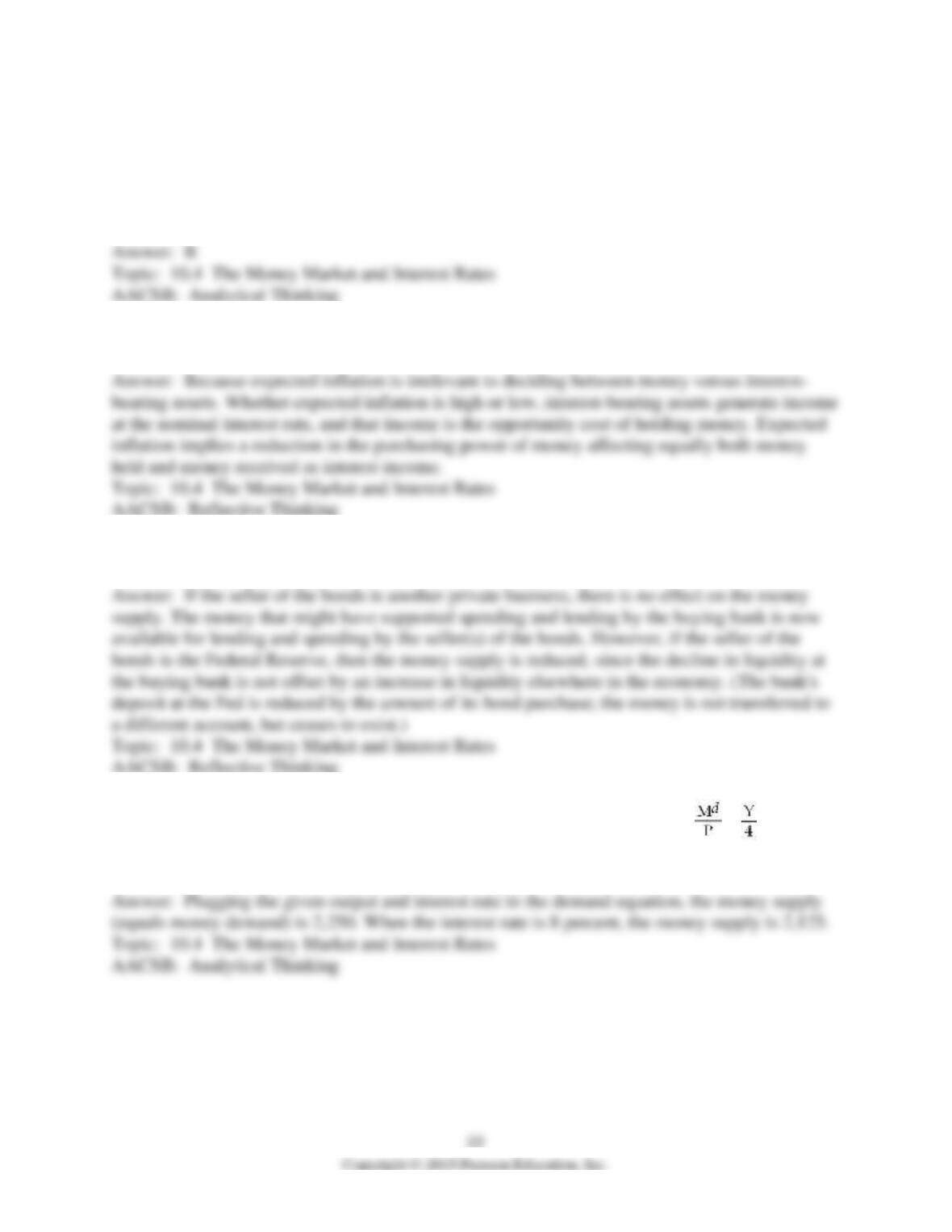
30) Suppose real output is 12,500, and the demand for real money balances is = – 125i. If
the equilibrium interest rate is 7 percent, calculate the money supply. If the central bank sets the
interest rate at 8 percent, what is the new money supply?