b.
higher short-run prices, short-run profits, and the entry of additional firms into the market.
c.
higher short-run prices and the exit of firms from the market due to economies of scale.
d.
no change in prices in the short run, but new firms will enter in the long run.
96. In both price-taker and competitive price-searcher markets, the long-run market price of a good will be
equal to the
a.
average total cost of producing the good.
b.
average variable cost of producing the good.
c.
average fixed cost of producing the good plus a normal return on that cost.
d.
marginal revenue derived from the sale of an additional unit of the good.
97. Which of the following characteristics is true for a competitive price searcher but not for a price taker?
a.
The firm earns zero profits in the long run.
b.
The firm has an incentive to operate efficiently.
c.
A reduction in market demand will lead to short-run losses.
d.
Price is above marginal cost in long-run equilibrium.
98. Which of the following is true?
a.
Price takers will not be able to earn economic profits in the long run, but competitive price
searchers will be able to do so.
b.
Competitive price searchers will not be able to earn economic profits in the long run, but
price takers will be able to do so.
c.
Neither competitive price searchers nor price takers will be able to earn economic profits
in the long run.
d.
Both competitive price takers and price searchers will be able to earn economic profits in
the long run.
99. In long-run equilibrium, output is expanded to the minimum long-run average total cost by
a.
price takers but not by competitive price searchers.
b.
competitive price searchers but not by price takers.
c.
both competitive price searchers and price takers.
d.
neither price takers nor competitive price searchers.
100. Suppose housing construction is a price-searcher market with low barriers to entry. Which of the
following will be true for this market?
a.
The output of the housing construction firms will be produced inefficiently.
b.
Consumers would be better off if there were fewer firms and less variety in the housing
market.
c.
If firms produced larger quantities but less variety, they could reduce the per-unit costs.
d.
Consumers do not have to pay for variety in the housing construction market.
101. Which of the following provides the strongest evidence that a firm operating in the highly competitive
retail sector is supplying goods and services that consumers value highly relative to their cost?
a.
The top-level managers of the firm are paid high salaries.
b.
The firm is on the verge of bankruptcy.
c.
The firm is a large corporation.
d.
The firm is highly profitable, and its sales have grown rapidly.
102. Which of the following provides the strongest evidence that a firm operating in the highly competitive
retail sector is failing to provide goods and services that consumers value highly relative to their cost?
a.
The firm is making losses, and its sales are declining.
b.
The top-level managers of the firm are paid high salaries.
c.
The wages earned by the employees of the firm are low.
d.
The firm is a large corporation.
e.
The firm is highly profitable, and its sales have grown rapidly.
103. Even though firms in competitive price-searcher markets do not produce at minimum ATC,
competitive price-searcher markets may still be consistent with economic efficiency because
a.
strict government regulations force the firms in these markets to keep their costs low.
b.
they provide consumers with a greater diversity of products.
c.
they encourage more advertising in both price-searcher and price-taker markets.
d.
special legal protections for price searchers make it possible for them to more efficiently
use resources.
104. Firms that engage in price discrimination
a.
will earn less profit than those that do not discriminate.
b.
will earn more profit than those that do not discriminate.
c.
are biased against certain buyers in the market.
d.
will always produce less output than firms that do not discriminate.
105. A major fruit juice manufacturer failed in its attempt to engage in price discrimination between
students and all other consumers. What is the most likely explanation for this failure?
a.
There was nothing to prevent the students from reselling the fruit juice to other consumers.
b.
The two groups of consumers have different demand elasticities for fruit juice.
c.
The cost of producing the product is relatively high.
d.
Market demand for fruit juice is inelastic.
106. Suppose that a price-discriminating firm divides its market into two segments. If the firm sells its
product for a price of $42 in the market segment where demand is relatively less elastic, the price in
the market segment whose customers’ demand is more elastic will be
a.
$42
b.
greater than $42
c.
less than $42
d.
$42 plus average fixed costs
107. A price-discriminating firm charges the lowest price to the group that
a.
has the most elastic demand.
b.
purchases the largest quantity.
c.
engages in the most arbitrage.
d.
is least responsive to price changes.
108. Price discrimination occurs when
a.
firms maximize their profit by setting price equal to marginal cost.
b.
a seller charges different prices to different consumers for the same product or service.
c.
a seller charges the same price to consumers for a different product or service.
d.
a seller charges different prices to consumers, discriminating by race or gender of the
consumer.
109. A practice whereby a seller charges different prices to different consumers of the same product or
service is called
a.
price discrimination.
b.
oligopolistic pricing.
c.
stay-out pricing.
d.
monopolistic pricing.
110. Price discrimination refers to a system of pricing
a.
based on buyer income rather than buyer demand conditions, so the poor pay more than
the rich.
b.
that is always more profitable than simple “single-price” pricing.
c.
that forces customers who require more service to pay higher prices.
d.
where consumer groups with a more elastic demand for the product are charged lower
prices.
111. Which of the following is a necessary condition for price discrimination to be profitable?
a.
All consumers must have an identical demand for the product.
b.
Groups of consumers with different demand elasticities must be easily distinguishable.
c.
The market demand for the product must be highly elastic.
d.
It must be possible for buyers to resell the product at a low cost.
112. Which of the following is a necessary condition for price discrimination to be profitable?
a.
All consumers must have identical preferences.
b.
It must be easy to distinguish consumer groups with differing responses to higher prices.
c.
The seller must face a horizontal demand curve for its product in at least one part of the
market.
d.
Both b and c are correct.
113. The strategy underlying price discrimination is to
a.
charge higher prices to customers who have better access to substitutes.
b.
charge everyone the same price but limit the quantity they are allowed to buy.
c.
increase total revenue by charging higher prices to those with the most inelastic demand
for the product and lower prices to those with the most elastic demand.
d.
reduce per-unit cost to the firm by charging higher prices to those with the most inelastic
demand and lower prices to those with the most elastic demand.
114. For which of the following products would effective price discrimination (from the seller’s viewpoint)
be most likely?
a.
medical care
b.
compact discs
c.
clothing
d.
groceries
115. Relative to a situation where only a single price is charged, a seller that engages in price discrimination
will
a.
charge consumers with an inelastic demand a lower price.
b.
charge consumers with an elastic demand a higher price.
c.
generally produce a larger total output.
d.
decrease social welfare and make all consumers worse off.
116. Which of the following is not a necessary condition for effective price discrimination?
a.
The firm must face a downward-sloping demand curve.
b.
There must be at least two distinguishable groups of consumers.
c.
The producer must be a pure monopolist.
d.
The seller must be able to prohibit buyers from easily reselling the product to other
potential buyers.
117. For effective price discrimination to occur, a seller must
a.
be a pure monopolist.
b.
have large economies of scale and control over a key natural resource.
c.
face a horizontal demand curve for its product.
d.
be able to prevent consumers from reselling the product to other consumers.
118. In order for effective price discrimination to occur, a seller must
a.
be a pure monopolist.
b.
have large economies of scale and control over a key natural resource.
c.
face a horizontal demand curve for its product.
d.
have at least two distinguishable groups of consumers.
119. A firm that uses price discrimination to enhance its net revenues will
a.
expand output as long as price exceeds average total costs.
b.
expand output as long as average total costs are declining.
c.
charge a higher price to consumers with a more elastic demand for the firm’s product.
d.
charge a lower price to consumers with a more elastic demand for the firm’s product.
120. Which of the following is true?
a.
A price-discriminating seller will charge consumers with an elastic demand a lower price
than consumers with an inelastic demand.
b.
A firm must face a horizontal demand curve for its product in order to engage in effective
price discrimination in a market.
c.
Price discrimination always harms consumers and helps sellers in the short run but in the
long run, consumers benefit at the expense of sellers.
d.
A seller must have a monopoly in order to gain from price discrimination.
121. Which of the following businesses is most likely to be able to increase its total revenues by employing
price discrimination?
a.
an automobile dealership
b.
a retail furniture store
c.
a grocery store chain like Publix or Kroger
d.
a college or university
122. If a profit-maximizing restaurant is going to increase its revenues by charging senior citizens (persons
age 65 and over) lower prices than other customers,
a.
the demand of senior citizens for the services of the restaurant must be inelastic.
b.
senior citizens must have lower incomes than other potential customers.
c.
the demand of senior citizens for the services of the restaurant must be elastic.
d.
senior citizens must have higher incomes than other potential customers.
e.
other customers must enjoy food more than senior citizens.
123. If a movie theater is going to gain by charging students a dollar less than other customers,
a.
the demand of students must be more elastic than that of other customers.
b.
the demand of students must be less elastic than that of other customers.
c.
students must have higher incomes than other customers.
d.
other customers must enjoy movies more than students.
124. Airlines generally charge travelers willing to stay over Saturday night lower fares because
a.
these travelers have lower incomes, and therefore, the airlines would like to help them.
b.
it cost less to transport travelers willing to stay over a Saturday night.
c.
the demand of these travelers is elastic, and therefore, the lower fares generate more
revenue.
d.
the demand of these travelers is inelastic, and therefore, the lower fares generate more
revenue for the airlines.
125. Why do airlines often charge students and vacationers a lower price than business travelers?
a.
It is cheaper to provide airline service to students and vacationers than to business
travelers.
b.
The demand of business travelers is generally more elastic than the demand of students
and vacationers.
c.
The demand of students and vacationers is generally more elastic than the demand of
business travelers.
d.
Airlines prefer to deal with students and vacationers rather than business travelers.
126. Airfares are generally cheaper if they include a Saturday night stay at the destination. This is because
a.
hotels give the airlines kickbacks to price this way.
b.
business travelers are less likely than leisure travelers to be willing to stay Saturday night
away from home, and business travelers will generally have more inelastic demand for air
travel.
c.
business travelers are less likely than leisure travelers to be willing to stay Saturday night
away from home, and business travelers will generally have more elastic demand for air
travel.
d.
this reduces the demand for travel on Saturdays, which is a high-cost day to fly airplanes.
127. Economic analysis suggest that in a competitive market economy, when an entrepreneur has made a
large profit,
a.
consumer benefits must have been reduced by at least the amount of the profit.
b.
other producers have lost profits of the same size.
c.
economic progress for society as a whole has normally been enhanced.
d.
luck or chance, rather than productive activity, has nearly always been the largest factor.
128. Part of the entrepreneurial process in a competitive market economy involves
a.
obtaining governmental control over the market so that a new product has some chance of
being successful.
b.
knowing from the start the proper output and price to set for each new product.
c.
choosing the best structure, size, and scope of production for the firm to produce a new
product.
d.
knowing in advance with certainty what products consumers will want to buy.
129. In order to be successful in a competitive market economy, an entrepreneur must
a.
provide buyers at least as much satisfaction per dollar spent as the buyer could get
elsewhere.
b.
supply consumers with goods and services valued less highly than the resources necessary
to produce them.
c.
take resources from other producers, thus reallocating wealth but not creating new wealth.
d.
gain government grants and subsidies.
130. Which of the following variables is left out of the simple economic model of the firm?
a.
the marginal cost of production
b.
consumer tastes and preferences
c.
the fact that many firms actually earn profits
d.
the entrepreneurial decision-making process
131. An important variable that is left out of economic models is
a.
implicit costs.
b.
excess profits.
c.
entrepreneurship.
d.
the opportunity cost of resources.
132. In the real world, business decisions must be made through insight, trial, and error, without perfect
knowledge about demand and costs. Will the profit-maximizing prices and levels of output from the
simple economic models still be good guides to real outcomes?
a.
No, because the simple economic models ignore the opportunity cost of resources.
b.
No, because even entrepreneurs who are able to find the profit-maximizing prices and
level of output will be unable to compete with other entrepreneurs who charge higher
prices.
c.
Yes, because they can hire economists who have sufficient knowledge of costs and
demand conditions.
d.
Yes, because the entrepreneurs who are best able to find the profit-maximizing prices and
output levels will survive and expand, driving others out of competitive markets.
133. In the real world, when there is no decision rule that can be applied using only information that is
freely available, which of the following is most needed?
a.
government direction
b.
entrepreneurial judgment
c.
protection from competition
d.
team production
134. A competitive market economy with low barriers to entry faces an entrepreneur with
a.
an environment that shields each currently successful producer from changing market
conditions.
b.
the opportunity to bring new and different products and services to the market.
c.
little opportunity for wealth creation.
d.
a static business environment.
135. What role do losses play in a competitive price-searcher market?
a.
They penalize a firm for producing a differentiated product.
b.
They signal that more resources are needed in a particular market.
c.
They show firms that barriers to entry are high.
d.
They send a message that more value would be created if the resources were used to
produce other goods.
136. Losses are important to a competitive price-searcher market (industry) because they send a message to
the market participants that
a.
more resources should be devoted to a particular industry.
b.
resources can rise in value if diverted away from that particular industry.
c.
resources are allocated exactly as they should be.
d.
the firms should charge lower prices.
137. When economic losses are present in a market, firms will tend to
a.
exit from the market.
b.
raise their prices until the break-even point is reached.
c.
lower their prices, regardless of cost, so they can capture more of the market.
d.
increase output.
138. If firms in competitive price-searcher markets are earning economic losses, what effect will the exit of
existing firms have?
a.
Demand for the product of each firm will be reduced until the losses are eliminated.
b.
Demand for the product of each firm will increase until all firms earn zero profit.
c.
Demand for the product of each firm will increase until price is greater than average total
cost.
d.
Demand for the product of each firm will fall until price equals marginal cost.
139. When an entrepreneur introduces a new improved product that is highly valued relative to cost
a.
consumers will be worse off.
b.
the demand for the products that are good substitutes for the new product will increase.
c.
some of the existing products will become obsolete and businesses producing those
products will fail.
d.
total employment will decline if there are business failures.
140. Which of the following is the best example of “creative destruction”?
a.
The imprudent use of a credit card by a family that already has a high level of debt.
b.
The virtual elimination of the film camera by the digital camera.
c.
The failure of a business because of poor management.
d.
The failure of a business because of higher cost resulting from government regulation.
141. Which of the following is a positive side effect of business start-ups and the business failures that often
follow?
a.
The process makes it possible to try out numerous new ideas, and some of them will
substantially improve our lives.
b.
The process increases total employment, and leads to a lower rate of unemployment.
c.
The process generates additional revenue for the government, which will then be used to
produce goods and services that people value.
d.
This is a trick question. There are no positive side effects of business failures.
142. Which of the following is true of entrepreneurship?
a.
Entrepreneurial discovery is an important source of economic growth and higher living
standards.
b.
The role of the entrepreneur is not very important and that is why it is generally not
included in economic models.
c.
The role of entrepreneurial discovery could be easily integrated into economic models, but
nonetheless economists choose not to do so.
d.
Economic models are able to capture fully the important role of the entrepreneur in the
market process.
Figure 10-1
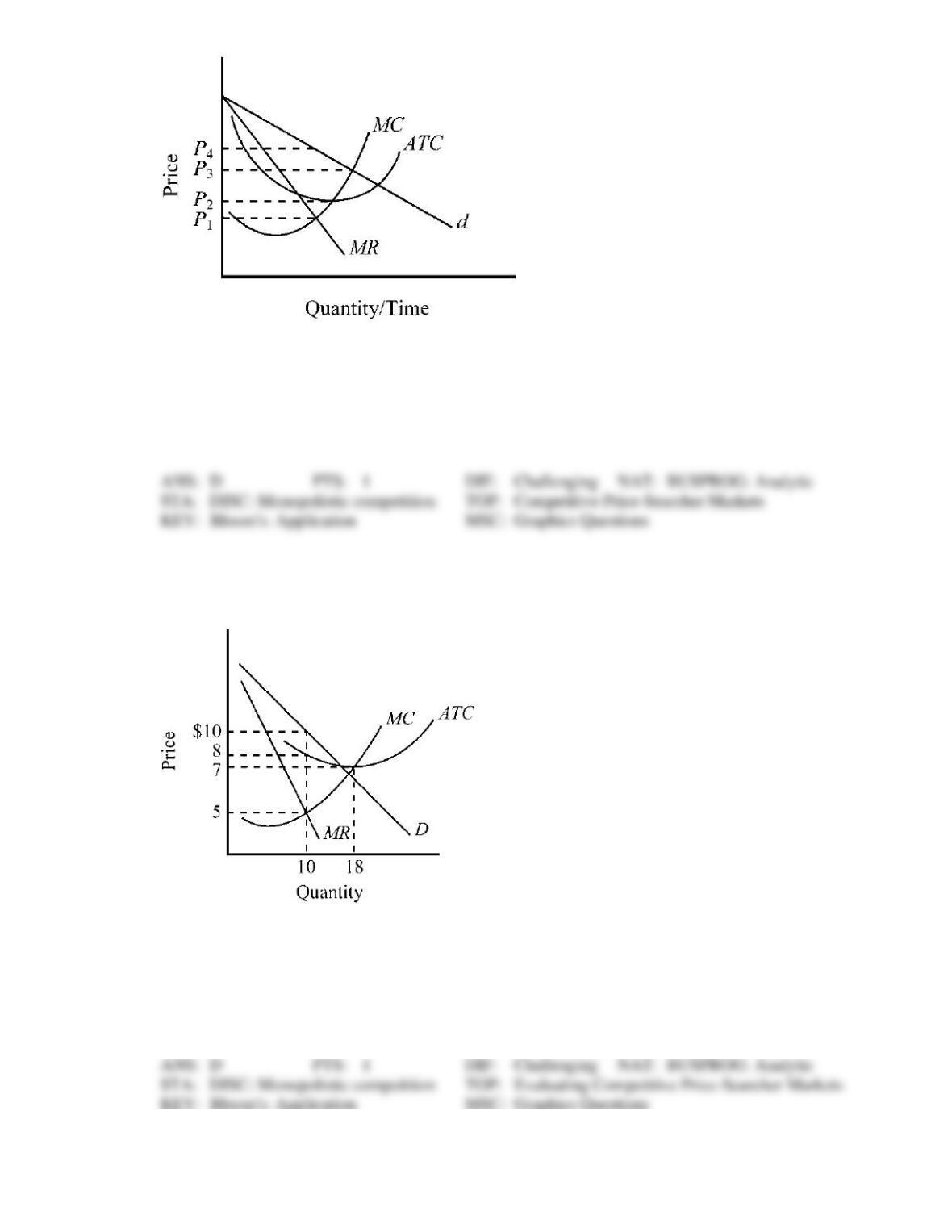
143. Given the cost and demand conditions in Figure 10-1, what price should this competitive
price-searcher firm charge in order to maximize profits?
a.
P1
b.
P2
c.
P3
d.
P4
Use the figure to answer the following question(s).
Figure 10-2
144. What price should a competitive price-searcher firm with the cost and demand conditions depicted in
Figure 10-2 charge if it wants to maximize its profit?
a.
$5
b.
$7
c.
$8
d.
$10
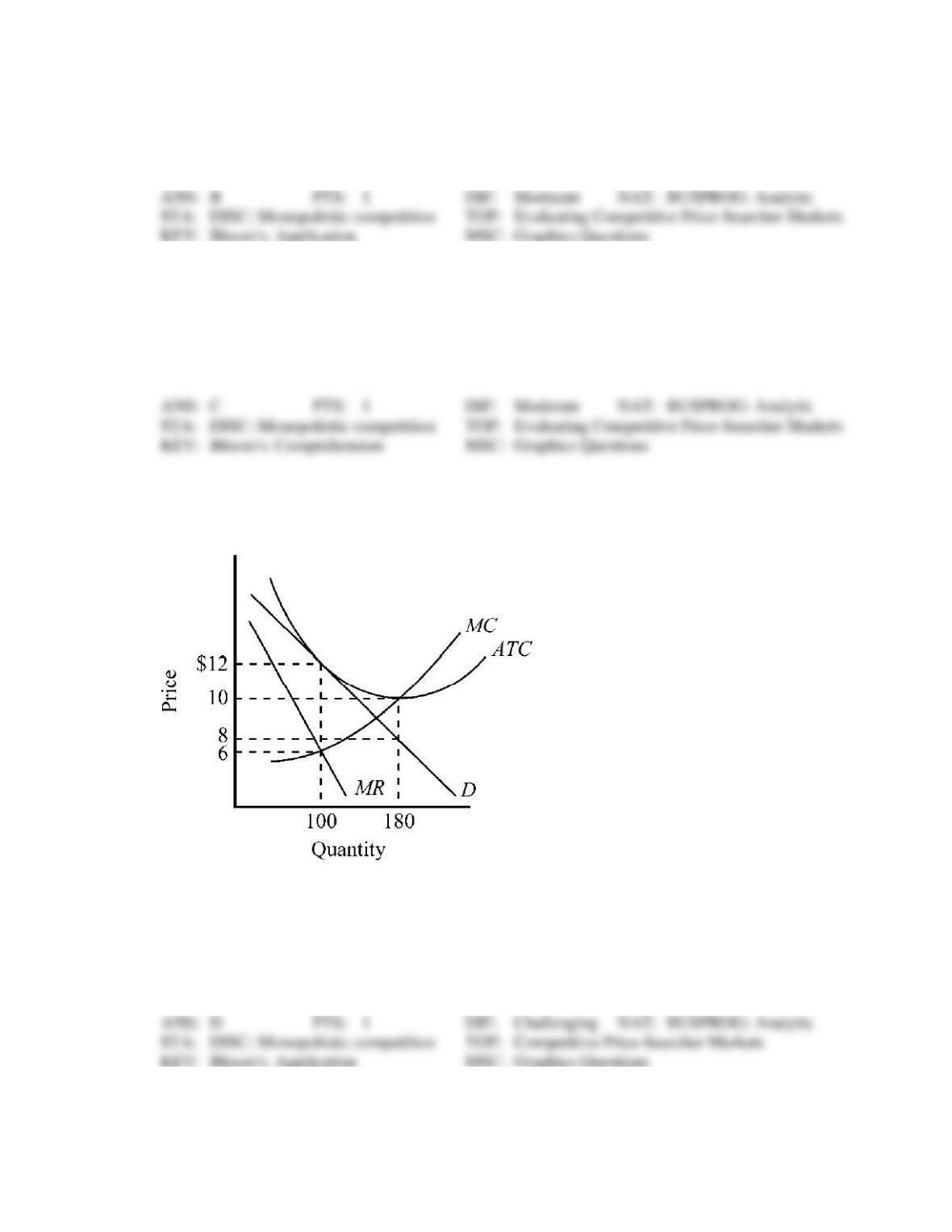
145. What is the maximum economic profit this firm depicted in Figure 10-2 will be able to earn?
a.
zero
b.
$20
c.
$30
d.
$100
146. If the cost and demand conditions of this competitive price-searcher firm depicted in Figure 10-2 are
representative of the market, what will happen in the future?
a.
Firms will go out of business, and the market price will rise.
b.
The current market price will tend to persist into the future.
c.
New firms will enter the market, and demand facing this firm will decline.
d.
The firms in this industry probably will collude in order to increase their profitability.
Use the figure to answer the following question(s).
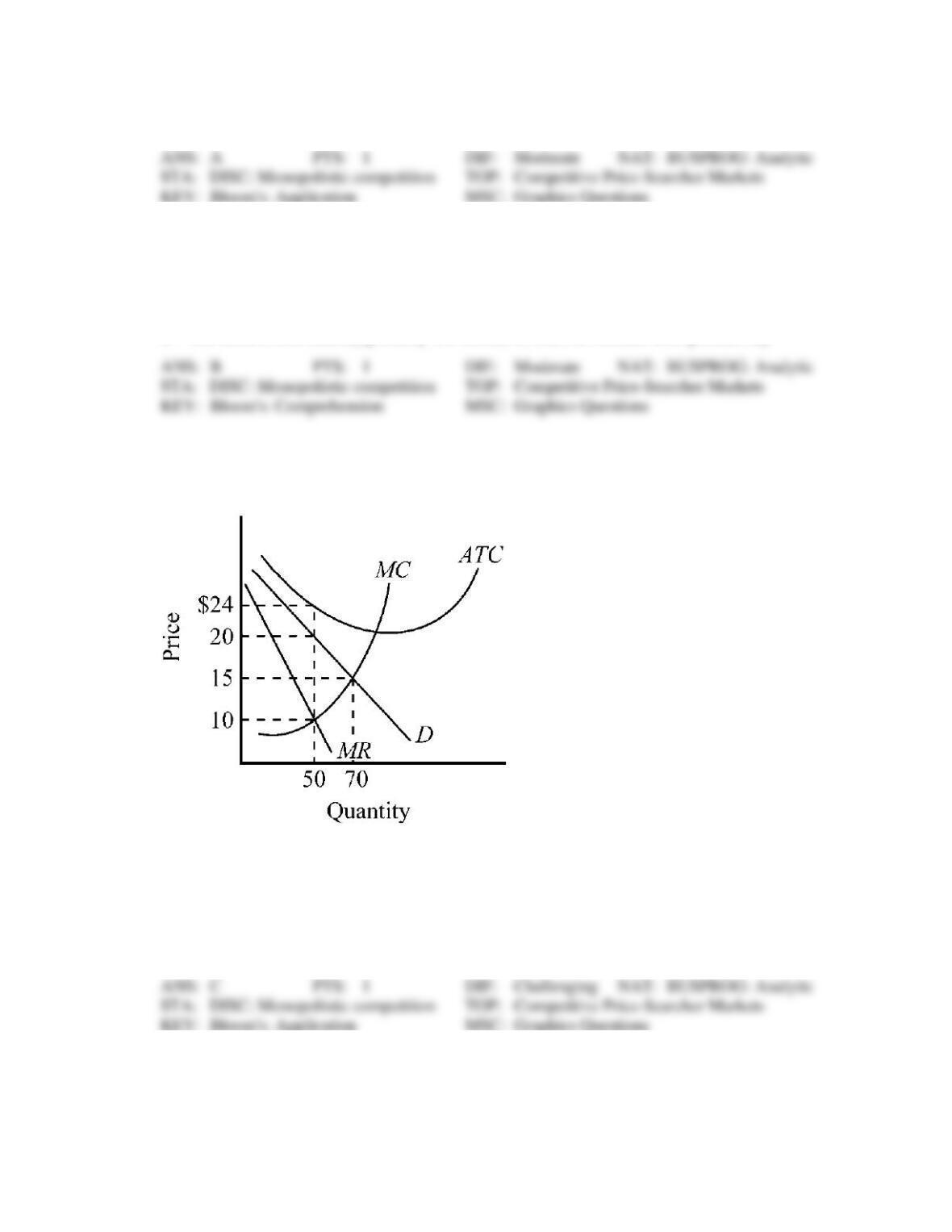
Figure 10-3
147. What price should a competitive price searcher firm with the cost and demand conditions depicted in
Figure 10-3 charge if it wants to maximize its profit?
a.
$6
b.
$8
c.
$10
d.
$12
148. What is the maximum economic profit this firm depicted in Figure 10-3 will be able to earn?
a.
zero
b.
$200
c.
$400
d.
$600
149. If the cost and demand conditions of this competitive price-searcher firm depicted in Figure 10-3 are
representative of the market, what will happen in the future?
a.
Firms will go out of business, and the market price will rise.
b.
The current market price will tend to persist into the future.
c.
New firms will enter the market, and the market price will decline.
d.
The firms in this industry probably will collude in order to increase their profitability.
Use the figure to answer the following question(s).
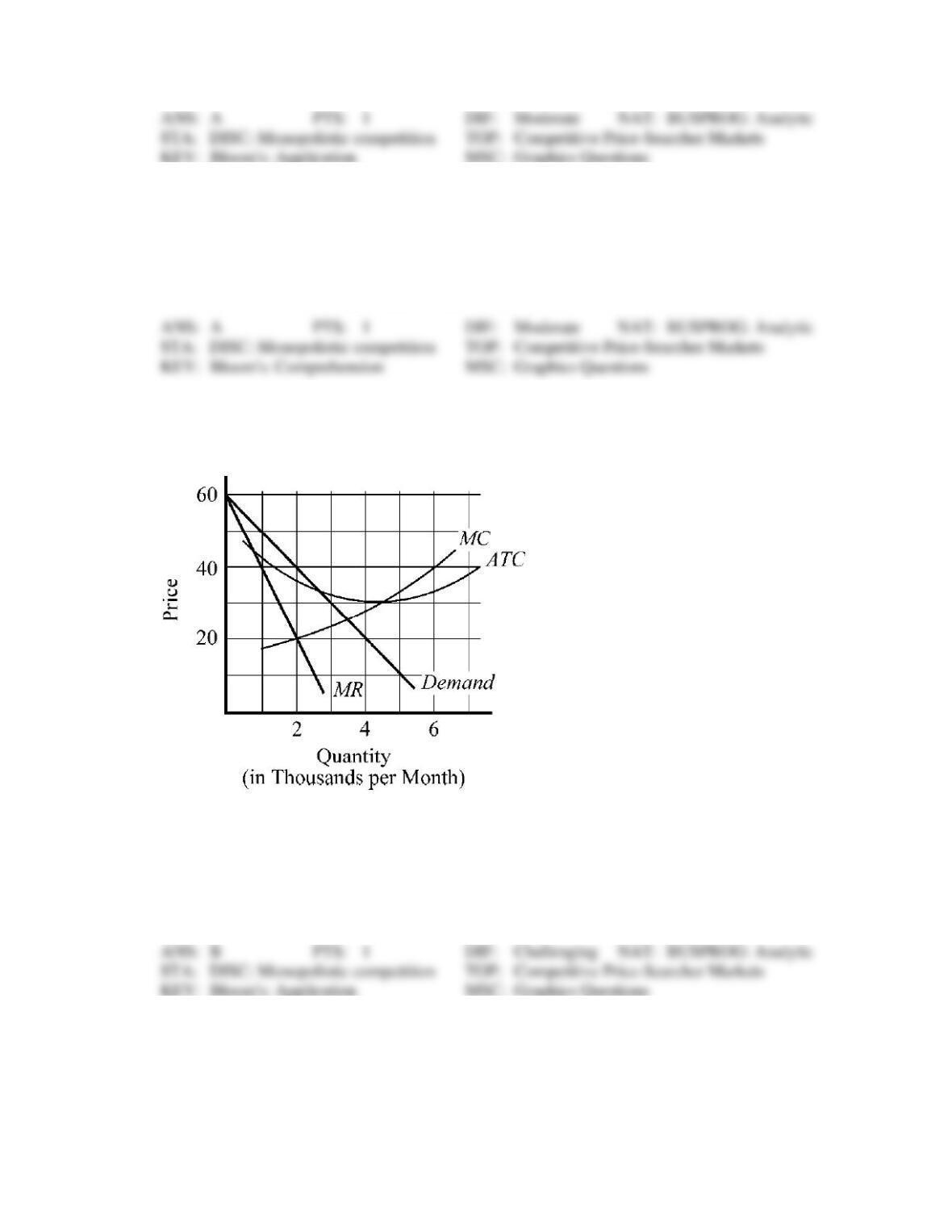
Figure 10-4
150. What price should a competitive price-searcher firm with the cost and demand conditions depicted in
Figure 10-4 charge if it wants to maximize its profit?
a.
$10
b.
$15
c.
$20
d.
$24
151. What is the maximum economic profit this firm depicted in Figure 10-4 will be able to earn?
a.
$200 loss
b.
zero profit
c.
$250 profit
d.
$700 profit
152. If the cost and demand conditions of this competitive price-searcher firm depicted in Figure 10-4 are
representative of the market, what will happen in the future?
a.
Some firms will go out of business, and the market price will rise.
b.
The current market price will tend to persist into the future.
c.
New firms will enter the market, and the market price will decline.
d.
The firms in this industry will probably collude in order to increase their profitability.
Use the figure to answer the following question(s).
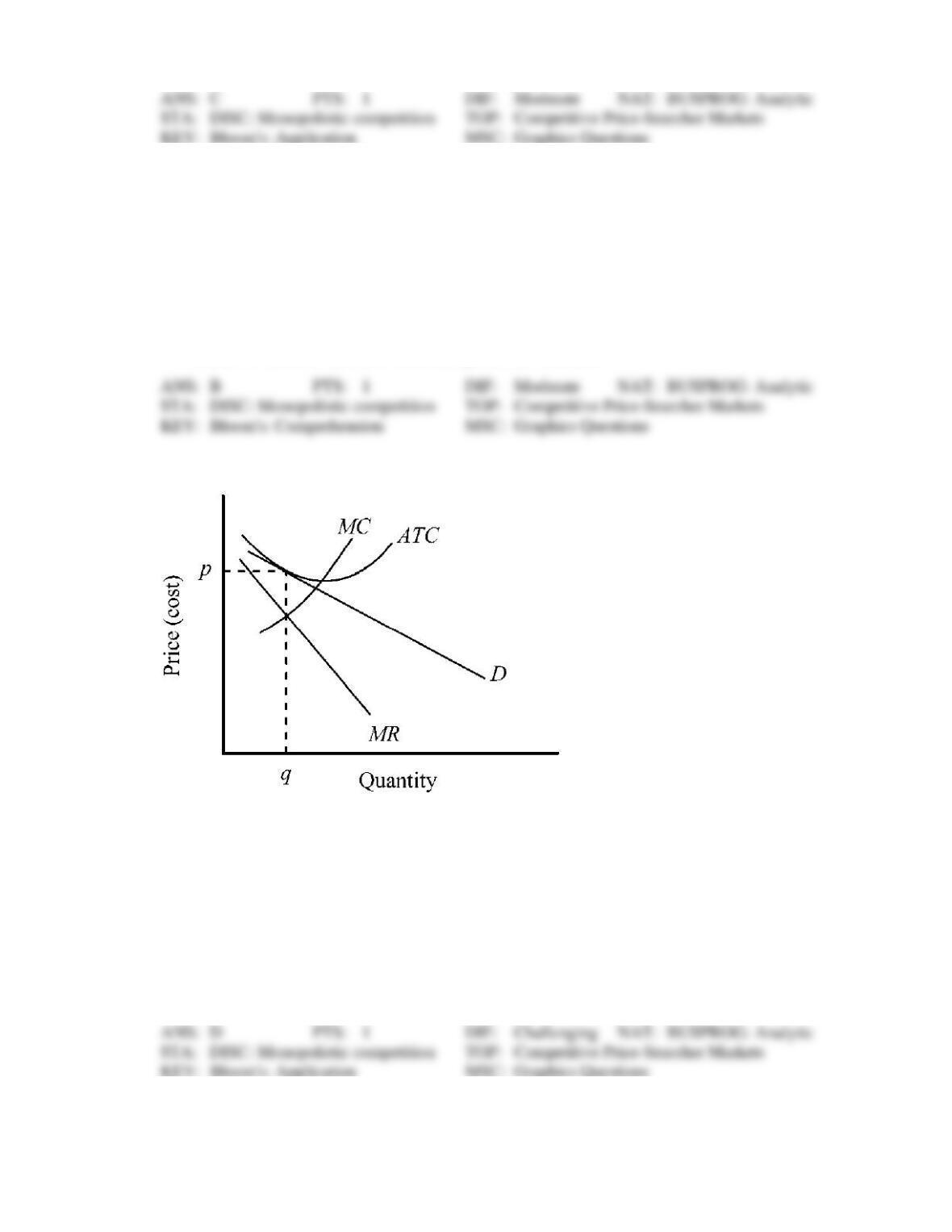
Figure 10-5
153. Given the cost and demand conditions shown in Figure 10-5 for the competitive price-searcher firm,
what is the level of output it should produce to maximize its profit?
a.
1
b.
2
c.
3
d.
4
154. Given the cost and demand conditions depicted in Figure 10-5 for the competitive price-searcher firm,
what is the price that the firm should charge if it wants to maximize its profit?
a.
20
b.
30
c.
40
d.
50
155. Given that the short-run cost and demand conditions shown in Figure 10-5 for the competitive
price-searcher firm are representative for all firms in the industry, what will happen in this industry in
the long run?
a.
The firm will make long-run economic profits.
b.
The firm will face competition from new entrants into the industry, causing this firm’s
demand to decline until zero economic profits are restored.
c.
The firm will face competition from new entrants into the industry, but since lower prices
will increase total sales, profit will stay the same as that shown in the figure.
d.
The firm will see some of its competitors exit from the industry, causing this firm’s
demand to increase until zero economic profits are restored.
Figure 10-6
156. Given that the short-run cost and demand conditions shown in Figure 10-6 for the competitive
price-searcher firm are representative for all firms in the industry, what will happen in this industry in
the long run?
a.
The firm will make long-run economic profits.
b.
The firm will face competition from new entrants into the industry, causing this firm’s
demand to decline until zero economic profits are restored.
c.
The firm will see some of its competitors exit from the industry, causing this firm’s
demand to increase until zero economic profits are restored.
d.
This industry is in long-run equilibrium and will not experience any new entry or exit of
firms.
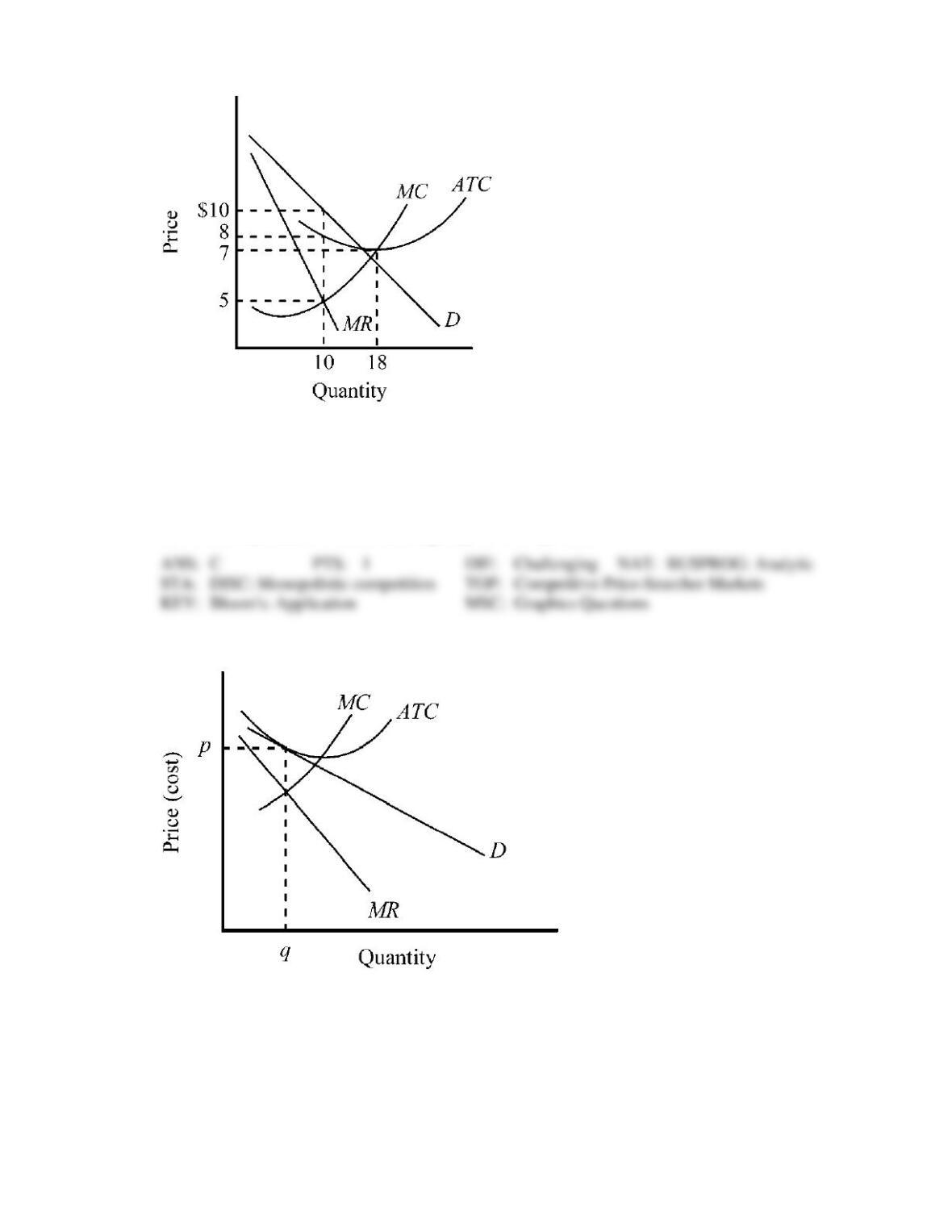
Figure 10-7
157. Given the cost and demand conditions shown in Figure 10-7 for the competitive price-searcher firm,
what price should it charge, and what quantity should it produce in order to maximize profit?
a.
It should produce 10 units and charge a price of $5 per unit.
b.
It should produce 10 units and charge a price of $8 per unit.
c.
It should produce 10 units and charge a price of $10 per unit.
d.
It should produce 18 units and charge a price of $7 per unit.
Figure 10-8
158. Figure 10-8 presents the demand, marginal revenue, and cost curves for a typical firm in a market.
This figure illustrates
a.
short-run equilibrium in a competitive price-taker market.
b.
long-run equilibrium in a competitive price-taker market.
c.
short-run equilibrium in a competitive price-searcher market.
d.
long-run equilibrium in a competitive price-searcher market.
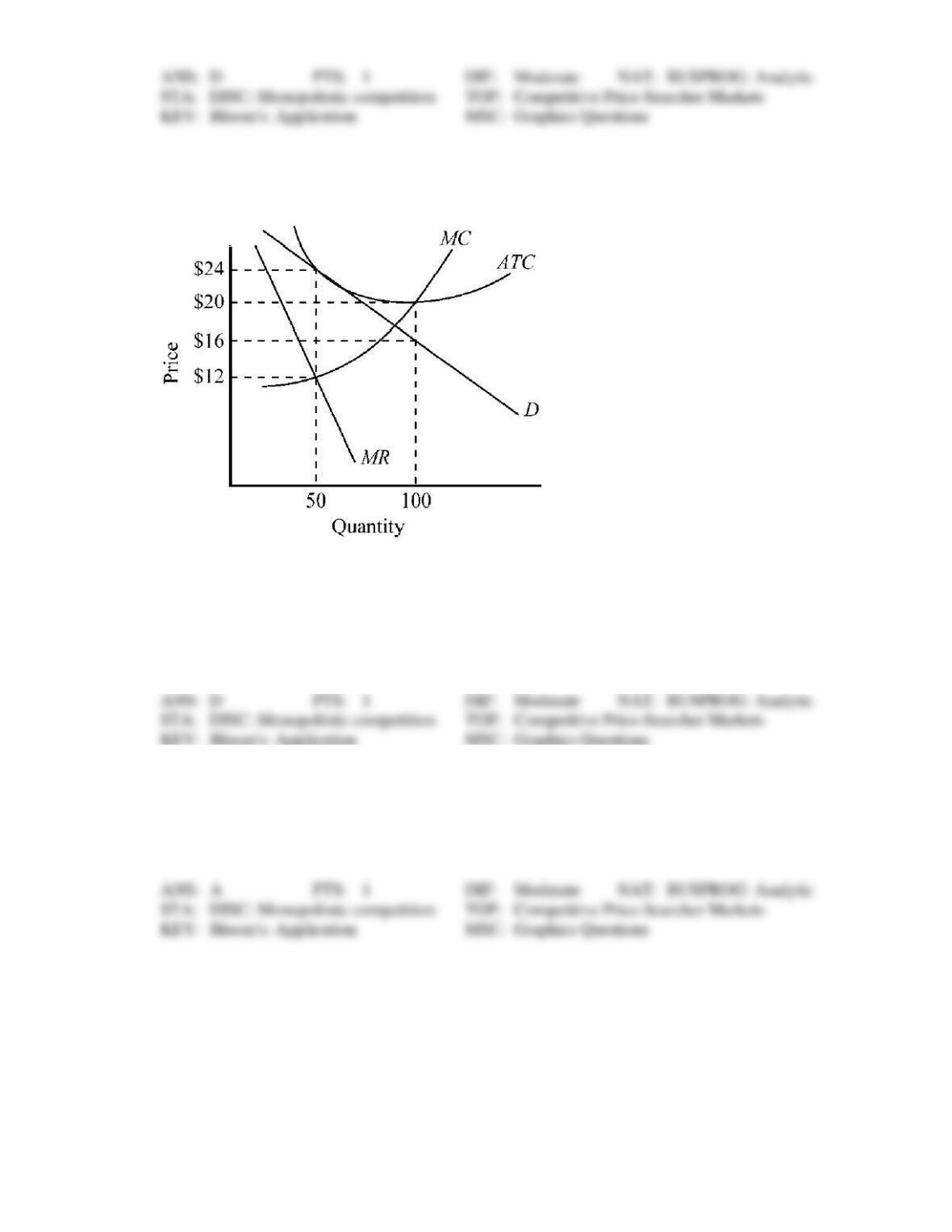
Use the figure to answer the following question(s).
Figure 10-9
159. What price should a competitive price-searcher firm charge with the cost and demand conditions
depicted in Figure 10-9 if it wants to maximize its profit?
a.
$12
b.
$16
c.
$20
d.
$24
160. What is the maximum economic profit this firm depicted in Figure 10-9 will be able to earn?
a.
zero profit
b.
$200 profit
c.
$400 profit
d.
$600 profit
Use the figure to answer the following question(s).
Figure 10-10