Economics Today, 19e (Miller)
Chapter 10 Real GDP and the Price Level in the Long Run
10.1 Output Growth and the Long-Run Aggregate Supply Curve
1) The aggregate supply curve
A) shows what each producer is willing and able to produce at each income level.
B) relates planned aggregate production to price level.
C) is the sum of all supply curves of natural resources.
D) shows a negative relationship between the price level and real Gross Domestic Product
(GDP).
2) The total of all planned production for the entire economy is known as
A) aggregate expenditures.
B) aggregate demand.
C) aggregate supply.
D) aggregate inflation.
3) The long run aggregate supply curve (LRAS) also represents
A) the full-information level of output.
B) the full-employment level of output.
C) the full-adjustment level of output.
D) all of the above.
4) All of the following would shift the LRAS curve to the right EXCEPT
A) an increase in the size of the labor force.
B) a net inflow of human capital.
C) an increase in the overall price level.
D) an improvement in technology.
5) Long-run aggregate supply reflects
A) total production in the economy at full employment.
B) total spending in the economy at full employment.
C) both production and spending in the economy.
D) only foreign production from U.S. subsidiaries.
6) The long-run aggregate supply curve is
A) horizontal at the full-employment level of real Gross Domestic Product (GDP).
B) vertical at the full-employment level of real Gross Domestic Product (GDP).
C) sloping upward due to the effects of price level changes on real Gross Domestic Product
(GDP).
D) the same as the short run aggregate supply (SRAS) curve.
7) The long-run aggregate supply curve
A) shifts to the right when there is a tax increase.
B) indicates the level of output (GDP) that occurs when resources are fully employed.
C) indicates that an increase in the overall price level will cause an increase in production.
D) shifts to the right when the Federal Reserve increases the money supply.
8) The long-run aggregate supply curve is vertical because
A) the economy has yet to use all its available resources.
B) the economy has reached its potential real Gross Domestic Product (GDP) and is at full
employment.
C) the economy has contracted.
D) the economy has large numbers of unemployed.
9) The long-run aggregate supply curve
A) shows that at higher prices, potential real Gross Domestic Product (GDP) increases.
B) slopes up and to the right.
C) shows that long-run aggregate supply equals potential real Gross Domestic Product (GDP).
D) is very sensitive to changes in the price level.
10) What is measured on the vertical axis of the aggregate demand/aggregate supply model?
A) real Gross Domestic Product (GDP)
B) nominal income
C) the price level
D) the interest rate
11) In the aggregate demand/aggregate supply model, the vertical axis shows the values of
________ and the horizontal axis shows the values of ________.
A) the unemployment rate; the inflation rate
B) real Gross Domestic Product (GDP); the price level
C) the price level; real Gross Domestic Product (GDP)
D) the inflation rate; the unemployment rate
12) What is measured on the horizontal axis of the aggregate demand/aggregate supply model?
A) real Gross Domestic Product (GDP)
B) nominal income
C) the price level
D) the interest rate
13) Which of the following statements is TRUE?
A) The long-run aggregate supply curve is upward sloping.
B) The long-run aggregate demand curve is upward sloping.
C) The short-run aggregate supply curve is vertical.
D) The long-run aggregate supply curve is vertical.
14) Long-run aggregate supply is
A) the sum of planned expenditures by consumers and firms.
B) the level of output that occurs when the economy is operating on the production possibilities
curve.
C) downward sloping.
D) upward sloping.
15) The long-run aggregate supply curve is
A) upward sloping.
B) downward sloping.
C) vertical.
D) horizontal.
16) The long-run aggregate supply curve of an economy corresponds to
A) a point inside the production possibilities curve.
B) a point outside the production possibilities curve.
C) a point on the production possibilities curve.
D) none of the above: there is no relationship between the long-run aggregate supply curve and
the production possibilities curve.
17) If a nation’s production possibilities curve shifts outward, we should expect its long-run
aggregate supply curve to
A) have an upward movement along the curve.
B) have a downward movement along the curve.
C) have a rightward shift.
D) have a leftward shift.
18) The full-employment and full-adjustment level of real Gross Domestic Product (GDP) in the
economy is represented by
A) the LRAS curve.
B) the horizontal line at the price level.
C) the AD curve.
D) the distance between the LRAS curve and the AD curve.
19) A human resource such as ingenuity can be thought of as
A) a positive for imports.
B) part of a country’s endowment.
C) part of government spending programs.
D) a causal factor for aggregate supply shifting left.
20) Which of the following will NOT cause a leftward shift in the long-run aggregate supply
curve?
A) a net outflow of human capital
B) an increase in the costs of obtaining energy resources
C) a reduction in the amount of capital
D) a reduction in government spending
21) Which of the following will cause the long-run aggregate supply curve to shift?
I. Changes in the amount of capital
II. Changes in the price level
III. Changes in the money supply
A) I only
B) II only
C) I, II, and III
D) only I and II
22) As the capital stock reduces , we would expect the long-run aggregate supply curve to
A) shift left.
B) shift right.
C) remain the same.
D) first shift right, then shift left.
23) The long-run aggregate supply will increase when
A) labor supply decreases.
B) international trade barriers are removed.
C) the price level increases.
D) tax rates increase.
24) A country’s long-run aggregate supply curve will shift to the left when there is (are)
A) fewer regulatory impediments to business.
B) a discovery of new oil reserves in that country.
C) a reduction in the labor force.
D) a reduction in the money supply.
25) Over time in a growing economy, the long run aggregate supply curve will
A) move so as to match the short run aggregate supply (SRAS) curve.
B) shift outward to the right.
C) shift inward to the left.
D) become increasingly steep.
26) Aggregate supply is
A) the summation of all product supply curves.
B) the horizontal summation of all supply curves for services.
C) the stock of all goods in the economy.
D) the sum of all planned production in the economy.
27) Economic growth can be depicted as
A) a shift of the LRAS curve to the left.
B) an inward shift of the production possibilities curve.
C) a shift of the LRAS curve to the right.
D) a movement along the production possibilities curve.

28) An assumption on the LRAS curve is
A) technology remains unchanged.
B) an increase in the average price level occurs.
C) the economy is operating to the right of the production possibilities curve.
D) labor productivity is increasing.
29) The total of all planned production for the economy is
A) aggregate supply.
B) aggregate demand.
C) endowments.
D) real-balance effect.
30) The total of all planned production for the economy is
A) determined only by individuals and firms.
B) determined only by the government.
C) aggregate demand.
D) aggregate supply.
31) When talking about aggregate supply, it is necessary to
A) focus on the short run.
B) focus on the long run.
C) distinguish between the long-run aggregate supply curve and the short-run aggregate supply
curve.
D) distinguish between the long-run aggregate supply curve and the long run aggregate demand
curve when all adjustments to price level changes have been made.
32) The real output of the economy under conditions of full employment
A) is long-run aggregate supply.
B) is long-run aggregate demand.
C) happens only when there is no inflation.
D) is determined by the real-balance effect.
33) The full-employment level of GDP is
A) endowments.
B) long-run aggregate demand.
C) long-run aggregate supply.
D) economic growth.
34) The position of the long-run aggregate supply curve is determined by
A) the long-run aggregate demand curve.
B) the production possibilities curve.
C) the open economy effect.
D) the interest rate effect.
35) The long-run aggregate supply when resources are fully employed
A) has no relationship with the production possibilities curve.
B) will always be associated with a point outside the production possibilities curve.
C) will always be associated with a point on the production possibilities curve.
D) is determined by demand.
36) The long-run aggregate supply curve is
A) horizontal.
B) vertical.
C) upward sloping.
D) downward sloping.
37) The long run aggregate supply curve is vertical because
A) the production possibilities curve is vertical.
B) the aggregate demand curve is downward sloping.
C) technology increases at a constant rate.
D) a change in the level of prices will have no effect on real output in the long-run.
38) The long-run aggregate supply curve occurs at the level of real GDP consistent with
A) individuals’ tastes and preferences.
B) the natural rate of unemployment.
C) no inflation.
D) low levels of inflation.
39) Which of the following does NOT affect the long-run aggregate supply curve?
A) technology
B) production possibilities curve
C) endowments of resources
D) price level
40) An increase in the level of prices of goods and services will do what to the long-run
aggregate supply curve?
A) shift it to the right
B) shift it to the left
C) a movement along the curve
D) make the curve flat
41) The long-run aggregate supply curve is determined by all of the following EXCEPT
A) aggregate demand.
B) human capital.
C) technology.
D) the amount of resources that exist in the economy.
42) The long-run aggregate supply curve can be thought of as the
A) level of output that the nation is currently producing.
B) full-employment level of real GDP.
C) level of real GDP associated with a constant price level.
D) level of output for which real GDP equals nominal GDP.
43) The long-run aggregate supply curve will shift to the left when
A) population decreases.
B) the price level increases.
C) technology improves.
D) new sources of natural resources are discovered.
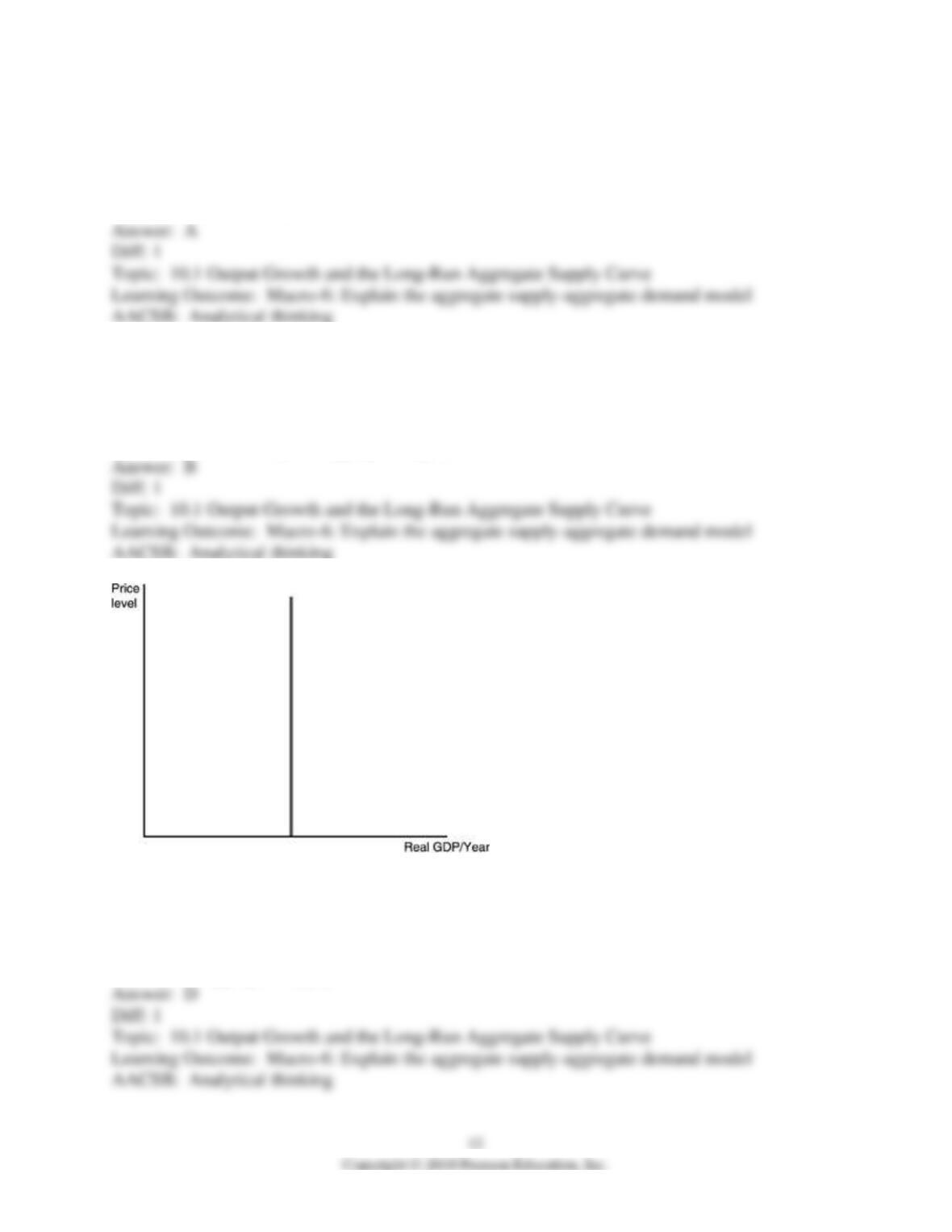
44) The long-run aggregate supply curve will shift outward to the right when
A) there is economic growth.
B) the price level decreases.
C) government spending increases.
D) the amount of labor decreases.
45) The natural rate of unemployment will help determine
A) the open economy effect.
B) the position of the long-run aggregate supply curve.
C) the level of economic growth in the economy.
D) the slope of the long-run aggregate supply curve.
46) The above figure shows a
A) short-run aggregate demand curve.
B) short-run aggregate supply curve.
C) long-run aggregate demand curve.
D) long-run aggregate supply curve.
47) The curve in the above figure will shift to the right when
A) the price level falls.
B) labor productivity increases.
C) population falls.
D) the proportion of the population that is elderly increases.
48) Which of the following will NOT lead to a rightward shift of the long-run aggregate supply
curve?
A) increase in labor productivity
B) increase in aggregate spending
C) increase in capital
D) increase in labor
49) Which of the following would cause the long-run aggregate supply curve to shift to the left?
A) an increase in wages
B) a decrease in aggregate demand
C) a decrease in labor productivity
D) a decrease in taxes on profits
50) If our economy is growing at a constant rate of 2 percent per year, then over a period of 20
years we would expect to see which of the following?
A) nice, steady flat-line growth
B) an upward sloping growth path
C) a downward sloping growth path
D) It is impossible to say what kind of growth path we would see.

51) Economic growth can be thought of as
A) an increase in the price level.
B) a decrease in the price level.
C) an increase in long-run aggregate supply.
D) an increase in aggregate demand.
52) Real GDP will increase over the long run if
A) prices continually go up.
B) the long-run aggregate supply curve shifts continually to the right.
C) the long-run aggregate supply curve shifts continually to the left.
D) the long-run aggregate demand curve shifts continually to the left.
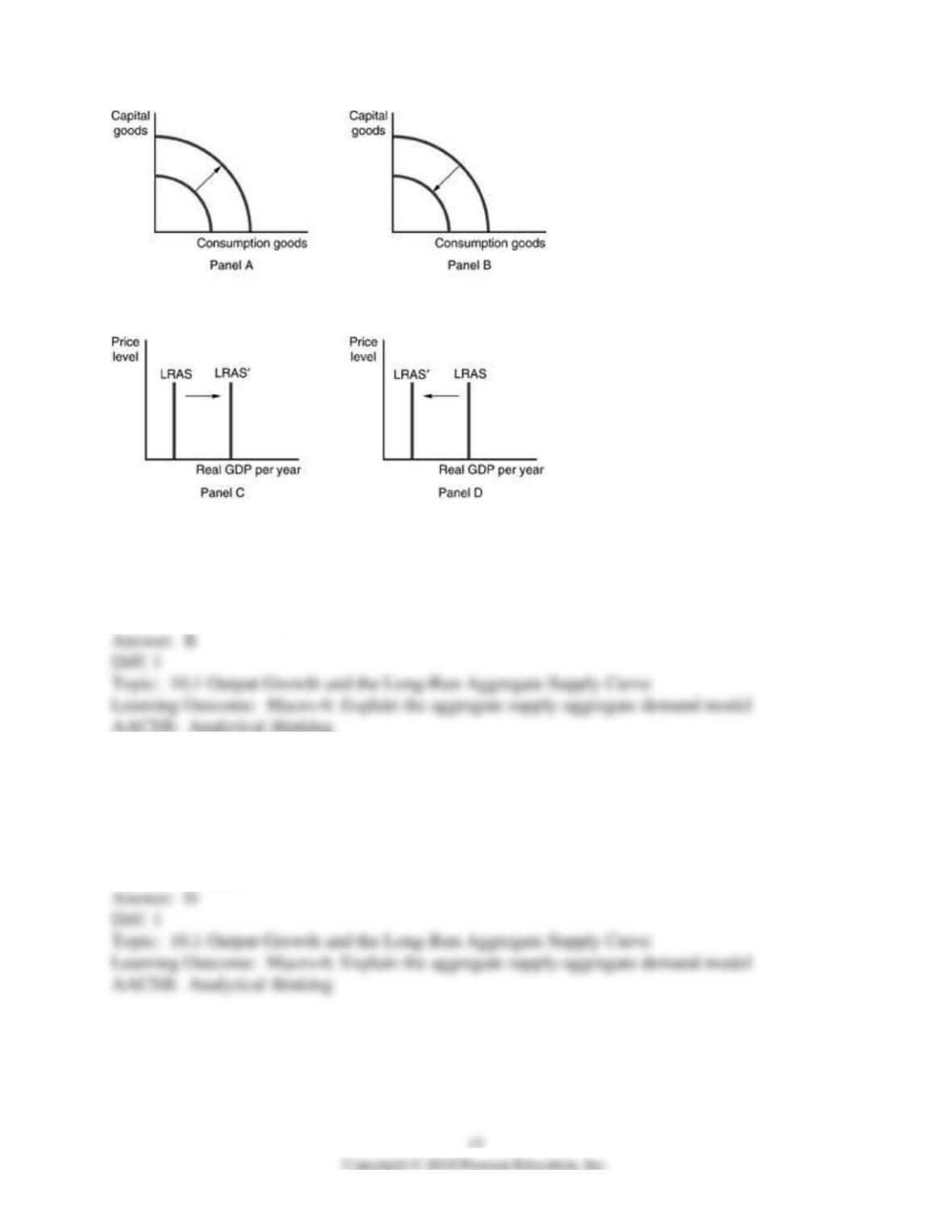
53) Refer to the above figures. Which panel(s) represent economic growth?
A) Panel A only
B) Panels A and C only
C) Panel D only
D) Panels B and D only
54) Refer to the above figures. Which panel(s) represent the effect of an increase in the price
level?
A) Panel A only
B) Panels A and C only
C) Panel D only
D) none of the panels
55) Refer to the above figures. Which panel(s) represent the effect of a decrease in labor
productivity?
A) Panel A only
B) Panels A and C only
C) Panel D only
D) Panels B and D only
56) The aggregate supply curve cannot tell us
A) anything about the quantity demanded of all commodities and the price level.
B) what the effect of changes in interest rates will be on real GDP.
C) how the total dollar values of spending will ultimately be divided between output and prices.
D) how changes in the price level affect quantity demanded of all commodities.
57) The aggregate supply curve shows
A) the total amount of planned production for an economy.
B) the various quantities of goods consumers will purchase.
C) that real GDP can only increase when the price level increases.
D) what an economy can produce if resource prices are constant.
58) Aggregate supply
A) is the total amount of raw materials available in an economy.
B) is the overall wealth within an economy.
C) is the total amount of money circulating in an economy.
D) is the total amount of planned production in an economy.

59) We draw the long-run aggregate supply curve as a vertical line to reflect the fact that
A) the productive capacity of the economy never changes after full adjustment has occurred.
B) changes in the price level do not alter the level of long-run real GDP after full adjustment has
occurred.
C) technology and resource endowments do not affect long-run real GDP after full adjustment
has occurred.
D) an accurate depiction of the production possibilities curve is vertical after full adjustment has
occurred.
60) The level of real GDP identified by the long-run aggregate supply curve is
A) the full-employment level of real GDP.
B) the level of GDP at which each business firm is experiencing growth in sales.
C) the level of GDP at which each industry is experiencing growth in sales.
D) the level of GDP at which no one is below the poverty line.
61) What is measured on the vertical axis when we draw a graph of long-run aggregate supply?
A) production of capital goods
B) spending on goods and services in an economy
C) the price level
D) real GDP
62) The values on the axes of the long-run aggregate supply diagram are
A) real GDP per year and the price level.
B) nominal GDP and the price level.
C) real GDP and interest rates.
D) real GDP and nominal GDP.
63) When the production possibilities curve shifts outward,
A) the long-run aggregate supply curve shifts to the left.
B) the long-run aggregate supply curve is unchanged.
C) the price level rises in the long run.
D) the long-run aggregate supply curve shifts to the right.
64) What is measured on the horizontal axis when we draw a graph of the long-run aggregate
supply curve?
A) production of capital goods
B) production of consumer goods
C) the price level
D) real GDP
65) What causes the long-run aggregate supply curve to shift right?
A) economic growth
B) inflation
C) unemployment
D) scarcity
66) The long-run aggregate supply curve shifts right at the same time as
A) wages increase.
B) the production possibilities curve shifts outward.
C) the production possibilities curve shifts inward.
D) the inflation rate increases.
67) A rightward shift of the long-run aggregate supply curve is caused by
A) an increase in the minimum wage.
B) an increase in the average duration of unemployment.
C) improvements in technology.
D) an increase in the GDP deflator.
68) The long-run aggregate supply curve assumes that
A) the unemployment rate is more than 9 percent.
B) all factors of production are fully employed.
C) only laborers are fully employed.
D) there is no government purchasing of goods and services.
69) The long-run aggregate supply curve is
A) U-shaped.
B) horizontal.
C) upward sloping.
D) vertical.
70) Long-run aggregate supply curve corresponds to
A) real GDP when the economy is above full employment.
B) real GDP when the economy is at full employment.
C) the economy outside its production possibilities curve.
D) the economy inside its production possibilities curve.
71) The slope of the long-run aggregate supply curve is
A) positive.
B) negative.
C) zero.
D) undefined.
72) Why is the long-run aggregate supply curve a vertical line?
A) At that level of real GDP, the unemployment rate is 0 percent.
B) At that level of real GDP, the inflation rate is 0 percent.
C) At that level of real GDP, the production costs are at their lowest level.
D) At that level of real GDP, production costs have fully adjusted to price changes.
73) Long-run aggregate supply is
A) the possible combinations of real GDP and inputs after full adjustments have been made.
B) the extraction of natural resources.
C) the real production of goods and services after full adjustments have been made.
D) all of the physical and human resources in the economy.
74) Long-run aggregate supply and a country’s production possibility curve (PPC)
A) are closely related.
B) are inversely related.
C) have no relationship.
D) are examples of microeconomic models.