DISC: Perfect competition
United States – BPROG: Analytic
Perfect competition
The Perfectly Competitive Industry
134. Perfectly competitive firms ____ earn zero economic profit in long-run equilibrium because ____.
a.
always; firms in perfectly competitive industries always maximize output and so flood the market until the
equilibrium price of output is driven to zero
b.
sometimes; the demand curve for an individual perfectly competitive firm may or may not cross the company’s
long-run average total cost curve at its lowest point
c.
always; firms enter whenever their economic profit is positive and exit whenever it’s negative, so in long-run
equilibrium economic profit must always be zero
d.
never; no firm would be willing to produce if it received zero economic profit
DISC: Perfect competition
United States – BPROG: Analytic
Perfect competition
The Perfectly Competitive Industry
135. If the opportunity cost of capital is below the rate of return to capital in the perfectly competitive beauty salon
industry,
a.
resources will flow into the industry.
b.
beauty salon owners must be earning negative economic profit.
c.
the beauty salon industry cannot be in long-run equilibrium.
d.
beauty salon owners must be earning negative marginal revenue at their current levels of output.
DISC: Perfect competition
United States – BPROG: Analytic
Perfect competition
The Perfectly Competitive Industry
136. The difference between zero accounting profit and zero economic profit is that
a.
an economic profit of zero indicates a fair rate of return because it includes opportunity cost. opportunity cost
and
b.
an economic profit of zero indicates an unacceptable rate of return because it does not include opportunity
cost.
c.
an economic profit of zero indicates more than a fair rate of return because it includes opportunity cost and
explicit cost..
d.
an accounting profit of zero indicates a fair rate of return because it includes opportunity cost.
a
Moderate
DISC: Perfect competition
United States – BPROG: Analytic
Perfect competition
The Perfectly Competitive Industry
137. Helga owns Viking, Inc., started with her $100,000 inheritance. Helga’s accountant informs her that her firm earned a
profit of $100,000 last year, and that if she chooses to invest the money she can expect a 10% return. If Helga did not run
Viking, she would not work. What were Helga’s economic profits last year?
a.
Zero
b.
$100,000
c.
$90,000
d.
$95,000
c
Difficult
DISC: Perfect competition
United States – BPROG: Reflective Thinking – BPROG: Analysis
Perfect competition
The Perfectly Competitive Industry
BLOOMS: Application
138. Richard Bland quit his job as an accounting professor to start his own restaurant. He gave up a salary of $50,000 per
year and withdrew $100,000 in bank CDs earning 5 percent to buy a building and equipment. In the restaurant’s first year
it had direct expenses of $75,000 and revenues of $150,000. The restaurant’s economic profit was
a.
$15,000.
b.
$20,000.
c.
$75,000.
d.
not possible to determine from the information given.
Difficult
DISC: Perfect competition
United States – BPRPOG: Analysis
Perfect competition
The Perfectly Competitive Industry
BLOOMS: Application
139. A perfectly competitive firm would be willing to remain in the industry in the long run at zero economic profit
because
a.
its total revenues would be positive.
b.
accounting profit would be negative.
c.
revenue is equal to all costs, including the opportunity cost of capital and labor.
d.
its fixed costs would prevent it from leaving the industry.
DISC: Perfect competition
United States – BPROG: Analytic
Perfect competition
The Perfectly Competitive Industry
140. Zero economic profits for a perfectly competitive firm in the long run means
a.
the firm must exit the industry.
b.
the firm is in equilibrium.
c.
the firm will shut down until the market improves.
d.
average revenue is insufficient to cover long-run average cost.
DISC: Perfect competition
United States – BPROG: Analytic
Perfect competition
The Perfectly Competitive Industry
141. Long-run average cost of the perfectly competitive firm includes the
a.
cost of raw materials per unit of output.
b.
opportunity cost of labor per unit of output.
c.
opportunity cost of capital per unit of output.
d.
All of the above are correct.
DISC: Perfect competition
United States – BPROG: Analytic
Perfect competition
The Perfectly Competitive Industry
142. Which of the following statements is not true in a perfectly competitive industry in long-run equilibrium?
a.
A profit-maximizing firm may produce any output level at which P < LRAC.
b.
Every firm produces at an output level at which MC = LRAC.
c.
There is no entry or exit from the industry.
d.
No firm earns an economic profit.
DISC: Perfect competition
United States – BPRPOG: Analysis
Perfect competition
The Perfectly Competitive Industry
143. The perfectly competitive widget industry is in long-run equilibrium. A profit-maximizing manufacturer receives
total revenue of $55,000. He uses his labor, $15,000 worth of wire, and $15,000 worth of steel to make the widgets. The
manufacturer
a.
is earning an economic profit of $25,000.
b.
must have an opportunity cost of labor of less than $25,000.
c.
must have an opportunity cost of labor of exactly $25,000.
d.
must have an opportunity cost of labor of more than $25,000.
DISC: Perfect competition
United States – BPRPOG: Analysis
Perfect competition
The Perfectly Competitive Industry
144. An increase in market demand will cause an increase in industry output in the long run because
a.
new firms enter the industry.
b.
new firms enter the industry and all firms increase their output.
c.
all firms decrease their output but more new firms enter.
d.
no firms enter but the existing firms increase their output.
DISC: Perfect competition
United States – BPROG: Analytic
Perfect competition
The Perfectly Competitive Industry
145. The entry of firms into a perfectly competitive industry causes the supply curve to
a.
increase its slope.
b.
decrease its slope.
c.
move toward the right.
d.
move toward the left.
DISC: Perfect competition
United States – BPROG: Analytic
Perfect competition
The Perfectly Competitive Industry
146. The market for a perfectly competitive industry clears at a price of $3, and the minimum average cost for all firms is
$2.50. In the long run, we would expect an increase in
a.
each firm’s output.
b.
the number of firms.
c.
each firm’s profit.
d.
each firm’s average cost.
DISC: Perfect competition
United States – BPROG: Analytic
Perfect competition
The Perfectly Competitive Industry
BLOOMS: Application
147. The long-run supply curve of an industry equals the industry’s
a.
long-run marginal cost curve.
b.
the horizontal sum of all firms’ supply curves at any point in time.
c.
long-run average cost curve.
d.
long-run total variable cost curve.
DISC: Perfect competition
United States – BPROG: Reflective Thinking – BPROG: Analysis
Perfect competition
The Perfectly Competitive Industry
148. Regardless of quantity in long-run equilibrium, the industry price cannot exceed the
a.
long-run average cost of supplying that quantity.
b.
total variable cost of supplying that quantity.
c.
long-run total cost of supplying that quantity.
d.
minimum long-run marginal cost of supplying that quantity.
DISC: Perfect competition
United States – BPROG: Analytic
Perfect competition
The Perfectly Competitive Industry
149. The long-run industry supply curve in perfect competition is derived from the
a.
short-run industry supply curve which shifts as new firms enter the industry.
b.
short-run industry supply curve which shifts as old firms exit the industry.
c.
freedom of firms from sunk costs so that new cost curves become long-run curves.
d.
All of the above reasons.
DISC: Perfect competition
United States – BPROG: Analytic
Perfect competition
The Perfectly Competitive Industry
150. The process of adjustment to a new long-run equilibrium in a perfectly competitive industry is complete when
a.
no firms want to enter or exit the industry.
b.
every firm has adjusted its production process to make the most efficient use of its resources.
c.
investors in the industry receive the standard economy-wide rate of return on their investments.
d.
All of the above are correct.
DISC: Perfect competition
United States – BPROG: Analytic
Perfect competition
The Perfectly Competitive Industry
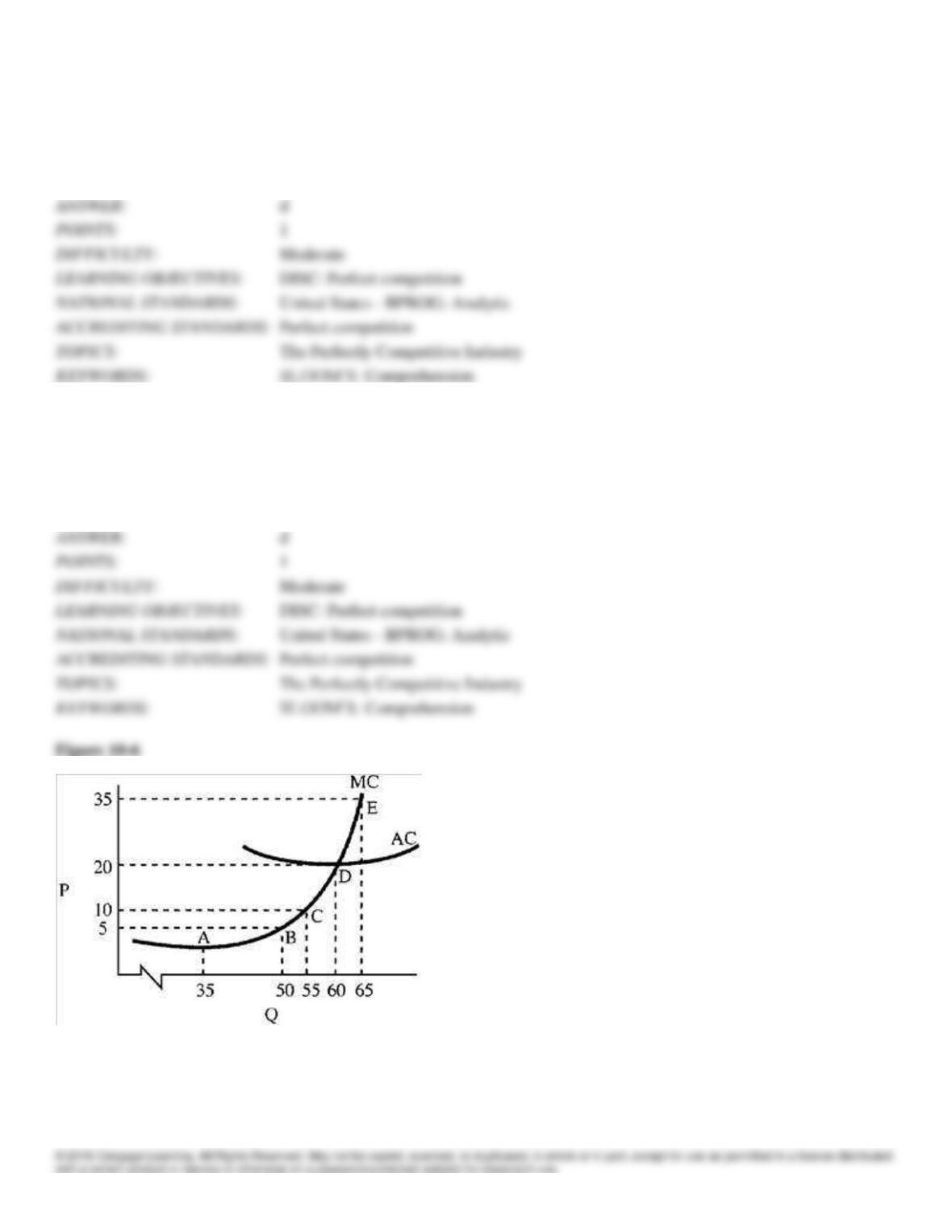
151. In Figure 10–6, the price at long-run equilibrium is
a.
$5.
b.
$10.
c.
$20.
d.
$35.
DISC: Perfect competition
United States – BPROG: Analytic
Perfect competition
The Perfectly Competitive Industry
BLOOMS: Application
152. At its long-run equilibrium level of output, the demand curve facing an individual perfectly competitive firm is
tangent to its
a.
total economic profit curve.
b.
long-run average cost curve.
c.
marginal cost curve.
d.
marginal profit curve.
DISC: Perfect competition
United States – BPROG: Analytic
Perfect competition
The Perfectly Competitive Industry
153. Firms will continue to enter a perfectly competitive industry until
a.
the supply curve is vertical.
b.
the supply curve is meaningless.
c.
any excess returns have been competed away.
d.
all resources are fully employed.
DISC: Perfect competition
United States – BPROG: Analytic
Perfect competition
The Perfectly Competitive Industry
154. A perfectly competitive industry in long-run equilibrium is described as efficient because firms
a.
produce at the low point on their average cost curve.
b.
produce where marginal cost yields a profit.
c.
earn no more than the cost of capital.
d.
are not profitable.
Moderate
DISC: Perfect competition
United States – BPROG: Analytic
Perfect competition
The Perfectly Competitive Industry
155. If you must determine the long-run equilibrium output of a perfectly competitive firm and you are permitted to see
only one curve, which of the following curves is most helpful?
a.
demand
b.
marginal cost
c.
average cost
d.
average fixed cost
c
Difficult
DISC: Perfect competition
United States – BPROG: Reflective Thinking – BPROG: Analysis
Perfect competition
The Perfectly Competitive Industry
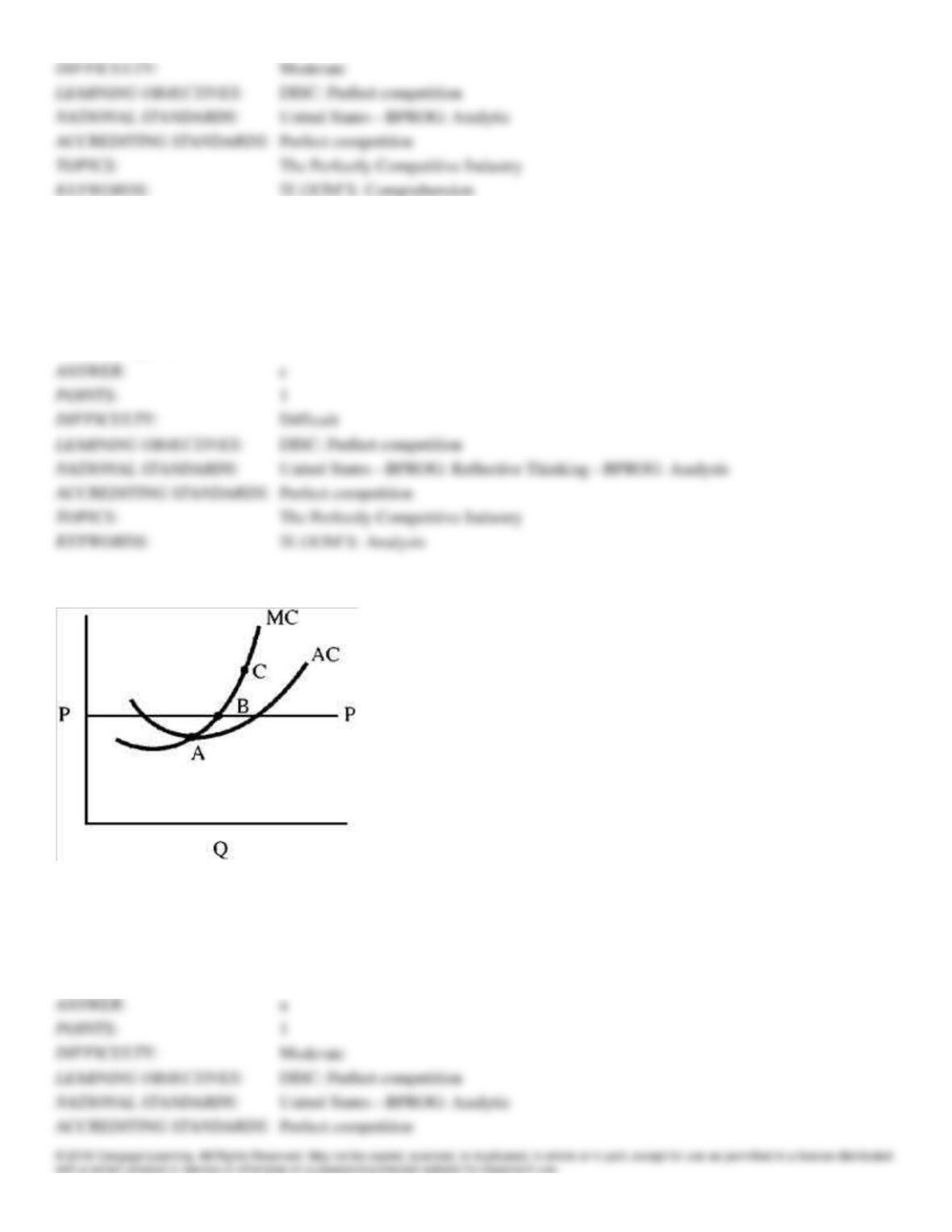
Figure 10-7
156. In Figure 10–7, through which point must a horizontal demand curve pass to yield a long-run equilibrium?
a.
A
b.
B
c.
C
d.
All of the above is correct.
a
Moderate
United States – BPROG: Analytic
Perfect competition
The Perfectly Competitive Industry
BLOOMS: Application
157. In Figure 10–7, output at which point represents short-run but not long-run equilibrium?
a.
A only
b.
B only
c.
both A and B
d.
both B and C
DISC: Perfect competition
United States – BPROG: Analytic
Perfect competition
The Perfectly Competitive Industry
BLOOMS: Application
Figure 10-8
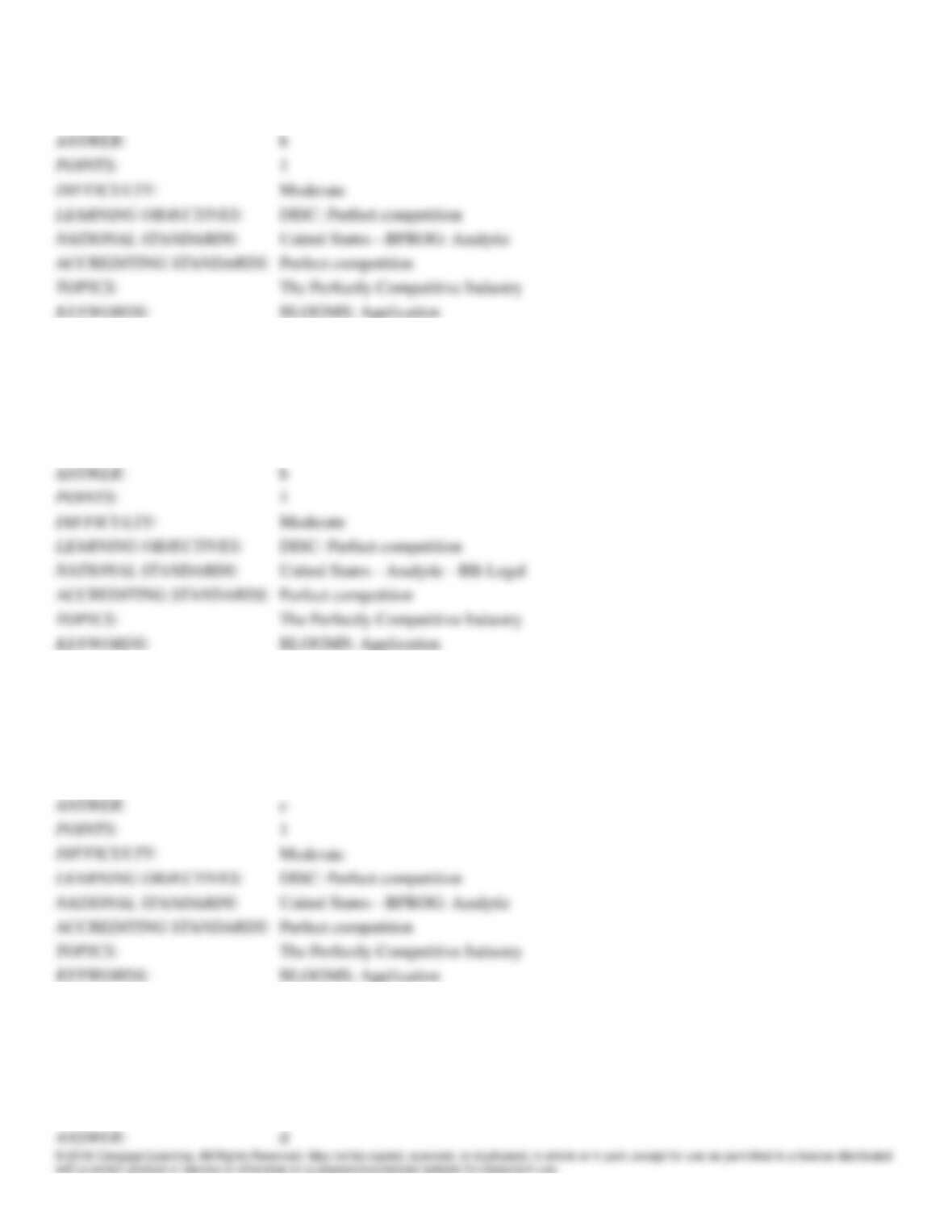
158. Figure 10-8 displays the cost curves of a perfectly competitive firm. Profits at a price of $10 would be approximately
a.
$1 per unit.
b.
$3 per unit.
c.
$5 per unit.
d.
$10 per unit.
DISC: Perfect competition
United States – BPROG: Analytic
Perfect competition
The Perfectly Competitive Industry
159. For the perfectly competitive firm in Figure 10–8, what is the long-run price and quantity?
a.
P = 4, Q = 150
b.
P = 9, Q = 200
c.
P = 10, Q = 200
d.
P = 5, Q = 150
DISC: Perfect competition
United States – BPROG: Analytic
Perfect competition
The Perfectly Competitive Industry
BLOOMS: Application
160. In the long run, the perfectly competitive firm in Figure 10-8 will leave the industry if the price falls below
a.
$10.
b.
$9.
c.
$5.
d.
$2.
DISC: Perfect competition
United States – Analytic – BB-Legal
Perfect competition
The Perfectly Competitive Industry
161. In the short run, the firm in Figure 10-8 will shut down if the price falls below
a.
$8.
b.
$6.
c.
$5.
d.
$1.
DISC: Perfect competition
United States – BPROG: Analytic
Perfect competition
The Perfectly Competitive Industry
BLOOMS: Application
162. The entry of new firms into an industry will very likely
a.
shift the industry supply curve to the right.
b.
cause the market price to fall.
c.
reduce the profits of existing firms in the industry.
d.
All of the above are correct.
DISC: Perfect competition
United States – BPROG: Analytic
Perfect competition
The Perfectly Competitive Industry
163. In long-run equilibrium under perfect competition,
a.
the firm and the industry will have the same cost curves.
b.
only a very few firms will be earning economic profits.
c.
the demand curves facing individual firms will fall to the level of minimum AC.
d.
individual firms will tend to increase their outputs.
DISC: Perfect competition
United States – BPROG: Analytic
Perfect competition
The Perfectly Competitive Industry
164. Which of the following statements concerning equilibrium in the long run is not true?
a.
Most firms earn economic profits in the long run.
b.
The firm can vary its plant size in the long run.
c.
Economic profits are eliminated as new firms enter the industry in the long run.
d.
For firms in long-run equilibrium, P = MC = AC.
DISC: Perfect competition
United States – BPROG: Analytic
Perfect competition
The Perfectly Competitive Industry
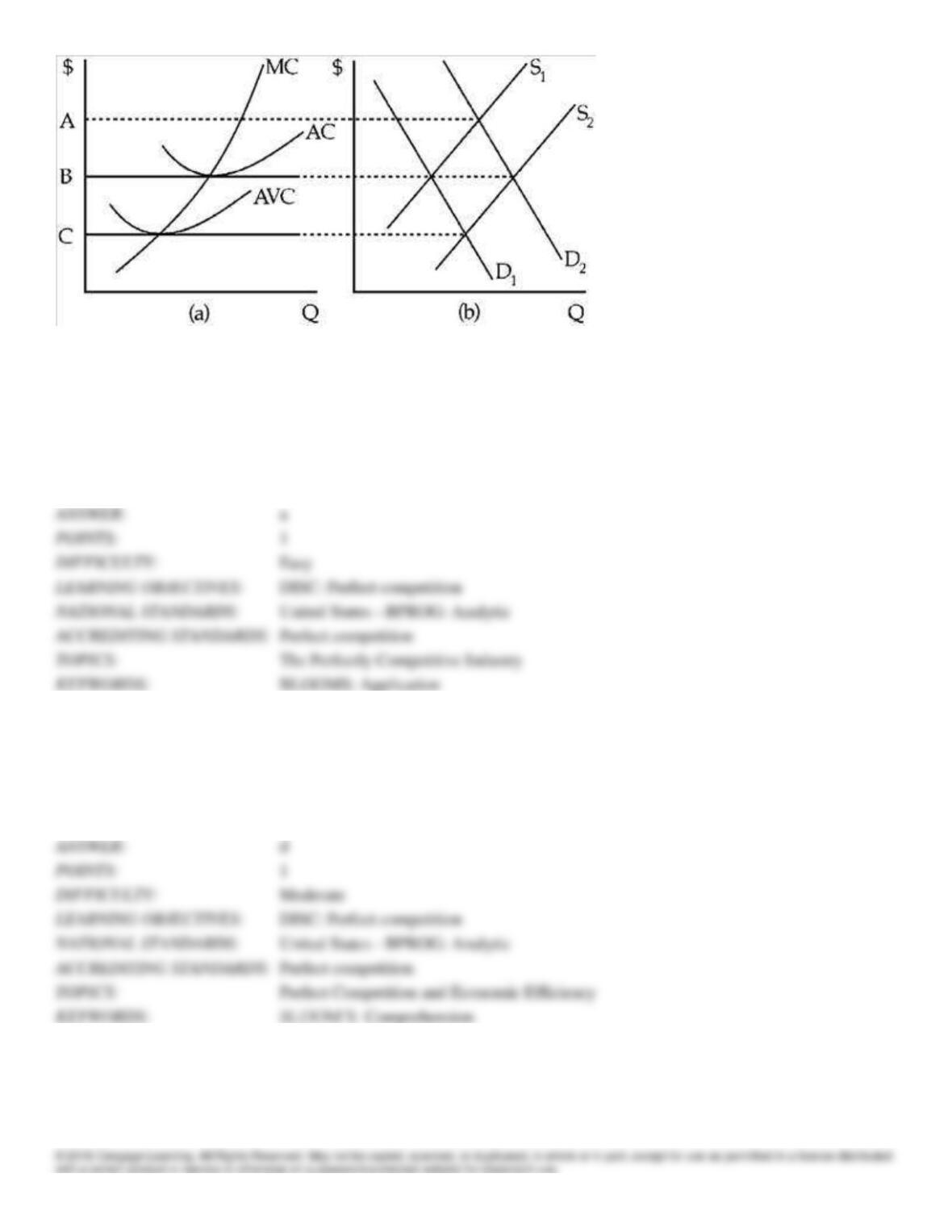
165. Figure 10-9 shows supply and demand conditions in a perfectly competitive industry and for a firm in that industry.
Assume the industry initially has supply curve S1 and demand curve D1. If demand shifts to D2, then in the short run price
will
a.
rise to A.
b.
rise to some level between A and B.
c.
remain at B.
d.
fall to C.
a
Easy
DISC: Perfect competition
United States – BPROG: Analytic
Perfect competition
The Perfectly Competitive Industry
BLOOMS: Application
166. In long-run equilibrium, the perfectly competitive firm produces
a.
where P = MC = AC.
b.
at the lowest point on its long-run average cost curve.
c.
where its long-run average cost curve is tangent to its horizontal demand curve.
d.
All of the above are correct.
Moderate
DISC: Perfect competition
United States – BPROG: Analytic
Perfect competition
Perfect Competition and Economic Efficiency
167. The most efficient market structure in the long run is
a.
perfect competition.
b.
monopolistic competition.
c.
oligopoly.
d.
monopoly.
a
Easy
DISC: Perfect competition
United States – BPROG: Reflective Thinking – BPROG: Analysis
Perfect competition
Perfect Competition and Economic Efficiency
168. If government forced a firm to charge a price equal to marginal cost in a situation where there are scale economies,
a.
new firms would enter the industry.
b.
the firm would be forced to go bankrupt.
c.
positive economic profit would grow even larger.
d.
marginal cost would exceed average cost.
Difficult
DISC: Perfect competition
United States – BPROG: Reflective Thinking – BPROG: Analysis
Perfect competition
Perfect Competition and Economic Efficiency
169. A tax on polluting firms
a.
would shift the LRAC curve upward.
b.
would shift the LRAC curve downward.
c.
would have the same impact on the firm as a subsidy.
d.
tends to have the perverse effect of increasing pollution.
a
Moderate
DISC: Perfect competition
United States – BPROG: Analytic
Perfect competition
Perfect Competition and Economic Efficiency
170. If the objective of economic policy is to decrease the amount of pollution by an industry in the long run, the
a.
most effective policy action would be a subsidy to firms for the reduction of emissions.
b.
most effective policy action would be a tax on polluting firms.
c.
appropriate course of action for government is to do nothing.
d.
appropriate course of action for government is to increase R&D outlays to develop technology to remove the
emissions from the environment.
DISC: Perfect competition
United States – BPROG: Analytic
Perfect competition
Perfect Competition and Economic Efficiency
171. A subsidy to firms intended to reduce pollution in an industry would
a.
shift the LRAC curve upward.
b.
have the same impact on the firm as a tax.
c.
likely drive some existing firms from the industry.
d.
likely have the paradoxical effect of increasing pollution in the industry in the long run.
DISC: Perfect competition
United States – BPROG: Analytic
Perfect competition
Perfect Competition and Economic Efficiency
172. Under perfect competition, a firm’s:
a.
demand curve and average revnenue curve are identical, but the marginal revenue curve is different.
b.
demand curve is different, but the average revenue curve and the marginal revenue curve are identical.
c.
demand curve, average revenue curve and marginal revenue curve are identical.
d.
none of these is true.
DISC: Perfect competition
United States – BPROG: Analytic
Perfect competition
The Perfectly Competitive Firm
173. Under perfect competition, regarding short-run profit, a firm may find itself losing money. This is true because:
a.
the firm was unable to pick the output that maximized profit
b.
the market conditions make the highest possible profit a negative number
c.
the demand for its product is weak or its costs are high
d.
both b and c
DISC: Perfect competition
United States – BPROG: Analytic