CHAPTER 10: OUTPUT, INFLATION, AND UNEMPLOYMENT:
ALTERNATIVE VIEWS
Additional Questions
Essay Questions and/or Problems:
1. According to the theory of the natural rate of unemployment, can the policymaker “peg” the
unemployment rate at some arbitrarily determined target rate? Why or why not? What is the
eventual result of attempting such an action?
2. What is meant by the natural rate of unemployment? Is the natural rate of unemployment a
constant value? According to the monetarist view, does expansionary monetary policy
lower the natural rate of unemployment temporarily or permanently?
3. Assume that there is a positive supply shock, such as an increase in the productivity of
labor. What impact will this have on the short-run and long-run Phillips curve? What will
be the observed relationship between inflation and unemployment? Provide a graph of the
Phillips curve and AD/AS to illustrate.
4. Use the natural rate Phillips curve to analyze a change in regime at a central bank that is
committed to maintaining a lower level of inflation than previous regimes. What will be the
short-run impact of such a change in policy? The long-run impact?
5. Does the Keynesian view of the short-run Phillips curve differ from the monetarist view?
6. If Keynesians acknowledge that there does exist a vertical aggregate supply curve in the
long-run, then, does that invalidate their belief in the use of monetary and fiscal policy to
stabilize output? Explain.
7. What is meant by “hysteresis?” Is hysteresis consistent with Friedman’s natural rate
hypothesis?
8. The divergent behavior of unemployment in the United States and Europe, especially in the
1990s, been attributed to different structural characteristics of labor markets in the two
regions. Describe the labor market in the United States, making sure to discuss differences
in the natural rate of unemployment across the two regions.
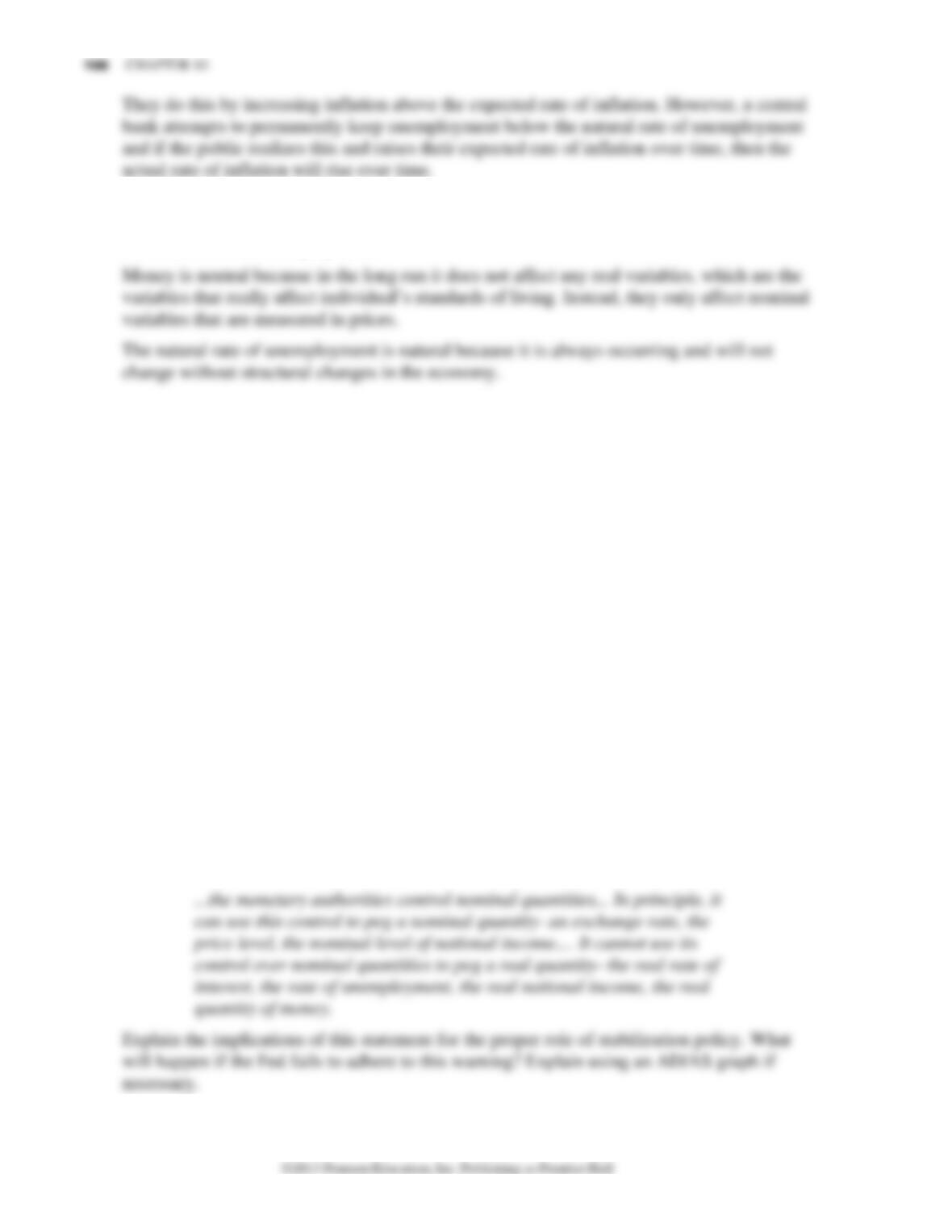
9. Milton Friedman argued that the Phillips curve is most accurately described by the
following equation:
e
10. Milton Friedman often referred to money as “neutral”. What do you think that he meant by
this? He also termed the phrase “the natural rate of unemployment”. What is natural about
the natural rate of unemployment?
Additional Essay Questions and/or Problems:
11. Suppose that a central bank thinks that the natural rate of output is above where the “true”
natural rate of output actually is (i.e. Utarget < UNR). What will be the long run impact of
such a policy? Use a Phillips curve graph to illustrate. How does your answer depend upon
what you assume to be true about how the public forms their expectations?
12. Milton Friedman believes that there will be only a temporary trade-off between inflation
and unemployment. Explain why.
13. Suppose that there is a decline in autonomous investment. Would a monetarist favor an
expansionary monetary policy to offset the short-run effects of this shock? Explain why or
why not.
14. Why is the assumption that the expected inflation rate is constant crucial to the concept of
the Phillips curve? Why is it crucial to its use in stabilization policy? Under what
circumstances do you think that constant expected inflation is a good assumption?
15. Suppose that there is a permanent increase in the level of government spending financed by
a larger budget deficit. What would Keynesians predict would happen to inflation and
unemployment as a result? What would Monetarists predict would happen to inflation and
unemployment as a result? Provide graphs of the Phillips curve to illustrate.
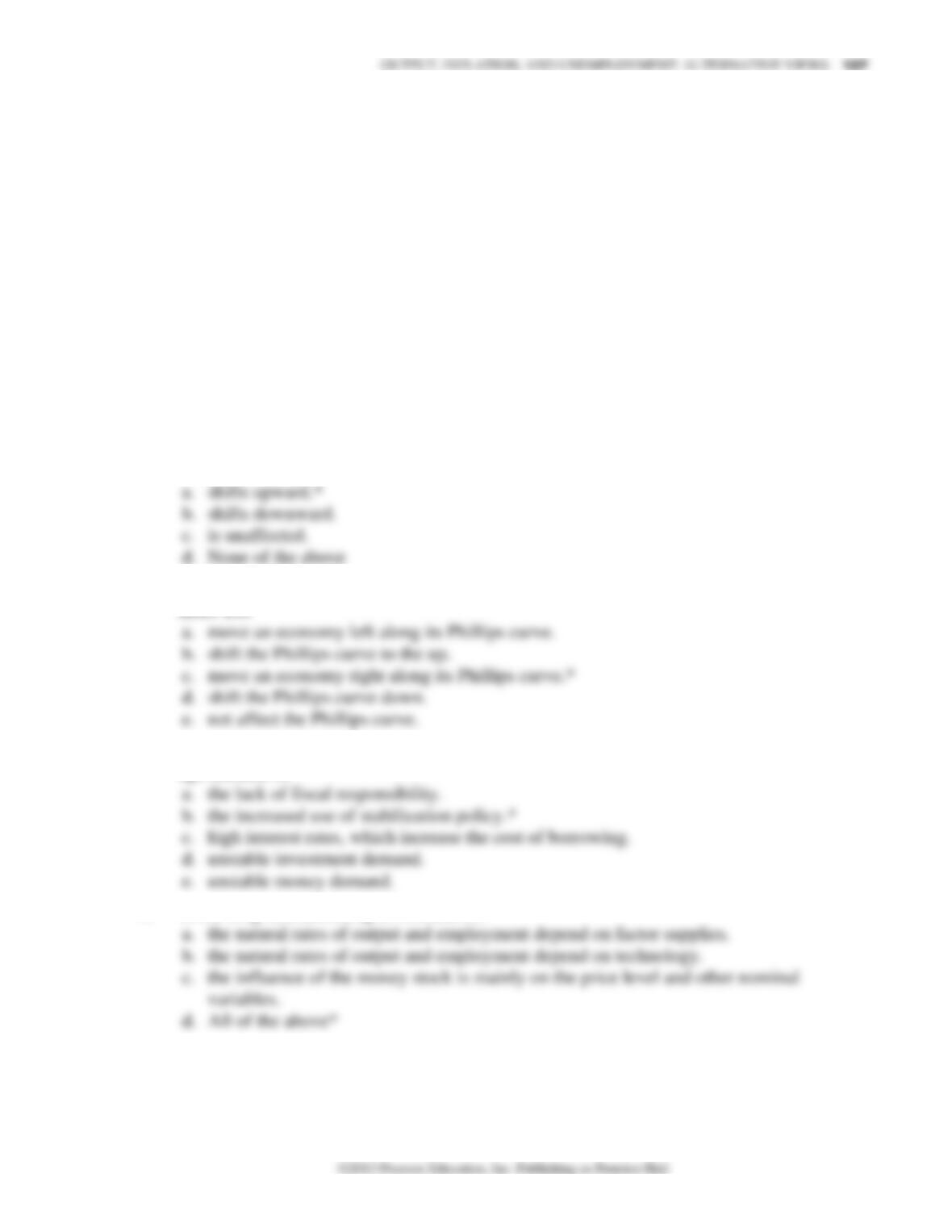
16. Consider the following quote from Milton Friedman in his article The Role of Monetary
Policy (pg. 11):
17. Suppose that an economy begins at the natural rate of unemployment and that the expected
inflation rate is equal to the actual price level in the preceding period. If the central bank
makes a permanent reduction in the money supply, draw a graph illustrating the path of
inflation and unemployment over time. Illustrate your intuiton using IS/LM, AD/AS, and
Phillips curve graphs.
18. Suppose that an economy has the following Phillips curve:
)04.(25.−−= uPP e
a. What is the natural rate of unemployment in this economy?
b. What is the tradeoff between inflation and unemployment in this economy?
c. Graph this Phillips curve if the expected rate of inflation is 3percent, or .03.
d. If current inflation is 4 percent and expected inflation is 3 percent, what is current
unemployment?
Multiple-Choice Questions:
1. According to the monetarists, when the expected rate of inflation rises, the short-run
Phillips curve
2. In the Keynesian model, and increase in government spending financed with an increase in
3. According to the Monetarists, average inflation is higher today than it was a hundred years
ago because of
4. In the long run, according to Monetarists
5. In the monetarist view, the long-run Phillips curve is
6. In the monetarist view, if there is an increase in money growth then
7. According to the monetarists,
8. In the Keynesian view,
9. For each Phillips curve, there
10. In the monetarist view, if the money supply has been rising too quickly for years, the
resulting inflation can be brought under control by slowing money growth. This will
11. According to Friedman, changes in the level of aggregate demand
12. With respect to Friedman’s natural rate theory, expansionary monetary policies can
13. Stagflation can be explained by a
14. The rate of unemployment can be calculated by
15. Monetarists assume that suppliers of labor
16. The short-run Phillips curve shifts when there is a change in
17. In the short run, an increase in the money stock growth rate
18. The long-run Phillips curve is consistent with
19. The most significant cost to a central bank of reducing unemployment is the costs
20. According to monetarists, the natural rate theory
21. If the short run aggregate supply curve is flat, the Phillips curve will be
22. The Keynesian model
23. According to the Keynesian view, the focus of stabilization policies
24. According to published data pertaining to unemployment rates in selected European
countries, the natural rate of unemployment
25. In the monetarist view, a bond-financed increase in government spending would have a
strong effect on real output in
26. In the monetarist model,
27. In response to an increase in the population and the labor force, we would expect
28. Which of the following statements is (are) correct?
29. Assume that the Phillips curve in an economy is = 3 – .5(u – 5), where is the inflation
rate and u is the unemployment rate. If unemployment is currently is currently 6 percent,
then inflation should be
30. If the government places a new tax on the firing of workers, then we would expect
31. If the government places a new tax on the hiring of workers, then we would expect
32. The short-run Phillips curve implied when all changes in aggregate demand are caused by
changes in the money supply is
33. Which of the following statements is (are) correct? There is agreement between the
Keynesians and monetarists that
34. The following Phillips curve of
)04.(25.03.−−= uP
would be consistent with the _____
model(s).
35. Friedman’s theory of the natural rate of unemployment and output
36. According to Monetarists, the natural rate of unemployment in each country will be
determined by the structural characteristics of the
37. In response to an increase in technology, we would expect
38. The natural rate of employment
39. Labor market regulations in European Union countries
40. The divergent behavior of unemployment in the United States and Europe, especially in the
1990s,
41. According to the Keynesian model, a decline in the expected price level
42. Which of the following is correct? The natural rate of unemployment
43. One would expect a shift down in the Phillips curve if there was a(n)
44. The idea that hysteresis plays a role in macroeconomics implies that
45. The tradeoff for monetary policy represented by the Phillips curve is
46. The natural rate of unemployment
47. The natural rate of unemployment
48. Policies aimed at reducing the natural rate of unemployment are referred to as
49. Which of the following statements is correct?
50. The rate of adjustment between the long run and short run Phillips curve will be determined
by
51. The short-run Phillips curve shifts upward whenever:
52. The natural rate of unemployment
53. According to the theory of hysteresis, a prolonged recession will:
54. Keynesian and classical theories agree that:

116 CHAPTER 10
55. The following Phillips curve of
)04.(25.−−= uPP e
would be consistent with the _____
model(s).