66) Holding nominal money balances constant, a decrease in the price level
A) causes the real value of the money balances to increase, in turn increasing total planned real
expenditures.
B) causes the real value of the money balances to decrease, in turn decreasing total planned real
expenditures.
C) causes the real value of the money balances to increase, thereby increasing the interest rate.
D) generates a reduction in the value of the money balances, leading to higher interest rates and a
decrease in total planned real expenditures.
67) An indirect effect of an increase in the price level works through
A) people substituting out of domestic goods and into foreign goods as exchange rates rise.
B) changes in trade balances as domestic goods become more expensive, causing interest rates to
move in the opposite direction from the change in the exchange rate.
C) interest rates as people save more as the higher prices make their money balances less
attractive.
D) interest rates as people borrow to maintain their money balances, bidding up interest rates and
reducing total planned real expenditures.
68) The interest rate effect is part of the reason
A) the short-run aggregate supply curve is upward sloping.
B) the long-run aggregate supply curve is vertical.
C) the aggregate demand curve is upward sloping.
D) the aggregate demand curve is downward sloping.
69) Which of the following statements is TRUE about the interest rate effect?
A) The interest rate effect is why the aggregate demand curve is upward sloping.
B) A lower price level lowers the interest rate, which causes businesses and consumers to
increase their desired spending.
C) A higher price level lowers the interest rate, which causes business and consumers to increase
their desired spending.
D) Expenditures will change as a result of a change in the real value of money balances when
there is a change in the price level.
70) Higher interest rates
A) reduce total planned real expenditures because they increase the cost of borrowing funds.
B) reduce total planned real expenditures because they reduce the income of bankers and other
creditors.
C) increase total planned real expenditures because they increase the incomes of all people in the
economy.
D) increase total planned real expenditures because they lower the costs of building new plants
and equipment.
71) If the price level increases, then
A) the exchange rate will increase, causing U.S. goods to become cheaper and increasing total
planned real expenditures.
B) imports increase but exports do not change. Therefore, there is no effect on total planned real
expenditures.
C) foreign residents buy fewer U.S. goods, leaving more goods for U.S. residents and an increase
in total planned real production by firms.
D) domestic goods are more expensive relative to foreign goods, which reduces total planed real
expenditures.
72) The open economy effect refers to the fact that
A) the position and shape of the long run aggregate supply curve is partially due to the fact that
we import goods.
B) the aggregate supply curve shifts when the economy grows.
C) the slope of the aggregate demand curve is partially explained by the reduction in the desire to
buy fewer U.S. goods by U.S. residents and foreign residents as a result of a higher price level.
D) the immigration policies of the United States are disruptive to labor markets.
73) A shift away from expenditures on domestic goods and a shift toward expenditures on
foreign goods when the domestic price level increases is known as
A) the real-balance effect.
B) the interest rate effect.
C) the open economy effect.
D) demand side inflation.
74) Suppose a country has no trade with other countries and people can borrow as many funds as
they want at the current interest rate. An increase in the price level will generate
A) a decrease in total planned real expenditures because of the real-balance effect.
B) a decrease in total planned real expenditures because of the open-economy effect and the
indirect effect.
C) a decrease in total planned real expenditures because the real-balance effect will be stronger
than the indirect effect and the open-economy effect.
D) a decrease in total planned real expenditures because the indirect effect will be stronger than
the real-balance effect.
75) A fall in the price level
A) increases the real value of money balances, which causes borrowing to decrease, leading to a
decrease in investment and total planned real expenditures.
B) causes exports to rise and imports to fall, leading to an increase in total planned real
expenditures.
C) leads to an increase in total planned real expenditures because of the indirect effect.
D) causes total planned real expenditures to increase as long as the fall is less than the fall in the
price level in other countries.
76) The aggregate demand curve
A) is like individual demand curves in that prices of other goods are held constant.
B) is like individual demand curves in that income is constant.
C) differs from individual demand curves in that the aggregate demand curve is not downward
sloping.
D) differs from individual demand curves in that the aggregate demand curve looks at the entire
circular flow of income and product while the individual demand curve looks at only one good.
77) Which of the following is NOT true about the aggregate demand curve?
A) The production possibilities curve determines the slope of the aggregate demand curve.
B) The aggregate demand curve shows total planned real expenditures at different price levels.
C) Changes in the economic conditions in other countries will lead to a shift of the aggregate
demand curve.
D) The aggregate demand curve considers the entire circular flow of income.
78) Which of the following is TRUE about how the aggregate demand curve differs from the
individual’s demand curve?
A) The individual’s demand curve shows the relationship between price and quantity demanded
while the aggregate demand curve is not influenced by price.
B) For the individual’s demand curve equilibrium is determined by the intersection of supply and
demand while for the aggregate demand curve equilibrium is determined by the real balance
effect.
C) The individual’s demand curve is just for an individual while the aggregate demand curve
looks at the entire circular flow of income.
D) The individual’s demand curve will shift when there is a change in taxes while the aggregate
demand curve will not.
79) What determines the total value of aggregate demand for U.S. real GDP?
A) the spending decisions of consumers, firms, and governments
B) the Congressional Budget Office
C) the Federal Reserve Board
D) Wall Street
80) Total planned expenditures for domestically produced goods and services consist of
A) government spending, business spending, and import spending only.
B) consumer spending, business spending, and net export spending only
C) consumer spending, business spending, government spending, and net export spending.
D) consumer spending, business spending, government spending, and import spending.
81) Which one of the following is NOT a component of aggregate demand?
A) merchandise inventories
B) consumption spending
C) investment expenditures
D) government purchases
82) The total of all planned real expenditures in the economy is called
A) aggregate demand.
B) aggregate spending.
C) aggregate GDP.
D) aggregate consumption.
83) The aggregate demand curve shows the relationship between planned purchases of
A) all final goods and services and interest rates.
B) all final goods and services and the price level.
C) all final goods and services and nominal GDP.
D) all final goods and services and total planned production.
84) The aggregate demand curve shows
A) a direct relationship between changes in the price level and changes in real GDP.
B) real GDP does not change as the price level changes.
C) an inverse relationship between the price level and real GDP.
D) an inverse relationship between changes in the price level and changes in nominal GDP.
85) Which of the following is NOT an explanation for the shape of the aggregate demand curve?
A) real balance effect
B) interest rate effect
C) open economy effect
D) investment effect
86) The downward slope of the aggregate demand curve shows that
A) an increase in aggregate demand reduces the long-run aggregate supply.
B) an increase in aggregate demand increases the long-run aggregate supply.
C) a higher price level will cause planned purchase rates for final goods and services to be
higher.
D) a lower price level will cause planned purchase rates for final goods and services to be higher.
87) What is one implication of the real-balance effect?
A) The part of your wealth that you hold in the form of cash loses some of its value as the price
level rises.
B) When the price level rises, people have an incentive to work harder in order to earn a higher
income.
C) When the price level falls, most consumers reallocate their spending so as to have an equal
balance between necessities and luxuries.
D) Aggregate demand and aggregate supply can never reach long-run equilibrium.
88) The open economy effect and interest rate effect are two of the reasons why
A) higher price levels increase long-run aggregate supply.
B) the aggregate demand curve slopes downward.
C) capital formation does not contribute to economic growth in poor countries.
D) growth of the labor force does not contribute to economic growth in wealthy countries.
89) The aggregate demand curve shows the
A) total amount of planned expenditures on goods and services at each possible price level.
B) total amount of nominal goods that the participants in the economy want to purchase.
C) total amount of real goods that foreigners want to purchase.
D) amount of goods producers will produce as production costs fall.
90) The aggregate demand curve is
A) downward sloping.
B) vertical.
C) horizontal.
D) U shaped.
91) The aggregate demand curve is
A) horizontal if full employment exists in the economy.
B) vertical if full employment exists in the economy.
C) downward sloping because of the real-balance, interest rate, and open economy effects.
D) downward sloping because more goods are produced as per unit cost of producing each item
falls.
92) The real-balance effect indicates that at higher price levels
A) the real value of money holdings fall, resulting in decreased spending.
B) the real value of money holdings increase, resulting in increased saving.
C) the purchasing power of money will increase.
D) the value of the dollar will increase.
93) Which of the following will occur when an economy’s price level increases?
A) Aggregate demand will increase.
B) The purchasing power of money will increase.
C) The purchasing power of money will decrease.
D) The real value of wealth will increase.
94) The interest rate effect shows that if the price level increases
A) consumers and businesses will increase their spending to buy the same amount of goods as
before to make up for the higher interest rates.
B) consumers and businesses will decrease their spending as the interest rate increases, thereby
pushing up the cost of acquiring funds.
C) U.S. exports and imports will both decrease.
D) the real value of financial assets will increase.
95) A decrease in U.S. prices relative to European prices
A) will decrease European exports to the United States.
B) will increase U.S. imports from Europe.
C) will decrease U.S. exports to Europe.
D) will not affect U.S. trade with Europe.
96) An increase in U.S. prices relative to Japanese prices will
A) increase total planned spending on U.S. goods and services.
B) increase U.S. imports and decrease U.S. exports.
C) decrease U.S. imports and increase U.S. exports.
D) decrease both U.S. exports and imports.
97) When the price level declines
A) the interest rate rises, and consumers borrow fewer funds, which causes a movement up the
aggregate demand curve.
B) the interest rate falls, and consumers borrow more funds, which causes a movement down
along the aggregate demand curve.
C) the interest rate is not affected, so there is no movement along the aggregate demand curve.
D) interest rates fall, and consumers borrow more funds, which causes the aggregate demand
curve to shift to the left.
98) When the price level falls
A) imports increase, and exports decrease, which causes a movement up along the aggregate
demand curve.
B) there is no impact on imports or exports, so there is no associated movement along the
aggregate demand curve.
C) imports decrease and exports increase, which cause a movement down along the aggregate
demand curve.
D) imports decrease and exports increase, which cause a movement up along the aggregate
demand curve.
99) The curve that displays total planned real spending on goods and services at each price level
by households, businesses, the government, and foreign residents is called
A) the aggregate supply curve.
B) the aggregate demand curve.
C) the price level curve.
D) the employment curve.
100) Which of the following cause the aggregate demand curve to slope downward and to the
right?
A) the prices of key goods
B) the interest rate effect
C) military expenditures of the government
D) the demand-shock effect
101) When a higher price level generates an increase in the interest rate that induces consumers
to borrow less and buy less, this chain of events is referred to as
A) the real-balance effect.
B) the interest rate effect.
C) the open economy effect.
D) the price level effect.
102) Total planned real expenditures measured along the aggregate demand curve are made up of
A) consumption spending, investment spending, government spending, and net export spending.
B) consumption spending, income, government spending, and net export spending.
C) consumption spending, saving, investment spending, and government spending.
D) consumption spending, factor payments, investment spending, and net export spending.
103) What is measured on the vertical axis of the aggregate demand graph?
A) nominal income
B) real GDP per year
C) the price level
D) unemployment
104) What is measured on the horizontal axis on the aggregate demand graph?
A) nominal income
B) real GDP per year
C) the price level
D) unemployment
105) When expenditures change due to changes in the real value of money caused by variations
in the price level, this is known as the
A) interest rate effect.
B) real-balance effect.
C) open economy effect.
D) aggregate balances effect.
106) When total planned real expenditures change due to changes in the cost of borrowing that
result from variations in the price level, this is known as the
A) interest rate effect.
B) real-balance effect.
C) open economy effect.
D) aggregate balances effect.
107) When total planned real expenditures change due to the changes in net exports, this is
known as the
A) interest rate effect.
B) real-balance effect.
C) open economy effect.
D) aggregate balances effect.
108) If your income stays the same and the price level increases, you will buy fewer goods and
services due to the
A) interest rate effect.
B) real-balance effect.
C) open economy effect.
D) aggregate balances effect.
109) If the dollar appreciates and foreign goods become less expensive, the total planned
expenditures on domestic goods and services will
A) fall due to the open economy effect.
B) fall due to the interest rate effect.
C) increase due to the open economy effect.
D) increase due to the interest rate effect.
110) Which of the following would cause aggregate demand to decrease?
A) The government increases taxes on both business and personal income.
B) A drop in the foreign exchange value of the dollar
C) The Fed increases the amount of money in circulation.
D) Businesses and households believe that the economy is headed for good times, so they begin
to feel increased security about their jobs.
111) An aggregate demand curve
A) shifts to the right when the price level increases and to the left when the price level falls.
B) shifts to the right when any non-price-level factor increases total planned real spending.
C) shifts to the right when population decreases and shifts to the left when population increases.
D) does not shift, unlike individual or market demand curves.
112) Which of the following statements is correct?
I. When economists derive the aggregate demand curve, they are looking at the effect of the
price level on one commodity only.
II. Any non-price-level change that increases total planned real spending on domestic goods
shifts the AD curve to the right.
A) I only
B) II only
C) Both I and II
D) Neither I nor II
113) Decreases in interest rates have made it less costly to finance purchases of new houses.
What impact will this have on U.S. aggregate demand?
A) None. A nation’s aggregate demand is not affected by changes in interest rates.
B) U.S. aggregate demand will remain unchanged.
C) U.S. aggregate demand will decrease.
D) The U.S. aggregate demand curve will shift to the right.
114) An aggregate demand curve
A) shifts to the right when a non-price level change increases total planned real expenditures.
B) shifts to the right when a non-price level change decreases total planned real expenditures.
C) shifts to the right when the price level falls.
D) does not shift to the right or to the left.
115) An increase in total planned real expenditures that is caused by a factor other than the price
level will lead to the
A) aggregate supply curve shifting to the right.
B) aggregate demand curve shifting to the right.
C) aggregate supply curve shifting to the left.
D) aggregate demand curve shifting to the left.
116) An increase in the money supply will cause which of the following to occur?
A) a rightward shift of the aggregate supply curve
B) a leftward shift of the aggregate demand curve
C) a leftward shift of the aggregate supply curve
D) a rightward shift of the aggregate demand curve
117) The aggregate demand curve would shift to the right as a result of
A) a drop in the price level.
B) tax increases.
C) a decrease in the U.S. real interest rate.
D) a decrease in the amount of money in circulation.
118) Which of the following will cause a leftward shift in the aggregate demand curve?
A) a reduction in the money supply
B) an increase in taxes
C) a reduction in government spending
D) all of the above
119) Which one of the following would NOT increase aggregate demand?
A) an increase in long-run aggregate supply
B) a reduction in real interest rates
C) tax decreases
D) an increase in the amount of money in circulation
120) All of the following would cause the aggregate demand curve to shift EXCEPT
A) a rise in real interest rates.
B) an increase in taxes.
C) improvements in economic conditions in other countries.
D) a decrease in the price level.
121) Which of the following will NOT shift the aggregate demand curve?
A) a change in the domestic marginal tax rates
B) a change in government expenditures
C) a change in the domestic price level
D) depreciation in the value of the national currency
122) The aggregate demand curve will shift to the left if
A) people are more optimistic about their future.
B) a reduction in the price level pushes down borrowing costs.
C) government expenditures increase.
D) the nation’s exports decrease.
123) A weakening in consumer confidence causes a
A) shift of the aggregate demand curve to the right.
B) shift of the aggregate demand curve to the left.
C) movement up along the aggregate demand curve.
D) movement down along the aggregate demand curve.
124) Which of the following will NOT shift the aggregate demand curve?
A) a change in the price level
B) a change in tax rates
C) a change in the amount of money in circulation
D) a change in real interest rates
125) An increase in the amount of money in circulation would cause a
A) shift of the aggregate demand curve to the right.
B) shift of the aggregate demand curve to the left.
C) movement up the aggregate demand curve.
D) movement down the aggregate demand curve.
126) An increase in the U.S. price level causes a
A) shift of the U.S. aggregate demand curve to the right.
B) shift of the U.S. aggregate demand curve to the left.
C) movement up the U.S. aggregate demand curve.
D) movement down the U.S. aggregate demand curve.
127) Which of the following would likely result in a shift of the aggregate demand curve to the
right?
A) a tax cut
B) a decrease in job security
C) a rise in the real interest rate
D) a decrease in the quantity of money in circulation
128) An increase in aggregate demand is shown by
A) a rightward shift in the aggregate demand curve.
B) a leftward shift in the aggregate demand curve.
C) a movement up along the aggregate demand curve.
D) the movement down along the aggregate demand curve.
129) Which of the following would likely result in a decrease in aggregate demand?
A) tax increases
B) a reduction in the real interest rate
C) increased job and future income security
D) a rise in the quantity of money in circulation
130) Other things being equal, appreciation of the dollar
A) increases aggregate demand in the United States, and may increase aggregate supply by
reducing the prices of imported resources.
B) increases aggregate demand in the United States, and may decrease aggregate supply by
reducing the prices of imported resources.
C) decreases aggregate demand in the United States, and may increase aggregate supply by
reducing the prices of imported resources.
D) decreases aggregate demand in the United States, and may decrease aggregate supply by
increasing the prices of imported resources.
131) Other things being equal, a depreciation of the dollar
A) increases aggregate demand in the United States, and may increase aggregate supply by
reducing the prices of imported resources.
B) increases aggregate demand in the United States, and may decrease aggregate supply by
increasing the prices of imported resources.
C) decreases aggregate demand in the United States, and may increase aggregate supply by
reducing the prices of imported resources.
D) decreases aggregate demand in the United States, and may decrease aggregate supply by
increasing the prices of imported resources.
132) When investors buy more capital goods because the interest rates have fallen, the aggregate
demand curve
A) shifts right.
B) shifts left.
C) does not shift.
D) stays the same.
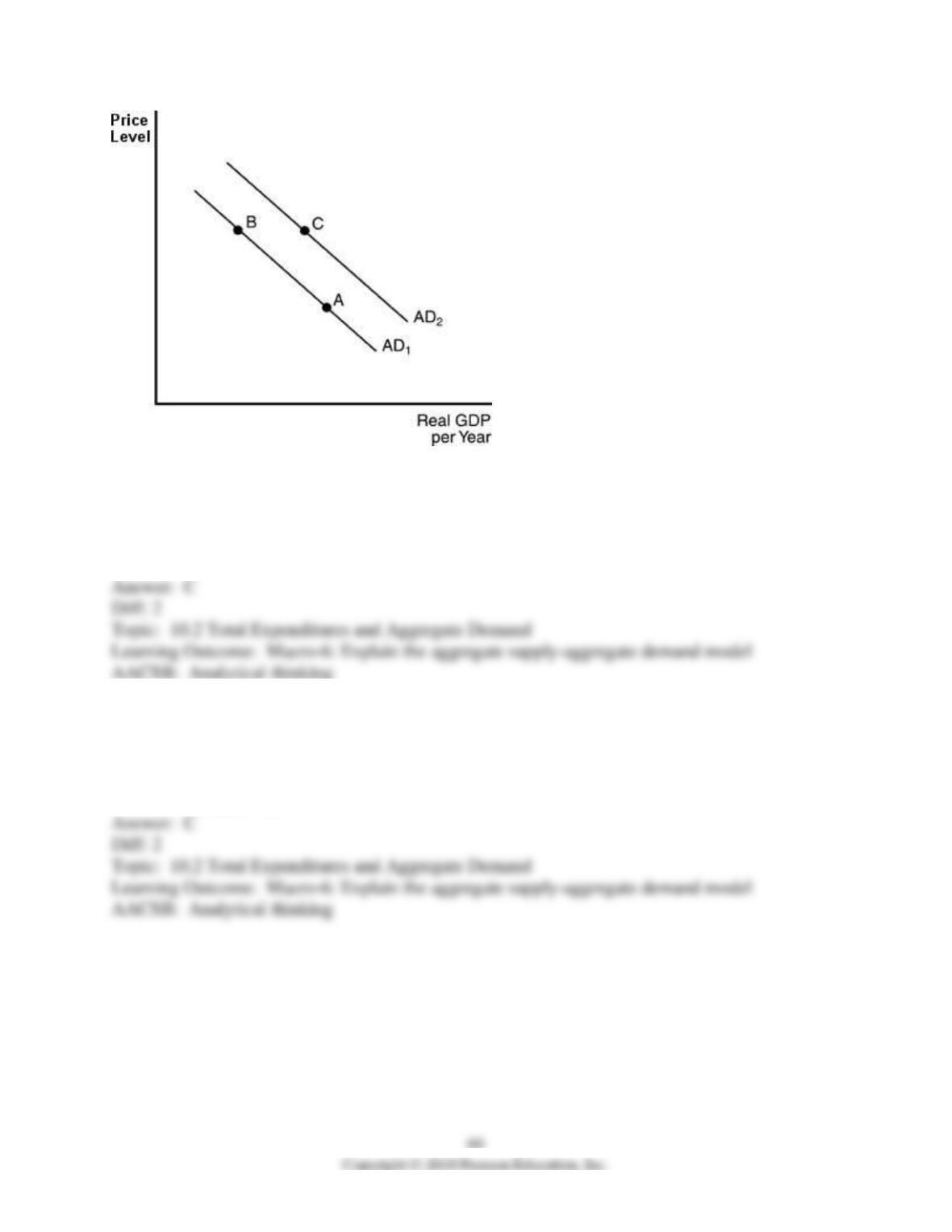
133) In the above figure, a movement from point B to point C could be explained by
A) an increase in the price level.
B) a decrease in the quantity of money in circulation.
C) increased government spending.
D) the real-balance effect.
134) In the above figure, a movement from point C to point B could be explained by
A) an increase in the price level.
B) an increase in the quantity of money in circulation.
C) increased government taxation.
D) the real-balance effect.