Macroeconomics: Policy and Practice, 2e (Mishkin)
Chapter 10 Monetary Policy and Aggregate Demand
10.1 The Federal Reserve and Monetary Policy
1) When the Federal Reserve ________.
A) drains liquidity, the federal funds rate falls
B) drains liquidity, real interest rates fall
C) provides more liquidity, the federal funds rate falls
D) all of the above
E) none of the above
2) The Federal Reserve ________.
A) sets the federal funds rate once a year
B) controls the interest rate in the short run
C) controls the interest rate in the long run
D) all of the above
E) none of the above
3) The federal funds rate is ________.
A) a real interest rate
B) set periodically by Congress
C) a nominal interest rate
D) all of the above
E) none of the above
4) A central bank can control the real interest rate precisely, so long as ________ remains
constant.
A) the nominal interest rate
B) monetary policy
C) expected inflation
D) all of the above
E) none of the above
2
5) In the very short run ________.
A) the real interest rate will be affected by changes in the nominal rate
B) monetary policy has an immediate effect on inflation
C) the inflation rate is determined by the federal funds rate
D) all of the above
E) none of the above
6) Changes in liquidity in the banking system affect ________.
A) the nominal interest rate
B) the real interest rate
C) the federal funds rate
D) all of the above
E) none of the above
10.2 The Monetary Policy Curve
1) The MP curve indicates the relationship between ________ and the ________.
A) taxes; price level
B) the real interest rate; inflation rate
C) monetary policy; IS curve
D) all of the above
E) none of the above
2) The exogenous variable in the monetary policy curve is ________.
A) the policy parameter, λ
B) the real interest rate
C) the autonomous component,
D) the federal funds rate
E) the inflation rate
3
3) The endogenous variable in the monetary policy curve is ________.
A) the policy parameter, λ
B) the real interest rate
C) the autonomous component,
D) the federal funds rate
E) the inflation rate
4) Which of the following is true about the Taylor principle?
A) it explains the link between higher inflation and higher real interest rates
B) it is the foundation for an upward sloping MP curve
C) it reflects the practice of monetary policy
D) all of the above
E) none of the above
5) If the central bank did not follow the Taylor principle, an increase in inflation would lead to a
decrease in ________.
A) the nominal interest
B) the real interest rate
C) aggregate output
D) all of the above
E) none of the above
6) If the central bank did not follow the Taylor principle, an increase in inflation would lead to
________.
A) a decrease in the nominal interest rate
B) an increase in inflation
C) a decrease in aggregate expenditure
D) all of the above
4
7) If expected inflation rises, monetary policy ________.
A) is rendered ineffective
B) must be tightened, to prevent further increases in inflation and expected inflation
C) will prevent any increase in the real interest rate
D) is designed to increase the nominal interest rate by more than the increase in expected
inflation
E) none of the above
8) Autonomous tightening of monetary policy involves ________.
A) raising interest rates and shifting the MP curve to the right
B) lowering interest rates and shifting the MP curve to the left
C) raising interest rates and shifting the MP curve to the left
D) lowering interest rates and shifting the MP curve to the right
E) none of the above
9) Autonomous easing of monetary policy involves ________.
A) raising interest rates and shifting the MP curve to the right
B) lowering interest rates and shifting the MP curve to the left
C) raising interest rates and shifting the MP curve to the left
D) lowering interest rates and shifting the MP curve to the right
E) none of the above
10) A movement along the MP curve ________.
A) implies an automatic adjustment of the interest rate
B) implies an autonomous adjustment to the interest rate
C) implies an autonomous adjustment of aggregate demand
D) all of the above
E) none of the above
11) A shift of the MP curve ________.
A) implies an automatic adjustment of the interest rate
B) implies a direct policy action of the Federal Reserve
C) does not alter the relationship between inflation and the interest rate
D) all of the above
E) none of the above
12) The MP curve may be used to represent ________.
A) movements of the real interest rate as a direct policy action of the Federal Reserve
B) movements of the real interest rate that are independent of direct Federal Reserve action
C) how the real interest rate is related to the inflation rate
D) all of the above
E) none of the above
13) The MP curve may be used to represent how ________.
A) movements of the inflation rate are determined by the real interest rate
B) monetary policy responds to changes in the real interest rate
C) movements of the real interest rate are related to the inflation rate
D) all of the above
E) none of the above
14) A decision to increase the parameter λ in the MP curve is an example of ________.
A) autonomous easing
B) leftward movement along the curve
C) rightward movement along the curve
D) endogenous response
E) autonomous tightening
6
15) Before the financial crisis of 2007, inflation was on the rise. According to the MP curve, this
would lead to ________.
A) an increase in the real interest rate
B) an upward shift of the MP curve, if policymakers opted for autonomous tightening
C) a decrease in aggregate output
D) all of the above
E) none of the above
16) As the financial crisis became more severe in 2008, the Federal Reserve undertook a(n)
________ of monetary policy, an effect of which is to ________ inflation.
A) contraction; raise
B) easing; raise
C) contraction; lower
D) easing; lower
E) none of the above
17) Throughout 2008, inflation and the real interest rate declined together. The cause is a
combination of ________.
A) monetary policy easing and declining autonomous spending
B) declining autonomous spending and movement along a fixed MP curve
C) monetary policy tightening and inversion of the MP curve
D) increased government spending and movement along a fixed MP curve
E) none of the above
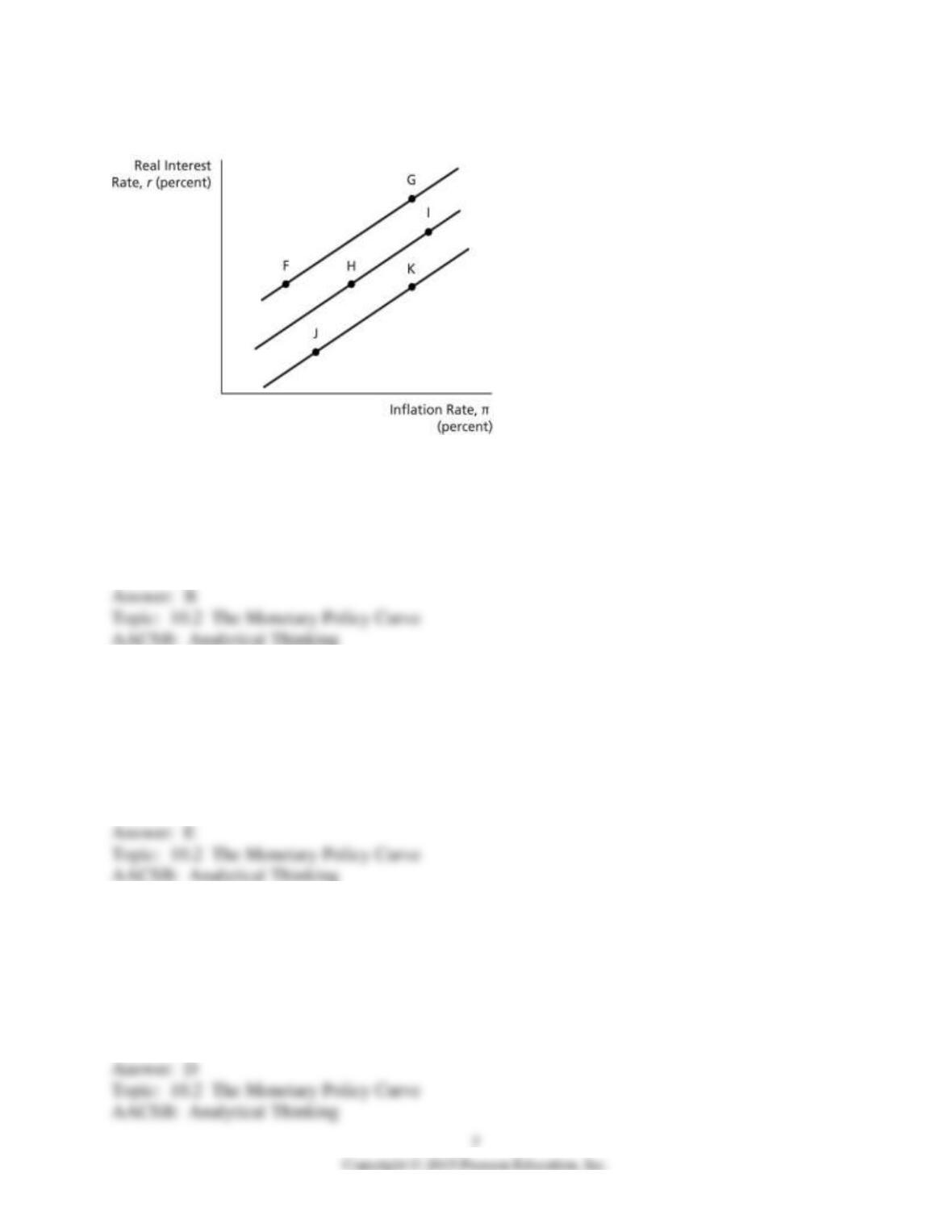
MP Curve
18) Referring to the graph above, a movement from point H to point I might represent ________.
A) the increase in the inflation rate that occurs when the real interest rate rises
B) the automatic response of monetary policy to an increase in the inflation rate
C) an autonomous tightening of monetary policy
D) any of the above
E) none of the above
19) On the graph above, which pair of points best represents the impacts in the U. S. of the
financial crisis and policy response from 2007 through 2008?
A) H to I
B) K to G
C) I to H
D) K to F
E) G to J
20) On the graph above, which pair of points best represents a scenario in which the nominal
interest rate and expected inflation decline equally?
A) I to H
B) G to K
C) I to J
D) K to F
E) J to H
21) Suppose the nominal interest rate is five percent, and the inflation rate rises from two percent
to three percent. Might an increase in the nominal interest rate to 5.5 percent be consistent with
the Taylor Principle? If not, what consequences might ensue?
22) A key concern of monetary policy makers is credibility. In particular, that people believe that
inflation will not deviate far from a rate consistent with a healthy macroeconomy. How might
credibility affect the slope of the monetary policy curve?
23) Suppose the economy is just recovering from a recession and all signs now point to robust
growth. How might this transition from recovery to expansion be reflected in the monetary
policy curve?
24) If the monetary policy curve is correct, then policy makers care only about inflation and not
at all about aggregate output and unemployment. Comment.
10.3 The Aggregate Demand Curve
1) The AD Curve ________.
A) demonstrates how central banks respond to changes in interest rates by changing the inflation
rate
B) shows how changes in equilibrium output affect the inflation rate
C) explains long run fluctuations in output and inflation
D) all of the above
E) none of the above
2) The MP Curve ________.
A) demonstrates how central banks respond to changes in inflation with changes in the interest
rate
B) shows how changes in interest rates affect equilibrium output
C) explains short run fluctuations in output and inflation
D) all of the above
E) none of the above
3) The IS Curve ________.
A) demonstrates how central banks respond to changes in inflation with changes in the interest
rate
B) shows how changes in interest rates affect equilibrium output
C) explains short run fluctuations in output and inflation
D) all of the above
E) none of the above
4) The AD Curve ________.
A) indicates the level of aggregate output corresponding to different goods-market-clearing
levels of the interest rate
B) is downward sloping, because with higher inflation comes higher interest rates and lower
spending, so equilibrium aggregate output declines
C) explains how inflation affects output in the short run
D) all of the above
E) none of the above
5) The AD Curve ________.
A) indicates the level of aggregate output corresponding to different goods-market-clearing
levels of the inflation rate
B) is downward sloping, because with higher inflation comes lower interest rates and lower
spending, so equilibrium aggregate output declines
C) explains how inflation affects output in the short run
D) all of the above
E) none of the above
6) Factors that shift the AD Curve include ________.
A) the inflation rate
B) aggregate output
C) taxes
D) all of the above
E) none of the above
7) In the aggregate demand curve, the endogenous variable is ________.
A) output
B) inflation
C) the real interest rate
D) real money balances
E) none of the above
8) An increase in the real interest rate occurs when ________.
A) monetary policy responds automatically to an increase in inflation
B) expected inflation increases, relative to the nominal interest rate
C) an increase in autonomous spending causes an increase in equilibrium output
D) all of the above
E) none of the above
11
9) A decrease in the real interest rate occurs when ________.
A) there is an autonomous tightening of monetary policy
B) expected inflation increases, relative to the nominal interest rate
C) a decrease in autonomous spending causes a decrease in equilibrium output
D) all of the above
E) none of the above
10) Factors that shift the AD Curve include ________.
A) government purchases
B) autonomous investment
C) taxes
D) all of the above
E) none of the above
11) Factors that shift the AD Curve include ________.
A) autonomous net exports
B) autonomous inflation
C) autonomous interest rates
D) all of the above
E) none of the above
12) If people begin to generally feel better about the future ________.
A) autonomous consumption should rise
B) autonomous investment should rise
C) the AD curve will shift to the right
D) all of the above
E) none of the above