74) Explain why a centrally-planned economy might not grow as rapidly as a market economy.
75) Suppose you are a famous international economic advisor. You have been asked to asses the
possibilities for growth in an African country. It is a country abundant in labor and some natural
resources. The capital-to-labor ratio is low. It has a free market economy. You have found that this
country does not have a very strong and healthy banking system, however the political system is stable
and the government does a good job protecting property rights. Assess this country’s prospects for
growth. Recommend two things that would enhance the country’s growth.
76) Outline the various actions the government sector could take to promote growth.
22
77) Use the rule of 70 to illustrate how small differences in growth rates can have a large impact on how
rapidly the standard of living in a country increases.
78) The growth rate of real GDP in the United States rises from 4.2% to 4.4%. Explain and calculate how
this increase in the growth rate of real GDP affects the number of years it will take for real GDP to
10.2 Saving, Investment, and the Financial System
1) Increasing the amount of consumption spending and reducing the amount of savings ________
investment expenditures, and ________ long-run economic growth in the economy.
A) increases; increases
B) increases; decreases
C) decreases; increases
D) decreases; decreases
2) A firm can fund an expansion of its operations by
A) issuing bonds.
B) buying stock.
C) paying dividends.
D) loaning money.
3) Liquidity refers to
A) the ease with a stock can be traded for a bond.
B) the ease with which a financial security can be traded for cash.
C) the number of times a dollar changes hands in the creation of GDP in an economy.
D) the number of shares of stock a corporation issues.
4) Which of the following is most liquid?
A) a mutual fund share
B) a government bond
C) a corporate bond
D) a dollar bill
5) Financial securities that represent promises to repay a fixed amount of funds are known as
A) bonds.
B) stocks.
C) pension funds.
D) insurance premiums.
6) One difference between stocks and bonds is that
A) stocks are financial securities, while bonds are labor market securities.
B) stocks are usually issued in electronic form, while bonds are usually issued in paper form.
C) stocks represent ownership in companies, while bonds represent ownership in banks.
D) stocks do not involve a promise to repay a purchaser of the stock, while bonds represent a promise
to repay the purchase price of the bond.
7) In a closed economy, which of the following components of GDP is not included?
A) investment
B) government spending
C) net exports
D) consumption
8) In a closed economy, which of the following equations reflects investment? (Y = GDP, C =
Consumption, G = Government purchases, T = Taxes, and TR = Transfers)
A) Y – C – G
B) Y – C – T
C) Y – T + TR
D) C + G –T
9) In a closed economy, private saving is equal to which of the following? (Y = GDP, C = Consumption,
G = Government purchases, T = Taxes, and TR = Transfers)
A) Y – C – T
B) Y – G – T
C) Y – G – T + TR
D) Y + TR – C – T
10) In a closed economy, public saving is equal to which of the following? (Y = GDP, C = Consumption,
G = Government purchases, T = Taxes, and TR = Transfers)
A) Y – C – T
B) Y – G – T
C) T – G – TR
D) Y – C – T + TR
Scenario 10-1
Consider the following data for a closed economy:
Y = $12 trillion
C = $8 trillion
I= $2 trillion
G = $2 trillion
TR = $2 trillion
T = $3 trillion
11) Refer to Scenario 10-1. Based on the information above, what is the level of private saving in the
economy?
A) $3 trillion
B) $4 trillion
C) $5 trillion
D) $8 trillion
12) Refer to Scenario 10-1. Based on the information above, what is the level of public saving?
A) $0
B) $1 trillion
C) $2 trillion
D) negative $1 trillion (a deficit of $1 trillion)
13) In a closed economy, public saving plus private saving is equal to
A) investment.
B) taxes minus transfers.
C) the budget surplus.
D) the budget deficit.
14) Under which of the following circumstances would the government be running a deficit?
A) G = $5 trillion
T = $5 trillion
TR = $1 trillion
B) G = $5 trillion
T = $7 trillion
TR = $1 trillion
C) G = $7 trillion
T = $7 trillion
TR = $0
D) G = $7 trillion
T = $10 trillion
TR = $3 trillion
15) Under which of the following circumstances would private saving be positive in a closed economy?
A) Y = $10 trillion
C = $5 trillion
TR = $2 trillion
G = $2 trillion
public saving = $1 trillion
B) Y = $9 trillion
C = $5 trillion
TR = $1 trillion
G = $1 trillion
public saving = $3 trillion
C) Y = $8 trillion
C = $2 trillion
TR = $4 trillion
G = $2 trillion
public saving = $4 trillion
D) Y = $6 trillion
C = $2 trillion
TR = $8 trillion
G = $3 trillion
public saving = $1 trillion
16) What is investment in a closed economy if you have the following economic data?
Y = $10 trillion
C = $5 trillion
TR = $2 trillion
G = $2 trillion
A) $2 trillion
B) $3 trillion
C) $5 trillion
D) cannot be determined without information on taxes (T)
17) There is a government budget surplus if
A) T – TR > G.
B) G > T.
C) G > TR.
D) TR < T.
18) If government saving is negative, then
A) T > TR.
B) G > T.
C) T – TR < G.
D) Y + TR < C – T.
19) When the government runs a budget deficit, we would expect to see that
A) private saving will fall.
B) investment will fall.
C) G + TR < T.
D) public saving is positive.
20) There is a federal budget deficit when
A) the government spends less that it collects in taxes.
B) the government spends more that it collects in taxes.
C) the government spends the same amount it collects in taxes.
D) taxes are too high.
21) If government purchases are $400 million, taxes are $700 million, and transfers are $200 million,
which of the following is true?
A) Public saving is $500 million.
B) The budget deficit is $100 million.
C) The budget deficit is $500 million.
D) Public saving is $100 million.
22) Which of the following will increase investment spending in the economy, holding everything else
constant?
A) an increase in the federal government surplus
B) an increase in the budget deficit
C) an increase in consumer dissavings
D) an increase in transfer payments
23) Borrowers are ________ of loanable funds, and lenders are ________ of loanable funds.
A) demanders; suppliers
B) suppliers; demanders
C) suppliers; suppliers
D) demanders; demanders
24) The demand for loanable funds is downward sloping because the ________ the interest rate, the
________ the number of profitable investment projects a firm can undertake, and the ________ the
quantity demanded of loanable funds.
A) lower; greater; greater
B) lower; smaller; greater
C) greater; greater; greater
D) greater; smaller; greater
25) If Ebenezer Scrooge spends rather than saves his vast wealth, he will
A) slow economic growth because he is reducing the amount of funds available for investment.
B) slow economic growth because he is increasing the amount of funds available for investment.
C) promote economic growth because he is increasing the amount of funds available for investment.
D) promote economic growth because he is decreasing the amount of funds available for investment.
26) A government budget surplus from reduced government spending (no change in net taxes) will
________ the level of investment in the economy and ________ the level of saving (private plus public)
in the economy.
A) increase; decrease
B) increase; increase
C) decrease; increase
D) decrease; decrease
27) If consumers decide to be more frugal and save more out of their income, then this will cause
A) a shift in the supply curve for loanable funds to the right.
B) a shift in the supply curve for loanable funds to the left.
C) a movement to the right along the supply curve for loanable funds.
D) a movement to the left along the supply curve for loanable funds.
28) The Congressional Budget Office reported that federal budget deficits in the United States were
likely to increase in future years, and these higher deficits might “pose a threat to the economy by
crowding out business investment and threatening a spike in interest rates.” This higher budget deficit
would be represented graphically by
A) a shift in the supply curve for loanable funds to the right.
B) a shift in the supply curve for loanable funds to the left.
C) a movement to the right along the supply curve for loanable funds.
D) a movement to the left along the supply curve for loanable funds.
29) An increase in the demand for loanable funds will occur if there is
A) an increase in the real interest rate.
B) a decrease in the real interest rate.
C) an increase in expected profits from firm investment projects.
D) an increase in the nominal interest rate accompanied by an equal increase in inflation.
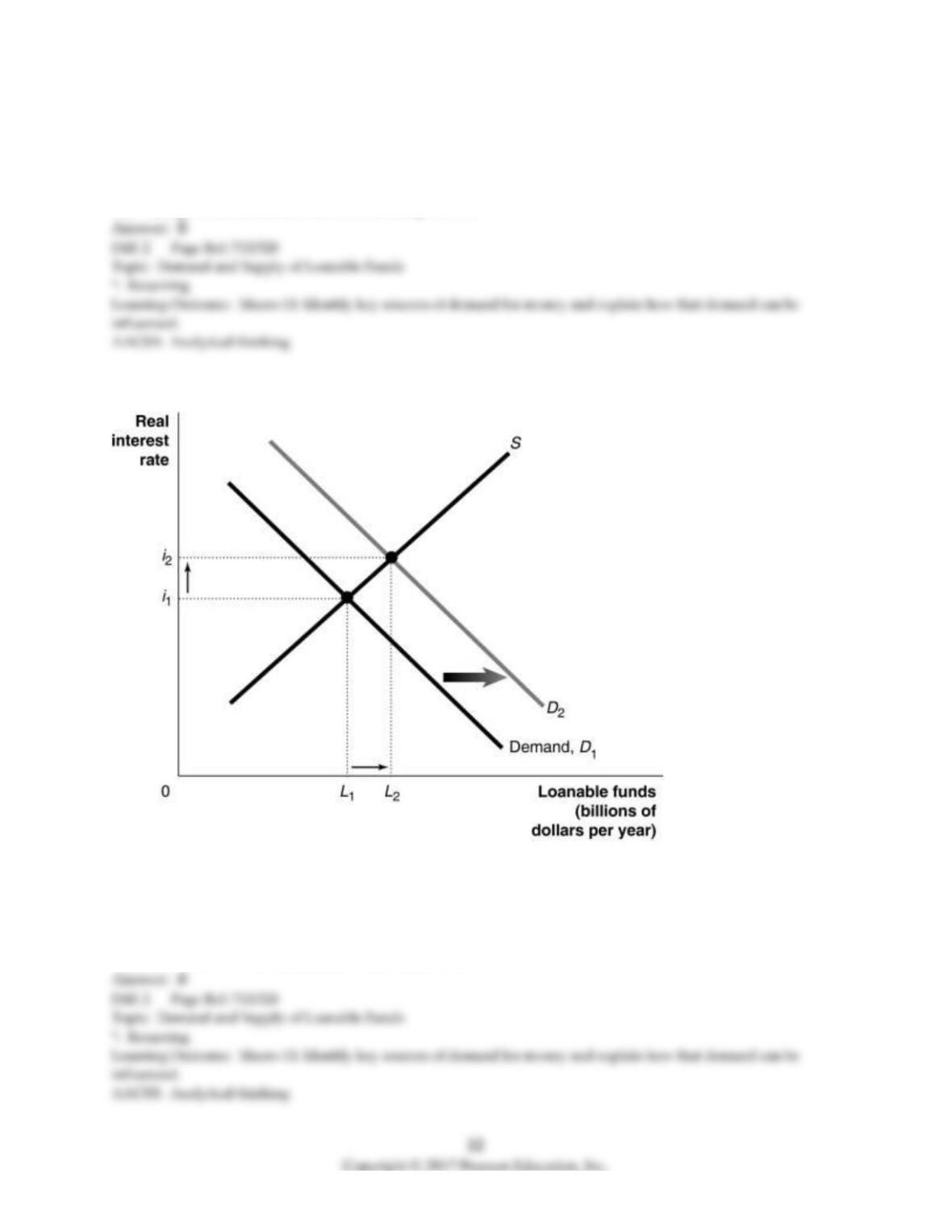
30) Which of the following would you expect to increase the equilibrium interest rate?
A) an increase in the percentage of income after net taxes that households save
B) an increase in the budget deficit
C) a decrease in the profitability of investment projects firms are considering
D) a change from an income tax to a consumption tax
Figure 10-1
31) Refer to Figure 10-1. Which of the following is consistent with the graph depicted above?
A) An expected recession decreases the profitability of new investment.
B) Technological change increases the profitability of new investment.
C) The government runs a budget surplus.
D) Households become spendthrifts and begin to save less.
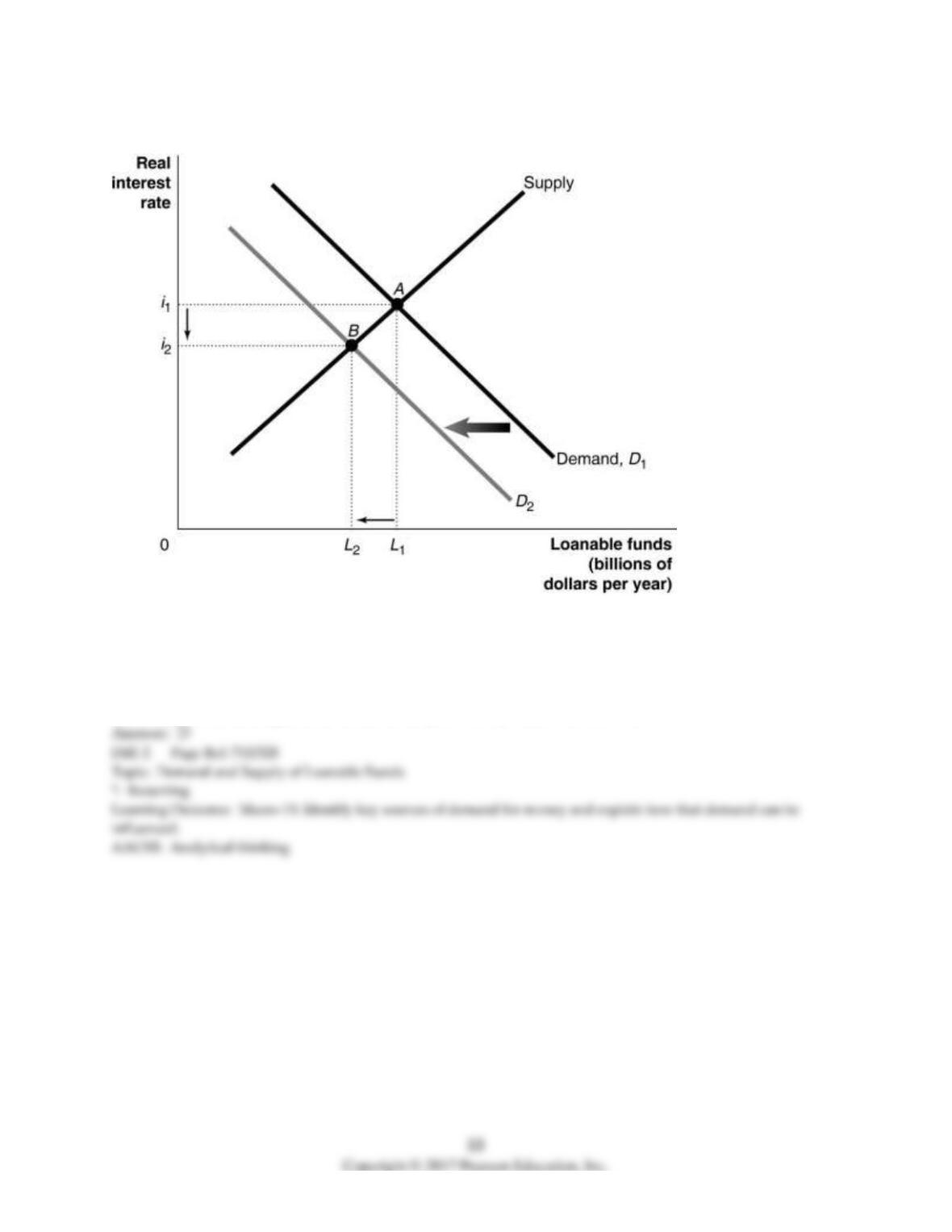
Figure 10-2
32) Refer to Figure 10-2. Which of the following is consistent with the graph depicted above?
A) An expected expansion increases the profitability of new investment.
B) The government runs a budget surplus.
C) There is a shift from an income tax to a consumption tax.
D) New government regulations decrease the profitability of new investment.
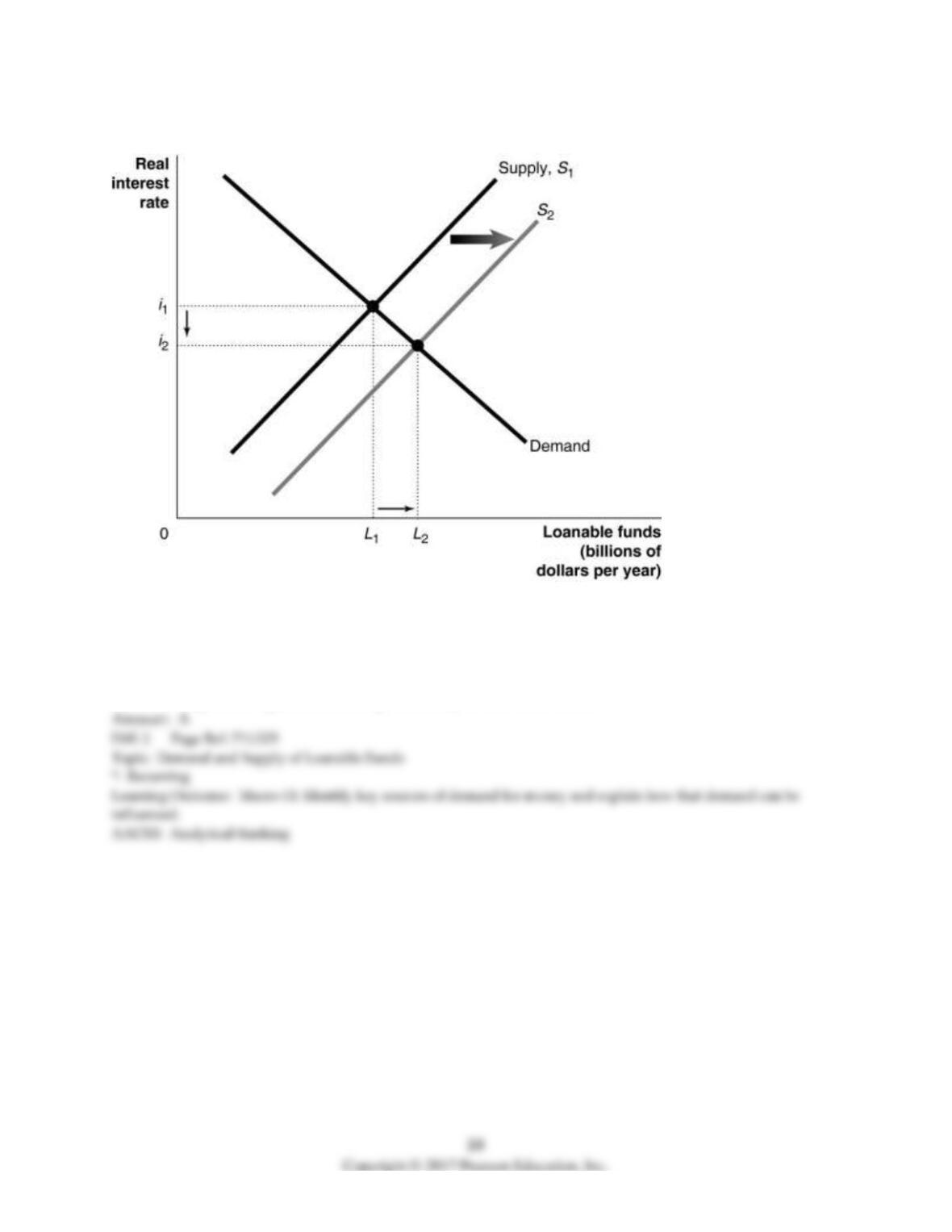
Figure 10-3
33) Refer to Figure 10-3. Which of the following is consistent with the graph depicted above?
A) Taxes are changed so that real interest income is taxed rather than nominal interest income.
B) An expected recession decreases the profitability of new investment.
C) The government runs a budget deficit.
D) Technological change increases the profitability of new investment.
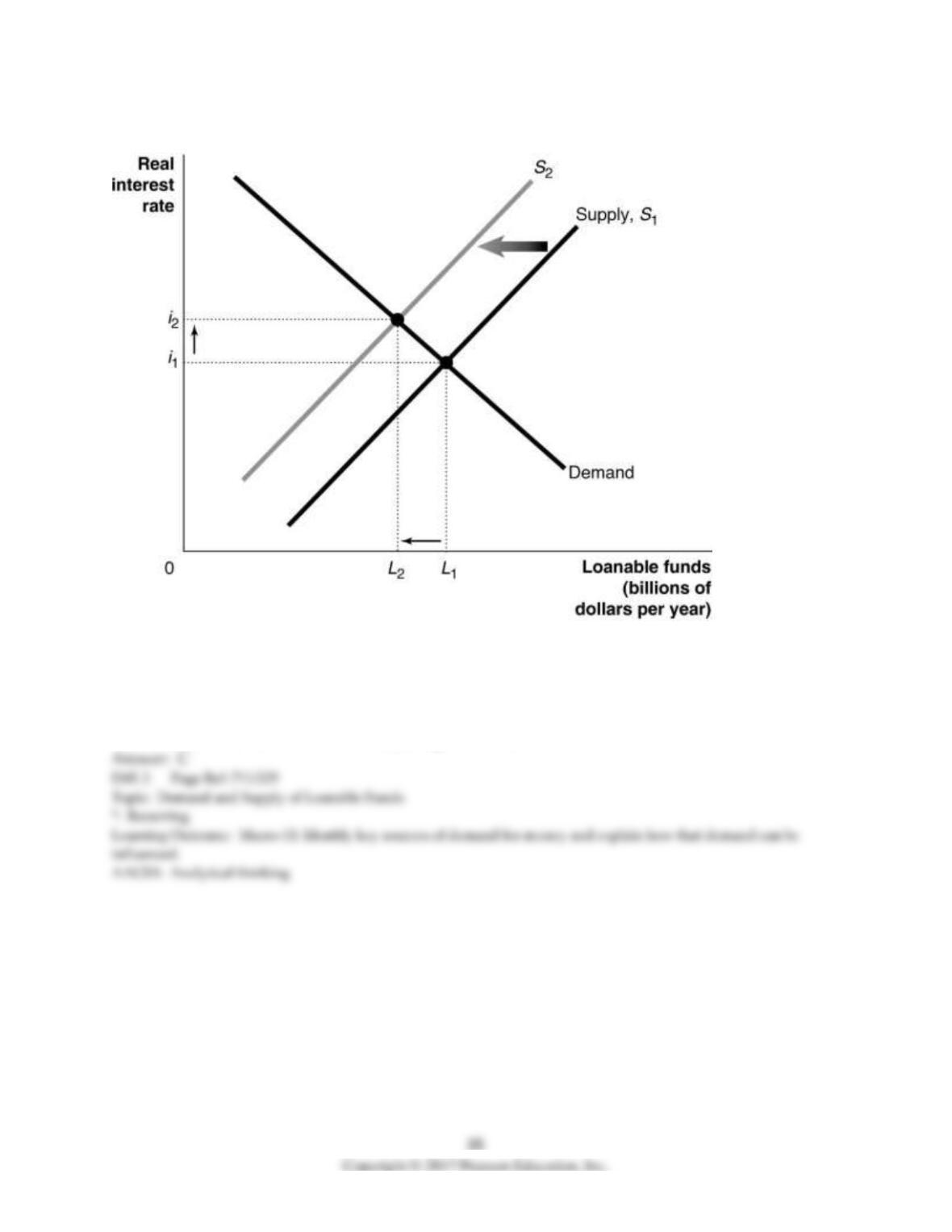
Figure 10-4
34) Refer to Figure 10-4. Which of the following is consistent with the graph depicted?
A) an increase in household income
B) an increase in transfer payments to households
C) an increase in the proportion of income after net taxes used for consumption
D) an increase in tax revenues collected by the government
35) In comparison to a government that runs a balanced budget, when the government runs a budget
deficit,
A) the equilibrium interest rate will fall.
B) business investment will fall.
C) household savings will fall.
D) none of the above
36) The response of investment spending to an increase in the government budget deficit is called
A) expansionary investment.
B) private dissaving.
C) crowding out.
D) income minus net taxes.
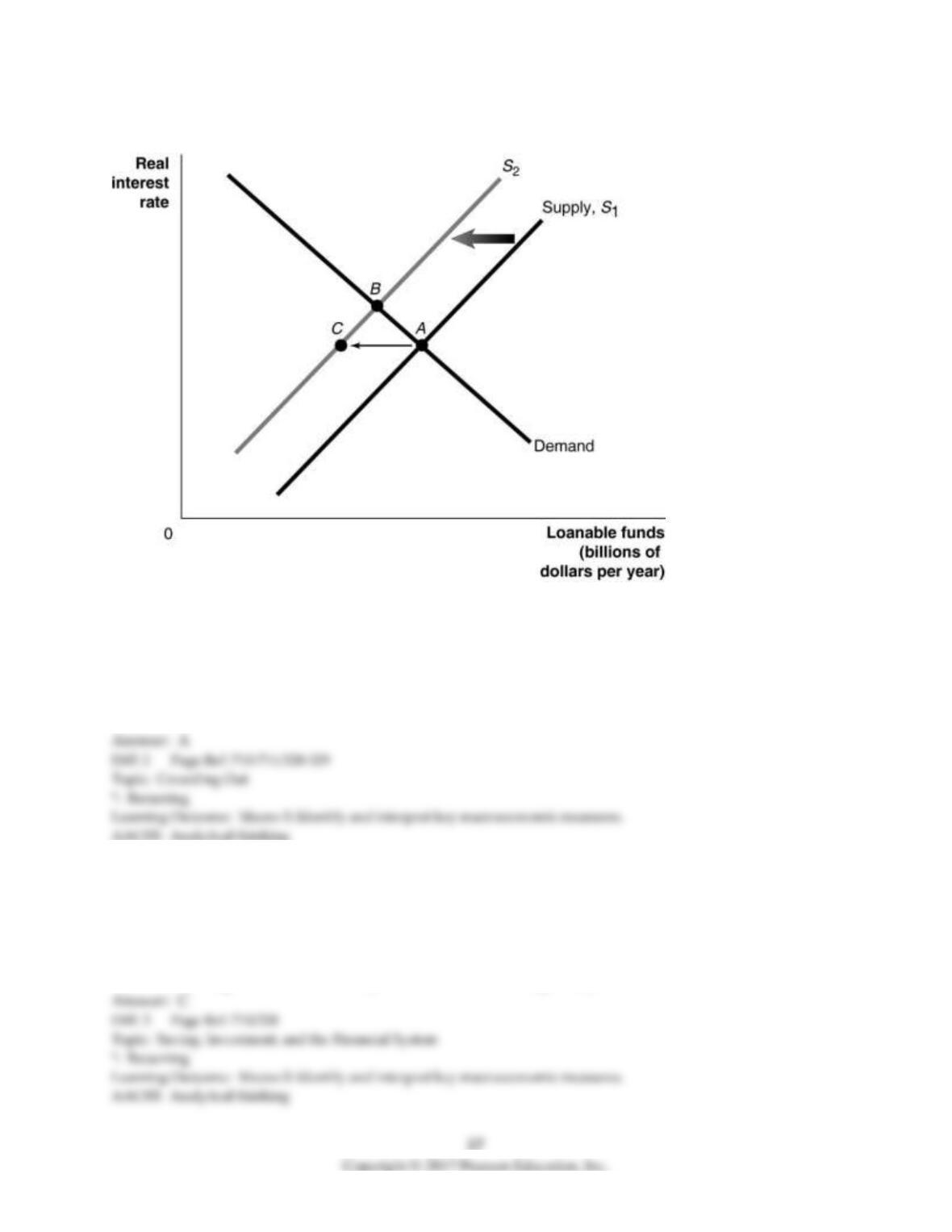
Figure 10-5
37) Refer to Figure 10-5. “Crowding out” of firm investment as a result of a budget deficit is illustrated
by the movement from ________ in the graph above.
A) A to B
B) B to A
C) B to C
D) C to A
38) How will an increase in the government budget surplus as a result of lower government spending
(with no change in net taxes) affect private saving in the economy?
A) Private saving will increase by the amount of increase in the budget surplus.
B) Private saving will decrease by the amount of increase in the budget surplus.
C) Private saving will decrease by less than the amount of increase in the budget surplus.
D) Private saving will be unaffected by the increase in the budget surplus.
39) The Congressional Budget Office reported that federal budget deficits in the United States were
likely to increase in future years, and these higher deficits might “pose a threat to the economy by
crowding out business investment and threatening a spike in interest rates.” This crowding out of
business investment would be represented graphically by
A) a shift in the demand curve for loanable funds to the right.
B) a shift in the demand curve for loanable funds to the left.
C) a movement to the right along the demand curve for loanable funds.
D) a movement to the left along the demand curve for loanable funds.
40) Which of the following would encourage economic growth through increases in the capital stock?
A) a change from an income tax to a consumption tax
B) an increase in household saving
C) a decrease in the government deficit
D) all of the above
41) If net taxes fall by $80 billion, we would expect
A) the government deficit to fall by $80 billion.
B) household saving to rise by $80 billion.
C) household saving to rise by less than $80 billion.
D) household saving to fall by more than $80 billion.
42) Which of the following will not occur as the result of a decrease in net taxes?
A) decreased household saving
B) decreased government saving
C) a shift to the left of the supply curve for loanable funds
D) all of the above
43) ________ are financial securities that represent partial ownership of a firm.
A) Stocks
B) Bonds
C) Treasury bills
D) Certificates of deposit
44) ________ are financial securities that represent promises to repay a fixed amount of funds.
A) Stocks
B) Bonds
C) Interest rates
D) Mutual funds
45) What is one difference between stocks and bonds?
A) Bonds earn a higher rate of return than stocks.
B) Stocks earn a higher rate of return than bonds.
C) Bonds are purchased at a bank, while stocks are purchased through the federal government.
D) Stocks represent partial ownership in a firm, while bonds do not.
46) Which one of the following is not considered a financial intermediary?
A) a bank
B) a pension fund
C) an insurance company
D) a credit counselor
47) ________ is the ease with which a financial security can be exchanged for money.
A) Risk
B) The face value
C) Liquidity
D) The rate of return
48) Which of the following financial securities is most liquid?
A) a savings account
B) a share of stock
C) a cashier’s check
D) a $20 bill
49) Which of the following is not one of the key services provided by the financial system?
A) decreasing taxes
B) risk sharing
C) liquidity
D) generating information