5) Short-run equilibrium occurs at the intersection of
A) the SAS and AD curves.
B) the SAS, LAS, and AD curves.
C) the SAS and LAS curves.
D) the LAS and AD curves.
6) If the economy is in short run equilibrium then
A) real GDP equals potential GDP.
B) nominal GDP equals potential GDP.
C) real GDP cannot be equal to potential GDP.
D) real GDP can be greater than, less than, or equal to potential GDP.
7) In the short-run, real GDP can be greater than or less than potential GDP because in the short
run the
A) money wage rate is fixed.
B) quantity of capital is fixed.
C) full-employment level of employment is fixed.
D) price level is fixed.
8) Short-run macroeconomic equilibrium occurs when the quantity of real GDP demanded
________.
A) equals potential GDP
B) equals full-employment GDP
C) does not equal full-employment GDP
D) equals the quantity of real GDP supplied
9) In the short run, the equilibrium level of real GDP
A) is necessarily less than potential GDP.
B) is necessarily equal to potential GDP.
C) is necessarily greater than potential GDP.
D) could be less than, equal to, or greater than potential GDP.
10) In the short run, the intersection of the aggregate demand and the short-run aggregate supply
curves,
A) determines the equilibrium price level.
B) is a point where there is neither a surplus nor a shortage of goods.
C) determines the equilibrium level of real GDP.
D) All of the above answers are correct.
11) A short-run macroeconomic equilibrium occurs
A) at the intersection of the short-run aggregate supply curve and the long-run aggregate supply
curve.
B) at the intersection of the short-run aggregate supply curve and the aggregate demand curve.
C) at the intersection of the short-run aggregate supply curve, the long-run aggregate supply
curve, and the aggregate demand curve.
D) when the rate at which prices of goods and services increase equals the rate at which money
wage rates increase.
12) Last year in the country of Union, the price level increased and real GDP increased. Such an
outcome might have occurred because short-run aggregate supply ________ and aggregate
demand ________.
A) decreased; decreased
B) increased; did not change
C) increased; decreased
D) did not change; increased
13) At long-run macroeconomic equilibrium, ________.
A) an inflationary gap exists
B) real GDP equals potential GDP
C) a recessionary gap exists
D) real GDP is less than potential GDP but is as close as it is possible to be
14) If the economy is at long run equilibrium then
A) real GDP equals potential GDP.
B) nominal GDP equals potential GDP.
C) real GDP cannot be equal to potential GDP.
D) real GDP can be greater than, less than, or equal to potential GDP.
15) Full-employment equilibrium occurs when
A) real GDP exceeds potential GDP.
B) real GDP equals potential GDP.
C) potential GDP exceeds real GDP.
D) None of the above answers are correct.
16) In long-run macroeconomic equilibrium
A) real GDP equals potential GDP.
B) the price level is fixed and aggregate demand determines real GDP.
C) real GDP and the price level are determined by short-run aggregate supply and aggregate
demand and long-run aggregate supply is irrelevant.
D) real GDP is less than potential GDP.
Real GDP supplied
Price level
Real GDP
demanded
(dollars)
Short run
(dollars)
Long run
(dollars)
90
700
300
600
100
600
400
600
110
500
500
600
120
400
600
600
17) The table above gives the aggregate demand and aggregate supply schedules in Lotus Land.
With no changes in aggregate demand or long-run aggregate supply, in long-run macroeconomic
equilibrium, the price level will be ________ and real GDP will be ________.
A) 120; $400
B) 110; $500
C) 90; $400
Price
level
Aggregate
demand
(trillions of
2009 dollars)
Short-run
aggregate
supply
(trillions of
2009 dollars)
Long-run
aggregate
supply
(trillions of
2009 dollars)
130
8
12
10
120
9
11
10
110
10
10
10
100
11
9
10
90
12
8
10
18) The data in the above table indicate that when the price level is 120
A) inventories fall and the price level rises.
B) the economy is in a long-run macroeconomic equilibrium.
C) inventories rise and the price level falls.
D) the unemployment rate is at its equilibrium level.
65
19) The data in the above table indicate that when the price level is 100
A) inventories fall and the price level rises.
B) the economy is in a long-run macroeconomic equilibrium.
C) inventories rise and the price level falls.
D) the unemployment rate is at its equilibrium level.
20) The data in the above table indicate that when the price level is 100
A) firms have unexpectedly low inventories, so prices will rise.
B) inventories are at levels planned by firms.
C) firms will plan to decrease the level of output.
D) firms have unexpectedly high inventories, so prices fall.
21) The data in the above table indicate that when the price level is 120
A) firms have unexpectedly low inventories, so prices will rise.
B) inventories are at levels planned by firms.
C) firms will plan to increase the level of output.
D) firms have unexpectedly high inventories, so prices fall.
66
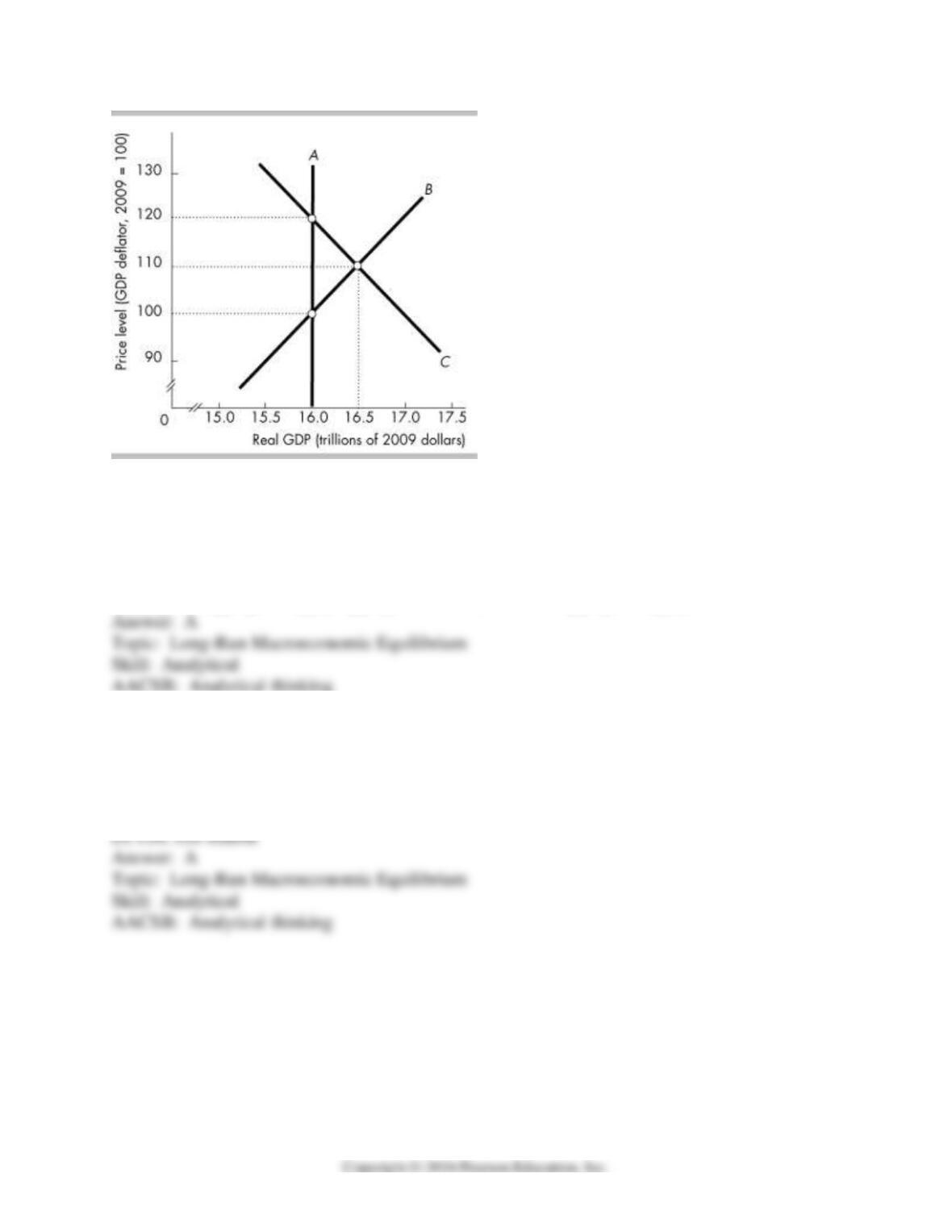
22) In the above figure, curve A is the ________ curve, curve B is the ________ curve, and curve
C is the ________ curve.
A) long-run aggregate supply; short-run aggregate supply; aggregate demand
B) aggregate demand; short-run aggregate supply; long-run aggregate supply
C) short-run aggregate supply; long-run aggregate supply; aggregate demand
D) long-run aggregate supply; aggregate demand; short-run aggregate supply
23) In the above figure, the short-run macroeconomic equilibrium is at the price level ________
and the real GDP level ________.
A) 110; $16.5 trillion
B) 120; $16 trillion
C) 100; $16 trillion
67
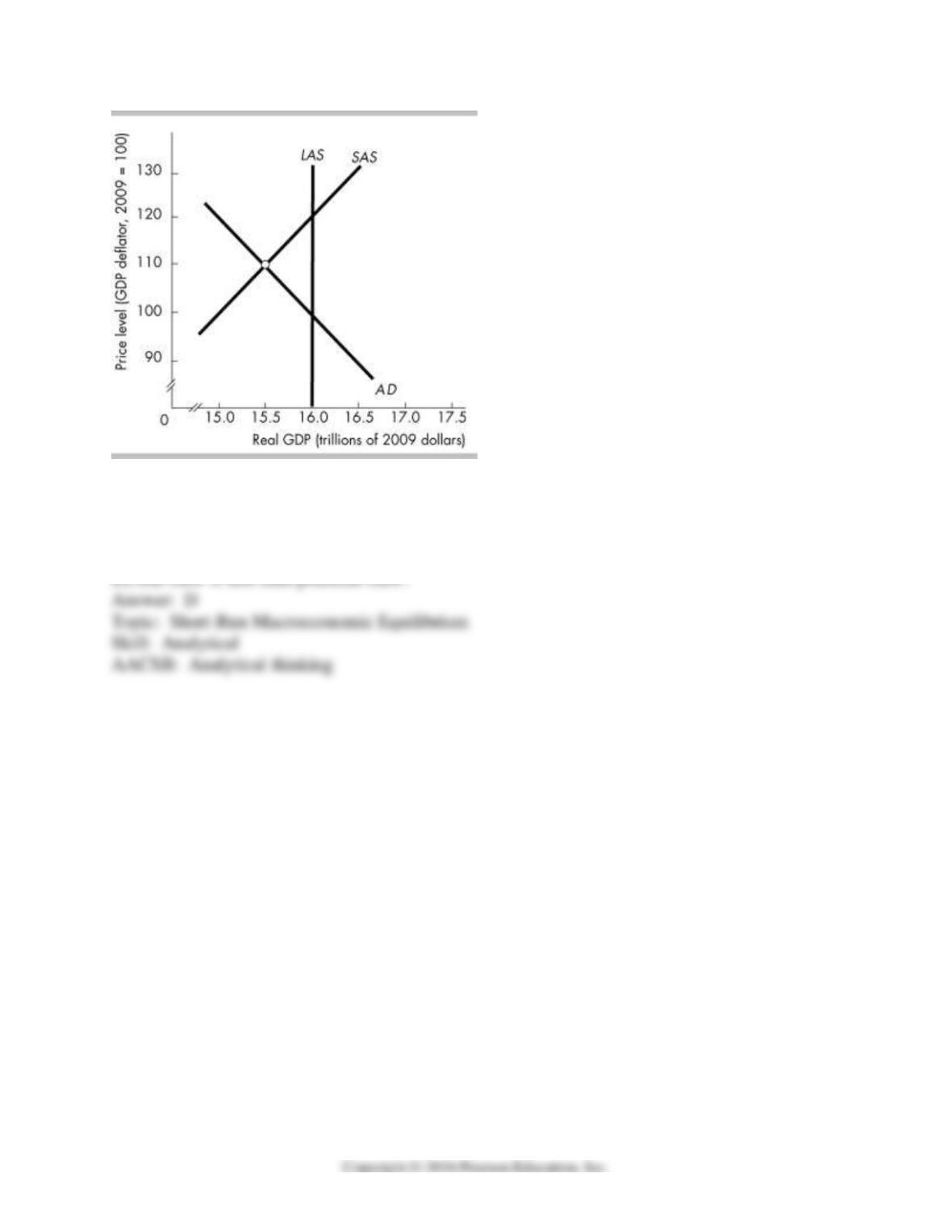
24) In the figure above, in the short-run macroeconomic equilibrium
A) there is no structural unemployment.
B) real GDP is greater than potential GDP.
C) real GDP equals potential GDP.
68
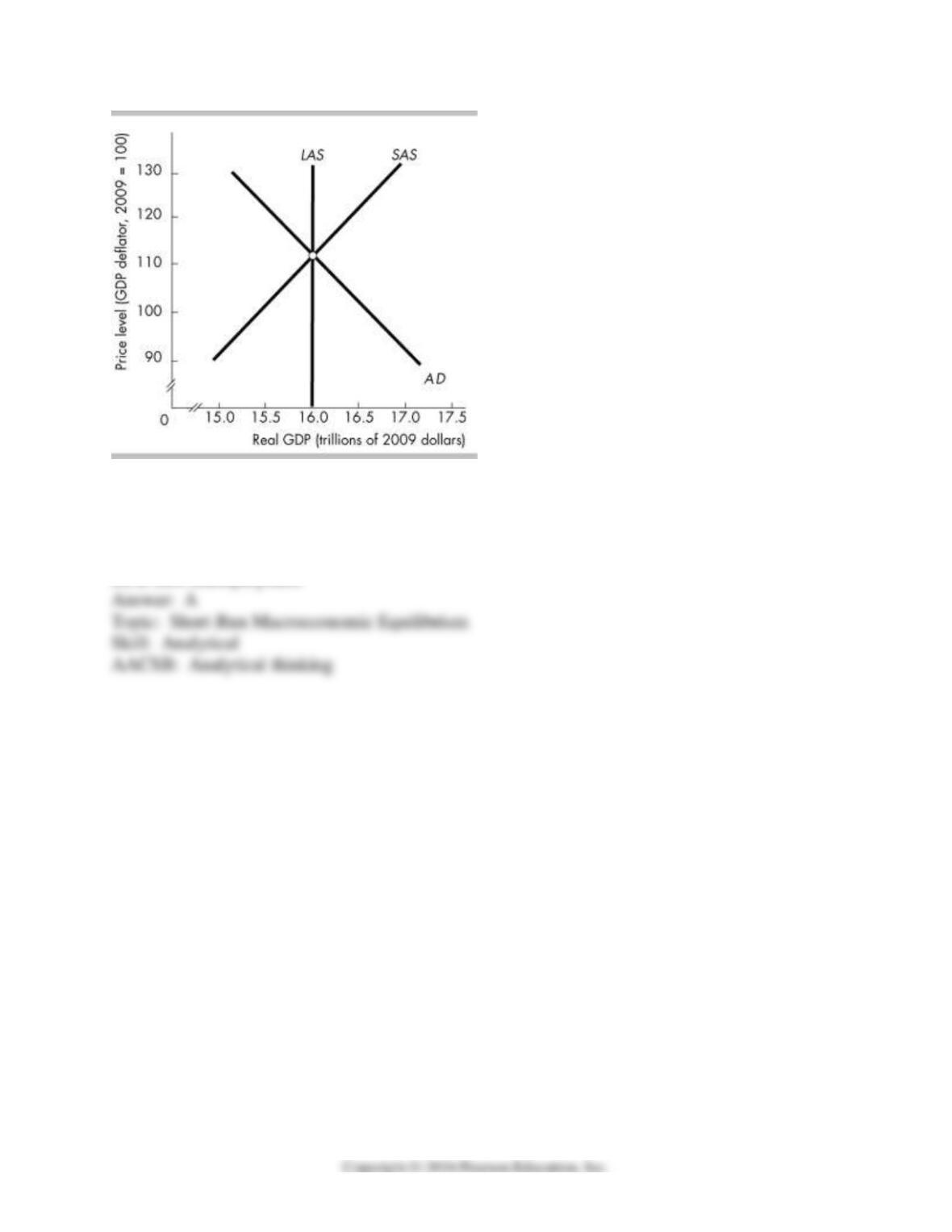
25) The above figure depicts an economy with a short-run equilibrium
A) at full employment.
B) below full employment.
C) at higher than full employment.
D) at zero unemployment
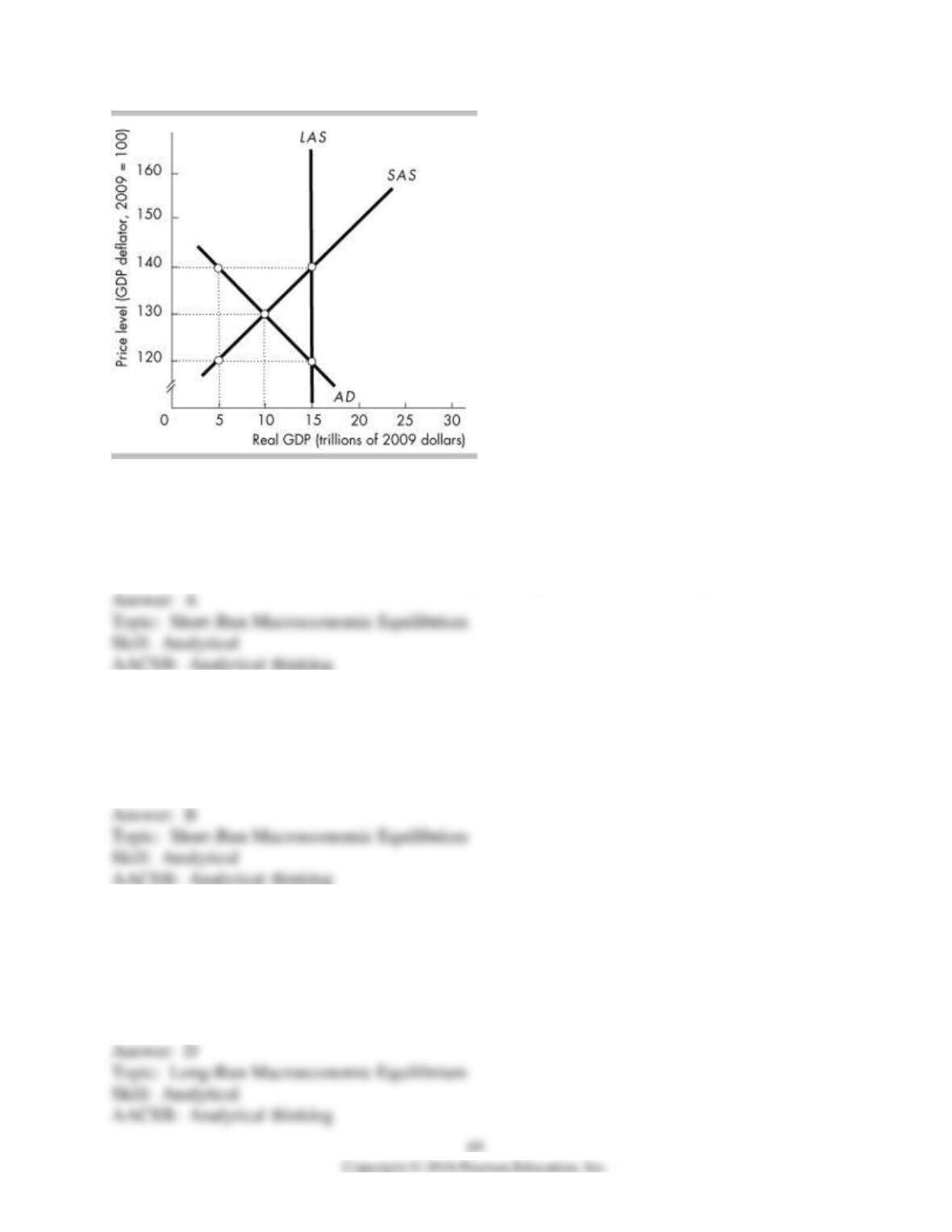
26) In the above figure, at the price level of 140 and real GDP of
A) $15 trillion, firms will not be able to sell all their output.
B) $5 trillion, firms will not be able to sell all their output.
C) $5 trillion, consumers will not be able to buy all the goods and services they demand.
D) $15 trillion, consumers will not be able to buy all the goods and services they demand.
27) Based on the figure above, short-run equilibrium occurs at the price level of
A) 120 and real GDP of $5 trillion.
B) 130 and real GDP of $10 trillion.
C) 140 and real GDP of $15 trillion.
D) 130 and real GDP of $15 trillion.
28) The data in the above figure indicate that the economy will be in a long-run macroeconomic
equilibrium at a price level of
A) 140.
B) 130.
C) 100.
D) 120.
29) Which of the following can be said about economic growth?
I. Economic growth is the result of increases in long-run aggregate supply.
II. Economic growth is the result of increases in aggregate demand.
A) I only
B) II only
C) I and II
D) neither I or II
30) Economic growth is best defined as
A) decreases in potential GDP.
B) increases in potential GDP.
C) rightward shifts of the AD curve.
D) rightward shifts of the SAS curve.
31) Which of the following helps determine the growth rate of potential GDP?
I. capital accumulation
II. technology advances
III. growth in the quantity of money
A) I
B) I and II
C) I and III
D) I, II and III
32) Economic growth
A) occurs when the long-run aggregate supply curve shifts upward.
B) is an increase in potential GDP as the long-run aggregate supply curve shifts rightward.
C) requires a compensating decrease in aggregate demand to offset the increase in aggregate
supply.
D) All of the above answers are correct.
33) Over time in a growing economy, the long-run aggregate supply curve will
A) become horizontal at the long-run potential price level.
B) shift rightward.
C) shift leftward.
D) become increasingly steep.
34) The country of Epsilon has continuous strong economic growth and a steady price level. This
situation is most likely the result of aggregate demand growing ________ aggregate supply.
A) at the same pace as long-run
B) slower than long-run
C) slower than short-run
D) faster than long-run
35) If aggregate demand grows only slightly faster than potential GDP, then the economy will
________.
A) experience economic growth with high inflation
B) experience recession
C) experience economic growth with low inflation
D) be at a business-cycle peak
36) In the United States, of the following decades economic growth was most rapid during the
________.
A) 1960s
B) 1990s
C) 1970s
D) 2000s
37) In the United States, of the following decades inflation was highest during the ________.,
A) 1970s
B) 1990s
C) 1960s
D) 2000s
38) Inflation occurs over time as a result of
A) long-run aggregate supply increasing faster than aggregate demand.
B) long-run aggregate supply increasing faster than short-run aggregate supply.
C) decreases in aggregate demand.
D) aggregate demand increasing faster than long-run aggregate supply.
39) If the aggregate demand curve shifts ________ faster than the long-run aggregate supply
curve, then ________ occurs.
A) leftward; economic growth
B) leftward; inflation
C) rightward; economic growth
D) rightward; inflation
40) When an increase in aggregate demand exceeds the increase in aggregate supply
A) real GDP decreases while nominal GDP increases.
B) the price level falls while real GDP increases.
C) nominal GDP decreases and real GDP decreases.
D) the economy will experience inflation as the price level rises.
41) Business cycles are the result of
A) regular shifts of the AD curve only.
B) irregular shifts of the SAS curve only.
C) regular shifts of both the AD and SAS curves.
D) irregular shifts of both the AD and SAS curves.
42) One result of a decrease in aggregate demand and no change in aggregate supply is
A) a recession.
B) an increase in employment levels.
C) an economic expansion.
D) a rise in the price level.
43) Starting at full employment, a business cycle can be described by the following sequence:
________ equilibrium, ________ equilibrium, ________ equilibrium.
A) full-employment; below full-employment; above full-employment
B) below full-employment; full-employment; above full-employment
C) above full-employment; below full-employment; full-employment
D) below full-employment; full-employment; below full-employment
44) When real GDP exceeds potential GDP, then the economy has
A) an inflationary gap.
B) a below-full-employment equilibrium.
C) a recessionary gap.
D) None of the above answers are correct.
45) An inflationary gap is occurs when
A) real GDP is less than potential GDP.
B) real GDP exceeds potential GDP.
C) real GDP equals potential GDP.
D) the economy is at full employment.
46) When the economy is at an above full-employment equilibrium, ________.
A) nominal GDP exceeds real GDP
B) an inflationary gap exists
C) a recessionary gap exists
D) real GDP is less than potential GDP
47) An above full-employment equilibrium is
A) a theoretical possibility but cannot happen in reality.
B) the equilibrium in which the economy is in most of the time.
C) when real GDP exceeds potential GDP.
D) the period of time when prices are falling.
48) A recessionary gap means that the level of real GDP at the short-run macroeconomic
equilibrium
A) is less than full-employment GDP.
B) equals full-employment GDP.
C) is more than full-employment GDP.
D) may be less than, more than, or the same as full-employment GDP depending on the level of
potential GDP.
49) If real GDP is less than potential GDP, then the economy is ________ equilibrium.
A) at an above-full-employment
B) not in short-run macroeconomic
C) at a below-full-employment
D) in long-run macroeconomic
50) A recessionary gap occurs when
A) real GDP is less than potential GDP.
B) nominal GDP is less than potential GDP.
C) high rates of inflation occur.
D) nominal GDP is greater than potential GDP.
51) If aggregate demand decreases and neither short-run nor long-run aggregate supply changes,
then
A) the price level increases in the short-run and decreases in the long run.
B) there is an inflationary gap.
C) there is a recessionary gap.
D) in the long run, the long-run aggregate supply will decrease.
52) A below-full-employment equilibrium
A) is not possible in the U.S. economy.
B) occurs when real GDP is less than potential GDP.
C) occurs when the price level is rising very quickly.
D) occurs when real GDP exceeds potential GDP.
53) An economy is at full employment. Which of the following events can create a recessionary
gap?
A) an increase in foreign income
B) an increase in taxes
C) a decrease in the quantity of capital
D) a decrease in money wages
54) The Great Depression, in which real GDP fell and unemployment rose, can be characterized
as a ________.
A) inflationary gap
B) long-run equilibrium
C) recessionary gap
D) full-employment equilibrium
55) Suppose the economy is experiencing a recessionary gap. In the long run, if aggregate
demand does not change, the following events happen: the money wage rate ________,
unemployment ________, and the price level ________.
A) falls; rises; falls
B) falls; falls; falls
C) rises; rises; rises
D) rises; falls; rises
56) An above-full-employment equilibrium occurs when
A) aggregate demand decreases while neither the short-run nor long-run aggregate supply
changes.
B) short-run aggregate supply decreases while neither aggregate demand nor long-run aggregate
supply changes.
C) the equilibrium level of real GDP is greater than potential GDP.
D) the equilibrium level of real GDP is less than potential GDP.
Real GDP supplied
Price level
Real GDP
demanded
(dollars)
Short run
(dollars)
Long run
(dollars)
90
700
300
600
100
600
400
600
110
500
500
600
120
400
600
600
57) The table above gives the aggregate demand and aggregate supply schedules in Lotus Land.
The short-run macroeconomic equilibrium is a price level of ________ and a real GDP of
________.
A) 90; $400
B) 100; $400
C) 110; $500
D) 120; $400
58) The table above gives the aggregate demand and aggregate supply schedules in Lotus Land.
In short-run equilibrium, there is ________.
A) an inflationary gap of $100
B) a recessionary gap of $100
C) a recessionary gap of $200
D) an inflationary gap of $200
59) The table above gives the aggregate demand and aggregate supply schedules in Lotus Land.
Lotus Land is in short-run macroeconomic equilibrium. In the long run, if aggregate demand
does not change, then Lotus Land will return to full employment as ________.
A) the money wage rate rises
B) the money wage rate falls
C) businesses cut their imports
D) the government cuts taxes
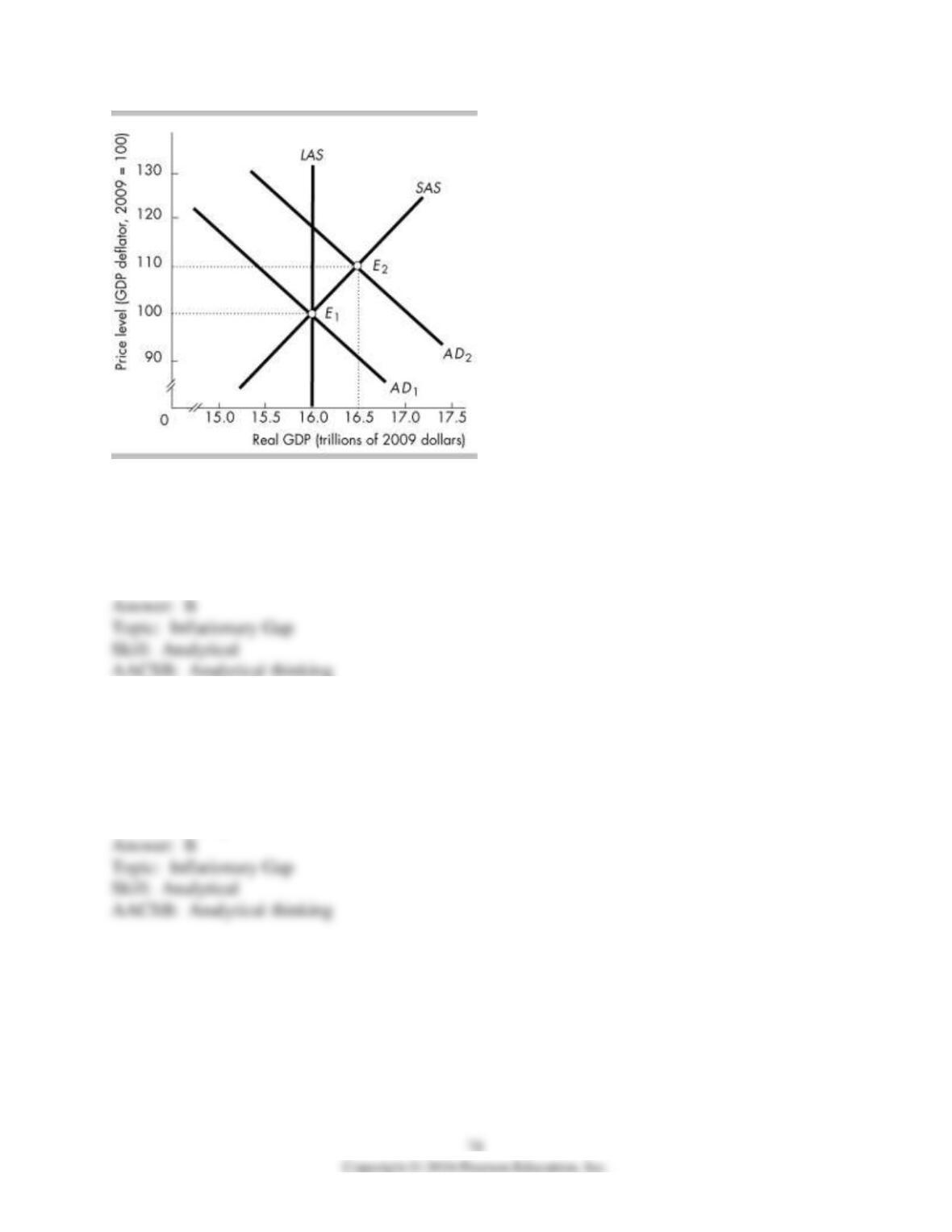
60) In the above figure, the inflationary gap when AD2 is the aggregate demand curve equals
A) the difference between 110 and 100.
B) the difference between $16.5 trillion and $16.0 trillion.
C) LAS minus SAS at a price level of 100.
D) AD1.
61) The reason that it is possible for the economy in the above figure to be at equilibrium point
E2 rather than at equilibrium point E1 is that
A) in the long run there is always less than full employment.
B) in the short run the economy can produce more than it can in a long-run situation.
C) AD always shifts rightward and never shifts leftward.
D) the economy must be in a recession.
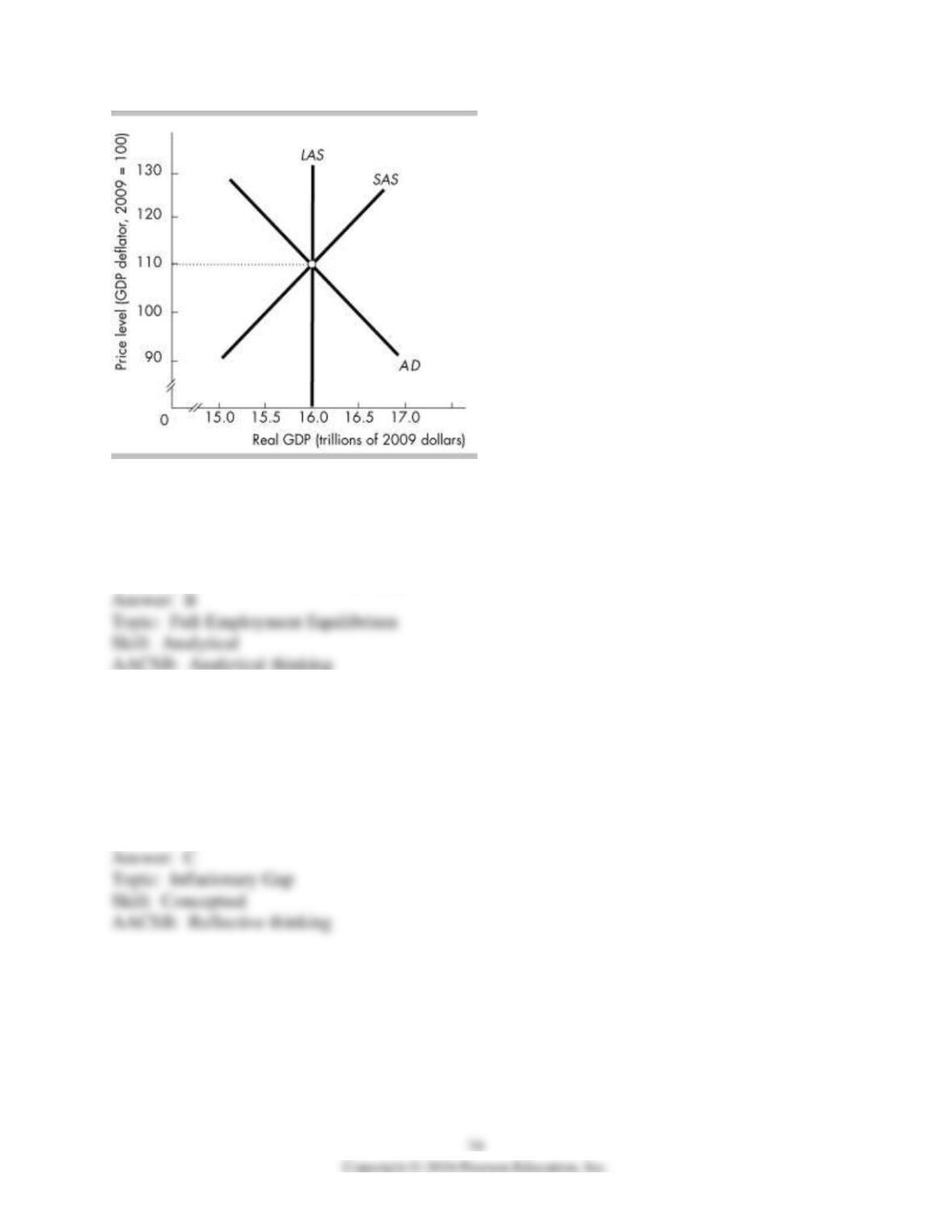
62) The above figure illustrates
A) a recessionary gap.
B) a full-employment equilibrium.
C) an inflationary gap.
D) an equilibrium at the economy’s physical limits.
63) An inflationary gap means that the level of real GDP at the short-run macroeconomic
equilibrium
A) is less than full-employment GDP.
B) equals full-employment GDP.
C) is more than full-employment GDP.
D) may be less than, more than, or the same as full-employment GDP depending on the level of
potential GDP.
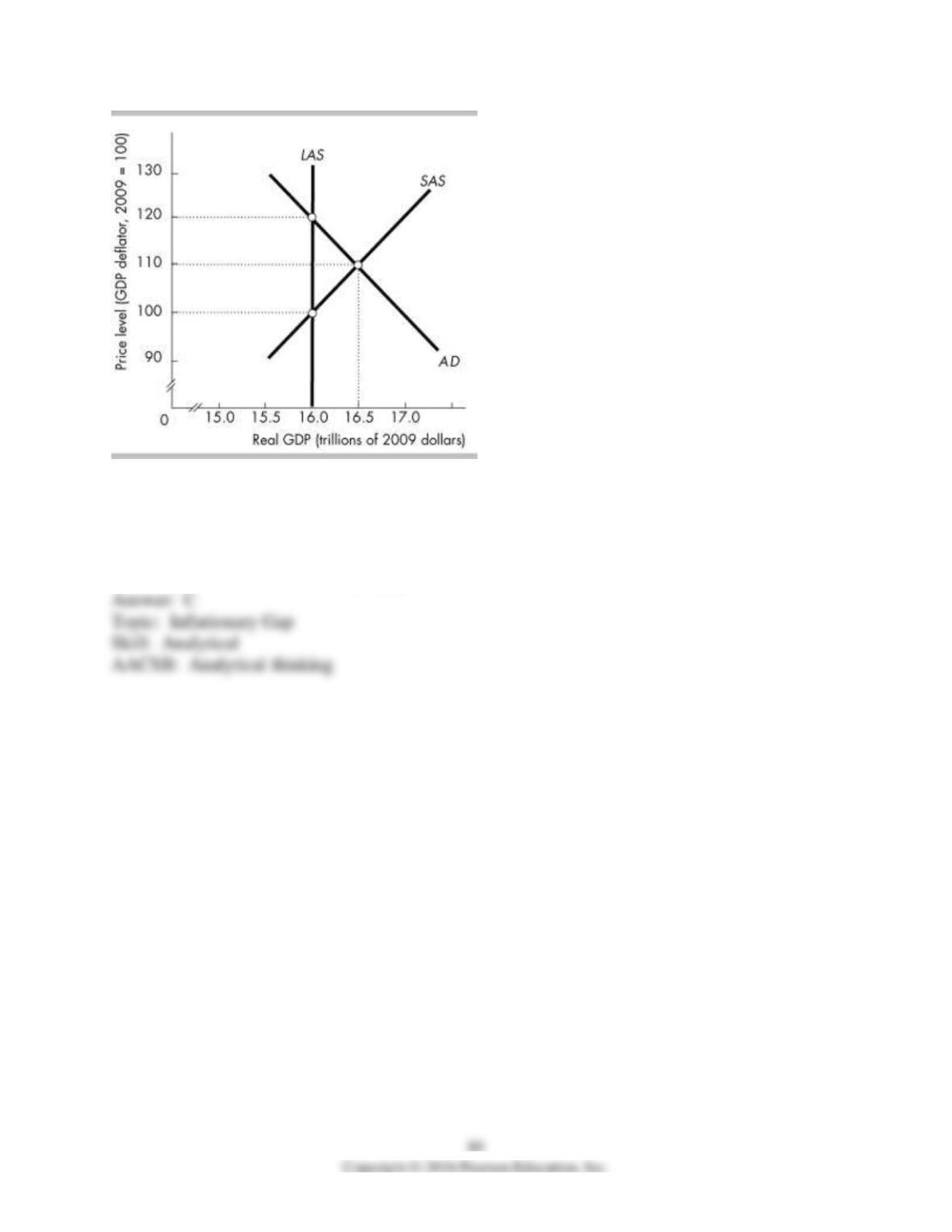
64) The above figure illustrates
A) a recessionary gap.
B) a full-employment equilibrium.
C) an inflationary gap.
D) an equilibrium at the economy’s physical limits.