135) In the above figure, a movement from point A to point B could be explained by
A) an increase in the price level.
B) an increase in the quantity of money in circulation.
C) a decrease in the price level.
D) a decrease in government spending.
136) Which of the following would cause an increase in aggregate demand (AD)?
A) a decrease in price levels
B) an increase in interest rates
C) a decrease in taxes
D) a rise in the foreign exchange value of the dollar
137) What is the aggregate demand curve and what does it represent?
138) “The aggregate demand curve slopes down for the same reason that the individual demand
curve for a good slopes down.” Do you agree or disagree with this statement? Why?
139) What is the interest rate effect of an increase in the price level?
140) What information is provided by the aggregate demand curve?
141) What is the real-balance effect of an increase in the price level?
142) What are the three forces that cause the aggregate demand curve to slope down? Explain.
143) What causes the aggregate demand curve to shift?
1) The shape of the aggregate demand curve does NOT tell us anything about how the total
dollar value of spending will ultimately be divided between output and prices. For this we need
A) information about the standard of living in the country.
B) information that only the Consumers’ Price Index can provide.
C) an aggregate supply curve.
D) to know how far from the origin the aggregate demand curve is.
2) To find an economy’s long-run equilibrium price level, locate the point where ________ and
________ cross and look to the left.
A) demand; supply
B) aggregate demand; short-run aggregate supply
C) aggregate demand; price level
D) long-run aggregate supply; aggregate demand
3) Suppose total planned expenditures equal $50 trillion when the value of the price level is 100.
If the price level drops to 90, total planned real expenditures will equal
A) $50 billion.
B) less than $50 trillion.
C) more than $50 trillion.
D) None of the above: Cannot be determined without additional information.
4) If you have $10,000 and the Gross Domestic Product (GDP) deflator increases from 100 to
110, then
A) the $10,000 will buy 10 percent less of the goods and services produced by society.
B) the $10,000 will buy 10 percent more of the goods and services produced by society.
C) the value of the $10,000 increases.
D) you will be able to buy fewer goods, but the real value of those goods will increase.
5) A persistently declining price level resulting from economic growth and unchanged aggregate
demand is called
A) demand-side deflation.
B) supply-side deflation.
C) ozian deflation.
D) secular deflation.
6) How is economic growth graphically depicted?
A) The aggregate demand curve shifts to the left.
B) Aggregate demand shifts to the right.
C) Short-run aggregate supply shifts left.
D) The long-run aggregate supply curve shifts right.
7) Which of the following will result in secular deflation?
A) a one-time rightward shift of the aggregate demand curve
B) continuous rightward shifts of the aggregate demand curve
C) a one-time rightward shift of the long-run aggregate supply curve
D) continuous rightward shifts of the long-run aggregate supply curve
8) Secular deflation occurs when
A) there is no economic growth and aggregate demand falls.
B) aggregate demand increases at the same time there is no economic growth.
C) aggregate demand remains unchanged while economic growth increases long-run aggregate
supply.
D) both aggregate demand and aggregate supply are shifting left.
9) An increase in the amount of physical capital will cause
A) an increase in both aggregate demand and real GDP, but have no effect on the price level.
B) aggregate demand and aggregate supply to increase by the same amounts, causing real GDP
to increase and the price level to remain constant.
C) an increase in both aggregate supply and real GDP, but have no effect on the price level.
D) an increase in both aggregate supply and real GDP and a reduction in the price level.
10) The U. S. has experienced inflation every year since 1959 due to
A) a sustained decrease in aggregate demand.
B) a sustained increase in aggregate demand accompanied by an even larger decrease in LRAS.
C) a sustained decrease in aggregate supply.
D) a sustained increase in aggregate supply accompanied by an even larger increase in aggregate
demand.
11) Supply-side inflation is caused by
A) a decrease in aggregate supply and no change in aggregate demand.
B) a decrease in aggregate demand and no change in aggregate supply.
C) an increase in aggregate supply and no change in aggregate demand.
D) an increase in aggregate demand and no change in aggregate supply.
12) If the economy grows steadily over several years and at the same time maintains the
aggregate demand curve in its present position, then the economy will experience which of the
following?
A) inflation
B) a stable price level
C) secular deflation
D) The price level cannot be determined without more information.
13) Suppose the central bank implements expansionary monetary policy where the money supply
increases. Which of the following will tend to occur in the long run as a result of this monetary
policy action?
A) Output and the price level will both increase.
B) Output will increase with no change in the price level.
C) an increase in the price level and no change in output
D) no change in either the price level or output
14) When the price level is below the level at which the aggregate demand curve crosses the long
run aggregate supply curve
A) there will be no price level change.
B) there will be pressures that will lead to a shift of either the aggregate demand or the long run
aggregate supply curves.
C) total planned real expenditures will exceed actual real GDP, and the price level will increase.
D) total planned real expenditure will be lower than actual real GDP, and the price level will
increase.
15) When the price level is below the level at which the aggregate demand curve crosses the long
run aggregate supply curve
A) there will be no price level change.
B) there will be pressures that will lead to a shift of either the aggregate demand or the long run
aggregate supply curves.
C) actual real GDP would be less than total planned real expenditures, and the price level will
rise.
D) actual real GDP would exceed total planned real expenditures, and the price level will fall.
16) Economic growth will be associated with a constant price level when
A) the increase in aggregate demand exactly equals the increase in long-run aggregate supply.
B) the increase in aggregate demand is more than the increase in long-run aggregate supply.
C) the increase in aggregate demand is less than the increase in long-run aggregate supply.
D) the increase in aggregate demand is accompanied by a reduction in short-run aggregate
supply.
17) Over the last twenty years, real GDP in the U.S. economy has increased and there has been
inflation. This indicates that
A) aggregate demand has increased while aggregate supply has been constant.
B) aggregate demand has been constant while aggregate supply has increased.
C) aggregate demand has increased more than aggregate supply.
D) aggregate demand has increased less than aggregate supply.
18) Economic growth takes place
A) only when both aggregate demand and aggregate supply increase.
B) when aggregate supply increases.
C) when aggregate demand decreases.
D) only if the price level is constant or rising.
19) The U.S. economy has had persistent inflation in recent decades. A possible explanation for
the inflation is that
A) there have been decreases in the growth rate while aggregate demand has remained
unchanged.
B) there have been increases in the growth rate while aggregate demand has remained
unchanged.
C) there have been decreases in aggregate demand while aggregate supply has remained
unchanged.
D) growth in aggregate demand has been greater than growth in aggregate supply.
20) In the long run, a decrease in government spending, other things equal, generates
A) a lower real GDP in the long run.
B) a higher real GDP in the short run.
C) a lower price level.
D) both a higher real GDP and a lower price level.
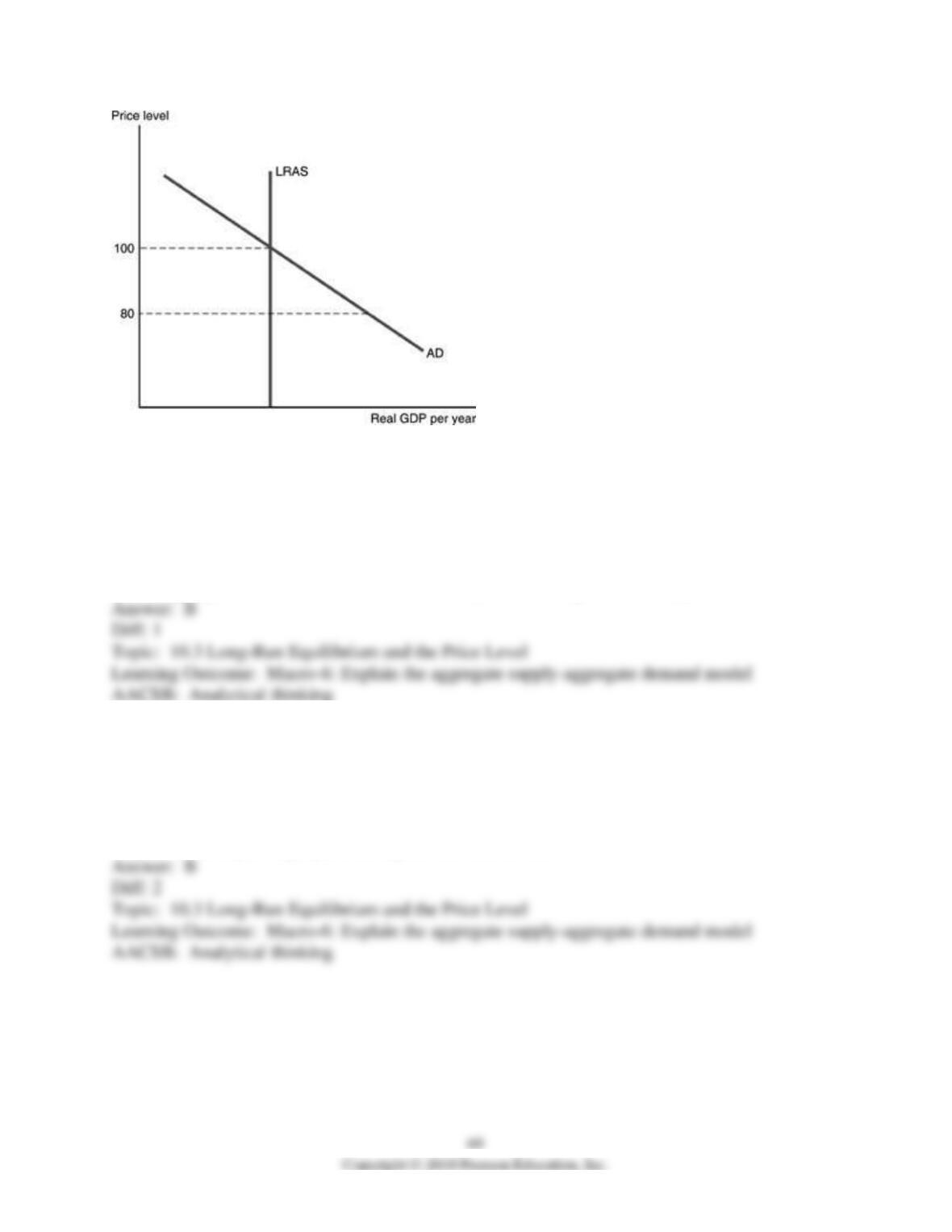
21) Refer to the above figure. If the price level is 80
A) the total planned real expenditures by individuals, businesses, and the government are less
than total planned production by firms.
B) the total planned real expenditures by individuals, businesses, and the government exceed
total planned production by firms.
C) the economy will have economic growth and the new equilibrium price level will be 80.
D) the aggregate demand curve will automatically shift leading to a stable equilibrium.
22) The intersection of aggregate demand and long-run aggregate supply identify the price level
at which total planned
A) real expenditures equal actual nominal GDP.
B) real expenditures equal total planned production.
C) export spending equals total planned import spending.
D) government spending equals total planned tax revenues.
23) What would happen in an economy if total planned production exceeded total planned real
expenditures?
A) Inventories would be depleted, and firms would tend to lower prices.
B) Inventories would accumulate, and firms would tend to lower prices.
C) Inventories would be depleted, and firms would tend to raise prices.
D) Inventories would accumulate, and firms would tend to raise prices.
24) If the current price level is lower than the equilibrium price level, then it must be TRUE that
total planned
A) government spending is less than total planned tax revenues.
B) government spending exceeds total planned tax revenues.
C) real expenditures are less than total planned production.
D) real expenditures exceed total planned production.
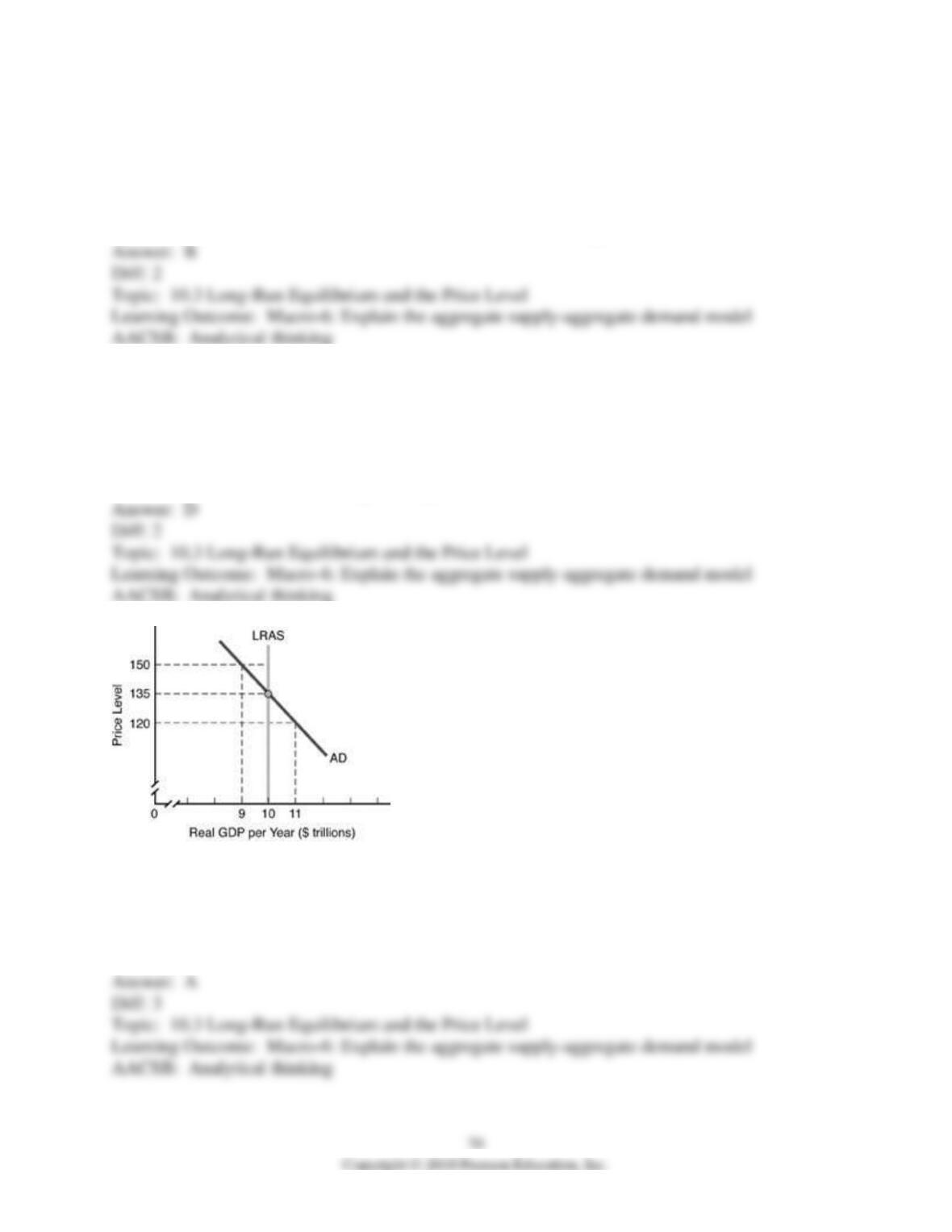
25) Consider the above figure. At a price level of 150
A) total planned production exceeds total planned real expenditures.
B) total planned real expenditures exceed total planned real production.
C) inventories of unsold goods decline.
D) the price level would rise.
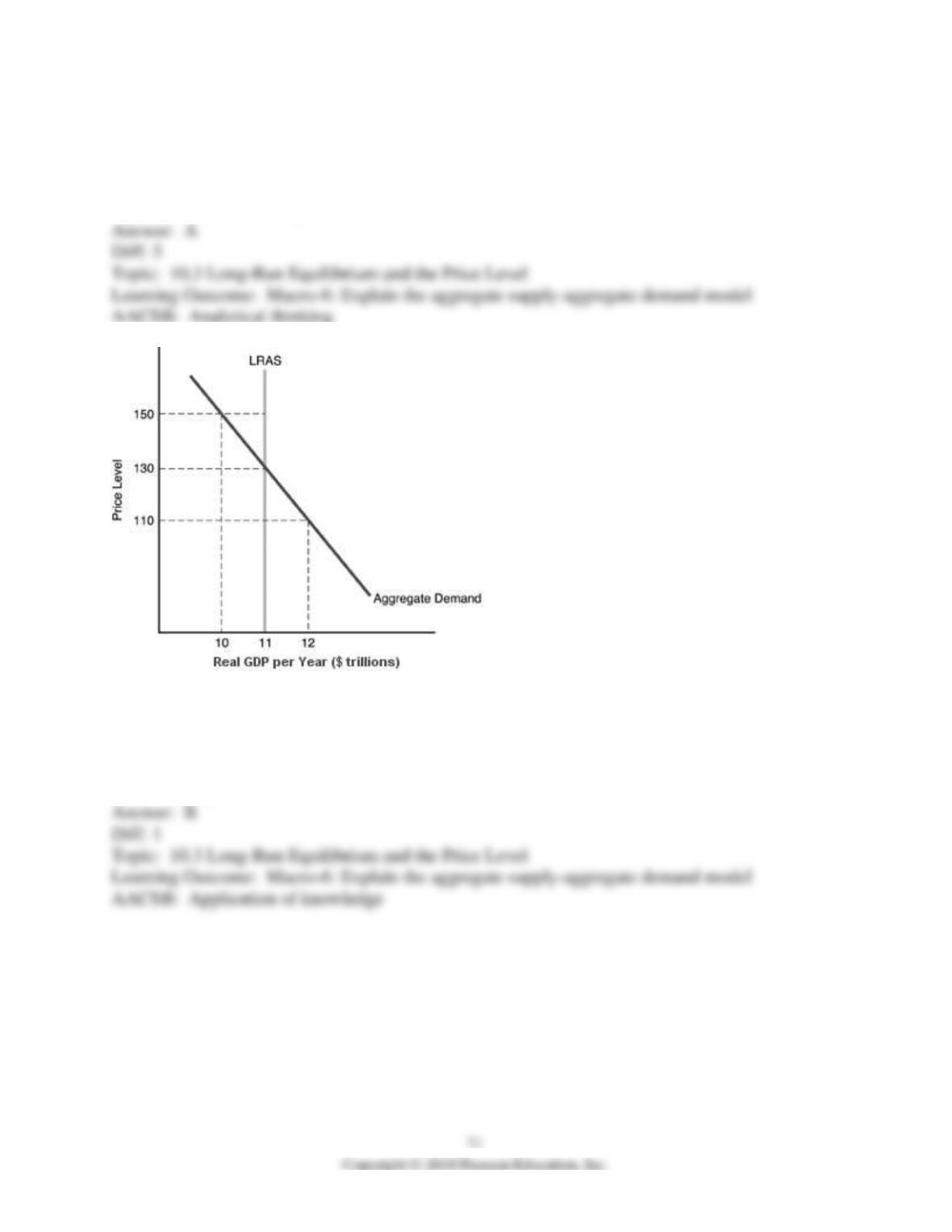
26) Consider the above figure. At a price level of 120
A) total planned real expenditures exceed total planned production.
B) total planned production exceeds total planned expenditures.
C) prices would fall.
D) inventories would begin to accumulate.
27) In the above figure, the long-run equilibrium price level is
A) 150.
B) 130.
C) 110.
D) not displayed.
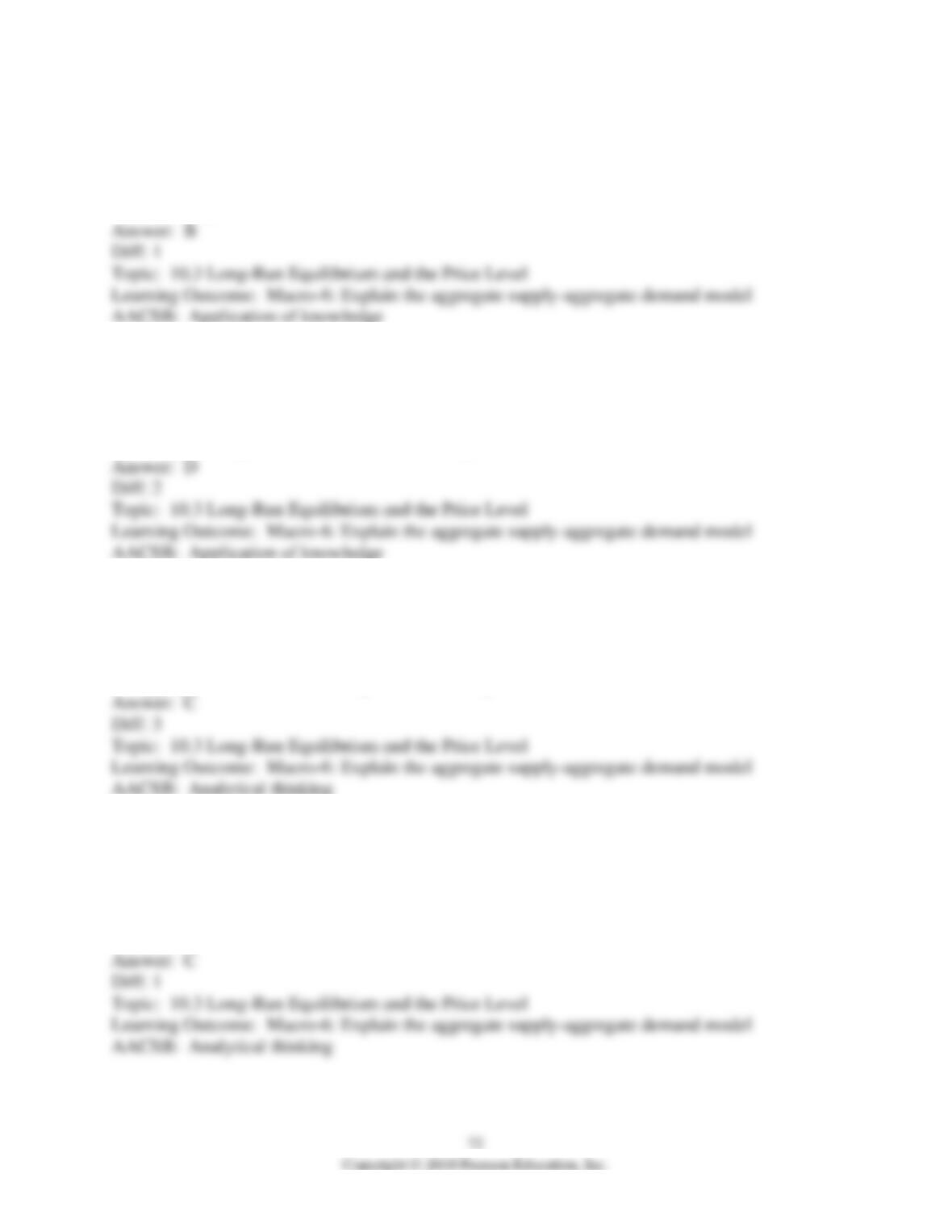
28) In the above figure, the long-run equilibrium real GDP is
A) $10 trillion.
B) $11 trillion.
C) $12.trillion
D) not displayed.
29) In the above figure, if the price level is 110
A) total planned production exceeds total expenditures.
B) total expenditures exceed total planned expenditures.
C) total planned production equals total expenditures.
D) total planned production is less than total expenditures.
30) If consumers’ confidence in the economy rises
A) aggregate demand will shift leftward and the price level will rise.
B) aggregate demand will shift leftward and the price level will fall.
C) aggregate demand will shift rightward and the price level will rise.
D) aggregate demand will shift rightward and the price level will fall.
31) A persistent decline in the price level resulting from economic growth in the presence of
stable aggregate demand is known as
A) demand-side deflation.
B) the interest rate effect.
C) secular deflation.
D) the real balance effect.
32) If aggregate demand is stable and there is economic growth, the economy will experience
A) secular degeneration.
B) secular deflation.
C) secular decline.
D) secular depreciation.
33) A rightward shift of long-run aggregate supply without any change in aggregate demand
A) will leave real GDP unchanged.
B) results in a lower price level.
C) increases the price level without any change in real GDP.
D) increases the price level along with an increase in real GDP.
34) An economy experiences real growth over time with stable aggregate demand. This would
likely result in
A) increasing prices.
B) decreasing prices.
C) secular inflation.
D) increased unemployment.
35) Which of the following is consistent with secular deflation?
A) a persistently decreasing price level caused by several periods of economic growth with stable
AD
B) a persistently increasing price level caused by several periods of economic growth with
decreasing AD
C) a persistently decreasing price level caused by increases in government expenditures
D) a persistently decreasing price level caused by money being withdrawn from the economy