98
Barro
Chapter 10
TRUE/FALSE
1. High powered money is commodity money like gold and silver.
2. If households reduce money balances, then their transactions costs go up.
3. If the money supply grows faster than money demand, then the price level rises.
4. If the interest rate increases, then the real demand for money also increases.
5. The neutrality of money means that one time changes in the money supply do not affect real variables.
6. M1 includes a broader array of deposit accounts than M2 does.
7. In the Barro model, money and barter can both be used for exchanges.
8. In the Barro model, households hold money as a long-term store of value.
9. If the price level doubles, then a household’s nominal demand for money also doubles.
10. If the nominal quantity of money supplied does not vary, then the price level will be countercyclical.
MULTIPLE CHOICE
1. Fiat money is money that has value because of:
a.
its intrinsic value.
c.
government decree.
b.
it is a commodity.
d.
all of the above.
99
2. Commodity money is money that has value because:
a.
of the intrinsic value of the commodity.
c.
the government says so.
b.
it is legal tender.
d.
all of the above.
3. If a person holds one dollar and does not lose it, then as long as the person holds that dollar they will
have:
a.
the commodity value of the dollar.
c.
an interest bearing asset.
b.
one dollar in currency.
d.
all of the above.
4. High powered money is:
a.
money held by business for investment.
c.
total currency in circulation.
b.
total currency in circulation plus
depository institutions deposits at the
Federal Reserve.
d.
government bonds held by the public and
depository institutions.
5. A monetary aggregate is:
a.
high powered money.
c.
money defined more broadly than
currency.
b.
commodity money.
d.
total currency in circulation plus
depository institutions deposits at the
Federal Reserve.
6. US M1 money includes:
a.
currency held by the public.
c.
traveler’s checks.
b.
checkable deposits.
d.
all of the above.
7. US M1 money includes:
a.
savings deposits.
c.
time deposits.
b.
checkable deposits.
d.
all of the above.
8. US M1 money includes:
a.
currency, traveler’s checks and checkable
deposits.
c.
currency, checkable deposits, savings
deposits.
b.
checkable deposits, traveler’s checks and
savings deposits.
d.
currency, time deposits, checkable
deposits.
9. US M2 money includes:
a.
currency.
c.
small time deposits.
b.
demand deposits
d.
all of the above.
100
10. US M2 money includes:
a.
currency, time deposits government
bonds.
c.
checkable deposits, savings deposits,
small time deposits.
b.
savings deposits, small time deposits,
private bonds.
d.
retail money market mutual funds, small
time deposits, government bonds.
11. Money is different from other assets like capital and bonds in that:
a.
money does not pay interest.
c.
capital and bonds are better long term
stores of value.
b.
money can be spent for purchases.
d.
all of the above.
12. Money is different from other assets like capital and bonds in that:
a.
money does not pay interest.
c.
money is a better long term store of value.
b.
money has intrinsic value.
d.
all of the above.
13. Money is different from other assets like capital and bonds in that:
a.
money pays a higher interest rate.
c.
money is a better long term store of value.
b.
money can be spent for purchases.
d.
all of the above.
14. Money is different from other assets like capital and bonds in that:
a.
money has intrinsic value.
c.
capital and bonds are better long term
stores of value.
b.
money pays a higher rate of interest.
d.
all of the above.
15. When households reduce their average money balances, they
a.
purchase more goods.
c.
incur more opportunity costs.
b.
they earn less interest.
d.
incur more transaction costs.
16. If a person’s income doubles we expect their cash holding to:
a.
double.
c.
less than double.
b.
more than double.
d.
decline.
17. Economies of scale in cash management means:
a.
at a higher income household’s hold more
money as a proportion of their income.
c.
the proportion of income held is not
affected by household income.
b.
at lower incomes household’s hold more
money as a proportion of their income
d.
at lower income households hold less
money as a proportion of their income.
18. Real money demand does not change when:
101
a.
nominal GDP changes.
c.
the price level changes.
b.
the interest rate changes.
d.
all of the above.
19. Among the source of transactions costs associated with reducing average money balances are:
a.
brokerage fees.
c.
the time spent going to the ATM.
b.
the time spent going to the bank.
d.
all of the above.
20. Among the sources of transactions costs associated with reducing average money balances are:
a.
brokerage fees.
c.
foregone interest payments.
b.
opportunity costs.
d.
all of the above.
21. Among the source of transactions costs associated with reducing average money balances are:
a.
foregone interest payments.
c.
opportunity costs.
b.
the time spent going to the bank or ATM.
d.
all of the above.
22. The demand for money is:
a.
negatively related to the price level.
c.
positively related to real GDP.
b.
positively related to the interest rate.
d.
all of the above.
23. The demand for money is:
a.
negatively related to the price level.
c.
negatively related to real GDP.
b.
negatively related to the interest rate.
d.
all of the above.
24. The demand for money is:
a.
positively related to the price level.
c.
negatively related to real GDP.
b.
positively related to the interest rate.
d.
all of the above.
25. The demand for money is:
a.
positively related to the price level.
c.
positively related to real GDP.
b.
negatively related to the interest rate.
d.
all of the above.
26. When the supply of money increases, then
a.
the price level rises.
c.
money demand increases.
b.
the price level falls.
d.
money demand decreases.
102
27. When the demand of money increases, then
a.
the price level rises.
c.
the money supply increases.
b.
the price level falls.
d.
the money supply decreases.
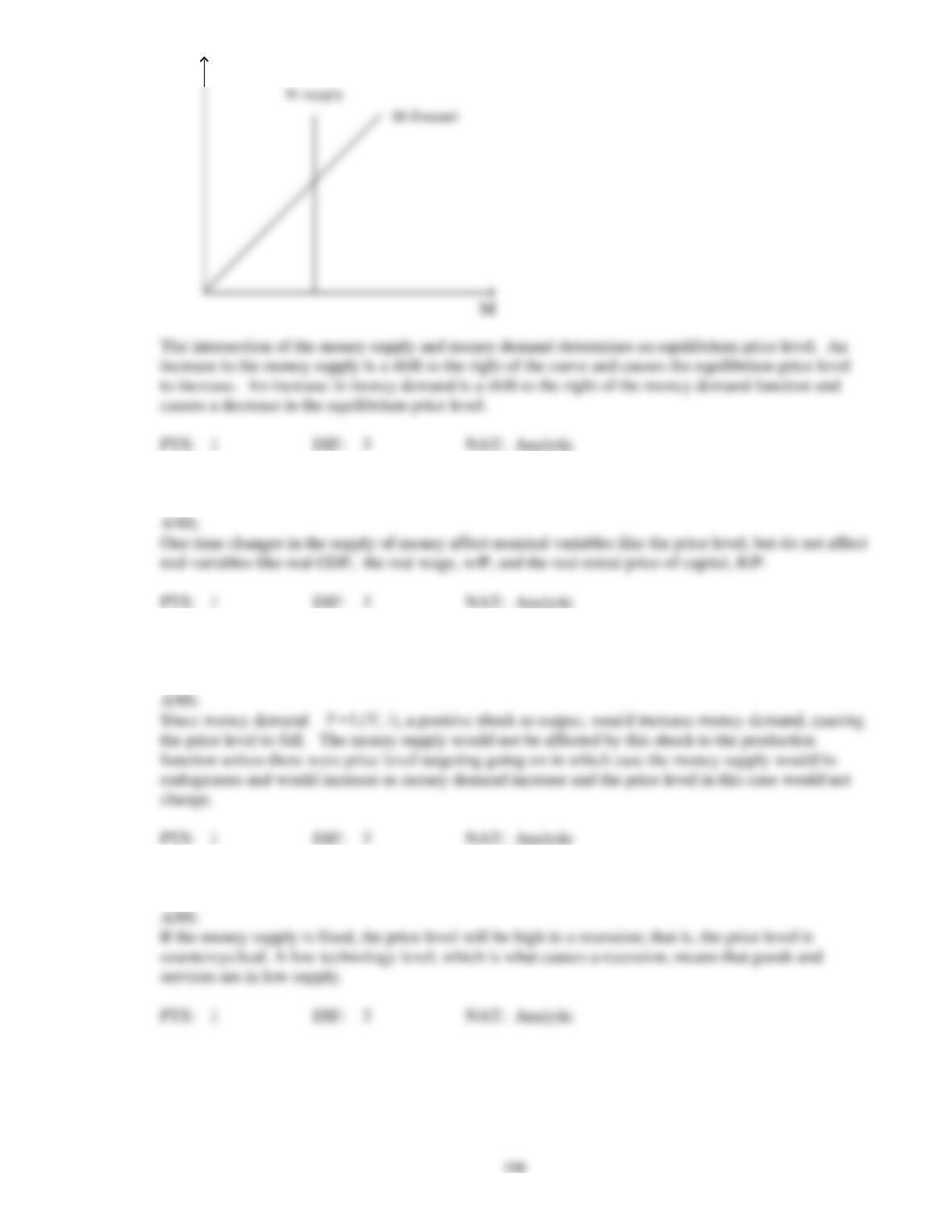
Figure 10.1
M-supply
M-Demand
M
P
28. In Figure 10.1, if money demand decreases then:
a.
the equilibrium price level rises.
c.
the money supply rises.
b.
the equilibrium prices level falls.
d.
the money supply falls.
29. In Figure 10.1, if the money supply decreases then:
a.
the equilibrium price level rises.
c.
money demand increases.
b.
the equilibrium price level falls.
d.
money demand decreases.
30. In Figure 10.1 if the interest rate, i, were to increase, then
a.
money demand decreases and the price
level increases.
c.
the money supply and the price level
would increase.
b.
money demand increases and the price
level decreases.
d.
the money supply and the price level
would decrease.
31. In Figure 10.1 if real GDP, Y, were to increase, then
a.
money demand decreases and the price
level increases.
c.
the money supply and the price level
would increase.
b.
money demand increases and the price
level decreases.
d.
the money supply and the price level
would decrease.
32. In Figure 10.1 the interaction of the money supply and money demand determines:
a.
real GDP.
c.
growth rate of the economy.
b.
the price level.
d.
all of the above.
103
33. In Figure 10.1 if money demand increases faster than the money supply then:
a.
the price level will rise over time.
c.
GDP will rise over time.
b.
the price level will fall over time.
d.
GDP will fall over time.
34. In Figure 10.1 if the money supply increases faster than money demand then:
a.
the price level will rise over time.
c.
GDP will rise over time.
b.
the price level will fall over time.
d.
GDP will fall over time.
35. In Figure 10.1, if money demand increases then:
a.
the equilibrium price level rises.
c.
the money supply rises.
b.
the equilibrium price level falls.
d.
the money supply falls.
36. In Figure 10.1, if the money supply increases then:
a.
the equilibrium price level rises.
c.
the money supply rises.
b.
the equilibrium price level falls.
d.
the money supply falls.
37. Real money demand is:
a.
Md/P.
c.
the purchasing power of money balances.
b.
a function of real GDP and the interest
rate.
d.
all of the above.
38. Real money demand is:
a.
money demand after taxes.
c.
determined by the central bank.
b.
a function of real GDP and the interest
rate.
d.
all of the above.
39. Real money demand is:
a.
determined by the central bank.
c.
the purchasing power of money balances.
b.
money demand after taxes.
d.
all of the above.
40. If the money supply doubles, then
a.
real GDP doubles.
c.
the interest rate, i, doubles.
b.
real money demand doubles.
d.
none of the above.
41. If the money supply doubles, then
a.
GDP doubles.
c.
the interest rate, i, doubles.
b.
the price level doubles.
d.
none of the above.
104
42. Under price level targeting the money supply becomes:
a.
neutral.
c.
exogenous.
b.
endogenous.
d.
predetermined.
43. During a recession,
a.
the interest rate and real GDP fall tending
to cause money demand to fall.
c.
the interest rate falls tending to cause
money demand to rise, but is at least
partly offset by real GDP falling tending
to cause money demand to fall.
b.
the interest rate and real GDP rise tending
to cause money demand to rise.
d.
the interest rate rising and real GDP
falling tend to cause money demand to
rise.
44. If policy makers target a specific price level, then:
a.
the money supply becomes exogenous in
the model.
c.
the money supply becomes endogenous in
the model.
b.
the money supply becomes predetermined
in the model.
d.
the money supply becomes neutral in the
model.
45. In US data from 1954 to 2006, the price level is:
a.
procyclical as we would expect if the
monetary authority does not vary the
money with the business cycle.
c.
countercyclical as we would expect if the
monetary authority does not vary the
money supply with the business cycle.
b.
procyclical as we would expect if the
monetary authority varies the money
supply with the business cycle.
d.
countercyclical as we would expect if the
monetary authority varies the money
supply with the business cycle.
46. Real money demand is:
a.
L(Y, i).
c.
P • L(Y, i).
b.
equal to the money supply.
d.
all of the above.
47. Money demand and the money supply are brought into equilibrium by:
a.
real GDP adjusting.
c.
the interest rate adjusting.
b.
the price level adjusting.
d.
the real wage rate adjusting.
48. Price level targeting implies that the monetary authority:
a.
changes the money supply to match
movements in money demand.
c.
changes money demand and money
supply to match movements in the price
level.
b.
changes money demand to match
movements in the money supply.
d.
changes money demand to match
movements in the price level.
105
49. The neutrality of money implies:
a.
one time changes in real variables do not
affect money demand.
c.
one time changes in nominal variables do
not affect money demand.
b.
one time changes in the money supply do
not affect real variables.
d.
one time changes in the money supply do
not affect nominal variables.
50. If for one period the money supply increases, then:
a.
real GDP increases.
c.
real capital per worker increases.
b.
the real wage increases.
d.
none of the above.
51. If James performs one hour of house cleaning for Lilly in exchange for Lilly performing one hour of
yardwork for James, then the exchange involved
a.
barter.
c.
items with no intrinsic value.
b.
fiat money.
d.
the capital services market.
52. Fiat money would most likely hold the dominant position as a medium of exchange when
a.
legal restrictions prevent private firms
from issuing small, interest-bearing bonds
as substitutes for money.
c.
the government requires that taxes be paid
using the fiat money.
b.
the government declares the money to be
legal tender.
d.
all of the above.
53. The monetary base does not include
a.
total currency in circulation.
c.
bank deposits at the Federal Reserve.
b.
checkable deposits.
d.
all of the above.
54. Checkable deposits are
a.
deposits at financial institutions that can
be withdrawn only after paying a penalty.
c.
deposits at financial institutions that can
be withdrawn by writing a check.
b.
savings deposits at financial institutions
that can be withdrawn by transfer to
another account.
d.
deposits on which the bank checks the
deposit slip carefully.
55. If Alicia transfers $100 from her savings deposit account to her checkable deposit account, then M1
a.
increases and M2 stays the same.
c.
increases and M2 decreases.
b.
increases and M2 increases.
d.
decreases and M2 increases.
56. If Hagen transfers $100 from his checkable deposit account to his savings deposit account, then M1
a.
increases and M2 stays the same.
c.
decreases and M2 stays the same.
b.
increases and M2 increases.
d.
decreases and M2 increases.
106
57. U.S. data show that checkable deposits have
a.
increased in importance as a payment
method.
c.
increased in importance as a portion of
M1.
b.
decreased in importance as a payment
method.
d.
decreased in importance as a portion of
the monetary base.
58. Which asset below is the least useful long-term store of value?
a.
bonds.
c.
either (a) or (b).
b.
ownership of capital.
d.
money.
59. A household’s demand for money arises from the household’s
a.
optimal strategy for money management.
c.
need to provide capital services to the
market.
b.
need to provide labor services to the
market.
d.
desire to increase its transactions costs.
60. The empirical evidence on the demand for money finds that
a.
an decrease in the price level lowers the
real demand for money in the same
proportion.
c.
an increase in the price level lowers the
nominal demand for money in the same
proportion.
b.
interest rates are negatively related to
money.
d.
real GDP is negatively related to money.
61. The point where money supplied equals money demanded determines
a.
the real interest rate.
c.
the price level.
b.
the nominal interest rate.
d.
the real return on capital services.
62. Which of the following scenarios would mostly likely cause the price level to double?
a.
The nominal quantity of money demanded
doubles.
c.
The nominal wage doubles.
b.
The nominal quantity of money demanded
falls by half.
d.
The nominal quantity of money supplied
doubles.
63. In general equilibrium, a one-time increase in the nominal quantity of money supplied
a.
does not affect the interest rate.
c.
decreases the interest rate.
b.
increases the interest rate.
d.
either (a) or (b).
64. The general equilibrium in the Barro model assumes that prices are
a.
inflexible and adjust slowly.
c.
unaffected by changes in the money
supply.
b.
flexible and adjust rapidly.
d.
unimportant in explaining money demand.
107
65. Most economists agree that money is
a.
not neutral in the long-run.
c.
neutral in the long-run.
b.
not neutral in the short- or long-run.
d.
neutral in the short-run.
SHORT ANSWER
1. What is the money demand function and what is the direction of influence of the variables on money
demand?
2. Why does economizing on money balances lead to greater transactions cost?
3. How do money demand and the money supply interact to determine the price level?
ANS:
P
4. What does money neutrality mean?
5. What would happen to money demand, the money supply and the price level if there were a positive
shock to production?
6. According to the Barro model, will the price level be high or low in a recession?