
Macroeconomics, 12e (Parkin)
Chapter 10 Aggregate Supply and Aggregate Demand
1 Aggregate Supply
1) The supply of real GDP is a function of
A) the total expenditures of consumers, investors and government.
B) the sum of wages, salaries, corporate profits, rents and interest.
C) only the state of technology.
D) the quantities of labor, capital and the state of technology.
2) The quantity of real GDP supplied depends on the
A) level of aggregate demand.
B) quantity of capital, bonds, and stocks.
C) quantity of labor, the quantity of capital, and the state of technology.
D) price level, the unemployment rate, and the quantity of government expenditures on goods
and services.
3) An aggregate supply curve depicts the relationship between
A) the price level and nominal GDP.
B) household expenditures and household income.
C) the price level and the aggregate quantity supplied.
D) the price level and the aggregate quantity demanded.
4) An aggregate supply curve depicts the relationship between
A) the price level and the quantity of nominal GDP supplied.
B) household expenditures and household income.
C) the price level and the quantity of real GDP supplied.
D) the money wage rate and the quantity of real GDP supplied.
5) In the macroeconomic short run
A) actual real GDP may be less than or more than potential GDP.
B) the unemployment rate is zero.
C) by definition, the economy is always moving away from full employment.
D) actual real GDP always equals potential GDP.
6) When talking about aggregate supply, it is necessary to
A) focus on the short run.
B) focus on the long run.
C) distinguish between long-run aggregate supply and short-run aggregate supply.
D) distinguish between long-run full employment and short-run full employment.
7) We distinguish between the long-run aggregate supply curve and the short-run aggregate
supply curve. In the long run
A) technology is fixed but it is not in the short run.
B) the price level is constant but in the short run it fluctuates.
C) the aggregate supply curve is horizontal while in the short run it is upward sloping.
D) real GDP equals potential GDP.
8) In the macroeconomic long run
A) real GDP is always below potential GDP.
B) there is full employment with no unemployment.
C) output always is above potential GDP.
D) there is full employment and real GDP is equal to potential GDP.
9) In the macroeconomic long run
A) real GDP equals potential GDP.
B) the economy is at full employment.
C) regardless of the price level, the economy is producing at potential GDP.
D) All of the above are correct.
10) In the long run
A) the aggregate supply curve is upward sloping.
B) real GDP is equal to potential GDP.
C) aggregate supply depends on the price level.
D) All of the above answers are correct.
11) The long-run aggregate supply (LAS) curve
A) has a positive slope.
B) has a negative slope.
C) is vertical.
D) is horizontal.
12) When the labor market is at full employment
A) real GDP equals potential GDP.
B) the price level is stable.
C) the price level equals the potential price level.
D) the short run aggregate supply curve is horizontal.
13) The long-run aggregate supply curve is vertical because
A) at full employment, prices are stable.
B) there is no cyclical inflation.
C) potential GDP is independent of the price level.
D) the money wage rate increases faster than the price level.
14) The long-run aggregate supply curve is
A) horizontal at the full-employment price level.
B) vertical at the full-employment level of real GDP.
C) upward sloping because of the effects of price level changes on real GDP.
D) the same as the short-run aggregate supply curve.
15) Which of the following statements is TRUE?
A) The long-run aggregate supply curve is upward sloping.
B) The long-run aggregate demand curve is upward sloping.
C) The short-run aggregate supply curve is vertical.
D) The long-run aggregate supply curve is vertical.
16) The long-run aggregate supply curve is ________ because along it, as prices rise, the money
wage rate ________.
A) vertical; falls
B) vertical; rises
C) upward sloping; falls
D) upward sloping; stays constant

17) The long-run aggregate supply curve illustrates the
A) relationship of the price level and real GDP when the economy is at full employment.
B) relationship of the price level and real GDP when the economy is at zero unemployment.
C) amount of products producers offer at various prices when money wages and other resource
prices are fixed.
D) surpluses, shortages and equilibrium level of GDP.
18) The long-run aggregate supply curve is the relationship between the quantity of real GDP
supplied and ________ when ________.
A) the price level; real GDP equals potential GDP
B) real GDP demanded; the wage rate is constant
C) the price level; real GDP equals nominal GDP
D) real GDP demanded; the price level does not change
19) When the price level rises, the long-run aggregate supply curve ________.
A) shifts rightward
B) does not shift
C) slopes upward
D) shifts leftward
20) For movements along the long-run aggregate supply curve
A) potential GDP is dependent on the price level.
B) the prices of goods and services change while the prices of productive resources hold steady.
C) the price level and the money wage rate change by the same percentage.
D) All of the above are correct.

21) For movements along the long-run aggregate supply curve
A) the price level changes while the money wage rate remains constant
B) the prices of goods and services change while the prices of productive resources remains
constant.
C) the price level and the money wage rate change by the same percentage.
D) the price level and the real wage rate change by the same percentage.
22) The long-run aggregate supply curve shows the
A) maximum GDP the nation will ever produce.
B) full-employment level of real GDP.
C) level of real GDP associated with a constant price level.
D) level of output at which real GDP equals nominal GDP.
23) Which of the following is TRUE about the long-run aggregate supply curve?
A) It is vertical at the level of potential GDP.
B) It shows the relationship between the price level and real GDP when the economy is at full
employment.
C) It does not shift in response to temporary changes in aggregate demand.
D) All of the above are true.
24) Which of the following events will increase long-run aggregate supply?
A) an increase in the interest rate
B) an increase in resource prices
C) a decrease in expected profit
D) an advance in technology
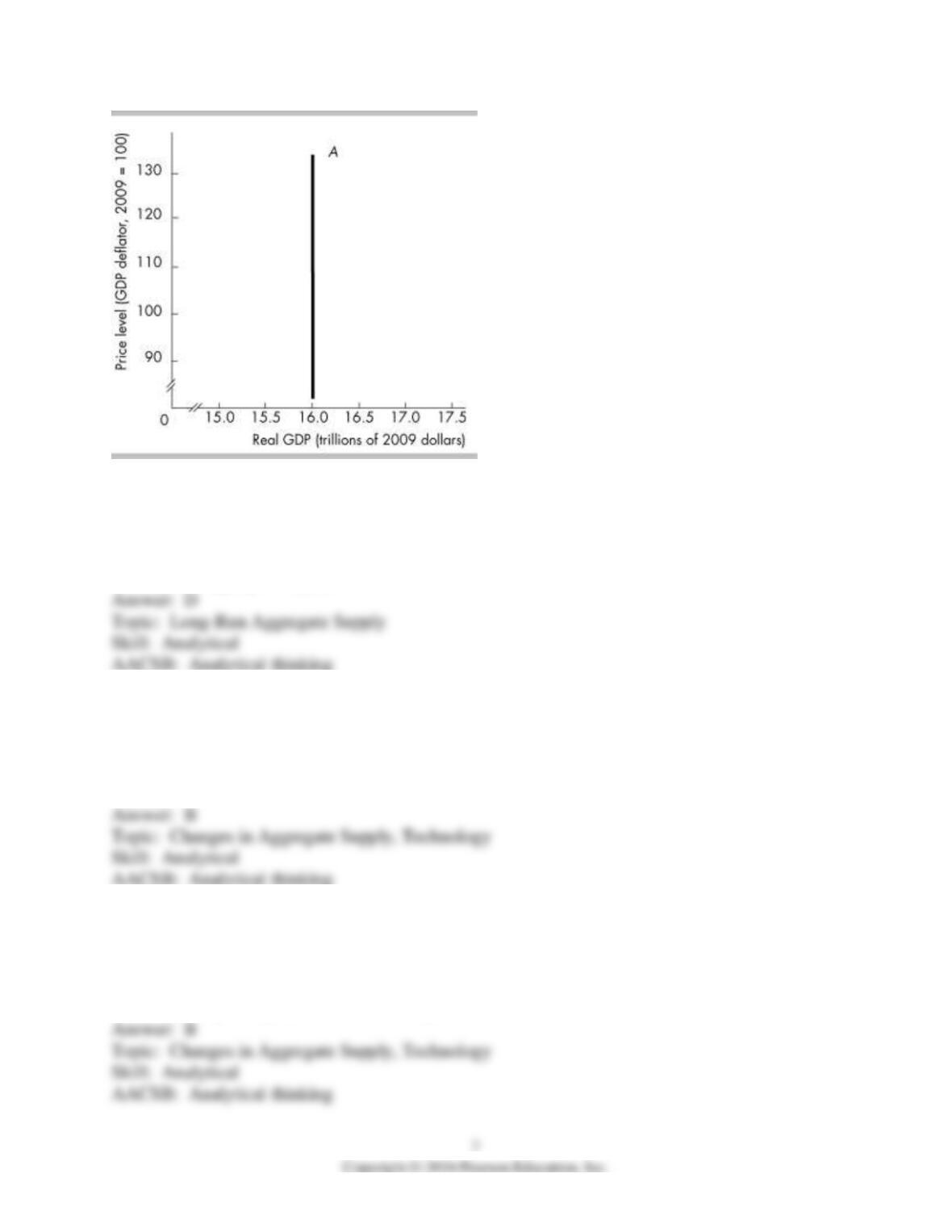
25) The curve labeled A in the above figure is a
A) short-run aggregate demand curve.
B) short-run aggregate supply curve.
C) long-run aggregate demand curve.
D) long-run aggregate supply curve.
26) The curve labeled A in the above figure will shift rightward when
A) the price level falls.
B) technology increases.
C) population falls.
D) the price level rises.
27) The curve labeled A in the above figure will shift rightward when
A) the quantity of capital increases or the price level falls.
B) technology increases or the quantity of capital increases.
C) technology increases or the price level increases.
D) the quantity of capital increases or the price level rises.

28) The short-run aggregate supply curve
A) shows what each producer is willing and able to produce at each level of income holding
constant potential GDP and all resource prices.
B) shows the relationship between aggregate production and the price level holding constant
potential GDP and all resource prices.
C) becomes vertical if there is excess production capacity within the economy.
D) shows a negative relationship between the price level and real national income holding
constant potential GDP and all resource prices.
29) The short-run aggregate supply curve
A) is vertical.
B) has a negative slope.
C) has a positive slope.
D) is horizontal.
30) The short-run aggregate supply curve is upward sloping because in the short run the
A) money wage rate changes but the price level does not.
B) price level changes but the money wage rate does not.
C) both the money wage rate and the price level change.
D) neither the money wage rate nor the price level can change.
31) The positive relationship between short-run aggregate supply and the price level indicates
that, in the short run
A) firms produce more output as the price level falls.
B) firms produce more output as the price level rises.
C) the money wage rate increases when moving along the short-run aggregate supply curve.
D) lower price levels are more profitable for firms.

32) Moving upward along the short-run aggregate supply curve results in a ________ in the price
level and ________ in real GDP.
A) rise; an increase
B) rise; a decrease
C) fall; an increase
D) fall; a decrease
33) The short-run aggregate supply curve is upward sloping because
A) a lower price level creates a wealth effect.
B) lower taxes motivate people to work more.
C) money wage rates do not immediately change when the price level changes.
D) most business firms operate with long-term contracts for output but not labor.
34) The short-run aggregate supply curve
A) is vertical.
B) shows the impact changes in the price level have on the quantity of real GDP when resource
prices are constant.
C) illustrates the level of potential real GDP.
D) shifts whenever the price level changes.
35) In the short-run
A) the aggregate supply curve is upward sloping.
B) real GDP is always equal to potential GDP.
C) the money wage rate can change.
D) the price level does not change.

36) Along a short-run aggregate supply curve, a decrease in the price level means that
A) more output is produced as consumer demand increases.
B) less output is produced as firms decrease production.
C) more output is produced as firms increase production because wages fall more than the price
level falls, making it profitable to hire more workers.
D) output does not change because firms do not change the quantity they produce.
37) In the short run, firms expand their production when the price level rises because
A) the money wage rate remains constant so the higher prices for their products makes it
profitable for firms to expand production.
B) each firm must keep its production up to the level of its rivals, and some firms will expand
production as the price level increases.
C) the higher prices allow the firm to hire more workers by offering higher wages, thereby
increasing productivity and profits.
D) firms can increase their profits by increasing their maintenance.
38) Moving along the short-run aggregate supply curve, ________.
A) the real wage rate is constant
B) real GDP equals potential GDP
C) the money wage rate, the prices of other resources, and potential GDP remain constant
D) real GDP equals nominal GDP
39) If the money wage rate and other resource prices do not change when the price level rises by
10 percent, ________.
A) the long-run aggregate supply curve shifts leftward
B) the short-run aggregate supply curve shifts leftward
C) the long-run aggregate supply curve shifts rightward
D) there is movement along the short-run aggregate supply curve

40) A change in ________ results in a movement along the short-run aggregate supply curve but
does not shift the short-run aggregate supply curve.
A) the money wage rate
B) technology
C) the quantity of capital
D) the price level
41) Which of the following does NOT shift the short-run aggregate supply curve?
A) a change in the money wage rate
B) technological progress
C) a reduction in the price of a raw material
D) a change in the price level
42) Which of the following occurs while moving along a short-run aggregate supply curve?
A) The money wage rate and the price level change by the same percentage.
B) The money wage rate changes and the price level is constant.
C) The price level changes and the money wage rate is constant.
D) Neither the price level nor the money wage rate changes.
43) For movements along the short-run aggregate supply curve
A) the money wage rate is constant.
B) the real wage rate changes.
C) potential GDP remains constant.
D) All of the above are correct.
44) Moving along a short-run aggregate supply curve, resource prices ________, the money rate
wage ________, and potential GDP ________.
A) do not change; changes; does not change
B) do not change; does not change; changes
C) change; does not change; does not change
D) do not change; does not change; does not change
45) A decrease in the price level accompanied by no change in the money wage rate leads to
________ movement along the ________ aggregate supply curve.
A) a downward; short-run
B) an upward; short-run
C) a downward; long-run
D) an upward; long-run
46) The SAS curve and the LAS curve
A) intersect at potential GDP.
B) are parallel at potential GDP.
C) are perpendicular to one another at potential GDP.
D) None of the above answers is correct.
47) Suppose the price level, the money wage, and the price of all other resources rise by 10
percent. This set of changes leads to
A) an upward movement along the LAS curve.
B) a downward movement along the LAS curve.
C) an upward movement along the SAS curve.
D) a leftward shift of the LAS curve.

13
48) Suppose the price level rises and the money wage remains constant. This set of changes leads
to
A) an upward movement along the LAS curve.
B) an upward movement along the SAS curve.
C) a leftward shift of the SAS curve.
D) a leftward shift of the SAS curve and the LAS curve.
49) Which of the following statements regarding aggregate supply are CORRECT?
A) Moving along the long-run aggregate supply curve, both the price level and the money wage
rate change by the same percentage.
B) Moving along the short-run aggregate supply curve, both the price level and the money wage
rate change by the same percentage.
C) Moving along the long-run aggregate supply curve, the money wage rate changes but the
price level is constant.
D) Moving along the short-run aggregate supply curve, the money wage rate changes but the
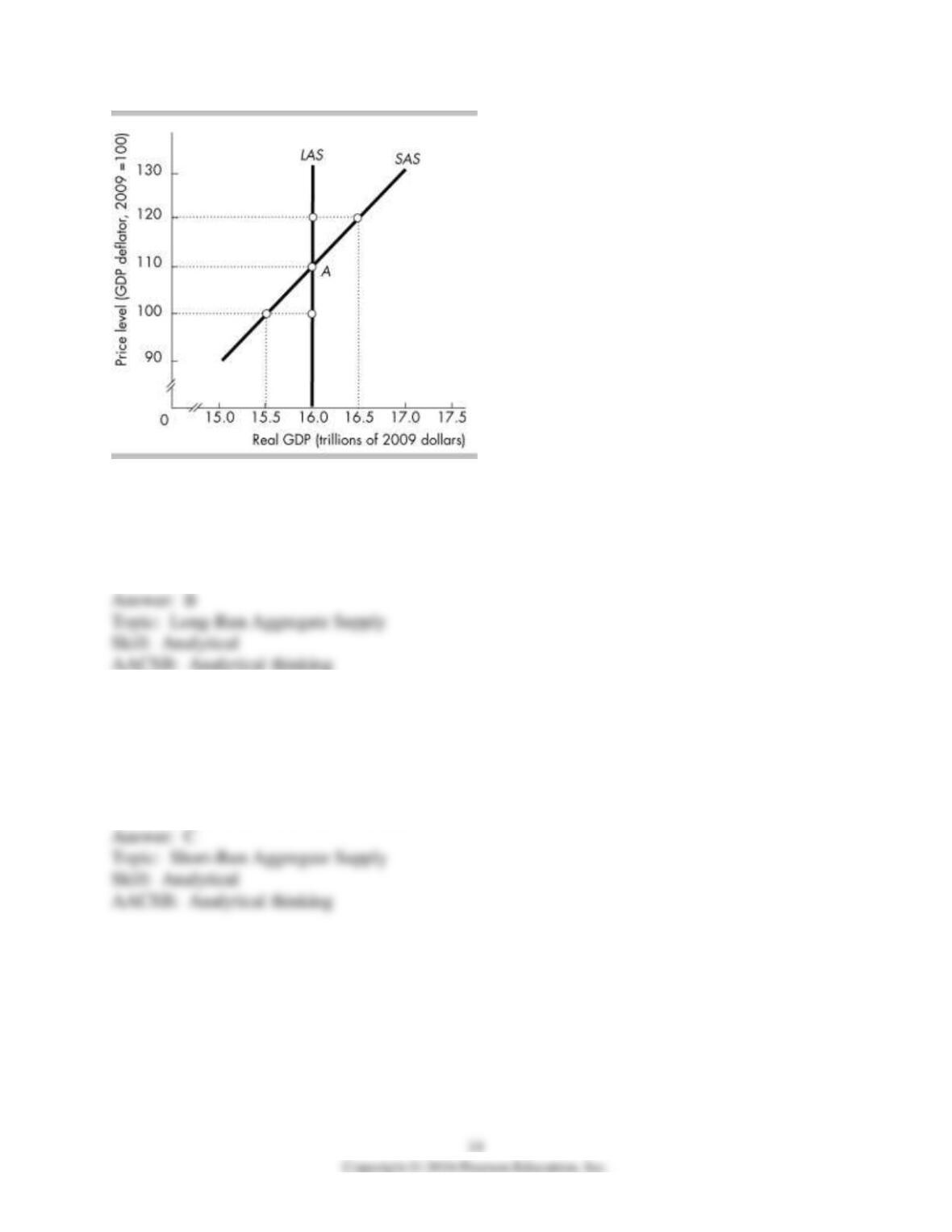
50) In the figure above, potential GDP equals
A) $15.5 trillion.
B) $16.0 trillion.
C) $16.5 trillion.
D) None of the above answers is correct.
51) In the figure above, the economy is at point A when the price level rises to 120. Money wage
rates and other resource prices remain constant. Firms are willing to supply output equal to
A) $15.5 trillion.
B) $16.0 trillion.
C) $16.5 trillion.
D) None of the above answers is correct.
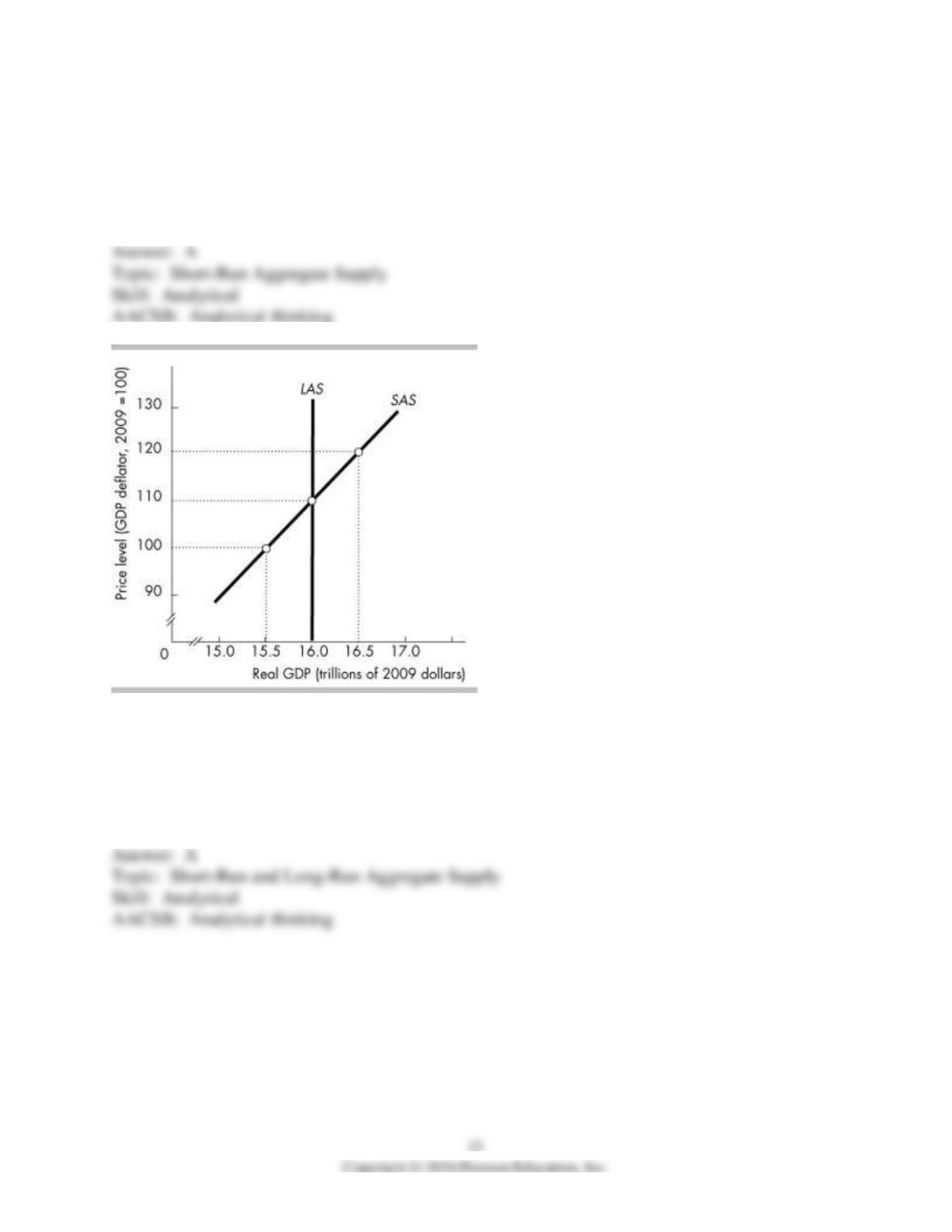
52) In the figure above, the economy is at point A when the price level falls to 100. Money wage
rates and all other resource prices remain constant. Firms are willing to supply output equal to
A) $15.5 trillion.
B) $16.0 trillion.
C) $16.5 trillion.
D) None of the above answers is correct.
53) In the above figure, the economy will be at full employment if the price level
A) is 110.
B) is above 110.
C) is below 100.
D) All of the above are possible because the economy will be at full employment at any price
level at, above, or below 110.
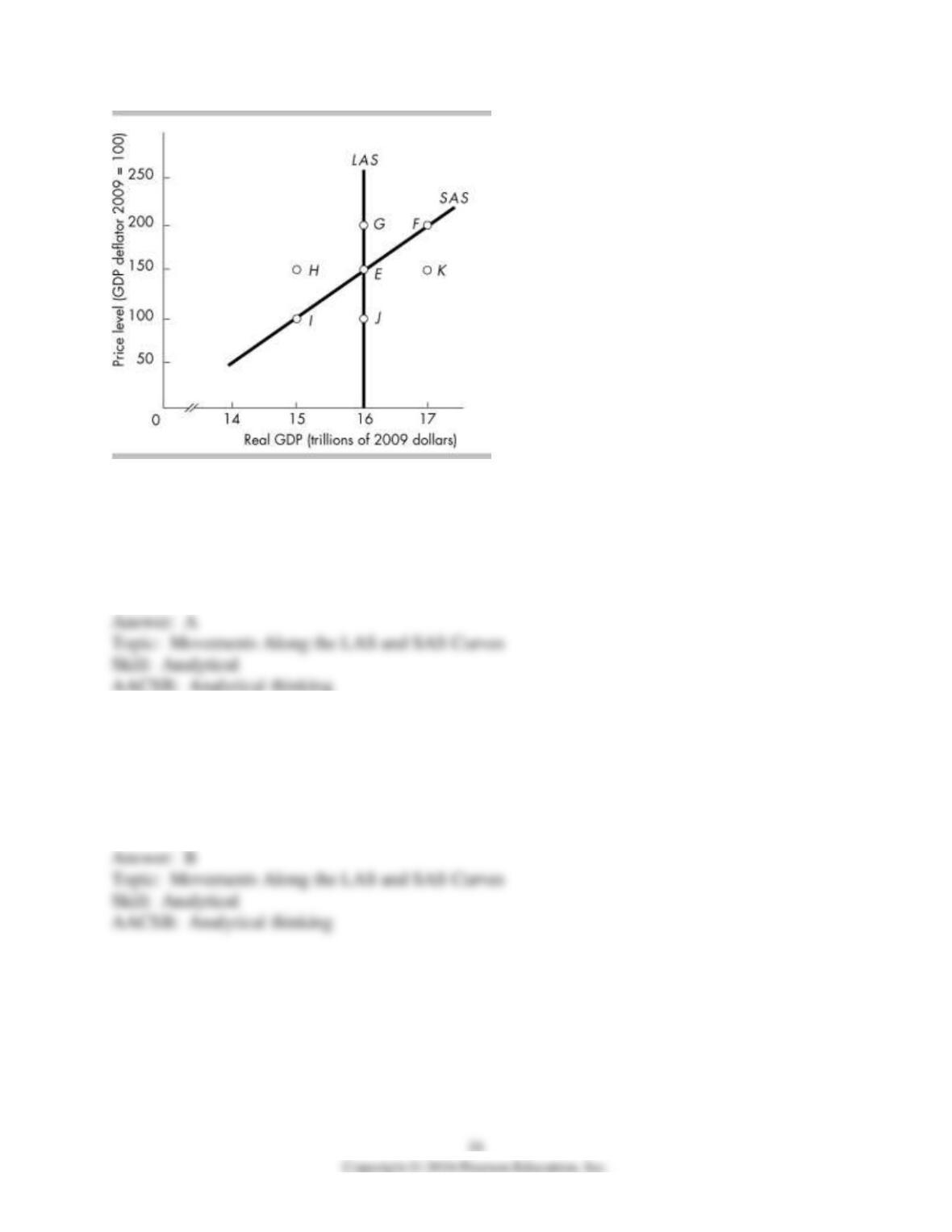
54) In the above figure, which movement illustrates the impact of a falling price level and a
constant money wage rate?
A) E to I
B) E to F
C) E to J
D) E to H
55) In the above figure, which movement illustrates the impact of a rising price level and a
constant money wage rate?
A) E to I
B) E to F
C) E to G
D) E to K
56) In the above figure, which movement illustrates the impact of the price level and money
wage rate falling at the same rate?
A) E to H
B) E to K
C) E to J
D) E to G
57) In the above figure, which movement illustrates the impact of the price level and money
wage rate rising at the same rate?
A) E to H
B) E to K
C) E to G
D) E to J
58) In the above figure, which movement illustrates the impact of a constant price level and a
rising money wage rate?
A) E to I
B) E to F
C) E to J
D) E to H
59) Which of the following events will increase short-run aggregate supply?
A) an advance in technology
B) an increase in resource prices
C) an increase in the natural unemployment rate
D) an increase in foreign income
60) The short-run aggregate supply curve shifts when
I. the full-employment quantity of capital changes.
II. technology advances.
A) I only
B) II only
C) neither I nor II
D) I and II
61) The SAS curve shifts if there is a change in
A) the price level.
B) real GDP.
C) nominal GDP.
D) potential GDP.
62) Which of the following changes does NOT shift the short-run aggregate supply curve?
A) an increase in the price level
B) an increase in technology
C) an increase in the quantity of capital
D) an increase in the money wage rate
63) Which of the following changes does NOT shift the long-run aggregate supply curve?
A) a decrease in the labor force
B) a fall in the price level
C) a rise in number of college graduates in the labor force
D) a tax hike that reduces the capital stock
64) In a change to immigration policy during 2012, “people younger than 30 who came to the
United States before the age of 16, pose no criminal or security threat, and were successful
students or served in the military can get a two-year deferral from deportation”, Homeland
Security Secretary Janet Napolitano said, according to CNN, 06/16/2012. If many of these
immigrants had previously been afraid to work, now as a result of being able to work legally
A) both the short-run and long-run aggregate supply curves shift rightward.
B) only the long-run aggregate supply curve shifts rightward.
C) only the short-run aggregate supply curve shifts rightward.
D) neither the short-run nor the long-run supply curve shift.
65) In a change to immigration policy during 2012, “people younger than 30 who came to the
United States before the age of 16, pose no criminal or security threat, and were successful
students or served in the military can get a two-year deferral from deportation”, Homeland
Security Secretary Janet Napolitano said, according to CNN, 06/16/2012. If many of these
immigrants had previously been afraid to work, now as a result of being able to work legally
A) the long-run aggregate supply curve shifts leftward and potential GDP decreases.
B) the short-run aggregate supply curve shifts rightward but potential GDP does not increase.
C) the long-run aggregate supply curve shifts rightward and potential GDP increases.
D) neither the short-run nor the long-run supply curve shifts.
66) All of the following shift the LAS curve EXCEPT
A) a change in the capital stock.
B) an increase in the money wage rate.
C) an increase in the stock of human capital.
D) technological progress.
67) All of the following shift the short-run aggregate supply curve EXCEPT
A) a change in the price level.
B) a change in the money wage rate.
C) a change in the price of a raw material.
D) technological progress.
68) Which of the following directly shifts the short-run aggregate supply curve?
A) a change in aggregate demand
B) a change in the price level
C) a change in resource prices
D) all of the above
69) Which of the following shifts the short-run aggregate supply curve?
I. changes in the size of the labor force
II. changes in the money wage rate
A) I only
B) II only
C) both I and II
D) neither I nor II
70) The short-run aggregate supply curve shifts leftward when the
A) price level increases.
B) general level of technology advances.
C) money wage rate increases.
D) availability of on-the-job training expands to all workers.
71) Suppose there is a temporary increase in the price of oil. This is represented by
A) a leftward shift of the SAS and the LAS curve.
B) a leftward shift of the LAS curve.
C) a rightward shift of the SAS curve.
D) a leftward shift of the SAS curve.