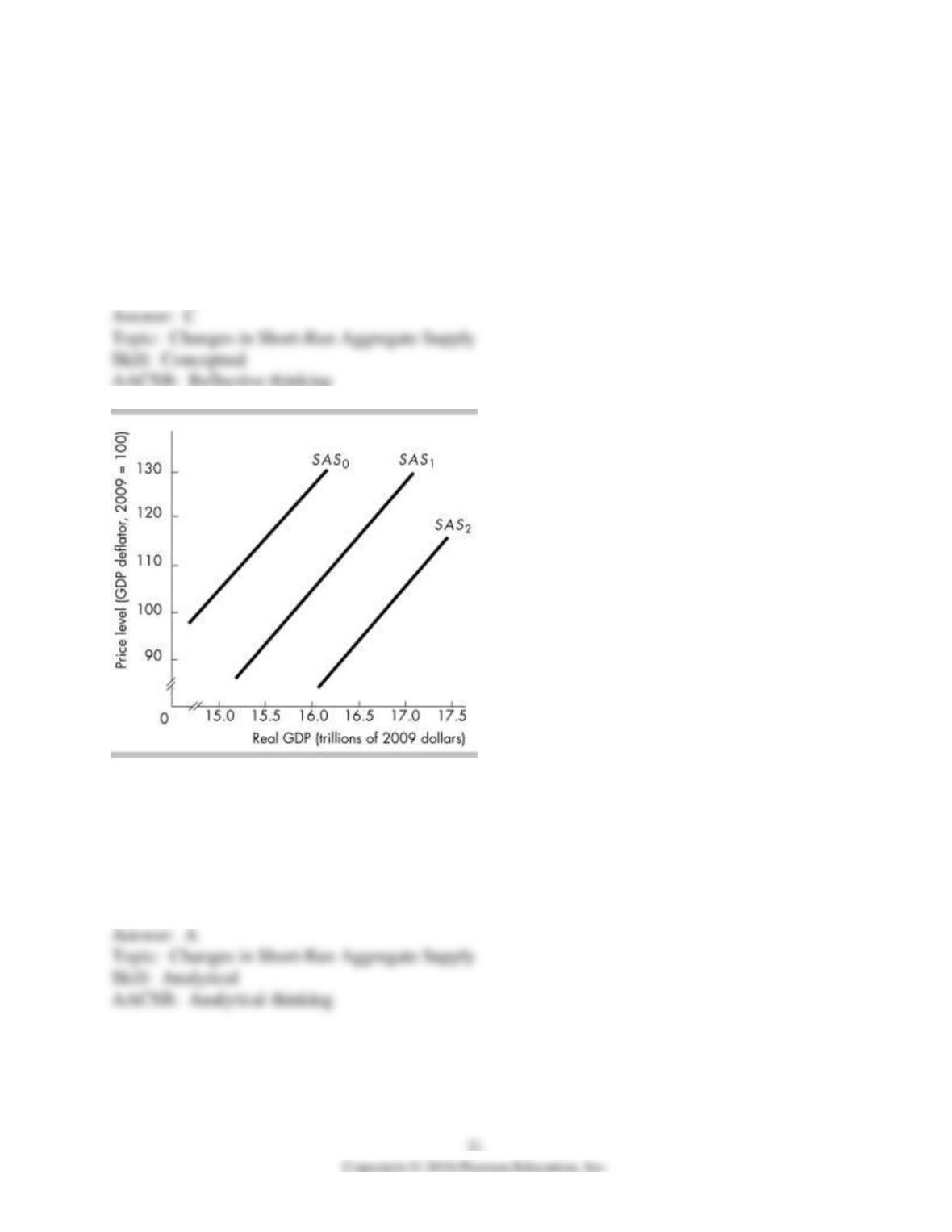
72) Which of the following shifts both the short-run aggregate supply curve and the long-run
aggregate supply curve?
I. changes in the size of the labor force
II. changes in the money wage rate
III. changes in the quantity of capital
A) II only
B) both I and II
C) both I and III
D) I, II and III
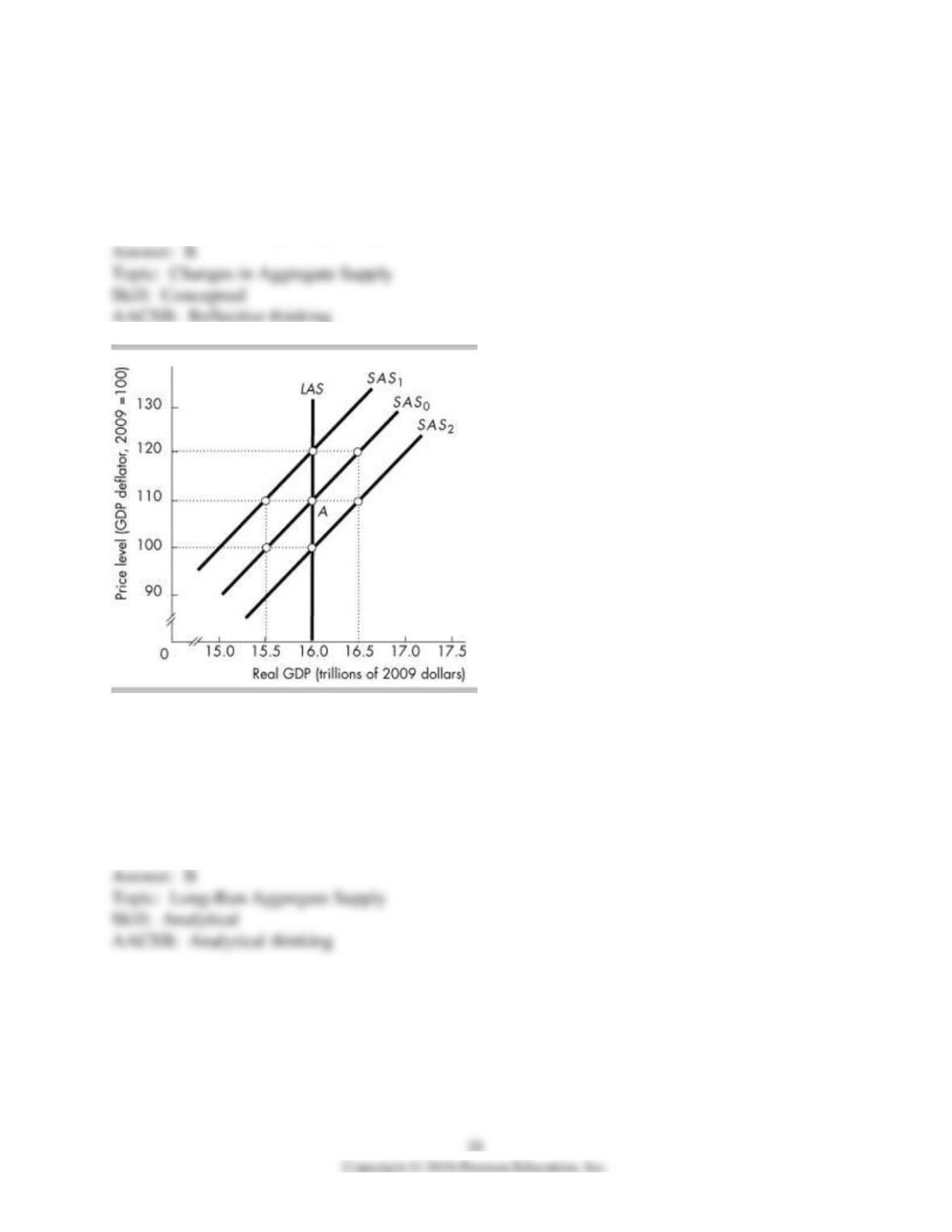
73) In the above figure, the short-run aggregate supply curve is SAS1. Suppose that the price
level in the economy increases. As a result there is
A) an upward movement along SAS1.
B) a downward movement along SAS1.
C) a shift to SAS0.
D) a shift to SAS2.
74) In the above figure, the short-run aggregate supply curve is SAS1. If technology advances,
there is
A) an upward movement along SAS1.
B) a downward movement along SAS1.
C) a shift to SAS0.
D) a shift to SAS2.
75) In the above figure, the short-run aggregate supply curve is SAS1. If the money wage rate
increases, there is
A) an upward movement along SAS1.
B) a downward movement along SAS1.
C) a shift to SAS0.
D) a shift to SAS2.
76) In the above figure, the short-run aggregate supply curve is SAS1. If the prices of resources
fall, there is
A) an upward movement along SAS1.
B) a downward movement along SAS1.
C) a shift to SAS0.
D) a shift to SAS2.
77) A change in the full-employment quantity of labor ________ the short-run aggregate supply
curve and ________ the long-run aggregate supply curve.
A) shifts; shifts
B) shifts; does not shift
C) does not shift; shifts
D) does not shift; does not shift
78) If the full-employment quantity of labor increases, then the
A) LAS curve shifts rightward and the SAS curve does not shift.
B) SAS curve shifts rightward and the LAS curve does not shift.
C) SAS curve shifts rightward and the LAS curve shifts rightward.
D) SAS curve shifts rightward and the LAS curve does shifts leftward.
79) When the quantity of capital increases, then the
A) LAS curve shifts rightward and the SAS curve does not shift.
B) SAS curve shifts rightward and the LAS curve does not shift.
C) SAS curve shifts rightward and the LAS curve shifts rightward.
D) SAS curve shifts rightward and the LAS curve does shifts leftward.
80) With an increase in the capital stock, the short-run aggregate supply curve
A) remains as it is.
B) shifts rightward.
C) shifts leftward.
D) becomes steeper.
81) An increase in the amount of human capital ________ the short-run aggregate supply curve
and ________ the long-run aggregate supply curve.
A) shifts; shifts
B) shifts; does not shift
C) does not shift; shifts
D) does not shift; does not shift

82) A change in the capital stock ________ the short-run aggregate supply curve and ________
the long-run aggregate supply curve.
A) shifts; shifts
B) shifts; does not shift
C) does not shift; shifts
D) does not shift; does not shift
83) The land of Mordor increases its capital stock. As a result, the long-run aggregate supply
curve shifts ________ and so does the ________ curve.
A) rightward; aggregate demand
B) leftward; aggregate demand
C) rightward; short-run aggregate supply
D) leftward; short-run aggregate supply
84) Which of the following shifts both the LAS and SAS curves?
A) a change in the price level
B) a change in the money wage rate
C) a simultaneous change in both the price level and the money wage rate
D) an advance in technology
85) A technological advance ________ the long-run aggregate supply curve and ________ the
short-run aggregate supply curve.
A) shifts; shifts
B) shifts; does not shift
C) does not shift; shifts
D) does not shift; does not shift
86) Technological progress will
A) shift the LAS curve rightward but will not shift the SAS curve.
B) not shift either the LAS or the SAS curve.
C) shift both the LAS and SAS curves rightward.
D) shift the SAS curve rightward but will not shift the LAS curve.
87) The short-run aggregate supply curve shifts because of changes in all of the following
EXCEPT
A) the capital stock.
B) technological progress.
C) money wage rates.
D) the price level.
88) If the money prices of resources changes
A) the LAS curve shifts.
B) the SAS curve shifts.
C) the AD curve shifts.
D) the macroeconomic equilibrium is unaffected.
89) If the money wage rate rises, then the
A) SAS curve shifts rightward.
B) SAS curve shifts leftward.
C) LAS curve shifts rightward.
D) LAS curve shifts leftward.
90) If the money price of a resource such as oil falls, then the
A) LAS curve shifts rightward.
B) LAS curve shifts leftward.
C) SAS curve shifts leftward.
D) SAS curve shifts rightward.
91) Suppose that the money wage in the economy increases by 8 percent. As a result the
A) long-run aggregate supply will decrease.
B) long-run and the short-run aggregate supply both decrease.
C) short-run aggregate supply will decrease.
D) long-run aggregate supply will increase and the short-run aggregate supply will decrease.
92) A decrease in the money wage rate
A) increases the long-run aggregate supply.
B) decreases the long-run aggregate supply.
C) increases the short-run aggregate supply.
D) decreases the short-run aggregate supply.
93) An increase in the money wage rate
A) increases the long-run aggregate supply.
B) decreases the long-run aggregate supply.
C) increases the short-run aggregate supply.
D) decreases the short-run aggregate supply.
94) A change in the money wage rate shifts
A) both the SAS and LAS curves.
B) the LAS curve but not the SAS curve.
C) the SAS curve but not the LAS curve.
D) neither the SAS nor the LAS curve.
95) An increase in the money wage rate shifts the short-run aggregate supply curve ________; an
increase in technology shifts the long-run aggregate supply curve ________.
A) rightward; rightward
B) rightward; leftward
C) leftward; rightward
D) leftward; leftward
96) A decrease in the money wage rate increases ________ and an increase in the full-
employment quantity of labor increases ________.
A) the SAS and the LAS; only the SAS
B) the SAS and the LAS; only the LAS
C) only the SAS; the SAS and the LAS
D) only the LAS; the SAS and the LAS
97) An increase in the quantity of capital increases ________ and increase in the full-
employment quantity of labor increases ________.
A) the SAS and the LAS; only the SAS
B) the SAS and the LAS; only the LAS
C) the SAS and the LAS; the SAS and the LAS
D) only the LAS; the SAS and the LAS
98) Suppose there is an increase in the short-run aggregate supply with no change in the long-run
aggregate supply. This situation could be the result of
A) an increase in the price of oil.
B) a decrease in the money wage rate.
C) a technological advancement.
D) an increase in the quantity of capital.
99) In the above figure, the economy is currently at point A. Suppose that the money wage rate
and the price level both fall by 10 percent. Firms will be willing to supply output equal to
A) less than $16.0 trillion.
B) $16.0 trillion.
C) more than $16.0 trillion.
D) Without more information, it is impossible to determine which of the above answers is
correct.
100) In the above figure, the economy is at point A. Then the price level falls to 90 while the
money wage rate does not change. Firms will be willing to supply output equal to
A) less than $16.0 trillion.
B) $16.0 trillion.
C) more than $16.0 trillion.
D) Without more information, it is impossible to determine which of the above answers is
correct.
101) In the above figure, the economy is at point A. Then the price level rises to 110 while the
money wage rate remains constant. Firms will be willing to supply output equal to
A) less than $16.0 trillion.
B) $16.0 trillion.
C) more than $16.0 trillion.
D) Without more information, it is impossible to determine which of the above answers is
correct.
102) In the above figure, the economy is at point A and the money wage rate falls by 10 percent.
If the price level is constant, firms will be willing to supply output equal to
A) less than $16.0 trillion.
B) $16.0 trillion.
C) more than $16.0 trillion.
D) Without more information, it is impossible to determine which of the above answers is
correct.
103) In the above figure, the economy is at point A and the money wage rate rises by 10 percent.
If the price level is constant, firms will be willing to supply output equal to
A) less than $16.0 trillion.
B) $16.0 trillion.
C) more than $16.0 trillion.
D) Without more information, it is impossible to determine which of the above answers is
correct.
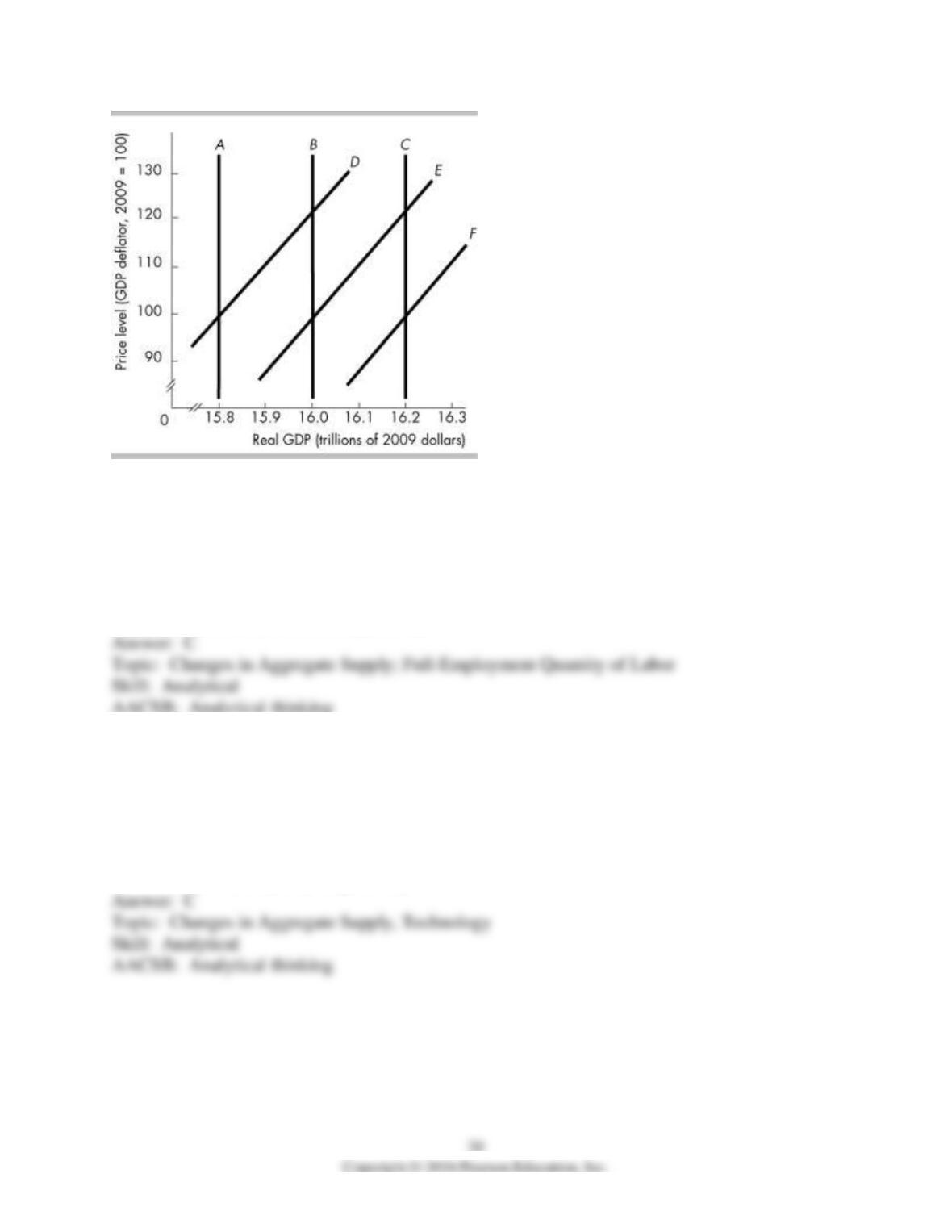
104) In the above figure, B is the current long-run aggregate supply curve and E is the current
short-run aggregate supply curve. If there is an increase in the full-employment quantity of labor,
then the long-run aggregate supply curve and the short-run aggregate supply curve
A) remain B and E.
B) shift to A and D, respectively.
C) shift to C and F, respectively.
D) remain at B and shift at F, respectively.
105) In the above figure, B is the current long-run aggregate supply curve and E is the current
short-run aggregate supply curve. Technological advances mean the long-run aggregate supply
curve and short-run aggregate supply curve
A) remain B and E.
B) shift to A and D, respectively.
C) shift to C and F, respectively.
D) shift to C and remain E, respectively.
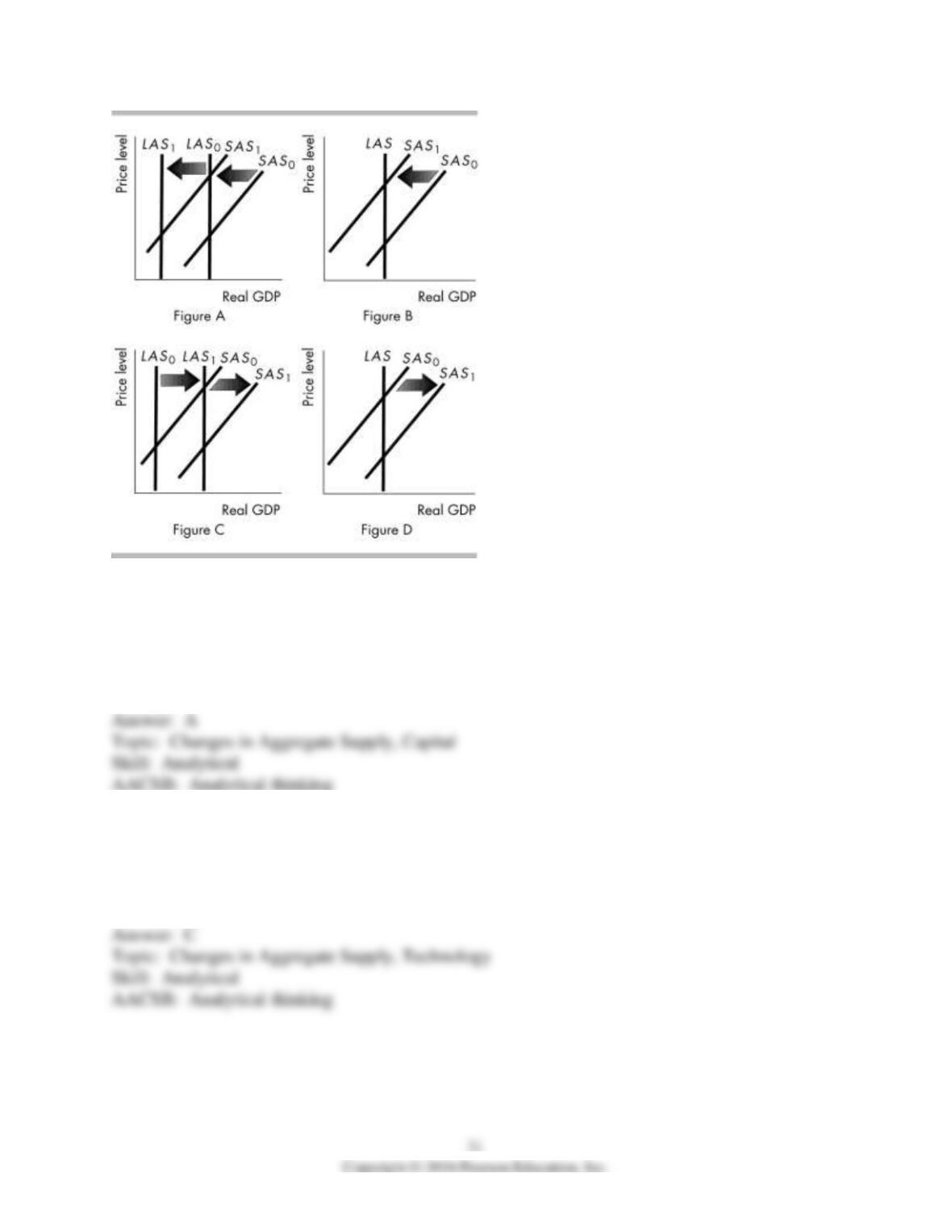
106) In the above figure, which part corresponds to a destruction of part of the nation’s capital
stock?
A) Figure A
B) Figure B
C) Figure C
D) Figure D
107) In the above figure, which point corresponds to an increase in technology?
A) Figure A
B) Figure B
C) Figure C
D) Figure D
108) In the above figure, which part corresponds to an increase in the money wage rate?
A) Figure A
B) Figure B
C) Figure C
D) Figure D
109) In the above figure, which part corresponds to a fall in the money wage rate?
A) Figure A
B) Figure B
C) Figure C
D) Figure D
110) In the above figure, which point corresponds to an increase in human capital?
A) Figure A
B) Figure B
C) Figure C
D) Figure D
111) Moving along which curve does the money wage rate and the price level change in the
same proportions?
A) the AD curve
B) the SAS curve
C) the LAS curve
D) None of the above because there is no curve along which both the money wage rate and the
price level change in the same proportions.
112) Long-run aggregate supply will decrease for all of the following reasons EXCEPT
A) reduced money wages.
B) decreased human capital.
C) decrease in the level of full employment.
D) decreased capital.
113) A fall in the money wage rate shifts
A) both the SAS and LAS curves rightward.
B) both the SAS and LAS curves leftward.
C) the SAS curve rightward but leaves the LAS curve unchanged.
D) the LAS curve rightward but leaves the SAS curve unchanged.
1) The aggregate demand curve shows
A) total expenditures at different levels of national income.
B) the quantity of real GDP demanded at different price levels.
C) that real income is directly (positively) related to the price level.
D) All of the above answers are correct.
2) The AD curve shows the sum of
A) the price level, employment, and real GDP.
B) consumption expenditure, investment, and real GDP.
C) consumption expenditure, investment, government expenditures on goods and services, and
net exports.
D) consumption expenditure, investment, the price level, and real GDP.
3) The aggregate demand curve
A) has a negative slope.
B) has a positive slope.
C) is vertical.
D) is horizontal.
4) Aggregate demand is the relationship between the quantity of real GDP demanded and the
________.
A) price level
B) money wage rate
C) real wage rate
D) nominal GDP demanded
5) Moving along the aggregate demand curve, a decrease in the quantity of real GDP demanded
is a result of
A) an increase in the price level.
B) a decrease in the price level.
C) an increase in income.
D) a decrease in income.
6) Other things constant, the economy’s aggregate demand curve shows that
A) as the price level falls, real GDP decreases.
B) any change in the price level shifts the aggregate demand curve.
C) the quantity of real GDP demanded decreases when the price level rises.
D) the quantity of real GDP demanded and the price level are not related.
7) The aggregate demand curve shows the ________ relationship between the price level and
________.
A) positive; the quantity of real GDP demanded
B) negative; aggregate labor demanded
C) positive; aggregate labor demand
D) negative; the quantity of real GDP demanded
8) Other things equal, along the aggregate demand curve, a higher price level is associated with
A) an increase in the quantity of real GDP demanded.
B) a decrease in the quantity of real GDP demanded.
C) a decrease in the quantity of nominal GDP demanded.
D) higher income levels.
9) The aggregate demand curve shows that, if other factors are held constant, the higher the price
level, the
A) greater the quantity of real GDP demanded.
B) smaller the quantity of real GDP demanded.
C) larger consumption expenditure.
D) None of the above answers is correct.
10) The aggregate demand curve shows that, if other factors are held constant, a
A) higher price level results in a decrease in the quantity of real GDP demanded.
B) higher price level results in an increase in the quantity of real GDP demanded.
C) higher price level results in a lower interest rate.
D) lower price level results in a higher interest rate.
11) The quantity of real GDP demanded equals $16.2 trillion when the price level is 90. If the
price level rises to 95, the quantity of real GDP demanded equals
A) less than $16.2 trillion.
B) $16.2 trillion.
C) more than $16.2 trillion.
D) more information is needed to determine if the quantity of real GDP demanded increases,
decreases, or does not change.
12) The quantity of real GDP demanded equals $16.4 trillion when the price level is 95. If the
price level falls to 90, the quantity of real GDP demanded equals
A) less than $16.4 trillion.
B) $16.4 trillion.
C) more than $16.4 trillion.
D) more information is needed to determine if the quantity of real GDP demanded increases,
decreases, or does not change.
13) Which of the following changes while moving along the aggregate demand curve?
A) future incomes of households
B) the price level
C) the amount of money in the economy
D) future profits from investment projects
14) The AD curve slopes
A) downward due to the wealth and price effects.
B) downward due to the wealth and substitution effects.
C) upward due to the price and substitution effects.
D) upward due to the wealth and substitution effects.
15) Your real wealth is measured as the
A) amount of assets you have in dollar terms.
B) amount of money you have.
C) amount of goods and services your wealth will buy.
D) amount of goods you have divided by the price level.
16) As the price level falls and other things remain the same, real wealth ________ and
________.
A) decreases; the short-run aggregate supply decreases
B) decreases; the quantity of real GDP demanded decreases
C) increases; aggregate demand increases
D) increases; the quantity of real GDP demanded increases
17) If you have $1,000 of money in the bank and the price level rises by 5 percent, your
A) money is worth more in terms of what it can purchase.
B) money is worth less in terms of what it can purchase.
C) money is worth the same in terms of what it can purchase.
D) purchasing power has increased.
18) According to the wealth effect, if real wealth decreases then people
A) decrease their consumption expenditure.
B) increase their consumption expenditure.
C) do not respond if their nominal wealth does not change.
D) decrease their consumption expenditure only if their nominal wealth also decreases.
19) An individual holds $10,000 in a checking account and the price level rises significantly.
Hence
A) the individual’s real wealth and consumption expenditure decrease.
B) the individual’s real wealth decreases but real national wealth increases.
C) there is no change in the individual’s real wealth.
D) the individual’s real wealth increases.
20) If you have $1,000 in wealth and the price level increases by 20 percent, then
A) the $1,000 will buy fewer goods and services.
B) the $1,000 dollars will buy 20 percent more goods and services.
C) the real value of the $1,000 increases.
D) you will be able to buy fewer goods, but the real value of those goods will increase.
21) If you have $5,000 in wealth and the price level decreases by 20 percent, then
A) the $5,000 will buy fewer goods and services.
B) the $5,000 will buy more goods and services.
C) the real value of the $5,000 decreases.
D) the real value of the $5,000 remains constant.
22) A rise in the price level changes aggregate demand because
A) firms increase their investment when prices are higher.
B) the real value of people’s wealth varies directly with the price level and so does their
spending.
C) the real value of people’s wealth decreases and so they decrease their consumption.
D) the more money people have, the more it is worth and hence the more goods and services
they demand.
23) One reason that the aggregate demand curve has a negative slope is because
A) people buy fewer goods and save more when the price level rises because their real wealth
decreases.
B) firms produce more when the price rises.
C) people earn more money when output rises.
D) The premise of the question is wrong because the aggregate demand curve has a positive
slope.
24) The intertemporal substitution effect refers to substitution of
A) goods for services.
B) goods and services for less expensive goods and services.
C) goods and services today for goods and services in the future.
D) goods and services produced domestically for goods and services produced in another
country.
25) According to the intertemporal substitution effect, when the price level rises and other things
remain the same
A) the interest rate falls.
B) the interest rate rises.
C) the quantity of money increases.
D) government taxes rise.
26) Substitution effects help explain the slope of the aggregate demand curve. One substitution
effect refers to the
A) inverse relationship between the interest rate and the price level.
B) direct relationship between the interest rate and the real value of wealth.
C) effect on investment expenditures that result from a change in interest rates produced by a
change in the price level.
D) change in wealth that results from a change in the interest rate.
27) According to the intertemporal substitution effect, a fall in the price level will
A) decrease the real value of wealth, which increases the quantity of real GDP demanded.
B) cause the interest rate to fall so that investment increases and the quantity of real GDP
demanded increases.
C) increase net exports, which causes the quantity of real GDP demanded to increase.
D) increase the real value of wealth, which raises the interest rate so that the quantity of real
GDP demanded decreases.
28) According to the intertemporal substitution effect, when the price level increases, the interest
rate
A) rises and the quantity of real GDP demanded increases.
B) rises and the quantity of real GDP demanded decreases.
C) falls and the quantity of real GDP demanded decreases.
D) is not affected.
29) According to the intertemporal substitution effect, a higher price level
A) decreases the quantity of real GDP demanded.
B) lowers the costs of building new plants and equipment.
C) increases the quantity of real GDP demanded.
D) makes it less costly for people to buy houses and cars.
30) The intertemporal substitution effect of the price level on aggregate demand
A) is the same as the real wealth effect.
B) is one reason that the aggregate demand curve has a negative slope.
C) explains why aggregate demand increases when the amount of money increases.
D) is one reason that the aggregate demand curve has a positive slope.