75) A long-run aggregate supply curve may graphically be represented as a
A) vertical line.
B) horizontal line.
C) an upward sloping line.
D) a downward sloping line.
76) Economic growth is represented on the aggregate supply model by a
A) shift in the long-run aggregate supply curve to the left.
B) shift in the long-run aggregate supply curve to the right.
C) shift in the short-run aggregate supply curve to the left.
D) shift in the short-run aggregate supply curve to the right.
77) Economic growth can be shown by
A) a leftward shift in the aggregate supply curve.
B) no change in the aggregate supply curve.
C) a rightward shift in the aggregate supply curve.
D) a leftward shift in the production possibilities curve.
78) Economic growth is demonstrated by the LRAS as it
A) shifts to the right.
B) shifts to the left.
C) becomes more horizontal.
D) becomes more vertical.
79) Economic growth causes the
A) production possibilities curve to shift rightward and the long-run aggregate supply curve to
shift rightward.
B) production possibilities curve to shift leftward and the long-run aggregate supply curve to
shift rightward.
C) production possibilities curve to shift rightward and the long-run aggregate supply curve to
shift leftward.
D) production possibilities curve to shift leftward and the long-run aggregate supply curve to
shift leftward.
80) What is the shape of the long-run aggregate supply curve? Why?
10.2 Total Expenditures and Aggregate Demand
1) Which of these questions does aggregate demand help us answer?
I. What determines the total amount of our output that individuals, firms, governments and
foreigners want to buy?
II. What is the economy’s long-run real Gross Domestic Product (GDP)?
III. What determines the economy’s equilibrium price level and the rate of inflation?
A) I only
B) I and II
C) II and III
D) I and III
2) The total level of all planned expenditures in the economy best describes
A) aggregate supply.
B) aggregate demand.
C) aggregate expenditures.
D) both B and C are correct.
3) All of the following explain the downward slope of the aggregate demand curve EXCEPT
A) changes in the stock of real wealth held by individuals.
B) the effect of changing interest rates on the quantity demanded of interest-rate-sensitive goods.
C) the availability of foreign substitute goods.
D) the presence of unused production capacity and unemployment.
4) Other things being equal, the economy’s aggregate demand curve shows that
A) as the price level falls, total planned expenditures fall as well.
B) a change in the general price level causes the curve to shift.
C) a change in the general price level causes a change in the quantity of final goods and services
purchased.
D) real Gross Domestic Product (GDP) and the price level are not related.
5) Aggregate demand reflects
A) planned total spending in the economy.
B) planned total production in the economy.
C) both spending and production in the economy.
D) planned demand for consumer goods only.
6) What is measured on the horizontal axis of the aggregate demand/aggregate supply model?
A) prices
B) real Gross Domestic Product (GDP)
C) planned expenditures
D) nominal income
7) The sum of all planned expenditures for the entire economy at each possible price level is
A) aggregate supply.
B) effective demand.
C) aggregate demand.
D) actual expenditures by consumers.
8) The aggregate demand curve plots
A) desired expenditures against production.
B) total expenditures against the level of employment.
C) planned expenditures against the price level.
D) employment against the price level.
9) The aggregate demand curve is usually
A) vertical.
B) upward sloping.
C) downward sloping.
D) horizontal.
10) The horizontal axis for an aggregate demand curve measures
A) quantity demanded of the representative good.
B) real Gross Domestic Product (GDP).
C) output of all goods and services measured as a quantity index.
D) disposable personal income.
11) The vertical axis for an aggregate demand curve measures
A) quantity demanded of the representative good.
B) real Gross Domestic Product (GDP).
C) the interest rate.
D) the price level.
12) Which of the following is NOT a reason for the slope of the aggregate demand curve?
A) the substitution effect
B) the real balance effect
C) the interest rate effect
D) the open-economy effect
13) At each price level, the aggregate demand curve indicates
A) the nominal value of total production of goods and services domestic income that will be
produced.
B) the total amount of real planned expenditures.
C) the nominal Gross Domestic Product (GDP) that will be produced.
D) the total amount of real Gross Domestic Product (GDP) that will be produced.
14) The aggregate demand curve shows that, if other factors are held constant
A) higher price levels will result in lower total planned spending.
B) higher price levels will result in higher total planned spending.
C) higher price levels will result in lower interest rates.
D) lower price levels will result in inflationary conditions.
15) According to the interest rate effect, an increase in the price level, if other factors are held
constant, will lead to
A) a reduction in total real spending on interest-rate-sensitive goods.
B) an increase in the stock of real wealth held by the public.
C) an outward shift of the aggregate demand curve.
D) an increase in the real interest rate.
16) The real-balance effect implies that when
A) the price level decreases, the value of money balances held by individuals, firms, government,
and foreigners increases and spending decreases.
B) the price level increases, the value of money balances held by individuals, firms, government,
and foreigners increases and spending increases.
C) the price level increases, the value of money balances held by individuals, firms, government,
and foreigners decreases and spending decreases.
D) the price level decreases, the value of money balances held by individuals, firms, government,
and foreigners decreases and spending decreases.
17) The real-balance effect refers to
A) the economy’s response to interest rate changes.
B) the change in the value of cash balances due to price level changes.
C) the change in net exports.
D) the economy’s ability to balance recession and expansion.
18) According to the real-balance effect, the value of money balances held by individuals
A) increases as the price level increases.
B) decreases as the price level increases.
C) does not change regardless of any change in the price level.
D) changes only when the price level remains constant.
19) When prices increase, the real interest rate
A) will increase and total planned spending on goods and services will increase.
B) will increase and total planned spending on goods and services will decrease.
C) will decrease and total planned spending on goods and services will decrease.
D) will not be affected.
20) The interest rate effect implies that
A) the aggregate demand curve has a positive slope.
B) the aggregate demand curve has a negative slope.
C) the short-run aggregate supply curve is horizontal.
D) the short-run aggregate supply curve is vertical.
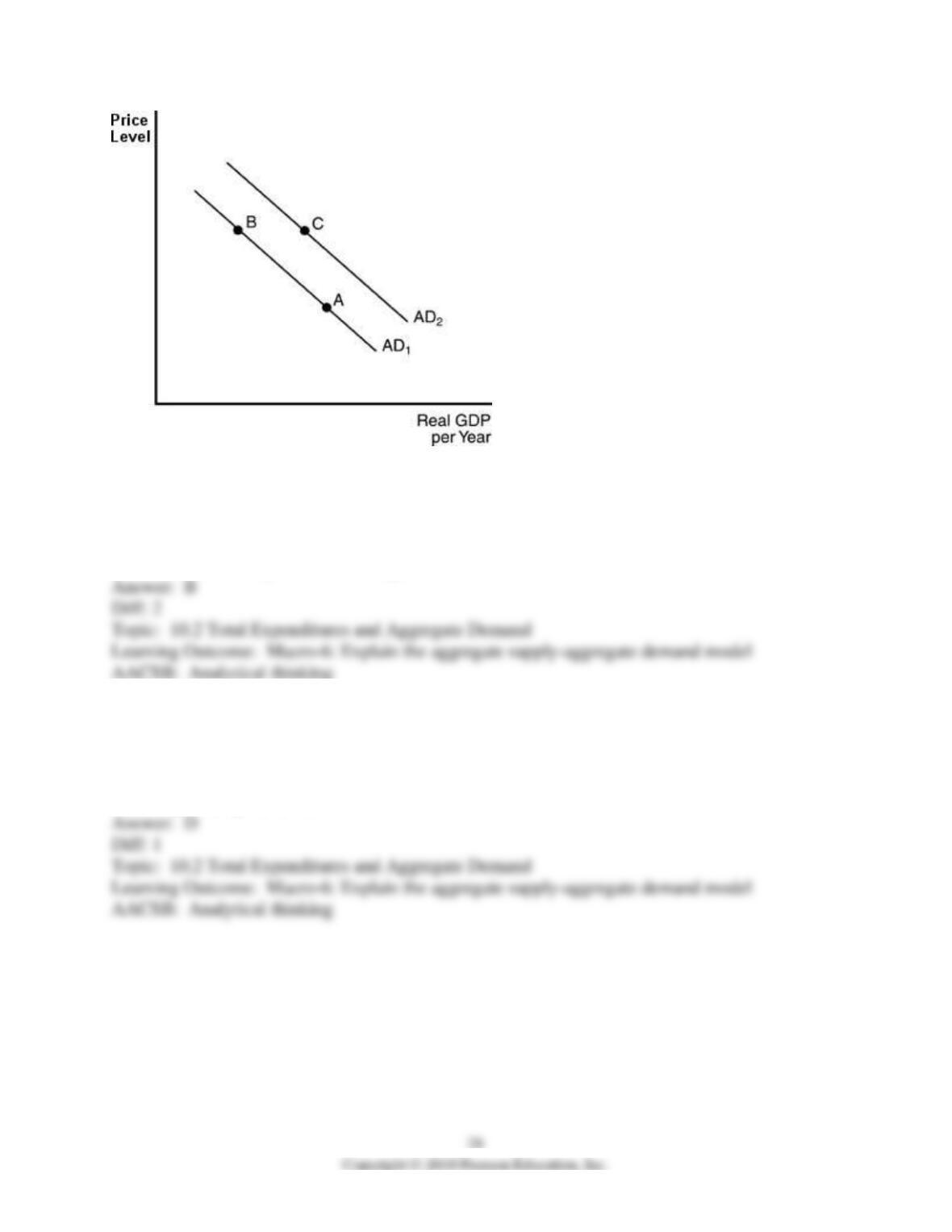
21) In the above figure, a movement from point A to point B can be explained by
A) an decrease in the quantity of money in circulation.
B) a decrease in the real value of cash balances.
C) the decrease in interest rates.
D) the increase in exports to the foreign sector.
22) In the above figure, a movement from point B to point A can be explained by
A) an increase in spending due to a war.
B) an increase in spending due to increases in education expenditures.
C) an increase in the demand for manufacturing goods due to new technology.
D) a drop in the price level.
23) The interest rate effect operates through
A) credit markets by changing borrowing costs.
B) the purchasing power of individuals’ checking accounts.
C) government spending levels.
D) labor supply.
24) When a change in the price level causes a change in the purchasing power of currency, which
then changes planned real expenditures at all income levels, it is called
A) the real-balance effect.
B) the substitution effect.
C) the open-economy effect.
D) the interest rate effect.
25) One reason that the aggregate demand curve slopes downward is because
A) higher price levels increase real wealth and consumption.
B) higher price levels reduce net exports.
C) higher price levels reduce interest rates.
D) higher price levels increase investment.
26) A rise in the price level has a direct effect on spending because
A) people like to spend more when prices are higher.
B) the real value of the money people have varies directly with the price level.
C) the real value of the money people have decreases and they can buy less with it.
D) a higher price gives people more money, and so the more goods and services they can buy.
27) The real-balance effect shows that
A) aggregate demand is upward sloping.
B) a higher price level leads to higher interest rates.
C) a lower price level will increase the purchasing power of currency and increase personal
consumption.
D) consumption and the price level are positively correlated.
28) Another term for the real-balance effect is
A) the substitution effect.
B) the wealth effect.
C) the indirect effect.
D) the interest rate effect.
29) If other factors are held constant, an increase in the price level
A) causes desired net export spending to rise.
B) causes desired net export spending to fall.
C) causes the real value of the money to increase.
D) induces people to spend their money faster.
30) The interest rate effect that helps explain the slope of the aggregate demand curve arises
because
A) interest rates and total planned real expenditures are unrelated.
B) an increase in the price level lead to decreases in interest rates, which induces more
borrowing and hence raises planned real expenditures.
C) an increase in the price level boosts interest rates, which discourages borrowing and hence
reduces planned real expenditures.
D) a decrease in the price level boosts interest rates, which discourages borrowing and hence
frees up income for more planned real expenditures.
31) Higher interest rates tend to
A) reduce the total planned spending on goods and services.
B) lower the costs of building new plants and equipment.
C) increase the quantity demanded of goods and services.
D) make it less costly for people to buy houses and cars.
32) When interest rates rise
A) borrowing costs increase, and total planned real expenditures decline.
B) borrowing costs increase and total planned real expenditures increase.
C) borrowing costs decline, and total planned real expenditures increase.
D) borrowing costs decline, and total planned real expenditures decline.
33) When the relative prices of U.S.-manufactured goods go up, the result is
A) an increase in exports.
B) a decrease in exports.
C) a decrease in imports.
D) no net change in imports or exports.
34) A price level increase tends to reduce net exports, thereby reducing the amount of real goods
and services purchased in the United States. Economists refer to this phenomenon as
A) the wealth effect.
B) the barrier effect.
C) the open-economy effect.
D) the Gross Domestic Product (GDP) effect.
35) If the price level increases
A) the buying power of your bank saving account falls.
B) the buying power of your bank saving accounts rises.
C) there is no effect on buying power.
D) the economy tends to grow faster.
36) One impact of a rise in the U.S. dollar’s value is that
A) imports become cheaper for the U.S. consumer.
B) exports will increase sharply.
C) U.S. goods will become cheaper overseas.
D) U.S. goods are cheaper domestically.
37) An individual holds $10,000 in a non-interest-earning checking account, and the overall
price level rises significantly. Other things being constant, we would expect
A) the individual’s real wealth to decrease and consumption to decline.
B) the individual’s stock of real wealth to decrease but real national income to increase.
C) no change in the individual’s real wealth but a decline in real national product.
D) the individual’s wealth to increase.
38) A higher domestic price level should
A) decrease net exports.
B) increase desired investment.
C) increase real wealth and consumption.
D) none of these.
39) According to the interest rate effect, a decrease in the price level will
A) decrease the real value of money balances, which causes total planned real expenditures to
increase.
B) cause interest rates to fall, which generates an increase in borrowing, so that total planned real
expenditures increase.
C) lead to a decrease in net exports, which causes total planned real expenditures to decrease.
D) increase the real value of money balances, which causes interest rates to increase, thereby
reducing total planned expenditures.
40) What happens when the price level falls?
A) Total planned real spending remains constant.
B) Total planned real spending increases.
C) Total planned real spending also falls.
D) Planned real spending on goods increases but planned real spending on services falls.
41) When the U.S. price level falls, the open economy effect indicates that
A) U.S. imports will rise.
B) U.S. residents will move away from domestic goods and buy more foreign goods.
C) U.S. exports will increase.
D) foreigners will buy fewer U.S. goods.
42) The aggregate demand curve differs from an individual demand curve in that
A) the aggregate demand curve may not slope down while an individual demand curve must
always slope down.
B) the aggregate demand curve looks at the entire circular flow of income and product, while an
individual demand curve looks at one good, holding everything else constant.
C) prices change along an individual demand curve but prices are held constant along an
aggregate demand curve.
D) the aggregate demand curve slopes up while an individual demand curve slopes down.
43) How does aggregate demand curve (AD) differ from an individual demand curve (D)?
A) AD is generally vertical while D is usually downward sloping.
B) D represents the price-quantity relationship for a single good or service while AD looks at the
entire economic system.
C) Look for D in macroeconomic analyses and for AD in microeconomics.
D) AD is generally a downward sloping curve while D usually slopes upward.
44) Aggregate demand is
A) the horizontal summation of all demand curves for a product.
B) the sum of all planned expenditures for the economy.
C) the total quantity of all goods sold in an economy in a year.
D) the horizontal summation of all demand curves for state, local, and federal governments and
business firms.
45) The total of all planned expenditures in the entire economy is the definition of
A) aggregate supply.
B) production possibilities curve.
C) aggregate demand.
D) net domestic product.
46) The open economy effect suggests that
A) a decrease in domestic price level will cause foreign residents to buy fewer domestic goods,
increasing net exports.
B) a decrease in domestic price level will cause foreign residents to buy more domestic goods,
increasing net exports.
C) a rise in domestic price level will cause foreign residents to buy more domestic goods.
D) a rise in domestic price level will cause domestic residents to buy fewer imported goods.
47) The interest rate effect suggests that
A) an increase in the price level decreases the interest rate, which causes businesses and
consumers to reduce desired spending.
B) an increase in the price level increases the interest rate, which causes businesses and
consumers to reduce desired spending.
C) a decrease in the price level decreases the interest rate, which causes businesses and
consumers to reduce desired spending.
D) an increase in the price level increases the money supply, which causes businesses and
consumers to increase desired spending.
48) The aggregate demand curve gives the
A) planned purchases for all goods and services in the economy, holding other things such as the
price level constant.
B) planned purchase rates for all goods and services in the economy at various price levels.
C) demand for goods and services by the government at various price levels.
D) amount of all goods everyone wants to buy at various income levels.
49) The total of all planned expenditures in the entire economy is
A) the open economy effect.
B) LRAS.
C) aggregate supply.
D) aggregate demand.
50) The various quantities of all final commodities demanded at various price levels, ceteris
paribus, is the
A) LRAS.
B) production possibilities curve.
C) aggregate demand curve.
D) aggregate supply curve.
51) The aggregate demand curve gives
A) the total amount of real domestic output that will be purchased at each price level.
B) the total amount of nominal domestic income that will be purchased at each price level.
C) the total value of nominal GDP in an economy for a year, holding income and technology
constant.
D) the total value of output produced by workers in both foreign and domestic markets at each
price level.
52) All of the following are components of aggregate demand EXCEPT
A) consumption spending.
B) government purchases.
C) the level of technology.
D) net foreign spending on domestic production.
53) The aggregate demand curve
A) is vertical at the full-employment level of output.
B) is horizontal at the full-employment level of output.
C) is downward sloping.
D) is upward sloping.
54) The aggregate demand curve has
A) no relationship between the price level and real GDP.
B) a negative relationship between the price level and real GDP.
C) a positive relationship between the price level and real GDP.
D) a positive relationship between the price level and nominal GDP.
55) Which of the following explains why the aggregate demand curve is downward sloping?
A) the interest rate effect
B) the real-balance effect
C) the open economy effect
D) all of the above
56) Suppose that along the aggregate demand curve, real GDP equals $15 trillion when the GDP
deflator is 90. If the GDP deflator were 95, real GDP along the aggregate demand curve would
equal
A) less than $15 trillion.
B) $15 trillion.
C) more than $15 trillion but less than $15.8 trillion.
D) more than $15 trillion.
57) Other things being equal, along an aggregate demand curve, a higher price level is associated
with
A) a higher real GDP.
B) a lower real GDP.
C) a lower nominal GDP.
D) higher income levels.
58) Other things being equal, the lower planned real expenditures along an aggregate demand
curve are, the
A) more the production possibilities cure shifts to the left.
B) lower the price level.
C) higher the price level.
D) lower the level of endowments.
59) When the price level increases, total planned real expenditures on goods and services falls.
All of the following are responsible EXCEPT
A) the substitution effect.
B) the real-balance effect.
C) the interest rate effect.
D) the open economy effect.
60) Which of the following is a factor that determines the shape of the aggregate demand curve?
A) the real-balance effect
B) the nominal-balance effect
C) the price level effect
D) the wage effect
61) According to the real-balance effect, an increase in the price level will
A) leave total planned real expenditures unchanged since the price level of all goods has
increased.
B) decrease total planned real expenditures because of an increase in interest rates.
C) lead to a corresponding increase in total planned real expenditures since businesses are now
earning higher profits.
D) decrease total planned real expenditures as a result of a decrease in the real value of money
balances.
62) The change in total planned real expenditures resulting from a change in the real value of
money balances when the price level changes, all other things held constant, is
A) the real-balance effect.
B) the interest rate effect.
C) the open economy effect.
D) demand side inflation.
63) The real-balance effect refers to
A) the real interest rate.
B) the production of real goods and services as opposed to financial instruments.
C) the prices of goods and services.
D) the real value of cash balances that a person is holding.
64) If you have $4000 and the GDP deflator decreases from 100 to 90
A) the $4000 will buy 10 percent less of the goods and services produced by society.
B) the $4000 will buy 10 percent more of the goods and services produced by society.
C) the value of the $4000 decreases.
D) the value of the $4000 remains constant.
65) The wealth effect is another term for the
A) substitution effect.
B) indirect effect.
C) real-balance effect.
D) interest rate effect.