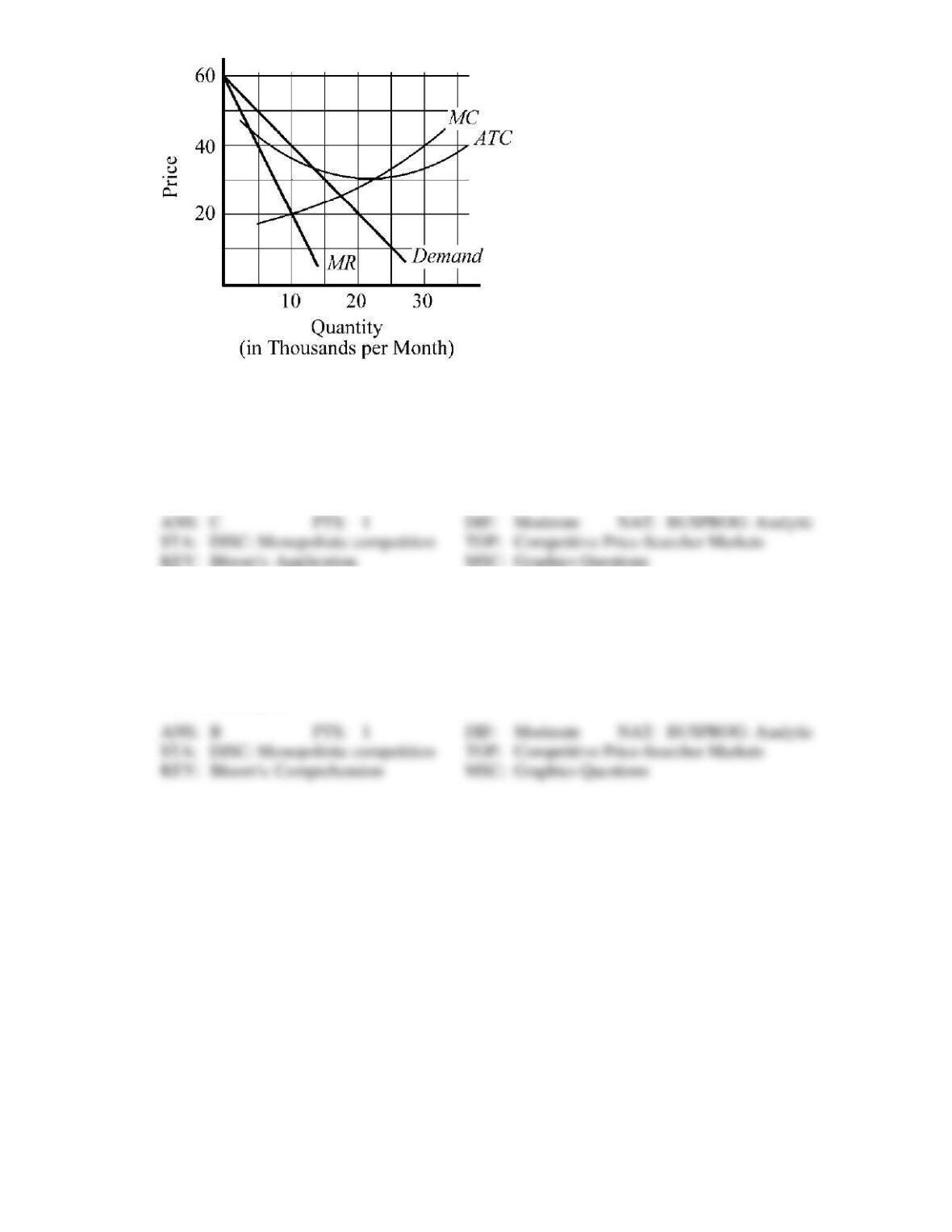
161. Given the cost and demand conditions depicted in Figure 10-10 for the competitive price-searcher
firm, what is the price that the firm should charge if it wants to maximize its profit?
a.
20
b.
30
c.
40
d.
50
162. What is the approximate maximum economic profit this firm depicted in Figure 10-10 will be able to
earn per month?
a.
zero profit
b.
$50,000 profit
c.
$200,000 profit
d.
$400,000 profit
Figure 10-11
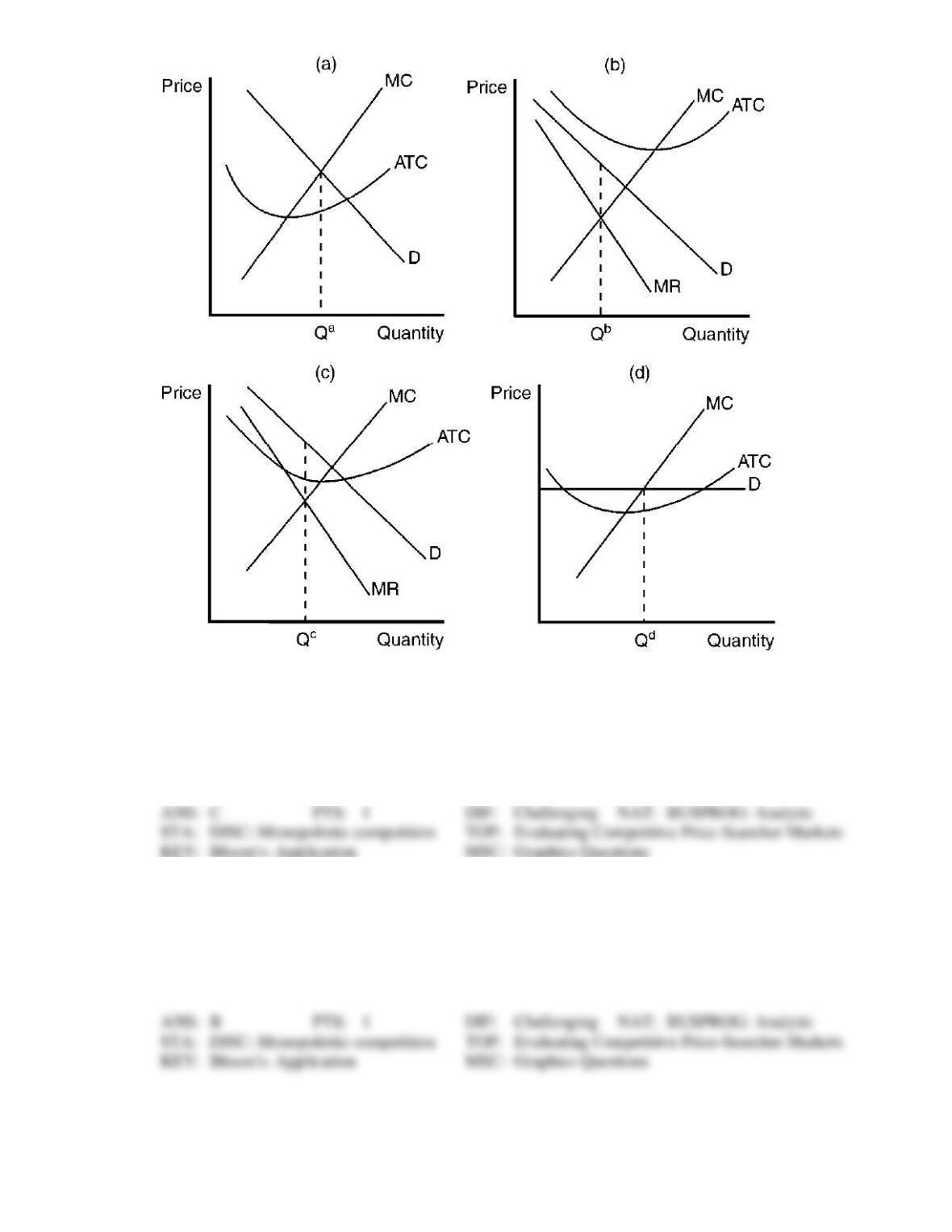
163. Refer to Figure 10-11. Which of the graphs shown would be consistent with a firm in a competitive
price-searcher market that is earning a positive profit?
a.
Panel a
b.
Panel b
c.
Panel c
d.
Panel d
164. Refer to Figure 10-11. Which of the graphs shown would be consistent with a firm in a competitive
price-searcher market that is maximizing profit but profit is still negative?
a.
Panel a
b.
Panel b
c.
Panel c
d.
Panel d
Figure 10-12
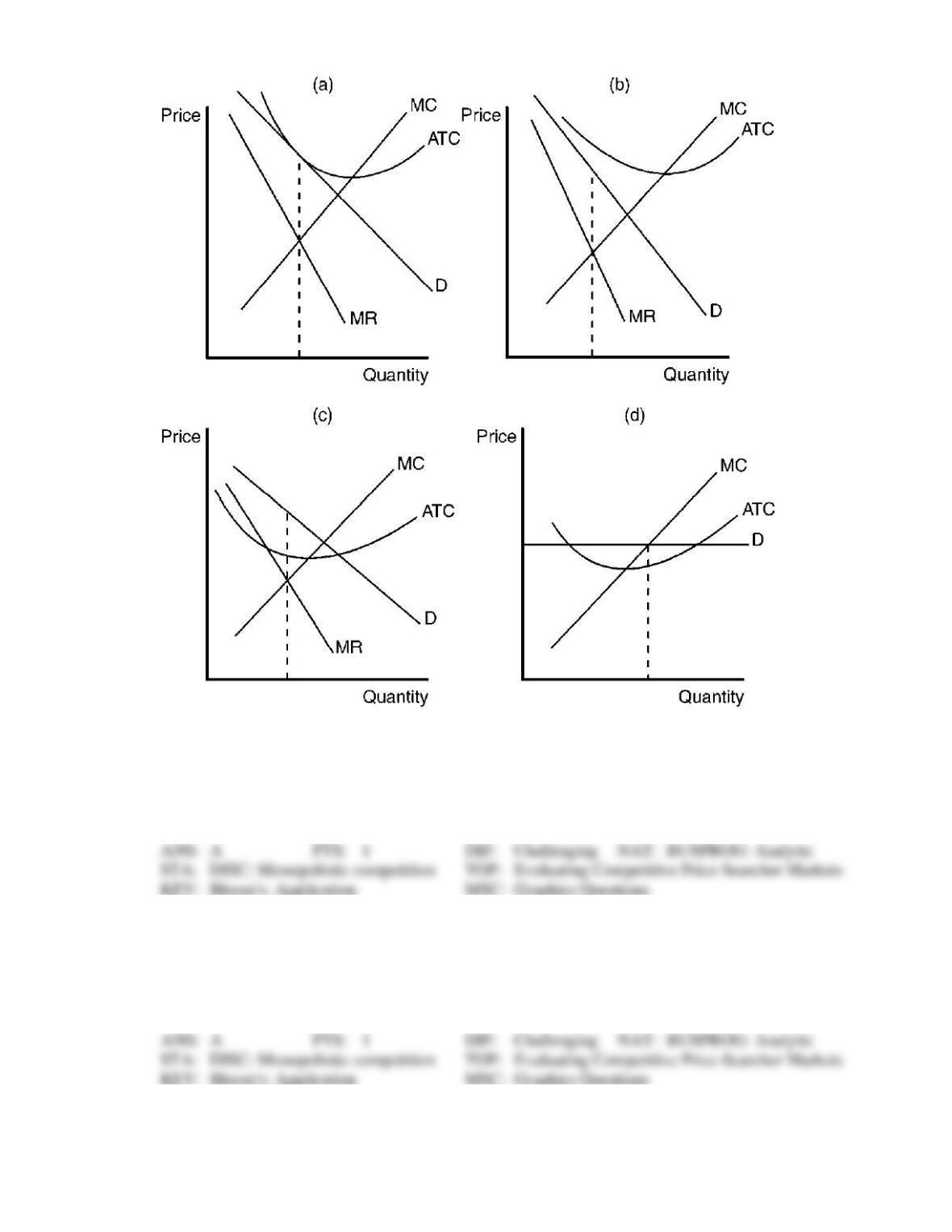
165. Refer to Figure 10-12. Panel (a) shows a profit-maximizing competitive price-searcher firm that is
a.
earning zero economic profit.
b.
likely to exit the market in the long run.
c.
producing its efficient scale of output.
d.
not maximizing its profit.
166. Refer to Figure 10-12. Panel (b) is consistent with a firm in a competitive price-searcher market that is
a.
not in long-run equilibrium.
b.
in long-run equilibrium.
c.
producing its efficient scale of output.
d.
earning a positive economic profit.
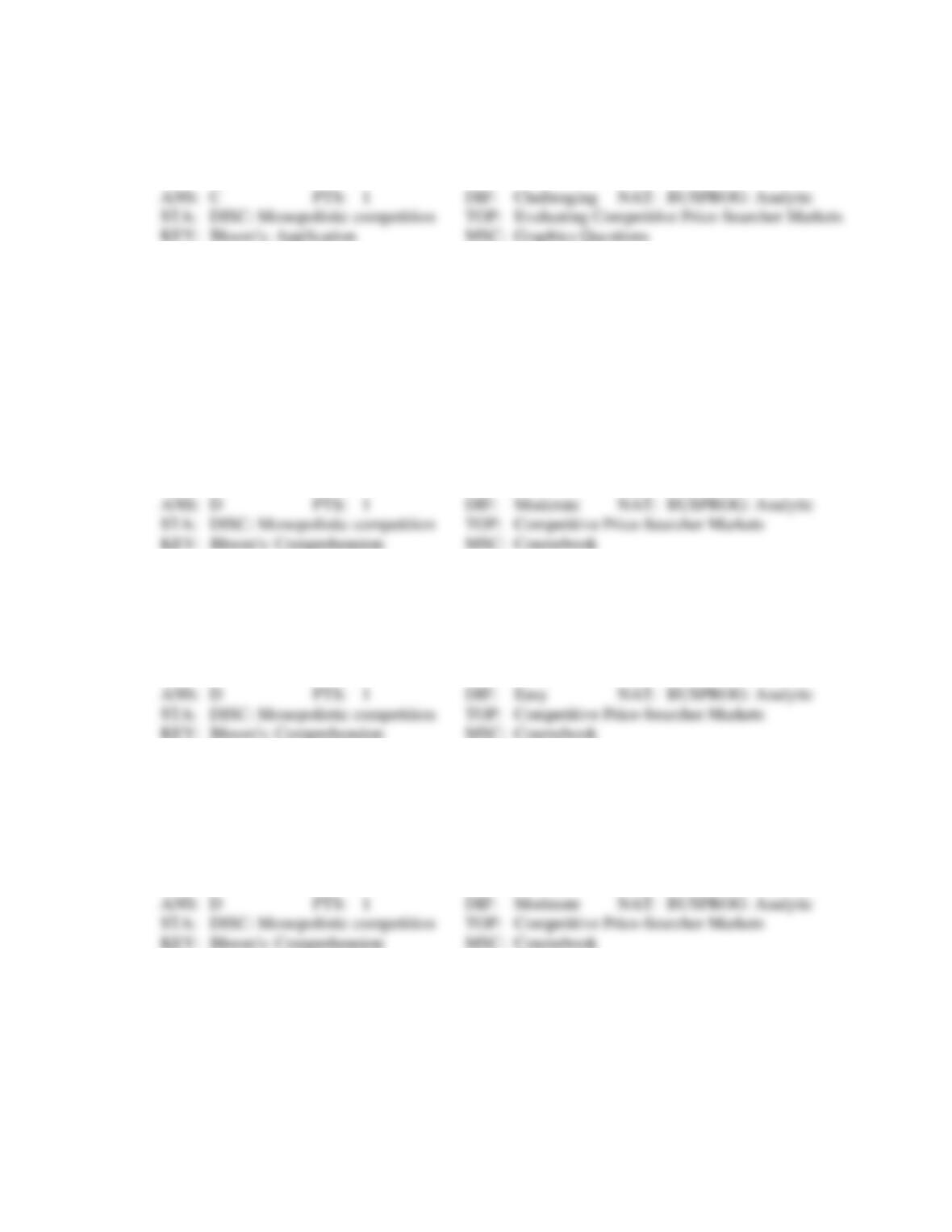
167. Refer to Figure 10-12. Which of the panels depicts a firm in a competitive price-searcher market
earning positive economic profits?
a.
Panel a
b.
Panel b
c.
Panel c
d.
Panel d
168. Which of the following is a major difference between a competitive price searcher and a price taker?
a.
Price takers need to compete through advertising because they cannot choose their own
price, whereas competitive price searchers compete primarily through their pricing
policies.
b.
Price takers are exposed to competition because of low barriers to entry, whereas
competitive price searchers are somewhat immune from competition due to relatively high
barriers to entry.
c.
Price takers can never earn economic profits, whereas competitive price searchers can earn
economic profits in the short run.
d.
Price takers produce identical goods, whereas competitive price searchers produce goods
that are differentiated from the goods produced by their competitors.
169. For the competitive price searcher,
a.
price will exceed marginal cost at the profit-maximizing level of output.
b.
price will equal average total cost in the long run.
c.
economic profit will be driven to zero in the long run by the entry and exit of firms.
d.
all of the above are correct.
170. Only undertaking an activity when it adds more to revenue than to cost is the decision rule a
profit-maximizing firm will use when deciding upon
a.
the level of output to produce.
b.
the amount of advertising to undertake.
c.
the level of product quality (for example, how many years it is designed to last).
d.
all of the above.
171. The marginal revenue curve lies below the demand curve for a competitive price searcher because
a.
in order for a competitive price searcher to sell an extra unit, it must cut the price on all
units. The lowered price offsets the additional revenue from the extra unit sold, so the
marginal revenue is lower than the price.
b.
in order for a competitive price searcher to sell an extra unit, it must increase its
advertising. The cost of advertising offsets the extra revenue generated by the extra sales,
so the marginal revenue is lower than the price.
c.
whenever a competitive price searcher discovers a profit-maximizing pricing policy, the
economic profit it generates attracts new competitors into the industry, driving marginal
revenue below the price.
d.
none of the above apply. The marginal revenue curve is the demand curve for a
competitive price searcher.
172. Suppose you were asked to determine whether a firm was a price taker or a competitive price searcher
by looking at a graph of the firm’s cost and revenue curves. The key is that for the competitive price
searcher,
a.
the firm’s marginal revenue curve lies above and to the right of the demand curve, not
below and to the left.
b.
there are only total costs, not variable costs, on the graph.
c.
the firm’s demand curve is downward sloping, not a horizontal line.
d.
all of the above are true.
173. A competitive price-searcher market is characterized by firms
a.
being able to choose their price and no barriers preventing firms from entering or leaving
the market.
b.
being able to choose their price and high barriers preventing firms from entering or
leaving the market.
c.
being able to accept the market price for their product and high barriers preventing firms
from entering or leaving the market.
d.
having to accept the market price for their product and no barriers preventing firms from
entering or leaving the market.
174. If a price-searcher firm can sell 4 units at a price of $6 or it can sell 5 units at a price of $5, the
marginal revenue from the fifth unit is
a.
$1.
b.
$5.
c.
$6.
d.
$25.
175. The fact that barriers to entry are low in competitive price-searcher markets means that if current firms
are making economic losses,
a.
these losses will remain in the long run because firms will not exit the market.
b.
some current firms will exit the market, causing the demand curves that face the remaining
firms to increase.
c.
new firms will enter the market, causing the demand curves that face the existing firms to
decrease.
d.
new firms will enter the market, causing no change in the demand curves that face the
existing firms in the market.
176. Which of the following is true when long-run equilibrium conditions are present in price-taker and
competitive price-searcher markets?
a.
MR = MC in both price-taker and competitive price-searcher markets
b.
P = ATC in both price-taker and competitive price-searcher markets
c.
P = MC in both price-taker and competitive price-searcher markets
d.
Both a and b, but not c are true.
177. A market in which the costs of entry and exit are low is called a
a.
regulated market.
b.
monopoly market.
c.
market with high barriers to entry.
d.
contestable market.
178. In both price-taker and competitive price-searcher markets, short-run economic profits will lead to
a.
firms being able to sustain those economic profits into the long run.
b.
the exit of firms from the market and the eventual restoration of zero long-run economic
profits.
c.
the entry of additional firms into the market and the eventual restoration of zero long-run
economic profits.
d.
none of the above.
179. In order for a firm to be able to engage in price discrimination, it must be able to
a.
identify and separate groups with different price elasticities of demand.
b.
prevent resale of the product between customer groups.
c.
maximize profits at the point where average total cost is minimized.
d.
do both a and b, but not c.
180. Some economists have argued that competitive price-searcher industries are allocatively inefficient
relative to price-taker industries because
a.
unlike price takers, price searchers fail to produce at the point where marginal revenue is
equal to marginal cost.
b.
competition forces price takers to find the most efficient method of production, whereas
product differentiation allows competitive price searchers to stay in business even when
their methods of production are inefficient.
c.
unlike price takers, price searchers do not produce at the minimum of their average total
cost curves.
d.
price searchers need to pay higher salaries to their managers because of the greater amount
of entrepreneurship required in price-searcher industries.
181. Other economists have argued that the allocative inefficiency of competitive price searchers apparent
in mechanical models is misleading. They argue that such mechanical models fail to account for
a.
the entry and exit of firms in the long run, which drives economic profits to zero, thereby
eliminating any short-run, allocative inefficiencies in competitive price-searcher
industries.
b.
the possibility that the higher prices paid by consumers in competitive price-searcher
industries are compensated by greater choice of goods or locations than would be present
in an allocatively “efficient” industry.
c.
the spillover effects on the advertising industry, which would shrink substantially if
competitive price searchers did not need to advertise so much.
d.
the fact that most competitive price-searcher industries are contestable markets, so
competitive price searchers react to competitive pressures whether or not numerous
competitors actually operate in the market.
182. If economic profits were present in a competitive price-searcher industry,
a.
production inefficiency would develop, causing costs to increase until the profits had been
eliminated.
b.
firms would operate in the short run, but they would be forced out of business in the long
run as competition eliminated the economic profit.
c.
competition from new entrants would occur until the economic profits had been
eliminated.
d.
the firms would eventually find these profits offset by long-run economic losses.
183. The practice of price discrimination has which of the following effects?
a.
Groups with the higher elasticity of demand will pay higher prices.
b.
Groups with the lower elasticity of demand will pay higher prices.
c.
With price discrimination, total output and allocative efficiency will fall.
d.
Groups will pay identical prices that are exactly equal to the firm’s marginal cost.
184. Neither price takers nor competitive price searchers will be able to earn long-run economic profit
because
a.
with low entry barriers, the entry and exit of firms result in prices that are equal to per-unit
costs in the long run.
b.
competition from new firms will result in higher prices in the market, which offset any
economic losses they earn.
c.
in both markets, firms charge a price equal to marginal cost.
d.
in both markets, firms produce products that are identical to the products produced by their
competitors.
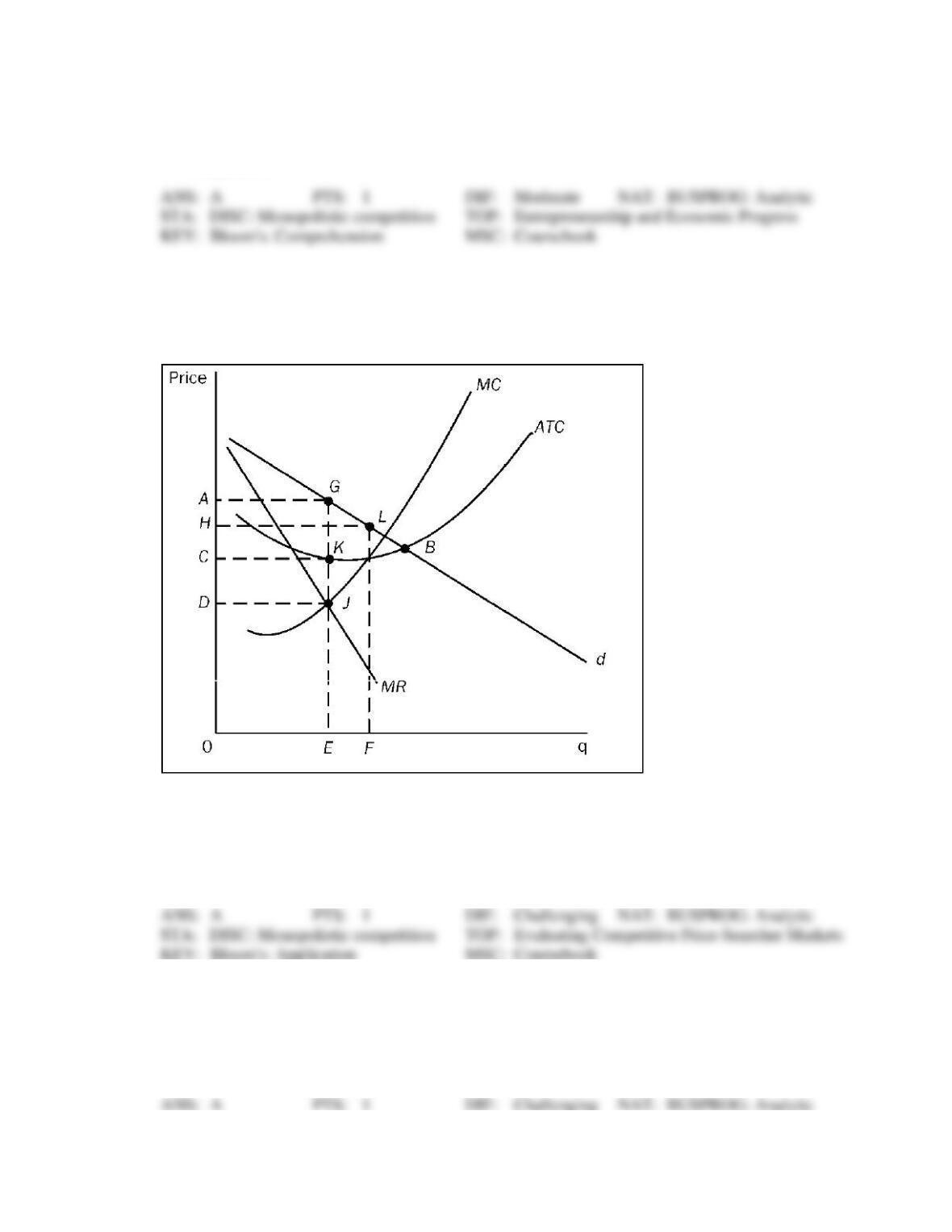
The following question(s) refer(s) to the figure below, which depicts the demand, marginal revenue,
and cost curves facing a firm in a competitive price-searcher industry.
Figure 10-13
185. Refer to Figure 10-13. This firm will maximize profits by producing a quantity of output equal to
a.
E and charging a price equal to A.
b.
E and charging a price equal to D.
c.
F and charging a price equal to H.
d.
F and charging a price equal to C.
186. Refer to Figure 10-13. The firm is currently earning an economic
a.
profit equal to the area CKGA.
b.
profit equal to the area DJGA.
c.
loss equal to the area CKGA.
d.
loss equal to the area DJGA.
187. Refer to Figure 10-13. In the long run, we would expect the firm’s
a.
ATC curve to fall as firms enter the industry, forcing the firm to increase its efficiency.
b.
demand curve to decrease as firms enter the industry due to the presence of positive
economic profits.
c.
demand curve to increase as firms exit the industry due to the presence of economic
losses.
d.
demand curve to shift such that marginal revenue and marginal cost intersect at quantity
F—the point where average total cost is at a minimum.
The following question(s) refer(s) to the figure below, which depicts the demand, marginal revenue,
and cost curves facing a firm in a competitive price-searcher industry.
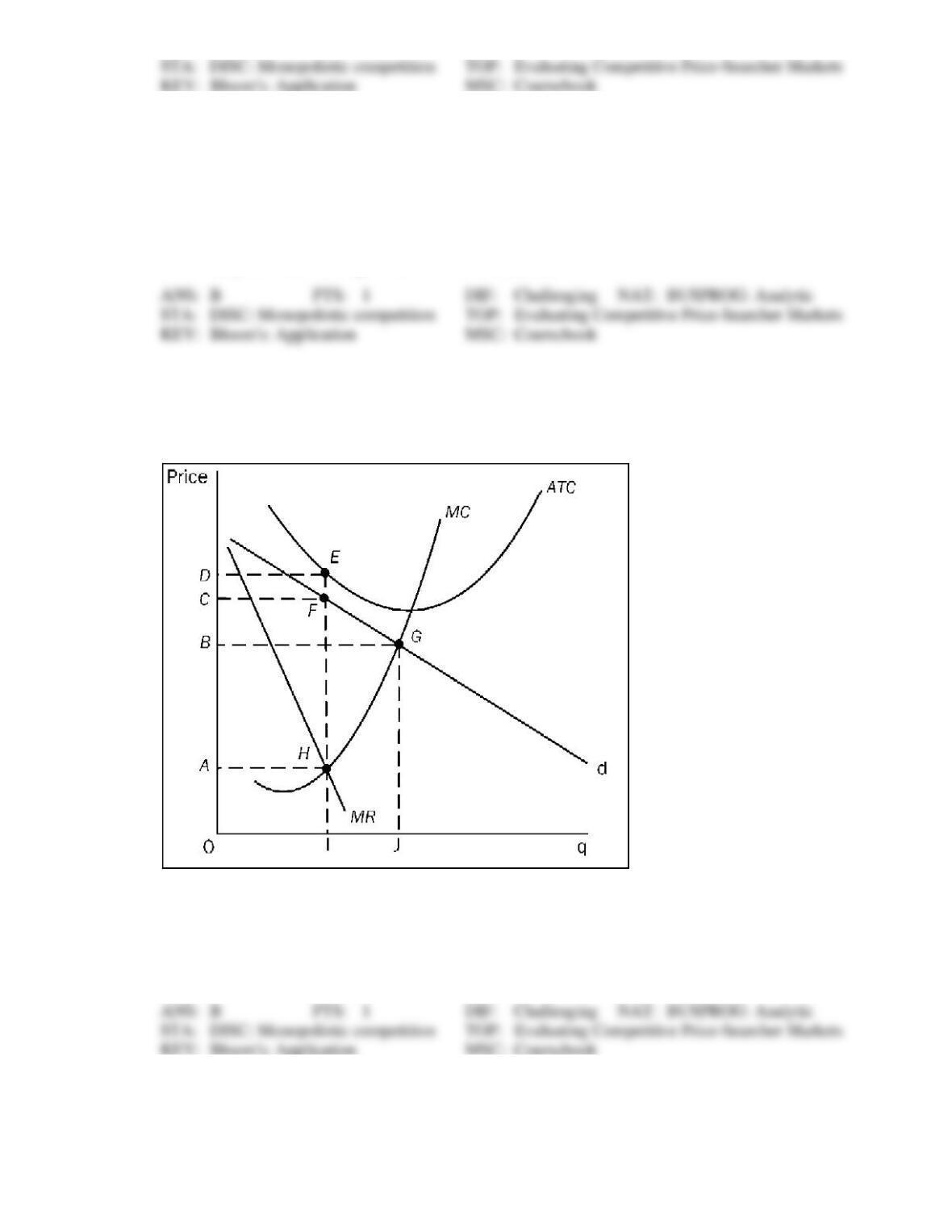
Figure 10-14
188. Refer to Figure 10-14. This firm will maximize profits by producing a quantity of output equal to
a.
I and charging a price equal to A.
b.
I and charging a price equal to C.
c.
I and charging a price equal to D.
d.
J and charging a price equal to B.
189. Refer to Figure 10-14. The firm is currently earning an economic
a.
profit equal to the area AHFC.
b.
profit equal to the area CFED.
c.
loss equal to the area AHED.
d.
loss equal to the area CFED.
190. Refer to Figure 10-14. In the long run, we would expect
a.
more firms to enter this industry until zero economic profits are restored.
b.
firms to exit this industry until zero economic profits are restored.
c.
the number of firms to remain constant and existing firms will continue to suffer economic
losses in the long run.
d.
the number of firms to remain constant and existing firms will continue to earn economic
profits in the long run.
191. Given the data shown in the table, what price and output level would a profit-maximizing price
searcher choose?
Output
Price
Total Cost
1
$10
$10
2
9
11
3
8
13
4
7
16
5
6
20
6
5
25
a.
price of $8, output of 3 units
b.
price of $7, output of 4 units
c.
price of $6, output of 5 units
d.
price of $5, output of 6 units
192. The idea that business failure is a positive force for progress in a market economy is often summarized
by the term “creative destruction.” Which of the following best states the central idea of this principle?
a.
When a business fails, the assets and resources from that business become unemployed,
resulting in higher government subsidies.
b.
Business failure allows the assets and resources from that business to move into other
areas where those resources are now more productive and highly valued.
c.
Only through frequent business failure will it be possible to avoid income being
concentrated in a few rich entrepreneurs.
d.
The new, rival businesses that drive out old competitors tend to be less efficient and less
creative than the older established businesses.
193. (I) The entrepreneurial discovery and development of improved products and production processes is
a central element of economic progress.
(II) Traditional economic models of the firm accurately capture the role of the entrepreneur.
a.
I is true; II is false.
b.
I is false; II is true.
c.
Both I and II are true.
d.
Both I and II are false.
194. The firms in a competitive price-searcher market produce goods and services that are
a.
identical to one another in quality and price.
b.
identical to one another in quality but not in price.
c.
identical to one another in price but not in quality.
d.
different from one another.
195. A price searcher confronts a downward sloping demand curve because
a.
products in the market are differentiated.
b.
there is no close competitor in the market.
c.
the market is essentially monopolized.
d.
the firm gains nothing if it lowers its price.
196. Which of the following is the major reason why most economists are reluctant to charge price searcher
markets with allocative inefficiency?
a.
Consumers value the wider variety of quality and styles in competitive price-searcher
markets.
b.
Advertising costs are typically so small that they are irrelevant.
c.
Competitive price searchers always operate that the lowest point on their average total cost
curve.
d.
Competitive price searchers charge a price equal to marginal cost.
197. Which of the following is a true statement about the difference between a price-taker firm and a
competitive price-searcher firm in the long run?
a.
Both will sell their products at a price equal to average total cost, but only the price taker
will produce at minimum average total cost.
b.
Both will sell their products at a price equal to average total cost, but only the competitive
price searcher will produce at minimum average total cost.
c.
Only the price taker will sell its product at a price equal to average total cost.
d.
Only the competitive price searcher will sell its product at a price equal to average total
cost.
198. Which of the following statements about price discrimination is correct?
a.
A price discriminating firm will want to charge a higher price to the consumer group with
the more inelastic demand.
b.
A firm will always be able to increase its profit by price discriminating rather than
charging the same price to all customers.
c.
Price discrimination will be most effective when buyers can easily resell the product
amongst themselves.
d.
Each consumer will pay a higher price when a firm is a price discriminator than would be
the case if all customers were charged the same price.
199. Which of the following statements is correct?
a.
Price discrimination is always more profitable than charging a single price.
b.
A price discriminator would want to charge the highest price to those customers with the
most elastic demand for his product.
c.
To be successful, a price discriminator must assure that items can be resold between high–
and low-price groups.
d.
To maximize profit, a price discriminator distinguishes groups with different demands and
charges higher prices to those with the more inelastic demand.
200. Entrepreneurial judgment requires
a.
the ability to use perfect information about the suture to your advantage.
b.
the ability to discover new approaches or solutions to complex problems.
c.
the use of government regulations to prevent competition
d.
that a firm make a profit.
201. Which is the best example of price discrimination?
a.
The clearance section at Target.
b.
The dollar menu at McDonalds.
c.
Airline ticket prices.
d.
A fancy restaurant that charges high prices on its menu.
202. Price searchers can be expected to charge a price that
a.
is the highest at which consumers will purchase any units.
b.
they expect to provide the largest possible flow of gross revenue.
c.
minimizes their per-unit costs of production.
d.
maximizes their profit.
203. When entry barriers are low, firms in a competitive price-searcher market
a.
can expect many new rivals to enter regardless of current profitability.
b.
can expect competing firms to enter the market if the activity is profitable.
c.
can never earn economic profit.
d.
will always be able to earn economic profit.
204. Whenever firms can freely enter and exit a market,
a.
firms can never earn a profit.
b.
prices will be the same for all firms in the market.
c.
products will be identical for all firms in the market.
d.
profits and losses play an important role in determining the size of the industry.
205. Which of the following is a characteristic of a contestable market?
a.
long-run economic profit
b.
many firms that are small relative to the market
c.
high costs for entry and exit
d.
minimum-cost production methods
206. Which of the following is most vital if the firms in an industry are going to earn economic profit in the
long run?
a.
an inelastic demand for the product produced by the firms
b.
an elastic demand for the product produced by the firms
c.
managerial efficiency
d.
high barriers to entry into the industry
207. To gain from price discrimination, price searchers
a.
must charge a higher price to those with a more inelastic demand.
b.
must be pure monopolists.
c.
must have small economies of scale
d.
must have access to widely available natural resources.
208. A market will tend to be more competitive when
a.
there are a small number of firms in the market.
b.
similar products are available from alternative sellers.
c.
entry barriers into the market are high.
d.
governments require firms to meet strict regulatory standards.
ESSAY
209. What type of model would be best if we wanted to analyze the market for fast food? Why?
210. When you go to a grocery store, most candy bars of a given size sell for virtually the same price. Can
we conclude that this is evidence of collusion on the part of candy bar manufacturers?
211. When Cabbage Patch Dolls were introduced, they were extremely popular at Christmas, and most
stores sold out. By the next year, there were plenty still available at Christmas. What happened?
212. What type of industry is the market for grocery products? Is over-capacity present?
213. The market for home-delivered pizza is extremely competitive in Introville, Utah, and prices continue
to fall. Assume they have fallen so low that the 20 pizza delivery firms are all suffering economic
losses. What will likely happen in the long run?
214. Why do the airlines charge less for passengers who stay over Saturday night and purchase their tickets
two weeks in advance?
215. Niceville, Ohio, only has two dentists, while the surrounding communities have many more on a per
capita basis. The demand for dental services is such that these two dentists could agree to raise their
prices (they play golf together every Saturday) and earn economic profit. Instead, they choose to price
competitively and earn what other dentists earn. What might explain this?
216. Evaluate the following statement: “Competitive price-searcher markets are inefficient relative to purely
competitive markets since prices are higher and firms don’t produce an output rate that minimizes
average total cost. As a result, government action should be undertaken to remedy this situation.”