Perfect competition
The Perfectly Competitive Firm
Essay
174. Give a complete but concise definition of the following terms.
a.
perfect competition
b.
perfectly competitive firm’s demand curve
c.
shutdown point
d.
long-run equilibrium in perfect competition
Easy
DISC: Perfect competition
United States – BPROG: Analytic
Perfect competition
The Perfectly Competitive Firm
175. Define the following terms and explain their importance to the study of economics.
a.
marginal cost
b.
marginal revenue
c.
short-run equilibrium
d.
supply curve of the firm
e.
economic profit
losses by shutting down.
Easy
176. What are the assumptions of the model of perfect competition? Explain why each is important for short-run and long-
run equilibrium.
177. Perfect competition displays the market mechanism at its best in many respects, yet most markets in operation today
are monopolistic or oligopolistic, composed of a few large firms. Should government regulation break up those large firms
into several smaller firms to try to achieve perfect competition? Why or why not?
178. Why study perfect competition, if it rarely exists?
179. Draw a graph illustrating the relationship between the demand curve of the perfectly competitive firm and the
perfectly competitive industry. Label all curves and axes correctly.
180. The demand curve for the perfectly competitive industry normally slopes downward, unlike the perfect competitive
firm. Why?
181. Why doesn’t a competitive firm reduce its price below the industry price to increase sales?
182. Why doesn’t a perfectly competitive firm charge a price slightly higher than the industry price in order to earn extra
profit?
183. What happens to the price of the product and total revenue for a perfectly competitive firm if it doubles the amount
of output it supplies in the market?
184. What makes the demand curve of the perfectly competitive firm uniquely different from that of firms in other kinds
of market structures?
185. We don’t need to draw separate curves for demand, average revenue, and marginal revenue curves for a perfectly
competitive firm. Why?
186. What is the difference between the short run and the long run as economists define the two?
187. Draw a graph illustrating a competitive firm in short-run equilibrium that is earning an economic profit. Be sure to
label all curves and axes correctly.
188. If a firm has short-run losses, will it stay open? Under what conditions will a firm close in the short run? Explain.
189. Explain the reasoning behind the shutdown rules. When is it appropriate to operate with a loss?
190. If there are no profits in competitive equilibrium, why do firms produce? How can they stay in business?
191. Why does the supply curve of the perfectly competitive industry shift to the right whenever a new firm enters the
industry?
192. A firm sells in a competitive market in which price is $10. Its marginal cost is 2 + .5Q. Determine the profit-
maximizing level of output.
193. A firm sells in a competitive market in which price is $12. Its marginal cost is 6 + .25Q. Determine the profit-
maximizing level of output.
194. Describe the process that would occur in the long run in a competitive industry if there were economic profits.
Illustrate this with a diagram.
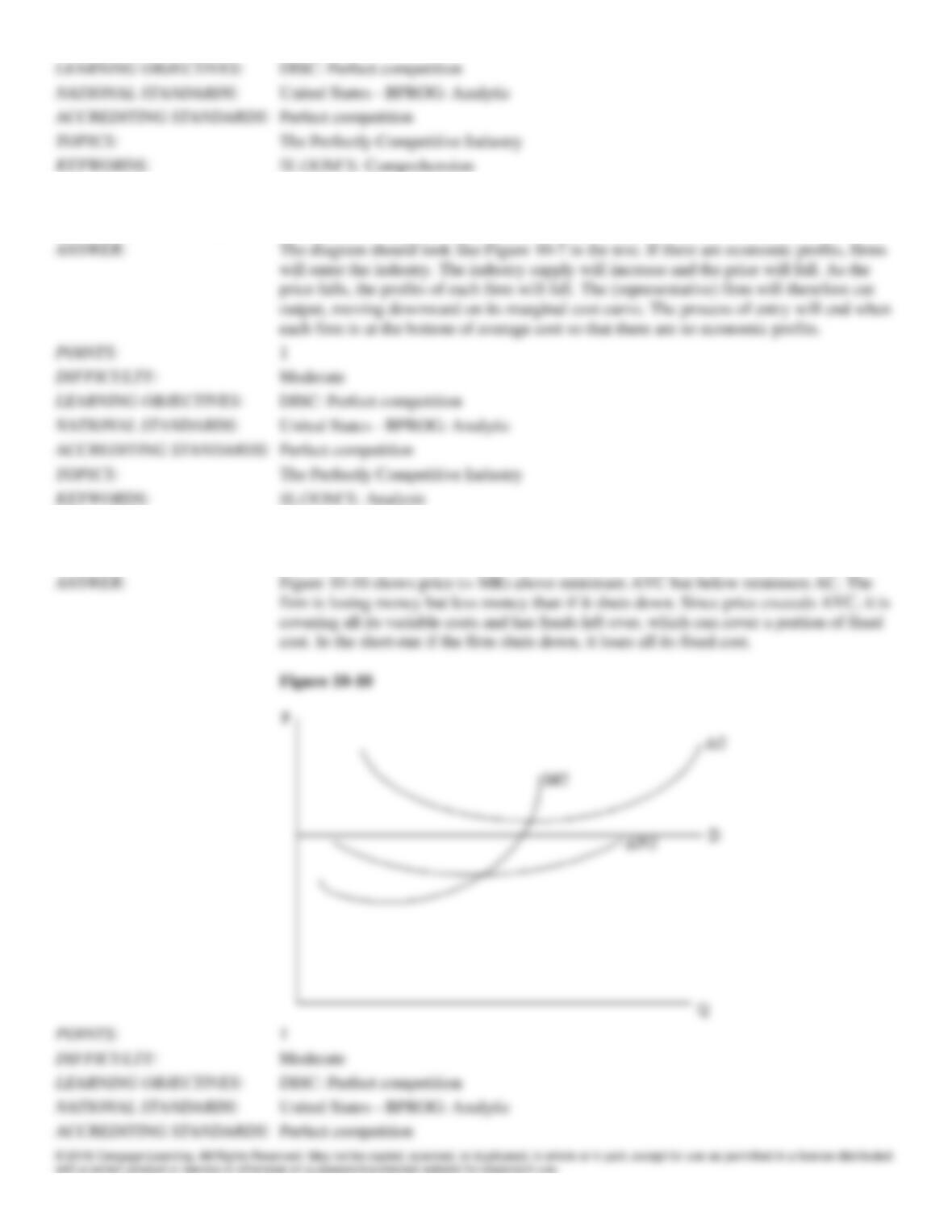
195. Draw a graph showing the typical competitive firm losing money but continuing to operate. Explain why the firm
continues to operate rather than shut down.
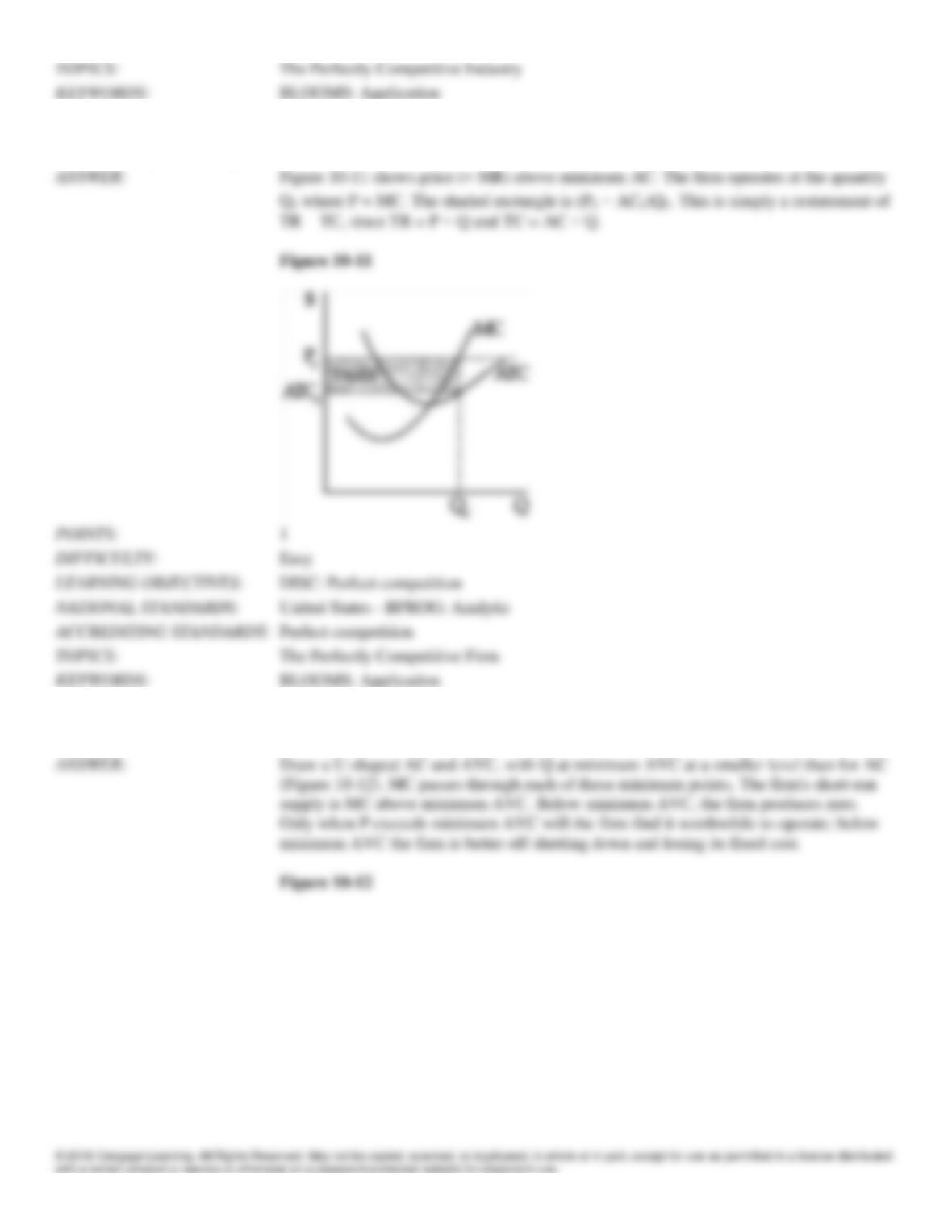
196. Graphically show a firm earning a profit; shade the appropriate profit rectangle. Explain how the profit formula
represented by the rectangle is analogous to TR – TC.
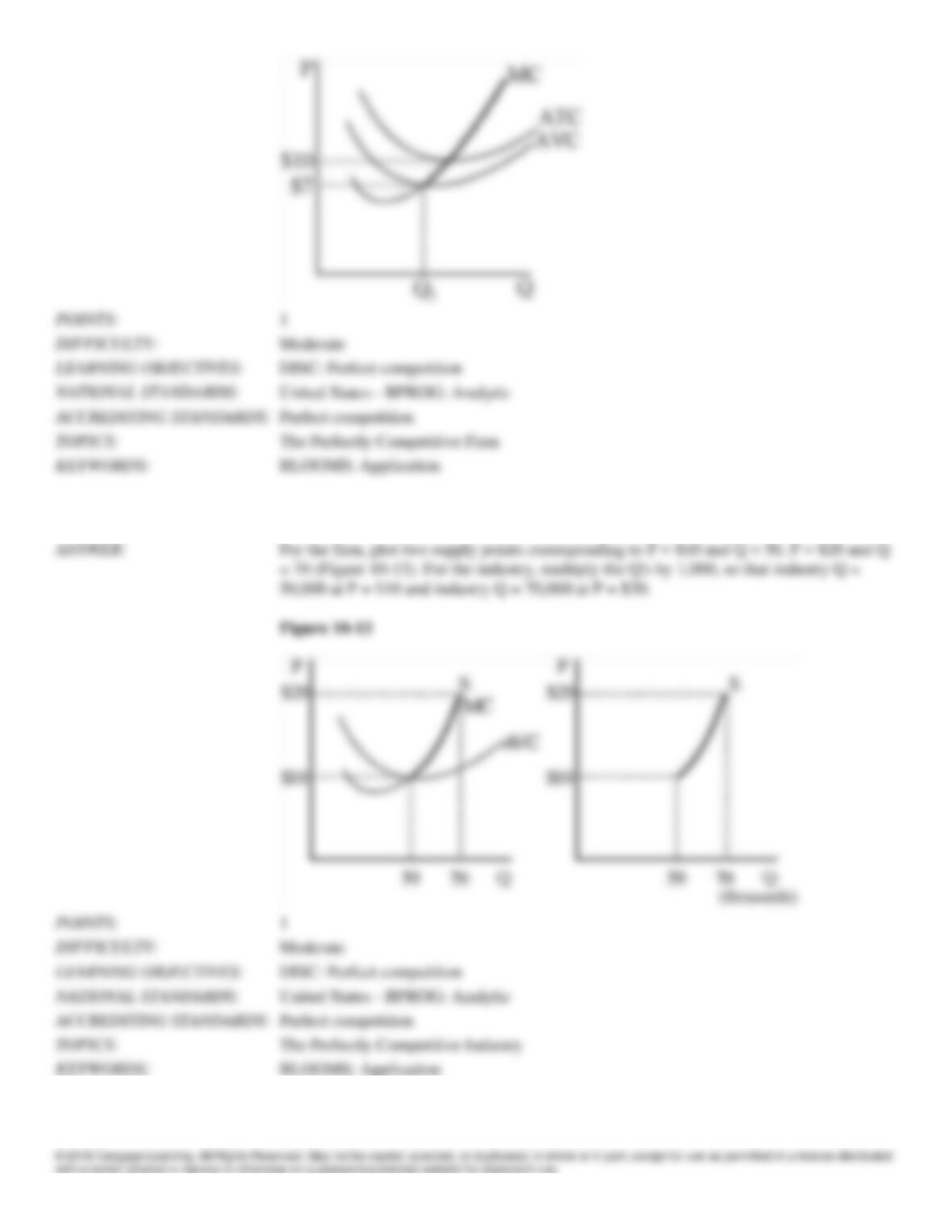
197. A firm’s minimum AC is $10, its minimum AVC $7. Show this firm’s short-run supply curve, explaining how you
obtained it.
DISC: Perfect competition
United States – BPROG: Analytic
Perfect competition
The Perfectly Competitive Firm
BLOOMS: Application
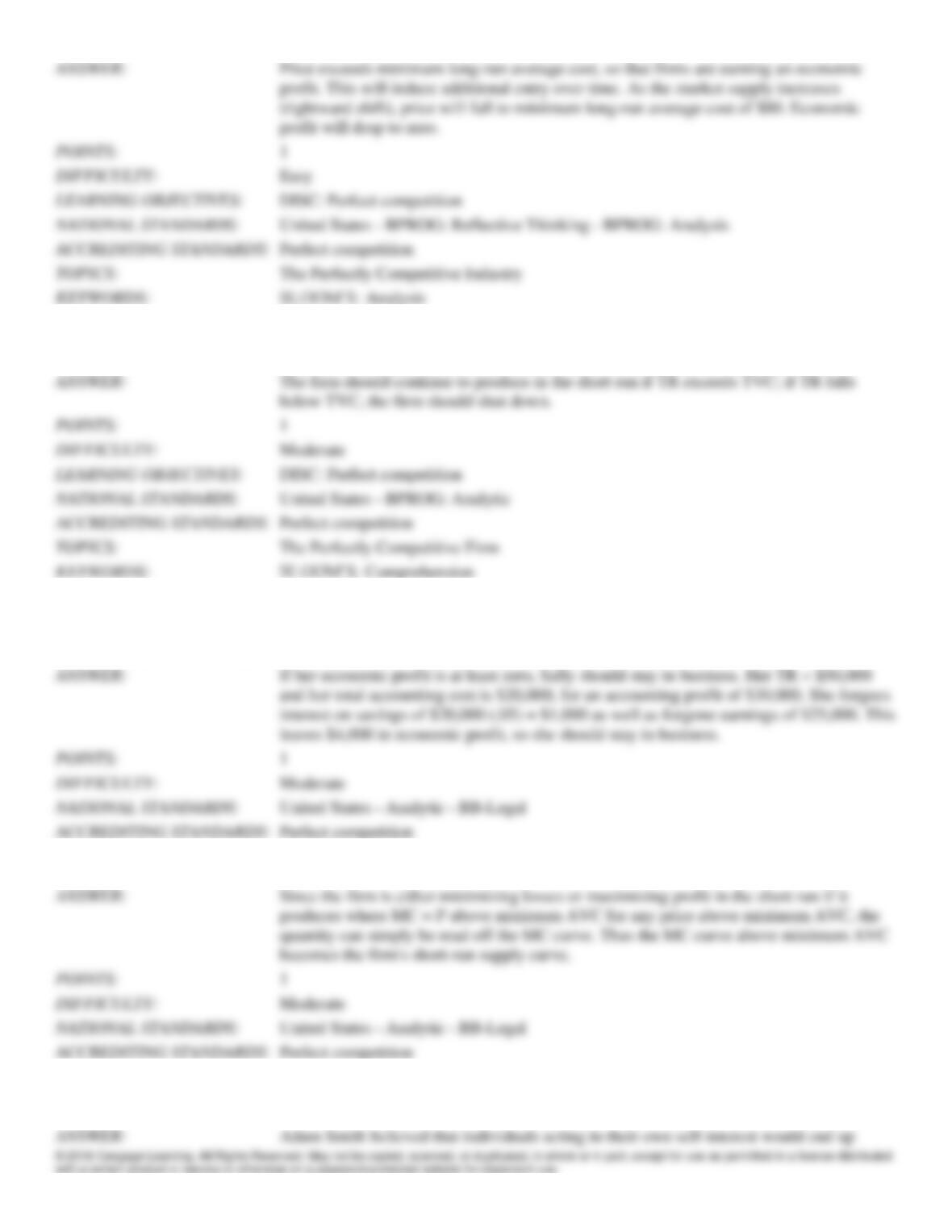
198. If the typical firm’s minimum average variable cost is $10 at an output of 50 units, if marginal cost is $20 at 70 units,
and there are 1,000 firms in the industry, sketch supply curves for the typical firm and for the industry as a whole.
DISC: Perfect competition
United States – BPROG: Analytic
Perfect competition
The Perfectly Competitive Industry
199. There are currently 1,000 firms in a competitive industry. Minimum long-run average cost is $80 and price $100.
Explain what will happen to price, profit, and the number of firms in this industry over time.
200. How does a firm that is losing money in the short run decide whether to shut down or continue to produce to
minimize its losses?
201. Sally Rand owns a ceiling fan company. She sells 1,000 ceiling fans at $50 each. Each fan costs her $20. She uses
her own money to buy the fans; she withdraws the money from her savings account where it earns 5 percent interest.
Before going into the ceiling fan business, she worked as a fan-dancer at $25,000 a year. Should Sally remain in business?
202. Explain how the short-run supply curve of the competitive firm is derived.
203. Explain why Adam Smith believed that competitive markets are a key component of achieving the gains from the
invisible hand.
204. Explain how the short-run industry supply curve for a perfectly competitive market is derived.
205. Profits or losses must be temporary for perfectly competitive firms. Why?
206. Explain why taxes on pollutants reduce pollution while subsidies to firms cutting their pollutants actually increase
pollution.
207. Show what happens to the industry equilibrium when new firms enter a perfectly competitive market in the long run.
208. What is the relationship between the long-run industry supply curve and the short-run supply curve in a perfectly
competitive market?
209. To own a taxicab in New York City, you must own a medallion. New York City regulates the number of official cabs
by limiting the number of medallions. Explain why the New York cab industry is not competitive by reviewing the four
conditions necessary for competition. NYC violates which one?
210. What is the difference between the accountant’s concept of profit and the economist’s view of profit?
211. Illustrate the cost curves and average revenue (demand) curve for the perfectly competitive firm in long-run
equilibrium.
212. Why do economists consider perfect competition to be the most efficient market structure?