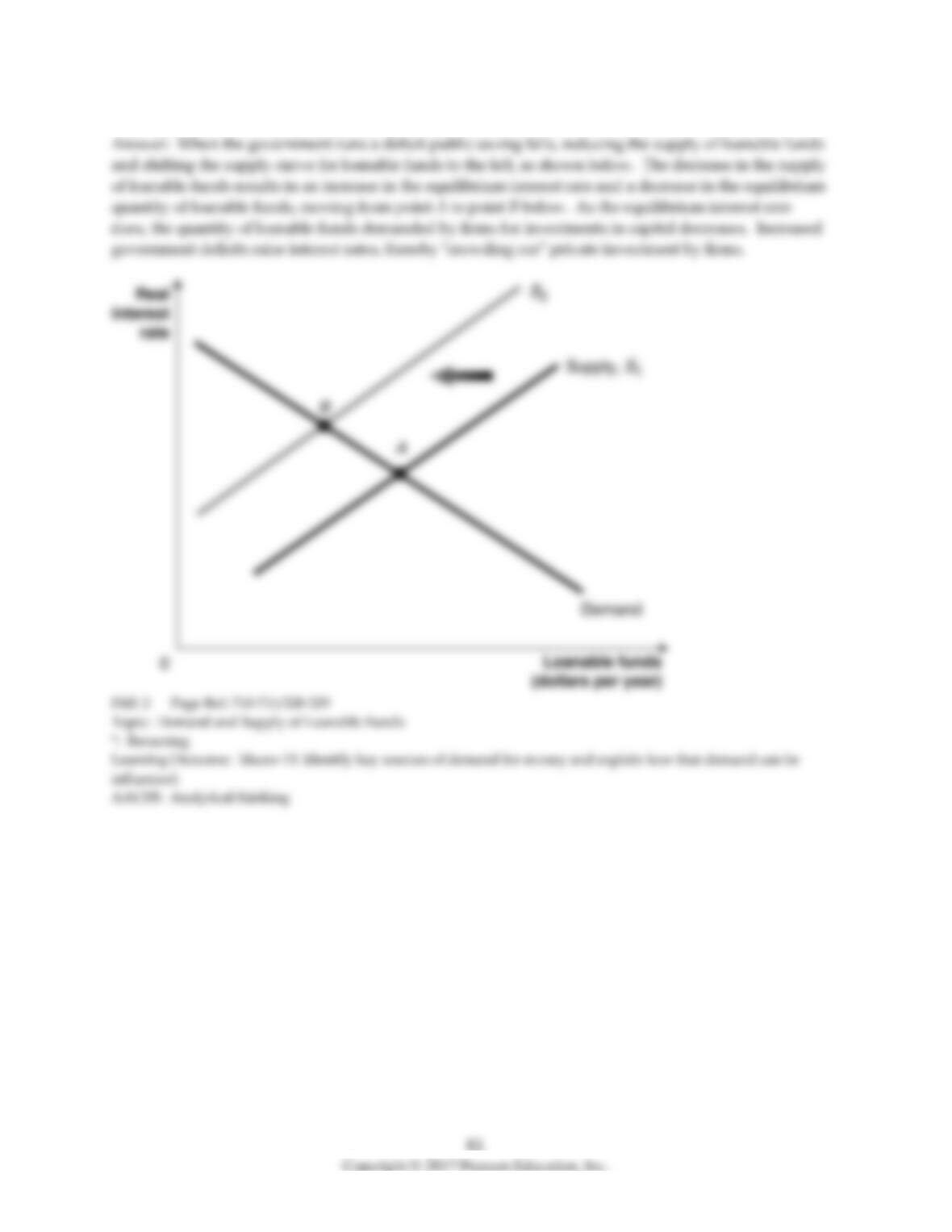
107) Explain and show graphically how government deficits can “crowd out” private investment.
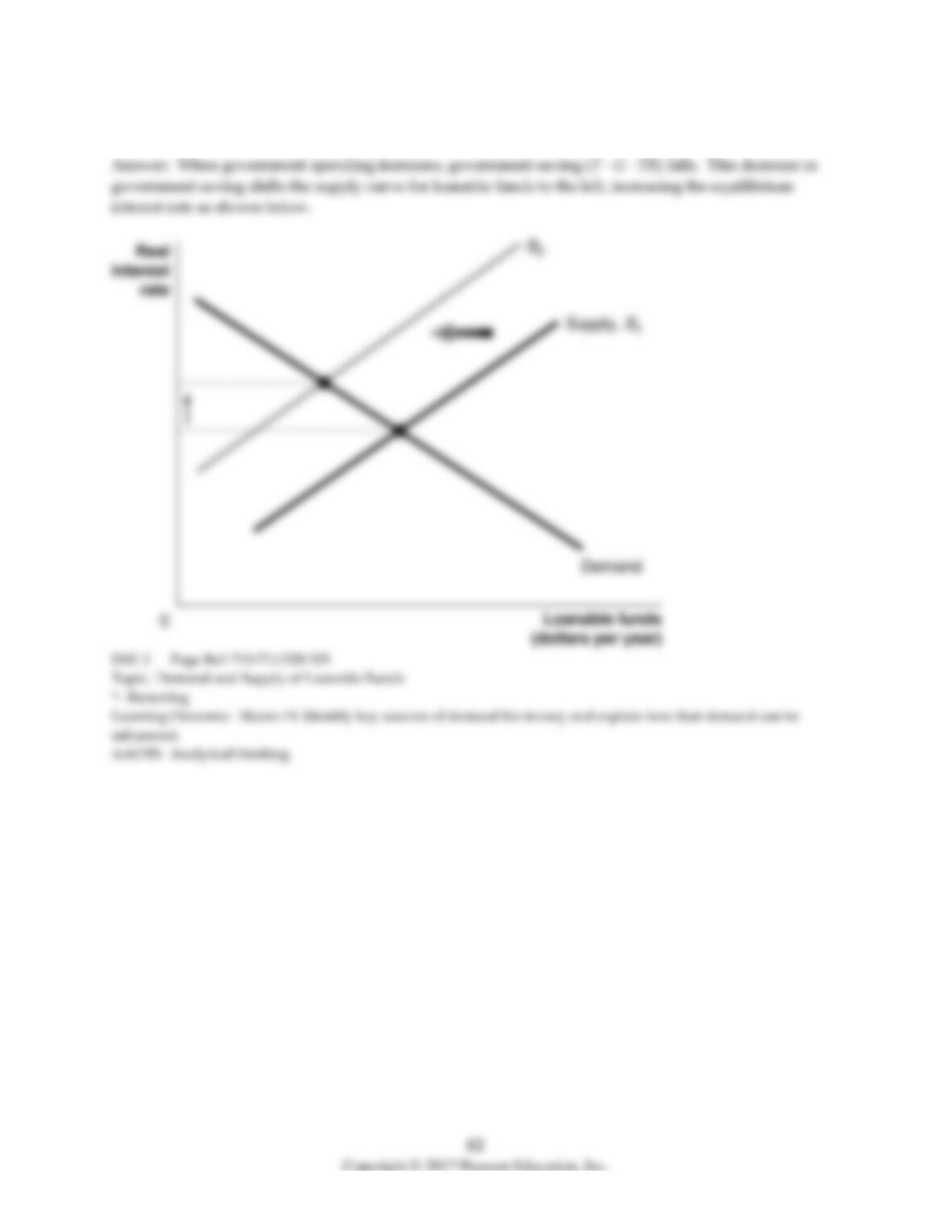
108) Explain and show graphically how an increase in government spending affects the equilibrium
interest rate in the market for loanable funds.
10.3 The Business Cycle
1) Which of the following explains the cause of the change in the unemployment rate at the end of a
recession?
A) Firms are hesitant to rehire laid off workers as they continue to operate below capacity.
B) Firms rapidly hire new workers at the first sign of an increase in demand for their goods.
C) Discouraged workers return to the labor force, and this makes the unemployment rate fall.
D) Discouraged workers leave the labor force, and this makes the unemployment rate rise.
2) During the expansion phase of the business cycle, which of the following eventually increases?
A) production
B) employment
C) income
D) all of the above
3) During the recession phase of the business cycle,
A) production is usually rising.
B) interest rates are usually falling.
C) unemployment is usually falling.
D) income is usually rising.
4) The period between a business cycle peak and a business cycle trough is called
A) expansion.
B) recession.
C) diffusion.
D) recalculation.
5) From 1991 until 2001, the United States was in a period of
A) expansion.
B) recession.
C) business cycle troughs.
D) business cycle peaks.
6) The period of expansion ends with a ________ and the period of recession ends with a ________.
A) business cycle peak; business cycle trough
B) business cycle trough; business cycle peak
C) business cycle peak; business cycle peak
D) business cycle trough; business cycle trough
7) What is the name of the organization that defines business cycle peaks and troughs in the United
States?
A) the Bureau of Labor Statistics
B) the Federal Reserve
C) the National Bureau of Economic Research
D) the National Peak and Trough Committee
8) At the end of World War II in 1945, many economists and business managers expected that the U.S.
economy would enter a severe recession. At that time, Sears and Montgomery Ward were the two
largest department store chains in the country. Sears CEO Robert Wood expected continuing prosperity
and opened new stores. Montgomery Ward CEO Sewell Avery expected falling incomes and rising
unemployment and closed a number of existing stores. The results of their actions were seen during the
late 1940s, when
A) Sears declared bankruptcy and was purchased by Montgomery Ward.
B) Montgomery Ward weathered the economic downturn in better financial shape than Sears.
C) Sears rapidly gained market share at Montgomery Ward’s expense.
D) Sears had to close many of the new stores it had opened following the end of the war.
9) As the economy nears the end of an expansion, which of the following do we typically see?
A) rising firm profits
B) rising levels of firm investment
C) rising interest rates
D) falling wages relative to output prices
10) As the economy nears the end of a recession, which of the following do we typically see?
A) further decreases in consumer spending
B) increased spending on capital goods by firms
C) increasing interest rates
D) all of the above
11) The demand for durable goods
A) has decreased over time.
B) declines by a greater percentage than does GDP during a recession.
C) declines by a smaller percentage than does GDP during a recession.
D) rises by a greater percentage than does GDP during a recession.
12) Purchases of which of the following goods would be dramatically reduced during a recession?
A) tomatoes
B) ink pens
C) gasoline
D) refrigerators
13) During a recession, spending on ________ tends to fall more dramatically than spending on
________.
A) necessities; luxuries
B) durable goods; nondurable goods
C) nondurable goods; durable goods
D) food; cars
14) Purchases of Huggies diapers should
A) remain fairly constant over the business cycle.
B) increase in recessions and decrease in expansions.
C) decrease in recessions and increase in expansions.
D) increase in recessions and remain constant in expansions.
15) The effect of a recession on a company like Whirlpool Corporation is such that
A) sales decline more sharply for Whirlpool as compared to firms that do not produce durable goods.
B) profits fall less sharply as compared to firms that do not produce durable goods.
C) the decline in sales is more short-lived as compared to firms that do not produce durable goods.
D) there is no difference in the impact of the recession on its profits as compared to firms that do not
produce durable goods.
16) Inflation tends to ________ during the expansion phase of the business cycle and ________ during
the recession phase of the business cycle.
A) increase; decrease
B) decrease; increase
C) decrease; decrease further
D) increase; increase further
17) Which of the following is a correct statement?
A) Inflation is measured as the percentage change in the CPI.
B) The CPI is a widely used measure of the inflation rate.
C) Real GDP is our best measure of economic growth.
D) The PPI measures inflation as experienced by producers.
18) When the economy enters a recessionary phase of the business cycle, unemployment tends to
A) decrease.
B) increase.
C) be unchanged.
D) change in the same direction as the rate of inflation.
19) Typically, as an economy begins to emerge from a recessionary phase of the business cycle,
A) unemployment falls immediately.
B) unemployment continues to rise.
C) inflation begins to fall.
D) investment begins to fall.
20) Since the 1950s,
A) the United States has not experienced a business cycle.
B) U.S. business cycle fluctuations have becomes more volatile.
C) U.S. business cycle fluctuations have become milder.
D) U.S. business cycle fluctuations have not changed.
21) Since 1950, the average length of a recession in the United States has been
A) such that recessions barely exist.
B) less than a year.
C) between 1 and 2 years.
D) greater than 2 years.
22) Since 1950, expansions in the United States have become ________, while recessions have become
________.
A) longer; longer
B) shorter; shorter
C) shorter; longer
D) longer; shorter
23) Which of the following explains why fluctuations in real GDP have become less volatile in the
United States since 1950?
A) Services have become a smaller fraction of GDP since the 1950s.
B) Unemployment insurance and other government transfer programs are more prevalent since the
1950s.
C) The government has become more reluctant to intervene when real GDP declines and
unemployment rises since the 1950s.
D) both B and C
24) Most economists believe that the return of ________ during the 2007-2009 recession is a key reason
why the recession was so severe.
A) high tariffs
B) financial instability
C) rapid inflation
D) high interest rates
25) According to the National Bureau of Economic Research, the United States has experienced
________ recessions since 1950.
A) 4
B) 7
C) 10
D) 15
26) According to the National Bureau of Economic Research, the recession that began in December 2007
A) lasted 12 months.
B) lasted 18 months.
C) lasted 27 months.
D) did not end until December 2011.
27) During the expansion phase of the business cycle,
A) production increases.
B) employment decreases.
C) income decreases.
D) unemployment increases.
28) A period of expansion in the business cycle ends when
A) real GDP is equal to potential GDP.
B) the business cycle reaches its peak.
C) the business cycle reaches its trough.
D) real GDP is less than potential GDP.
29) When the economy reaches a trough in a business cycle, which of the following will occur?
A) Income, production, and employment will continue to fall.
B) Income, production, and employment will begin to rise.
C) Income and production will rise, but employment will continue to fall.
D) Employment rises, but income and production will continue to fall.
30) The Business Cycle Dating Committee, a part of the ________, officially decides when a recession
begins and ends.
A) federal government
B) Bureau of Labor Statistics
C) National Bureau of Economic Research
D) Federal Reserve
31) A(n) ________ comes to an end with a business cycle ________.
A) recession; peak
B) recession; trough
C) expansion; trough
D) expansion; bubble
32) The Business Cycle Dating Committee defines a recession as
A) two consecutive quarters of declining real GDP.
B) two consecutive quarters of declining nominal GDP.
C) a significant decline in activity visible in industrial production, employment, real income, and
wholesale/retail trade lasting more than a few months.
D) a significant decline in inflation and unemployment lasting more than a few months.
33) Following the September 11, 2001, terrorist attacks, the managers of many hotels expected a
prolonged period of reduced travel and responded by laying off workers and postponing or canceling
new construction. Isadore Sharp, the chairman and CEO of Four Seasons Hotels, decided to
A) continue expanding and was able to maintain or enhance the company’s market share.
B) continue expanding and the company ended up losing significant market share.
C) curtail expansion plans, and by significantly cutting back on expansion was able to maintain the
company’s market share.
D) curtail expansion plans and the company ended up losing significant market share.
34) As the economy nears the end of an expansion, interest rates usually ________ and wages rise more
________ than prices.
A) rise; rapidly
B) rise; slowly
C) fall; rapidly
D) fall; slowly
35) A recession begins with a(n) ________ in spending by firms on capital goods and a(n) ________ in
spending on durable goods by households.
A) increase; decrease
B) increase; increase
C) decrease; increase
D) decrease; decrease
36) Which of the following goods would see the largest decline in demand during a recession?
A) automobiles
B) food
C) clothing
D) haircuts
37) When a recession ends,
A) interest rates decrease.
B) households decrease spending on durable goods.
C) the household sector decreases spending substantially.
D) firms increase the amount of borrowing.
38) Because Corning produces durable goods, the demand for their goods
A) is likely to increase during recession.
B) declines when incomes in the economy are rising.
C) is consistently high, regardless of the state of the economy.
D) tends to follow the business cycle.
39) For the recessions in the United States since the 1950s,
A) cyclical unemployment has been non-existent.
B) unemployment rises on average by about 1.2 percentage points during the 12 months after a
recession begins.
C) unemployment falls on average by 2 percentage points during the 12 months after a recession begins.
D) unemployment rises on average about 5 percentage points during the 12 months after a recession
begins.
40) For the recessions in the United States since the 1950s,
A) inflation has been nonexistent.
B) the inflation rate rises on average by about 2.5 percentage points 12 months after a recession begins.
C) the inflation rate falls on average by about 2.5 percentage points 12 months after a recession begins.
D) deflation occurs.
41) Recessions typically cause the unemployment rate to ________ and the inflation rate to ________.
A) rise; rise
B) rise; fall
C) fall; rise
D) fall; fall
42) During an expansion, how do inflation and unemployment typically change?
A) Inflation and unemployment both rise.
B) Inflation and unemployment both fall.
C) Inflation falls and unemployment rises.
D) Inflation rises and unemployment falls.
43) Between 1950 and 2009, the average length of recessions in the United States was
A) 11 months.
B) two years.
C) three months.
D) eighteen months.
44) Inflation is measured
A) using the level of the consumer price index.
B) as the percentage change in the consumer price index.
C) using the level of real GDP.
D) as the percentage change in real GDP.
45) If the CPI is currently 202, what does this tell you about inflation between last year and this year?
A) There was deflation in the economy between this year and last year.
B) Inflation in the economy between this year and last year was 2%.
C) Inflation in the economy between this year and last year was 102%.
D) The CPI measures only the level of prices in a given year, not the percentage change in prices from
one year to the next.
46) Since 1950, recessions in the United States
A) have not occurred.
B) have become more severe than before 1950.
C) have become less severe than before 1950.
D) are about as severe as they were before 1950.
47) Since 1950,
A) economic expansions in the United States have been so short that expansions barely exist.
B) the average length of expansions in the United States have become shorter as compared to before
1950.
C) the average length of expansions in the United States have become longer as compared to before
1950.
D) the average length of expansions in the United States are about the same length as compared to
before 1950.
48) Which of the following is not a reason why the U.S. economy has been more stable since 1950?
A) Goods have become a larger fraction of GDP and services have become a smaller fraction of GDP.
B) The government has actively pursued policy to combat recessions and prolong expansions.
C) Unemployment insurance and other government programs curtail the decline in spending that
occurs during a recession.
D) Services have become a larger fraction of GDP and goods have become a smaller fraction of GDP.
49) Which of the following indicates that the U.S. economy has become more stable since 1950?
A) longer recessions
B) shorter expansions
C) less severe fluctuations in real GDP
D) All of the above indicate that the U.S. economy has become more stable since 1950.
50) If you spend more of your income on consumption goods, which of the following will occur?
A) The production of investment goods will fall.
B) Economic growth will be stimulated.
C) Investments in education will rise.
D) For every dollar you spend on consumption, real GDP will fall by a dollar.
51) Which of the following is a true statement about the length of recessions and expansions in the
United States economy?
A) Prior to 1900, the length of expansions equaled the length of recessions.
B) Prior to 1900, the length of expansions were much less than the length of recessions.
C) Prior to 1900, the length of expansions were much longer than the length of recessions.
D) Prior to 1900, the length of recessions were brief and almost nonexistent.
52) Which of the following is a true statement about the length of recessions and expansions in the
United States economy?
A) After 1950, the length of expansions equaled the length of recessions.
B) After 1950, the length of expansions were much less than the length of recessions.
C) After 1950, the length of expansions were much longer than the length of recessions.
D) After 1950, the length of expansions were brief and almost nonexistent.
53) Economists have not found a way to predict when recessions will begin and end.
54) The NBER’s Business Cycle Dating Committee defines a recession as at least two consecutive
quarters of falling real GDP.
55) At the end of an expansion, wages of workers are usually rising faster than prices.
56) In the United States, the average length of expansions from 1950 to 2009 was more than twice as
long than they were from 1900 to 1950.
57) The lengths of the recession and expansion phases and which sectors of the economy are most
affected will rarely be the same in any two business cycles.
58) A period of economic expansion ends with a business cycle trough.
59) The U.S. economy has been more stable since 1950.
60) Inflation usually increases during a recession and decreases during an expansion.
61) Explain how unemployment changes over the business cycle. Why do these changes occur?
62) How are unemployment, inflation, and the business cycle related?
63) How have government policies and programs affected the volatility of the business cycle in the
United States since 1950? Explain and provide at least two specific examples of policies or programs
that may have had an impact.
64) Suppose you are an advisor to the Business Cycle Dating Committee. You are asked to look at
macroeconomic data to evaluate whether the economy has entered a recession this year. Which data do
you look at? How does the economy behave at the onset of a recession?
65) What type of consumer goods are most affected by the business cycle: durable goods or nondurable
goods? Why?
66) Explain what happens to inflation during the business cycle. Give an intuitive explanation as to why
inflation changes the way it does over the business cycle.
67) Give three reasons why the U.S. economy is more stable since 1950.