36) If persistent inflation was due to declines in long-run aggregate supply, what pattern would
be observed?
A) Increases in the price level would occur simultaneously with decreases in real GDP.
B) Increases in the price level would occur simultaneously with increases in real GDP.
C) Only prices of goods would increase; prices of services would remain constant.
D) Only prices of services would increase; prices of goods would remain constant.
37) In an economy in which aggregate demand is stable and a period of sustained and significant
productivity growth occurs, there will be
A) secular deflation.
B) secular inflation.
C) a constant price level.
D) a shift of aggregate supply to the left.
38) What could cause a decrease in the price level and simultaneously an increase in GDP
similar to the 1920s in the United States?
A) an increase in interest rates
B) a decrease in consumer confidence
C) an increase in productivity
D) a decrease in interest rates
39) Long-run equilibrium will occur at the price level at which
A) the long-run aggregate demand and short-run aggregate supply curves intersect.
B) the aggregate demand and short-run aggregate supply curves intersect.
C) the aggregate demand and long-run aggregate supply curves intersect.
D) the short-run aggregate supply and long-run aggregate supply curves intersect.
40) How can the long-run equilibrium level of real Gross Domestic Product (GDP) increase
without the price level changing?
41) Explain how an economy can experience long-run economic growth and deflation at the
same time.
42) How can a country experience economic growth and stable prices?
10.4 Causes of Inflation
1) What has been TRUE about inflation in the United States since 1960?
A) Inflation rates have been consistently above 100 percent per year.
B) The nation has experienced persistent deflation.
C) The annual rate of inflation has varies around zero percent.
D) Inflation rates have been consistently positive.

2) Supply-side inflation could be caused by which of the following?
A) an increase in aggregate demand
B) a decrease in aggregate demand
C) an increase in long-run aggregate supply
D) a decrease in long-run aggregate supply
3) If there are steady decreases in aggregate supply, the economy will experience
A) a slow decrease in price levels.
B) demand-side inflation.
C) an expansionary gap.
D) supply-side inflation.
4) What has caused persistent inflation in the United States?
A) The nation’s long-run aggregate supply curve has shifted to the left.
B) supply-side inflation
C) a decrease in labor productivity
D) none of the above
5) Secular inflation in the United States since 1960 has been most likely be the result of
A) persistent leftward shifts of the long-run aggregate supply curve.
B) persistent rightward shifts of the long-run aggregate supply curve.
C) persistent rightward shifts of the aggregate demand curve.
D) persistent leftward shifts of the aggregate demand curve.

6) Whenever the general level of prices rises because of continual increases in aggregate
demand, we say that the economy is experiencing
A) supply-side inflation.
B) monetary stagflation.
C) demand-side inflation.
D) aggregate supply shock.
7) Demand-side inflation occurs when
A) increases in aggregate demand are not matched by increases in aggregate supply.
B) increases in aggregate supply outstrip increases in aggregate demand.
C) aggregate demand falls more rapidly than aggregate supply.
D) long-run aggregate demand rises faster than short-run aggregate supply.
8) Over the past 40 years, which of the following has the U.S. economy experienced?
A) persistent deflation
B) stable prices and so zero inflation rate
C) persistent inflation
D) secular deflation
9) Which of the following factors could cause the economy to experience supply-side inflation?
A) increased security about jobs and future income
B) government laws which say that the average work week must be reduced by one hour every
year
C) Increase the number of immigrants allowed into the country.
D) Develop new technology to increase productivity.
10) Supply side inflation can be caused by
A) a persistent increase in aggregate supply while aggregate demand remains unchanged.
B) a persistent decrease in aggregate supply while aggregate demand remains unchanged.
C) a persistent decrease in aggregate supply while aggregate demand has significant decreases.
D) a persistent increase in aggregate demand while aggregate supply remains unchanged.
11) Which of the following is the main cause of the persistent inflation that we have experienced
in the United States?
A) supply-side inflationary factors
B) demand-side inflationary factors
C) a combination of supply- and demand-side inflationary factors
D) supply-side secularity factors
12) A reduction the amount of oil (a resource) will tend to cause which of the following?
A) a reduction in output and a reduction in the price level
B) a reduction in output with no change in the price level
C) a reduction in output and an increase in the price level
D) an increase in the price level and no change in output if accompanied by an increase in the
money supply
13) If there is persistent inflation
A) long-run aggregate supply is growing at a faster rate than aggregate demand.
B) long-run aggregate supply is growing at a slower rate than aggregate demand.
C) there is an excess of total planned expenditures.
D) long-run aggregate supply is constant.
14) Secular deflation
A) has been a serious problem during the last three decades in the United States.
B) although present, has not been a problem during the last three decades in the United States.
C) has not been present in the United States since 1960.
D) cannot exist in a capitalistic economy.
15) Which of the following is the most likely explanation for inflation in the United States?
A) increases in aggregate supply
B) decreases in aggregate supply
C) increases in aggregate demand
D) decreases in aggregate demand
16) In the long run, persistent inflation in the United States is caused by
A) leftward shifts in both the long-run aggregate supply curve and in the aggregate demand
curve.
B) rightward shifts in the long-run aggregate supply curve and the leftward shift of the aggregate
demand curve.
C) a faster rightward shift of the aggregate demand curve than the rightward shift of the long-run
aggregate supply curve.
D) leftward shifts in the aggregate demand curve while the position of the long-run supply curve
is unchanged.
17) For supply-side inflation to occur in the long run
A) the aggregate demand curve has to shift to the left.
B) the aggregate demand curve has to shift to the right.
C) the long-run aggregate supply curve has to shift to the right.
D) the long-run aggregate supply curve has to shift to the left.
18) Which of the following can cause supply-side inflation?
A) an increase in human capital
B) increases in the money supply
C) tax cuts
D) none of the above
19) Suppose that an economy is initially producing at the full-employment level of output. Now
suppose there is a reduction in the money supply. Other things being equal we can expect
A) supply-side inflation.
B) demand-side inflation.
C) cost-pull inflation.
D) deflation.
20) What will be the result in a growing economy if increases in aggregate demand outpace
rightward shifts of the long-run aggregate supply curve?
A) secular deflation
B) inflation accompanied by declines in real GDP
C) inflation accompanied by increases in real GDP
D) a decline in consumption spending
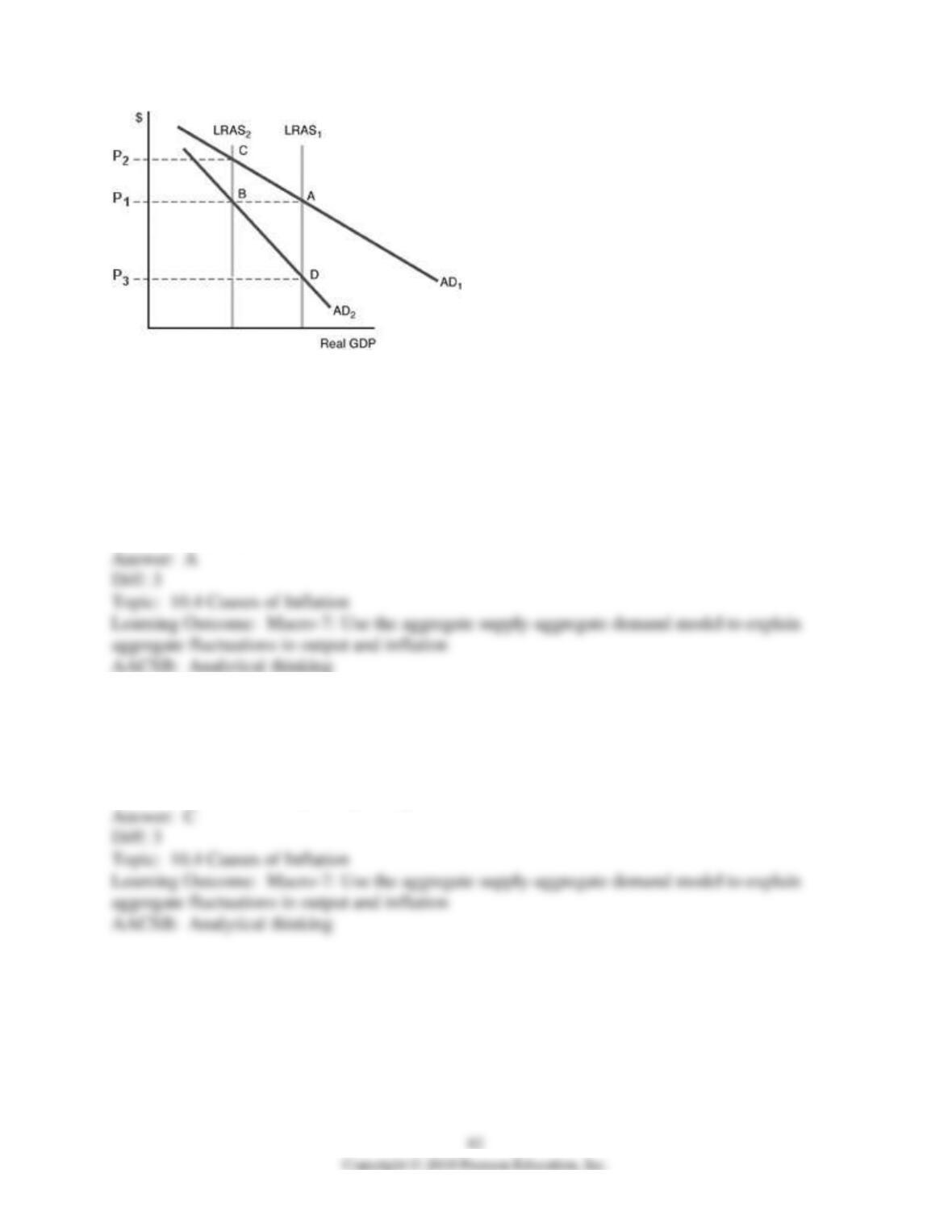
21) Refer to the above figure. Suppose the economy’s initial equilibrium is represented by the
intersection of LRAS1 and AD1. Suppose there is a persistent reduction in labor force
participation, which reduces total planned production at any given price level. The resulting
change in the economy’s long-run equilibrium position would be represented by a
A) movement from A to C.
B) movement from A to B.
C) movement from B to C.
D) movement from C to A.
22) Refer to the above figure. A movement from B to C would be NOT be the result of
A) an increase in foreign income levels.
B) an increase in government spending.
C) an increase in worker productivity.
D) an increase in consumption spending.
23) Refer to the above figure. A movement from B to D would be a result of
A) an increase in the quantity of money in circulation.
B) an increase in labor productivity.
C) an increase in government expenditures.
D) an increase in the marginal income tax rate.
24) Refer to the above figure. Suppose the economy’s initial equilibrium is represented by the
intersection of LRAS2 and AD2. Now there is an increase in labor productivity which increases
total planned production at any given price level and aggregate demand remains stable. The
resulting change in the economy’s long-run equilibrium position would be represented by a
A) movement from B to D.
B) movement from C to D.
C) movement from C to B.
D) movement from A to B.
25) When the economy is in long-run equilibrium, the price level adjusts so as to equate which
two values with one another?
A) import and export spending
B) the inflation rate and the unemployment rate
C) government spending and tax revenues
D) total planned real expenditures and total planned production
26) What pattern would you observe in an economy in which aggregate demand is increasing but
in which long-run aggregate supply remained the same?
A) secular deflation
B) inflation accompanied by no change in real GDP
C) inflation accompanied by declines in real GDP
D) a decline in consumption spending
27) Steadily improving improvements in technology, other things being equal, will result in
A) no change in the price level and steadily increasing output.
B) persistent deflation
C) steadily rising price level (inflation) and steadily increasing output.
D) a steadily falling price level with no change in output.
28) When the aggregate demand curve shifts ________ than the long-run aggregate supply shifts
leftward, the result will be inflation.
A) rightward at a slower rate
B) leftward at a slower rate
C) rightward at a faster rate
D) leftward at the same rate

29) What would likely happen to the long-run aggregate supply curve if the U.S. federal
government decreases marginal tax rates on wages?
A) The LRAS curve would shift rightward.
B) The LRAS curve would shift leftward.
C) The LRAS curve would remain stable while the AD curve would shift leftward.
D) The LRAS curve would remain stable while the AD curve would shift rightward.
30) Which of the following would unambiguously generate deflation?
A) a decrease in aggregate demand accompanied by an increase in aggregate supply
B) an increase in aggregate demand accompanied by an increase in aggregate supply
C) a decrease in aggregate demand accompanied by a decrease in aggregate supply
D) an increase in aggregate demand accompanied by a decrease in aggregate supply
31) If long-run economic growth is NOT accompanied by a change in aggregate demand, the
result will be
A) persistent inflation.
B) secular deflation.
C) devaluation of the dollar.
D) appreciation of the dollar.
32) What causes demand-side inflation? What causes supply-side inflation?
86
33) What are three causes of supply-side inflation?