50) A financial intermediary’s main function is to match ________ with excess funds to ________ with a
shortage of funds.
A) savers; borrower
B) borrower; savers
C) governments; households
D) firms; insurance companies
51) A country with no trade and no borrowing and lending relationships with other countries is known
as a(n)
A) planned economy.
B) market economy.
C) open economy.
D) closed economy.
52) In a closed economy,
A) I = Y – C – G.
B) I = Y + C – G.
C) I = Y – C + G.
D) I = Y + C + G.
53) Private saving is defined as
A) Y + TR – C – T.
B) T + G + TR.
C) T – G + TR.
D) Y + TR + C – T.
54) Public saving in the economy can be increased by
A) lowering taxes.
B) raising government spending.
C) raising taxes.
D) raising transfer payments.
55) If real GDP in a closed economy is $40 billion, consumption is $20 billion, and government
purchases are $10 billion, what is investment?
A) $10 billion
B) $30 billion
C) $40 billion
D) $70 billion
56) If, in a closed economy, real GDP is $30 billion, consumption is $20 billion, and government
purchases are $5 billion, what is total saving in the economy?
A) $5 billion
B) $15 billion
C) $45 billion
D) $55 billion
57) In a closed economy, what is the relationship between saving and investment?
A) Saving is greater than investment.
B) Investment is greater than saving.
C) Investment is equal to saving.
D) Investment may be greater or smaller than saving.
58) The sum of public and private saving in an economy is equal to
A) Y – C – T.
B) T – TR – G.
C) Y – C – G.
D) I – C – G.
59) When the government runs a deficit, which of the following is true?
A) T > TR – G
B) G > T + TR
C) G > TR – T
D) T < G + TR
60) If taxes are less than transfers plus government spending, then
A) there is positive saving.
B) there is a balanced budget.
C) there is a budget surplus.
D) there is public dissaving.
61) There is public dissaving if
A) G + TR > T.
B) G + TR < T.
C) TR > G + T.
D) TR < G + T.
62) Which of the following would increase public saving?
A) an increase in taxes
B) an increase in transfers
C) an increase in government purchases
D) All of the above would increase public saving.
63) An increase in government purchases, ceteris paribus, will
A) increase public saving.
B) increase the supply of loanable funds.
C) reduce investment.
D) reduce real GDP.
64) The budget deficit is defined as
A) T – (G + TR), and this is negative.
B) T – (G + TR), and this is positive.
C) T + (G – TR), and this is negative.
D) T + (G + TR), and this is negative.
65) Which of the following statements about the budget deficit is true?
A) In 1992, the federal budget was balanced.
B) In 2000, the federal budget was in surplus.
C) In 2004, the federal budget was in surplus.
D) In 2011, the federal budget was in surplus.
66) The federal budget deficit can be reduced by
A) raising taxes.
B) raising government spending.
C) raising transfer payments.
D) higher interest rates.
67) An increase in public saving has what impact on the market for loanable funds?
A) The supply of loanable funds increases.
B) The demand for loanable funds increases.
C) The supply of loanable funds decreases.
D) The demand for loanable funds decreases.
68) The demand for loanable funds has a ________ slope because the lower the interest rate, the
________ number of investment projects are profitable, and the ________ the quantity of loanable funds
demanded.
A) negative; greater; greater
B) negative; greater; lesser
C) negative; lesser; greater
D) positive; lesser; lesser
69) An increase in the real interest rate does which of the following?
A) reduces the demand for loanable funds
B) reduces saving
C) reduces consumption spending
D) increases the demand for loanable funds
70) The demand for loanable funds is determined by the willingness of ________ to borrow money to
engage in new investment projects.
A) government
B) households
C) banks
D) firms
71) Using the market for loanable funds, which of the following has the potential to raise the real
interest rate?
A) an increase in the demand for loanable funds
B) an increase in the quantity of loanable funds demanded
C) an increase in the supply of loanable funds
D) an increase in the quantity of loanable funds supplied
72) An increase in the real interest rate results in which of the following?
A) an increase in the demand for loanable funds
B) a decrease in the demand for loanable funds
C) an increase in the quantity of loanable funds supplied
D) Both B and C will occur as a result of an increase in the real interest rate.
73) A decrease in the real interest rate will
A) increase consumption and reduce investment.
B) increase saving and investment.
C) decrease investment and government spending.
D) increase consumption and investment.
74) The supply of loanable funds has a ________ slope because the greater the interest rate, the ________
the reward to saving, and the ________ the quantity of loanable funds supplied.
A) positive; lesser; lesser
B) positive; greater; lesser
C) negative; lesser; greater
D) positive; greater; greater
75) Equilibrium in the loanable funds market determines
A) the nominal interest rate.
B) the current interest rate.
C) the real interest rate.
D) the expected interest rate.
76) If technological change increases the profitability of new investments for firms, then the ________
curve for loanable funds will shift to the ________.
A) supply; right
B) supply; left
C) demand; right
D) demand; left
77) Because ________ in the government budget deficit increase the real interest rate, budget deficits can
________ firm investment.
A) increases; increase
B) decreases; increase
C) decreases; decrease
D) increases; decrease
78) Economist Steve Landsburg has pointed out that Ebenezer Scrooge’s change in behavior from miser
to spender might actually be detrimental to the economy because
A) Scrooge’s miserly saving helped contribute to the production of investment goods rather than
consumption goods.
B) Scrooge was happiest when he was saving money, and happiness is the key to economic growth.
C) saving has to be greater than consumption for the economy to grow.
D) Scrooge’s consumption habits were more detrimental to the environment than were his earlier saving
habits.
79) If technological change increases the profitability of new investment for firms, then the ________
curve for loanable funds will shift to the ________ and the equilibrium real interest rate will ________.
A) supply; right; fall
B) supply; left; rise
C) demand; right; rise
D) demand; left; fall
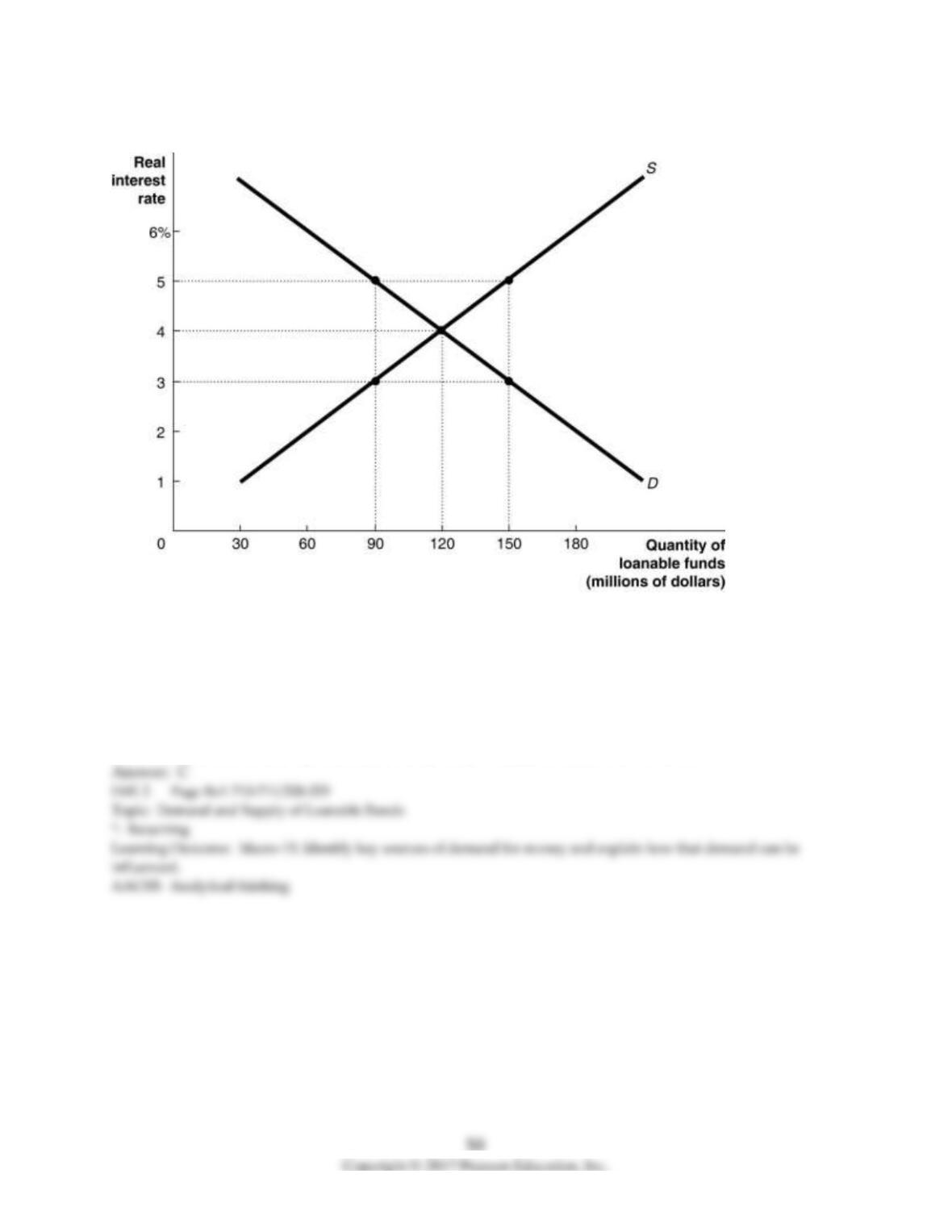
Figure 10-6
80) Refer to Figure 10-6. The loanable funds market is in equilibrium, as shown in the figure above. An
increase in the supply of loanable funds could result in which of the following combinations of the real
interest rate and quantity of loanable funds at a new equilibrium?
A) The real interest rate is 5 percent, and the quantity of loanable funds is $150 million.
B) The real interest rate is 5 percent, and the quantity of loanable funds is $90 million.
C) The real interest rate is 3 percent, and the quantity of loanable funds is $150 million.
D) The real interest rate is 3 percent, and the quantity of loanable funds is $90 million.
81) Refer to Figure 10-6. The loanable funds market is in equilibrium, as shown in the figure above. As a
result of an increase in the government budget deficit, the ________ for loanable funds will ________,
thereby ________ the equilibrium real interest rate and ________ the equilibrium quantity of loanable
funds.
A) demand; rise; increasing; decreasing
B) supply; rise; decreasing; increasing
C) demand; fall; decreasing; decreasing
D) supply; fall; increasing; decreasing
82) Refer to Figure 10-6. The loanable funds market is given in the figure above. If the current real
interest rate is 5 percent, which of the following is true?
A) The loanable funds market is in equilibrium.
B) There is a surplus of loanable funds in the market.
C) There is a shortage of loanable funds in the market.
D) The quantity of loanable funds being demanded in the market is less than $90 million.
83) Refer to Figure 10-6. The market is in equilibrium. If the government budget deficit rises, which of
the following would you expect to see?
A) The quantity of loanable funds demanded by firms will rise above $120 million.
B) The quantity of loanable funds demanded by firms will fall below $120 million.
C) The budget deficit will have no impact on the quantity of loanable funds demanded by firms.
D) The interest rate will fall below 4 percent.
84) An increase in the government budget deficit will shift the ________ curve for loanable funds to the
________ and the equilibrium real interest rate will ________.
A) supply; right; fall
B) supply; left; rise
C) demand; right; rise
D) demand; left; fall
85) An increase in the government budget surplus will shift the ________ curve for loanable funds to the
________ and the equilibrium real interest rate will ________.
A) supply; right; fall
B) supply; left; rise
C) demand; right; rise
D) demand; left; fall
86) Which of the following will increase the real interest rate?
A) an increase in the supply of loanable funds
B) an increase in household saving
C) an increase in the demand for loanable funds
D) an increase in the budget surplus
87) Countries without well-developed financial systems are able to sustain high levels of economic
growth.
88) In an open economy, there is interaction with other economies in terms of both trading of goods and
services and borrowing and lending.
89) If there is public dissaving, investment spending in the economy will decline, holding everything
else constant.
90) An increase in the real interest rate will decrease consumption and investment.
91) Retained earnings are always sufficient to finance a firm’s rapid expansion in a high-growth
economy.
92) Financial markets and financial intermediaries comprise the financial system.
93) Empirical evidence shows that the impact of government budget deficits and surpluses on the
equilibrium interest rate is quite large.
94) In an open economy, the relationship between GDP (Y) and expenditures is Y = C + I + G.
95) In 2003, Congress passed a tax cut that included a reduction in the marginal tax rate on stock
dividends. This essentially increased the after-tax rate of return on stocks that offer dividends. Using the
loanable funds market, describe what will happen to saving, investment, economic growth, the real
interest rate, and the quantity of loanable funds exchanged.
96) Carefully define the two categories of saving in the economy.
97) Briefly explain how the miserliness of Ebenezer Scrooge might actually be beneficial for economic
growth.
98) How does a decrease in the tax rate on income earned on saving affect saving, investment, the
interest rate, and economic growth?
99) Explain why the demand curve for loanable funds has a negative slope.
56
100) Explain why increasing the government budget deficit can decrease investment spending.
101) Use the equations for public and private saving to demonstrate how total saving in the economy
equals investment.
102) Using equations for public and private saving, show that saving must equal investment in a closed
economy. Begin with the expression for total saving in the economy.
103) Consider the following data for a closed economy:
a. Y = $12 trillion
b. C = $8 trillion
c. I = $3 trillion
d. TR = $2 trillion
e. T = $3 trillion
Use the data provided to calculate the level of private saving and the level of public saving and
demonstrate their relationship to investment.
58
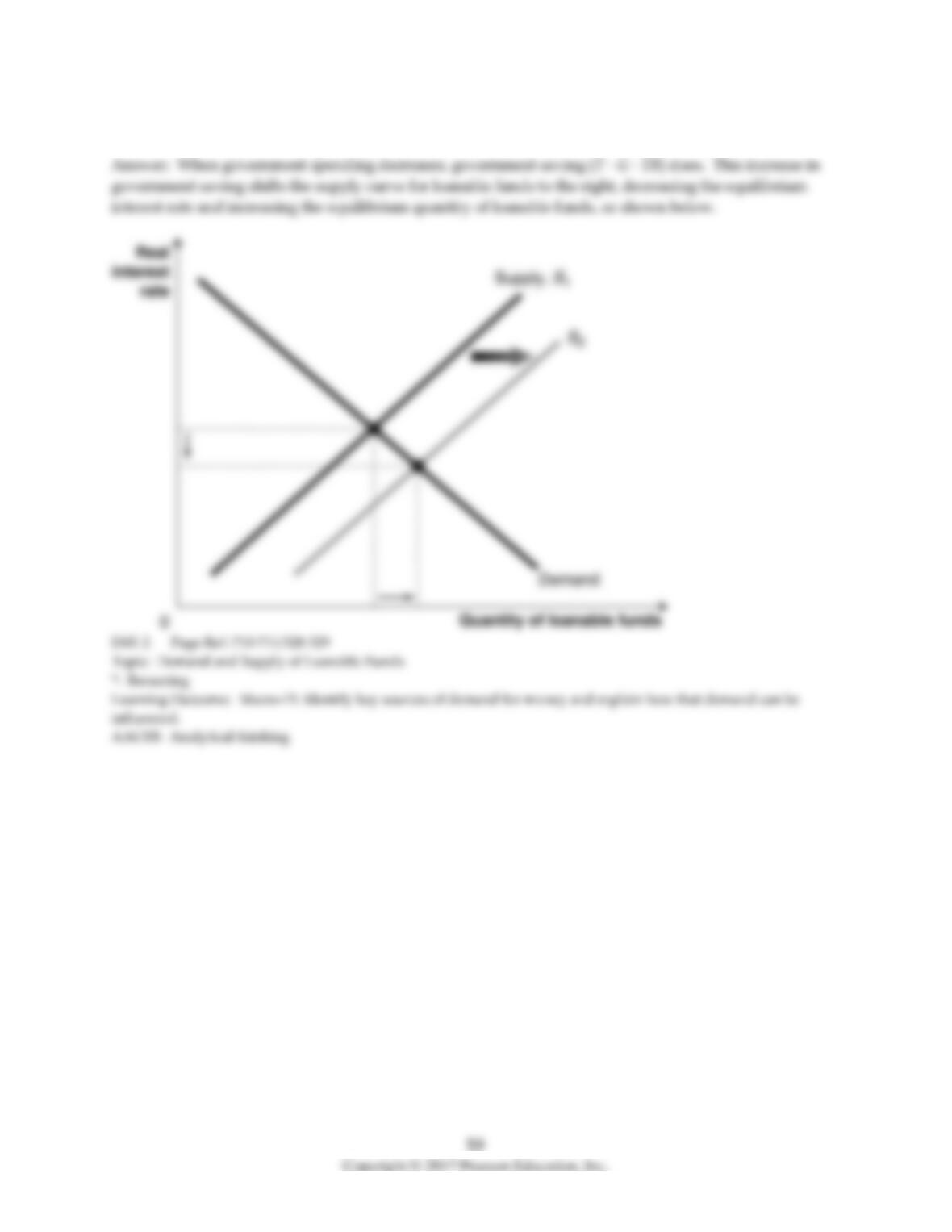
104) Explain and show graphically how a decrease in household saving affects the equilibrium interest
rate and the equilibrium quantity of loanable funds.
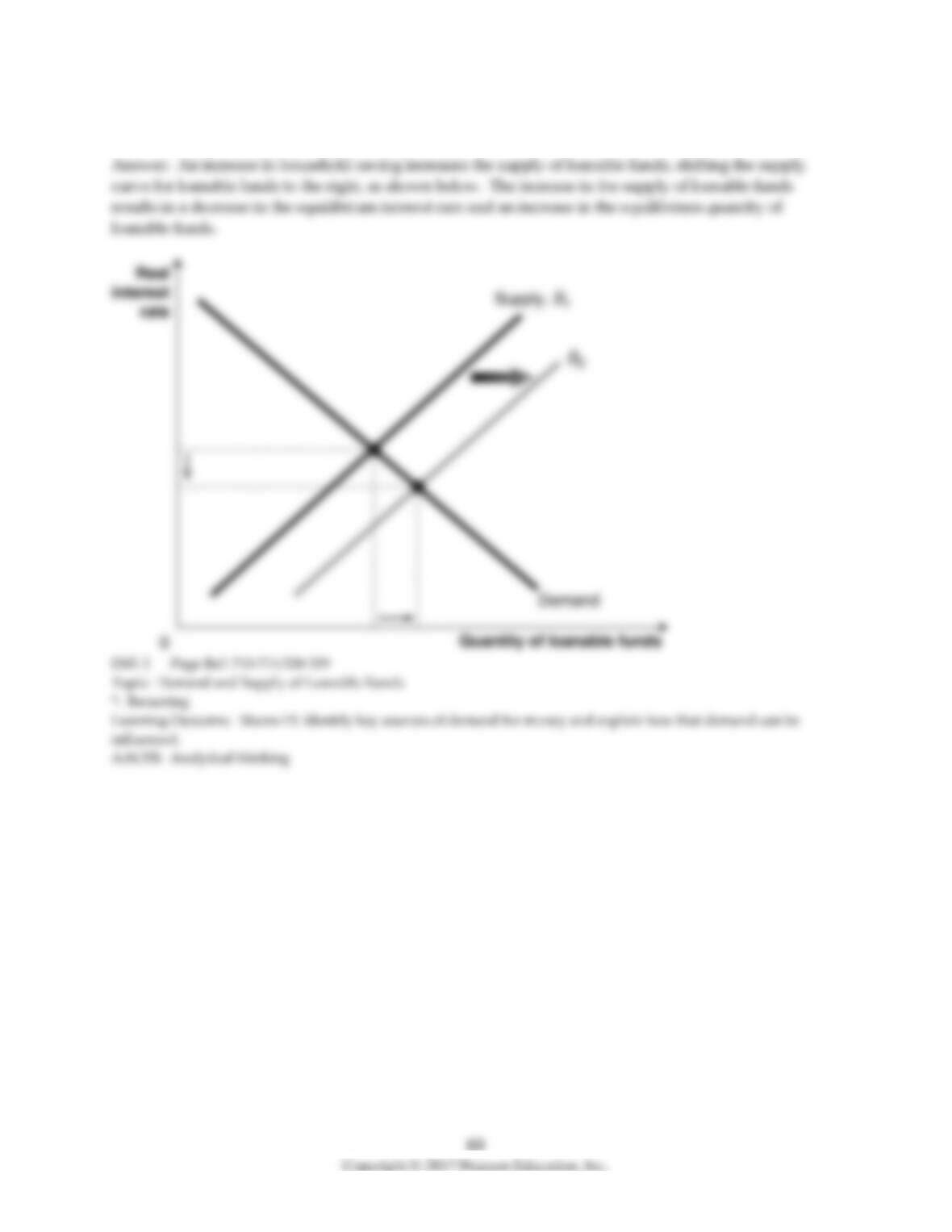
105) Explain and show graphically how a decrease in government spending affects the equilibrium
interest rate and equilibrium quantity of loanable funds in the market for loanable funds.
106) Explain and show graphically how an increase in household saving affects the equilibrium interest
rate and the equilibrium quantity of loanable funds.