CHAPTER 10—COMPETITIVE MARKETS Key
1. If P = $8 and MC = $5 + 0. 2Q, the competitive firm’s profit-maximizing level of output is:
2. In the long run, firms will offer supply at the point where P = MR = MC if:
3. Graphically, competitive market supply is measured by the:
4. For a firm in perfectly competitive market equilibrium:
5. Competition tends to be light when:
6. By itself, a reduction in import tariffs (taxes) will:
7. Above-normal profits in a perfectly competitive market are caused by:
8. In a perfectly competitive market:
9. The firm demand curve in a competitive market is:
10. A firm will earn normal profits when price:
11. In the short run, a perfectly competitive firm will shut down and produce nothing if:
12. In the long run, firms will exit a perfectly competitive industry if:
13. Perfect competition always prevails in markets with:
14. In perfectly competitive markets, profits are maximized when:
15. Economic profit:
16. Market structure is not typically characterized on the basis of:
17. Effects of market structure are not typically measured in terms of:
18. Price and product quality competition tends to be vigorous when:
19. Industry cartels never:
20. The rate of return necessary to attract and retain capital investment is called:
21. In competitive market equilibrium, the firm’s:
22. At the point of minimum AVC:
23. So long as P > AVC, the competitive firm’s short-run supply curve is equal to:
24. When profits are maximized in a competitive market, average cost is always:
25. The following market cannot be described as perfectly competitive:
26. Competitive Markets. Indicate whether each of the following statements is true or false and why.
A.
In long-run equilibrium, every firm in a perfectly competitive industry earns an economic profit.
B.
Pure competition exists in a market when firms are price makers as opposed to price takers.
C.
A natural monopoly results when the profit-maximizing output level occurs at a point where long-run average costs are decreasing.
D.
Downward-sloping industry demand curves characterize monopoly markets; horizontal demand curves characterize perfectly
competitive markets.
E.
A decrease in the price elasticity of demand would follow an increase in monopoly power.
B.
False. Pure competition exists in a market when individual firms have no influence over price. Such firms take industry prices as a
given.
False. A natural monopoly occurs in a market when the market clearing price, or price where Demand (Price) = Supply (Marginal Cost),
False. Downward sloping demand curves follow from the law of diminishing marginal utility and characterize both perfectly
competitive and monopoly market structures. Horizontal demand curves characterize perfectly competitive firms.
E.
True. A decrease in the price elasticity of demand would result following an increase in monopoly power.
27. Market Structure. Specify whether each of the following statements is true or false and demonstrate why.
A.
A market is confined to all firms and individuals willing and able to buy or sell a particular product at a given time and place.
B.
The more even the balance of power between sellers and buyers, the more likely it is that the competitive process will yield maximum
benefits.
C.
A close link between the numbers of market participants and the vigor of price competition is always evident.
D.
Market structure describes the competitive environment in the market for any good or service.
E.
Competitors often benefit from the effects of potential entrants in industries with only a handful of viable firms.
28. Product Differentiation. Suggest whether each of the following statements is true or false and illustrate
why.
A.
Sources of product differentiation include only physical differences, not merely perceived differences.
B.
Price competition tends to be most vigorous for products with many actual or perceived differences.
C.
The availability of good substitutes decreases the degree of competition.
D.
Competition tends to be less vigorous when buyers and sellers have easy access to detailed price/product performance information.
E.
The availability of good complements increases the degree of competition.
B.
False. Price competition tends to be most vigorous for homogenous products with few actual or perceived differences.
C.
False. The availability of good substitutes increases the degree of competition.
E.
False. The availability of good substitutes increases the degree of competition.
29. Entry and Exit Conditions. Signify whether each of the following statements is true or false and document
why.
A.
A barrier to mobility is any factor or industry characteristic that creates an advantage for incumbents over new arrivals.
B.
A barrier to entry is any factor or industry characteristic that creates an advantage for large leading firms over smaller nonleading rivals.
C.
Barriers to entry and mobility sometimes result in compensating advantages for consumers.
D.
A barrier to exit is any restriction on the ability of incumbents to redeploy assets from one industry or line of business to another.
E.
Government actions that create barriers to exit can have the unintended effect of retarding industrial development.
milk producers struggle to earn a normal return.
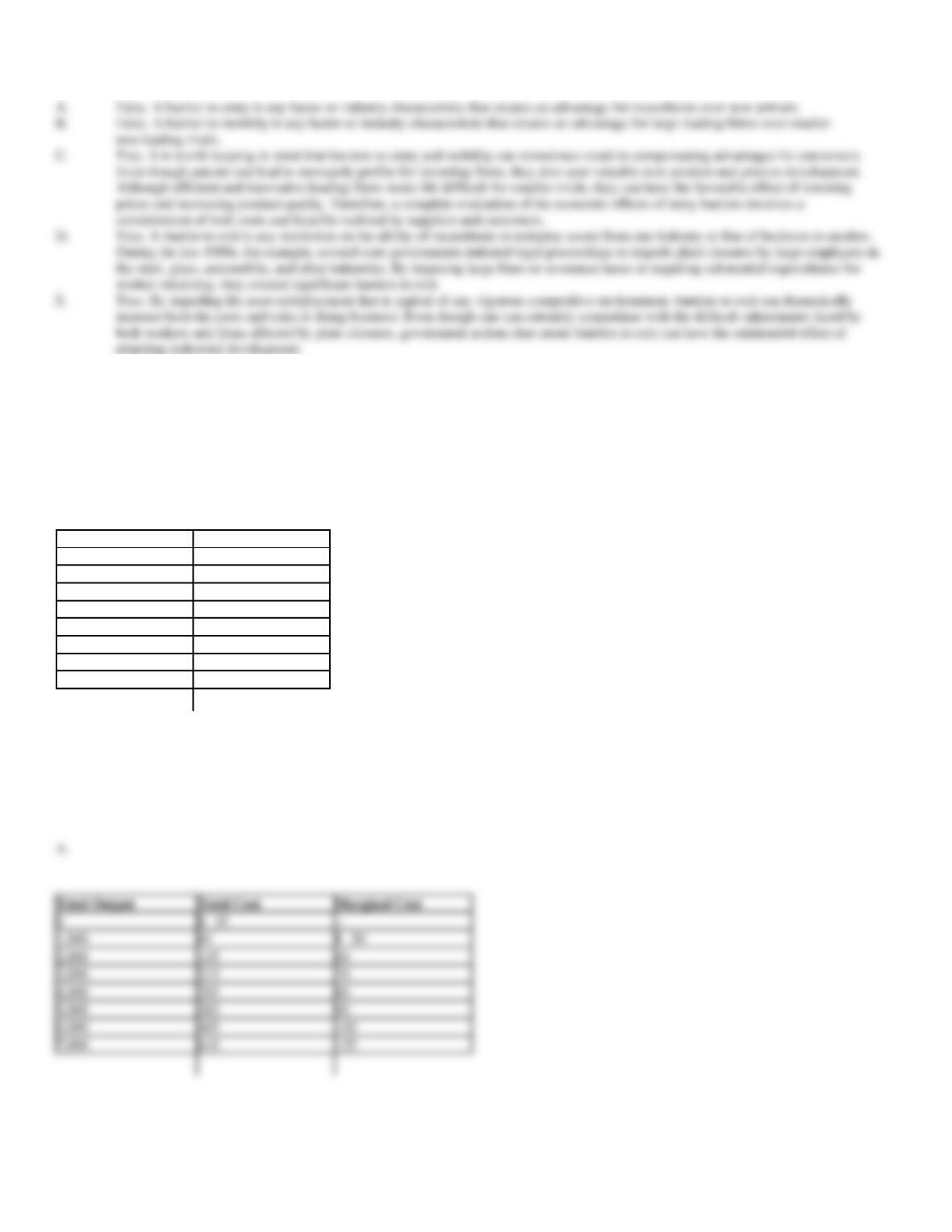
30. Price/Output Determination. Cold Case, Inc., produces beverage containers used by fast food franchises.
This is a perfectly competitive market. The following relation exists between the firm’s beverage container
output per hour and total production costs:
Total Output
Total Cost
0
$ 35
1,000
85
2,000
145
3,000
215
4,000
295
5,000
385
6,000
485
7,000
610
A.
Construct a table showing the marginal cost of paper cup production.
B.
What is the minimum price necessary for the company to supply one thousand cups?
C.
How many cups would the company supply at industry prices of $75 and $100 per thousand?
0
$ 35
1,000
$ 50
2,000
3,000
4,000
5,000
6,000
7,000
A.
False. A barrier to entry is any factor or industry characteristic that creates an advantage for incumbents over new arrivals.
worker retraining, they created significant barriers to exit.
retarding industrial development.
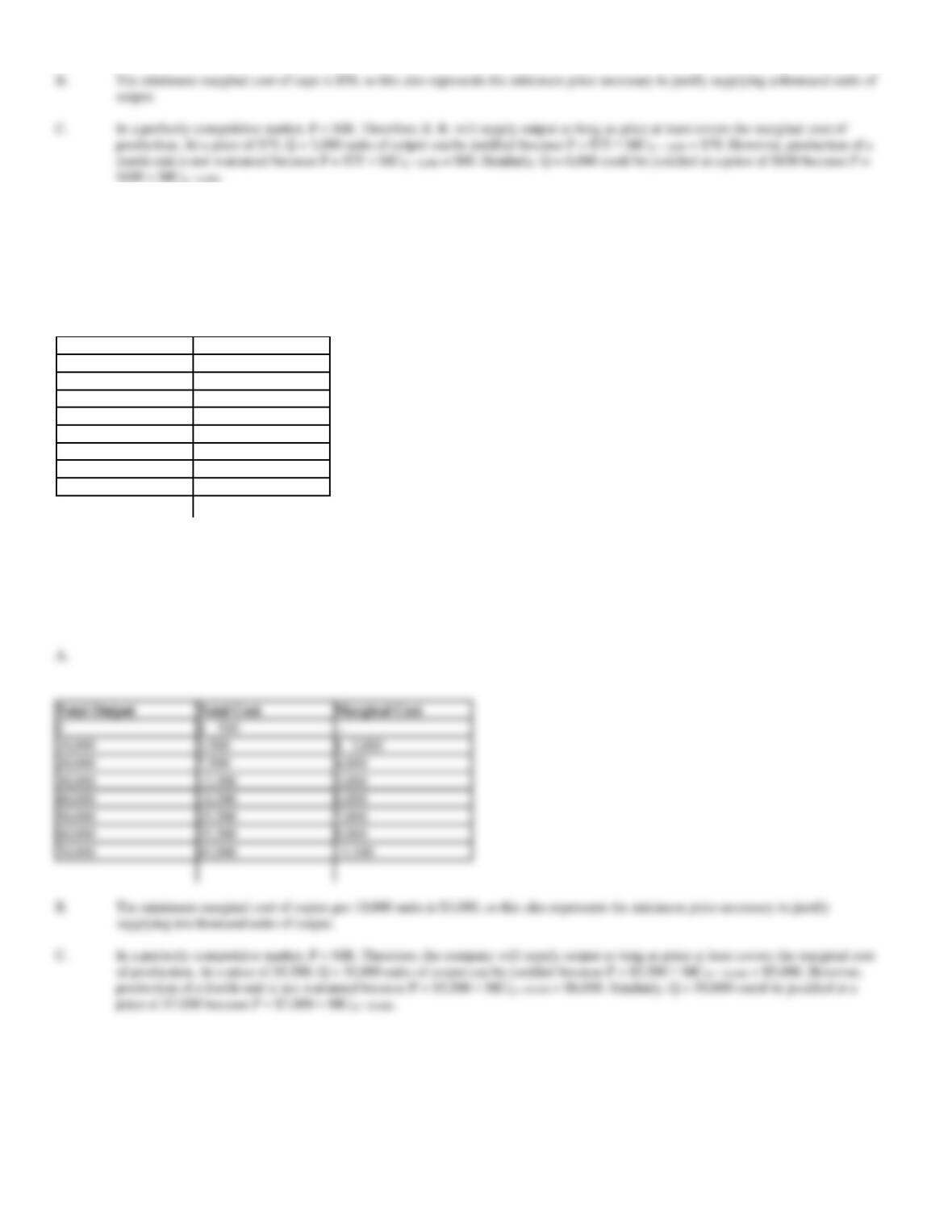
31. Firm Supply. The Copy Center specializes in high-volume printing and color copying for small businesses.
This is a fiercely competitive market. The following relation exists between output and total production costs:
Total Output
Total Cost
0
$ 500
10,000
3,500
20,000
7,500
30,000
12,500
40,000
18,500
50,000
25,500
60,000
33,500
70,000
45,000
A.
Construct a table showing the marginal of production.
B.
What is the minimum price necessary for the company to supply ten thousand copies?
C.
How many copies would the company supply at industry prices of $5,500 and $7,000 per ten thousand?
0
$ 500
10,000
3,500
$ 3,000
20,000
7,500
4,000
30,000
12,500
5,000
40,000
18,500
6,000
50,000
25,500
7,000
60,000
33,500
8,000
70,000
45,000
11,500
$100 = MCQ = 6,000.
32. Firm Supply. Credit Check, Inc., offers credit checking services to credit card companies and retailers. The
following relation exists between the number of credit checks performed and total costs in this viciously
competitive market:
Total Output
Total Cost
0
$ 150
1,000
600
2,000
1,060
3,000
1,540
4,000
2,040
5,000
2,565
6,000
3,115
7,000
3,750
A.
Construct a table showing the marginal cost of production.
B.
What is the minimum price necessary for the firm to supply one thousand credit checks?
C.
How many credit checks would the firm perform at industry prices of $510 and $550 per thousand?
Total Output
Total Cost
Marginal Cost
0
$ 150
1,000
$450
2,000
1,060
3,000
1,540
480
4,000
2,040
5,000
2,565
6,000
3,115
7,000
3,750
P = $550 = MCQ = 6,000.
33. Firm Supply. Retirement Planning Services.com is a wholesale producer of standardized retirement plans
for high net worth individuals. These plans are produced and e-mailed to financial planners who incorporate
them in their client presentations. The following relation exists between the firm’s output and total production
costs in this highly price-competitive market:
Total Output
Total Cost
0
$ 50
100
150
200
275
300
425
400
600
500
800
600
1,050
700
1,350
A.
Construct a table showing the firm’s marginal cost of production.
B.
What is the minimum price necessary for the firm to supply one hundred plans?
C.
How many plans would the firm supply at industry prices of $180 and $300 per hundred?
34. Long-run Firm Supply. The Los Angeles retail market for unleaded gasoline is fiercely price competitive.
Consider the situation faced by a typical gasoline retailer when the local market price for unleaded gasoline is
$2.50 per gallon and total cost (TC) and marginal cost (MC) relations are:
TC = $156,250 + $2.25Q + $0.0000001Q2
MC = TC/ Q = $2.25 + $0.0000002Q
Total Output
Total Cost
Marginal Cost
0
$ 50
100
150
$100
200
275
125
300
425
150
400
600
175
500
800
200
600
1,050
250
700
1,350
300
= $300 = MCQ = 700.
and Q is gallons of gasoline. Total costs include a normal profit.
A.
Using the firm’s marginal cost curve, calculate the profit-maximizing long-run supply from a typical retailer
B.
Calculate the average total cost curve for a typical gasoline retailer, and verify that average total costs are less than price at the optimal
activity level.
35. Long-run Firm Supply. The Boston retail market for unleaded gasoline is fiercely price competitive.
Consider the situation faced by a typical gasoline retailer when the local market price for unleaded gasoline is
$1.80 per gallon and total cost (TC) and marginal cost (MC) relations are:
TC = $400,000 + $1.64Q + $0.0000001Q2
MC = TC/ Q = $1.64 + $0.0000002Q
provided that P > ATC:
P
= $2.25 + $0.0000002Q
2.50
= $2.25 + $0.0000002Q
0.25
= 0.0000002Q
Q
= 1,250,000
The average total cost curve is determined by dividing total cost by output:
ATC
= $156,250/Q + $2.25 + $0.0000001Q
= $2.50
and Q is gallons of gasoline. Total costs include a normal profit.
A.
Using the firm’s marginal cost curve, calculate the profit-maximizing long-run supply from a typical retailer
B.
Calculate the average total cost curve for a typical gasoline retailer, and verify that average total costs are less than price at the optimal
activity level.
36. Short-run Firm Supply. Produce Pride, Inc., supplies sweet corn to canneries located throughout the
Missouri River Valley. Like many grain and commodity markets, the market for sweet corn is perfectly
competitive. With $500,000 in fixed costs, the company’s total and marginal costs per ton (Q) are:
1.80
= $1.64 + $0.0000002Q
Q
= 800,000
ATC
= $2.22
A.
Calculate the industry price necessary to induce short-run firm supply of 5,000, 10,000, and 15,000 tons of sweet corn. Assume that MC
> AVC at every point along the firm’s marginal cost curve and that total costs include a normal profit.
B.
Calculate short-run firm supply at industry prices of $400, $1,000, and $2,000 per ton.
37. Short-run Firm Supply. Nature’s Best, Inc., supplies asparagus to canners located throughout the
Mississippi River valley. Like several grain and commodity markets, the market for asparagus is perfectly
competitive. Marginal cost per ton of asparagus is:
MC = $1.50 + $0.0005Q
A.
Calculate the industry price necessary for the firm to supply 500, 1,000, and 2,000 pounds.
B.
Calculate the quantity supplied by Nature’s Best at industry prices of $1.50, $2.25, and $2.75 per pound.
MC = TC/ Q = $400 + $0.08Q
Therefore, at:
Q = 5,000:
P = MC = $400 + $0.08(5,000) = $800
Q = 10,000:
P = MC = $400 + $0.08(10,000) = $1,200
Q = 15,000:
P = MC = $400 + $0.08(15,000) = $1,600
B.
When quantity is expressed as a function of price, the firm’s supply curve can be written:
P = MC
= $400 + $0.08Q
0.08Q
Q
Therefore, at:
P = $400:
Q = -5,000 + 12.5($400) = 0
P = $1,000:
Q = -5,000 + 12.5($1,000) = 7,500
38. Short-run Firm Supply. Whole Fruit, Inc., distributes oranges to wholesalers located throughout the
country. Like several grain and commodity markets, the market for oranges is perfectly competitive. The
marginal cost per crate of oranges is:
MC = $15 + $0.0001Q
A.
Calculate the industry price necessary for the firm to supply 25,000, 50,000, and 100,000 crates.
B.
Calculate the quantity supplied by Whole Fruit at industry prices of $15, $22.50, and $27.50 per crate.
Q = 25,000:
P = MC = $15 + $0.0001(25,000) = $17.50
Q = 50,000:
P = MC = $15 + $0.0001(50,000) = $20
Q = 100,000:
P = MC = $15 + $0.0001(100,000) = $25
Q = 500:
P = MC = $1.50 + $0.0005(500) = $1.75
Q = 1,000:
P = MC = $1.50 + $0.0005(1,000) = $2.00
Q = 2,000:
P = MC = $1.50 + $0.0005(2,000) = $2.50
B.
When quantity is expressed as a function of price, the firm’s supply curve can be written:
P = MC
= $1.50 + $0.0005Q
0.0005Q
= P – 1.50
Q
= 2,000P – 3,000
Therefore, at:
P = $1.50:
Q = 2,000(1.50) – 3,000 = 0
P = $2.25:
Q = 2,000(2.25) – 3,000 = 1,500
P = $2.75:
Q = 2,000(2.75) – 3,000 = 2,500
0.0001Q
= P – 15
Q
= 10,000P – 150,000
Therefore, at:
P = $15:
Q = 10,000(15) – 150,000 = 0
P = $22.50:
Q = 10,000(22.50) – 150,000 = 75,000
P = $27.50:
Q = 10,000(27.50) – 150,000 = 125,000
39. Short-run Firm Supply. Give Me a Pane, Inc., distributes window glass to hardware and building supply
chains located throughout the Northeast. Like several grain and commodity markets, the market for common
single-pane glass is perfectly competitive. The company’s technology defines a marginal cost per pound of
single-pane glass given by the relation:
MC = $1.00 + $0.0001Q
where Q is pounds of single-pane glass.
A.
Calculate the industry price necessary for the firm to supply 10,000, 20,000, and 30,000 pounds.
B.
Calculate the quantity supplied by the firm at industry prices of $1.50, $2.50, and $3.50 per pound.
Q = 10,000:
P = MC = $1.00 + $0.0001(10,000) = $2
Q = 20,000:
P = MC = $1.00 + $0.0001(20,000) = $3
Q = 30,000:
P = MC = $1.00 + $0.0001(30,000) = $4
B.
When quantity is expressed as a function of price, the firm’s supply curve can be written:
P = MC
= $1.00 + $0.0001Q
0.0001Q
= P – 1.00
Q
= 10,000P – 10,000
Therefore, at:
P = $1.50:
Q = 10,000(1.50) – 10,000 = 5,000
P = MC
= $15 + $0.0001Q