123) A decrease in short-run aggregate supply ________ the equilibrium price level and
________ the equilibrium quantity of real GDP.
A) increases; increases
B) increases; decreases
C) decreases; increases
D) decreases; decreases
124) In the short run, a rightward shift of the short-run aggregate supply curve ________ real
GDP and ________ the price level.
A) decreases; lowers
B) increases; raises
C) decreases; raises
D) increases; lowers
125) In the short run, a supply shock that shifts the short-run aggregate supply curve leftward
________ real GDP and ________ the price level.
A) increases; raises
B) decreases; raises
C) increases; lowers
D) decreases; lowers
126) Assume that the economy is at a long run equilibrium and oil prices rise. As a result, the
________ shifts ________.
A) AD; rightward
B) AD; leftward
C) SAS; rightward
D) SAS; leftward
127) In the short-run, a rise in the money wage rate leads to
A) an increase in the price level and an increase in real GDP.
B) an increase in the price level and a decrease in real GDP.
C) an increase in the price level, but no change in real GDP.
D) no change in the price level, but an increase in real GDP.
128) Stagflation is the combination of
A) inflation and increasing real GDP.
B) deflation and recession.
C) inflation and recession.
D) deflation with increasing real GDP.
129) In the above figure, the economy is at point A when changes occur. If the new equilibrium
has a price level of 120 and real GDP of $15.0 trillion, then it must be the case that
A) aggregate demand has increased.
B) aggregate demand has decreased.
C) aggregate supply has decreased.
D) aggregate supply has increased.
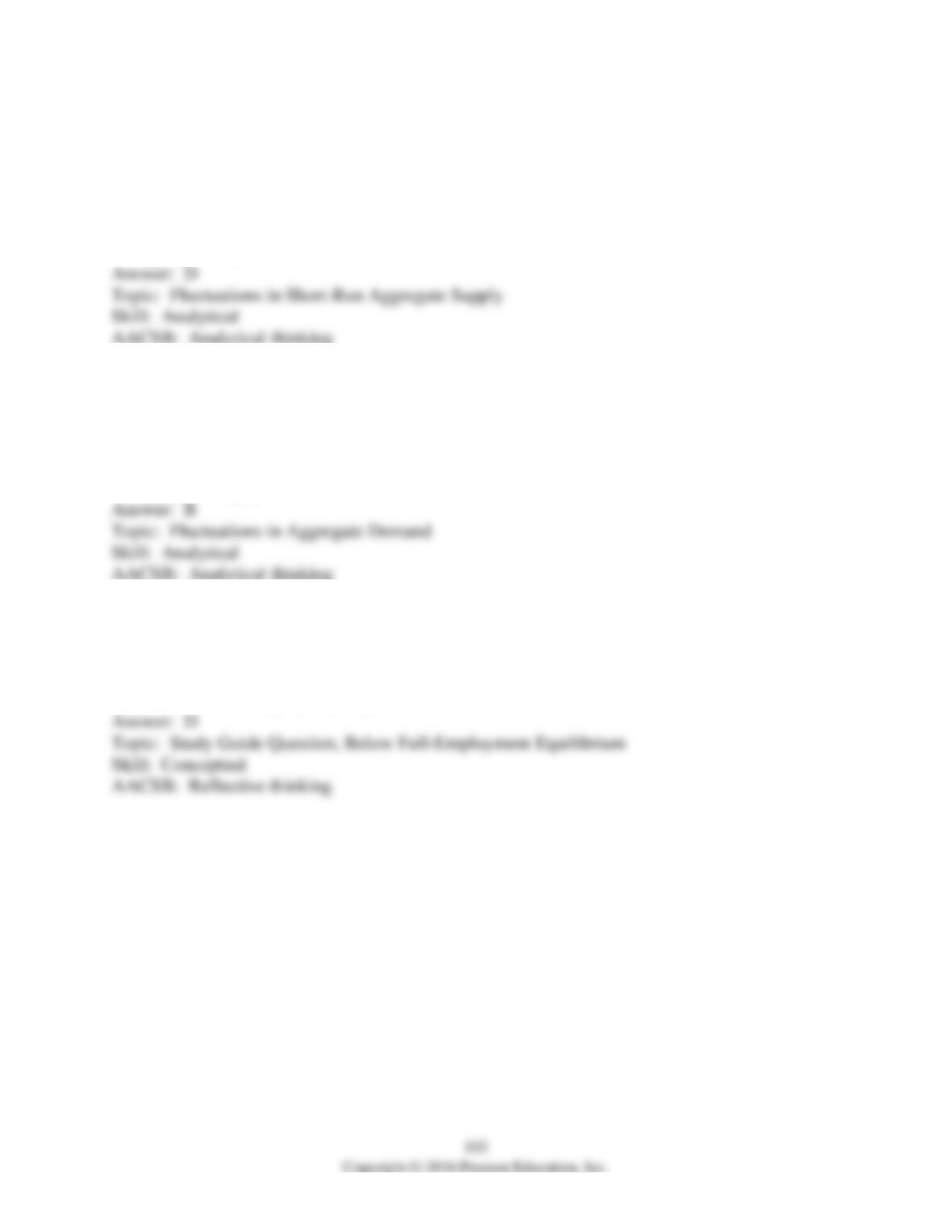
130) In the above figure, the economy is at point A when changes occur. If the new equilibrium
has a price level of 100 and real GDP of $17.0 trillion, then it must be the case that
A) aggregate demand has decreased.
B) aggregate supply has decreased.
C) aggregate demand has increased.
D) aggregate supply has increased.
131) In the above figure, the economy is at point A when changes occur. If the new equilibrium
has a price level of 100 and real GDP of $15.0 trillion, then it must be the case that
A) aggregate demand has increased.
B) aggregate demand has decreased.
C) aggregate supply has decreased.
D) aggregate supply has increased.
132) If real GDP is less than potential GDP, the economy is
A) not in macroeconomic equilibrium.
B) at full employment.
C) in an above-full-employment equilibrium.
D) in a below-full-employment equilibrium.
Price
level
Aggregate
demand
(trillions of
2009 dollars)
Short-run
aggregate
supply
(trillions of
2009 dollars)
Long-run
aggregate
supply
(trillions of
2009 dollars)
100
13
9
10
105
12
10
10
110
11
11
10
115
10
13
10
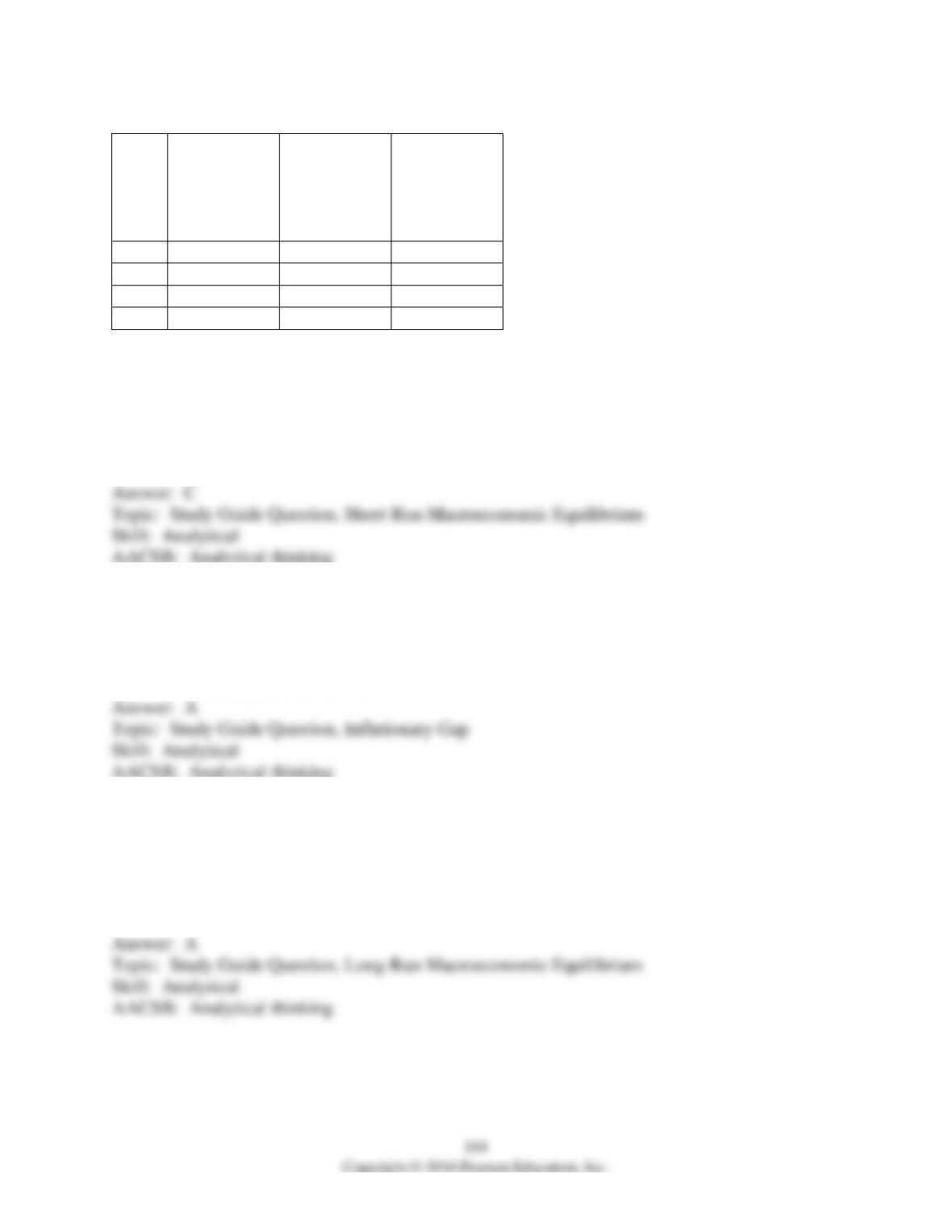
133) Using the data in the above table, in the short-run macroeconomic equilibrium, the price
level is ________ and the level of real GDP is ________.
A) 105; $10 trillion
B) 110; $10 trillion
C) 110; $11 trillion
D) 115; $10 trillion
134) Using the data in the above table, in the short-run macroeconomic equilibrium, there is
A) an inflationary gap of $1 trillion.
B) an inflationary gap of $2 trillion.
C) a recessionary gap of $1 trillion.
D) a recessionary gap of $2 trillion.
135) Using the data in the above table, in the long-run macroeconomic equilibrium, the price
level is ________ and the level of real GDP is ________.
A) 115; $10 trillion
B) 110; $10 trillion
C) 105; $11 trillion
D) 115; $11 trillion
4 Macroeconomic Schools of Thought
1) ________ economists believe that the economy is self-regulating and always at full
employment.
A) Keynesian
B) Monetarist
C) Classical
D) All
2) A classical economist believes that
A) if the economy was left alone, it would rarely operate at full employment.
B) the economy is self-regulating and always at full employment.
C) the economy is self-regulating and will normally, though not always, operate at full
employment if monetary policy is not erratic.
D) the economy is self-regulating and will normally, though not always, operate at full
employment if fiscal policy is not erratic.
3) Which of the following statements is INCORRECT?
A) A monetarist believes that recessions are the result of erratic monetary policy.
B) A new classical macroeconomist believes the business cycle is the efficient response to the
uneven pace of technological change.
C) A Keynesian believes the business cycle is mainly influenced by changes in people’s
expectations.
D) A classical macroeconomist believes that the money wage rate adjusts slowly.
4) Which of the following statements CORRECTLY describes the policy stance of a
macroeconomist?
A) A monetarist believes that the quantity of money should be constantly changed in order to
offset changes in aggregate demand.
B) A new classical macroeconomist believes that fiscal and monetary policy are required to
maintain full employment.
C) A Keynesian believes that if taxes are always kept low and the quantity of money is kept on a
steady growth path, no policy actions will be needed to maintain full employment.
D) A classical macroeconomist believes that maintaining consistently low taxes will allow the
economy to expand at an appropriate and rapid pace.
5) A Keynesian economist believes that
A) if the economy was left alone, it would rarely operate at full employment.
B) the economy is self-regulating and always at full employment.
C) the economy is self-regulating and will normally, though not always, operate at full
employment if monetary policy is not erratic.
D) the economy is self-regulating and will normally, though not always, operate at full
employment if fiscal policy is not erratic.
6) ________ economists believe that active help from fiscal and monetary policy is needed to
insure that the economy is operating at full employment.
A) Keynesian
B) Monetarist
C) Classical
D) All
7) In 2009, just after taking office, President Obama approved an $800 billion stimulus package
of tax cuts and increased government spending to combat the recession brought on by the
financial crisis of 2007. Which group of economists most approved of President Obama’s
actions?
A) Keynesian economists
B) classical economists
C) monetarists
D) free market economists
8) What could Keynes have meant by his now famous statement, “in the long run we are all
dead?”
A) Government intervention is destabilizing, will lead to slower growth in the long run, and will
prevent an economy from self-regulating.
B) Government intervention in the economy is necessary in times of recession because an
economy rarely restores itself to full employment.
C) Government intervention in the economy is useless because it takes too long to take effect.
D) Government intervention in the economy is only effective if it is not erratic.
9) ________ economists believe that the economy is self-regulating and will be at full
employment as long as monetary policy is not erratic.
A) Keynesian
B) Monetarist
C) Classical
D) All
10) A monetarist economist believes that
A) if the economy was left alone, it would rarely operate at full employment.
B) the economy is self-regulating and always at full employment.
C) the economy is self-regulating and will normally, though not always, operate at full
employment if monetary policy is not erratic.
D) the economy is self-regulating and will normally, though not always, operate at full
employment if fiscal policy is not erratic.
11) Which school of thought believes that recessions are the result of inappropriate monetary
policy?
A) only classical
B) only Keynesian
C) Monetarist
D) both Keynesian and classical
12) Which school of thought believes that real GDP always equals potential GDP?
A) only classical
B) only Keynesian
C) Monetarist
D) both Keynesian and classical
1) Consider a BMW automobile plant. If the price of BMWs increase by 10 percent and the
money wage rate and other costs ________, there will be ________.
A) increase by 10 percent; an increase in BMWs profits
B) do not change; an increase in BMW’s production and profit
C) increase by 10 percent; an increase in BMWs production
D) do not change; no change in production
2) In Japan in 2000 the price level fell by 5 percent and the money wage rate did not change. As
a result, there was a
A) movement down along Japan’s short-run aggregate demand curve.
B) movement down along Japan’s short-run aggregate supply curve.
C) rightward shift in Japan’s short-run aggregate supply curve.
D) movement down along Japan’s long-run aggregate supply curve.
3) In recent years, Japan’s capital stock has increased by about 6 percent from one year to the
next. As a result, we would expect
A) a leftward shift in Japan’s aggregate demand curve.
B) a movement up along Japan’s short-run aggregate supply curve.
C) only Japan’s long-run aggregate supply curve to shift rightward.
D) rightward shifts in both Japan’s short-run aggregate supply and long-run aggregate supply
curves.
4) According to www.oecd.org, the United States spends a larger portion of expenditures on
higher education compared to any other country. Increasing the amount of higher education
produces
I. rightward shifts in the U.S. long-run aggregate supply curve.
II. movements up along the U.S. aggregate demand curve.
III. increases in U.S. human capital.
A) I and III only
B) I, II and III
C) II and III only
D) III only
5) In 2008 the money wage rate in Ireland increased by 4 percent while the price level increased
by 8 percent. As a result, Ireland’s
A) short-run aggregate supply curve shifted leftward.
B) short-run aggregate supply curve shifted rightward.
C) long-run aggregate supply curve shifted rightward.
D) short-run and long-run aggregate supply curves shifted rightward.
6) If the price level in Great Britain increases from 102 to 105 (holding all else constant), real
wealth ________ and there is a movement ________ along Great Britain’s aggregate demand
curve.
A) decreases; upward
B) increases; upward
C) decreases; downward
D) increases; downward
7) The price level in India increases from 131 to 137 while its trading partners’ price levels
remain constant. As a result, people will buy ________ Indian-made goods and there will be a
movement ________ along India’s aggregate demand curve.
A) more; upward
B) more; downward
C) less; downward
D) less; upward
8) In 2008, the Bank of England increased the country’s money supply and lowered its interest
rate. This policy was designed to
A) encourage people to buy more goods and services.
B) shift the aggregate demand curve rightward.
C) cause a movement up along the aggregate demand curve.
D) Both A and B are correct.
9) In 2008, Japan’s government approved a $1 trillion fiscal stimulus plan comprised of both tax
cuts and government expenditure increases. As a result
A) Japan’s aggregate demand curve shifted rightward.
B) Japan’s aggregate supply curve shifted leftward.
C) Japan’s aggregate demand curve shifted leftward.
D) Japan’s long-run aggregate supply curve shifted leftward.
10) China is one of the world’s largest exporters. As the world’s economies slipped into a
worldwide recession in 2008, there was a ________ China’s aggregate demand curve as China’s
exports ________.
A) rightward shift of; decreased
B) movement upward along; increased
C) leftward shift of; decreased
D) movement upward along; decreased
11) In 2008, the dollar appreciated relative to the euro. This appreciation caused ________ and a
________.
A) a movement up along the U.S. aggregate demand curve; decrease in U.S. exports to Europe
B) a decrease in U.S. exports to Europe; leftward shift in the U.S. aggregate demand curve
C) an increase in U.S. exports to Europe; movement up along the U.S. aggregate demand curve
D) a decrease in U.S. exports to Europe; a movement up along the U.S. aggregate demand curve
12) As world economies start to recover from the 2008 financial crisis and firms expect profits to
increase
A) the price level in the U.S. will decrease as firms increase investment.
B) the U.S. short-run aggregate supply curve immediately will shift rightward.
C) investment will increase and there will be a movement up along the aggregate demand curve.
D) both investment and aggregate demand will increase.
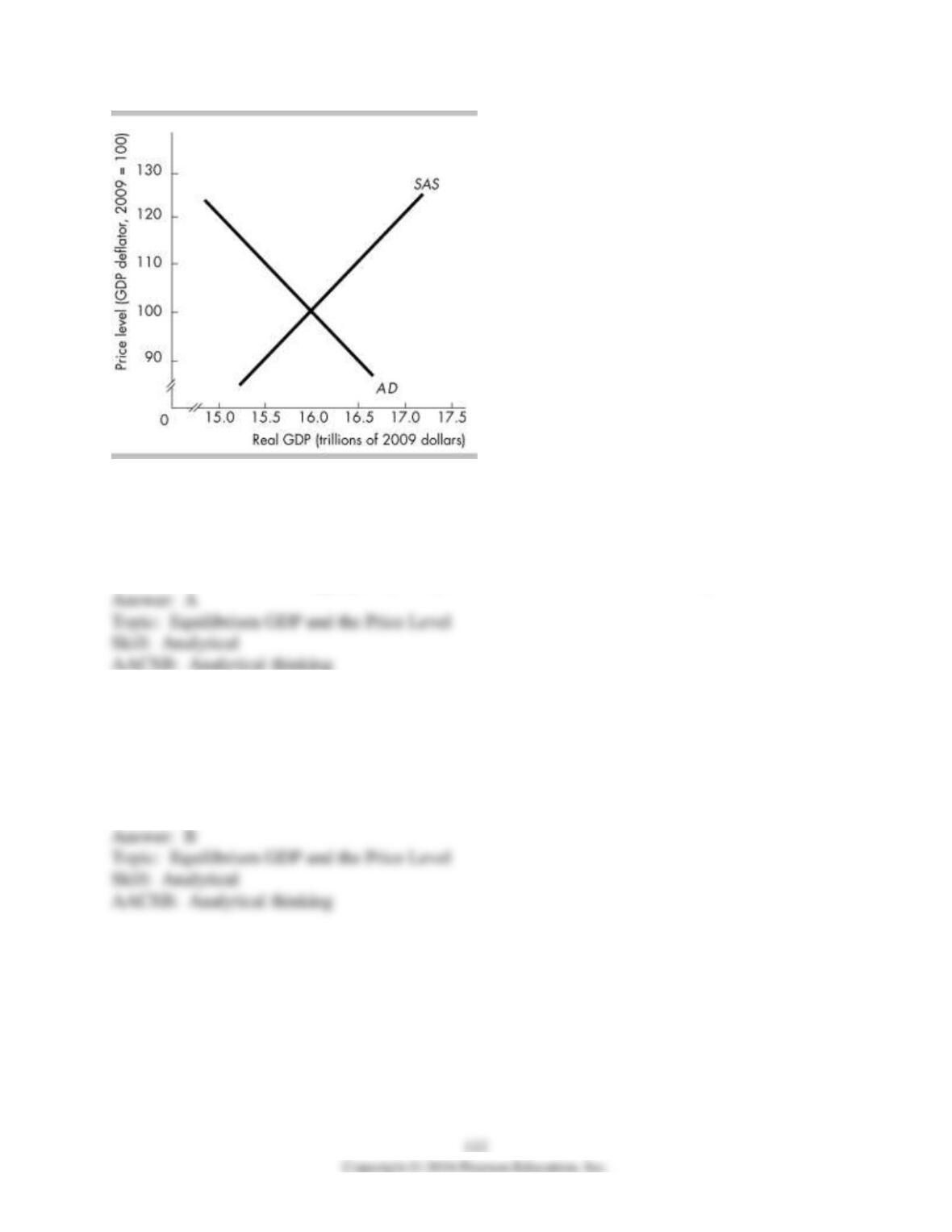
13) Use the figure above to answer this question. At a price level of 110
A) real GDP is greater than the aggregate quantity demanded and firms will cut production.
B) real GDP is less than the aggregate quantity demanded and firms will increase production.
C) inventories will decrease.
D) real GDP less than the aggregate quantity demanded and firms will increase prices.
14) Use the figure above to answer this question. At a price level of 90
A) people will be forced to cut consumption so that aggregate demand will decrease.
B) the aggregate quantity demanded exceeds real GDP and inventories will decrease.
C) inventories increase and firms will increase production.
D) the aggregate quantity demanded exceeds real GDP, inventories increase and the price level
will rise.
15) The table below shows data for India’s economy. Real GDP is measured in millions of
rupees.
Price level
Real GDP
supplied in the short
run
Real GDP demanded
a
114
23,501
35,898
b
120
25,355
32,341
c
125
27,670
27,670
d
131
30,366
18,569
e
138
33,164
15,898
If potential GDP in India is ________ million rupees, India is experiencing ________.
A) 26,500; an inflationary gap
B) 28,500; an above-full-employment gap
C) 26,500; a recessionary gap
D) 30,000; a potential GDP gap
16) Economic growth in India has averaged about 8.5 percent in recent years and while inflation
averaged almost 9 percent. The AS–AD model shows this process as
A) rightward shifts in the short-run aggregate supply curve.
B) rightward shifts in the both the aggregate demand and long-run aggregate supply curves.
C) movements upward along the aggregate demand curve.
D) rightward shifts in the aggregate demand curve and leftward shifts in the short-run aggregate
supply curve.
17) Aggregate demand in India increased in 2008. In addition, real GDP grew strongly and
inflation approached 10 percent. The best explanation for this inflation is that
A) aggregate supply did not change.
B) potential GDP decreased.
C) there was a movement up along the aggregate demand curve in 2008.
D) potential GDP increased, but at a slower rate than aggregate demand.
18) The table below shows data for India’s economy. Real GDP is measured in millions of
rupees. Suppose that full employment occurs when real GDP is 27,000 million rupees.
Price level
Real GDP
supplied in the short
run
Real GDP demanded
a
114
23,501
35,898
b
120
25,355
32,341
c
125
27,670
27,670
d
131
30,366
18,569
e
138
33,164
15,898
The economy is experiencing ________ gap and firms will ________.
A) an inflationary gap; increase production
B) an inflationary gap; increase money wages paid to workers
C) a recessionary gap; increase production
D) a recessionary gap; decrease money wages paid to workers
19) In the first half of 2008, food and energy costs in the United States increased. At the same
time, the financial crisis slowed production. As a result, economists warned that the economy
would
A) suffer an inflationary gap.
B) see a decrease in aggregate demand and an increase in long-run aggregate supply.
C) experience stagflation.
D) see an increase in potential GDP.
20) In the first half of 2008, food and energy costs in the United States increased. At the same
time, the financial crisis slowed production as firms predicted lower profits. A ________
macroeconomist would support the use of ________.
A) classical; taxes to push the economy back to full employment
B) Keynesian; fiscal or monetary policy to stimulate aggregate demand
C) classical; monetary policy to stimulate aggregate demand
D) Keynesian; technology to push the economy back to full employment
21) In 2008, Japan’s economy suffered as world economies slowed. If authorities in Japan
followed the monetarist viewpoint, ________ to bring the economy back to full employment.
A) taxes would be decreased and the money supply should be increased
B) nothing should be done
C) aggregate supply would shift leftward
D) the money supply would be kept growing at a steady pace
22) In 2008, Germany passed a stimulus package of $29 billion as its economy slowed. This
policy action follows the ________ to restore full employment.
A) Keynesian viewpoint that supports increases in federal government expenditure
B) Keynesian viewpoint that supports increases in the money supply
C) monetarist viewpoint that supports increases in expenditure by the federal government
D) new classical viewpoint that discourages the use of expenditure by the federal government
6 Essay Questions
1) In the aggregate demand-aggregate supply framework, how does an increase in the price level
affect potential GDP?
2) How are potential GDP, full employment and the LAS curve related?