7) What is an incentive system?
8) What is the principal-agent problem as applied to corporations?
9) What are three major ways that corporations can cope with the principal-agent problem?
10) What is the main advantage and the main disadvantage of organizing a businesses as either a
proprietorship or as a partnership rather than as a corporation?
11) What are the main advantages and disadvantages of organizing a business as a corporation?
12) Is the number of sellers in the market the only thing that is different in each of the four
market types economists study?
13) What are the four types of markets? Give a brief description of each type.
14) A student wrote: “Monopolistic competition is a market structure in which a small number of
firms compete by making an identical product.” If you were the instructor, how would you
correct this statement?
15) Describe the conditions under which monopoly exists. Give two examples.
16) What is the Herfindahl-Hirschman Index and what does it measure?
17) If the Herfindahl-Hirschman Index for an industry is 8,528, is the industry competitive or
concentrated?
18) What is the difference between a four-firm concentration ratio and a Herfindahl-Hirschman
Index?
19) How would a merger between Coca-Cola and Pepsi Cola affect the four-firm concentration
ratio for the soft drink market? How would it affect the Herfindahl-Hirschman Index for the soft
drink market?
20) “The concentration measures for the United States calculated by the Department of
Commerce understate the degree of concentration in the newspaper industry.” Do you agree?
Explain.
21) What would be an example of economies of scope achieved in the automobile insurance
industry?
8 Numeric and Graphing Questions
1) Professor Rush decides to quit teaching economics and opens a shoe store out at the mall. He
gave up an annual income of $50,000 to open the store. A year after opening the shoe store, the
total revenue for the year was $200,000. Rush’s expenses were $30,000 for labor, rent was
$18,000, and utilities were $1,200. He also had to purchase new shoes from manufacturers, at a
cost of $60,000, which was financed by cashing in his savings of $60,000 that had been in a bank
earning 8 percent per year. The normal profit from operating a shoe store in the mall is $20,000.
Determine Professor Rush’s total cost and economic profit.
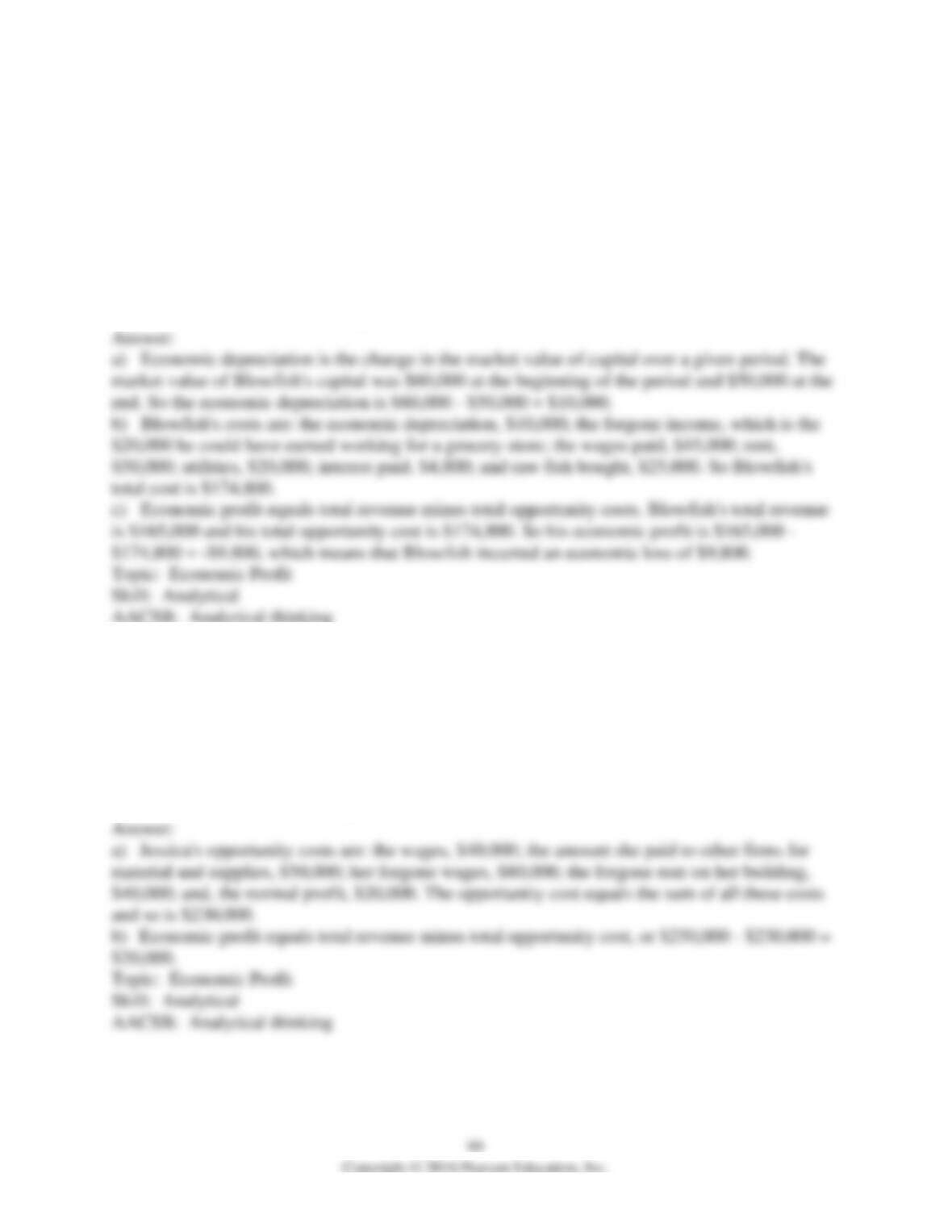
2) Mr. Blowfish opened a seafood store in December. He borrowed $60,000 from a bank at an
annual interest rate of 8 percent. He used the funds he borrowed to purchase $60,000 of capital
equipment. Over the year, he rented a building for $50,000 a year. During the first year of
operation, Blowfish paid $45,000 to his employees, $20,000 for utilities, and $25,000 for raw
fish he bought from other firms. In December of the next year, the market value of his capital
was $50,000. Blowfish’s best alternative to running the seafood store is to work for a grocery
store as a sales clerk for $20,000 a year.
a) What is the economic depreciation of Blowfish’s capital?
b) What are Blowfish’s total opportunity costs?
c) What is Blowfish’s economic profit?
3) Jessica is a young doctor who has just started her own practice. Her previous position paid her
$80,000 a year. For office space, she uses a building which she owns and which she has rented in
the past for $40,000 a year. Her total revenue from her new practice is $250,000. She pays
$50,000 to other firms for materials and supplies, and she pays $40,000 in wages to her office
nurse. Assume that Jessica’s building and equipment do not depreciate and that her normal profit
is $20,000.
a) What is the opportunity cost of all factors of production employed by Jessica?
b) What is Jessica’s economic profit?
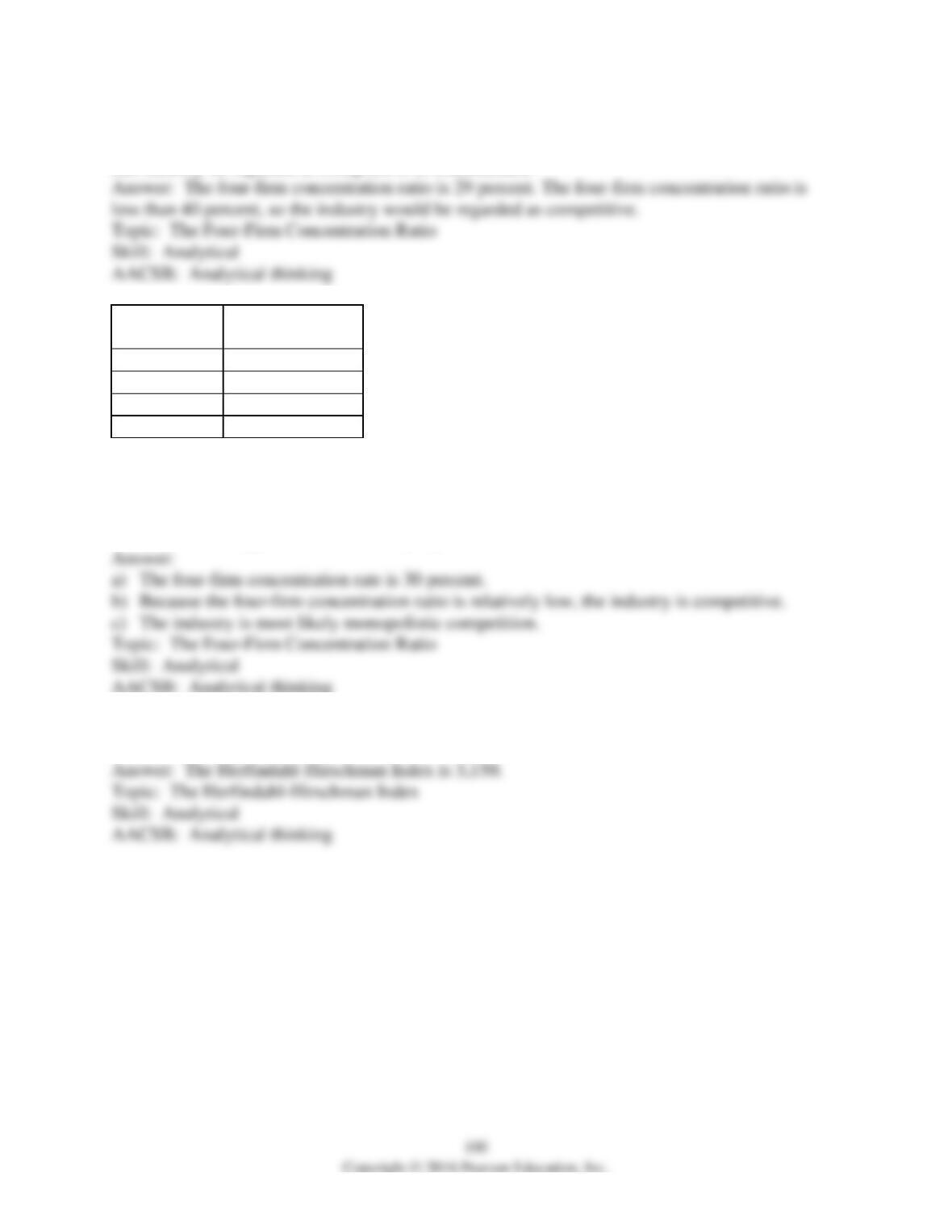
4) The four largest firms in an industry account for the following value of industry sales: 12
percent, 8 percent, 5 percent and 4 percent. Calculate the four-firm concentration ratio. Would
this industry be regarded as competitive or concentrated?
Company
Market share
(percent of sales)
A
12
B
10
C
5
D
3
5) The above table shows the percent of sales held by the four largest firms in an industry.
a) Calculate this industry’s four-firm concentration ratio.
b) Is this industry competitive?
c) What market type does it most likely represent?
6) An industry has only four firms, who have market shares of 45 percent, 25 percent, 20
percent, and 10 percent. What is the Herfindahl-Hirschman Index?
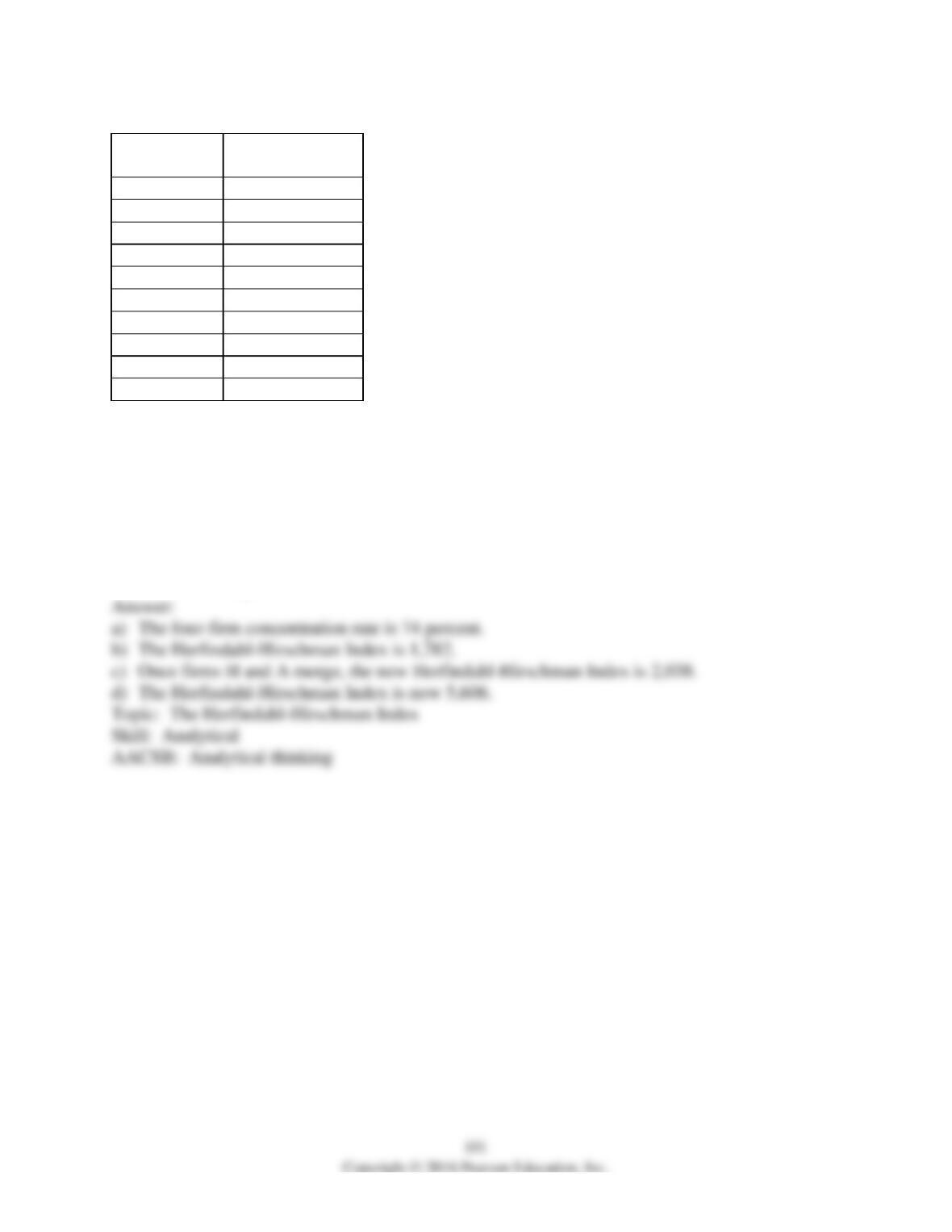
Company
Market share
(percent of sales)
A
32
B
17
C
15
D
10
E
7
F
7
G
5
H
4
I
2
J
1
7) Suppose there are ten firms that occupy the Odell, Oregon cherry pie market. The market
share of each firm is listed in the above table.
a) What is the four-firm concentration ratio in this market?
b) What is the Herfindahl-Hirschman Index for this market?
c) If Firm H and Firm A merge, what is the new Herfindahl-Hirschman Index for this market?
d) A severe winter causes every firm except A, B, and E to close. With only these three firms
operating, Firm A’s market share is 71 percent, Firm B’s market share is 23 percent, and Firm C’s
market share is 6 percent. What is the Herfindahl-Hirschman Index for this market now?
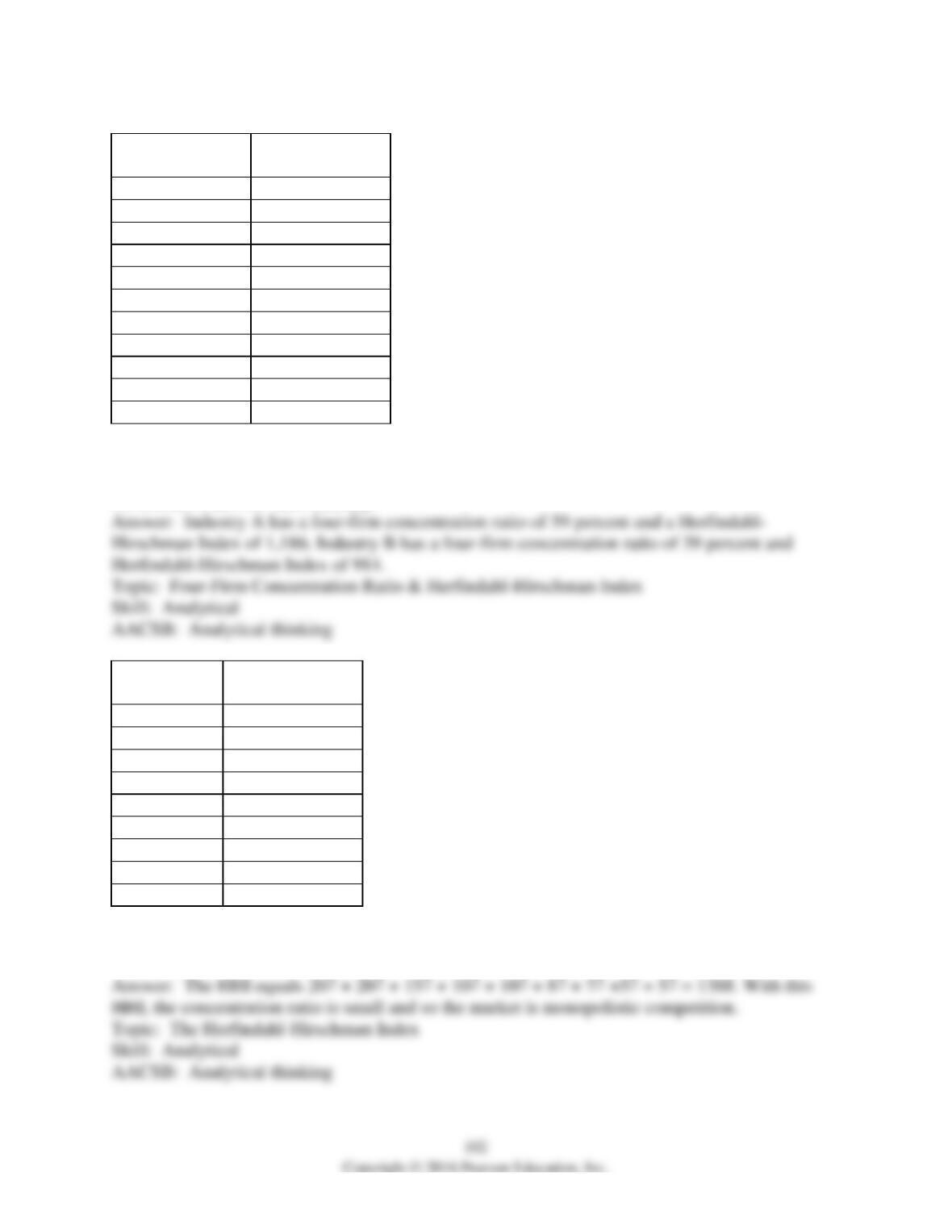
Industry A
(percent of sales)
Industry B
(percent of sales)
5
10
7
8
4
9
16
8
11
9
10
10
8
9
19
9
13
10
4
9
3
9
8) Listed in the above table are the market shares for the firms in two different industries. Each
industry has only eleven firms. Find the four-firm concentration ratio and the Herfindahl-
Hirschman Index for each industry.
Company
Market share
(percent of sales)
A
20
B
20
C
15
D
10
E
10
F
8
G
7
H
5
I
5
9) There are 9 firms in an industry with market shares in the table above. Calculate the HHI for
the industry. What kind of market does this operate in and why?

9 True or False
1) A firm’s goal is to maximize normal profit.
2) Technological efficiency occurs when it is not possible for a firm to get more output from the
inputs it is currently using.
3) Technological efficiency occurs when the firm produces a given output by using the least
amount of inputs.
4) If a firm is achieving economic efficiency it must also be achieving technological efficiency.
5) If a firm produces a given amount of output using the least amount of inputs, it definitely
achieves economic efficiency.
6) Firms organize production by using a mixture of two systems: (1) command systems and (2)
incentive systems.

7) The possibility that the managers of a corporation might not always act in the best interest of
its owners is an example of the principal-agent problem.
8) The only two ways of dealing with the principal agent problem are the use of long-term
contracts and monitoring.
9) The decision about whether a firm in each particular industry must operate as a proprietorship,
partnership, or corporation is made by the Internal Revenue Service.
10) Proprietorships generally have unlimited liability, whereas partnerships and corporations
have limited liability.
11) Although a corporation is the most common type of firm, corporations generate only a small
share of business revenue in the U.S. economy.
12) A monopolistically competitive firm produces a good or service that has no close substitutes.
13) In their calculation, concentration ratios take barriers to entry into a market into
consideration.
14) The most prevalent market structures in the U.S. economy are perfect competition and
monopolistic competition.
15) Economies of scope has to do with lowering production costs by increasing the quantity of a
product produced, whereas economies of scale has to do with lowering production costs by
producing several products within the same firm.
10 Extended Problems
1) Two university graduates, Bill and Steve, worked for an advertising agency at an annual
salary of $40,000 each for 3 years after they graduated. Then, they decided to quit their jobs and
start a partnership that designs and builds Web sites. They rented an office for $12,000 a year
and bought capital for $30,000. To pay for the equipment, Bill and Steve borrowed money from
a bank at an annual interest rate of 6 percent. During their first year of operation, the partners’
total revenue was $100,000. The market value of their capital at the end of the year was $20,000.
If Bill and Steve do not design Web pages, their best alternatives are to return to their previous
job.
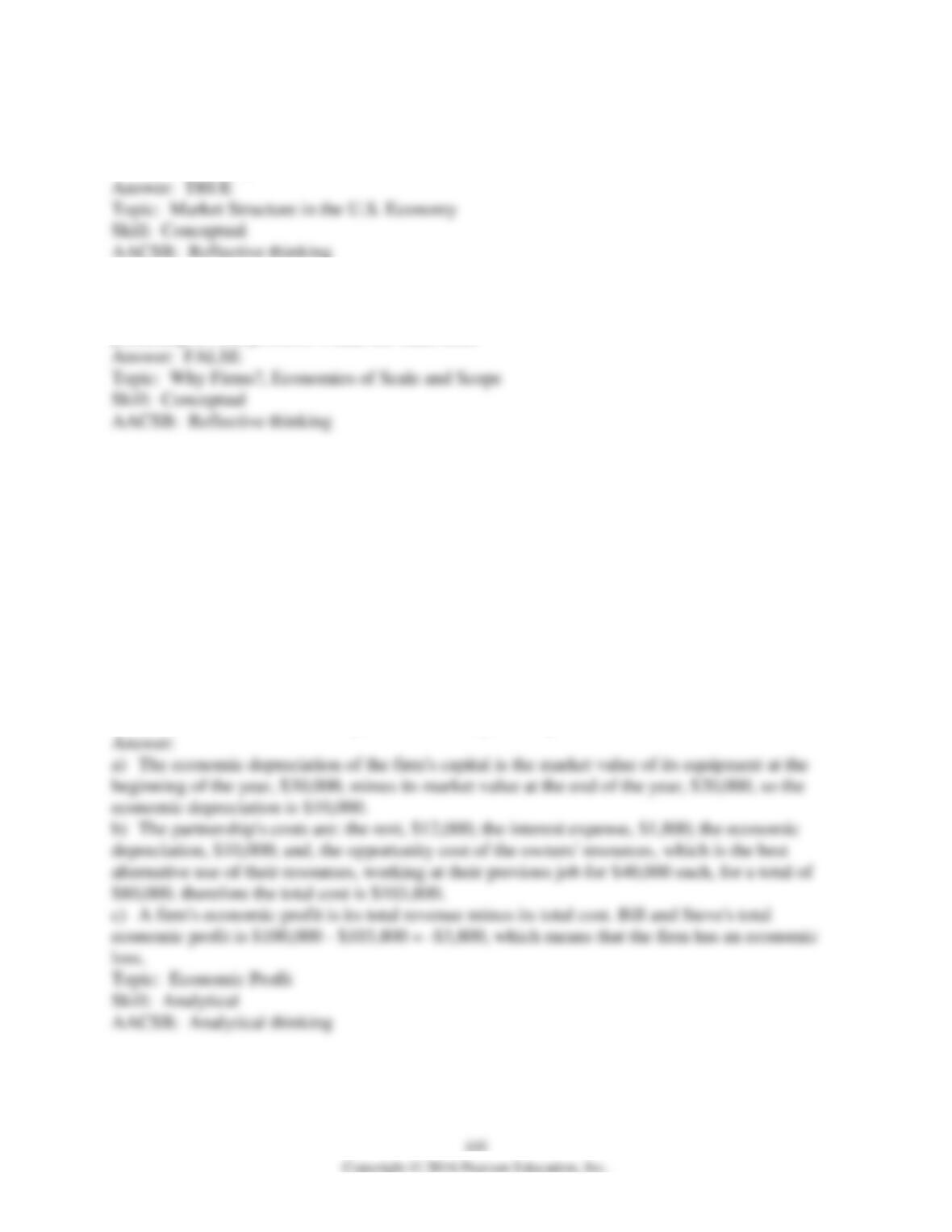
a) What is the firm’s economic depreciation?
b) What are the partnership’s costs?
c) What is the firm’s economic profit in the first year of operation?
2) One year ago, Ms. Case and Mr. Bond opened a jewelry store called T & J. They invested
$1,000,000 of their savings into the partnership to buy equipment and initial inventory. They
rented a building for $90,000 a year, and hired two employees for an annual wage of $40,000
each. Case and Bond believed that the best alternative investment of their money would be
government bonds, which could yield an annual return of 8 percent. To run the store, Case quit
her previous job, at which she earned $100,000, but her former boss told her that she was
welcome to return anytime. Bond kept his job with the government, but gave up 6 hours of
leisure each week (for 50 weeks), the time he used to spend playing golf. Bond used to say: “I’d
only give up my golf time if someone paid me $100 an hour.” During the first year of operation,
T & J paid $20,000 for utilities and the firm’s total revenue was $350,000. The market value of T
& J’s equipment was $200,000 at the beginning of the year and $170,000 at the end of the year.
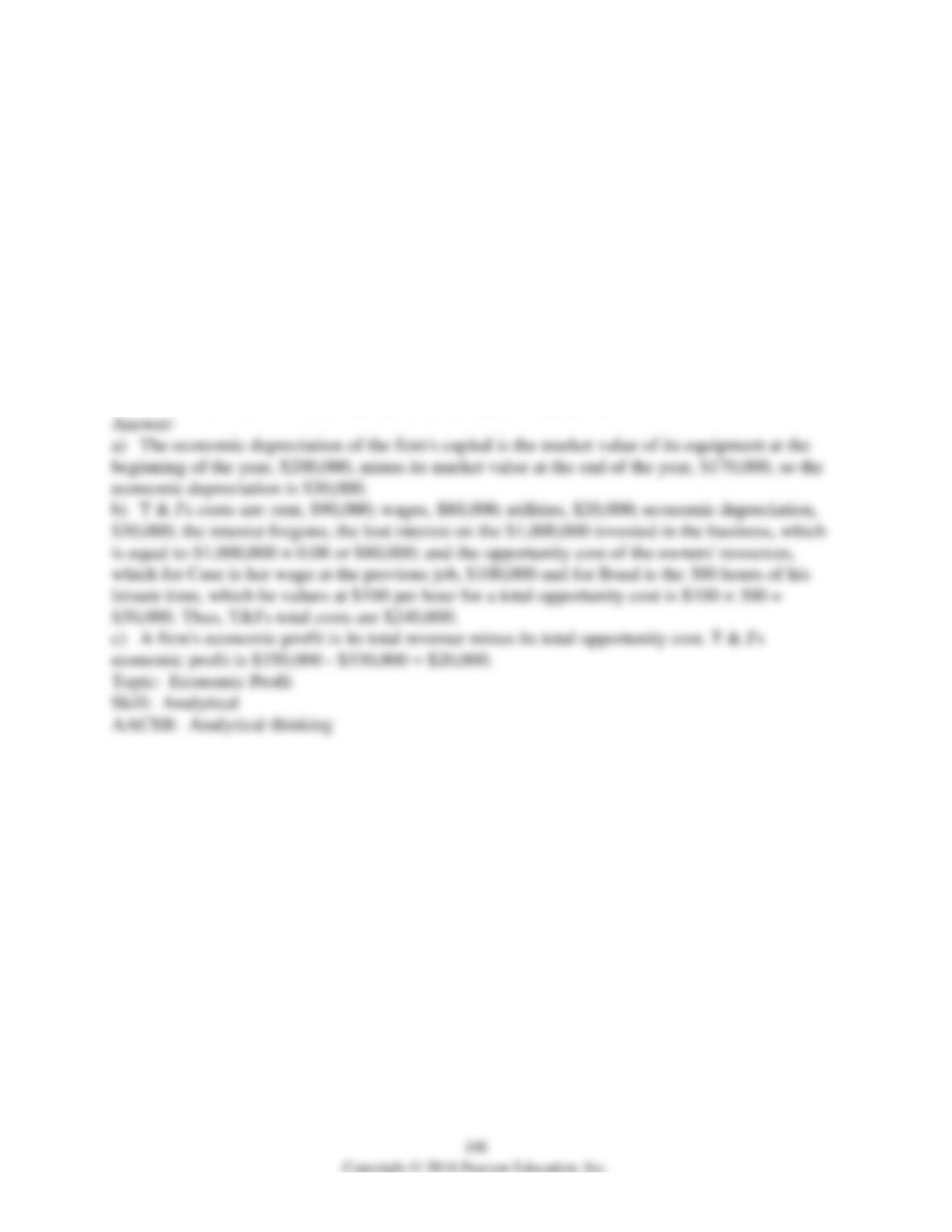
a) What is the economic depreciation of their capital?
b) What are T & J’s opportunity costs?
c) What is the firm’s economic profit in the first year of operation?
Technique
Labor
(hours)
Capital
(units)
A
120
10
B
80
21
C
60
20
D
30
22
E
20
30
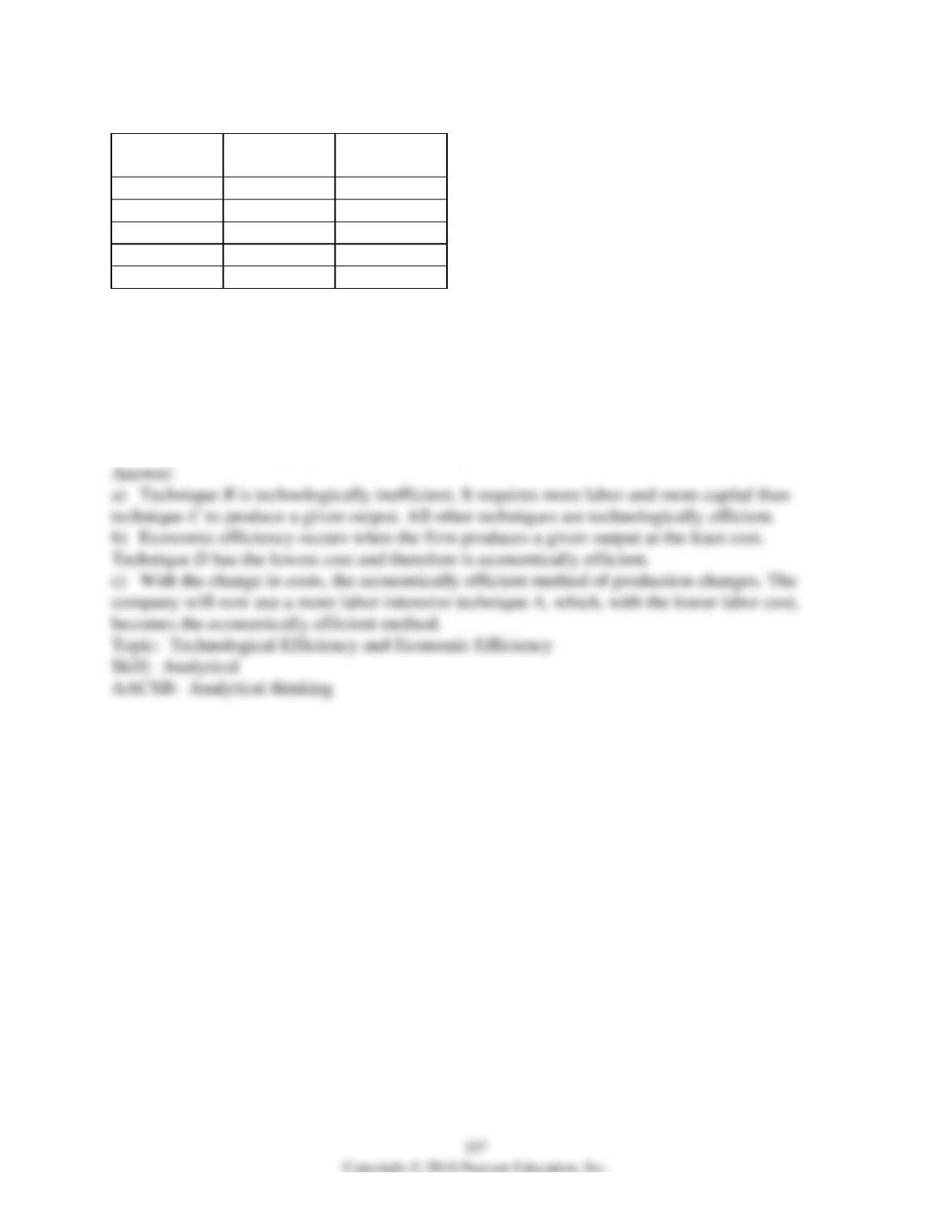
3) FasterChip, Inc. is considering five alternative techniques for assembling personal computers.
The table shows the amounts of labor and capital required by each of these techniques to make
10 computers a day. Labor costs $15 an hour and capital costs $100 a unit.
a) Which techniques are technologically efficient and which are not? Explain your answer.
b) Which technique is economically efficient? Explain.
c) If FasterChip uses its plant in Mexico, it can lower the labor cost to $10 an hour. Which
technique will the company use in Mexico? Explain.
108
Firm
Sales
(thousands of
galleons)
Nimbus, Inc
57.5
Cleansweep, Inc
33.3
Bogey, Inc
12.6
Muggle Handles, Inc
9.9
Salazar’s Sticks
11.1
Draco Dormiens, Inc
8.6
Avada’s Broom
7.8
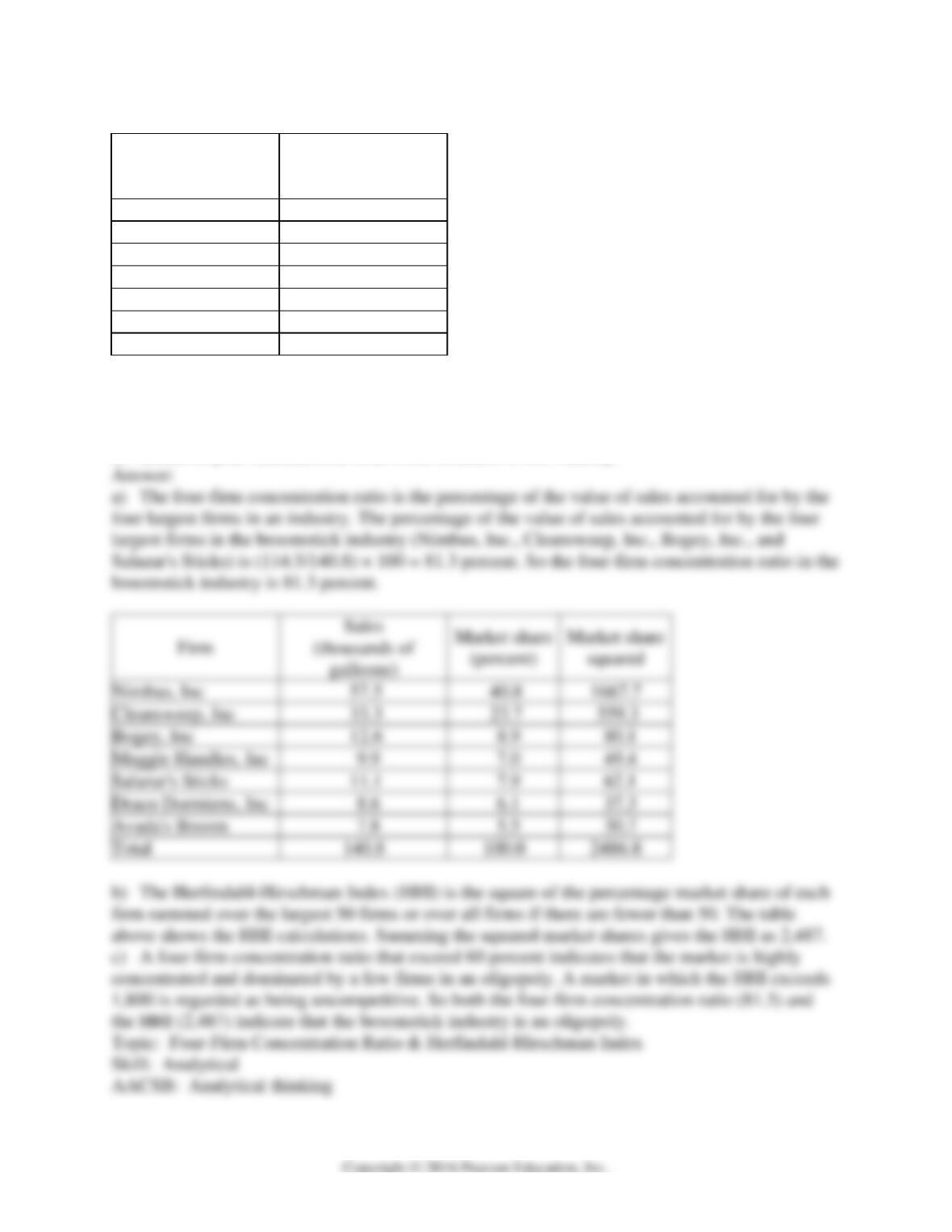
4) The table above shows sales of the firms in the broomstick industry:
a) Calculate the four-firm concentration ratio.
b) Calculate the Herfindahl-Hirschman Index.
c) Based on your calculations, what is the structure of the industry?
(thousands of
galleons)
Nimbus, Inc
Cleansweep, Inc
Bogey, Inc
Muggle Handles, Inc
Salazar’s Sticks
Draco Dormiens, Inc
Avada’s Broom
Total