b. the provider is betting that customers will buy both rather than neither.
c. government regulations limit the range of services a monopolist can offer.
d. offering the two separately would be a market inefficiency.
e. it is technologically much easier to keep them together.
95. Which statement about rent seeking is INCORRECT?
a. It may not involve rent in the sense of payment for the use of property.
b. It is a form of beneficial competition.
c. It aims at securing monopoly rights.
d. It is motivated by a desire for increased profits.
e. It is often associated with lobbying of policymakers.
96. The market price for a New York City taxi medallion is less today than it was in 2013. This is
because
a. the city instituted price caps as part of an effort to regulate the monopoly.
b. New Yorkers have turned to walking and bicycling as ways to get around.
c. ridesharing services like Uber have made the medallions less valuable.
d. the city greatly increased the number of medallions by selling new ones.
e. passenger-on-driver crime has made taxi driving a less desirable line of work.
97. When a competitive market becomes controlled by a monopoly, the price ________ and the output
________.
a. increases; stays the same d. increases; decreases
b. increases; increases e. decreases; decreases
c. decreases; stays the same
98. Willow Park is a small community in Texas with only one gas station. The price of gasoline in
Willow Park most likely
a. never changes.
b. is lower than in the big cities in Texas.
c. is determined by competitive market forces.
d. is higher than in the big cities in Texas.
e. produces a surplus of gasoline.
99. Monopolies result in a(n) ________ level of output and provide ________ choice to consumers.
a. inefficient; less d. efficient; more
b. inefficient; more e. high; more
c. efficient; less
100. Beer prices at major league baseball stadiums are usually much higher than prices at a bar or
restaurant. This is mainly because
a. it costs the owners of the baseball teams more money to buy the beer from distributors.
b. demand is much higher at a baseball game than at a bar.
c. baseball team owners have market power and can charge a higher price when they are the only
sellers of the beer.
d. the government forces the owners of baseball teams to charge a high price.
e. the owners’ baseball teams are not profit maximizing.
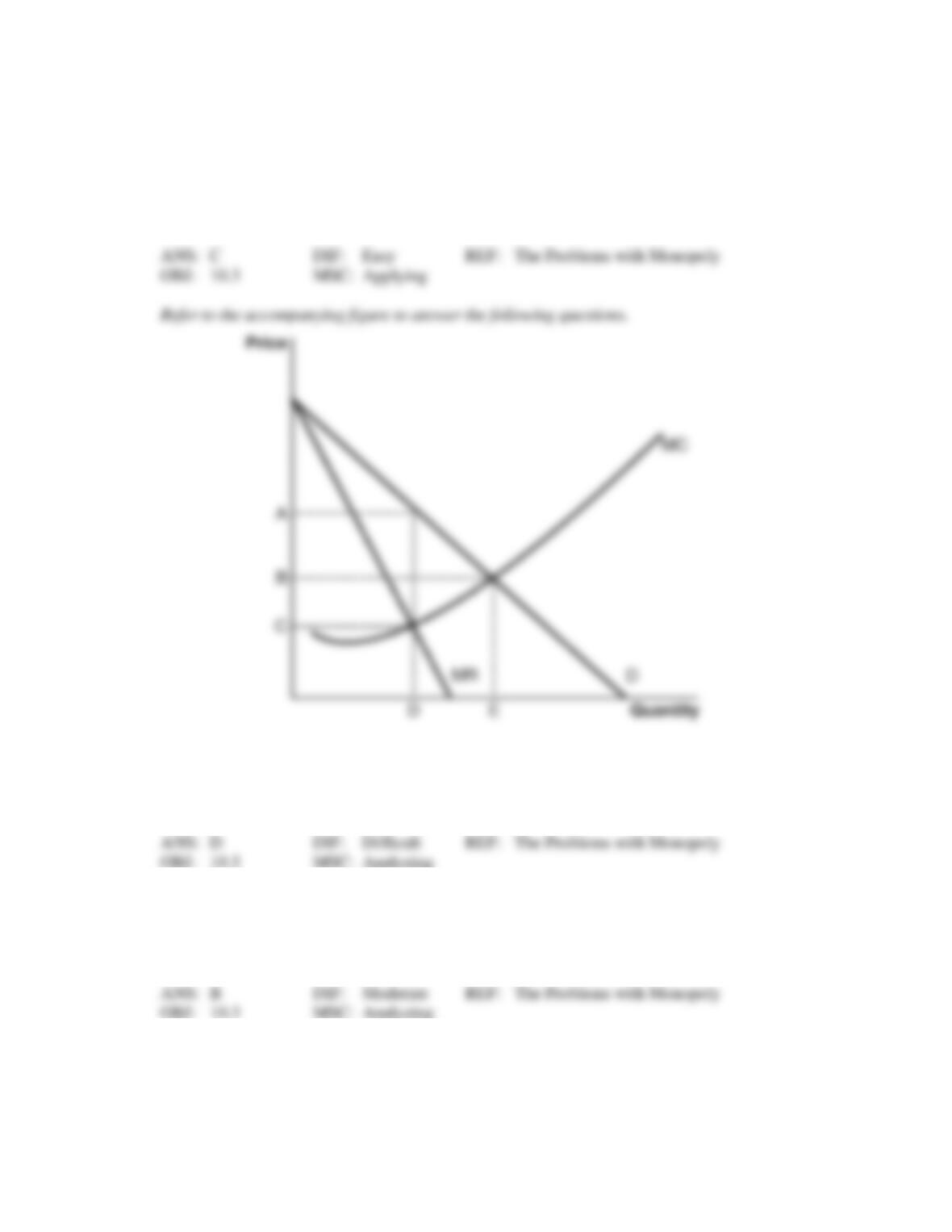
101. When a competitive market comes under the control of a monopoly, the price changes from
a. D to E. d. B to A.
b. C to B. e. A to C.
c. C to A.
102. When a competitive market comes under the control of a monopoly, the quantity changes from
a. D to E. d. B to A.
b. E to D. e. A to B.
c. C to A.
103. Deadweight loss exists in a monopoly because the monopolist
a. charges a price equal to marginal cost, which is higher than the price charged in a competitive
market.
b. produces a quantity that is higher than the quantity produced in a competitive market.
c. makes a positive economic profit in the short run.
d. charges a price below marginal cost.
e. charges a price that is above marginal revenue.
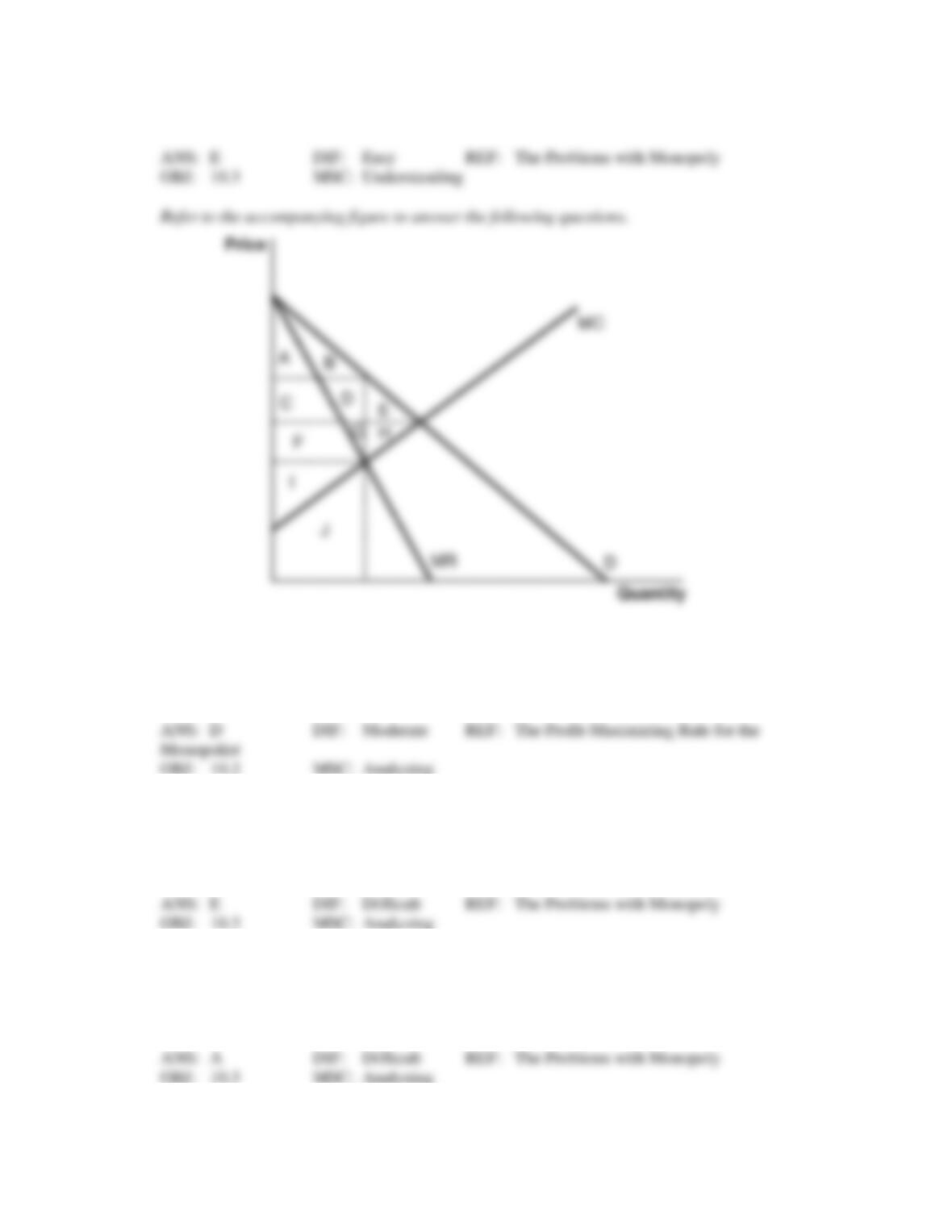
104. The revenue received by the profit-maximizing monopolist in this market is represented by
a. A + B + C + D + F + G + I + J. d. C + D + F + G + I + J.
b. B + D + G + E + H. e. E + H.
c. I + J.
105. The deadweight loss associated with this profit-maximizing monopoly is represented by area(s)
a. A + B. d. J.
b. B + D + G + E + H. e. E + H.
c. D + G.
106. The consumer surplus associated with this profit-maximizing monopoly is represented by areas
a. A + B. d. A + B + C + D + E.
b. B + D + G + E + H. e. E + H.
c. F + G + H + I.
107. Which areas of the graph represent the consumer surplus transferred to the monopolist as a result
of the monopolist taking over the market?
a. A + B d. A + B + C + D + E
b. B + D + G + E + H e. E + H
c. C + D
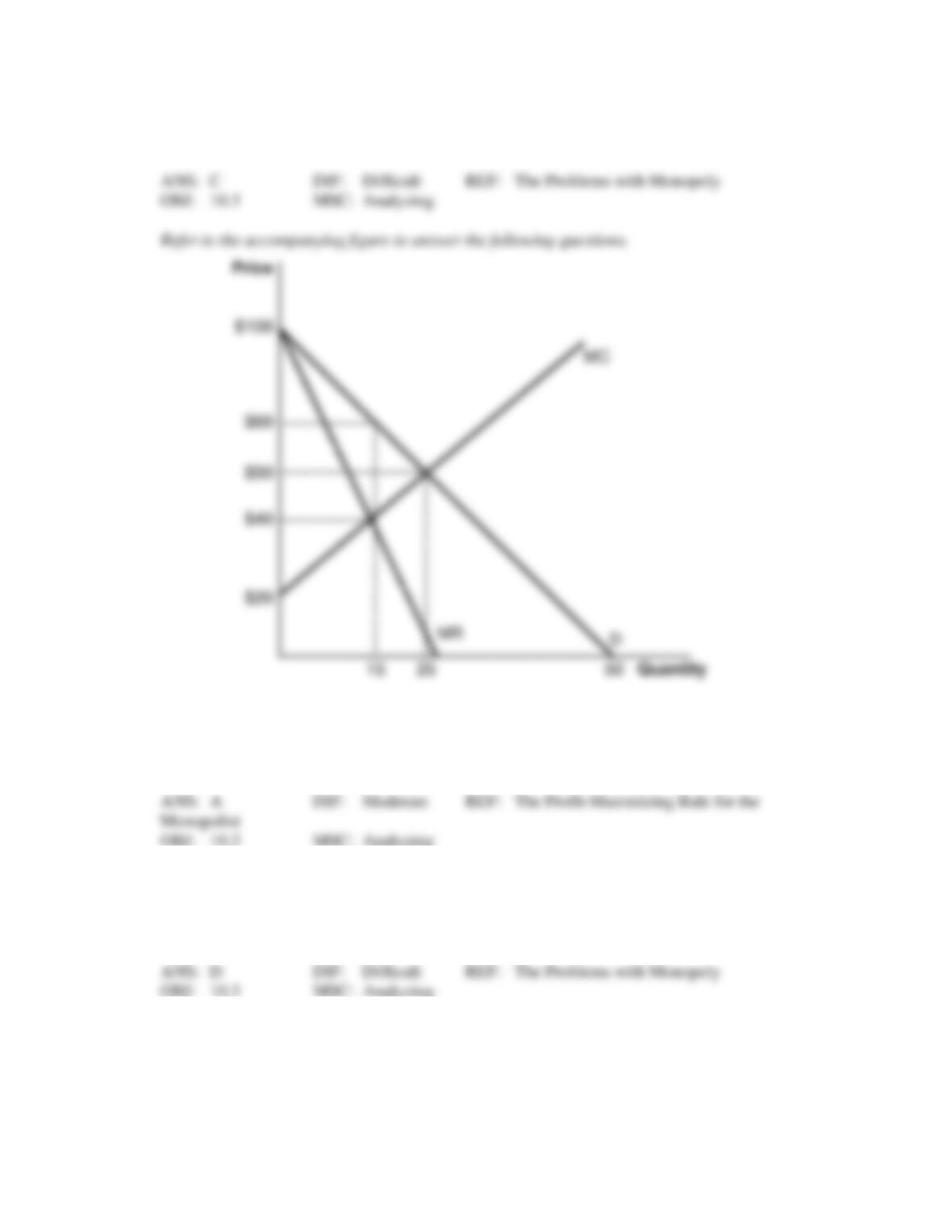
108. The revenue received by the profit-maximizing monopolist is
a. $900. d. $100.
b. $150. e. $450.
c. $300.
109. The deadweight loss associated with this profit-maximizing monopoly is equal to
a. $900. d. $100.
b. $600. e. $450.
c. $300.
110. Consumer surplus associated with a profit-maximizing monopoly is equal to
a. $900. d. $100.
b. $600. e. $450.
c. $300.
111. The consumer surplus that is transferred to the monopolist as a result of the monopolist taking over
the market is
a. $900. d. $100.
b. $150. e. $450.
c. $300.
112. When a town has a single cable provider
a. the cable company usually offers many different cable packages to satisfy customers’ wants.
b. customers must buy some cable channels they don’t want in order to get the channels they do
want.
c. the government regulates the cable provider’s offerings.
d. the cable provider is a price taker.
e. the consumers experience no consumer surplus.
113. Marie’s Car Dealership is the only dealership in Victorville, California. The owner, Marie,
experiences large economies of scale. Because she is the only seller of cars in the town,
a. Marie has market power.
b. Marie has no market power and must price at marginal cost.
c. Marie can charge any price she wants and will still sell the number of cars that maximize her
profits.
d. consumer surplus is maximized in the car market.
e. total economic surplus is maximized in the car market.
114. We cannot purchase a cable subscription for single channels like the Food Network or Cartoon
Network because cable companies
a. act like perfectly competitive firms.
b. are not interested in maximizing their profits.
c. have no market power to sell individual channels.
d. act like monopolies.
e. are pressured by the government to provide channel packages.
115. Most economists are against monopolies because
a. monopolists do not maximize profits.
b. monopolies produce too much of a product.
c. monopolies offer consumers more choices than they need.
d. monopolies can never produce the quantity that a perfectly competitive market would produce.
e. monopolies offer less choice to consumers.
116. If cable companies were in a highly competitive market, we would expect
a. cable companies to make profits in the long run.
b. customers to be unhappy about their cable package options.
c. a company to be willing to sell specific channels as well as packaged options.
d. cable companies to force us to choose between buying a little more cable than we really need
or going without cable altogether.
e. deadweight loss in the market.
117. Rent seeking occurs when
a. resources are used to deregulate a market through the political process.
b. resources are used to maximize profits.
c. resources are used to secure monopoly rights through the political process.
d. two firms try to enter the same market.
e. landlords attempt to raise the rent on tenants.
118. When resources are used to secure monopoly rights through the political process
a. firms are rent seeking. d. the government is deregulating.
b. consumers are profit maximizing. e. prices decrease.
c. total surplus is maximized.
119. Rent seeking
a. is desired by consumers.
b. is not a type of competition.
c. is a type of competition that leads to a market price and output.
d. is a type of competition that leads to an undesirable outcome.
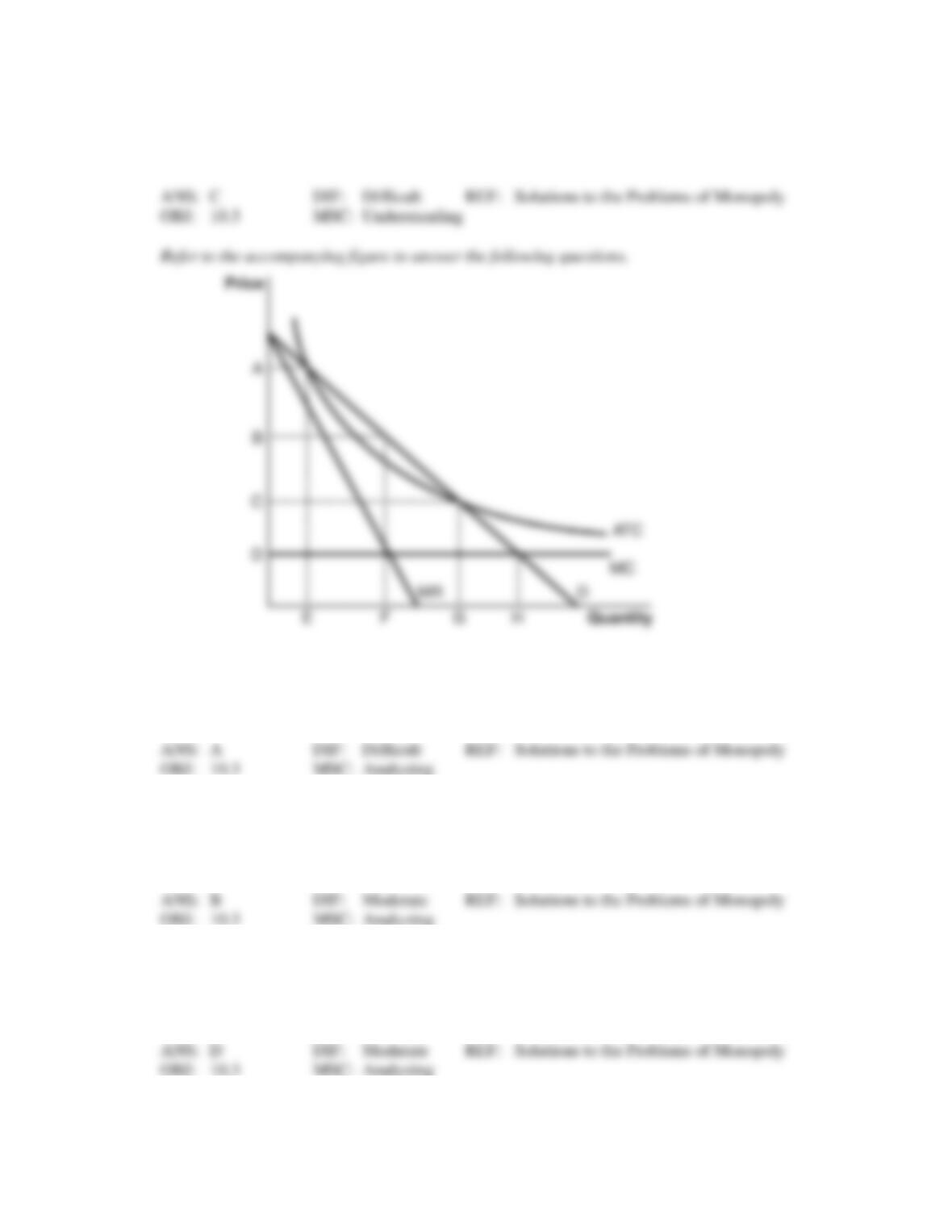
e. occurs when resources are used to deregulate a market through the political process.
120. Sandra’s Steel Mill has decided that lobbying Congress to pass a tariff on imported steel will cost
less than trying to modernize its facility to compete with foreign steel prices. Sandra’s Steel Mill
will
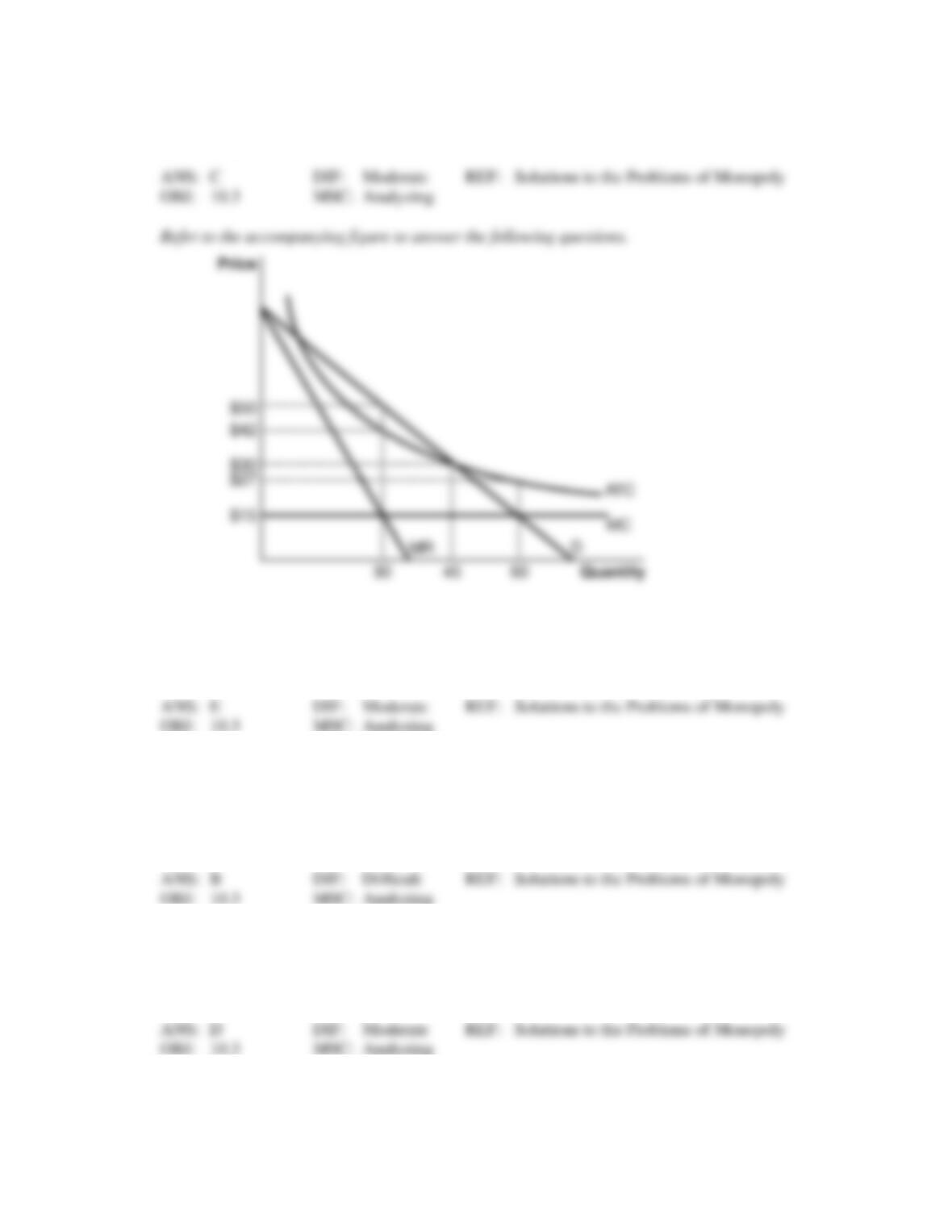
a. decide that lobbying is wrong and modernize its facility.
b. participate in rent seeking and lobby Congress for the tariff.
c. lobby Congress for the tariff and modernize its facility.
d. produce more steel to attract more customers.
e. lower its price to compete with the imported foreign steel.
121. Economists view rent seeking as
a. a good way to inspire competition between firms.
b. a good way to incentivize firms to invest in research and development.
c. essential to solving the problem of scarcity.
d. a detrimental form of competition.
e. beneficial to the consumer.
122. Lobbying the government to place harsh tariffs on imports is a form of
a. beneficial competition. d. rent seeking.
b. market failure. e. natural monopoly.
c. deregulation.
123. Taxi medallions are an example of
a. perfect competition. d. rent seeking.
b. a naturally created barrier to entry. e. economies of scale.
c. a government-created barrier to entry.
124. Three examples of solutions to the problems of a monopoly are harnessing the benefits of
________, ________ trade barriers, and ________ markets.
a. competition; reducing; regulating d. monopolies; increasing; regulating
b. monopolies; reducing; regulating e. competition; increasing; deregulating
c. competition; increasing; regulating
125. Harnessing the benefits of competition, reducing trade barriers, and regulating markets are three
a. market structures.
b. problems of the monopolist.
c. solutions to the problem of scarcity.
d. solutions to negative and positive externalities.
e. solutions to the problems of monopoly.
126. The government has exercised control over monopoly practices since the passage of the
a. Morrill Land-Grant Act of 1890. d. Sherman Act.
b. Gold Standard Act. e. Foraker Act of 1900.
c. Crimes Act.
127. Antitrust laws are designed to
a. promote monopoly practices.
b. promote competition.
c. increase prices.
d. decrease output.
e. promote awareness of government programs.
128. One possible outcome of promoting competition is
a. higher prices. d. regulated markets.
b. lower output. e. less efficiency.
c. eliminating deadweight loss.
129. One way the government can restore competitiveness in a market is through
a. patents. d. taxes.
b. copyrights. e. antitrust laws.
c. tariffs.
130. When the government passes antitrust laws in an industry, we see
a. higher prices, lower output, and more choices.
b. lower prices, higher output, and fewer choices.
c. lower prices, higher output, and more choices.
d. higher prices, lower output, and fewer choices.
e. higher prices, higher output, and more choices.
131. A tariff is a(n)
a. tax on an import.
b. tax on domestically produced and sold products.
c. natural barrier to entry.
d. example of a market structure.
e. way to promote competition.
132. Reducing trade barriers creates ________ competition, ________ the influence of monopoly, and
________ the efficient use of resources.
a. less; reduces; promotes d. more; reduces; hinders
b. more; reduces; promotes e. more; increases; hinders
c. less; increases; promotes
133. One benefit from tariffs would be
a. the increase in efficiency.
b. the elimination of deadweight loss.
c. the increase in consumer surplus.
d. the protection of domestic businesses.
e. more imports into the country.
134. By reducing trade barriers, the government
a. reduces imports.
b. increases the price of the imported good.
c. reduces exports.
d. decreases efficiency.
e. decreases deadweight loss.
135. The point of the 1890 Sherman Act was to
a. nationalize industries where economies of scale were especially important.
b. prevent monopoly practices and promote commercial competition.
c. make rent seeking through lobbying of public officials illegal.
d. forbid states from imposing import tariffs on other states.
e. establish patents and copyrights as ways to protect creative activity.
136. Which provision in the U.S. Constitution blocks the erection of trade barriers between neighboring
states?
a. “No State shall, without the consent of Congress, lay any imposts or duties on imports or
exports.”
b. “. . . nor shall private property be taken for public use, without just compensation.”
c. “The Congress shall have power to lay and collect taxes, duties, imposts and excises.”
d. “The judicial power of the United States shall not . . . extend to any suit in law or equity,
commenced or prosecuted against one of the United States by citizens of another state.”
e. “The powers not delegated to the United States by the Constitution . . . are reserved to the
States respectively.”
137. Which pricing rule generates the greatest welfare for society?
a. marginal cost d. fixed cost
b. average cost e. variable cost
c. total cost
138. The ________ cost pricing rule means that the government can regulate a natural monopoly to
minimize deadweight loss without forcing the private firm out of the market.
a. marginal d. fixed
b. average e. variable
c. total
139. It is unrealistic to regulate a natural monopoly at marginal cost pricing because
a. the government is not allowed to regulate markets.
b. marginal cost pricing ends up having the natural monopoly firm earn zero economic profits.
c. with this type of regulation, the firm will want to shut down, and that outcome is not desirable
for society.
d. regulating a market causes more deadweight loss.
e. firms do not need to follow regulations from the government.
140. Which price and quantity combination is undesirable for both the monopolist firm and society?
a. A and E d. D and H
b. B and F e. A and H
c. C and G
141. Which of the following is the profit-maximizing price and quantity combination?
a. A and E d. D and H
b. B and F e. A and H
c. C and G
142. Which of the following is the most efficient price and quantity combination for society?
a. A and E d. D and H
b. B and F e. D and E
c. C and G
143. At which price and quantity combination would the government regulate this firm to get as close as
possible to the most efficient point for society?
a. A and E d. D and H
b. B and F e. D and E
c. C and G
144. A profit-maximizing firm without any price regulations would make ________ in profits.
a. $1,500 d. −$240
b. −$720 e. $240
c. $720
145. If the government forces a firm to produce at the point that generates the greatest welfare for
society, that firm would make ________ in profits.
a. $1,500 d. −$240
b. −$720 e. $240
c. $720
146. If this firm is profit maximizing, society would experience ________ in deadweight loss.
a. $0 d. $525
b. $112.50 e. $240
c. $720
147. If this firm is regulated at a point where price is $30, society would experience ________ in
deadweight loss.
a. $0 d. $525
b. $112.50 e. $240
c. $720
148. Breaking up a company that has a natural monopoly would
a. result in higher production costs.
b. result in lower production costs.
c. benefit society.
d. result in lower prices for consumers.
e. increase government tax revenue.
149. One way the government could regulate a natural monopoly at the marginal cost level would be to
a. allow the natural monopoly to produce at the profit-maximizing point.
b. tax the monopoly.
c. place a tariff on the monopoly.
d. give the monopoly a patent.
e. subsidize the monopoly.
150. In the case of a natural monopoly, which government response is LEAST practical?
a. leave the monopolist firm free to maximize its profits
b. buy the monopolist firm and operate it as a government-owned entity
c. force the monopolist to break up into firms that compete with one another
d. subsidize the monopoly, so it can operate at the socially optimal production level
e. regulate the monopolist firm’s price, to equal average total cost
151. A privately owned firm that is regulated by the government is very similar to a firm that the
government owns because
a. both make economic profits. d. both result in no deadweight loss.
b. neither has a profit motive. e. neither earn economic profits.
c. both minimize costs.
152. The government oversight and management of monopolies
a. is illegal in most cases.
b. never increases efficiency.
c. always increases efficiency.
d. is problematic because government agencies do not care about deadweight loss.
e. is problematic because there are no incentives to keep costs in check.
SHORT ANSWER
1. Why are barriers to entry so important to obtaining monopoly power in a market?
2. Compare and contrast natural barriers to entry and government-created barriers to entry.
3. Explain why problems raising capital constitute a natural barrier and not a government-created
one.
4. In Alabama, it is illegal to hunt alligators without a license. The government controls the number
of licenses that can be purchased each year; thus, there is a limit on the number that can be
purchased. Assuming there is an unlimited supply of alligators in Alabama, what would happen to
the price and quantity of alligator sausage if the government stopped controlling the number of
these hunting licenses?