Chapter 10: The Cost of Capital
65.
Bosio Inc.’s perpetual preferred stock sells for $97.50 per share, and it pays an $8.50 annual dividend. If the
company were to sell a new preferred issue, it would incur a flotation cost of 4.00% of the price paid by
investors.
What is the company’s cost of preferred stock for use in calculating the WACC?
a. 8.72%
b. 9.08%
c. 9.44%
d. 9.82%
e. 10.22%
66.
A company’s perpetual preferred stock currently sells for $92.50 per share, and it pays an $8.00 annual dividend.
If
the company were to sell a new preferred issue, it would incur a flotation cost of 5.00% of the issue price.
What is
the firm’s cost of preferred stock?
a. 7.81%
b. 8.22%
c. 8.65%
d. 9.10%
e. 9.56%
67.
O’Brien Inc. has the following data: rRF = 5.00%; RPM = 6.00%; and b = 1.05. What is the firm’s cost of equity
from retained earnings based on the CAPM?
a. 11.30%
b. 11.64%
c. 11.99%
d. 12.35%
e. 12.72%
68.
Scanlon Inc.’s CFO hired you as a consultant to help her estimate the cost of capital. You have been provided
with
the following data: rRF = 4.10%; RPM = 5.25%; and b = 1.30. Based on the CAPM approach, what is the
cost of
equity from retained earnings?
a. 9.67%
b. 9.97%
c. 10.28%
d. 10.60%
e. 10.93%
69.
Assume that you are a consultant to Broske Inc., and you have been provided with the following data: D1 =
$0.67;
P0 = $27.50; and g = 8.00% (constant). What is the cost of equity from retained earnings based on the
DCF
approach?
a. 9.42%
b. 9.91%
c. 10.44%
d. 10.96%
e. 11.51%
70.
Teall Development Company hired you as a consultant to help them estimate its cost of capital. You have been
provided with the following data: D1 = $1.45; P0 = $22.50; and g = 6.50% (constant). Based on the DCF
approach,
what is the cost of equity from retained earnings?
a. 11.10%
b. 11.68%
c. 12.30%
d. 12.94%
e. 13.59%
71.
A. Butcher Timber Company hired your consulting firm to help them estimate the cost of equity. The yield on
the
firm’s bonds is 8.75%, and your firm’s economists believe that the cost of equity can be estimated using a
risk
premium of 3.85% over a firm’s own cost of debt. What is an estimate of the firm’s cost of equity from
retained
earnings?
a. 12.60%
b. 13.10%
c. 13.63%
d. 14.17%
e. 14.74%
72.
You were hired as a consultant to Giambono Company, whose target capital structure is 40% debt, 15%
preferred,
and 45% common equity. The after-tax cost of debt is 6.00%, the cost of preferred is 7.50%, and the
cost of
retained earnings is 12.75%. The firm will not be issuing any new stock. What is its WACC?
a. 8.98%
b. 9.26%
c. 9.54%
d. 9.83%
e. 10.12%
WACC = wd × rd × (1 − T) + wp × r p + wc × rs
9.26%
73.
To help finance a major expansion, Castro Chemical Company sold a noncallable bond several years ago that
now
has 20 years to maturity. This bond has a 9.25% annual coupon, paid semiannually, sells at a price of
$1,075, and has
a par value of $1,000. If the firm’s tax rate is 40%, what is the component cost of debt for use
in the WACC
calculation?
a. 4.35%
b. 4.58%
c. 4.83%
d. 5.08%
e. 5.33%
74.
Several years ago the Jakob Company sold a $1,000 par value, noncallable bond that now has 20 years to
maturity
and a 7.00% annual coupon that is paid semiannually. The bond currently sells for $925, and the
company’s tax rate
is 40%. What is the component cost of debt for use in the WACC calculation?
a. 4.28%
b. 4.46%
c. 4.65%
d. 4.83%
e. 5.03%
75.
Assume that Kish Inc. hired you as a consultant to help estimate its cost of capital. You have obtained the
following
data: D0 = $0.90; P0 = $27.50; and g = 7.00% (constant). Based on the DCF approach, what is the
cost of equity
from retained earnings?
a. 9.29%
b. 9.68%
c. 10.08%
d. 10.50%
e. 10.92%
76.
Rivoli Inc. hired you as a consultant to help estimate its cost of capital. You have been provided with the
following
data: D0 = $0.80; P0 = $22.50; and g = 8.00% (constant). Based on the DCF approach, what is the
cost of equity
from retained earnings?
a. 10.69%
b. 11.25%
c. 11.84%
d. 12.43%
e. 13.05%
77.
Trahan Lumber Company hired you to help estimate its cost of capital. You obtained the following data: D1 =
$1.25;
P0 = $27.50; g = 5.00% (constant); and F = 6.00%. What is the cost of equity raised by selling new
common stock?
a. 9.06%
b. 9.44%
c. 9.84%
d. 10.23%
e. 10.64%
78.
You were recently hired by Scheuer Media Inc. to estimate its cost of capital. You obtained the following data:
D1 = $1.75; P0 = $42.50; g = 7.00% (constant); and F = 5.00%. What is the cost of equity raised by selling new
common
stock?
a. 10.77%
b. 11.33%
c. 11.90%
d. 12.50%
e. 13.12%
79.
Weaver Chocolate Co. expects to earn $3.50 per share during the current year, its expected dividend payout
ratio is
65%, its expected constant dividend growth rate is 6.0%, and its common stock currently sells for $32.50
per share.
New stock can be sold to the public at the current price, but a flotation cost of 5% would be incurred.
What would
be the cost of equity from new common stock?
a. 12.70%
b. 13.37%
c. 14.04%
d. 14.74%
e. 15.48%
80.
Sorensen Systems Inc. is expected to pay a $2.50 dividend at year end (D1 = $2.50), the dividend is expected to
grow at a constant rate of 5.50% a year, and the common stock currently sells for $52.50 a share. The before–
tax
cost of debt is 7.50%, and the tax rate is 40%. The target capital structure consists of 45% debt and 55%
common
equity. What is the company’s WACC if all the equity used is from retained earnings?
a. 7.07%
b. 7.36%
c. 7.67%
d. 7.98%
e. 8.29%
81.
You were hired as a consultant to Quigley Company, whose target capital structure is 35% debt, 10% preferred,
and
55% common equity. The interest rate on new debt is 6.50%, the yield on the preferred is 6.00%, the cost
of
retained earnings is 11.25%, and the tax rate is 40%. The firm will not be issuing any new stock. What is
Quigley’s
WACC?
a. 8.15%
b. 8.48%
c. 8.82%
d. 9.17%
e. 9.54%
82.
Keys Printing plans to issue a $1,000 par value, 20-year noncallable bond with a 7.00% annual coupon, paid
semiannually. The company’s marginal tax rate is 40.00%, but Congress is considering a change in the corporate
tax
rate to 30.00%. By how much would the component cost of debt used to calculate the WACC change if the
new tax
rate was adopted?
a. 0.57%
b. 0.63%
c. 0.70%
d. 0.77%
e. 0.85%
83.
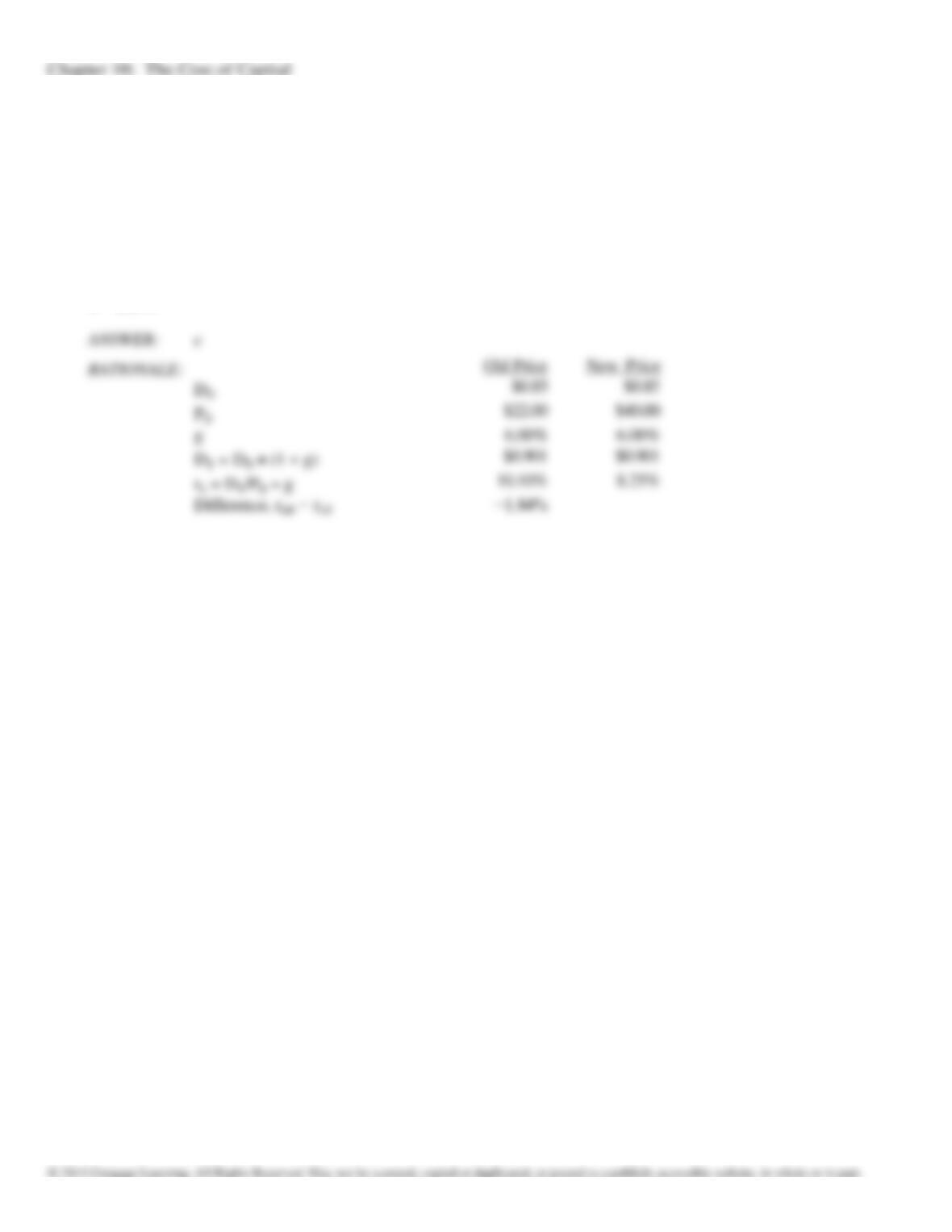
S. Bouchard and Company hired you as a consultant to help estimate its cost of capital. You have obtained the
following data: D0 = $0.85; P0 = $22.00; and g = 6.00% (constant). The CEO thinks, however, that the stock
price is
temporarily depressed, and that it will soon rise to $40.00. Based on the DCF approach, by how much
would the cost
of equity from retained earnings change if the stock price changes as the CEO expects?
a. −1.49%
b. −1.66%
c. −1.84%
d. −2.03%
e. −2.23%
84.
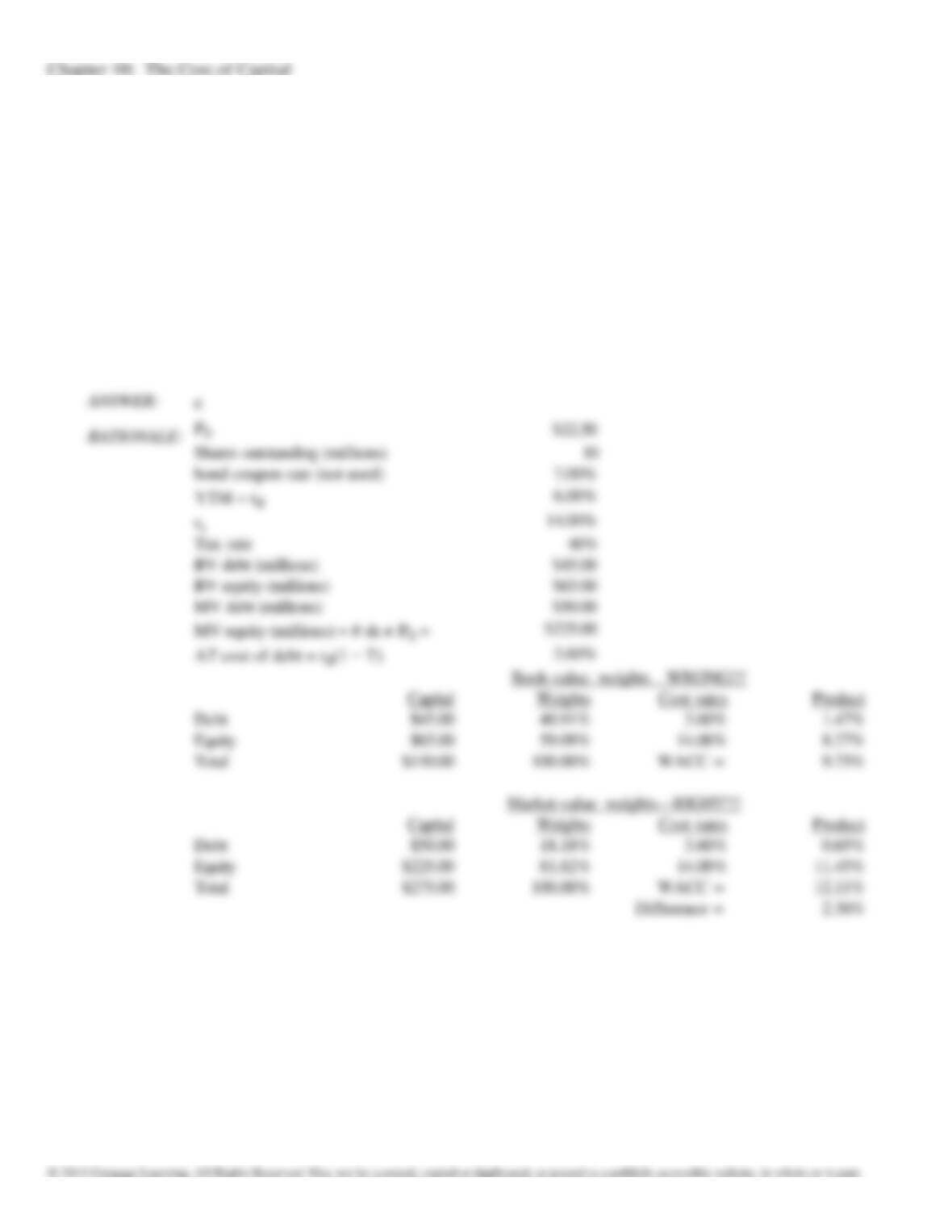
Sapp Trucking’s balance sheet shows a total of noncallable $45 million long-term debt with a coupon rate of
7.00%
and a yield to maturity of 6.00%. This debt currently has a market value of $50 million. The balance
sheet also
shows that the company has 10 million shares of common stock, and the book value of the common
equity (common
stock plus retained earnings) is $65 million. The current stock price is $22.50 per share;
stockholders’ required return,
rs, is 14.00%; and the firm’s tax rate is 40%. The CFO thinks the WACC should
be based on market-value weights,
but the president thinks book weights are more appropriate. What is the
difference between these two WACCs?
a. 1.55%
b. 1.72%
c. 1.91%
d. 2.13%
e. 2.36%
85.
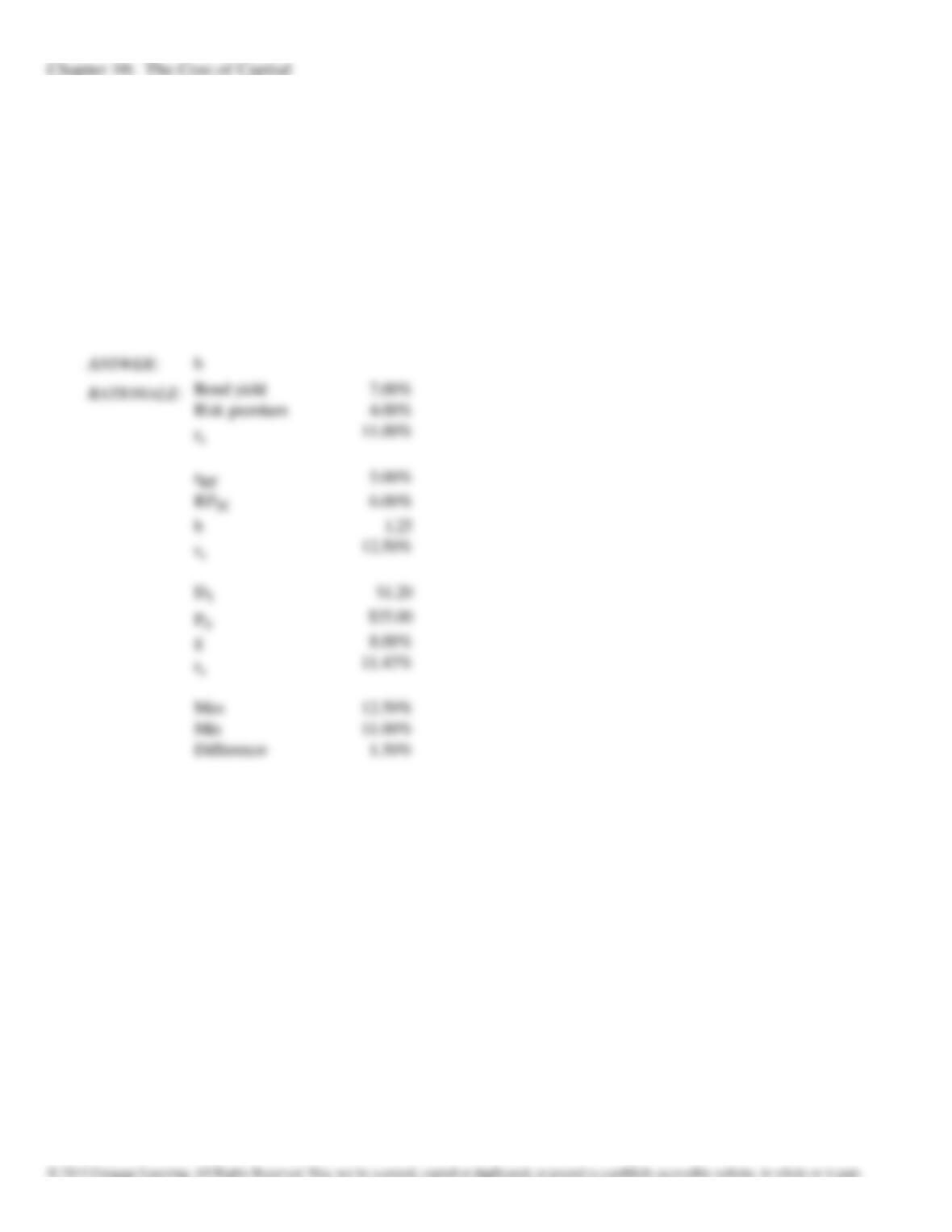
The CFO of Lenox Industries hired you as a consultant to help estimate its cost of capital. You have obtained
the
following data: (1) rd = yield on the firm’s bonds = 7.00% and the risk premium over its own debt cost =
4.00%. (2)
rRF = 5.00%, RPM = 6.00%, and b = 1.25. (3) D1 = $1.20, P0 = $35.00, and g = 8.00% (constant).
You were asked
to estimate the cost of equity based on the three most commonly used methods and then to
indicate the difference
between the highest and lowest of these estimates. What is that difference?
a. 1.13%
b. 1.50%
c. 1.88%
d. 2.34%
e. 2.58%
86.
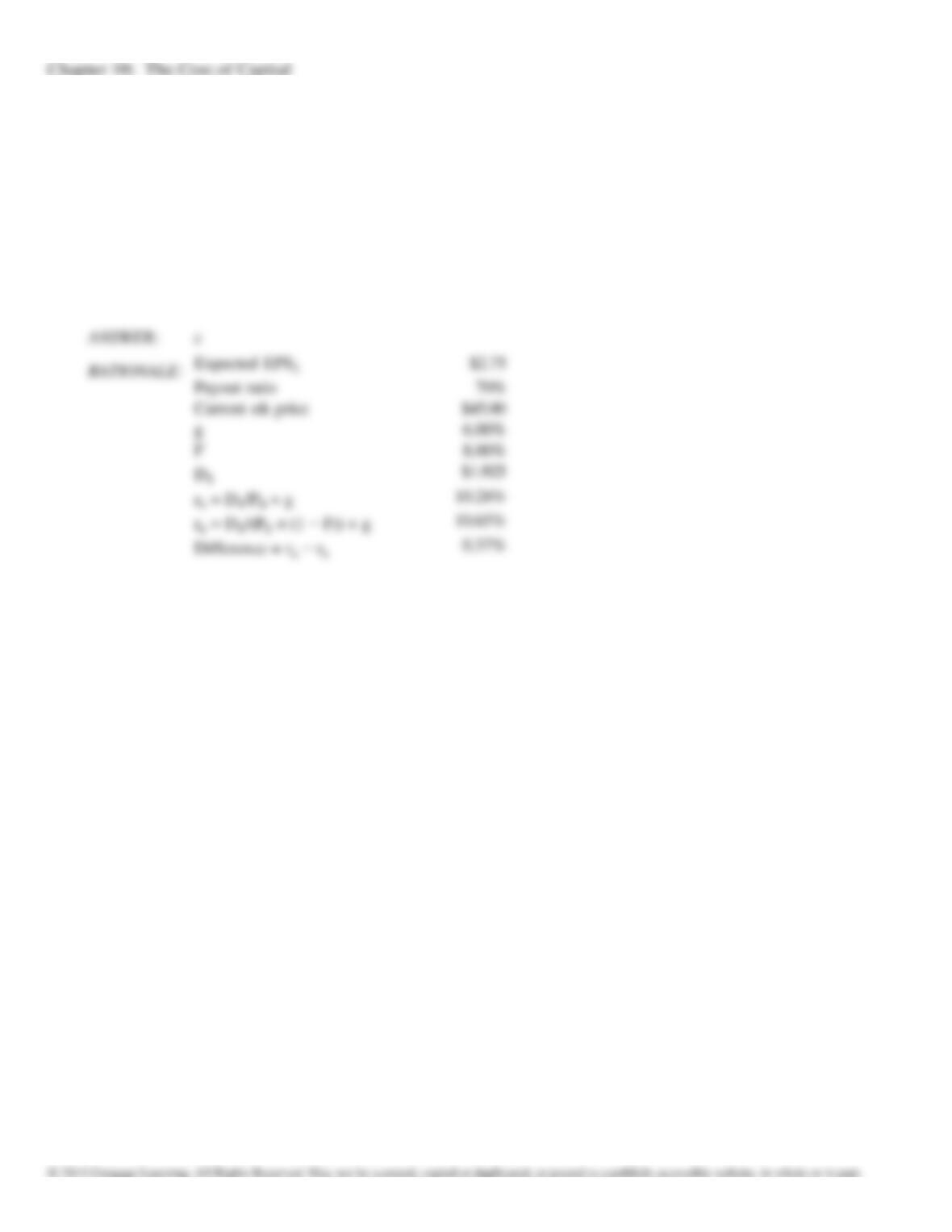
Eakins Inc.’s common stock currently sells for $45.00 per share, the company expects to earn $2.75 per share
during
the current year, its expected payout ratio is 70%, and its expected constant growth rate is 6.00%. New
stock can
be sold to the public at the current price, but a flotation cost of 8% would be incurred. By how much
would the cost
of new stock exceed the cost of retained earnings?
a. 0.09%
b. 0.19%
c. 0.37%
d. 0.56%
e. 0.84%
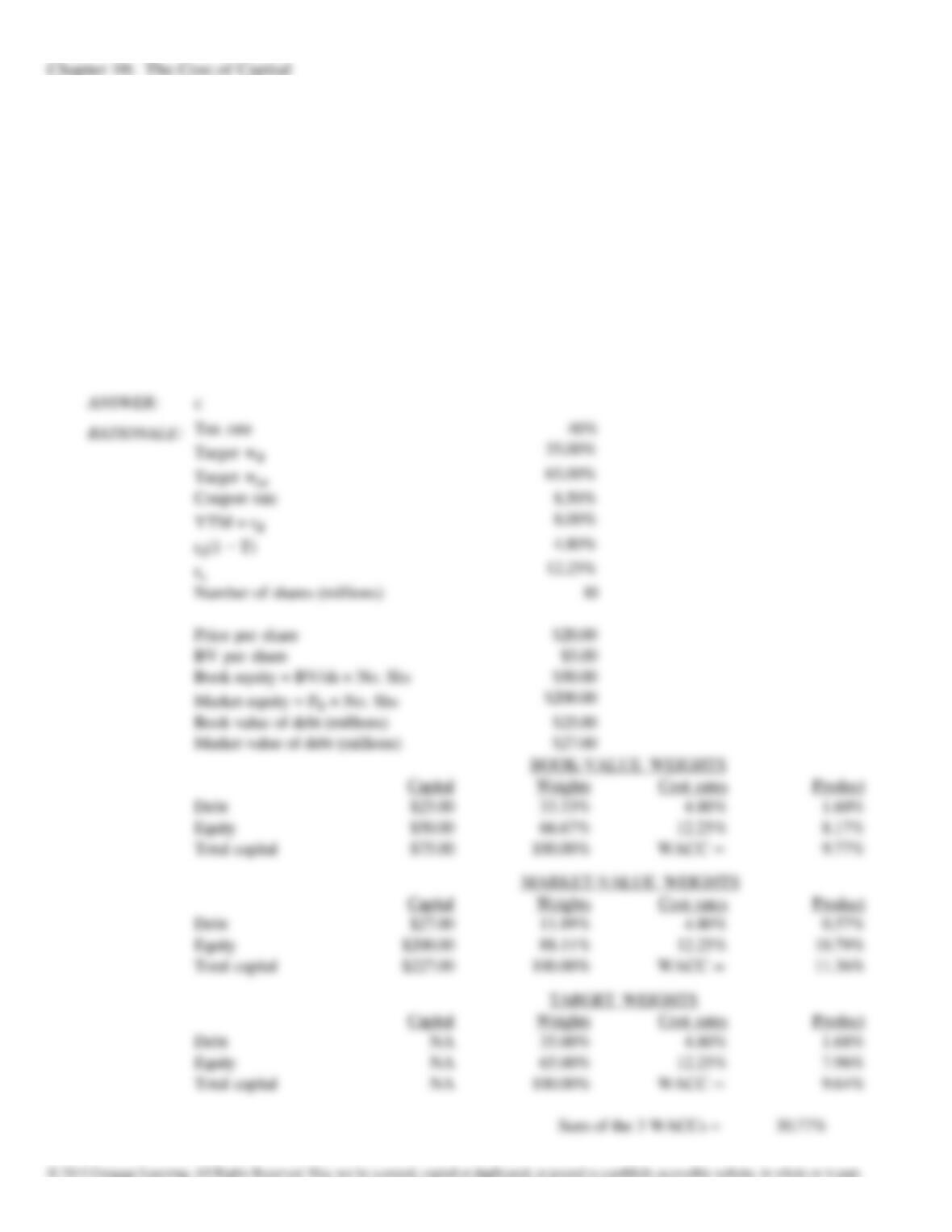
87.
Bolster Foods’ (BF) balance sheet shows a total of $25 million long-term debt with a coupon rate of 8.50%.
The
yield to maturity on this debt is 8.00%, and the debt has a total current market value of $27 million. The
balance
sheet also shows that the company has 10 million shares of stock, and the stock has a book value per
share of $5.00.
The current stock price is $20.00 per share, and stockholders’ required rate of return, rs, is
12.25%. The company
recently decided that its target capital structure should have 35% debt, with the balance
being common equity. The
tax rate is 40%. Calculate WACCs based on book, market, and target capital
structures, and then find the sum of
these three WACCs.
a. 28.36%
b. 29.54%
c. 30.77%
d. 32.00%
e. 33.28%
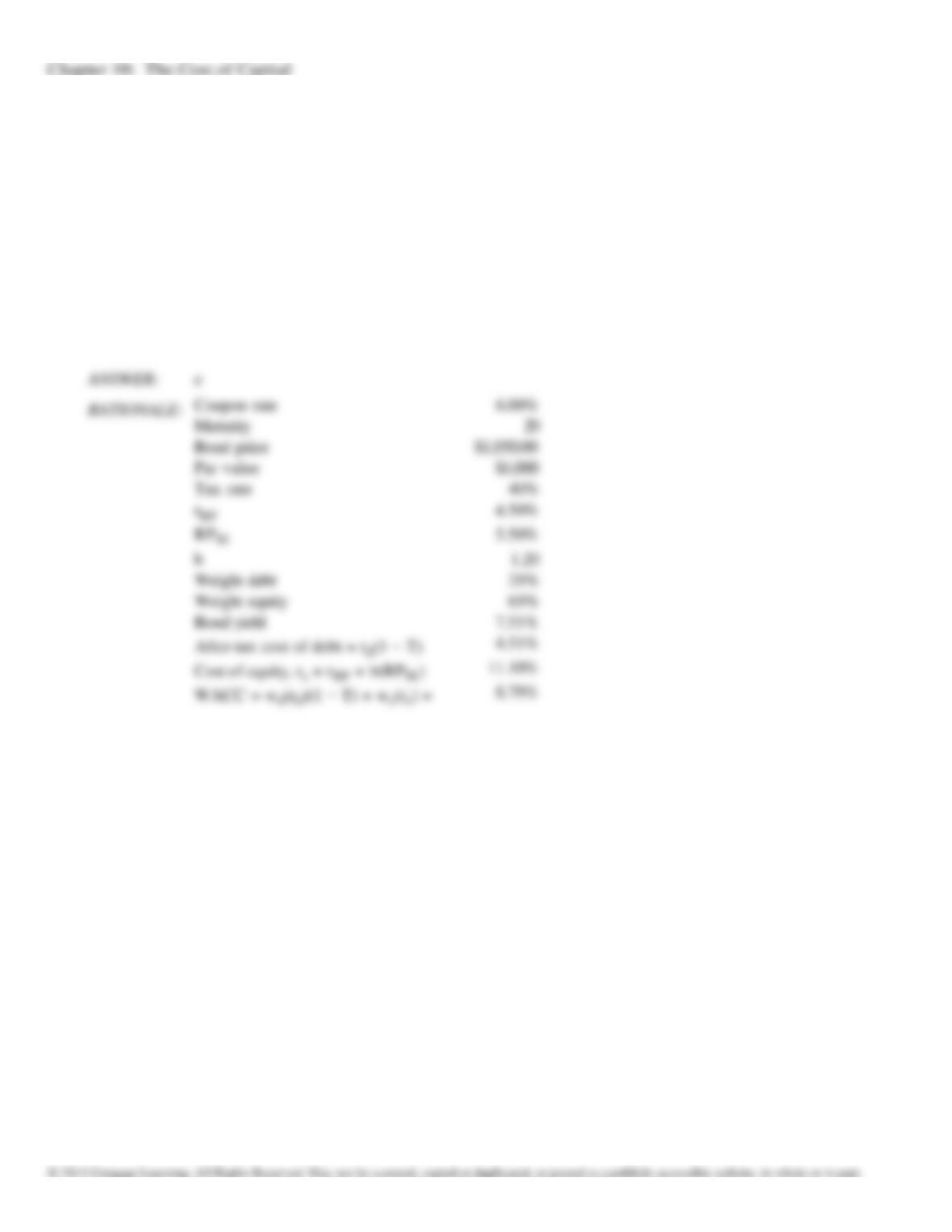
88.
Daves Inc. recently hired you as a consultant to estimate the company’s WACC. You have obtained the
following
information. (1) The firm’s noncallable bonds mature in 20 years, have an 8.00% annual coupon, a
par value of $1,000, and a market price of $1,050.00. (2) The company’s tax rate is 40%. (3) The risk-free rate
is 4.50%, the
market risk premium is 5.50%, and the stock’s beta is 1.20. (4) The target capital structure
consists of 35% debt and
the balance is common equity. The firm uses the CAPM to estimate the cost of
equity, and it does not expect to
issue any new common stock. What is its WACC?
a. 7.16%
b. 7.54%
c. 7.93%
d. 8.35%
e. 8.79%
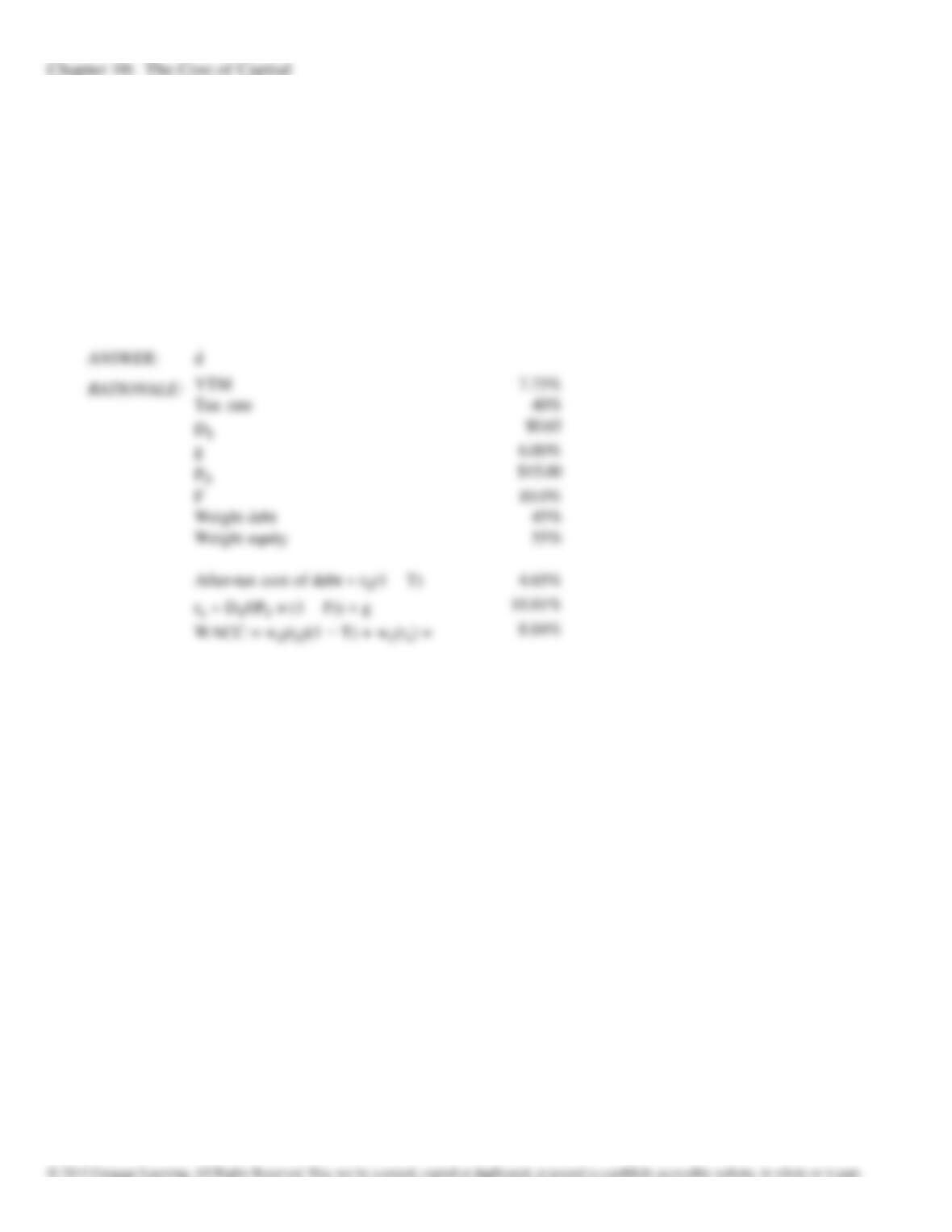
89.
Assume that you are on the financial staff of Vanderheiden Inc., and you have collected the following data: The
yield on the company’s outstanding bonds is 7.75%, its tax rate is 40%, the next expected dividend is $0.65 a
share,
the dividend is expected to grow at a constant rate of 6.00% a year, the price of the stock is $15.00 per
share, the
flotation cost for selling new shares is F = 10%, and the target capital structure is 45% debt and 55%
common
equity. What is the firm’s WACC, assuming it must issue new stock to finance its capital budget?
a. 6.89%
b. 7.26%
c. 7.64%
d. 8.04%
e. 8.44%
1
7.56%
2
8.56%
3
9.56%
10.10%
4
10.40%
5
10.80%
6
10.90%
90.
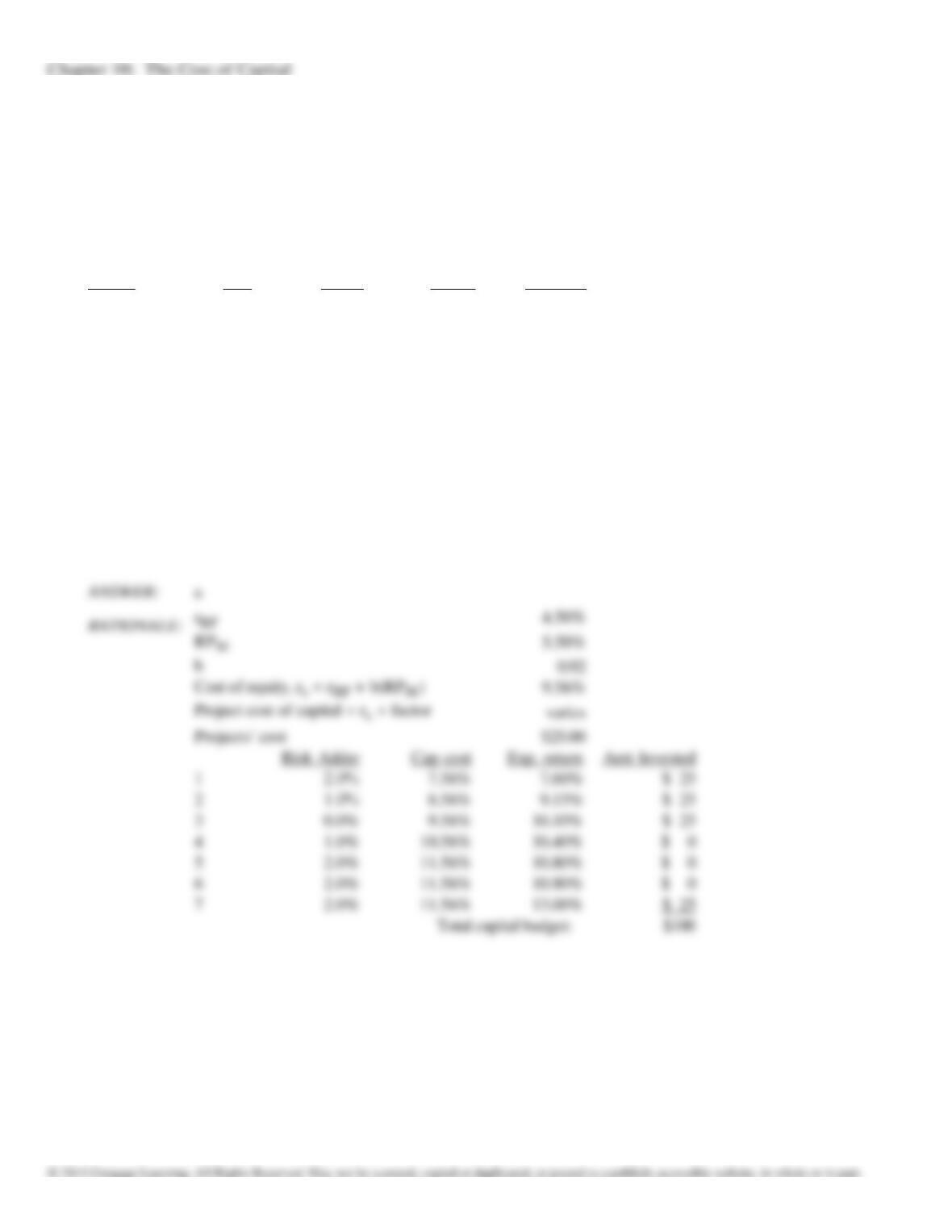
Vang Enterprises, which is debt-free and finances only with equity from retained earnings, is considering 7
equal-
sized capital budgeting projects. Its CFO hired you to assist in deciding whether none, some, or all of
the projects
should be accepted. You have the following information: rRF = 4.50%; RPM = 5.50%; and b =
0.92. The company
adds or subtracts a specified percentage to the corporate WACC when it evaluates projects
that have above- or
below-average risk. Data on the 7 projects are shown below. If these are the only projects
under consideration, how
large should the capital budget be?
Risk
Expected
Cost
Project
Risk
Factor
Return
(Millions)
1
Very low
−2.00%
7.60%
$25.0
2
Low
−1.00%
9.15%
$25.0
3
Average
0.00%
10.10%
$25.0
4
High
1.00%
10.40%
$25.0
5
Very high
2.00%
10.80%
$25.0
6
Very high
2.00%
10.90%
$25.0
7
a. $100
Very high
2.00%
13.00%
$25.0
b. $ 75
c. $ 50
d. $ 25
e. $ 0
Chapter 10: The Cost of Capital
Exhibit 10.1
Assume that you have been hired as a consultant by CGT, a major producer of chemicals and plastics, including
plastic grocery bags, styrofoam cups, and fertilizers, to estimate the firm’s weighted average cost of capital. The
balance sheet and some other information are provided below.
Assets
Current assets
$ 38,000,000
Net plant, property, and equipment
101,000,000
Total assets
$139,000,000
Liabilities and Equity
Accounts payable
$ 10,000,000
Accruals
9,000,000
Current liabilities
$ 19,000,000
Long-term debt (40,000 bonds, $1,000 par value)
40,000,000
Total liabilities
$ 59,000,000
Common stock (10,000,000 shares)
30,000,000
Retained earnings
50,000,000
Total shareholders’ equity
80,000,000
Total liabilities and shareholders’ equity
$ 139,000,000
The stock is currently selling for $15.25 per share, and its noncallable $1,000 par value, 20-year, 7.25% bonds
with
semiannual payments are selling for $875.00. The beta is 1.25, the yield on a 6-month Treasury bill is
3.50%, and the
yield on a 20-year Treasury bond is 5.50%. The required return on the stock market is 11.50%,
but the market has
had an average annual return of 14.50% during the past 5 years. The firm’s tax rate is 40%.
91.
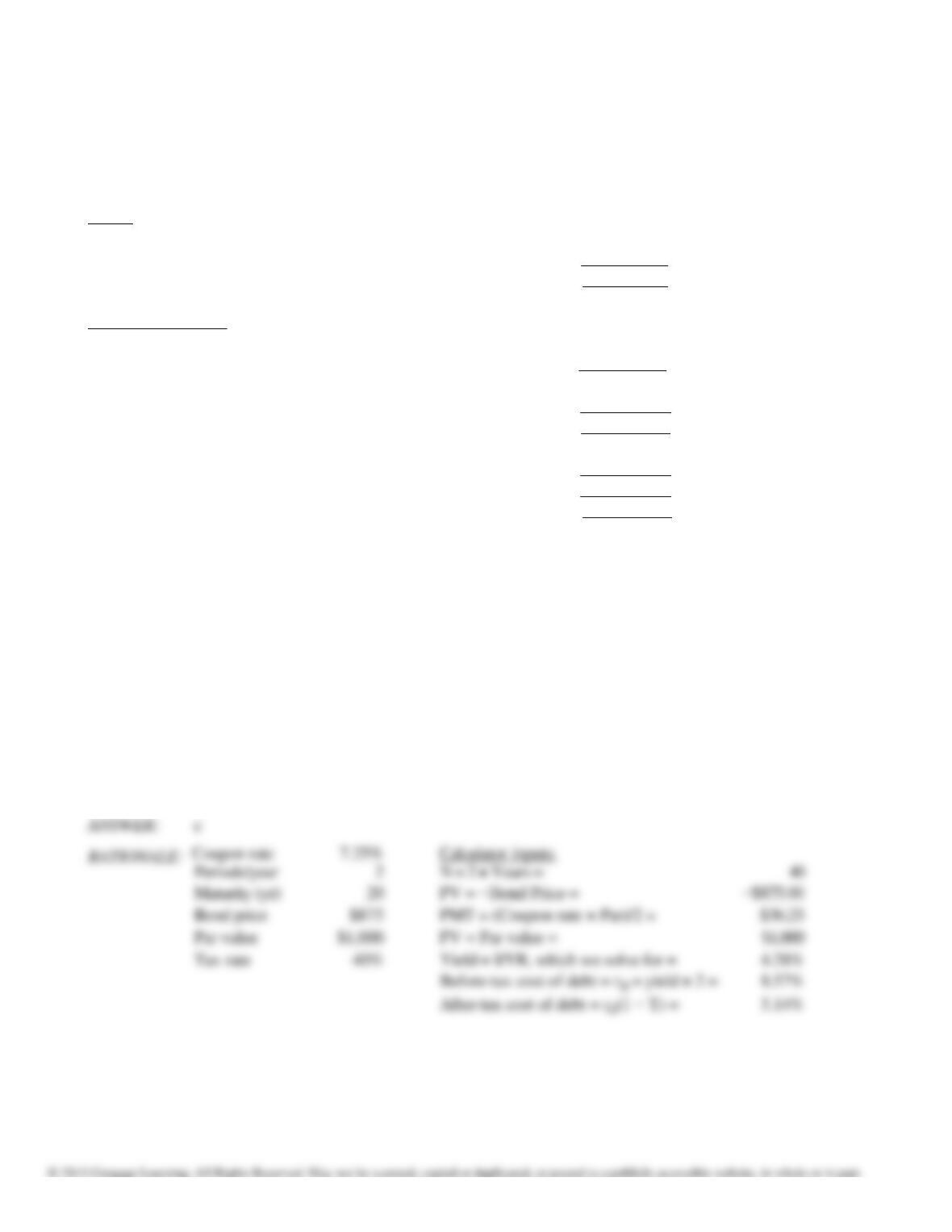
Refer to Exhibit 10.1. What is the best estimate of the after-tax cost of debt?
a. 4.64%
b. 4.88%
c. 5.14%
d. 5.40%
e. 5.67%
92.
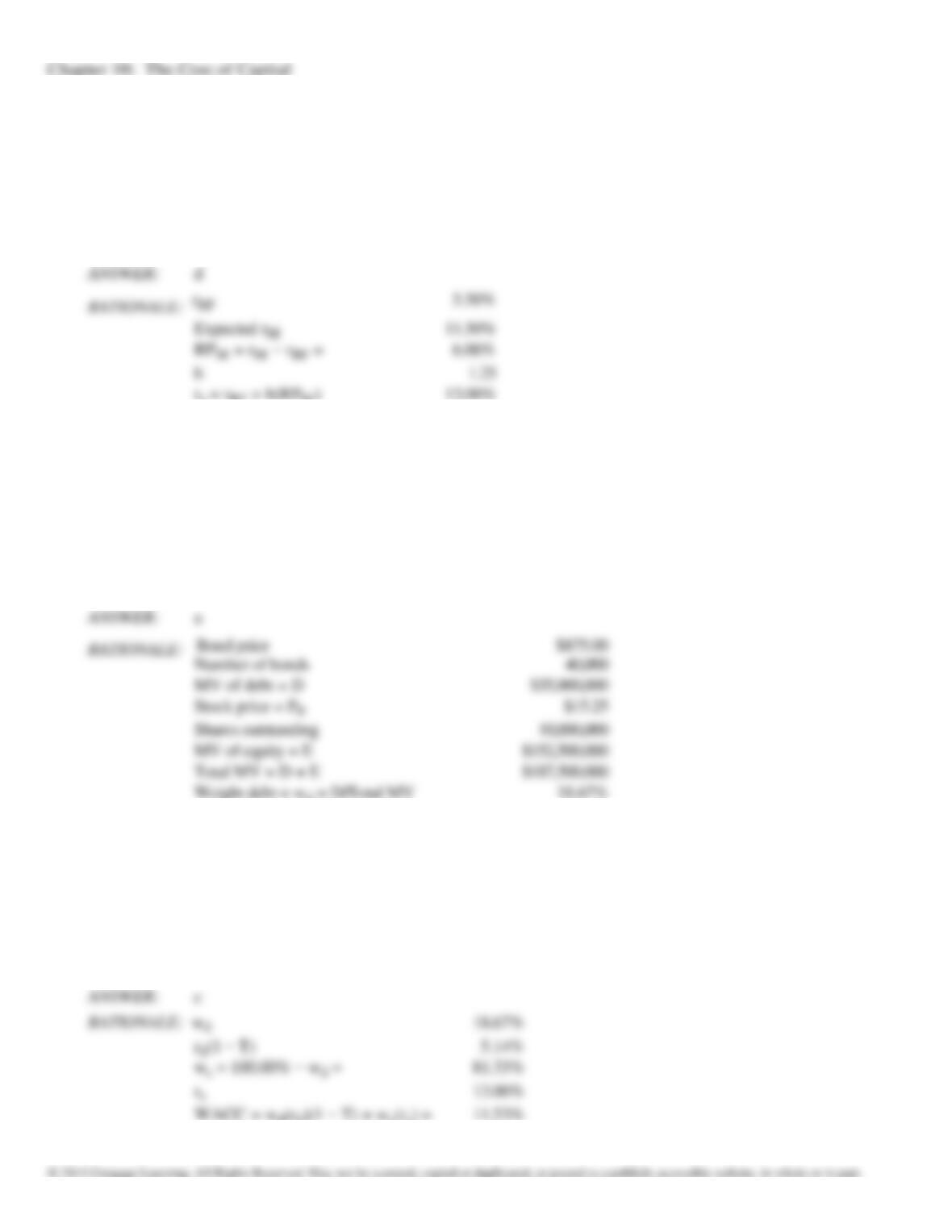
Refer to Exhibit 10.1. Based on the CAPM, what is the firm’s cost of equity?
a. 11.15%
b. 11.73%
c. 12.35%
d. 13.00%
e. 13.65%
93.
Refer to Exhibit 10.1. Which of the following is the best estimate for the weight of debt for use in calculating the
WACC?
a. 18.67%
b. 19.60%
c. 20.58%
d. 21.61%
e. 22.69%
94.
Refer to Exhibit 10.1. What is the best estimate of the firm’s WACC?
a. 10.85%
b. 11.19%
c. 11.53%
d. 11.88%
e. 12.24%