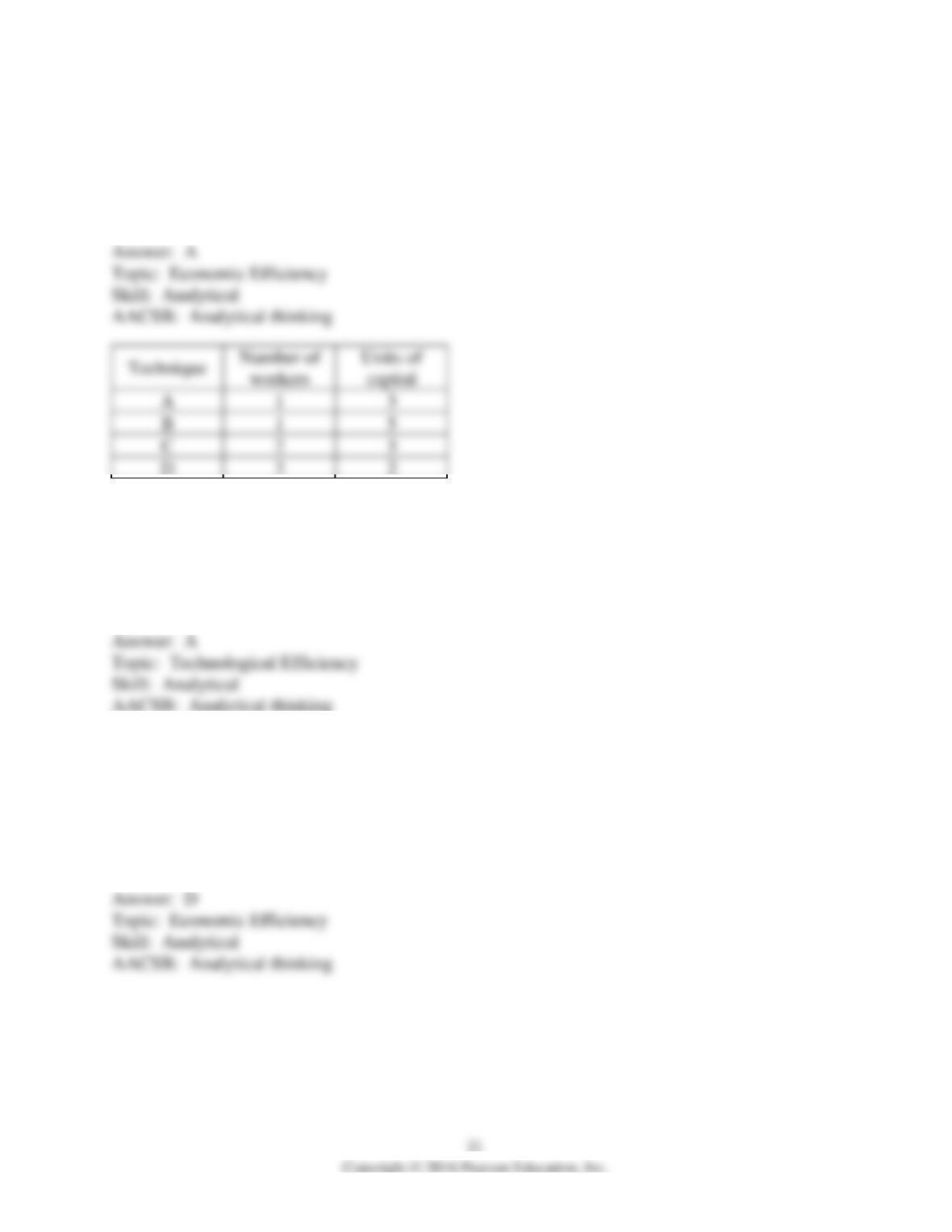
24) Using the data in the above table, if the price of an hour of labor is $20 and the price of a unit
of capital is $10, then the most economically efficient technique for producing 100 sweaters is
A) A.
B) B.
C) C.
D) D.
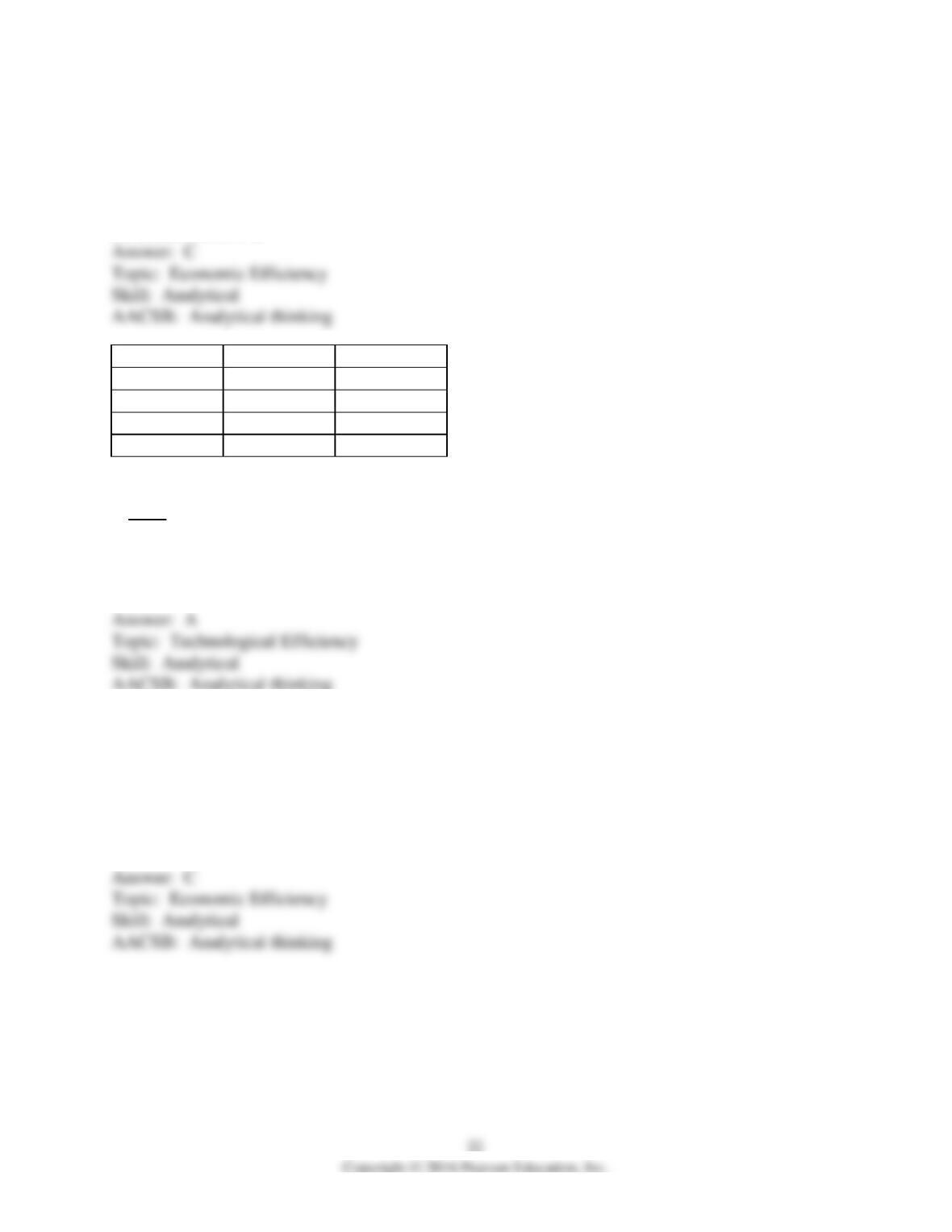
25) The table above shows four methods for producing 10 computer desks a day. Of the four
methods, ________ technologically inefficient.
A) B and C are
B) B is
C) D is
D) A and B are
26) The table above shows four methods for producing 10 computer desks a day. If the cost of a
worker is $100 a day and the cost of capital is $100 a day, the method that is economically
efficient is ________.
A) C
B) B
C) B, C, or D
D) A
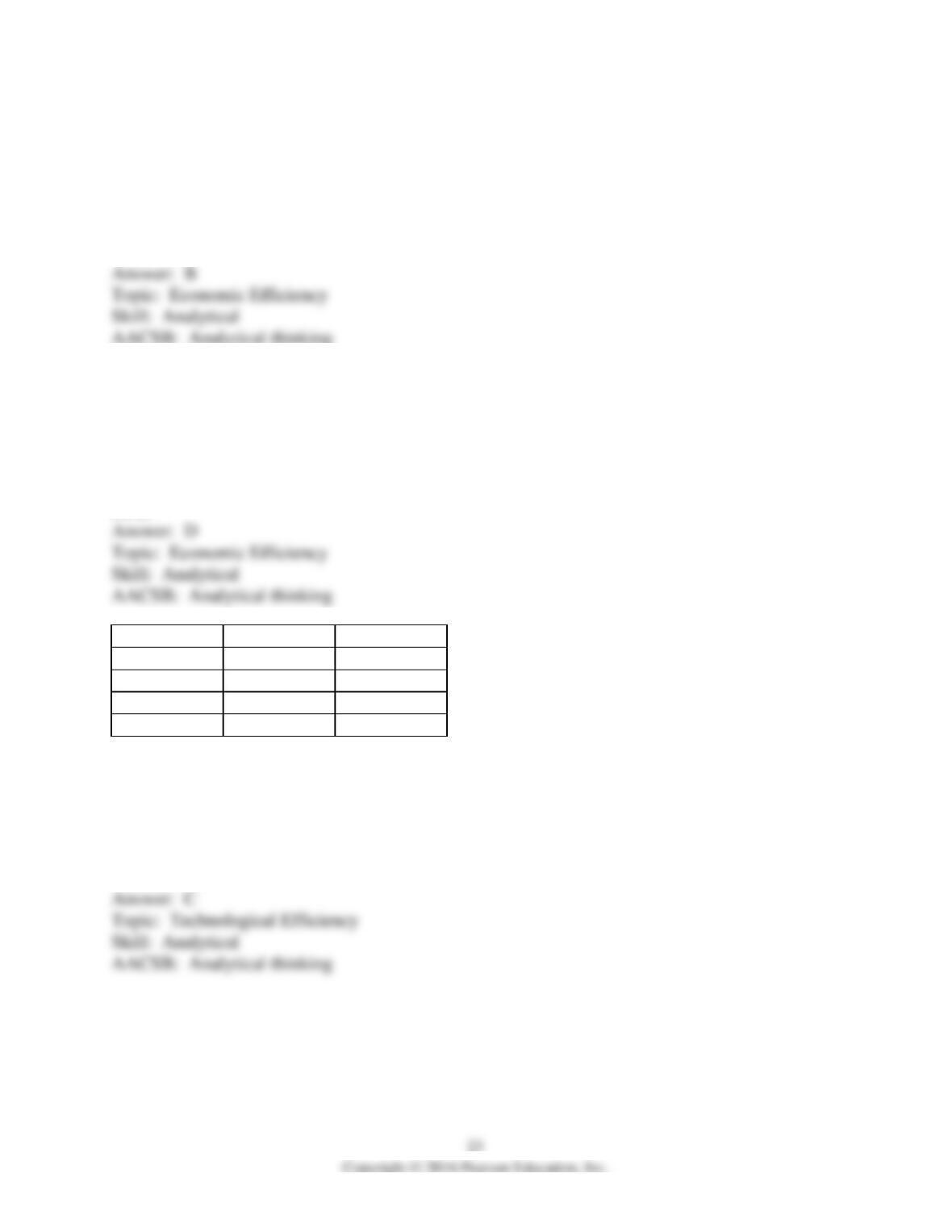
27) The table above shows four methods for producing 10 computer desks a day. If the cost of a
worker is $50 a day and the cost of capital is $150 a day, ________ economically efficient.
A) method A is
B) method B is
C) method D is
D) method A or C is
Technique
Capital (units)
Labor (units)
W
25
30
X
35
10
Y
25
25
Z
45
5
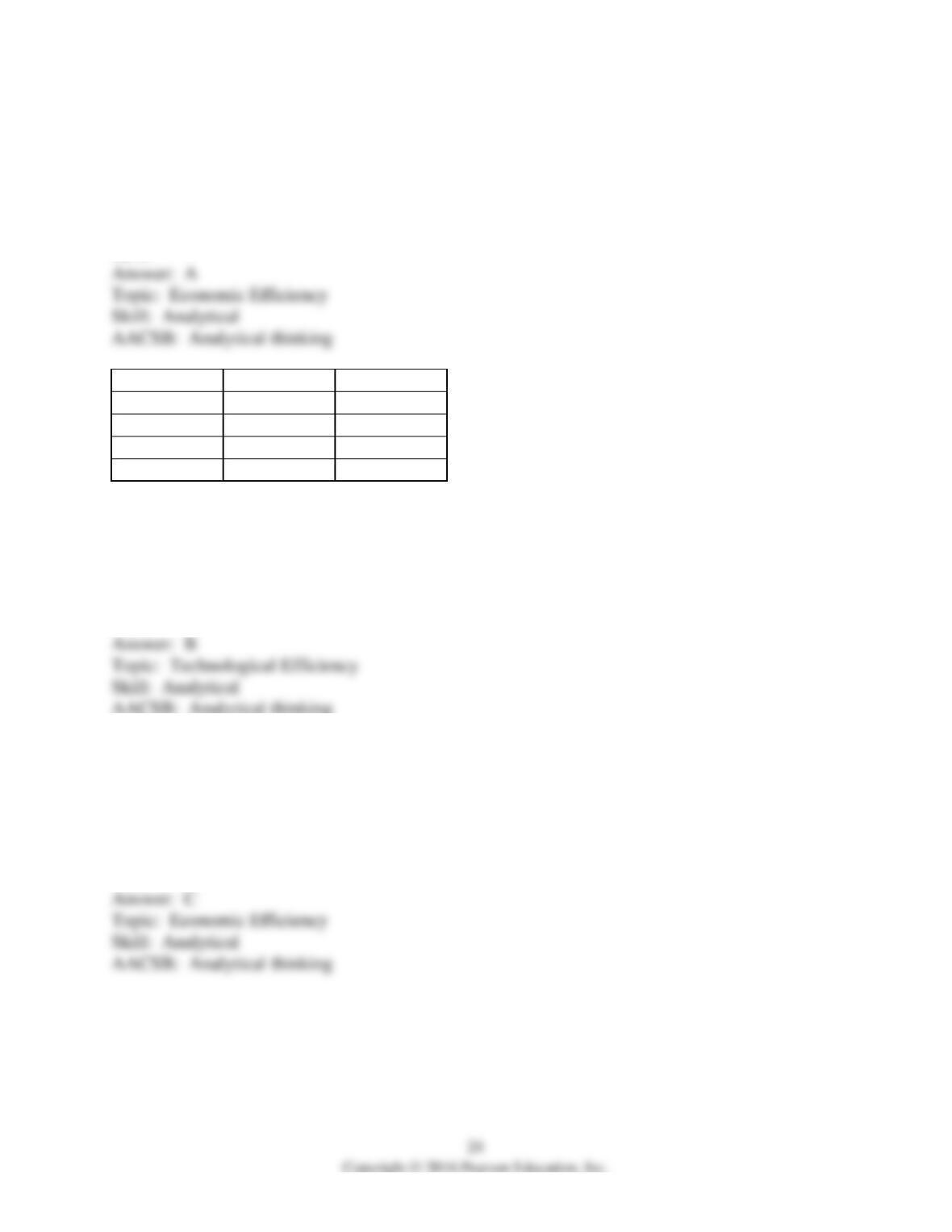
28) The table above shows techniques that can be used to produce 100 shirts. The technique that
is NOT technologically efficient is
A) W.
B) X.
C) Y.
D) Z.
29) The table above shows techniques that can be used to produce 100 shirts. If the price of an
hour of labor is $6 and the price of a unit of capital is $30, then the economically efficient
technique is
A) W.
B) X.
C) Y.
D) Z.
30) The table above shows techniques that can be used to produce 100 shirts. If the price of an
hour of labor is $10 and the price of a unit of capital is $12, then the economically efficient
technique is
A) W.
B) X.
C) Y.
D) Z.
31) The table above shows techniques that can be used to produce 100 shirts. If the price of an
hour of labor is $20 and the price of a unit of capital is $8, then the economically efficient
technique is
A) W.
B) X.
C) Y.
D) Z.
Technique
Capital (units)
Labor (units)
A
70
20
B
80
60
C
120
20
D
5
180
32) The above table gives techniques Jitters Coffee Company can use to package 5,000 pounds
of coffee. Which technique(s) is (are) technologically inefficient?
A) A
B) C
C) B and C
D) B, C, and D
33) The above table gives techniques Jitters Coffee Company can use to package 5,000 pounds
of coffee. If the cost of capital is $50 per unit and the cost of labor is $100 per unit, the
economically efficient technique for packaging 5000 pounds of coffee is
A) A.
B) B.
C) C.
D) D.
Technique
Capital (units)
Labor (units)
A
110
10
B
90
20
C
80
15
D
75
20
34) The above table gives techniques that Fatz Confectionery can use to produce 2,000 pounds of
candy. Which technique is technology inefficient?
A) A
B) B
C) C
D) D
35) The above table gives techniques that Fatz confectionery can use to produce 2,000 pounds of
candy. If the cost of capital is $20 per unit and the cost of labor is $40 per unit, the economically
efficient technique for producing 2000 pounds of candy is
A) A.
B) B.
C) C.
D) D.
Production Information for
Scully’s Splendid Spacecrafts
Technique to
produce 50
space crafts
Units of
capital
(thousands)
Hours of labor
(thousands)
W
4
28
X
4
16
Y
8
4
Z
10
1
36) In the above table, which technique is technologically inefficient?
A) Technique W
B) Technique X
C) Technique Y
D) Technique Z
37) In the above table, if the price of labor is $10 per hour and the price of capital is $20 per unit,
what is the total cost of Technique W?
A) $80,000
B) $200,000
C) $280,000
D) $360,000
38) In the above table, if the price of labor is $10 per hour and the price of capital is $20 per unit,
which method of producing 50 space crafts is economically efficient?
A) Technique W
B) Technique X
C) Technique Y
D) Technique Z
Techniques for making 100 pizzas
Options
Labor
(workers)
Capital (units)
1
23
2
2
10
5
3
8
5
4
5
10
39) Labor costs $20 per worker and capital costs $100 per unit. Then, according to the above
table, which of the following options for pizza production is technologically efficient?
A) Option 1
B) Option 2
C) Option 4
D) All of the above listed options are technologically efficient.
40) Labor costs $20 per worker and capital costs $100 per unit. Then, according to the above
table, which of the following options for pizza production is economically efficient?
A) Option 1
B) Option 3
C) Option 4
D) Both options 1 and 3 are economically efficient.
Techniques for making 100 automobiles
Method
Labor
(workers)
Capital (units)
A
50
500
B
20
700
C
6
0400
41) The table above shows three production methods to produce 100 automobiles per day. Which
of the three methods is technologically efficient?
A) Method A only
B) Method B only
C) Method C only
D) Method A, B and C are all technologically efficient.
42) The table above shows three production methods to produce 100 automobiles per day. If the
price of labor is $20 per unit and the price of capital is $100 per unit, which of the three methods
is economically efficient?
A) Method A only
B) Method B only
C) Method C only
D) All three methods are economically efficient.
Methods for making 2,000 CDs per day
Method
Capital (units)
Labor
(workers)
A
12
200
B
20
80
C
70
10
D
30
85
43) In the table above, which method is NOT technologically efficient?
A) A
B) B
C) C
D) D
44) In the table above, if a unit of capital is $50 per day and an hour of labor is $15 per day,
which method is economically efficient?
A) A
B) B
C) C
D) D
45) In the table above, if the cost of capital is $20 per day and an hour of labor is $15 per day,
which method is economically efficient?
A) A
B) B
C) C
D) D
Method
Labor required
(person-hours)
Capital required
(machine-hours)
T-1
200
100
T-2
150
150
T-3
150
130
T-4
100
200
46) The table below shows four alternative techniques for assembling a car. The cost of labor is
$20 per hour, and the cost of capital is $10 per hour. Which of the four techniques for assembling
a car is not technologically efficient?
A) T-1
B) T-2
C) T-3
D) T-4
47) The table below shows four alternative techniques for assembling a car. The cost of labor is
$20 per hour, and the cost of capital is $10 per hour. Which of the four techniques for assembling
a car is economically efficient?
A) T-1
B) T-2
C) T-3
D) T-4
48) The table below shows four alternative techniques for assembling a car. Which of the four
techniques for assembling a car cannot be economically efficient with any input prices?
A) T-1
B) T-2
C) T-3
D) T-4
49) Which of the following is CORRECT?
A) If a firm is technologically efficient, it is always economically efficient.
B) If a firm is technologically efficient, it is always producing at the lowest costs of production.
C) If a firm is economically efficient, it is always technologically efficient.
D) None of the above answers is correct.
50) A firm that is maximizing its profit
A) is economically efficient and technologically efficient.
B) is economically efficient but might be technologically inefficient.
C) is technologically efficient but might be economically inefficient.
D) might be economically inefficient and/or technologically inefficient.
51) A firm that is technologically efficient
A) must be economically efficient, but a firm that is economically efficient is not always
technologically efficient.
B) must be economically efficient, and a firm that is economically efficient must always be
technologically efficient.
C) is not always economically efficient, and a firm that is economically efficient is not always
technologically efficient.
D) is not always economically efficient, but a firm that is economically efficient must always be
technologically efficient.
52) A method that is technologically inefficient
A) might or might not be economically efficient.
B) can never be economically efficient.
C) results from failure to calculate the ratio of the cost of labor to the cost of capital.
D) means that it uses too much labor and too little capital.
53) Which of the following statements is TRUE?
I. A firm that is not economically efficient does not maximize profit.
II. Economic efficiency depends on the relative costs of resources.
III. A technological efficient firm is also economically efficient.
A) I only
B) II only
C) II and III
D) I and II
54) If a firm chooses to produce 100 units of output for $150 with 10 units of labor and 12 units
of capital, when they could produce the same 100 units for $120 with 10 units of labor and 8
units of capital, the firm is technologically ________ and economically ________.
A) efficient; inefficient
B) inefficient; efficient
C) efficient; efficient.
D) inefficient; inefficient
3 Information and Organization
1) Firms organize production by using a mix of
A) command and incentive systems.
B) market and agency systems.
C) command and market systems.
D) incentive and agency systems.
2) In order to maximize profits, firms organize their production using
A) only a command system.
B) only an incentive system.
C) a combination of command and incentive systems.
D) neither a command nor an incentive system.
3) If worker output is not measurable in physical units, and employees are hard to monitor, it
would be best to organize the firm using
A) a command system.
B) a monitoring system.
C) an incentive system.
D) None of the above answers is correct.
4) A command system is a method of coordinating a firm’s productive resources that uses
A) government regulations.
B) discipline and punishment.
C) a managerial hierarchy.
D) survival of the fittest.
5) A command system is a
A) method of organizing production that uses a market-like mechanism inside the firm.
B) method of organizing production that uses a managerial hierarchy.
C) set of rules that induce an agent to act in the best interest of a principal.
D) method of production that implements an assembly-line process.
6) A command system is a method of organizing production that
A) uses a market-like mechanism inside the firm.
B) relies on competitive markets.
C) uses a managerial hierarchy.
D) uses incentives most extensively.
7) An incentive system is a
A) method of organizing production that uses a market-like mechanism inside the firm.
B) method of organizing production that uses a managerial hierarchy.
C) set of rules that induce an agent to act in the best interest of a principal.
D) method of production that implements an assembly-line process.
8) When a firm links its employees’ compensation to the performance of the firm, the firm is
using
A) an incentive system.
B) a command system.
C) a cooperative system.
D) an agency system.
9) A golf club manufacturer pays its workers based on the number of sets of clubs they produce.
This firm
A) organizes production based on an incentive system.
B) organizes production based on a command system.
C) does not have any implicit costs.
D) does not have explicit costs.
10) Which of the following statements is CORRECT?
A) Command systems are used only in the military.
B) An incentive system is a method of organizing production that uses a market-like mechanism
inside the firm.
C) Selling organizations usually don’t use incentive systems.
D) A production line is a good example of how an incentive system works.
11) The principal-agent problem is the issue of inducing
A) agents and principals to work hard.
B) principals to act in the best interests of agents.
C) agents to act in the best interests of principals.
D) None of the above answers is correct.
12) An example of the principal-agent problem is when
A) managers try to cope with employees that are inefficient.
B) proprietors don’t receive any money payment for their entrepreneurial skills.
C) managers devise penalties that eliminate employee waste.
D) managers devise incentives that encourage employees to act in the owner’s behalf.
13) The principal-agent problem means that managers must
A) find ways for managers to get people to buy stock in their company.
B) devise compensation rules to induce principals to act in the best interest of agents.
C) devise compensation rules to induce agents to act in the best interest of principals.
D) find efficient agents who will negotiate fair compensation rules for a firm’s principal
managers.
14) A large part of the principal-agent problem stems from the desire of
A) agents to work hard.
B) agents to avoid working.
C) principals to work hard.
D) principals to avoid working.
15) The principal-agent problem refers to the fact that firms must
A) choose between economic efficiency and technological efficiency.
B) choose between a managerial and an incentive system.
C) devise incentives to get employees to work in the best interest of the firm’s owners.
D) choose between operating as a partnership or corporation.
16) A principal-agent problem occurs when hiring workers to work for a firm because
A) workers’ interests are not always the same as the interests of the owners of the firm.
B) workers do not respond to incentives.
C) the owners of a firm are always in a position to exploit the workers.
D) workers’ interests are not important in the managerial decisions of the firm.
17) Bill is working as the only employee at a local store. The relation between Bill and the owner
of the store is such that Bill is ________ and the owner is ________.
A) the agent; the principal
B) both principal and agent; neither a principal nor an agent
C) neither a principal nor an agent; both principal and agent
D) the principal; the agent
18) The principal-agent problem suggests that
A) principals and agents always have the same goals.
B) principals and agents will never have the same goals.
C) principals and agents are more likely to have the same goals if the principal gives the agent
flexibility to make his own decisions.
D) principals and agents are more likely to have the same goals if the agent’s pay is tied to
satisfying the principal’s goals.
19) When bank tellers converse with each other, keeping customers waiting in line, they are
A) unemployed.
B) out of the labor force.
C) working in the best interest of the agent.
D) working in the best interest of the principals.
20) A baseball player who has signed a long-term contract with his club and then constantly says
he is injured and cannot play is an example of ________.
A) the principal-agent problem
B) marginal returns to work
C) the law of diminishing returns
D) inefficient hiring practices
21) In their relationship with stockholders, a firm’s managers act
A) as agents.
B) as principals.
C) in loco parentis.
D) as proprietors.
22) A manager in a corporation is likely to be
A) both a principal and an agent.
B) neither a principal nor an agent.
C) an agent but not a principal.
D) a principal but not an agent.
23) In the principal-agent relationship between a bank manager and a bank teller, the manager is
A) an agent, as is the teller.
B) an agent and the teller is a principal.
C) a principal and the teller is an agent.
D) a principal, as is the teller.
24) Which of the following statements regarding principal-agent relations is CORRECT?
A) Workers are principals for managers.
B) Stockholders are agents.
C) Managers are both principals and agents.
D) All of the above answers are correct.
25) Which of the following CORRECTLY characterize principals and agents in important
examples of the principal-agent problem?
A) In the doctor/patient relationship, the patient is the principal and the doctor is the agent.
B) In the lawyer/client relationship, the client is the principal and the lawyer is the agent.
C) Both of the above answers are correct.
D) Neither of the above answers is correct.
26) In a corporation, the managers are the stockholders’
A) principals.
B) agents.
C) level coordinators.
D) incentive system.
27) In a corporation, the stockholders are the
A) principals.
B) agents.
C) level coordinators.
D) entrepreneurs.
28) You have just been named President and Chief Executive Officer at the StrideRite Shoe
Corporation. This appointment places you in the role of ________ to lower managers and
________ to the stockholders.
A) principal; principal
B) principal; agent
C) agent; principal
D) agent; agent
29) You have just purchased 100 shares of the stock of Microsoft Corporation. This places you
in the role of
A) principal.
B) incentive system operator.
C) agent.
D) long-term contractor.
30) Which of the following forms of business organization is likely to suffer most from the
principal agent problem between the owners and managers of the business?
A) proprietorships
B) partnerships
C) corporations
D) All are equally likely to suffer from the principal-agent problem.
31) Which of the following compensation schemes can be explained as an attempt to solve a
principal-agent problem?
A) Real estate agents are paid on a strict commission basis; if they don’t sell a client’s listed
property they don’t get paid.
B) Personal injury lawyers often work on a contingency basis. If the lawyer wins the case they
receive a significant share of the award; if the lawyer doesn’t win the case the lawyer doesn’t get
paid.
C) Traveling sales people, who are costly and difficult to monitor, generally receive a significant
share of their compensation in the form of commissions or bonuses for meeting sales targets.
D) All of the above compensation schemes attempt to solve a principal-agent problem.
32) By making most of its employees owners of the company, United Airlines attempted to
A) cope with the unlimited liability problem.
B) change its business organization from a corporation to a partnership.
C) address the principal-agent problem between the workers and managers.
D) increase the role of the command system in managing the firm.
33) Mr. Adams owns a textile business. In order to deal with the principal-agent problem, Mr.
Adams might offer his employees
A) incentive pay.
B) long-term contracts.
C) part- ownership.
D) all of the above.
34) Which of the following is NOT a solution to a principal-agent problem?
A) ownership
B) managerial hierarchy
C) incentive pay
D) long-term contracts
35) Giving managers an ownership stake in a company is an example of
A) a command system.
B) an incentive system.
C) a system that encourages managers to become agents that monitor their principals.
D) economies of scope.
36) Corporations that offer incentive pay schemes that link pay to meeting profit, production, or
sales targets are doing so to cope with the
A) scarcity problem.
B) inefficiencies usually found in large firms.
C) principal-agent problem.
D) problems of unionization.
37) One of the ways of coping with the principal-agent problem is
A) giving orders.
B) providing incentive pay.
C) shirking.
D) using only short-term contracts.
38) A chief reason firms give employees bonuses based on the firm’s profit is to cope with
A) the tax laws.
B) the law of diminishing returns.
C) the principal-agent problem.
D) unions.
39) Gilda’s Art Gallery rewards its employees with stock each year the gallery makes profits.
This stock allows the employees to own part of the gallery. This practice is known as
A) the principle-agent problem.
B) incentive pay.
C) minimizing implicit costs.
D) minimizing explicit costs.
40) Gilda’s Art Gallery pays a commission to her sales people when they sell a painting. This
practice is known as
A) the principal-agent problem.
B) incentive pay.
C) minimizing implicit costs.
D) minimizing explicit costs.
41) A chief purpose of long-term contracts is to improve agents’
A) information.
B) incentives.
C) control over principals.
D) security.