14) Consider a society consisting of just a farmer and a tailor. The farmer has 30 units of food but no
clothing. The tailor has 60 units of clothing but no food. Suppose each has the utility function U =
F1/3C2/3. If the price of clothing is always $1, and the food price is currently $1, then we can conclude
A) the market is at a competitive equilibrium.
B) the price of food will drop towards a competitive equilibrium.
C) the price of food will increase towards a competitive equilibrium.
D) None of the above.
For the following, please answer “True” or “False” and explain why.
15) A competitive equilibrium is not Pareto efficient if some members of society are unable to afford a
necessary good.
16) Assume a government likes a particular equilibrium along the contract curve. It can achieve that
equilibrium through competition and income redistribution.
17) According to the Fundamental Theorems of Welfare Economics, the competitive equilibrium is
dependent on the relative bargaining powers of the parties trading.
18) The competitive equilibrium determines the absolute prices of each of the goods based on the
endowments and marginal rates of substitution.
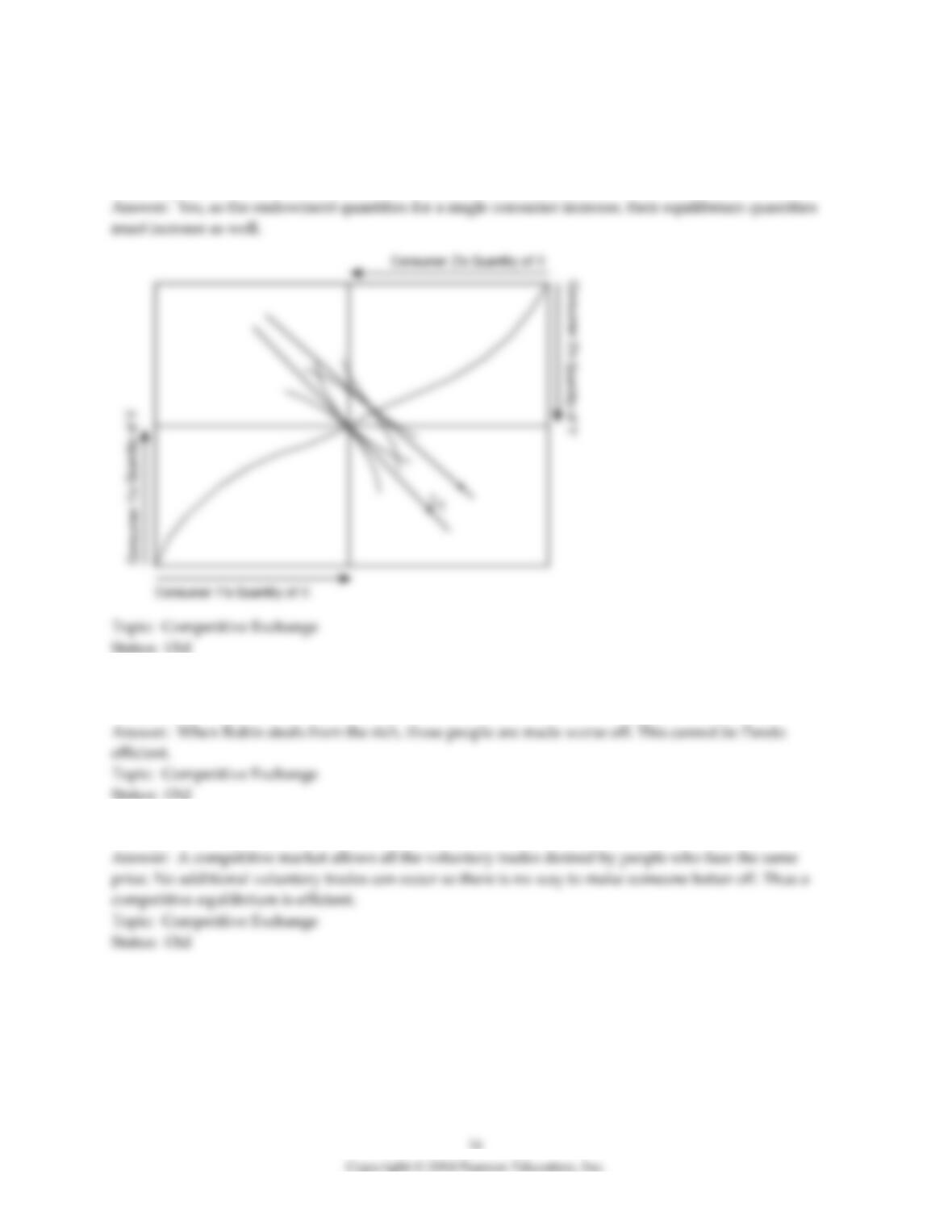
19) Consider a two-trader/two-good exchange economy in equilibrium. If the endowment point moves to
the north east, i.e. the endowment quantities to one of the consumers increase, can we determine the
direction in which the equilibrium quantities will change? Demonstrate your answer with a graph
including the relevant indifference curves, contract curve and price line.
20) Explain why Robin Hood’s practice of stealing from the rich to give to the poor is never Pareto
efficient.
21) Explain the logic behind the First Theorem of Welfare Economics.
22) Consider a society consisting of just a farmer and a tailor. The farmer has 10 units of food but no
clothing. The tailor has 20 units of clothing but no food. Suppose each has the utility function U = F ∗ C.
The price of clothing is always $1. If the price of food is $3, does a competitive equilibrium exist? If not,
what will happen to the price of food?
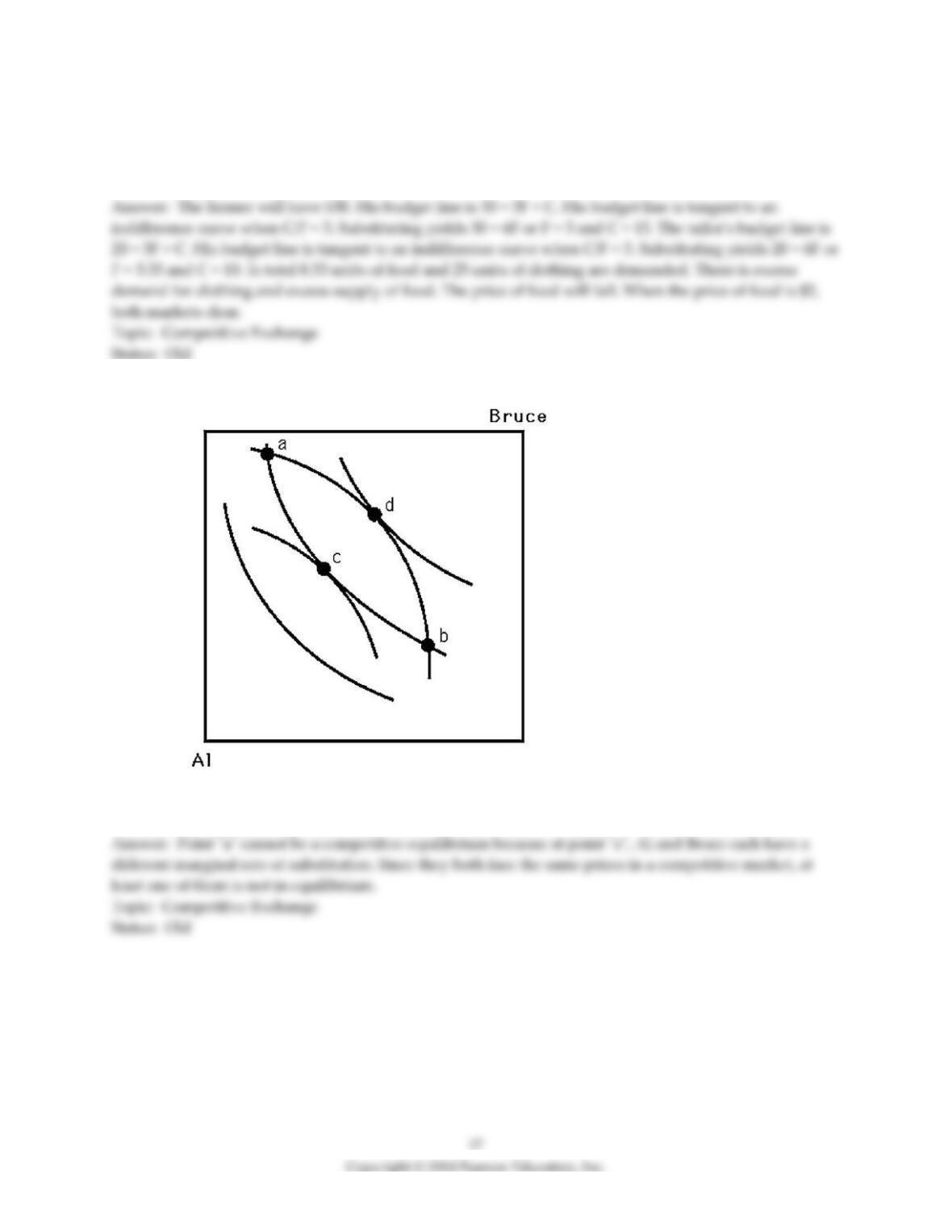
23) The above figure depicts the Edgeworth box for two consumers, Al and Bruce. Explain why point “a”
cannot be a competitive equilibrium.
24) Sarah and Andrew are two traders in a pure exchange economic with two goods, Bikes (B) and
Computers (C). Sarah’s preferences are described by the Cobb-Douglas Utility function:
US = BS1/3CS2/3
Andrew’s preferences are given by:
UA = BA1/2CA1/2
Assume the price of Bikes is 1 and the price of computers is p. The initial endowments are BA = 10, BS =
20, CA = 20 and CS = 10. Solve for the competitive equilibrium prices (relative prices) and quantities.
10.4 Production and Trading
1) If pizza is measured on the horizontal axis and pretzels are measured on the vertical axis, the slope of
the production possibility frontier at a given combination reflects
A) the total cost of producing that combination.
B) the total cost of producing that quantity of pizza in terms of pretzels.
C) the cost of making the last pizza in terms of pretzels.
D) the cost of making the last pretzel in terms of pizza.
2) The ability to produce a good at a lower opportunity cost than someone else is called
A) competitive production.
B) comparative advantage.
C) selective advantage.
D) absolute advantage.
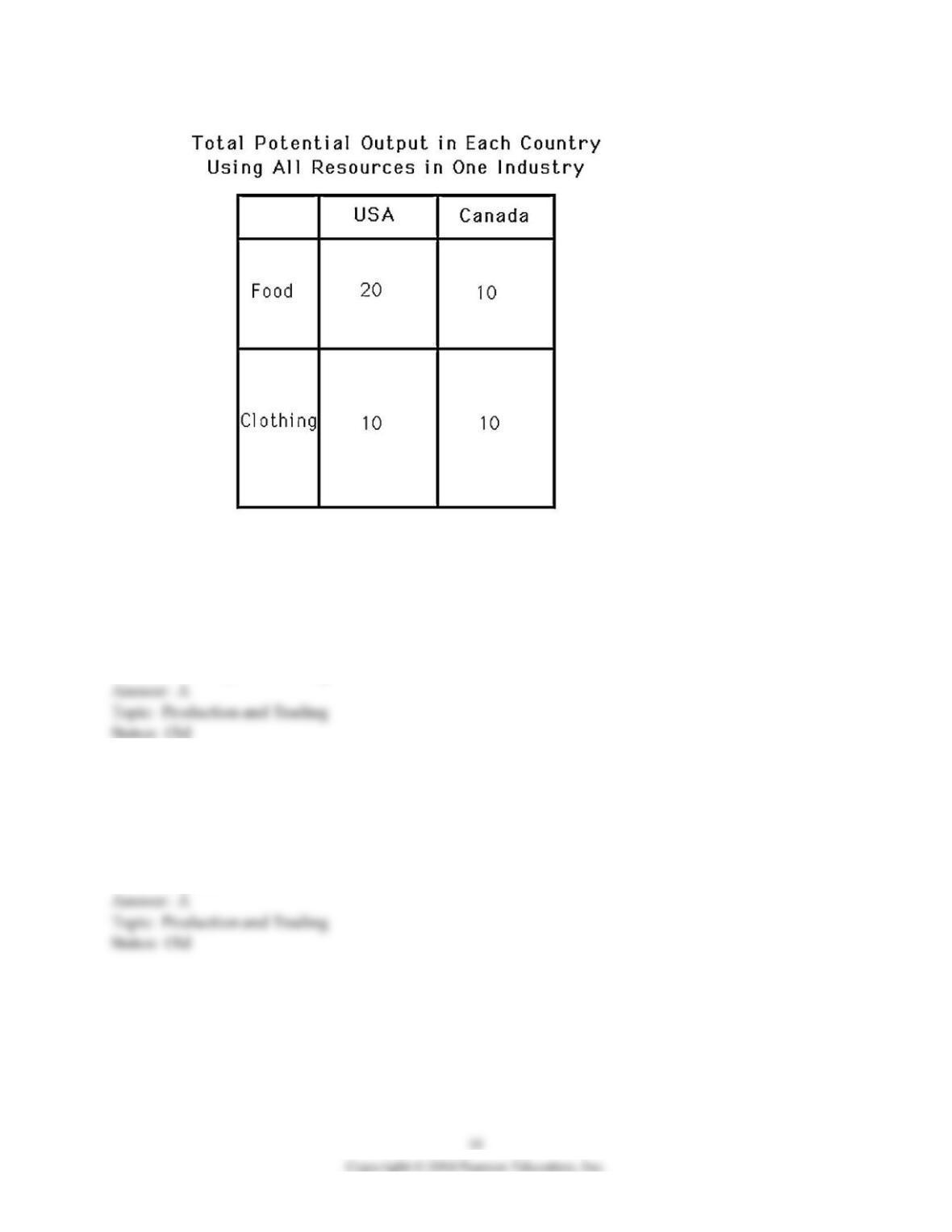
3) Suppose the production possibilities for two countries, producing either food or clothing, are shown in
the above figure. They can each produce any linear combination as well. Measuring food on the
horizontal axis, the joint production possibility frontier
A) will kink away from the origin at 20 units of food.
B) will kink toward the origin at 20 units of food.
C) will kink toward the origin at 10 units of food.
D) will kink away from the origin at 10 units of food.
4) Suppose the production possibilities for two countries, producing either food or clothing, are shown in
the above figure. The U.S. has a comparative advantage in producing
A) food.
B) clothing.
C) food and clothing.
D) neither good.

5) Suppose the production possibilities for two countries, producing either food or clothing, are shown in
the above figure. They can each produce any linear combination as well. Measuring food on the
horizontal axis, the joint production possibility frontier
A) will have a slope of -3/4 over the entire frontier.
B) will have a slope of -2 when less than 20 units of food are produced.
C) will have a slope of -1 when less than 20 units of food are produced.
D) will have a slope of -1/2 when less than 20 units of food are produced.
6) Suppose the production possibilities for two countries, producing either food or clothing, are shown in
the above figure. They can each produce any linear combination as well. Assuming free trade between
these two countries, Canada will produce food
A) as long as any positive amount of food is demanded.
B) as long as more than 10 units of food are demanded.
C) as long as people are willing to give up at least 1 unit of clothing to get a unit of food.
D) as long as people are willing to give up more than 1/2 a unit of clothing to get a unit of food.
7) Suppose the production possibilities for two countries, producing either food or clothing, are shown in
the above figure. They can each produce any linear combination as well. Free trade between these two
countries will take place
A) as long as Canada is willing to give up 0.25 unit of clothing to get a unit of food.
B) as long as USA asks for at least 1.5 units of clothing in exchange for a unit of food.
C) as long as Canada asks for at least 3 units of food in exchange for a unit of clothing.
D) as long as USA is willing to give up at least 1.5 units of food in exchange for a unit of clothing.
8) Suppose the production possibilities for two countries, producing either food or clothing, are shown in
the above figure. They can each produce any linear combination as well. If production occurs at the kink
on the joint production possibility frontier,
A) the U.S. will specialize in food and Canada will specialize in clothing.
B) the U.S. will specialize in clothing and Canada will specialize in food.
C) each country will devote half of its resources to each industry.
D) joint output is minimized.
9) Suppose the production possibilities for two countries, producing either food or clothing, are shown in
the above figure. They can each produce any linear combination as well. Suppose each country is in
competitive equilibrium prior to free trade being allowed. Once free trade is allowed, the price of food
will be
A) two times the price of clothing.
B) equal to the price of clothing.
C) one-half the price of clothing.
D) somewhere between one-half the price of clothing and the price of clothing, depending upon the
relative bargaining power of the two countries.
10) Suppose the production possibilities for two countries, producing either food or clothing, are shown
in the above figure. They can each produce any linear combination as well. Once free trade is allowed,
Canada will produce
A) no clothing.
B) 10 units of clothing.
C) 20 units of clothing.
D) 5 units of clothing.
11) Suppose the production possibilities for two countries, producing either food or clothing, are shown
in the above figure. They can each produce any linear combination as well. Assuming that consumers
place equal value on both of these goods and that free trade between these two countries is possible,
gains from trade
A) are not possible.
B) exist because food is more expensive to produce in Canada than in the U.S.
C) exist because food is more expensive to produce in the U.S. than in Canada.
D) do not exist because the consumers in each country have set their marginal rate of substitution equal
to their country’s marginal rate of transformation.
12) Suppose the production possibilities for two countries, producing either food or clothing, are shown
in the above figure. They can each produce any linear combination as well. Measuring food on the
horizontal axis, the joint production possibility frontier has a horizontal intercept of
A) 10.
B) 20.
C) 30.
D) 50.
13) Suppose the production possibilities for two countries, producing either food or clothing, are shown
in the above figure. They can each produce any linear combination as well. Measuring food on the
horizontal axis, the joint production possibility frontier has a vertical intercept of
A) 10.
B) 20.
C) 30.
D) 50.
14) Suppose the production possibilities for two countries, producing either food or clothing, are shown
in the above figure. They can each produce any linear combination as well. Measuring food on the
horizontal axis, the joint production possibility frontier will have a slope of –1
A) only when 20-30 units of food are produced.
B) only when 10-20 units of food are produced.
C) only when 10-20 units of clothing are produced.
D) throughout the entire PPF.
15) Suppose the production possibilities for two countries, producing either food or clothing, are shown
in the above figure. They can each produce any linear combination as well. Measuring food on the
horizontal axis, the joint production possibility frontier has a kink because
A) each country has a constant marginal rate of transformation that differs from the other country.
B) each country has a marginal rate of transformation that varies with the product mix.
C) all production possibility frontiers have kinks.
D) the two countries have the same marginal rate of transformation.
16) Every point on the joint production possibilities frontier represents
A) an initial endowment.
B) inefficient production.
C) the marginal rate of substitution of goods for each producer.
D) at least one producer specializing in production.
17) Competition results in the efficient product mix because
A) producers are setting MRT equal to minus the price ratio while consumers are setting MRS equal to
minus the price ratio ensuring that MRT will equal MRS.
B) consumers are on the contract curve.
C) the slope of the production possibility frontier will equal the slope of the contract curve.
D) the distribution of the final output is Pareto efficient.
18) By saying that MRS = MRT, an economist means that
A) for all goods, the value that society places on the last unit produced equals the cost of making that
unit.
B) for all goods, the value that a consumer places on the last unit consumed equals the value that all
consumers would place on that unit.
C) society is able to produce more output of one good without reducing the output of any other good.
D) no other output mix is technically feasible.
For the following, please answer “True” or “False” and explain why.
19) If MRS’s are equal across all consumers, then the efficient product mix has been achieved.
20) At the competitive equilibrium quantity supplied equals quantity demanded in all markets.
21) Explain how it is possible for one of two people in a two-good economy to have an absolute
advantage in producing both goods, but trade can still benefit both people.
22) Suppose a society’s PPF for food (F) and clothing (C) can be written as 25 = F2 + C2. If all consumers
have the same endowment and the same utility function Ui = Fi ∗ Ci, what is the efficient product mix of
food and clothing?
23) Can consumption efficiency be achieved even if the efficient product mix is not achieved?
24) How does competition ensure that the efficient product mix is attained?
25) The above figure shows a production possibility frontier for a society with two members, Al and
Bruce. If point “a” is the efficient product mix, draw a possible Edgeworth box and indifference curves.
26) Suppose the U.S. can produce 10 units of food and five units of clothing (or any linear combination)
and Canada can produce six units of food and three units of clothing (or any linear combination). What
type of trade will occur between these two countries? Explain.
27) Suppose the U.S. can produce 10 units of food and five units of clothing (or any such linear
combination) and Canada can produce six units of food and four units of clothing (or any such linear
combination). If trade occurs between these two countries, which should produce more food and which
more clothing?
10.5 Efficiency and Equity
1) Any policy change that results in a Pareto-superior allocation
A) will increase welfare under certain conditions.
B) must increase welfare.
C) will leave welfare unchanged.
D) will have an unpredictable effect on welfare.
2) A cake is to be shared by two people. Both desire the largest piece possible. One of the two will cut the
cake. Under which of the following situations will the cutter adopt a Rawlsian social welfare function?
A) The person cutting the cake chooses the first piece.
B) The person not cutting the cake chooses the first piece.
C) The two individuals will bid for the right to cut the cake and choose first.
D) The two individuals will toss a coin for the right to cut the cake and choose first.

3) Suppose in a democratic society, all voters prefer choice G over choice B; however, when the two
choices are presented along with a third choice, R, B wins the election. This violates the assumption of
A) transitivity.
B) non-dictatorship.
C) independence of irrelevant alternatives.
D) completeness.
4) No clearly defined socially preferred outcome may result when majority voting on outcomes because
A) often voters don’t understand the outcomes.
B) voting may violate the independence of irrelevant alternatives.
C) voting may lead to incomplete preferences.
D) voting may lead to non-transitive preference.
5) If everyone’s utility is given equal weight and a change in resource allocation results in one person’s
gain exceeding another person’s loss, we can say that the new allocation
A) is Pareto superior to the original one.
B) increases social welfare.
C) decreases social welfare.
D) is efficient.
6) If price support policy increases producer surplus more than reducing consumer surplus, then
A) the policy leads to a Pareto-superior allocation.
B) the policy leads to an increase in social welfare.
C) the policy improves the efficiency of society.
D) None of above.
7) If a society only cares about efficiency and not equity, then
A) all points on the contract curve yield the same level of social welfare.
B) it will not rely on competitive markets to allocate goods.
C) it will maximize the utility of its worst-off member.
D) an equitable outcome is impossible.

8) If a society relies on competitive markets to allocate goods, then
A) an equitable distribution is assured.
B) an equitable distribution is certain to not occur.
C) the competitive equilibrium will be Pareto superior to any other.
D) social welfare as measured by consumer surplus plus producer surplus will equal zero.
9) A dictator is most likely to
A) adopt a Rawlsian social welfare function.
B) maximize her own utility.
C) place equal weight on everyone’s utility function.
D) have nontransitive preferences.
10) If society were to maximize the utility of its worst-off member, the final allocation would most likely
be
A) relatively egalitarian.
B) on the contract curve.
C) Pareto efficient.
D) one in which one person gets everything.
11) If society were to maximize the utility of its best-off member, the final allocation would be
A) perfect equity.
B) on the contract curve.
C) Pareto efficient.
D) one in which one person gets everything.
12) For most commonly used social welfare functions, an efficient allocation is
A) always preferred over any inefficient allocation.
B) not possible.
C) usually preferred.
D) never preferred.
For the following, please answer “True” or “False” and explain why.
13) At a given point in time, the Rawlsian welfare function gives equal weight to each individual’s utility.
14) Equity and efficiency can be achieved simultaneously through competition.
15) If a market is controlled by one perfect price discriminator who is able to charge each consumer the
highest price that consumer is willing to pay, the seller will produce output until the price paid by the last
consumer is equal to the marginal cost of making the good. That is, the price of the last good equals the
marginal cost of making the good. If welfare is measured as consumer surplus plus producer surplus,
compare this market structure to a competitive market in terms of efficiency and equity.
16) Explain why a government may select an inefficient allocation.
17) According to the Theory of the Second Best, why might market liberalization through elimination of
some market distortions, such as particular trade restrictions, lead to social welfare losses?
18) Suppose the government currently places tariffs and/or other import restrictions on good X. Will
imposing a tariff and/or trade restriction on good Y necessarily reduce overall social welfare for the
economy?