Microeconomics, 12e (Parkin)
Chapter 10 Organizing Production
1 The Firm and Its Economic Problem
1) The most important goal of the firm is to
A) maximize its revenues.
B) maximize its sales volume.
C) maximize its profits.
D) minimize its costs.
2) A firm’s basic goal is best described as
A) maximizing total revenue.
B) maximizing sales.
C) maximizing profit.
D) minimizing total cost.
3) Profit maximization
A) makes a firm become as large as possible.
B) makes a firm remain small in the long run.
C) increases the likelihood that a firm will survive.
D) leads a firm to become the target of a takeover.
4) Firms that survive in the long run are usually those that
A) become as large as possible.
B) remain small.
C) use more capital rather than more labor.
D) earn the largest possible profit.
5) Firms use incentives to pursue their most fundamental goal, which is to maximize
A) profits.
B) sales revenue.
C) worker satisfaction.
D) worker pay.
6) A firm’s opportunity costs ________.
A) equal the costs of resources it buys from others in the market
B) include the cost of using resources owned by the firm
C) increase when economies of scope exist
D) do not include any opportunity costs for resources the owner suppliers
7) Which of the following costs are part of a firm’s opportunity costs?
I. costs for resources bought in markets
II. costs for resources the firm owns
III. costs for resources supplied by the owner
A) I and II
B) I and III
C) I only
D) I, II, and III
8) If instead of working on his own as a consultant making $25,000, Joe takes a job at a bank, the
$25,000 is
A) an opportunity cost.
B) a depreciation.
C) a loss.
D) an accounting profit.
9) An electrician quits her current job, which pays $40,000 per year. She can take a job with
another firm for $45,000 per year or work for herself. The opportunity cost of working for
herself is
A) $5,000.
B) $40,000.
C) $45,000.
D) $85,000.
10) Which of the following is part of a firm’s opportunity costs?
I. wages
II. utility costs
III. interest on a bank loan
IV. interest forgone on funds used to buy capital equipment
A) I and II
B) III and IV
C) I, II and III
D) I, II, III and IV
11) The implicit rental rate for capital is
A) an accounting cost.
B) part of the firm’s normal profit.
C) an opportunity cost.
D) a cost that is irrelevant to the business.
12) The implicit rental rate for capital includes the
A) total value of a piece of capital equipment.
B) interest income forgone by purchasing the piece of capital equipment.
C) firm’s normal profit.
D) amount paid for the use of a piece of capital equipment owned by someone else.
13) Which of the following are two components of the opportunity cost of using capital already
owned by the firm?
A) economic profit and normal profit
B) implicit rental rate and economic profit
C) explicit rental rate and economic costs
D) economic depreciation and forgone interest
14) Wanda takes $3,000 from her savings account that pays 5 percent interest per year and uses
the funds to purchase a computer for $3,000 for her business. At the end of the year the computer
is worth $2,000. Wanda pays an implicit rental rate of ________ a year.
A) $1,150
B) $4,000
C) $3,150
D) zero
15) Over a given period, economic depreciation is the change in capital equipment’s
A) output.
B) market value.
C) rate of return.
D) cost of maintenance.
16) Economic depreciation is the
A) firm’s opportunity cost of using its own capital.
B) change in the market value of capital over a given period.
C) return that an entrepreneur can expect to receive on average.
D) forgone return on the funds used to buy capital.
17) The difference between the market price of a new car used by a firm and the market price of
the same car one year later is known as
A) economic depreciation.
B) physical depreciation.
C) economic deterioration.
D) physical deterioration.
18) ________ is the change in market value of capital over a given period.
A) Accounting depreciation
B) Implicit rental rate
C) Economic depreciation
D) Accounting implicit rental cost
19) Costs as measured by accountants generally does not include
A) any of the opportunity costs of the firm.
B) any measure of depreciation.
C) the economic depreciation of the firm’s equipment.
D) any rental rates.
20) Tudor’s Deli and Catering could have sold their delivery van on December 31, 2010 for
$16,000. If they could sell the same van on December 31, 2011, for $13,000, then the economic
depreciation in 2011 for this van
A) is $13,000.
B) is $16,000.
C) is $29,000.
D) is $3,000.
21) Flora’s Flower Shop bought a new van for $23,000. Today, the market price of this van is
$11,000. The economic depreciation of the van is ________.
A) $23,000
B) $12,000
C) $11,000
D) $34,000
22) Suppose Pippi buys an oven for her pizza parlor for $100,000. Pippi’s pizza tasted so pitiful
she went out of business 12 months later. She was able to sell the pizza oven for $75,000. This
decrease in the value of the oven is
A) the total implicit rental rate on the oven.
B) an economic loss.
C) economic depreciation.
D) interest forgone.
23) The average return for supplying entrepreneurial ability is the entrepreneur’s
A) accounting profit.
B) normal profit.
C) explicit profit.
D) economic profit.
24) The return that an entrepreneur can expect to earn, on average, is called
A) profit.
B) normal profit.
C) economic profit.
D) accounting profit.
25) Lucinda starts a business consulting company. She makes all the business decisions and
bears the risk of running the business. The typical payment for Lucinda’s work is ________.
A) all the revenue greater than her opportunity cost
B) all the revenue greater than the capital investment
C) a normal profit
D) an economic profit
26) Which of the following statements does NOT correctly characterize normal profit?
A) It is part of a firm’s opportunity cost.
B) It is equal to a firm’s total revenue minus its opportunity cost.
C) It is the average return for supplying entrepreneurial ability.
D) None of the above because all the statements correctly characterize normal profit.
27) A normal profit is
A) the revenue remaining after all opportunity costs have been paid.
B) the profit a firm makes each year.
C) the average return for entrepreneurship.
D) part of the implicit rental rate of capital.
28) A normal profit for a self-employed entrepreneur is
I. an opportunity cost.
II. part of the implicit rental rate of the funds invested in the business.
A) only I
B) only II
C) both I and II
D) neither I nor II
29) Economic profit is the difference between total revenue and
A) the normal profit.
B) interest costs of production.
C) opportunity costs of production.
D) the costs of resources bought in markets.
30) Economic profit is
A) equal to the firm’s total revenue minus its opportunity costs.
B) an opportunity cost of operating the firm.
C) equal to the firm’s total revenue minus its normal profit.
D) the average return for supplying entrepreneurial ability.
31) An economic profit for a self-employed entrepreneur is
A) an opportunity cost.
B) the same as the normal profit.
C) a profit over and above opportunity cost.
D) None of the above answers is correct.
32) If economic profit is equal to zero, then
A) the entrepreneur’s profit as measured by accountants is also equal to zero.
B) the entrepreneur’s profit as measured by accountants must be less than zero.
C) the entrepreneur is making only a normal profit.
D) The entrepreneur’s profit cannot be determined based on the information given.
33) Among the opportunity costs of a firm are all of the following EXCEPT
A) the owner’s forgone wage.
B) costs of resources bought in markets, such as labor.
C) normal profits.
D) economic profits.
34) Joe quits his job as an insurance agent and opens his own sporting goods store. If his profits
as measured by his accountant are greater than zero, then
A) he made a good move because he is earning above normal profits.
B) his economic profit must be greater than zero.
C) his opportunity costs must be zero.
D) There is not enough information to determine his economic profit, if any.
35) Sue owns a baking company. The company’s total revenue for a month is $4000. The
monthly costs of resources bought in the market and of resources owned by the firm are $2000
and monthly costs of resources supplied by the owner are $1000. Sue’s economic profit for the
month is equal to
A) $4000.
B) $3000.
C) $2000.
D) $1000.
36) Ed is a freelance writer who could work for a newspaper at $25,000 a year but instead works
for himself for $41,000 a year. His only business expenses are $1,000 for writing materials and
$12,000 for rent. Ed’s normal profit is $1,000. Ed’s economic profit from working as a freelance
writer is
A) $1,000.
B) $2,000.
C) $15,000.
D) $25,000.
37) Heidi quit her job as a chef making $40,000 per year to start her own restaurant. The first
year, Heidi’s restaurant earned $100,000 in revenue. Heidi pays $50,000 per year in wages to the
waitresses and hostess and $20,000 per year to buy food. What is Heidi’s profit as measured by
an accountant for the year?
A) $80,000
B) $50,000
C) $30,000
D) -$10,000
38) Heidi quit her job as a chef making $40,000 per year to start her own restaurant. The first
year, Heidi’s restaurant earned $100,000 in revenue. Heidi pays $50,000 per year in wages to the
waitresses and hostess and $20,000 per year to buy food. What is Heidi’s economic profit for the
year?
A) $80,000
B) $50,000
C) $30,000
D) -$10,000
39) Sheila’s Sports Shop is a very popular sporting goods store, which has a yearly revenue of
$600,000. Sheila runs the business herself. Her alternative employment options are to be a
college swimming coach for $50,000 per year or a construction worker for $40,000 per year.
Sheila spends $230,000 purchasing goods for resale to her customers. She also has four
employees, who each earn $25,000 per year. Sheila owns the building that her Sports Shop is
housed in and she could have rented it out for $20,000 per year. Sheila’s costs for resources
bought in the market equal
A) $70,000 per year.
B) $200,000 per year.
C) $330,000 per year.
D) $350,000 per year.
40) Sheila’s Sports Shop is a very popular sporting goods store, which has a yearly revenue of
$600,000. Sheila runs the business herself. Her alternative employment options are to be a
college swimming coach for $50,000 per year or a construction worker for $40,000 per year.
Sheila spends $230,000 purchasing goods for resale to her customers. She also has four
employees, who each earn $25,000 per year. Sheila owns the building that her Sports Shop is
housed in and she could have rented it out for $20,000 per year. Sheila’s costs for the resources
that she supplies to the business equal
A) $70,000 per year.
B) $90,000 per year.
C) $0 per year.
D) $330,000 per year.
41) Sheila’s Sports Shop is a very popular sporting goods store, which has a yearly revenue of
$600,000. Sheila runs the business herself. Her alternative employment options are to be a
college swimming coach for $50,000 per year or a construction worker for $40,000 per year.
Sheila spends $230,000 purchasing goods for resale to her customers. She also has four
employees, who each earn $25,000 per year. Sheila owns the building that her Sports Shop is
housed in and she could have rented it out for $20,000 per year. Sheila’s economic profit is equal
to
A) $160,000 per year.
B) $200,000 per year.
C) $250,000 per year.
D) $270,000 per year.
42) Tara, a pharmacist, is planning on opening her own pharmacy. Tara currently earns $50,000
a year at her job. She has calculated that it will cost her $6,000 in rent and utilities and $25,000
for an assistant per year to run her pharmacy. What is the amount of opportunity cost that Tara
incurs in running her own pharmacy?
A) $31,000
B) $25,000
C) $50,000
D) $81,000
43) Greg, a landscaper, is planning on opening his own landscaping company. He currently earns
$40,000 per year working for his uncle but he will need to quit that job. He plans to use $10,000
in savings to pay for the equipment he needs, though even after use he could sell the equipment
for what he paid, $10,000. The current interest rate on savings is 5 percent. What is the total
opportunity cost incurred by Greg in running his own business?
A) $10,000
B) $40,500
C) $40,000
D) $50,000
44) Bud opened a flower shop. He rented a building for $9,000 a year. To buy equipment for the
store, he withdrew $10,000 from his savings account, which earned an annual interest rate of 3
percent. During the first year of operation, Bud paid $4,000 for utilities and $12,000 to his
suppliers. The store’s total annual revenue was $55,000. The market value of the store’s
equipment at the end of the year was $8,000. If Bud had not started this business, he would have
continued to work as an employee at another flower shop for $30,000 a year. What was Bud’s
opportunity cost of running his business?
A) $57,300
B) $67,000
C) $67,300
D) $27,000
45) Bud opened a flower shop. He rented a building for $9,000 a year. To buy equipment for the
store, he withdrew $10,000 from his savings account, which earned an annual interest rate of 3
percent. During the first year of operation, Bud paid $4,000 for utilities and $12,000 to his
suppliers. The store’s total annual revenue was $55,000. The market value of the store’s
equipment at the end of the year was $8,000. If Bud had not started this business, he would have
continued to work as an employee at another flower shop for $30,000 a year. During the first
year of operation, Bud
A) received an economic profit of $30,000.
B) received an economic profit of $20,000.
C) incurred an economic loss of $2,300
D) incurred an economic loss of $12,300
46) Mr. Sweet opened a candy store. He rented a building for $30,000 a year. During the first
year of operation, Sweet paid $40,000 to his employees, $10,000 for utilities, and $20,000 for
goods he bought from other firms. His total revenue was $135,000. Sweet’s best alternative to
running this candy store is to work for Wal-Mart as a sales associate for $15,000 a year. What is
Sweet’s total opportunity cost?
A) $15,000
B) $100,000
C) $135,000
D) $115,000
47) Mr. Sweet opened a candy store. He rented a building for $30,000 a year. During the first
year of operation, Sweet paid $40,000 to his employees, $10,000 for utilities, and $20,000 for
goods he bought from other firms. His total revenue was $135,000. Sweet’s best alternative to
running this candy store is to work for Wal-Mart as a sales associate for $15,000 a year. What is
Sweet’s economic profit?
A) $20,000
B) -$20,000
C) zero
D) $35,000
48) Which of the following constrain (that is, limit) a firm’s profits?
I. its technology
II. its information
III. the market in which it operates
A) I only
B) I and II
C) II and III
D) I, II and III
49) Any method of producing a good or service is ________. It ________ the maximum profit
that a firm can make.
A) an information constraint; always increases
B) a technology; always increases
C) a technology; limits
D) an information constraint; limits
50) A firm’s market constraints include the conditions under which it can
A) convert inputs into outputs.
B) buy its inputs and sell its outputs.
C) issue stock.
D) produce the inputs to production.
51) An economic profit is
A) an opportunity cost of the company.
B) a cost that is always measured by the accountant.
C) the amount of profit an accountant calculates for a company.
D) not the same as the company’s normal profit.
2 Technological and Economic Efficiency
1) Technological efficiency occurs when the firm produces a given output
A) by using the least amount of inputs.
B) by using the maximum amount of inputs.
C) at the least cost.
D) at the greatest cost.
2) Technological efficiency necessarily means producing
A) at minimum cost.
B) with the highest level technology available.
C) without using more inputs than necessary.
D) technology itself.
3) A firm has achieved technological efficiency whenever it has
A) fully depreciated all its assets.
B) produced the given output using the fewest inputs.
C) produced the given output at the lowest cost.
D) all of the above.
4) Emma owns a firm that produces umbrellas. Currently, Emma produces 2,500 umbrellas a
day. Emma cannot produce more umbrellas in a day unless she purchases another machine or
else hires more workers. Emma is ________ efficient.
A) cost
B) technologically
C) economically
D) capital and labor
5) Which of the following is TRUE?
A) Technological efficiency occurs if the maximum feasible amount of output is achieved from a
given quantity of inputs.
B) Technological efficiency depends on the relative cost of the resources used in production.
C) If production is technologically efficient, then it must be economically efficient.
D) All of the above answers are correct.
6) Which of the following is a CORRECT statement?
A) Economic efficiency definitely occurs when a firm cannot increase production without using
more resources.
B) Technological efficiency depends on the costs of resources while economic efficiency
depends on only production methods.
C) Technological efficiency depends only on production methods, while economic efficiency
depends on the costs of resources.
D) all of the above
7) A company does not need to know the price of each resource it employs if it wants to
determine whether or not it is achieving
A) technological efficiency.
B) economic efficiency.
C) accounting efficiency.
D) managerial efficiency.
8) A firm uses labor and capital. To tell if the firm is technologically efficient, you
A) do not need to know the cost of labor or the cost of capital.
B) need to know the cost of capital but not the cost of labor.
C) need to know the cost of labor and the cost of capital.
D) need to know the cost of labor but not the cost of capital.
9) Firm A can produce a unit of output with 10 hours of labor and 5 units of material. Firm B can
produce a unit of output with 5 hours of labor and 10 units of material. Firm C can produce a unit
of output with 10 hours of labor and 10 units of material. If the prices of labor and material are
$10 per hour and $5 per unit, respectively, which of these firms is the most technologically
efficient?
A) firm A only
B) firm B only
C) firm C only
D) Firms A and B could both be technologically efficient.
10) The accountant for Muzhi’s Sushi claims that Muzhi has accomplished “technological
efficiency.” This means that Muzhi’s Sushi
A) produces a given output using the least inputs.
B) produces a given output at the lowest cost.
C) has an economic profit greater than a normal profit.
D) has a normal profit greater than an economic profit.
11) When Acme Inc. produces a certain amount of output by using the least amount of inputs,
Acme Inc. definitely
A) maximizes profits.
B) minimizes labor costs.
C) achieves technological efficiency.
D) achieves economic efficiency.
12) When Acme, Inc. produces a certain amount of output at least cost, Acme, Inc. definitely
A) achieves economic efficiency.
B) uses more capital than labor.
C) earns a normal profit.
D) None of the above is true.
13) Economic efficiency occurs when the firm produces a given output
A) by using the least amount of inputs.
B) by using the maximum amount of inputs.
C) at the least cost.
D) at the greatest cost.
14) Economic efficiency necessarily occurs when the firm
A) produces a given output at least cost.
B) produces a given output by using the least inputs.
C) earns a normal profit.
D) earns an economic profit.
15) Which of the following is TRUE?
A) Economic efficiency occurs if the maximum feasible amount of output is achieved from a
given quantity of inputs.
B) Economic efficiency depends only on what is feasible.
C) If production is technologically efficient then it must be economically efficient.
D) None of the above statements are correct.
16) Economic efficiency definitely occurs whenever
A) a firm cannot increase its output without increasing all its inputs.
B) there are no implicit costs.
C) the most modern technology is used in the production process.
D) the firm produces a given output at the least cost.
17) Which of the following statements is CORRECT?
A) Technological efficiency depends on the relative costs of resources.
B) Economic efficiency occurs when the firm produces a given output at the least cost.
C) A firm can be economically efficient without being technologically efficient.
D) Economic efficiency depends only on production methods.
18) A company needs to know the price of each resource it employs if it wants to determine
whether or not it is achieving
A) technological efficiency.
B) economic efficiency.
C) accounting efficiency.
D) managerial efficiency.
19) The accountant for Muzhi’s Sushi claims that Muzhi has accomplished “economic
efficiency.” This means that Muzhi’s Sushi
A) produces a given output using the least inputs.
B) produces a given output at the lowest cost.
C) has an economic profit greater than a normal profit.
D) has a normal profit greater than an economic profit.
20) Firm A can produce a unit of output with 10 hours of labor and 5 units of material. Firm B
can produce a unit of output with 5 hours of labor and 10 units of material. Firm C can produce a
unit of output with 10 hours of labor and 10 units of material. If the prices of labor and material
are $10 per hour and $5 per unit, respectively, which of these firms is economically efficient?
A) firm A only
B) firm B only
C) firm C only
D) Firms A and B could both be economically efficient.
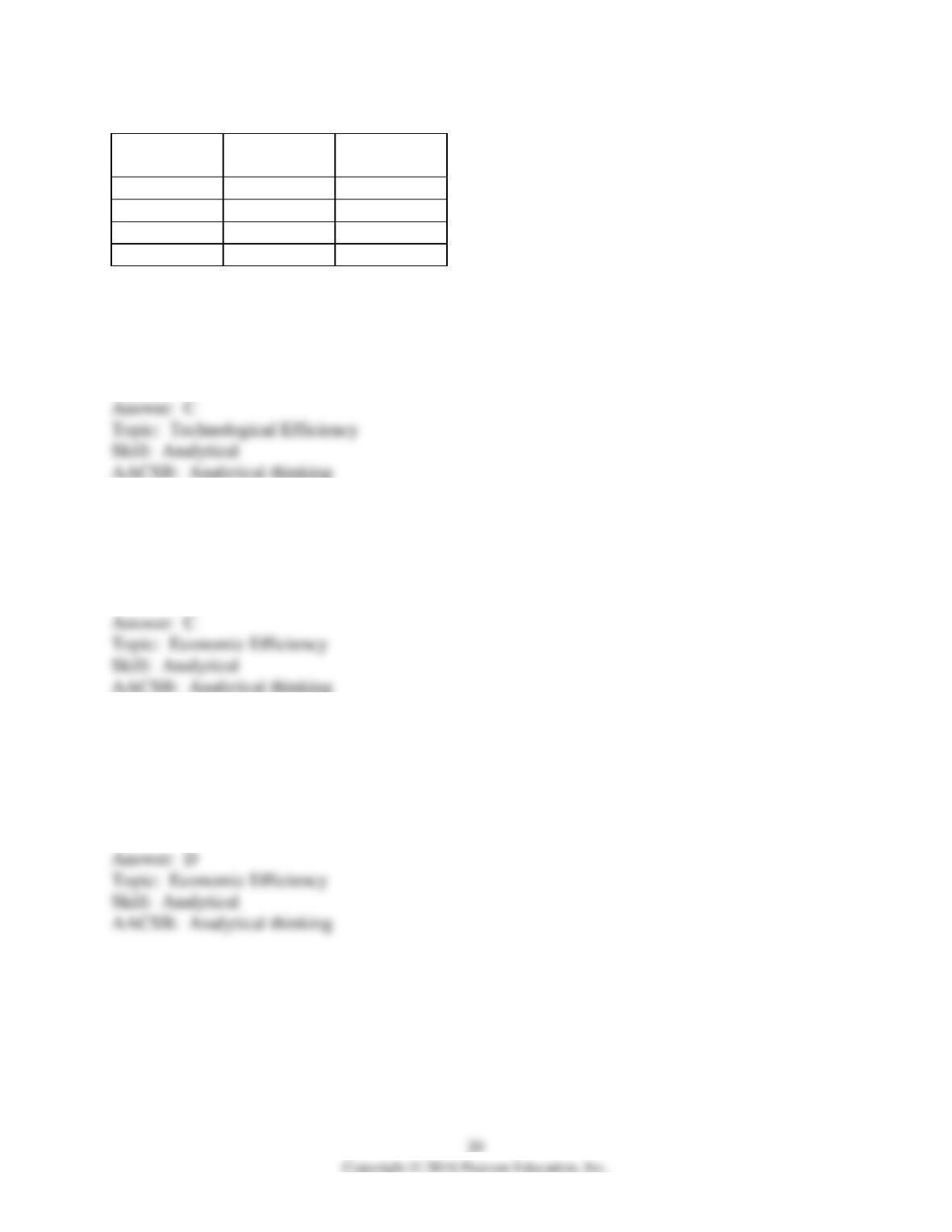
Techniques that produce 100 sweaters
Technique
Labor
(hours)
Capital
(machines)
A
10
35
B
25
25
C
10
60
D
30
20
21) In the above table, the technique that is not technologically efficient is
A) A.
B) B.
C) C.
D) D.
22) In the above table, the technique that is never economically efficient is
A) A.
B) B.
C) C.
D) D.
23) Using the data in the above table, if the price of an hour of labor is $10 and the price of a unit
of capital is $20, then the most economically efficient technique for producing 100 sweaters is
A) A.
B) B.
C) C.
D) D.