CHAPTER 10: Understanding Monopoly
MULTIPLE CHOICE
1. A monopoly
a. always makes a profit.
b. can force consumers to purchase what it is selling.
c. is characterized by a single seller who produces a well-defined product for which there are no
good substitutes.
d. always has naturally created barriers.
e. always has government-created barriers.
2. Monopolists
a. enjoy market power for their specific product.
b. have no market power for their specific product.
c. will never experience a loss.
d. always experience economies of scale.
e. exist in all markets.
3. Barriers to entry
a. measure the ability of firms to set the price for a good.
b. do not exist for monopolies.
c. always lead to profits.
d. restrict the entry of new firms into the market.
e. exist for perfectly competitive firms.
4. Two conditions allow a single seller to become a monopolist. Those two conditions are that the
firm must
a. have something unique to sell and it must be able to estimate its demand curve.
b. have something unique to sell and it must have a way to prevent potential competitors from
entering the market.
c. be able to estimate its demand curve and it must have a way to prevent potential competitors
from entering the market.
d. be able to segregate its consumers and it must have a way to prevent potential competitors
from entering the market.
e. have something unique to sell and it must be able to segregate its consumers.
5. Monopoly power is a measure of
a. a firm’s ability to set prices.
b. the uniqueness of a firm’s product.
c. the existence of close substitutes for a firm’s product.
d. a firm’s ability to overcome barriers to entry in its market.
e. a firm’s profitability.
6. In the movie Forrest Gump, the title character’s Bubba Gump Shrimp Company is able to gain
monopoly power in its market because of
a. control of an essential resource. d. economies of scale.
b. high barriers to entry. e. Forrest’s good luck.
c. a unique product.
7. Which of the following is NOT a necessary characteristic of monopolies?
a. Prices are set by the seller, not the consumer.
b. There is just one firm in the role of seller.
c. The market is for a unique product without close substitutes.
d. Government plays a role in maintaining barriers to entry.
e. The seller has a high level of market power.
8. The typical result of monopoly is ________ prices and ________ output than we find in a
competitive market.
a. lower; lower d. lower; higher
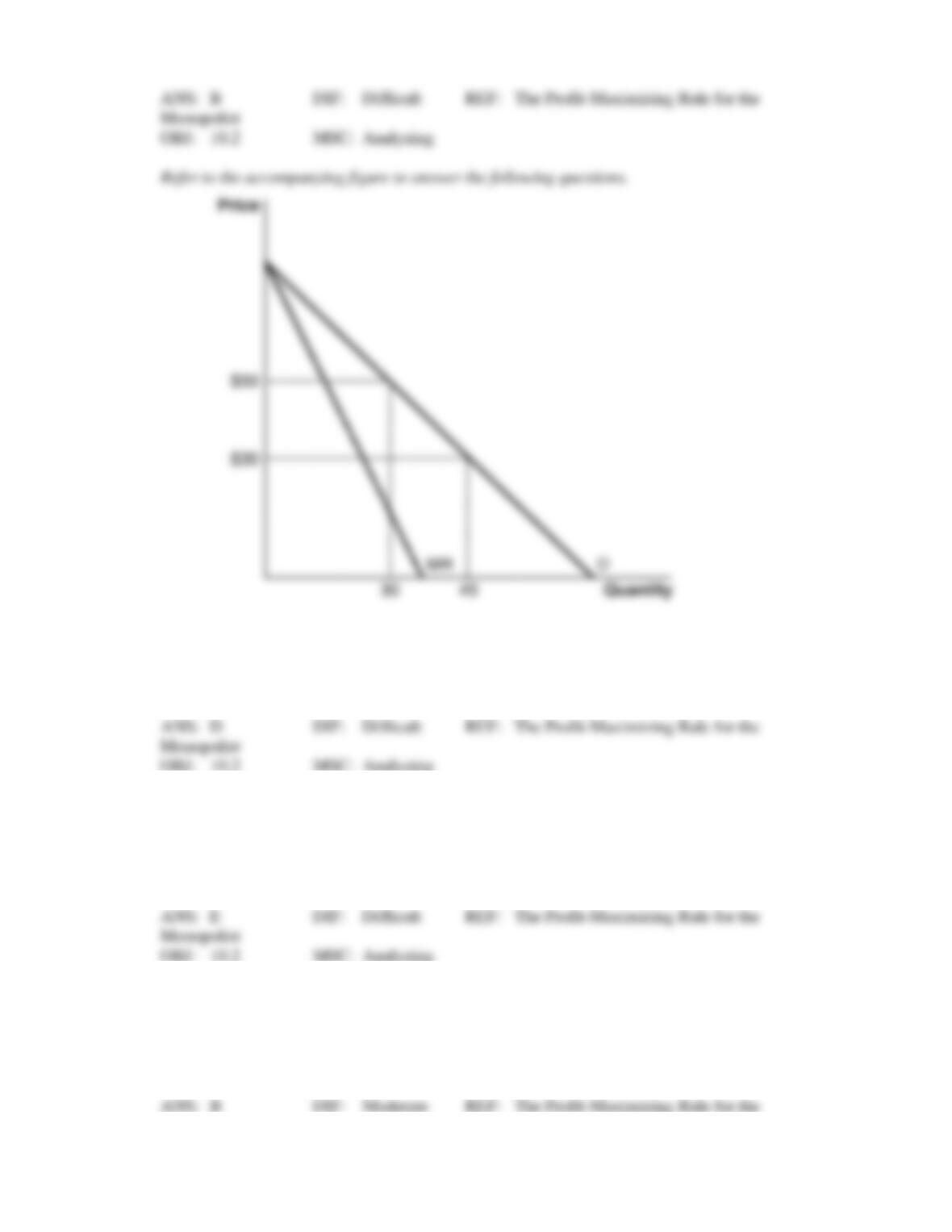
b. higher; higher e. higher; the same
c. higher; lower
9. Which of the following is NOT an example of a natural barrier to entry?
a. A software firm cannot get a loan to fund development of a new computer operating system.
b. A manufacturing firm has to buy a rare metal from the one company that controls most of the
worldwide supply.
c. A small soft-drink company struggles to produce its product as cheaply as its much larger
competitor can.
d. A single utility firm can deliver services to every home in an area more efficiently than a
cluster of competing firms could.
e. A patent gives a pharmaceutical firm the exclusive right to manufacture and sell an anticancer
drug.
10. Control of resources, problems raising capital, and economies of scale are all examples of
a. government-created barriers. d. price makers.
b. market structures. e. natural barriers.
c. patents and copyright laws.
11. Three natural barriers to entry are
a. control of resources, patents and copyright law, and licensing.
b. economies of scale, problems raising capital, and control of resources.
c. problems raising capital, patents and copyright law, and licensing.
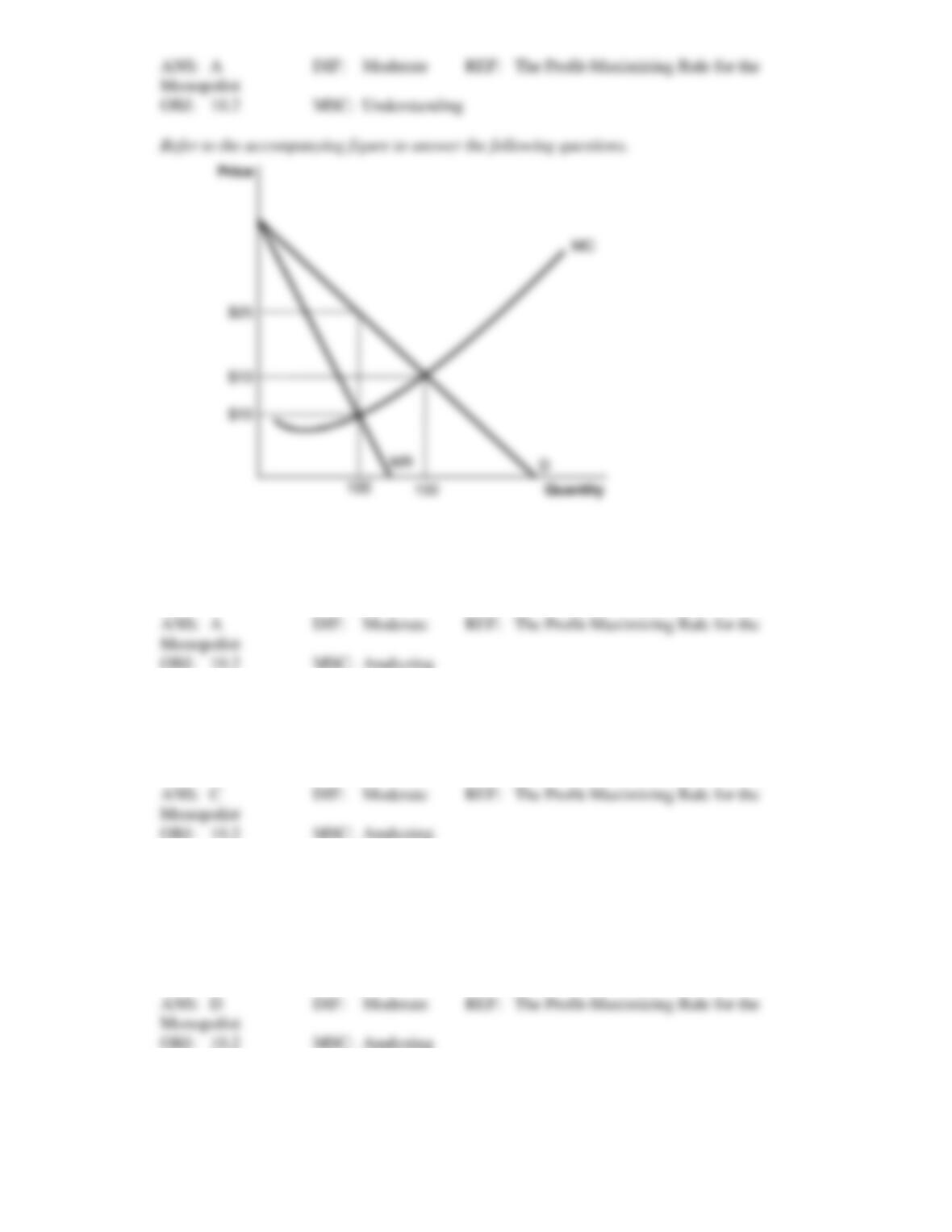
d. control of resources, patents and copyright law, and economies of scale.
e. control of resources, economies of scale, and licensing.
12. Control of resources is an example of
a. an externality. d. a natural barrier.
b. consumer surplus. e. rent seeking.
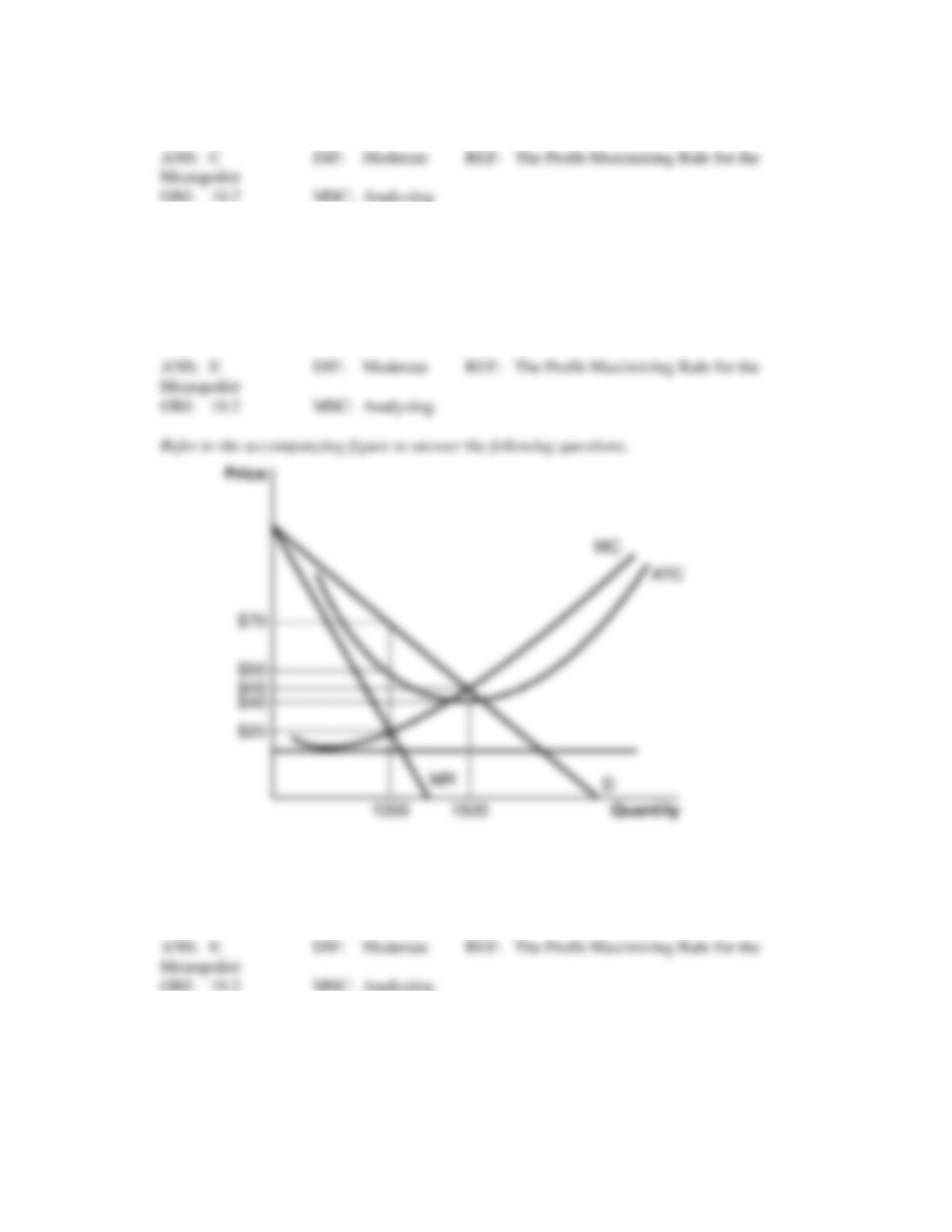
c. a government-created barrier.
13. The best way to limit competition is to
a. lobby for a government-created barrier.
b. charge a low price.
c. produce a high quantity.
d. control a resource that is essential in the production process.
e. minimize costs.
14. Ash is the preferred wood to be used in the production of baseball bats. If a company was to buy
the rights to harvesting the ash trees out of all the forests in North America, which of the following
barriers of entry has this company created?
a. control of resources d. licensing
b. problems raising capital e. patents and copyright law
c. economies of scale
15. Problems raising capital is an example of
a. a natural barrier. d. an externality.
b. consumer surplus. e. inefficient output and price.
c. a government-created barrier.
16. Raising capital to compete against an entrenched monopolist
a. is very easy.
b. is unnecessary.
c. can be done only through private investors.
d. is very difficult.
e. can be done only through banks.
17. Reginald has developed a new social media site that he feels can compete heavily with Facebook.
Unfortunately, he cannot find someone to lend him enough money to market his product to
consumers. Reginald is facing which kind of barrier to entry?
a. control of resources d. licensing
b. problems raising capital e. patents and copyright law
c. economies of scale
18. Economies of scale exist
a. only for monopolists.
b. when long-run average total costs increase.
c. when long-run average total costs decrease.
d. when long-run average total costs are constant.
e. when governments create barriers to entry.
19. Economies of scale is an example of
a. rent seeking. d. an externality.
b. consumer surplus. e. a natural barrier.
c. a government-created barrier.
20. A natural monopoly
a. exists when many sellers experience lower average total costs than potential competitors do.
b. exists when a firm has sole ownership of a natural resource.
c. is an example of a government-created barrier.
d. is needed to make a profit in the long run.
e. exists when a single seller experiences lower average total costs than any potential competitor.
21. In the soda industry, production costs per unit continue to fall as the firm expands. In this type of
industry, smaller rivals trying to enter the industry
a. will easily be able to gain market power.
b. have lower average costs.
c. do not have high fixed costs.
d. will have much higher average costs.
e. experience a government-created barrier.
22. Two government-created barriers to entry are
a. licensing and economies of scale.
b. economies of scale and patent system/copyright law.
c. licensing and patent system/copyright law.
d. economies of scale and control of resources.
e. licensing and control of resources.
23. Market-created and government-created barriers
a. are the same thing.
b. are regarded by all economists as bad.
c. increase competition in markets.
d. create monopolies.
e. are problems solved only by government intervention.
24. Licensing
a. is a natural barrier.
b. creates more competition.
c. causes more varieties of goods and services at different price levels.
d. creates an opportunity for corruption.
e. always results in zero economic profits.
25. In instances when having a single firm in the market makes sense, governments ________ to
minimize negative externalities.
a. will grant a patent or copyright d. hand out subsidies
b. require licenses e. break down barriers to entry
c. deregulate industries
26. What is the usual rationale for governments to issue monopoly-promoting licenses to firms
providing services such as trash collection?
a. lower risk for investors in the firms d. economies of scale
b. increased customer choice e. public safety
c. better-quality services
27. Apple and Google apply for hundreds of patents every year. These patents
a. allow Apple and Google to produce goods with no risk of monetary loss.
b. provide incentives for Apple and Google to spend large amounts of money up front on
research and development of new products.
c. create more competition among Apple, Google, and other tech firms than would occur without
government intervention.
d. make it easy for Apple and Google products to be similar.
e. make it easy for other firms to compete with Apple and Google.
28. Patents and copyright law
a. are natural barriers.
b. create more competition.
c. mean more varieties of goods and services at different price levels.
d. assure inventors that no one else will sell their ideas.
e. always result in zero economic profits.
29. Patents and copyrights can
a. create strong incentives to develop new medicines.
b. provide heavy competition in markets.
c. never lead to deadweight loss.
d. assure firms that their products will make a profit.
e. be considered natural barriers.
30. After a patent on a product expires,
a. other firms must wait to mimic the product.
b. all negative and positive externalities are internalized.
c. rivals can start to mimic the product.
d. no other firms can mimic the product.
e. no further profits are able to be made by the original producer of the good.
31. One argument against patent and copyright laws is that they
a. provide incentives to invest in research and development.
b. protect intellectual property.
c. hinder creativity.
d. increase competition.
e. limit exposure that can benefit companies and individuals.
32. Why do governments issue patents?
a. Patents foster economies of scale.
b. Inventors have a moral right to control their inventions.
c. Patents ensure that socially beneficial goods are affordable.
d. Firms benefit from the publicity associated with patents.
e. The prospect of large profits is an incentive to innovation.
33. Why do copyrights expire after a set period of time?
a. so that creative industries will operate as efficiently as possible
b. to provide an incentive for artists and other creators of original work
c. to ensure that creative activity gets the publicity it deserves
d. so that in the long run, creative works are readily and cheaply available
e. to help writers and musicians become price makers
34. Both monopolies and competitive firms
a. are price takers. d. make long-run economic profits.
b. are price makers. e. try to maximize profits.
c. face barriers to entry.
35. A price maker
a. is a characteristic held by a perfectly competitive firm.
b. must set the price at the market price.
c. has some control over the price it charges.
d. can sell its product at any price.
e. will always make economic profits.
36. The price effect refers to how
a. lower prices affect the quantity sold. d. lower prices affect revenue.
b. firms can set their prices. e. lower output affects the price.
c. firms choose their quantities.
37. The output effect refers to how
a. lower prices affect the quantity sold. d. lower prices affect revenue.
b. firms can set their prices. e. lower output affects the price.
c. firms choose their quantities.
38. The profit-maximizing rule for a monopolist is
a. marginal revenue = marginal cost.
b. price = marginal cost.
c. price = marginal revenue.
d. average total cost = marginal revenue.
e. average total cost = marginal cost.
39. Which of the following can fall below the x axis when graphing price and cost against quantity?
a. demand curve d. fixed cost curve
b. marginal cost curve e. marginal revenue curve
c. total cost curve
40. The demand curve for the product of a firm in a competitive market is ________, and the demand
curve for the product of a monopolist is ________.
a. horizontal; downward sloping
b. horizontal; horizontal
c. downward sloping; upward sloping
d. downward sloping; horizontal
e. upward sloping; downward sloping
41. The demand curve for the product of a firm in a competitive market is ________, and the demand
curve for the product of a monopolist is ________.
a. perfectly inelastic; downward sloping
b. horizontal; perfectly inelastic
c. downward sloping; perfectly elastic
d. downward sloping; horizontal
e. perfectly elastic; downward sloping
42. Because the demand curve for a monopolist is downward sloping,
a. there is no limit on the monopolist’s ability to make a profit.
b. the monopolist can sell its product at any price it wants.
c. the monopolist can sell as many units of its product as it wants.
d. the monopolist is a price taker.
e. the monopolist is a price maker.
43. The marginal revenue lies ________ the demand curve because there is a(n) ________ effect
whenever the price is lowered.
a. above; price d. above; output
b. below; price e. on; price
c. below; output
44. When marginal revenue is negative, the
a. lost revenues associated with the price effect outweigh the revenue gains created by the output
effect.
b. lost revenues associated with the price effect are outweighed by the revenue gains created by
the output effect.
c. output effect is negative.
d. firm is maximizing revenues.
e. firm cannot be maximizing profits.
45. At high price levels, demand tends to be ________ and the price effect is ________, relative to the
output effect.
a. inelastic; small d. elastic; large
b. inelastic; large e. inelastic; insignificant
c. elastic; small
46. At low price levels, demand tends to be ________ and the price effect is ________, relative to the
output effect.
a. inelastic; small d. elastic; large
b. inelastic; large e. elastic; insignificant
c. elastic; small
47. Clarice’s Campground is the only campground located in Abilene, Texas. Clarice’s Campground’s
demand curve is
a. perfectly elastic. d. the market demand curve.
b. perfectly inelastic. e. upward sloping.
c. horizontal.
48. If a monopolist is producing a quantity where marginal revenue is equal to $32 and the marginal
cost is equal to $30, the monopolist should ________ to maximize profits.
a. increase production and lower the price
b. decrease production and increase the price
c. continue producing at the current price
d. increase production and increase the price
e. decrease production and decrease the price
49. If a monopolist is producing a quantity where marginal revenue is equal to $16 and the marginal
cost is equal to $17, the monopolist should ________ to maximize profits.
a. increase production and lower the price
b. decrease production and increase the price
c. continue producing at the current price
d. increase production and increase the price
e. decrease production and decrease the price
50. If a monopolist is producing a quantity where marginal revenue is equal to $125 and the marginal
cost is equal to $125, the monopolist should ________ to maximize profits.
a. increase production and lower the price
b. decrease production and increase the price
c. continue producing at the current price
d. increase production and increase the price
e. decrease production and decrease the price
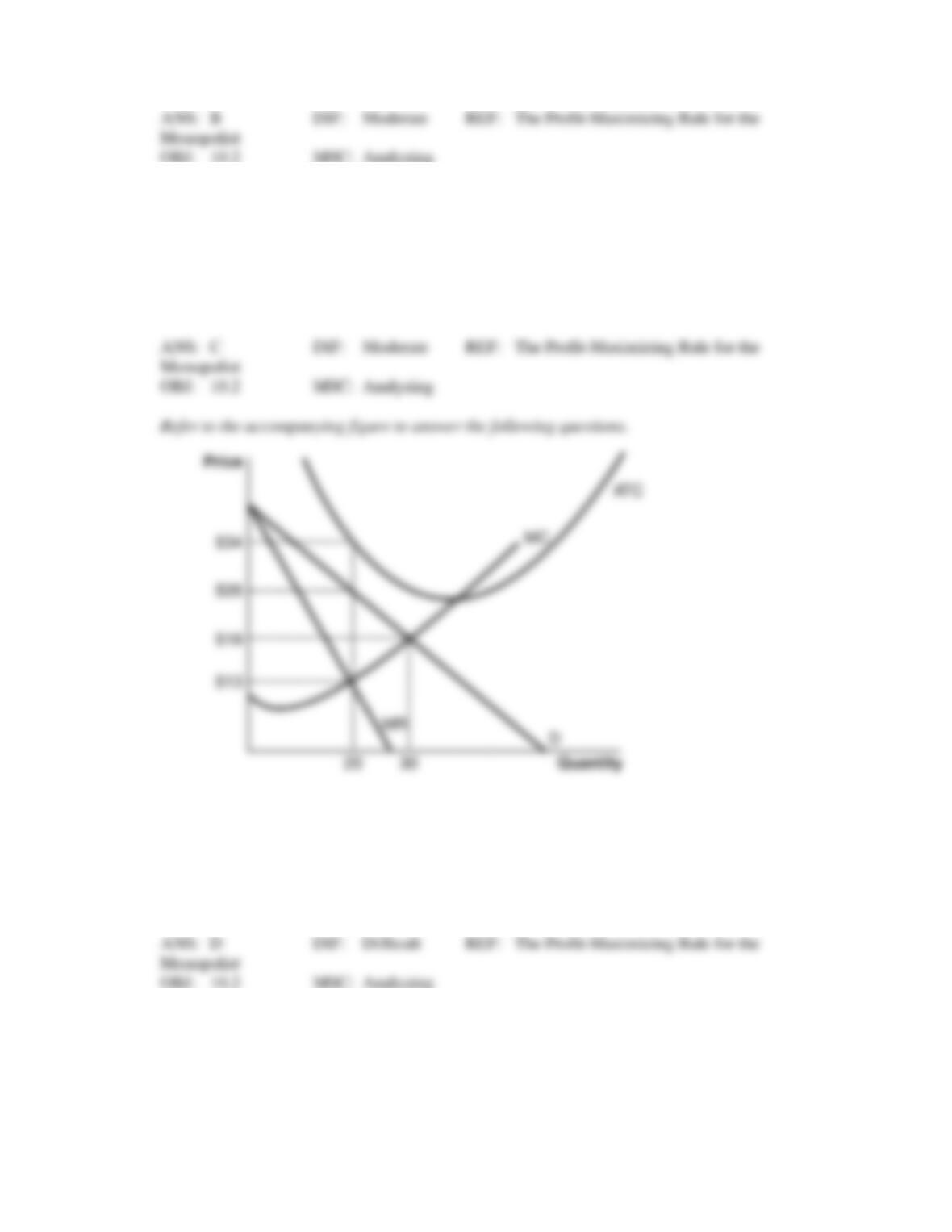
51. This firm
a. is in a competitive market.
b. can make a profit.
c. does not want to maximize profit.
d. cannot make a profit.
e. is not a monopolist because it is incurring a loss.
52. This profit-maximizing firm’s total profit is equal to
a. $160. d. −$320.
b. −$160. e. $100.
c. $320.
53. The profit-maximizing price and quantity are ________, respectively.
a. $34 and 20 d. $18 and 30
b. $26 and 20 e. $13 and 20
c. $18 and 20
54. The demand curve for Arnold’s Airport Shuttle is downward sloping. With only this information,
it can be concluded that Arnold’s Airport Shuttle
a. is the only firm in the market for airport shuttles.
b. is currently maximizing profits.
c. is a price maker.
d. makes economic profits.
e. should produce where the demand curve crosses marginal cost.
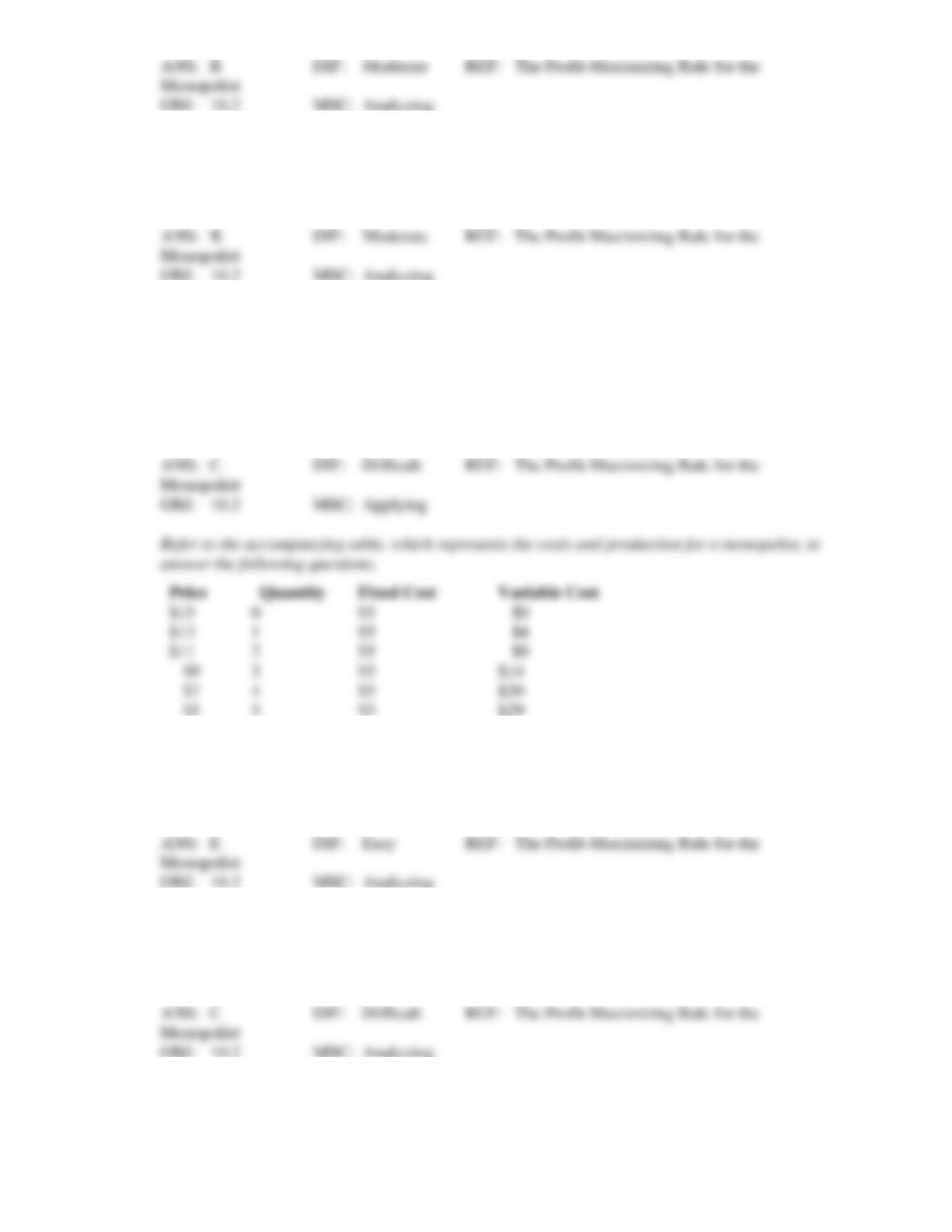
55. As production increases, the price consumers pay for the good
a. increases and then decreases. d. increases.
b. decreases and then increases. e. decreases.
c. stays the same.
56. The profit-maximizing quantity for this firm is
a. zero. d. four.
b. one. e. five.
c. three.
57. The profit-maximizing price for this firm is
a. $15. d. $9.
b. $5. e. $13.
c. $7.
58. The profit made by this profit-maximizing firm is
a. $8. d. $7.
b. $4. e. $9.
c. $3.
59. The equation of a firm’s marginal revenue curve is estimated to be price = 50 − Q (quantity), and
the equation of its marginal cost curve is estimated to be price = 10 + 3Q. The profit-maximizing
quantity for this firm is
a. 5. d. 50.
b. 10. e. 40.
c. 15.
60. When a monopolist lowers its price from $80 to $70, the quantity it is able to sell increases from
100 to 150. The change in revenue associated with the output effect is equal to
a. $3,500. d. −$500.
b. −$3,500. e. $4,000.
c. $500.
61. When a monopolist lowers a price from $80 to $70, the quantity that the firm is able to sell
increases from 100 to 150. The change in revenue associated with the price effect is equal to
a. $3,500. d. −$1,000.
b. −$3,500. e. $4,000.
c. $1,000.
62. When marginal revenue is positive, the
a. lost revenues associated with the price effect outweigh the revenue gains created by the output
effect.
b. lost revenues associated with the price effect are outweighed by the revenue gains created by
the output effect.
c. output effect is relatively small compared to the price effect.
d. firm is maximizing revenues.
e. firm cannot be maximizing profits.
63. When the price changes from $50 to $30, the price effect leads to a loss of ________ in revenue.
a. $20 d. $600
b. $15 e. $450
c. $900
64. When the price changes from $50 to $30, the output effect leads to an increase of ________ in
revenue.
a. $20 d. $600
b. $15 e. $450
c. $900
65. At the profit-maximizing output in a monopoly controlled market, the price a monopolist charges
is ________ cost.
a. below marginal d. below average total
b. above marginal e. equal to marginal
c. above average total
66. The equation of a firm’s marginal revenue curve is estimated to be P = 50 − Q (quantity), and the
equation of its marginal cost curve is estimated to be P = 10 + 3Q. The profit-maximizing price for
this firm is
a. $5. d. $50.
b. $10. e. $40.
c. $15.
67. Which of the following is a characteristic of a monopoly but not a characteristic of a competitive
market?
a. A monopoly contains many firms.
b. A monopoly produces an efficient level of output.
c. A producer in a monopoly may earn long-run economic profits.
d. A producer in a monopoly has no market power.
e. A producer in a monopoly is a price taker.
68. To maximize profits, a monopolist chooses the quantity where
a. revenues are maximized.
b. marginal revenue equals zero.
c. marginal cost equals zero.
d. marginal revenue equals marginal cost.
e. costs are minimized.
69. Which of the following is a characteristic of a monopoly but not of a competitive market?
a. A monopoly contains many firms.
b. price marginal cost
c. price marginal cost
d. price = marginal cost
e. A firm in a monopoly is a price taker.
70. A big difference between a competitive firm and a monopolist is that a monopolist
a. does not charge a price equal to marginal revenue.
b. does not set marginal revenue equal to marginal cost to maximize profits.
c. does not try to maximize profits.
d. can always make positive economic profits.
e. cannot set its price at the market price.
71. The profit-maximizing price and quantity are ________, respectively.
a. $25 and 100 d. $10 and 100
b. $25 and 150 e. $10 and 150
c. $13 and 100
72. When this firm is producing at the profit-maximizing price and quantity, its total revenue is
a. $1,000. d. $3,750.
b. $1,950. e. $5,000.
c. $2,500.
73. If a firm is producing a quantity of 150 and charging a price of $13, it
a. should continue to produce 150 units but lower the price to $10 to maximize profits.
b. should continue to produce 150 units but raise the price to $25 to maximize profits.
c. should lower production to 100 units but keep charging $13 to maximize profits.
d. should lower production to 100 units and raise the price to $25 to maximize profits.
e. is already maximizing profits and should not change the price or quantity produced.
74. If a firm is producing a quantity of 100 and charging a price of $10, it
a. should continue to produce 100 units but raise the price to $13 to maximize profits.
b. should increase production to 150 units but raise the price to $25 to maximize profits.
c. should continue to produce 100 units but raise the price to $25 to maximize profits.
d. should increase production to 100 units and raise the price to $13 to maximize profits.
e. is already maximizing profits and should not change the price or quantity produced.
75. If a firm is producing a quantity of 100 and charging a price of $25, it
a. should raise production to 150 units but lower the price to $10 to maximize profits.
b. should raise production to 150 units and continue to charge $25 to maximize profits.
c. should keep production at 100 units but lower the price to $13 to maximize profits.
d. should keep production at 100 units and lower the price to $10 to maximize profits.
e. is already maximizing profits and should not change the price or quantity produced.
76. The profit-maximizing price and quantity are ________, respectively.
a. $25 and 1,000 d. $50 and 1,000
b. $40 and 1,500 e. $70 and 1,000
c. $45 and 1,500
77. The total revenue when a firm is profit maximizing is
a. $70,000. d. $60,000.
b. $50,000. e. $25,000.
c. $67,500.
78. The total cost when a firm is profit maximizing is
a. $70,000. d. $60,000.
b. $50,000. e. $25,000.
c. $67,500.
79. The profit when a firm is profit maximizing is
a. $70,000. d. $20,000.
b. $50,000. e. $25,000.
c. $20,500.
80. When marginal revenue intersects marginal cost on a graph,
a. profits are maximized for a monopolist but not for a competitive firm.
b. profits are maximized for a competitive firm but not for a monopolist.
c. a monopolist prices the good at that point.
d. a monopolist always makes an economic profit.
e. a monopolist must go up to the demand curve to find the price.
81. What will happen if the firm offers its product at a price slightly above price PC?
a. The marginal revenue will drop below zero.
b. The firm will slightly increase its profits.
c. The sales volume will plummet to essentially zero.
d. The firm will run into high barriers to exit from the market.
e. The number of units sold will slightly increase.
82. What will happen if the firm offers its product at a price slightly below price PC?
a. The sales volume will plummet to essentially zero.
b. The number of units sold will slightly decrease.
c. The average total cost will slightly increase.
d. The firm will run into high barriers to exit from the market.
e. The firm will lose money on each unit sold.
83. A monopolist’s marginal revenue
a. is constant with respect to the quantity produced.
b. increases with the quantity produced.
c. decreases with the quantity produced.
d. is unrelated to the quantity produced.
e. is inversely proportional to the quantity produced.
84. Which of the following is characteristic of a firm in a competitive market?
a. It cannot earn long-run economic profits.
b. It cannot control its costs.
c. It does not operate at a socially efficient output level.
d. It cannot control output quantity.
e. It can set the price at which its product sells.
85. Under what circumstances will a manufacturing firm facing foreign competition generally lobby
for trade barriers rather than improve its production and delivery processes?
a. when the foreign goods are more expensive than the firm’s
b. when no improvement is possible
c. when the foreign goods are of inferior quality
d. when lobbying is cheaper
e. when rent seeking is illegal
86. The monopolist’s preferred production level, for maximum profit, is determined by the intersection
of which two curves?
a. demand and marginal cost
b. demand and marginal revenue
c. marginal revenue and marginal cost
d. marginal cost and average total cost
e. demand and average total cost
87. For movement along the demand curve, from an old position to a new one, the price effect is
quantifiable as
a. the old quantity times the change in price.
b. the new price times the change in quantity.
c. the new quantity divided by the change in price.
d. the old price times the change in quantity.
e. the old price times the new quantity.
88. For movement along the demand curve, from an old position to a new one, the output effect is
quantified as
a. the old quantity times the change in price.
b. the new price times the change in quantity.
c. the old price divided by the change in quantity.
d. the new quantity times the change in price.
e. the new price times the old quantity.
89. The high-speed Internet access technology that raises the greatest concerns about monopoly
control of infrastructure is
a. satellite broadband. d. mobile broadband.
b. fiber optic cable. e. dial-up.
c. DSL.
90. Market failure occurs
a. when the output level of the firm is efficient.
b. when the output level of the firm is inefficient.
c. when firms do not maximize profits.
d. only in the presence of a monopoly.
e. only in the presence of externalities.
91. Inefficient output and price, few choices for consumers, and rent seeking are all problems
associated with
a. externalities. d. scarcity.
b. competitive markets. e. trade.
c. monopolies.
92. Monopoly leads to an inefficient level of the production of goods. This means that
a. the total social benefit is not as high as it could be.
b. the monopolist’s production costs are higher than necessary.
c. government tax collected from the monopolist is less than it might be.
d. externalities are not as large as they should be.
e. fewer people are employed than might be.
93. When several goods or services are sold together as a single take-it-or-leave-it package, that
package is called a(n)
a. bundle. d. fusion.
b. grouping. e. aggregate.
c. cluster.
94. When a cable TV provider offers, say, ESPN and the Weather Channel together but not separately,
the reason is that
a. there is no demand for either one without the other.