
Microeconomics: Theory and Applications with Calculus, 3e (Perloff)
Chapter 10 General Equilibrium and Economic Welfare
10.1 General Equilibrium
1) General-equilibrium analysis is the study of
A) how an equilibrium is determined in all markets simultaneously.
B) how an equilibrium is determined in all closely related markets.
C) the effects of a change in a market, and all spillover effects in all related markets.
D) All of the above.
2) As opposed to general-equilibrium analysis, partial equilibrium analysis looks
A) at an equilibrium and changes to it in a single, isolated market.
B) at how changes in one market effect other markets.
C) at how equilibrium is determined in all markets simultaneously.
D) at either price or quantity movements.
3) A general-equilibrium analysis of a price change in the corn chip market would include an
investigation of the impacts in
A) the television market.
B) the coffee market.
C) the salsa market.
D) All of the above.
4) A general-equilibrium analysis of the impact of a tax on the peanut butter market would include an
investigation of the impacts in
A) the television market.
B) the coffee market.
C) the salsa market.
D) the jelly market.

5) The general-equilibrium analysis of a minimum wage applied to only some sectors of the economy
suggests that
A) workers in all sectors will face increased wages.
B) some workers in the covered sectors will lose their jobs and remain unemployed.
C) some workers originally employed in the covered sectors will move to the uncovered sectors, driving
down wages in the uncovered sectors.
D) all workers will be worse off.
6) When the U.S. minimum wage was first passed in 1938, only 56% of workers were employed in
covered firms. The incomplete coverage suggests that
A) the partial equilibrium ignores the movement of workers from uncovered sectors to covered sectors.
B) the decrease in employment is higher in general-equilibrium analysis.
C) the general-equilibrium analysis suggests the wage in uncovered sectors will fall.
D) all the workers will be worse off in both general- and partial-equilibrium analysis.
7) When comparing partial-equilibrium effects to general-equilibrium effects, one can conclude that
A) general-equilibrium effects are always larger.
B) partial-equilibrium effects are always larger.
C) the effects are of equal size.
D) one cannot determine before the fact which effect is greater.
For the following, please answer “True” or “False” and explain why.
8) The effects of a price change are always understated by a partial-equilibrium analysis when compared
to a general-equilibrium analysis.
9) Employing a general-equilibrium approach, describe the effect of a new law that prohibits steel
imports.
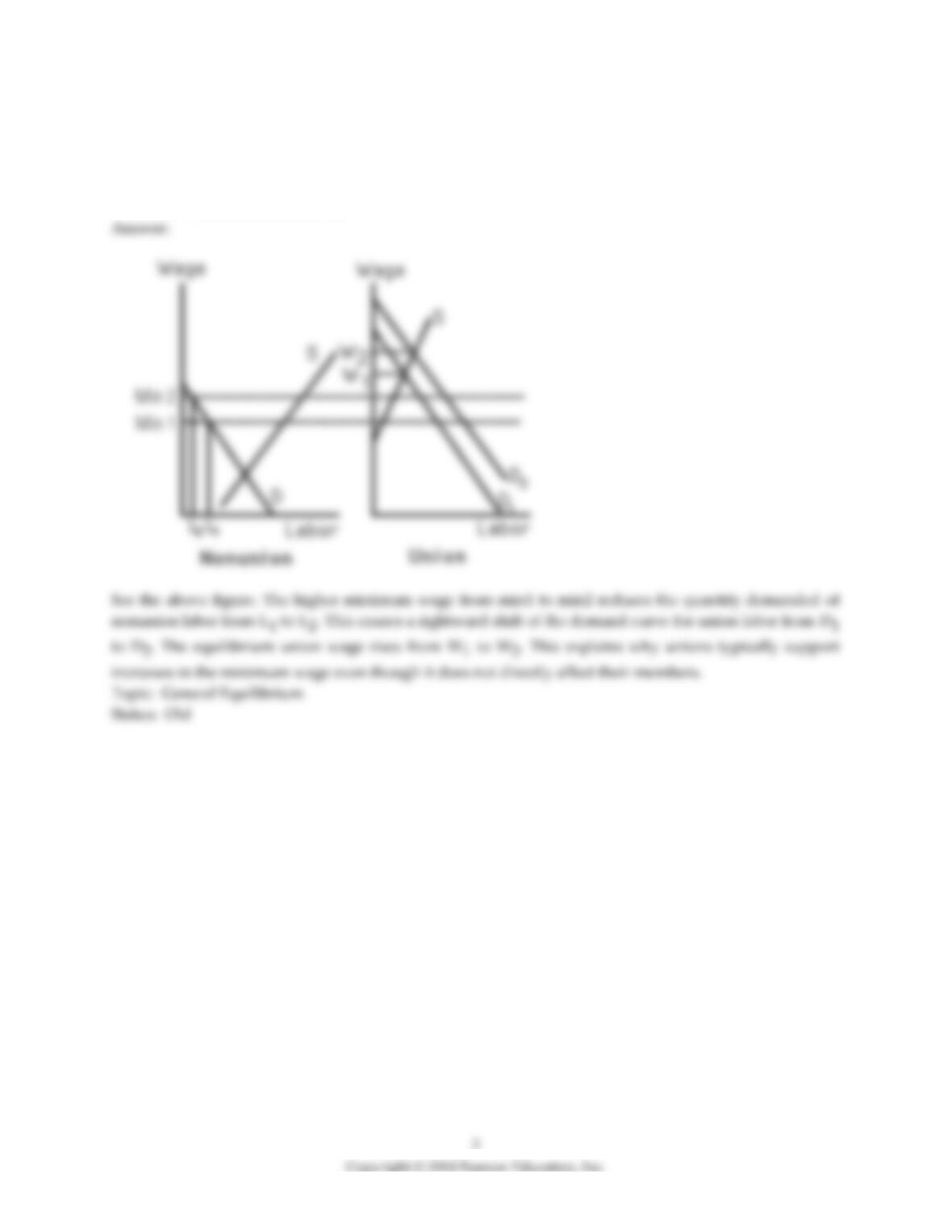
10) Suppose that the minimum wage covers all sectors of the economy; however, for unionized laborers,
the minimum wage is ineffective. That is, the union wage is already above the minimum wage. Analyze
the impact of an increase in the minimum wage on both the unionized and non-unionized labor markets.
(Assume that the higher minimum wage is still ineffective in the unionized sector and that union and
nonunion labor are substitutable.)
11) Suppose there are only two goods – Food (F) and Shelter (S). The demand equations for these two
goods depend on their prices, pF and pS as follows:
DF (pF, pS) = 10 – 2pF – pS
DS (pF, pS) = 10 – pF – 2pS
The supply curves depend only on their own prices:
SF (pF) = pF
SS (pS) = 5pS
Determine the equilibrium price and quantity of these goods.
10.2 Trading Between Two People
1) Joe and Rita each have some cookies and milk. Joe is willing to trade 2 cookies for an additional ounce
of milk. Rita is willing to trade four cookies for an additional ounce of milk. If trading is possible, which
of the following is most likely to occur?
A) Joe will give some milk to Rita in exchange for cookies.
B) Rita will give some milk to Joe in exchange for cookies.
C) No trade will take place since they both prefer to have more milk and fewer cookies.
D) There is not enough information to make any predictions.
2) Joe and Rita each have some milk and cookies (Milk on the horizontal axis). Joe’s MRS of cookies for
milk is two. Rita’s MRS of cookies for milk is four. Which of the following statements is TRUE?
A) No gains from trade are possible.
B) Both Rita and Joe can be made better off if Rita gives Joe some cookies in exchange for milk.
C) Rita and Joe are on the contract curve.
D) Both Rita and Joe can be made better off if Joe gives Rita some cookies in exchange for milk.
3) Gains from trade can only occur when
A) marginal rates of substitutions differ across people.
B) marginal rates of substitution are equal across people.
C) indifference curves are convex.
D) people find themselves on the contract curve.
4) Moving away from the contract curve will
A) harm both parties.
B) harm only one of the parties.
C) harm at least one of the parties.
D) harm neither of the parties.
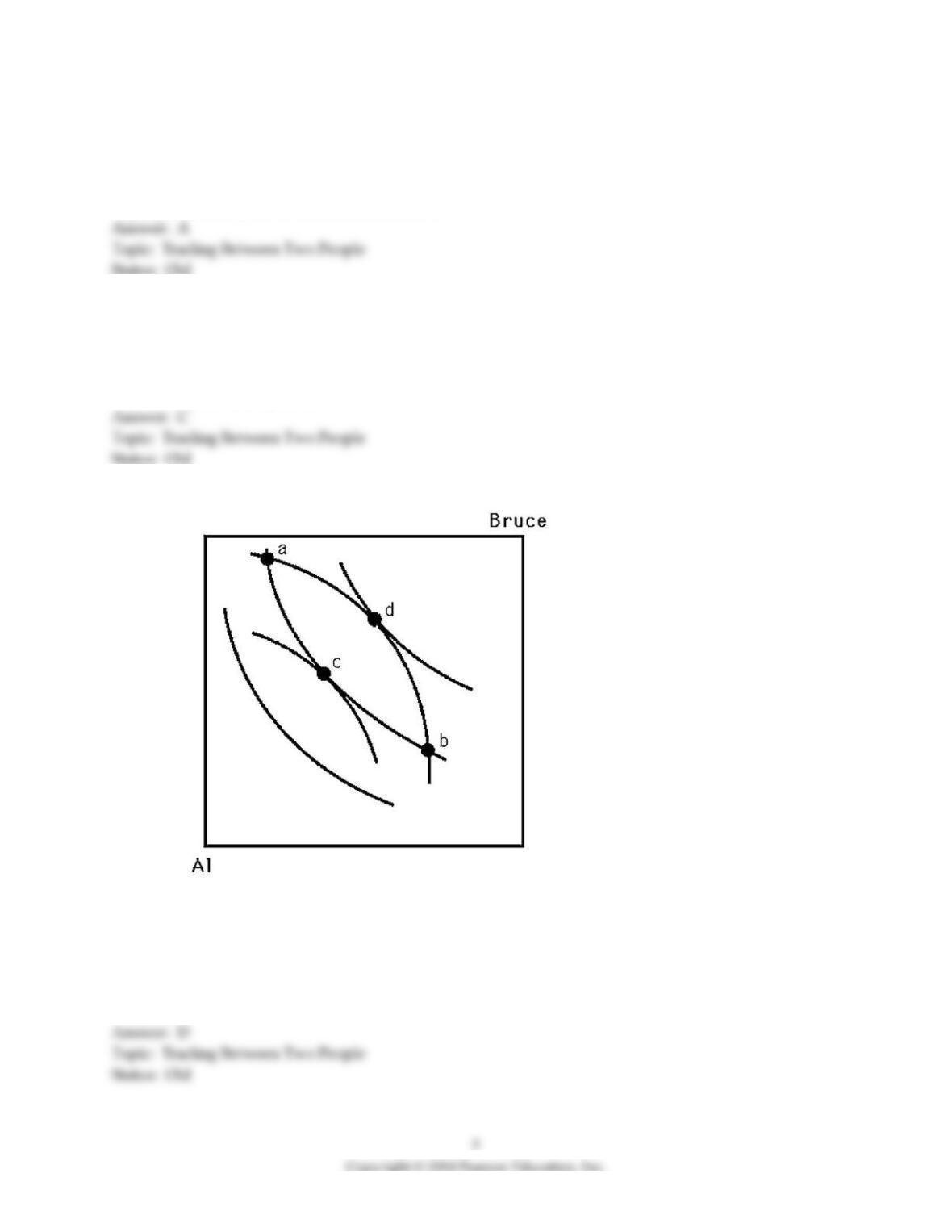
5) The above figure depicts the Edgeworth box for two individuals, Al and Bruce. The contract curve can
be found by connecting points
A) a and b.
B) a and c.
C) b and d.
D) c and d.
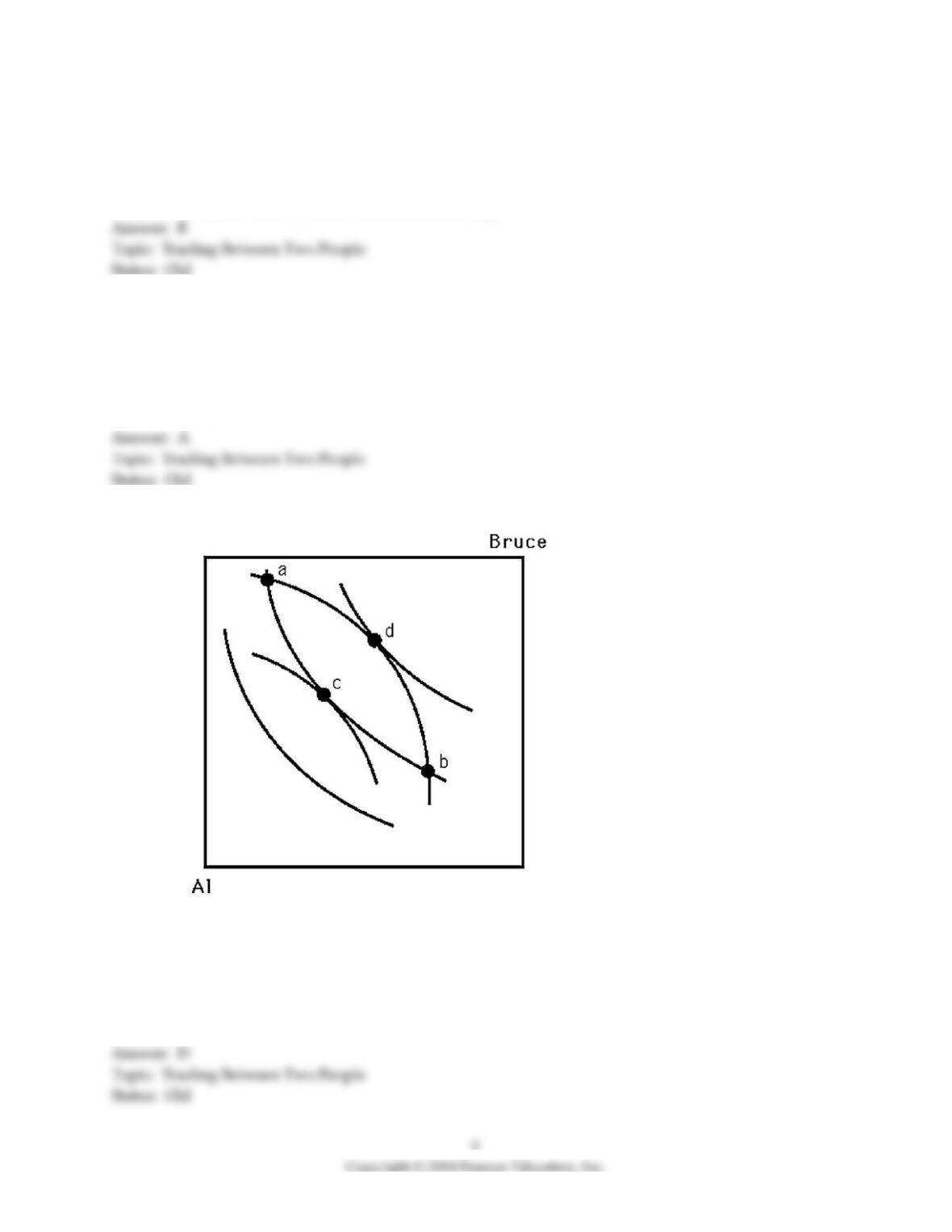
6) The above figure depicts the Edgeworth box for two individuals, Al and Bruce. Points a and b
A) are most likely to reflect the final endowments after trading.
B) are least likely to reflect the final endowments after trading.
C) are equally likely to reflect the final endowments after trading than other points on the contract curve.
D) are definitely not the final endowments after trading.
7) If only two people are trading their endowments and no production is possible, then the equilibrium
they reach will
A) be on their contract curve.
B) result in unequal marginal rates of substitution for the two people.
C) result in one person being worse off than with his or her endowment.
D) All of the above.
8) The above figure depicts the Edgeworth box for two individuals, Al and Bruce. If the endowment is at
point a and trade is possible, which of the following points are possible equilibria?
A) a and b
B) a and c
C) b and d
D) c and d

9) The above figure depicts the Edgeworth box for two individuals, Al and Bruce. Considering only the
labeled points, point c is a possible equilibrium
A) only if it is the endowment.
B) only if point a is the endowment.
C) if either point a or b is the endowment.
D) only if point d is the endowment.
10) The above figure depicts the Edgeworth box for two individuals, Al and Bruce. If the endowment is at
point a, and Al has no ability to bargain, the final allocation will be at point
A) a.
B) b.
C) c.
D) d.
11) The above figure depicts the Edgeworth box for two individuals, Al and Bruce. If the endowment is at
point a, and Bruce has no ability to bargain, the final allocation will be at point
A) a.
B) b.
C) c.
D) d.
12) The above figure depicts the Edgeworth box for two individuals, Al and Bruce. Point a is NOT Pareto
efficient because
A) Al’s MRS exceeds Bruce’s MRS.
B) the point is not near the center of the box.
C) Al’s indifference curve is not far enough away from the origin.
D) All of the above.

13) The above figure depicts the Edgeworth Box for two individuals, Al and Bruce. Point c is Pareto
efficient because
A) the MRS’s are equal.
B) the indifference curves are tangent.
C) no mutual gains from trade exist.
D) All of the above.
14) When considering trade of two goods between two people, if one person has all the endowment of
both goods this allocation
A) is never on a contract curve.
B) will result in trade so each person has all of one good.
C) will result in trade to a equal division of goods between the two people.
D) is Pareto efficient.
15) When two people are on the contract curve, the allocation of goods
A) cannot be improved.
B) is pareto efficient.
C) is such that neither individual can be made better off without making the other worse off.
D) All of the above.
16) Gains from trade will be possible as long as
A) people have different endowments.
B) people place different values on some goods.
C) marginal rates of substitution are equal across individuals.
D) excess supply equals excess demand.
17) Gains from trade will be possible as long as
A) levels of utility differ.
B) utility functions differ.
C) marginal rates of substitution differ.
D) endowments differ.

18) The assumptions about tastes and behavior to model the trading between two people do NOT include
A) utility maximization.
B) convex indifference curves.
C) nonsatiation.
D) interdependence.
For the following, please answer “True” or “False” and explain why.
19) Any point on the contract curve is Pareto efficient regardless of the initial endowment.
20) If two grade-school children willingly trade their lunches with one another, we can conclude that at
least one of them preferred the other’s lunch to his own.
21) When two people trade their initial endowments to a point on the contract curve, only the level of the
endowments will determine the new allocation.
22) Explain why having different marginal rates of substitution is necessary for trade to occur.
23) Consider a society consisting of just a farmer and a tailor. The farmer has 10 units of food but no
clothing. The tailor has 20 units of clothing but no food. Suppose each has the utility function U = F ∗ C.
Derive the contract curve.
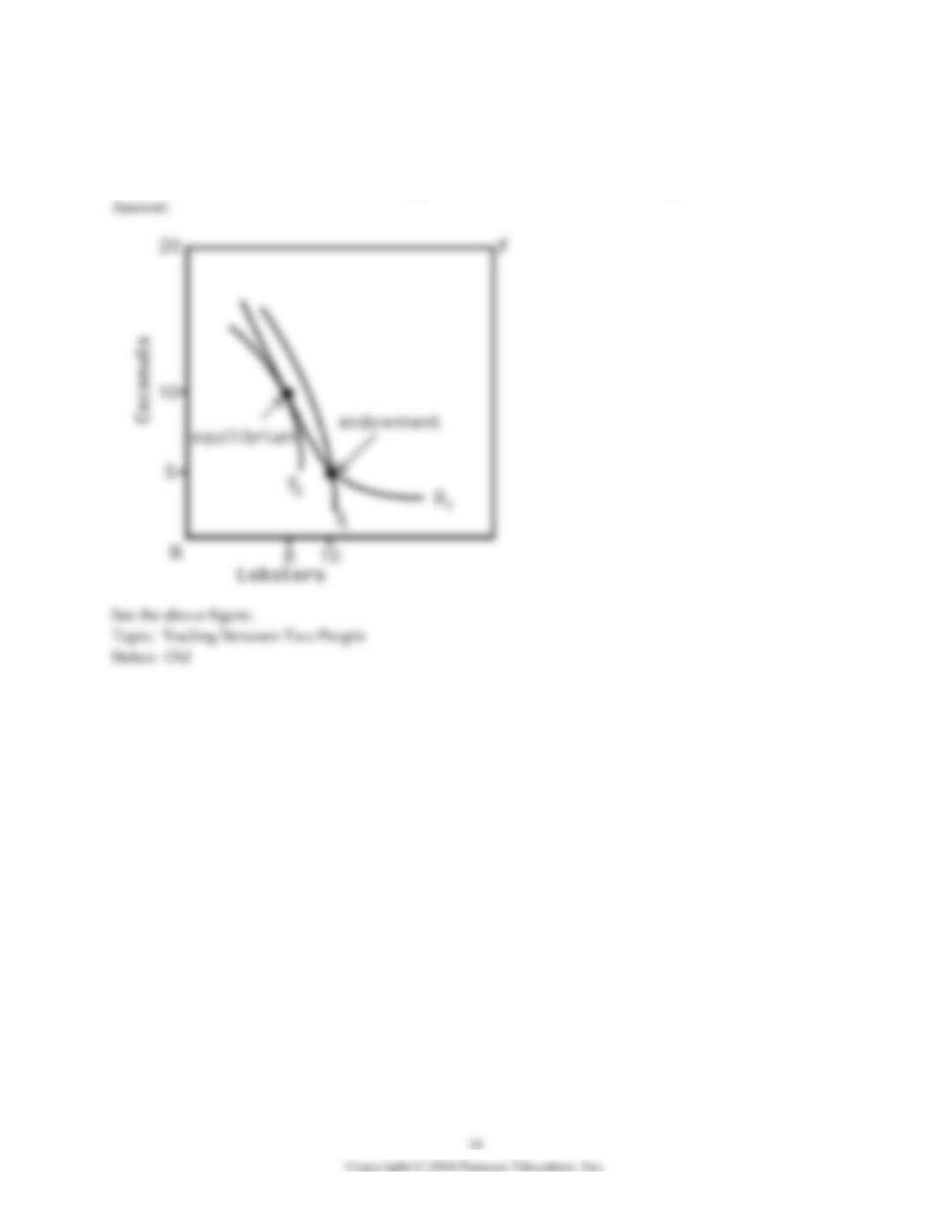
24) Robinson starts out with 10 lobsters and five coconuts. Friday starts out with 10 lobsters and 15
coconuts. After trading, Robinson ends up with eight lobsters and 10 coconuts. Robinson feels neither
better nor worse off than when he started but cannot get Friday to agree to any more trades. Friday feels
better off than when he started. Draw the Edgeworth box consistent with this story.

25) Consider trade between two consumers (1 and 2) and two goods, X and Y. Suppose the total
quantities of each good are 100 units. Each consumer has Cobb-Douglas preferences given by:
U(X,Y) = XY
What is the shape of the contract curve, i.e. derive the equation? How does the contract curve change is
consumer one has the utility function
U(X,Y) = X2Y
while the other consumer’s preferences are as before? Again, derive the equation for the contract curve.
26) Andrew and Sarah are two traders in a pure exchange economy with two goods, Bikes and TVs.
Suppose Andrew has preferences given by:
U(B,T) = BT
where B is the number of bikes and T is the number of TVs. Sarah only derives utility from TV, so her
utility function can be given by:
V(B,T) = T
Describe the contract curve.
27) Can it be efficient for one trader to consume all units of the goods while the other trader consumes
nothing? In other words, does this point lie on the contract curve?

28) Does the contract curve for two traders and two goods always go through the origin (0,0)?
10.3 Competitive Exchange
1) The First Theorem of Welfare Economics can be expressed as
A) the competitive equilibrium results only when no transactions costs exist.
B) the competitive equilibrium does not involve reallocation of endowments.
C) any efficient allocations can be achieved by competition.
D) the competitive equilibrium is efficient.
2) An initial allocation of goods is called a(n)
A) endowment.
B) inheritance.
C) pareto set.
D) general-equilibrium goods set.
3) In a competitive marketplace, prices adjust until
A) MRS’s are equal to zero.
B) excess supply equals excess demand equals zero in all markets.
C) each consumer has maximized utility subject to his budget constraint.
D) all firms earn zero profit.
4) A competitive equilibrium is Pareto efficient because at the competitive equilibrium,
A) prices have been allowed to adjust.
B) there are no further gains from trade.
C) the final outcome is different from the original inefficient endowment.
D) all members of society can be made better off.

5) A competitive equilibrium is Pareto efficient because at the competitive equilibrium,
A) prices reflect the differences in marginal rates of substitution across individuals.
B) there are no further gains from trade.
C) there is an equal distribution of the goods.
D) everyone has the same level of utility.
6) The fact that at the competitive equilibrium nobody can be made better off without making someone
else worse off implies that
A) the equilibrium is pareto efficient.
B) the equilibrium is not pareto efficient.
C) the prices need to adjust further.
D) further gains from trade are possible.
7) Any competitive equilibrium is Pareto efficient because with a competitive equilibrium,
A) the marginal rates of substitution are equal for all consumers.
B) the price line is the contract curve.
C) mutual gains from trade exist.
D) the slope of the price line equals the ratio of the MRS for all consumers.
8) The fact that any pareto efficient equilibrium can be achieved through competition by adjusting
endowments is called
A) the second welfare theorem.
B) the first welfare theorem.
C) the third welfare theorem.
D) That is not possible.
9) For a given set of prices, two consumers choose bundles that are off the contract curve. In a competitive
market,
A) prices will adjust until the consumers choose bundles that are on the contract curve.
B) the indifference curves will shift back to the contract curve.
C) the contract curve will shift to connect these bundles.
D) no adjustments need to be made.

10) In a competitive market, prices adjust until all consumers find themselves
A) maximizing utility.
B) on the contract curve.
C) happy with their original endowment.
D) with many opportunities to gain from additional exchange.
11) There are two consumers in the market, Jack and Jane. Each have some coffee and candies (coffee on
the horizontal axis). Jack’s MRS of candies for coffee is 3. Jane’s MRS of candies for coffee is 3. Which one
of the following statements is incorrect?
A) This allocation is on the contract curve.
B) This can be a competitive equilibrium.
C) This allocation is Pareto efficient.
D) We can reallocate goods so as to make one person better off without harming another.
12) Consider a society consisting of just a farmer and a tailor. The farmer has 10 units of food but no
clothing. The tailor has 40 units of clothing but no food. Suppose each has the utility function U = F ∗ C.
The price of clothing is always $1. What is the competitive equilibrium price for food?
A) $5
B) $4
C) $3
D) $2
13) Consider a society consisting of just a farmer and a tailor. The farmer has 10 units of food but no
clothing. The tailor has 40 units of clothing but no food. Suppose each has the utility function U =
F1/2C1/2. If the price of clothing is always $1, and the food price is currently $3, then we can conclude
A) the market is at a competitive equilibrium.
B) the price of food will drop towards a competitive equilibrium.
C) the price of food will increase towards a competitive equilibrium.
D) None of the above.