1
Barro
Chapter 1
TRUE/FALSE
1. Macroeconomists study the amount of employment and unemployment.
2. Macroeconomists study the price of individual products like beer.
3. When the gross domestic product is growing, it is called inflation.
4. A recession is when GDP is falling toward a trough.
5. If price is below equilibrium in a market, then quantity supplied will be less than quantity demanded.
6. The annual inflation rate measures the annual percentage growth in the overall price level.
7. The annual inflation rate measures the growth in the prices of oil and food only.
8. Endogenous variables in an economic model are those that the model takes as given and does not try to
explain.
9. Exogenous variables in an economic model are those that the model takes as given and does not try to
explain.
10. In a model with perfect competition, both buyers and sellers take the price of a good as given.
MULTIPLE CHOICE
1. Macroeconomics deals with:
a.
how individual markets work.
2
b.
the overall performance of the economy.
c.
relative prices in different markets.
d.
substitution of one good for another good.
2. Macroeconomics includes the study of:
a.
the general price level.
c.
the relative price of goods.
b.
the price of individual goods.
d.
all of the above.
3. Macroeconomists study:
a.
the determination of the economy’s total production.
b.
unemployment
c.
the general price level.
d.
all of the above.
4. Macroeconomists study:
a.
the determination of real GDP.
b.
the production of specific goods.
c.
the relative production in different markets.
d.
all of the above.
5. Among the prices that macroeconomist study are:
a.
the price of coffee.
c.
the interest rate.
b.
the price of tea.
d.
all of the above.
6. Among the prices that macroeconomists study are:
a.
the wage rate.
c.
the exchange rate.
b.
the interest rate.
d.
all of the above.
7. Monetary policy involves:
a.
the government’s expenditure.
c.
determining the quantity of money.
b.
taxation.
d.
the fiscal deficit.
8. The unemployment rate is:
a.
the fraction of the population with no job.
b.
the fraction of those seeking work with no job.
c.
the rate of growth of those with no job.
d.
the rate of growth of those seeking work.
9. Fiscal policy involves:
3
a.
determining exchange rates.
c.
interest rates.
b.
government expenditures.
d.
all of the above.
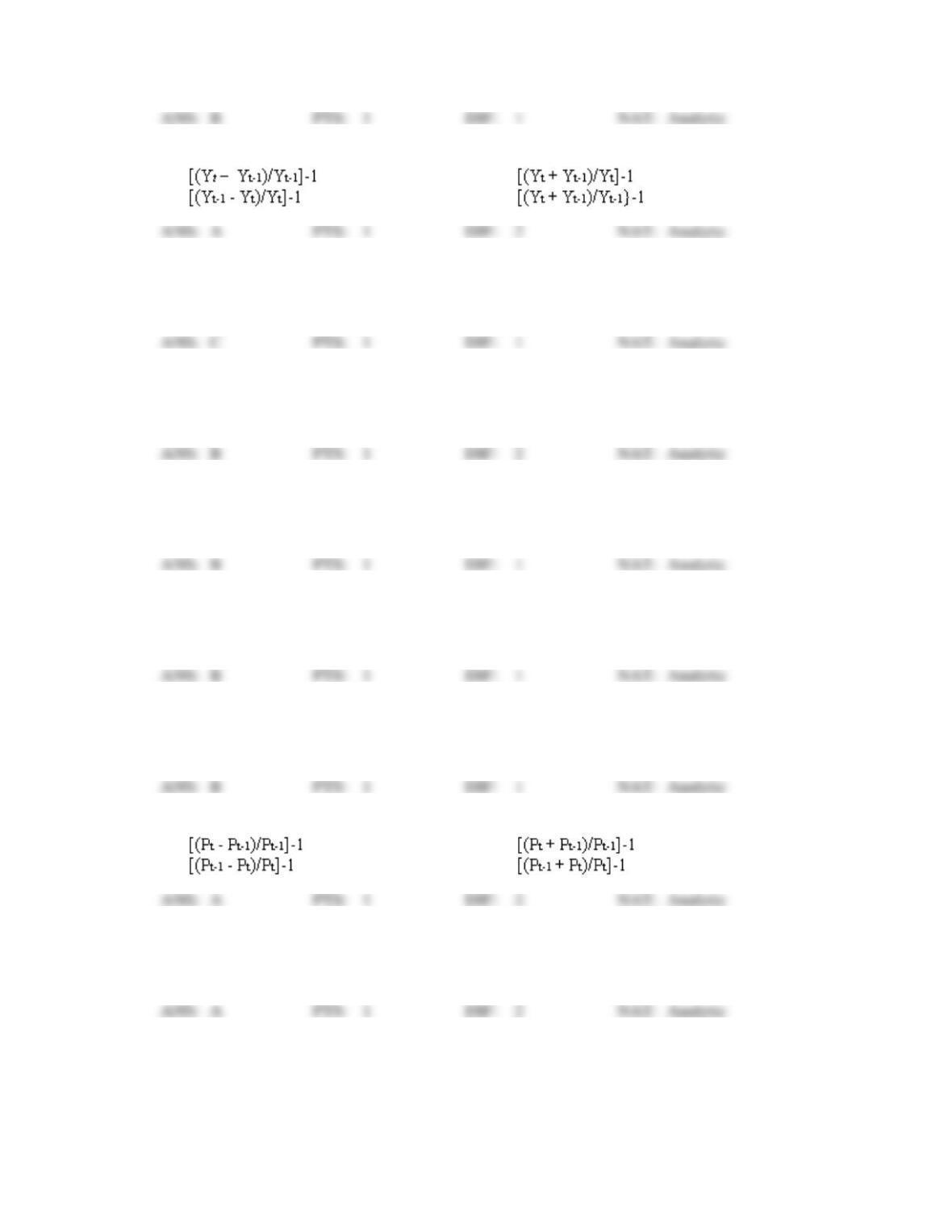
10. The rate of growth of GDP for period t is:
a.
c.
b.
d.
11. Variations in real GDP are called:
a.
inflation.
c.
economic fluctuations.
b.
deflation.
d.
all of the above.
12. When GDP is expanding toward a high point it is called a[n]:
a.
depression.
c.
recession.
b.
boom.
d.
inflation.
13. When real GDP falls toward a low point or trough it is called a[n]:
a.
boom.
c.
inflation.
b.
recession.
d.
expansion.
14. During recessions the unemployment rate:
a.
declines.
c.
is stable.
b.
increases.
d.
is unmeasureable.
15. The unemployment rate in the US was highest in the:
a.
1990s
c.
1980s
b.
1930s
d.
1950s
16. The inflation rate for year t is:
a.
c.
b.
d.
17. A variable that macroeconomists want to model is a[n]
a.
endogenous variable.
c.
exogenous variable.
b.
dummy variable.
d.
predetermined variable.
18. A variable taken as given in a model is a[n]
a.
endogenous variable.
c.
exogenous variable.
b.
dummy variable.
d.
dichotomous variable.
19. The dollar price paid to use capital is known as:
a.
the interest rate.
c.
the rental price of capital.
b.
the exchange rate.
d.
the general price level.
20. The price of labor is the:
a.
exchange rate.
c.
interest rate.
b.
wage rate.
d.
the rental price.
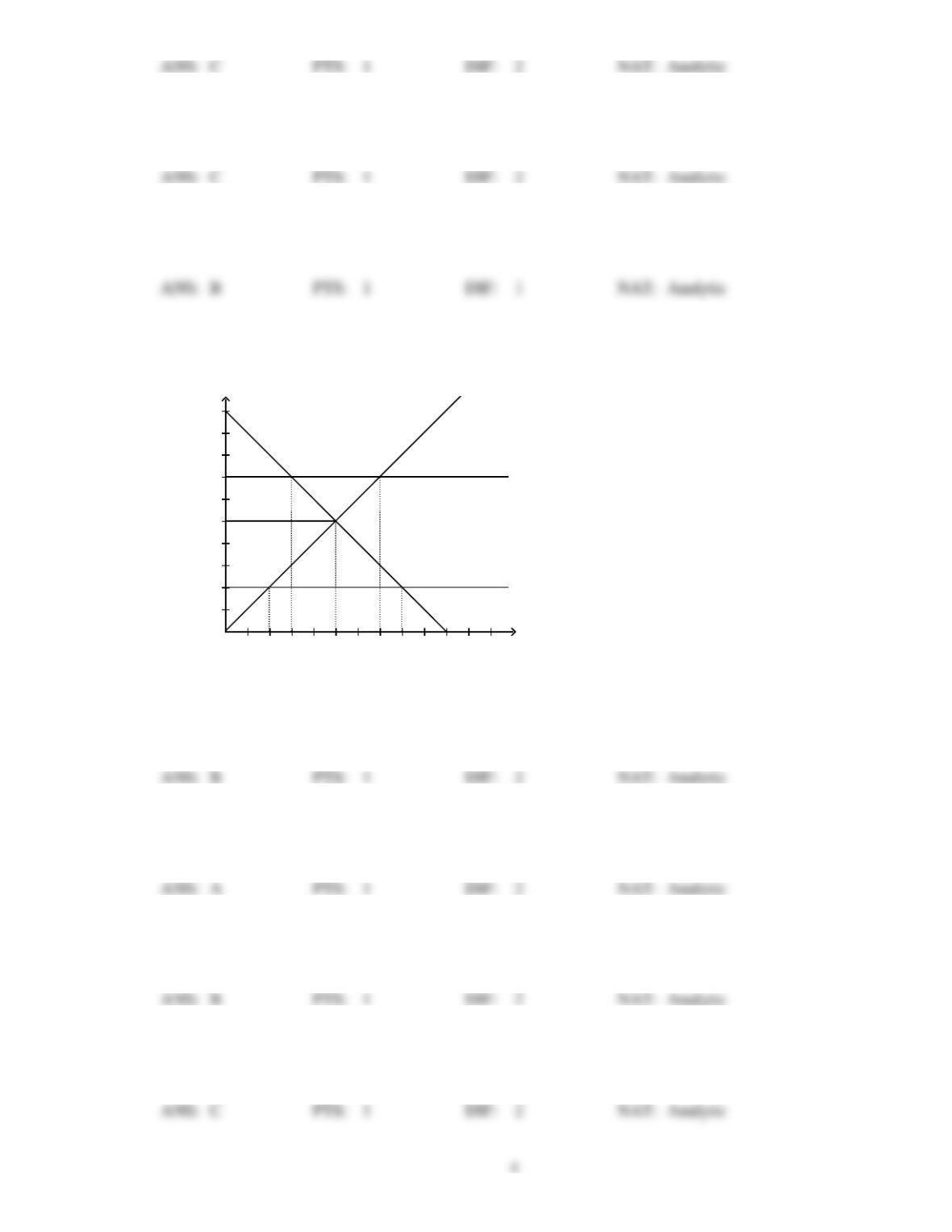
Figure1.1
Price
Supply
Demand
1 2 3 4 5 6 7 8 9 10 Quantity
1
2
3
4
5
6
7
8
9
10
21. In Figure1.1 the equilibrium price is:
a.
2
c.
7
b.
5
d.
0
22. In Figure1.1 the equilibrium quantity is
a.
5
c.
7
b.
2
d.
8
23. In Figure1.1 if price is 7, then
a.
the market is in equilibrium.
c.
there is excess quantity demanded.
b.
there is excess quantity supplied.
d.
the market clears.
24. In Figure1.1 if the price is 2, then:
a.
the market is in equilibrium.
c.
there is excess quantity demanded.
b.
there is excess quantity supplied.
d.
the market clears.
5
25. In Figure1.1, if price is 7, then quantity demanded is:
a.
2.
c.
3.
b.
7.
d.
8.
26. In Figure1.1, if price is 7, then quantity demanded is:
a.
2.
c.
3.
b.
7.
d.
8.
27. In Figure1.1, if price is 7, then quantity supplied is:
a.
2.
c.
3.
b.
7.
d.
8.
28. In Figure1.1, if price is 2, then quantity demanded is:
a.
2.
c.
3.
b.
7.
d.
8.
29. In Figure1.1, if price is 2, then quantity supplied is:
a.
2.
c.
3.
b.
7.
d.
8.
30. In Figure1.1, if price is 5, then quantity demanded is:
a.
2.
c.
3.
b.
7.
d.
5.
31. In Figure1.1, if demand falls, then equilibrium:
a.
price and quantity fall.
c.
price falls and quantity rises.
b.
price and quantity rise.
d.
prices rises and quantity falls.
32. In Figure1.1 if supply increases, then equilibrium:
a.
price and quantity fall.
c.
price rises and quantity falls.
b.
price and quantity rise.
d.
price falls and quantity rises.
33. A possible order of events in an economy over time is:
a.
expansion, recession, peak, expansion.
c.
expansion, peak, trough, recession.
b.
recession, trough, expansion, peak.
d.
recession, trough, peak, expansion.
34. A trough in an economy is when the economy:
a.
is growing.
c.
is contracting.
6
b.
reaches a low point.
d.
reaches a high point.
35. A peak in an economy is when the economy:
a.
is growing.
c.
is contracting.
b.
reaches a low point.
d.
reaches a high point.
36. A possible order of economic fluctuations is:
a.
recession, boom, expansion, trough.
c.
recession, trough, expansion, peak.
b.
expansion, recession, boom, trough.
d.
expansion, trough, recession, peak.
37. If prices are sticky:
a.
the market quickly sticks at equilibrium.
c.
the market only slowly moves toward
equilibrium.
b.
the market clears quickly.
d.
all of the above.
38. In an economic model:
a.
endogenous variables feed into a model to
affect exogenous variable.
c.
exogenous and endogenous variables feed
into the model.
b.
exogenous variables feed into a model to
affect endogenous variables.
d.
none of the above.
39. A price taker:
a.
takes the price to the market.
c.
accepts the market price and decides
whether and how much to buy or sell.
b.
controls the market price.
d.
accepts the market quantity and sets price.
40. A macroeconomist would study the:
a.
price of cars.
c.
the sales of beer.
b.
the market for shoes.
d.
none of the above.
41. Since the late 1800s, U.S. GDP has followed
a.
a general downward trend.
c.
a flat trend.
b.
a general upward trend.
d.
no discernable trend.
42. An economic expansion ends when the economy
a.
reaches a peak.
c.
begins a boom.
b.
reaches a trough.
d.
begins a surge.
43. An economic recession ends when
7
a.
the economy reaches a peak.
c.
unemployment reaches zero percent.
b.
the economy reaches a trough.
d.
unemployment rises at a slow pace.
44. The unemployment rate measures
a.
the number of people applying for
unemployment insurance.
c.
the number of people in government
welfare programs.
b.
the percentage of people working at the
minimum wage.
d.
the percentage of people seeking work
who do not have a job.
45. The trend in the U.S. inflation rate since the 1970s has been
a.
an increase in the rate.
c.
a decrease in the rate.
b.
a decrease in the rate, followed by an
increase in the rate.
d.
a steady trend, with no major change in
the rate.
46. The changing rates of inflation in the U.S. mostly reflects changes in institutions such as
a.
the gold standard.
c.
the U.S. tax code.
b.
U.S. Federal Reserve policy.
d.
both (a) and (b).
47. In the past twenty-five years, the U.S. Federal Reserve mostly has pursued a policy of
a.
low income tax rates.
c.
low and stable inflation.
b.
low corporate tax rates.
d.
high required reserve rates.
48. An example of an exogenous variable in a macroeconomic model most likely would be
a.
the level of employment.
c.
the weather.
b.
the level of real GDP.
d.
the interest rate.
49. An example of an endogenous variable in a macroeconomic model most likely would be
a.
the level of employment.
c.
the level of real GDP.
b.
the existence of a war.
d.
either (a) or (c).
50. An example of an endogenous variable in a macroeconomic model most likely would be
a.
the interest rate.
c.
the development of a new technology.
b.
the existence of a war.
d.
natural disasters.
51. Which is NOT an example of an exogenous variable in a macroeconomic model?
a.
the interest rate.
c.
the development of a new technology.
b.
the existence of a war.
d.
natural disasters.
52. Macroeconomics uses microeconomic models
8
a.
to model the level of real GDP.
c.
to model the market for coffee.
b.
to model the decisions of individual
households and businesses.
d.
in no circumstances.
53. In a macroeconomic model, the term disequilibrium refers to
a.
a discrepancy between the quantities of
labor supplied and demanded.
c.
a gap between the wages of unskilled and
skilled workers.
b.
a discrepancy between the quantities of
coffee supplied and demanded.
d.
a gap between the level of real GDP in
two cities.
54. In a macroeconomic model, the term disequilibrium refers to
a.
the argument that some prices in the goods
market are sticky.
c.
a gap between the wages of unskilled and
skilled workers.
b.
a discrepancy between the quantities of
coffee supplied and demanded.
d.
a gap between the unemployment rate in
two cities.
55. The new Keynesian approach argues that
a.
the economy reflects perfect competion.
c.
individuals and businesses are mostly
price-takers.
b.
some prices are sticky and move only
slowly.
d.
supply and demand in the goods market
move prices quickly.
56. The new Keynesian approach argues that
a.
individuals and businesses are mostly
price-takers.
c.
sectors of the economy may be in
disequilibrium for extended periods.
b.
most prices are flexible and move quickly.
d.
supply and demand in the goods market
move prices quickly.
57. The economist John Maynard Keynes argued that labor markets
a.
are perfectly competitive.
c.
are usually in disequillibrium.
b.
are usually at a point of disengagement.
d.
reflect rapid adjusment of wages to market
conditions.
58. When a country follows a gold standard,
a.
the price of gold is mostly constant.
c.
the price of gold varies quite a bit.
b.
the price of silver is mostly constant.
d.
a central bank cannot also exist.
59. An exchange rate reflects
a.
the sum of the values of two currencies.
c.
the relative levels of labor supply in two
countries.
b.
the rate at which one currency exchanges
for another currency.
d.
the relative levels of capital in two
countries.
60. In a macroeconomic model with perfect competition,
a.
no individual buyer can noticeably affect
the prices of goods.
c.
buyers can affect the prices of goods, but
sellers cannot.
b.
no individual seller can noticeably affect
the prices of goods.
d.
both (a) and (b).
61. In a macroeconomic model with perfect competition,
a.
there are many buyers and a few sellers.
c.
there are many buyers and sellers.
b.
there are many sellers and a few buyers.
d.
there are few buyers and sellers.
62. A macroeconomic model which uses a microeconomic foundation will begin with
a.
a microeconomic model, which is then
aggregated to form a macroeconomic
model.
c.
a macroeconomic model, which is then
aggregated to form a microeconomic
model.
b.
a macroeconomic model, which is then
disaggregated to form a microeconomic
model.
d.
a gold standard model, which is then held
exogenous to form a macroeconomic
model.
63. An equilibrium price in a microeconomic model
a.
shows where the quantity demanded is
less than the quantity supplied.
c.
shows where disequilibrium occurs.
b.
is a market-clearing price.
d.
shows where the quantity demanded is
greater than the quantity supplied.
64. An equilibrium price in a microeconomic model
a.
shows where the quantity demanded is
less than the quantity supplied.
c.
occurs when there is no pressure for the
price to rise or fall.
b.
is a market-lowering price.
d.
shows where the quantity demanded is
greater than the quantity supplied.
65. The number for employment refers to the number of
a.
employers who have job openings.
c.
people looking for jobs.
b.
adults in the population.
d.
people with jobs.
SHORT ANSWER
1. What types of economic issues do macroeconomists study?
2. How is the annual inflation rate calculated?
3. What is the rate of growth of real GDP?
4. Describe what happens when demand or supply increase in a market.
5. What are exogenous and endogenous variables?
6. Why are both flexible prices and sticky prices important to macroeconomic models?