Macroeconomics, 7e (Abel/Bernanke/Croushore)
Chapter 1 Introduction to Macroeconomics
1.1 What Macroeconomics Is About
1) The two major reasons for the tremendous growth in output in the U.S. economy over the last
125 years are
A) population growth and low inflation.
B) population growth and increased productivity.
C) low unemployment and low inflation.
D) low inflation and low trade deficits.
2) The main reason that the United States has such a high standard of living is
A) low unemployment.
B) high average labor productivity.
C) low inflation.
D) high government budget deficits.
3) Average labor productivity is the
A) amount of workers per machine.
B) amount of machines per worker.
C) ratio of employed to unemployed workers.
D) amount of output per worker.
4) In analyzing macroeconomic data during the past year, you have discovered that average labor
productivity fell, but total output increased. What was most likely to have caused this?
A) There is nothing unusual in this outcome because this is what normally occurs.
B) The capital/output ratio probably rose.
C) There was an increase in labor input.
D) Unemployment probably increased.
5) In which of the following periods did average labor productivity in the United States grow the
fastest?
A) 1929 to 1935
B) 1949 to 1973
C) 1973 to 1995
D) 1995 to 2008
6) The most direct effect of an increase in the growth rate of average labor productivity would be
an increase in
A) the inflation rate.
B) the unemployment rate.
C) the long-run economic growth rate.
D) imported goods.
7) Short-run contractions and expansions in economic activity are called
A) recessions.
B) expansions.
C) deficits.
D) the business cycle.
8) When national output rises, the economy is said to be in
A) an expansion.
B) a deflation.
C) an inflation.
D) a recession.
9) Which of the following best describes a typical business cycle?
A) Economic expansions are followed by economic contractions.
B) Inflation is followed by unemployment.
C) Trade surpluses are followed by trade deficits.
D) Stagflation is followed by inflationary economic growth.
10) During recessions, the unemployment rate ________ and output ________.
A) rises; falls
B) rises; rises
C) falls; rises
D) falls; falls
11) The number of unemployed divided by the labor force equals
A) the inflation rate.
B) the labor force participation rate.
C) the unemployment rate.
D) the misery index.
12) The unemployment rate is the
A) number of unemployed divided by the number of employed.
B) number of employed divided by the number of unemployed.
C) number of unemployed divided by the labor force.
D) labor force divided by the number of unemployed.
13) The highest and most prolonged period of unemployment in the United States over the last
125 years occurred during
A) World War II.
B) the 1890s Depression.
C) the 1990-1991 recession.
D) the Great Depression of the 1930s.
14) During the Great Depression, the unemployment rate for the United States peaked at
approximately
A) 10%.
B) 70%.
C) 45%.
D) 25%.
15) A country is said to be experiencing inflation when
A) prices of most goods and services are rising over time.
B) prices of most goods and services are falling over time.
C) total output is rising over time.
D) total output is falling over time.
16) From 1800 to 1940, the price level in the United States
A) trended neither upward nor downward.
B) fluctuated wildly.
C) declined slowly.
D) increased slowly.
17) Before World War II, the average level of prices in the United States usually
A) fell during wartime and rose during peacetime.
B) fell during wartime and fell during peacetime.
C) rose during wartime and fell during peacetime.
D) rose during wartime and rose during peacetime.
18) A country is said to be experiencing deflation when
A) prices of most goods and services are rising over time.
B) prices of most goods and services are falling over time.
C) total output is rising over time.
D) total output is falling over time.
19) The inflation rate is the
A) percent increase in the average level of prices over a year.
B) percent increase in output over a year.
C) percent increase in the unemployment rate over a year.
D) price level divided by the level of output.
20) If the price level was 100 in 2009 and 102 in 2010, the inflation rate was
A) 102%.
B) 20%.
C) 2%.
D) 0.2%.
21) A closed economy is a national economy that
A) doesn’t interact economically with the rest of the world.
B) has a stock market that is not open to traders from outside the country.
C) has extensive trading and financial relationships with other national economies.
D) has not established diplomatic relations with other national economies.
22) An open economy is a national economy that
A) doesn’t interact economically with the rest of the world.
B) has a stock market that is open to traders from anywhere in the world.
C) has extensive trading and financial relationships with other national economies.
D) has established diplomatic relations with most other national economies.
23) An economy that doesn’t interact economically with the rest of the world is called ________
economy.
A) a closed
B) an open
C) a surplus
D) an authoritarian
24) U.S. imports are goods and services
A) produced abroad and sold to Americans.
B) produced in the United States and sold to Americans.
C) produced abroad and sold to foreigners.
D) produced in the United States and sold to foreigners.
25) Following World War I and World War II, the United States had a
A) small trade surplus.
B) small trade deficit.
C) large trade deficit.
D) large trade surplus.
26) In the 1980s, 1990s, and 2000s, the United States has had a
A) small trade surplus.
B) small trade deficit.
C) large trade deficit.
D) large trade surplus.
27) A country has a trade surplus when
A) imports exceed exports.
B) imports equal exports.
C) exports exceed imports.
D) imports equal zero.
28) A country has a trade deficit when
A) imports exceed exports.
B) imports equal exports.
C) exports exceed imports.
D) exports are zero.
29) Data on exports and imports for the United States over the period from 1890 to 2008 show
that
A) the United States had large trade deficits throughout this entire period.
B) the United States had large trade surpluses throughout this entire period.
C) the percentage of total output exported by U.S. firms fell dramatically during World War I
and World War II.
D) a higher percentage of U.S. goods was exported in recent years than in earlier years.
30) A central bank is an institution that
A) pays for government expenditures.
B) controls a nation’s monetary policy.
C) runs a country’s stock market.
D) determines a nation’s fiscal policy.
31) In the United States, monetary policy is determined by
A) the Federal Reserve.
B) the president.
C) private citizens.
D) the Treasury Department.
32) The peak in U.S. government spending as a percent of GDP occurred during
A) World War II.
B) the 1960s war on poverty.
C) the Great Depression.
D) the war against Iraq in the 2000s.
33) Why were the U.S. government budget deficits of the 1980s and early 1990s so unusual from
a historical point of view?
A) It was the first time the U.S. government had ever run deficits.
B) In the past, deficits were usually that large only in wartime.
C) It was the first time that deficits were accompanied by very high rates of inflation.
D) It was the first time that deficits diverted funds from other productive uses, such as
investment in modern equipment.
34) Critics of the government’s fiscal policies argued that government deficits
A) prevented capital from flowing into the United States.
B) were linked to the excess of imports over exports that occurred in the 1980s.
C) caused the level of unemployment in the United States to increase during the 1980s.
D) had directly contributed to a decline in the level of demand in the American economy.
35) The difference between microeconomics and macroeconomics is that
A) microeconomics looks at supply and demand for goods, macroeconomics looks at supply and
demand for services.
B) microeconomics looks at prices, macroeconomics looks at inflation.
C) microeconomics looks at individual consumers, macroeconomics looks at national totals.
D) microeconomics looks at national issues, macroeconomics looks at global issues.
36) Aggregation is the process of
A) calculating real GDP based on nominal GDP and the price index.
B) summing individual economic variables to obtain economy-wide totals.
C) forecasting the components of GDP.
D) predicting when recessions will occur.
37) What are the major factors affecting the long-term growth of the economy’s output?
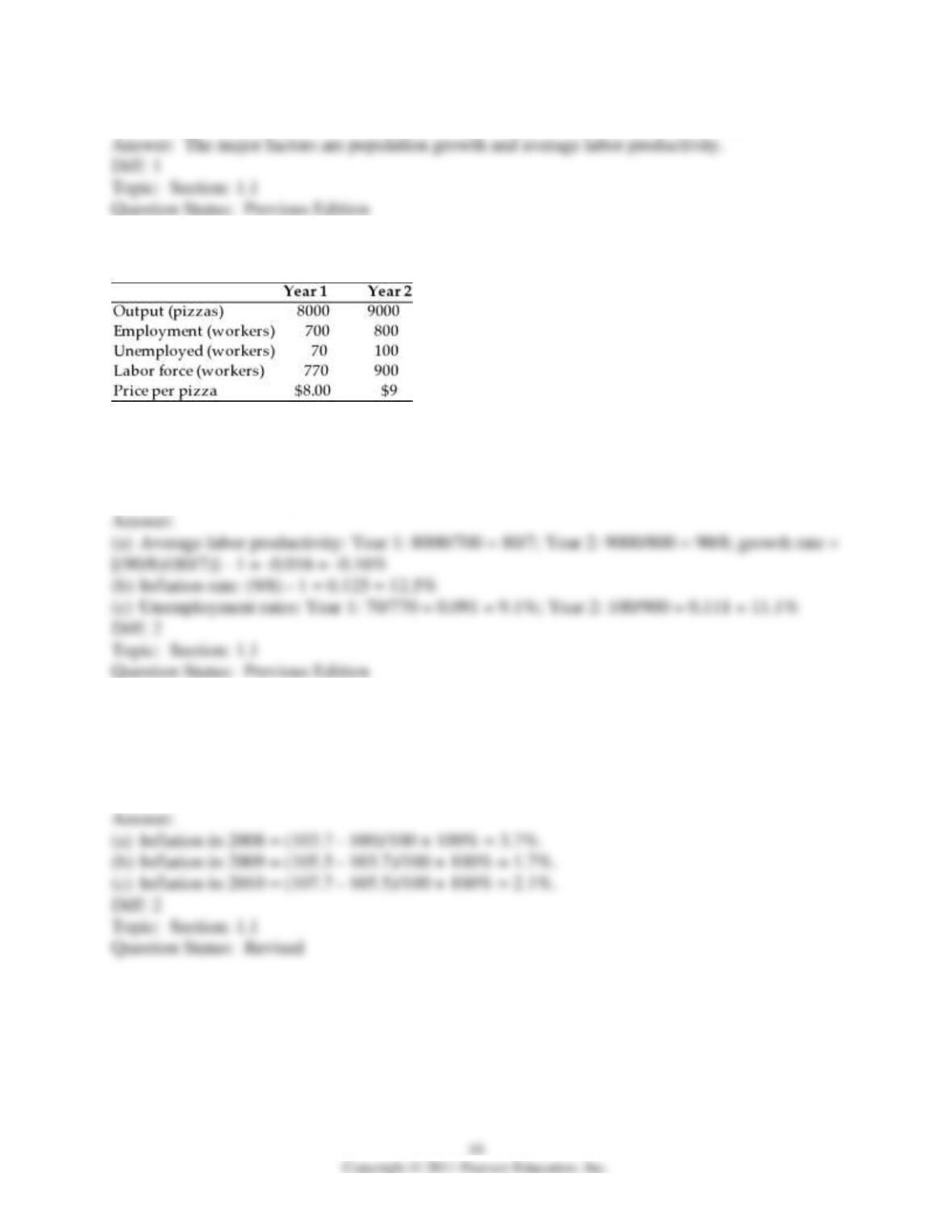
38) Macroeconomic information for the economy of Anchovy is given below.
(a) What was the growth rate of average labor productivity in Anchovy between Year 1 and
Year 2?
(b) What was the inflation rate in Anchovy between Year 1 and Year 2?
(c) What was the unemployment rate in Year 1? In Year 2?
39) Using the CPI measure of the price level, which is 100 in the base year of 2007, calculate the
annual inflation rates for
(a) 2008, when the index is 103.7.
(b) 2009, when the index is 105.5.
(c) 2010, when the index is 107.7.
40) What is meant by aggregation? Why is aggregation important for macroeconomic analysis?
1.2 What Macroeconomists Do
1) A country that has many well-trained macroeconomic analysts will not necessarily have more
beneficial macroeconomic policies because
A) economists’ understanding of the economy remains poor.
B) there are few ways in which economists’ complex models can be applied to the real world.
C) economists agree on so few government policies.
D) economic policy is usually made by politicians, not economists.
2) The main goal of macroeconomic research is to
A) predict how the macroeconomy will perform in the future.
B) analyze current macroeconomic data.
C) develop new data that can be used to understand better the operation of the economy.
D) make general statements about how the economy works.
3) A set of ideas about the economy that have been organized in a logical framework is called
A) empirical analysis.
B) a methodology.
C) economic theory.
D) data development.
4) Assumptions for economic theories and models should be
A) rejected if they are not totally realistic.
B) logical rather than empirically testable.
C) simple and reasonable rather than complex.
D) maintained until overwhelming evidence to the contrary occurs.
5) If the theory behind an economic model fits the data poorly, you would probably want to
A) use the theory to predict what would happen if the economic setting or economic policies
change.
B) start from scratch with a new model.
C) enrich the model with additional assumptions.
D) restate the research question.
6) Match each of the following jobs to its major area: forecasting, analysis, research, or data
development. Explain your answers.
(a) Economist at university, testing theories about the efficient allocation of resources in the
foreign exchange market
(b) Economist at Wall Street firm trying to predict the rate of inflation next year using past data
(c) Economist at auto firm looking at demand for new automobiles
(d) Economist at the International Trade Commission trying to determine whether foreign firms
are dumping goods in the United States
(e) Economist at the Commerce Department developing new methods for calculating price
indexes
(f) Economist consulting in Eastern Europe about how to set up free-market financial systems.
1.3 Why Macroeconomists Disagree
1) Positive analysis of economic policy
A) examines the economic consequences of policies but does not address the question of whether
those consequences are desirable.
B) examines the economic consequences of policies and addresses the question of whether those
consequences are desirable.
C) generates less agreement among economists than normative analysis.
D) is rare in questions of economic policy.
2) Equilibrium in the economy means
A) unemployment is zero.
B) quantities demanded and supplied are equal in all markets.
C) prices are not changing over time.
D) tax revenues equal government spending, so the government has no budget deficit.
3) Adam Smith’s idea of the “invisible hand” says that given a country’s resources and its initial
distribution of wealth, the use of markets will
A) insulate a nation from the effects of political instability.
B) eliminate problems of hunger and dissatisfaction.
C) eliminate inequalities between the rich and the poor.
D) make people as economically well off as possible.
4) The two most comprehensive, widely accepted macroeconomic models are
A) the classical model and the supply-side model.
B) the supply-side model and the real business cycle model.
C) the classical model and the Keynesian model.
D) the Austrian model and the Keynesian model.
5) Classical economists argue that
A) the government should have an active role in the economy.
B) government policies will be ineffective and counterproductive.
C) the government should actively intervene in the economy to eliminate business cycles.
D) wages and prices don’t adjust quickly, so the economy is slow to return to equilibrium.
6) Keynes was motivated to create a macroeconomic theory different from classical theory
because
A) he believed in government intervention in the economy.
B) he believed in the idea of the invisible hand.
C) monetary policy was more important than the classicals acknowledged.
D) classical theory was inconsistent with the data in the Great Depression.
7) Keynes assumed that wages and prices were slow to adjust in order to explain
A) persistently high unemployment.
B) high inflation.
C) the high level of interest rates.
D) why inflation fell in recessions.
8) How did Keynes propose to solve the problem of high unemployment?
A) Increase the growth rate of the money supply.
B) Allow wages to decline, so that firms will want to hire more workers.
C) Put on wage and price controls, so wages won’t rise and firms won’t have to lay people off to
cut costs.
D) Have the government increase its demand for goods and services.
9) The primary factor that caused most economists to lose their faith in the classical approach to
macroeconomic policy was
A) the high levels of unemployment that occurred during the Great Depression.
B) the presence of both high unemployment and high inflation during the 1970s.
C) the theoretical proof that classical ideas were invalid.
D) the evidence that classical ideas were useful during economic booms, but not during
economic recessions.
10) The primary factor that caused some economists to lose their faith in the Keynesian approach
to macroeconomic policy was
A) the high levels of unemployment that occurred during the Great Depression.
B) the presence of both high unemployment and high inflation during the 1970s.
C) theoretical proof that Keynes’s ideas were invalid.
D) evidence that Keynes’s ideas were useful during economic recessions, but not during
economic booms.
11) Why is wage and price flexibility crucial to the idea of the “invisible hand?”
12) Compare and contrast the classical and Keynesian schools of thought for the following
economic issues.
(a) The flexibility of wages and prices.
(b) The importance of macroeconomic policies.
13) In 1993, the debate heated up in the United States about the North American Free Trade
Agreement (NAFTA), which proposed to reduce barriers to trade (such as taxes on or limits to
imports) among Canada, the United States, and Mexico. Some people opposed strongly the
agreement, arguing that an influx of foreign goods under NAFTA would disrupt the U.S.
economy, harm domestic industries, and throw American workers out of work. How might a
classical economist respond to these concerns? Would you expect a Keynesian economist to be
more or less sympathetic to these concerns than the classical economist? Why?