
1. According to the text, as compared to rich countries, most of the poor countries do not fare well because:
a.
they have no oil.
b.
the people in these countries have limited property rights.
c.
access to education in these countries is very limited.
d.
high tariffs in these countries prevent international trade.
e.
they do not have any natural resources.
2. _____ is the primary reason that explains why some nations are richer than the others.
a.
A democratic government
b.
A strong judicial system
c.
Access to education
d.
Private ownership
e.
A stable currency
3. In spite of having no natural resources, a country like _____ was able to make itself one of the wealthiest countries in
the world because it allowed private ownership.
a.
India
b.
Poland
c.
Hungary
d.
Hong Kong
e.
China
4. It can be said that ____ laid the foundation for the Industrial Revolution.
a.
the discovery of the Americas
b.
private property rights
c.
the invention of the cotton gin
d.
the discovery of gold
e.
the development of a strong judicial system
5. Private property rights are important because:
a.
they create incentives for people to improve their standard of living.
b.
the Constitution says so.
c.
they allow students to choose their major field of study in college.
d.
an economy cannot function without them.
e.
goods cannot be produced without them.
6. GDP per capita is one way to measure an economy’s growth. China and India began to progress when they allowed
private ownership, around ____. Since then, there has been steady, strong growth in these economies.
a.
1960
b.
1970
c.
1980

d.
1990
e.
2000
7. Overfishing and extinction of species arise because of:
a.
an abundance of natural resources.
b.
communist countries.
c.
the lack of incentive to take care of these species.
d.
private ownership of these resources.
e.
a high degree of economic freedom in all countries.
8. Sonia works at a restaurant where tips are pooled and divided equally. Anna works at a different restaurant where she
keeps the tips her customers leave for her. Which of the following is true?
a.
Both work equally hard because their hourly wage from the employer is low, and they can make up for this
with tips.
b.
Sonia works harder, because she receives the same amount of tips as other workers.
c.
Anna works harder, because she works at an expensive restaurant.
d.
Anna works harder, because her tips are her private property.
e.
Neither of them has an incentive to work hard because tips are a small part of their earnings.
9. Villagers in Xiaogang, China, produced more rice than those in surrounding villages because:
a.
they had better farmland.
b.
they were given better seeds.
c.
they were able to keep the output they produced individually.
d.
they made each family responsible for a certain, higher quota of rice production.
e.
they had common ownership over the rice produced.
10. In 1981, in San Francisco Solano, Argentina, about 1,800 families took over a piece of wasteland. The government
was able to deed 60 percent of this land to some families while the remaining part could not be deeded. The resulting
houses varied greatly, based on whether the residents received title. Those who received title also behaved differently,
having fewer children, and the children experienced more education and better health. This is an example of the results
from:
a.
scarcity.
b.
economic growth.
c.
economic freedom.
d.
private property rights.
e.
improved quality of life.
11. One of the reasons communism failed was because:
a.
governments ran out of money.
b.
workers received the same pay whether or not they worked hard.
c.
there was no unemployment.

d.
Mao Zedong passed away.
e.
technological improvements were impossible in a communist economy.
12. The economist Hernando de Soto extensively studied:
a.
the problem of scarcity.
b.
opportunity costs.
c.
insecure property rights.
d.
economic freedom in rich countries.
e.
the sources of comparative advantage in trade.
13. A piece of land is divided between John and Mary. However, only John gets the title to his share of land. Which of the
following is true?
a.
Both Mary and John will not take care of their lands.
b.
Mary will have a higher per capita output from her piece of land.
c.
John will not be able to rent out a portion of his land.
d.
Mary will have a greater incentive than John to invest in her piece of land.
e.
John will be able to use his land as collateral for a loan from a bank.
14. Economic freedom:
a.
is the right to own property.
b.
means not having to pay taxes.
c.
is absent in rich countries.
d.
affects only poor people.
e.
is the ability to engage in voluntary trade.
15. Which of the following would economic freedom lead to?
a.
A higher standard of living
b.
Better living conditions
c.
Longer life expectancy
d.
Better education
e.
All of these
16. Which of the following hinders economic freedom?
a.
Lower taxes
b.
Regulations on emissions from automobiles
c.
International trade
d.
Secure private property rights
e.
A democratic government
17. Scarcity:

a.
ensures that people become satisfied with less than what they want.
b.
exists only during a recession.
c.
exists only in some countries.
d.
affects only poor people.
e.
requires people to make choices to satisfy their wants.
18. Which of the following is not a limitation a person faces when shopping for clothes?
a.
The amount of time available to shop
b.
The person’s budget
c.
The various styles that are available
d.
The selection of stores
e.
The freedom to make rational choices
19. The major economic problem is to:
a.
provide for full employment.
b.
eliminate scarcity.
c.
increase the standard of living.
d.
allocate limited resources among unlimited uses.
e.
increase leisure.
20. Which of the following is true regarding scarcity?
a.
Scarcity could be eliminated if all economies of the world would work together to solve world hunger.
b.
Scarcity could be eliminated if we had full employment.
c.
It is impossible to eliminate scarcity, given limited resources and unlimited wants.
d.
Scarcity could be eliminated if all economies of the world would adopt communism.
e.
Scarcity could be eliminated if all economies of the world would adopt a free market system.
21. Which of the following statements is true?
a.
Goods are scarcer than services in an economy.
b.
Goods are scarce for neither the poor nor the rich.
c.
Goods are scarce for both the poor and the rich.
d.
Goods are scarce for the poor but not for the rich.
e.
Goods are scarce for the rich but not for the poor.
22. Economics is the study of:
a.
the allocation of scarce resources and the ways in which human decision makers utilize those resources.
b.
the methods that human decision makers use to transform a scarce good into a non-economic good.
c.
how to operate a business successfully.
d.
a utopian society.
e.
how to make money in the stock market.

23. Economics is:
a.
concerned with the problem of scarce resources combined with unlimited wants.
b.
the study of how to make money in the stock market.
c.
highly theoretical and has little practical application.
d.
primarily concerned with day-to-day business decision making.
e.
a decision making process involving individuals and firms rather than governments.
24. To say that something is scarce means that:
a.
it is no longer available in stores.
b.
it must be conserved at any cost.
c.
even the government cannot supply it.
d.
sufficient amounts of it available only at a zero price.
e.
not enough is available to satisfy people’s wants at a zero price.
25. The concept of scarcity as used by economists refers to:
a.
a situation of excess supply.
b.
a situation in which the available resources are not enough to satisfy the wants of the people at a zero price.
c.
a situation in which an item is available only in very small quantities.
d.
a situation in which an item is very expensive.
e.
a situation in which a resource is nonrenewable.
26. To an economist, scarcity means that:
a.
it is very time-consuming to find a good.
b.
at a zero price, the available quantity of a good is insufficient to meet people’s wants.
c.
a good is unavailable even at very high prices.
d.
at the current market price, the amount available is less than the amount that people want and are willing to
pay for.
e.
resources are unlimited but people’s desires are limited.
27. Goods are scarce when:
a.
their price is too low.
b.
their price is too high.
c.
the amount people want is more than the amount available at a zero price.
d.
people want less of something as compared to what is available.
e.
their prices are controlled.
28. The basic economic problem is:
a.
inflation.
b.
unemployment.
c.
poverty.

d.
scarcity.
e.
lack of money.
29. To say that there is a scarcity of gold means that:
a.
gold prices will fall in the future.
b.
there is not enough gold to satisfy people’s demand for it at a zero price.
c.
there are very few substitutes for gold.
d.
gold is very expensive.
e.
the demand for gold is changing.
30. Choices need to be made because of all of the following, except limited _____.
a.
resources
b.
income
c.
wants
d.
time
e.
availability of goods
31. Which of the following statements is false?
a.
Economists look at the factors that lead an individual to decide that a particular idea is in his or her best
interest.
b.
Economists do not ask whether a particular decision is in the individual’s best interest.
c.
Choices must be made because of scarcity.
d.
A particular choice is made by an individual because that choice provides the greatest satisfaction.
e.
None of these statements is false, they are all true.
32. Which of the following statements concerning opportunity costs is false?
a.
Opportunity costs are only expressed in money terms.
b.
Every choice involves opportunity costs.
c.
Opportunity costs are the highest-valued alternatives that must be forgone when a choice is made.
d.
The concept of opportunity cost is used to demonstrate scarcity.
e.
Economists refer to the forgone benefits of the next-best alternative as opportunity costs.
33. Which of the following sayings best represents the concept of opportunity costs?
a.
“A glass can be half empty or half full.”
b.
“When in Rome, do as the Romans do.”
c.
“There is no such thing as a free lunch.“
d.
“No taxation without representation.”
e.
“What’s up?”
34. Which economic concept is the closest to the saying, “There’s no such thing as a free lunch“?

a.
Specialization
b.
Unlimited wants
c.
Underutilization of resources
d.
Opportunity costs
e.
Overutilization of resources
35. Which of the following is a result of scarcity?
a.
Costs are incurred in making choices.
b.
We attempt to utilize our resources as efficiently as possible.
c.
We must make choices between production possibilities.
d.
We are unable to produce all we would like to produce.
e.
All of these.
36. Which economic concept is illustrated by the saying “You can’t have your cake and eat it too”?
a.
Private property rights
b.
Economic freedom
c.
Scarcity
d.
Opportunity cost
e.
Gains from trade
37. Ronnie waits one hour in queue to buy a ticket to a rock concert. The opportunity cost of buying the $28 ticket:
a.
is Ronnie’s best alternative use of the sum of $28 spent on the ticket.
b.
is Ronnie’s best alternative use of the one hour it took to wait in queue.
c.
is the revenue of $28 earned by the ticket agent.
d.
is Ronnie’s best alternative use of both $28 and the one hour spent in the queue.
e.
cannot be measured because there is no opportunity cost associated with consumption.
38. If you must make a choice about consuming two apples, three oranges, or one candy bar, the opportunity cost of the
candy bar is:
a.
two apples.
b.
three oranges.
c.
two apples and three oranges.
d.
two apples or three oranges, whichever you prefer more.
e.
equal to the difference in the prices of the three options.
39. Opportunity cost is best defined as the:
a.
sum of all alternatives given up when a choice is made.
b.
money spent once a choice is made.
c.
highest-valued alternative given up when a choice is made.
d.
cost of a good minus the satisfaction obtained from consuming it.
e.
cost of capital resources used in the production of additional capital.

40. Which of the following should not be considered as an opportunity cost of attending college?
a.
Expenses that are the same whether or not you attend college
b.
Lost salary
c.
Business lunches
d.
Interest that could have been earned on your money had you put the money into a savings account, rather than
spent it on tuition
e.
Opportunities sacrificed in the decision to attend college
41. An example of opportunity cost:
a.
is the Chinese food that you gave up when you chose to eat Italian food.
b.
is the tuition that you pay to attend college.
c.
for a professor of economics is the pleasure that he or she derives from teaching economics.
d.
is sweets given up by a person who would never eat them even if he or she could.
e.
is the amount spent on buying movie tickets.
42. Opportunity cost:
a.
applies only to consumption decisions.
b.
applies only to production decisions.
c.
is the same as monetary costs.
d.
exists because of scarcity.
e.
is irrelevant for wealthy economies.
43. In economics, which of the following is considered as financial capital?
a.
Offices and warehouses
b.
Stocks and bonds
c.
Machinery
d.
Factories
e.
Equipment
44. An economy’s resources:
a.
are limited in quantity.
b.
are always efficiently utilized.
c.
consist of land, labor, capital, and money.
d.
are unrelated to its standard of living.
e.
are unlimited when we use the latest technology.
45. Oil found underground in Texas is an example of:
a.
labor.
b.
land or a natural resource.

c.
an entrepreneur.
d.
human capital.
e.
capital resource.
46. Labor resources include:
a.
skilled workers but not unskilled workers.
b.
unskilled workers but not skilled workers.
c.
a robot.
d.
education and training of workers.
e.
coffee breaks.
47. A skilled worker is an example of:
a.
unproductive resources.
b.
land resources.
c.
labor resources.
d.
capital resources.
e.
both labor and capital resources.
48. A factory is an example of:
a.
capital.
b.
scarcity.
c.
an enterprise.
d.
land resources.
e.
output.
49. Which of the following is true of resources?
a.
Capital resources include manual labor.
b.
Natural resources are available in nature and are available at a zero price.
c.
Labor includes the skills and training people acquire to use in production.
d.
Technological know-how is an example of a natural resource.
e.
Human capital is the technical term for a robot.
50. Every society must deal with the problem of scarcity because:
a.
people do not have enough money to buy everything they need.
b.
government levies heavy taxes on households and firms.
c.
human beings become satiated as consumption increases.
d.
human wants are nearly unlimited relative to the availability of resources.
e.
productive resources, technology, and labor are unlimited.
51. Which of the following is an example of capital?

a.
Education
b.
Natural resources
c.
Machinery
d.
Training
e.
Money
52. Stocks and bonds are examples of:
a.
natural resources.
b.
financial capital.
c.
physical capital.
d.
financial labor.
e.
internal capital.
53. What accounts for specialization?
a.
People specialize in the activity in which their opportunity costs are at a maximum.
b.
People specialize in the activity in which their opportunity costs are lowest.
c.
People do not specialize in any activity.
d.
People specialize in the activity that pays the highest wage.
e.
People specialize in the activity that they enjoy the most, no matter what the salary is.
54. People:
a.
tend to specialize in those activities in which their opportunity costs are minimum
b.
tend to specialize in those activities in which their opportunity costs are maximum.
c.
never consider opportunity costs while deciding which activities to specialize in.
d.
consider only direct costs while deciding which activities to specialize in.
e.
do not behave in their own self-interest.
55. A person has a comparative advantage in producing a good if that person:
a.
can produce the good at a lower absolute cost than anyone else.
b.
can produce the good at a lower opportunity cost than anyone else.
c.
can do a better job than anyone else.
d.
spends more money in out-of-pocket expenses than anyone else.
e.
can produce the good at a higher opportunity cost than anyone else.
56. James has a comparative advantage in the production of corn, while Harry has a comparative advantage in the
production of bread. If James and Harry decide to trade with each other, _____.
a.
both Harry and James will enjoy gains from trade
b.
only Harry will enjoy gains from trade
c.
only Harry will suffer losses from trade
d.
only James will suffer loses from trade
e.
neither of them will gain from trade
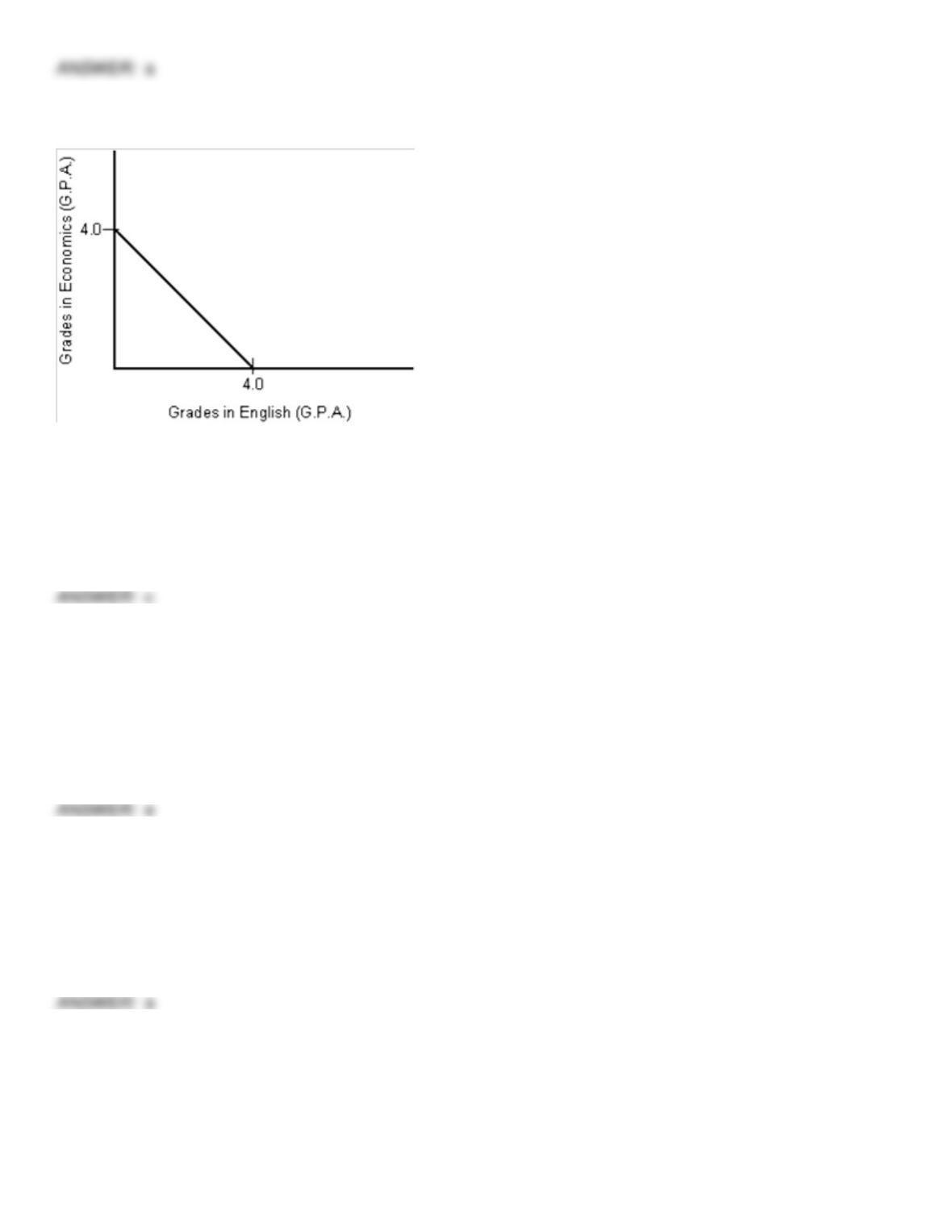
Figure 1.2
57. The PPC in Figure 1.2 indicates a student who:
a.
is more proficient at Economics than English.
b.
is more proficient at English than Economics.
c.
is equally proficient in Economics and English.
d.
prefers Economics over English.
e.
prefers English over Economics.
58. Which of the following does the production possibilities curve illustrate?
a.
The tradeoffs facing a society
b.
The fact that more of one product can be produced only by reducing the quantity of other products that are
being produced, assuming that resources are being used efficiently
c.
The maximum output that can be produced with a limited amount of resources
d.
The opportunity cost of alternative choices
e.
All of these
59. If an economy is producing at a point on the production possibilities curve it represents:
a.
full employment of existing resources.
b.
the gains from trade that an economy can enjoy.
c.
the maximum amount of two goods that can be produced with existing resources.
d.
decreasing opportunity costs of producing both goods.
e.
overutilization of existing resources.
60. A combination of two goods which lies beyond the production possibilities curve indicates:
a.
underutilization of resources.
b.
overutilization of resources.
c.
constant opportunity costs.
d.
a combination that cannot be produced with existing resources.
e.
society’s most preferred combination of two goods.
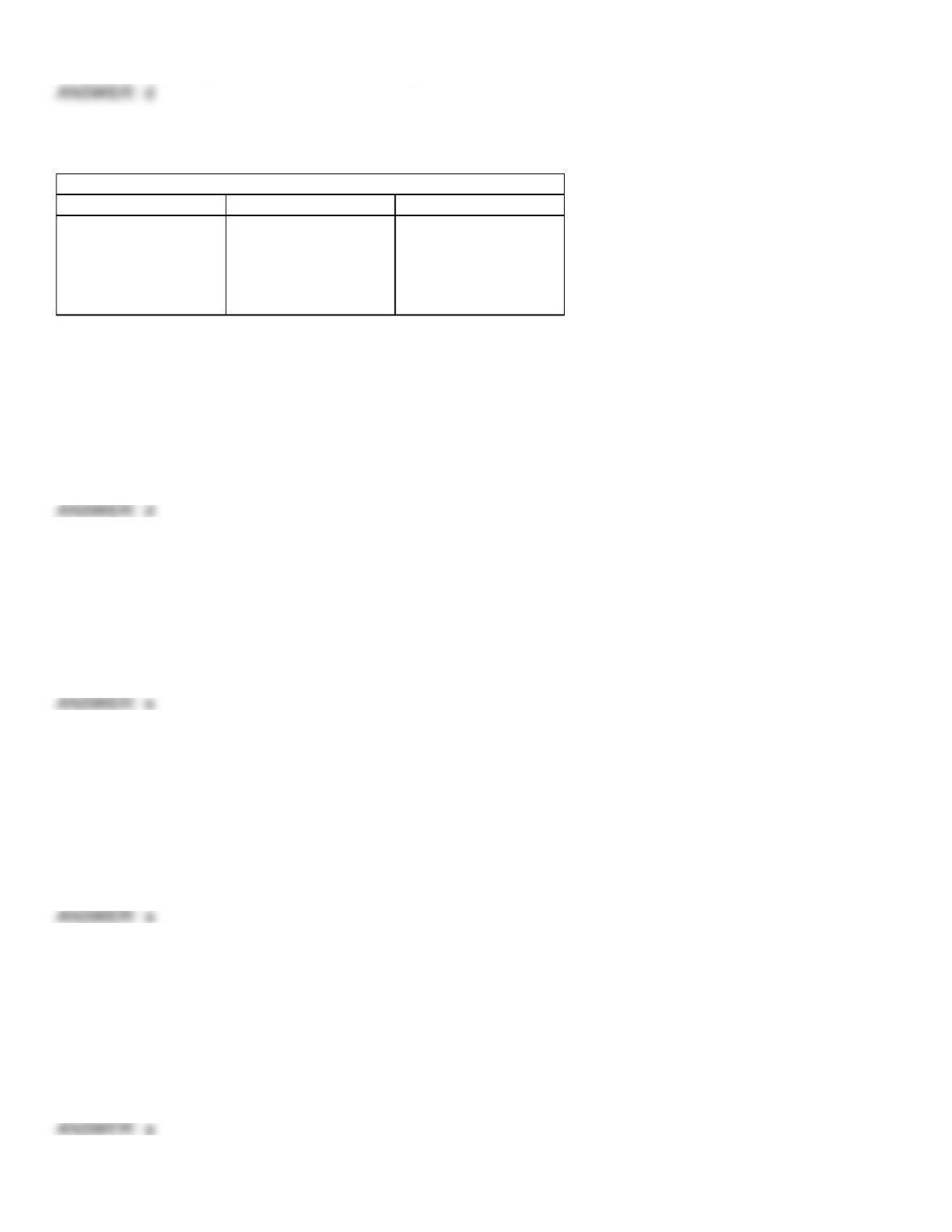
Table 1.4
Table 1.4: Production Possibilities Schedule
Choice
Good A
Good B
1
2
3
4
5
100
90
70
40
0
0
20
40
60
80
61. According to the production possibilities schedule in Table 1.4, which of the following statements is true?
a.
This economy could produce 100 units of good A and 20 units of good B.
b.
The opportunity cost of producing more of good A decreases as the amount of good A produced increases.
c.
The opportunity cost of producing more of good B decreases as the amount of good B produced increases.
d.
This economy could produce 70 units of good A and 40 units of good B.
e.
If this economy were to fully and efficiently employ all its resources, it could provide 100 units of good A and
80 units of good B.
62. According to the production possibilities schedule in Table 1.4, which of the following statements is true?
a.
If one moves from choice 2 to choice 3, the opportunity cost of 20 more units of good B is 20 units of good A.
b.
There are increasing opportunity costs associated with producing more of good B.
c.
If one moves from choice 3 to choice 4, the opportunity cost of 20 more units of good B is 30 units of good A.
d.
If one moves from choice 1 to choice 2, the opportunity cost of 20 more units of good B is 10 units of good A.
e.
All of these
63. Assume that our national economy is operating at a point on its bowed-out production possibilities curve. According
to the production possibilities schedule in Table 1.4, if our nation produces more of Good A, then:
a.
it must sacrifice larger and larger amounts of Good B to do so.
b.
the amount of Good B that must be forgone decreases.
c.
the resources transferred will be increasingly efficient in producing Good A.
d.
it must have a comparative advantage in the production of Good A.
e.
we will experience a greater rate of economic growth.
64. When an economy is operating on its production possibilities curve, more production of one good means less
production of another because:
a.
resources are limited.
b.
resources are not perfectly adaptable to alternative uses.
c.
wants are limited.
d.
wants are unlimited.
e.
some resources are not employed.
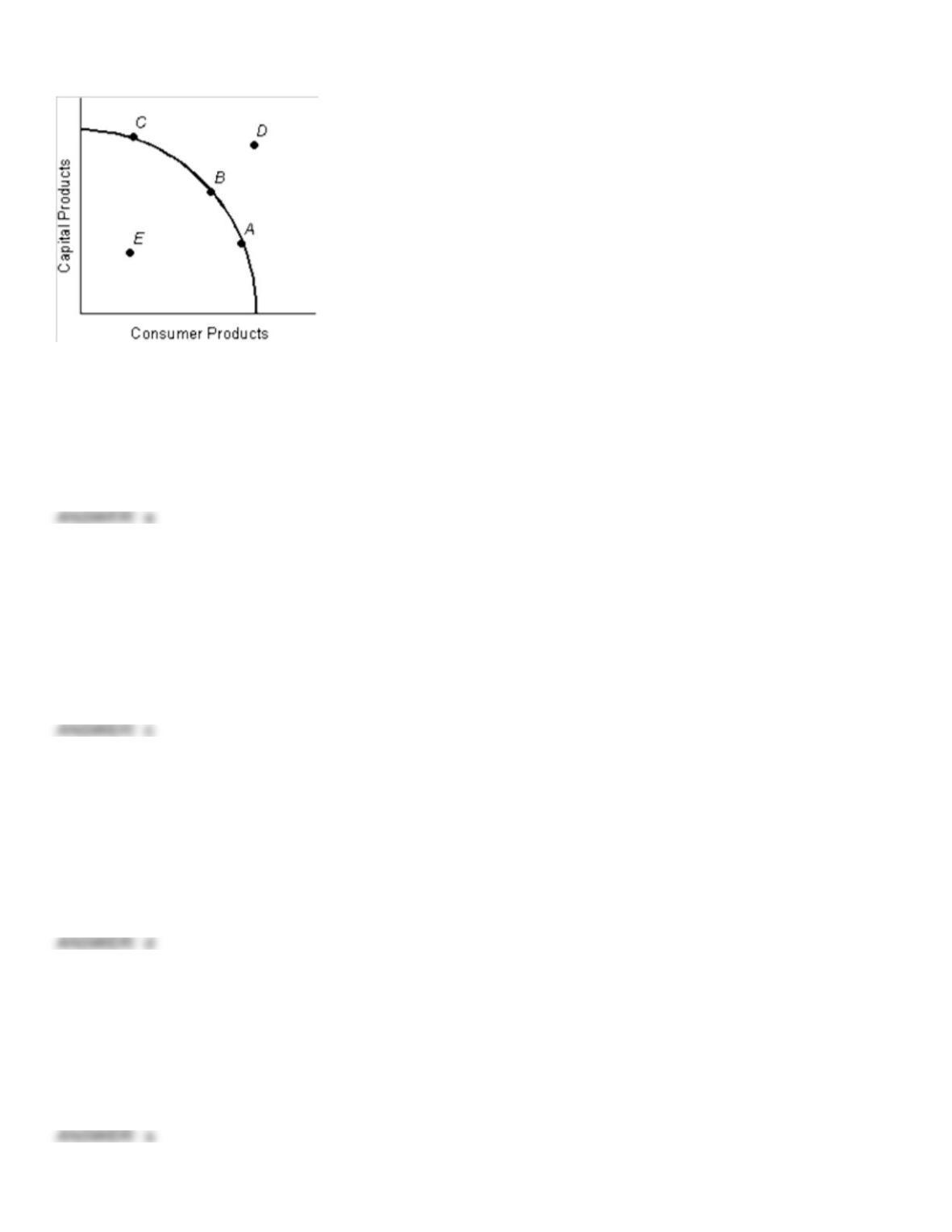
Figure 1.3
65. In Figure 1.3, underutilization of resources is represented by point:
a.
A.
b.
B.
c.
C.
d.
D.
e.
E.
66. In Figure 1.3, which of the following points would best enhance future production (that is, which point would be best
for investment purposes)?
a.
Point A
b.
Point B
c.
Point C
d.
Point D
e.
Point E
67. Point D in Figure 1.3 represents:
a.
economic growth.
b.
an inefficient use of resources.
c.
full employment.
d.
a combination of consumer and capital products that may be obtainable sometime in the future, but is
impossible to produce now.
e.
a combination of products that can be produced only if resources are fully and efficiently employed.
68. In Figure 1.3, full employment is shown with:
a.
points A, B, and C.
b.
only point C.
c.
point D.
d.
only point A.
e.
only point B.

69. In Figure 1.3, which point should society produce at to maximize efficiency?
a.
Only point A
b.
Only point B
c.
Only point C
d.
Only point E
e.
Any point on its PPC
70. Private property rights imply that people can own things, and they can do what they want with what they own even if
they infringe on the private property rights of others.
a.
True
b.
False
71. When private property rights in a country are not secure, people cannot use their property as collateral for loans.
a.
True
b.
False
72. The greater the economic freedom in a country, the higher is the index of human development.
a.
True
b.
False
73. The primary goal of economics is to help people make money.
a.
True
b.
False
74. Scarcity is a concept that implies that choices must be made.
a.
True
b.
False
75. A limitation one faces when shopping for clothes is the amount of time available to shop.
a.
True
b.
False
76. Scarcity is a result of an unfair distribution of income.
a.
True
b.
False
77. Economics is the study of the allocation of scarce resources and scarce time, and the ways in which people utilize
those resources or that time.
a.
True

b.
False
78. A positive (non-zero) price for a good means there is a surplus of that good.
a.
True
b.
False
79. Choices must be made because of scarcity; people do not have enough time or money to get everything they want.
a.
True
b.
False
80. According to economic analysis, while making a decision, an individual compares the benefits expected from one
option with the benefits expected from other options.
a.
True
b.
False
81. Because of scarcity, we attempt to utilize our resources as efficiently as possible.
a.
True
b.
False
82. If you have a choice between consuming bundle X or bundle Y, the opportunity cost of consuming bundle X is bundle
Y.
a.
True
b.
False
83. If you must make a choice about consuming two apples, three oranges, or one candy bar, the opportunity cost of the
two apples is the candy bar plus the three oranges.
a.
True
b.
False
84. An example of an opportunity cost is the time you forgo to eat a “free lunch.”
a.
True
b.
False
85. The opportunity cost of going to the movies is always the same for everyone.
a.
True
b.
False
86. When you work to support your lifestyle, you are making a tradeoff.

a.
True
b.
False
87. Specialization according to comparative advantage, followed by trade, allows everyone to acquire more of the goods
they want.
a.
True
b.
False