Macroeconomics 2017 (Hubbard)
Chapter 1 Economics: Foundations and Models
1.1 Three Key Economic Ideas
1) Technological progress has made it possible for firms such as Apple and Alivecor to develop small
electronic devices, including smartwatches, smartphones, and products that can be attached to the
smartwatches and smartphones, to serve consumers who have become more health conscious and wish
to monitor various health conditions. These firms are reacting to which of the three key economic ideas?
A) firms attempt to maximize revenues
B) optimal decisions are made at the margin
C) people are rational
D) people respond to economic incentives
2) The study of economics arises due to
A) money.
B) scarcity.
C) greed.
D) resources.
3) Scarcity refers to the situation in which
A) unlimited wants exceed limited resources.
B) unlimited resources exceed limited wants.
C) a country’s population is larger than its resource base.
D) a nation’s poverty level increases faster than its population.
4) The basic economic problem of scarcity
A) has always existed and will continue to exist.
B) will eventually disappear as technology continues to advance.
C) is a problem only in developing economies.
D) does not apply to the wealthy in society.
5) Economics is the study of the ________ people make to attain their goals, given their ________
resources.
A) purchases; unlimited
B) choices; scarce
C) income; available
D) decisions; household
6) What is an economic model?
A) It is a description of an economic issue that includes all possible related information.
B) It is a description of an economic issue based on official government information.
C) It is a detailed version of some aspect of economic life used to analyze an economic issue.
D) It is a simplified version of some aspect of economic life used to analyze an economic issue.
7) The term “market” in economics refers to
A) a place where money changes hands.
B) a legal institution where exchange can take place.
C) a group of buyers and sellers of a product and the arrangement by which they come together to
trade.
D) an organization which sells goods and services.
8) Economists assume that
A) individuals behave in unpredictable ways.
B) consumer behavior is explained by the existence of unlimited resources.
C) people put other people’s interests ahead of their own.
D) optimal decisions are made at the margin.
9) Which of the following best describes an assumption economists make about human behavior?
A) They assume that individuals act rationally all the time in all circumstances.
B) They assume that rational behavior is useful in explaining choices people make even though people
may not behave rationally all the time.
C) They assume that people take into account the question of fairness in all decisions they make.
D) They assume that individuals act randomly.
10) Economists assume that rational people
A) never use all available information as they act to achieve their goals.
B) undertake activities that benefit others and hurt themselves.
C) only weigh the benefits and costs of the most desirable alternative actions.
D) respond to economic incentives.
11) Your roommate, Serafina, a psychology major, said, “The problem with economics is that it assumes
that consumers and firms always make the correct decision. But we know that everyone’s human, and
we all make mistakes.” Do you agree with her comment?
A) Yes, I agree with her. One cannot make predictions about economic behavior because in reality
people make incorrect choices in many situations.
B) I disagree with her. Economics does not study correct or incorrect behaviors but rather it assumes
that economic agents behave rationally, meaning they make the best decisions given their knowledge of
the costs and benefits.
C) Yes, I agree with her. Economic theory should allow for irrational behavior so that we can have more
reliable predictions.
D) I disagree with her. If we cannot assume that decisions are correct, then we will not be able to
examine the moral implications of these decisions.
12) Consider the following statements:
a. Consumers rent more kayaks from a vendor that rents kayaks at a lower price than other rival
kayak vendors along Waikiki beach.
b. Department stores take steps to increase security since they believe it is more costly to allow
shoplifting than to install expensive security monitoring equipment.
c. Farmers produce more cotton when its selling price falls.
Which of the above statements demonstrates that economic agents respond to incentives?
A) a only.
B) b only.
C) c only.
D) a and b.
E) a, b, and c.
13) In the first six months of 2003, branches of Commerce Bank in New York City were robbed 14 times.
The New York City Police recommended steps the bank could take to deter robberies, including the
installation of plastic barriers called “bandit barriers.” The police were surprised the bank did not take
their advice. According to a deputy commissioner of police, “Commerce does very little of what we
recommend. They’ve told our detectives they have no interest in ever putting in the barriers.”
It would seem that Commerce Bank would have a strong incentive to install “bandit barriers” to deter
robberies. Why wouldn’t they do it?
A) The banks would rather delay installation of any theft deterring equipment in anticipation of new,
lower-cost innovations in the security devices market.
B) The banks must have weighed the cost of installing bandit barriers against the benefits and decided
that they have “no interest in ever putting in the barriers.”
C) The banks are concerned that “bandit barriers” would send the wrong message to customers — that
the bank is unsafe.
D) The banks probably resent any interference from the police department.
14) Holding all other personal characteristics-such as age, gender, and income-constant, economists
would expect that
A) people without health insurance will be less likely to be overweight than people with health
insurance.
B) people without health insurance will be more likely to be overweight than people with health
insurance.
C) people without health insurance will be equally likely to be overweight as people with health
insurance.
D) there is no correlation between not having health insurance and being overweight.
15) According to the Centers for Disease Control and Prevention, ________ in 2013 in which less than 20
percent of the population was considered obese.
A) Colorado was the only state
B) there were only 5 states
C) there were more than 25 states
D) there were no states
16) What does the term “marginal” mean in economics?
A) the edge of a market
B) an additional or extra
C) illegal
D) secondary
E) trivial
17) An office supply store sells a ream of printer paper at a fixed price of $4.50. Which of the following is
a term used by economists to describe the money received from the sale of an additional ream of paper?
A) marginal revenue
B) gross earnings
C) pure profit
D) marginal costs
E) net benefit
18) Economics promotes which of the following as the way to make the best decision?
A) Continue an enjoyable activity as long as you do not have to pay for it.
B) Continue an enjoyable activity until it is no longer enjoyable.
C) Continue an enjoyable activity until you cannot afford to pursue it.
D) Continue an enjoyable activity up to the point where its marginal benefit equals its marginal cost.
19) ________ involves undertaking an activity until its marginal benefits equal marginal costs.
A) Scarcity reduction
B) Central planning
C) Marginal analysis
D) Market intervention
20) The revenue received from the sale of an additional unit of a product
A) is a marginal benefit to the firm.
B) is called profit.
C) is called gross sales.
D) is called a net gain.
21) The cost incurred from the production of an additional unit of a product
A) is a marginal cost to the firm.
B) is called a loss.
C) is called opportunity cost.
D) must be zero for a firm to be efficient.
22) If the marginal cost for Big Ed’s Used Car Emporium to advertise one additional day each week on a
local TV station is $1,500, then Big Ed’s should advertize that additional day
A) only if the marginal benefit the company receives each week is greater than $1,500 plus an acceptable
profit margin.
B) as long as the marginal benefit the company receives each week is just equal to or greater than $1,500.
C) as long as the weekly marginal cost does not rise.
D) until the marginal benefit the company receives reaches zero.
23) If the marginal cost of producing a television is constant at $200, then a firm should produce this
item
A) only if the marginal benefit it receives is greater than $200 plus an acceptable profit margin.
B) as long as the marginal benefit it receives is just equal to or greater than $200.
C) as long as its marginal cost does not rise.
D) until the marginal benefit it receives reaches zero.
24) Which of the following is an example of a “how much” decision?
A) The Pleasantville movie theatre is open only in the evenings. The theatre’s manager is debating
whether to add daily matinee shows.
B) The Zhous have demolished their old home and are debating whether to build a ranch-style house or
a Craftsman home.
C) You’re planning to hold a graduation party and must decide between having your party catered or
having a pot-luck.
D) Chelsea has withdrawn from the swim team to take a full-time job.
25) Which of the following is an example of a “how much” decision?
A) Octavia is debating whether to buy a pair of Jimmy Choo shoes or Steve Madden boots.
B) Humberto has taken a second job to earn money to buy a Harley-Davidson SuperLow Sportster.
C) You plan on going to Las Vegas for your birthday and are deciding if you should fly or drive.
D) Diana is trying to decide if she should open her pet shop on Sundays.
26) Marginal cost is the ________ associated with a particular increase in an activity.
A) total cost
B) additional cost
C) opportunity cost
D) forgone cost
27) Cassie’s Quilts alters, reconstructs, and restores heirloom quilts. Cassie has just spent $800
purchasing, cleaning, and reconstructing an antique quilt which she expects to sell for $1,500 once she is
finished. After having spent $800, Cassie discovers that she would need some special period fabric that
would cost her $200 in material and time in order to complete the task. Alternatively, she can sell the
quilt “as is” now for $900. What is her marginal benefit if she sells the quilt “as is” now?
A) $100
B) $900
C) She makes a marginal loss of $600, not a marginal benefit.
D) The marginal benefit cannot be determined.
28) Cassie’s Quilts alters, reconstructs, and restores heirloom quilts. Cassie has just spent $800
purchasing, cleaning, and reconstructing an antique quilt which she expects to sell for $1,500 once she is
finished. After having spent $800, Cassie discovers that she would need some special period fabric that
would cost her $200 in material and time in order to complete the task. Alternatively, she can sell the
quilt “as is” now for $900. What is the marginal cost of completing the task?
A) $200
B) $500
C) $1,000
D) $1,000 plus the value of her time
29) Cassie’s Quilts alters, reconstructs, and restores heirloom quilts. Cassie has just spent $800
purchasing, cleaning, and reconstructing an antique quilt which she expects to sell for $1,500 once she is
finished. After having spent $800, Cassie discovers that she would need some special period fabric that
would cost her $200 in material and time in order to complete the task. Alternatively, she can sell the
quilt “as is” now for $900. What should she do?
A) She should cut her losses and sell the quilt now.
B) It does not matter what she does; she is going to take a loss on her project.
C) She should purchase the period fabric, complete the task and then sell the quilt.
D) She should not do any more work on the quilt because she has already spent too much time on it and
has not been paid for that time.
30) Lionel’s Lawn Care is a company that maintains residential yards. Lionel’s cost for his standard
package of mowing, edging, and trimming is $15, and he charges $25 for this service. For a total price of
$40, Lionel will also trim shrubs, a service that adds an additional $10 to the total cost of the standard
package. What is Lionel’s marginal benefit if he sells the standard package?
A) $10
B) $15
C) $25
D) $40
31) Lionel’s Lawn Care is a company that maintains residential yards. Lionel‘s cost for his standard
package of mowing, edging, and trimming is $15, and he charges $25 for this service. For a total price of
$40, Lionel will also trim shrubs, a service that adds an additional $10 to the total cost of the standard
package. What is Lionel’s marginal cost of adding the shrub-trimming service to the standard package?
A) $10
B) $15
C) $25
D) $40
32) Lionel’s Lawn Care is a company that maintains residential yards. Lionel‘s cost for his standard
package of mowing, edging, and trimming is $15, and he charges $25 for this service. For a total price of
$40, Lionel will also trim shrubs, a service that adds an additional $10 to the total cost of the standard
package. Should Lionel continue to offer the shrub-trimming service?
A) yes, his marginal benefit is greater than his marginal cost
B) yes, but only if he raises the price of the standard package
C) no, his marginal benefit is less than his marginal cost
D) More information is needed for Lionel to make this decision.
Scenario 1-1
Suppose a t-shirt manufacturer currently sells 5,000 t-shirts per week and makes a profit of $10,000 per
week. A manager at the plant observes, “Although the last 400 t-shirts we produced and sold increased
our revenue by $4,000 and our costs by $4,800, we are still making an overall profit of $10,000 per week
so I think we’re on the right track. We are producing the optimal number of t-shirts.”
33) Refer to Scenario 1-1. Using marginal analysis terminology, what is another economic term for the
incremental revenue received from the sale of the last 400 t-shirts?
A) gross earnings
B) marginal revenue
C) sales revenue
D) gross profit
34) Refer to Scenario 1-1. Using marginal analysis terminology, what is another economic term for the
incremental cost of producing the last 400 t-shirts?
A) marginal cost
B) operating cost
C) explicit cost
D) Any of the above terms are correct.
35) Refer to Scenario 1-1. Had the firm not produced and sold the last 400 t-shirts, would its profit be
higher or lower, and if so by how much?
A) Its profit would be $4,800 higher.
B) Its profit would be $800 higher.
C) Its profit would be $800 lower.
D) Its profit would be $4,000 lower.
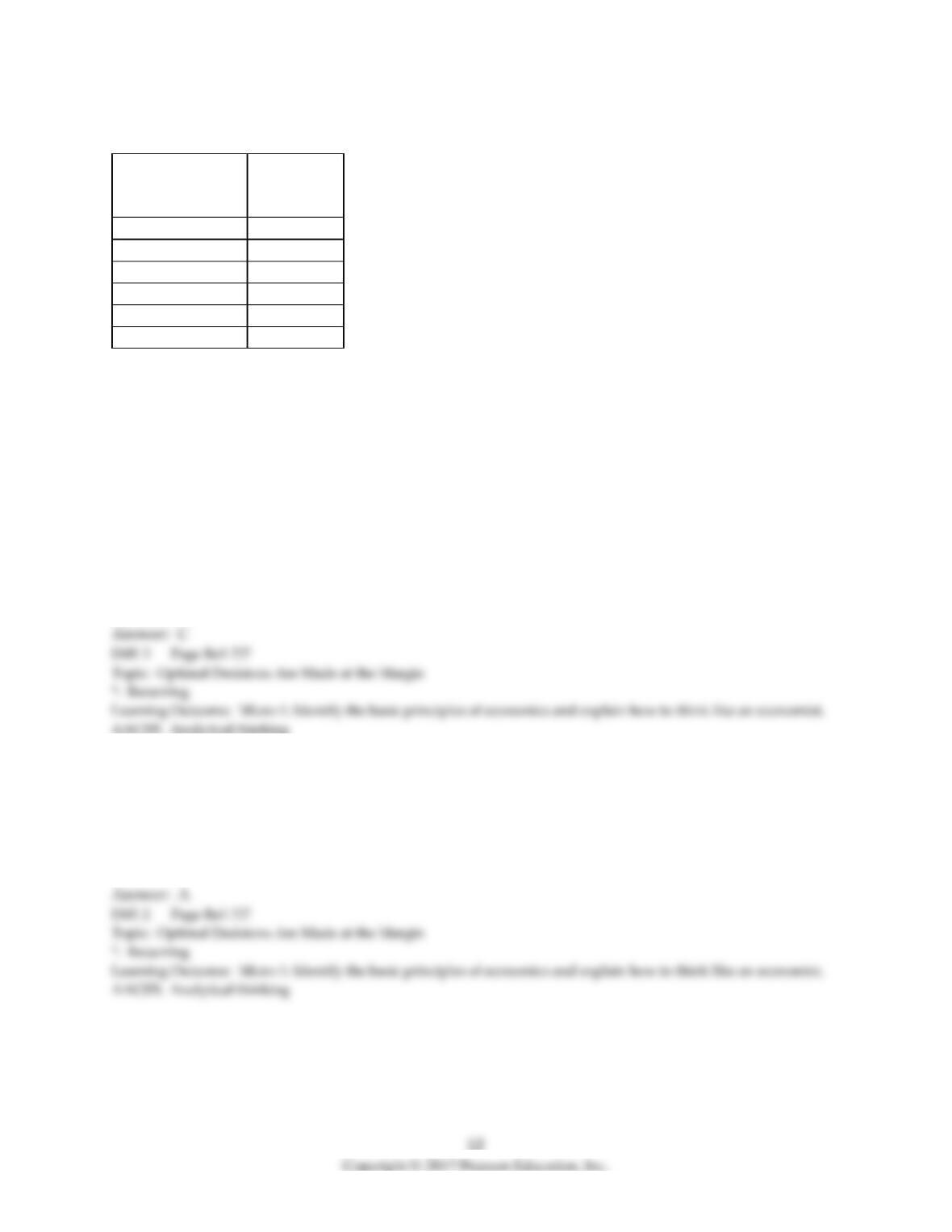
Table 1-1
Hours
Open
Total
Revenue
(dollars)
1
$35
2
60
3
80
4
92
5
100
6
105
Eva runs a small bakery in the village of Roggerli. She is debating whether she should extend her hours
of operation. Eva figures that her sales revenue will depend on the number of additional hours the
bakery is open as shown in the table above. She would have to hire a worker for those hours at a wage
rate of $12 per hour.
36) Refer to Table 1-1. Using marginal analysis, how many hours should Eva extend her bakery’s hours
of operations?
A) 2 hours
B) 3 hours
C) 4 hours
D) 5 hours
E) 6 hours
37) Refer to Table 1-1. What is Eva’s marginal benefit if she decides to stay open for two hours instead
of one hour?
A) $25
B) $36
C) $60
D) $95
38) Refer to Table 1-1. What is Eva’s marginal cost if she decides to stay open for two hours instead of
one hour?
A) $12
B) $24
C) $36
D) $71
Table 1-2
Hours
Open
Total
Revenue
(dollars)
1
$40
2
65
3
80
4
90
5
95
6
98
Julius runs a small tailor shop in the city of Bloomfield. He is debating whether he should extend his
hours of operation. Julius figures that his sales revenue will depend on the number of additional hours
the tailor shop is open as shown in the table above. He would have to hire a worker for those hours at a
wage rate of $18 per hour.
39) Refer to Table 1-2. Using marginal analysis, how many hours should Julius extend his shop‘s hours
of operations?
A) 2 hours
B) 3 hours
C) 4 hours
D) 5 hours
E) 6 hours
40) Refer to Table 1-2. What is Julius’s marginal benefit if he decides to stay open for three hours
instead of two hours?
A) $15
B) $25
C) $65
D) $80
41) Refer to Table 1-2. What is Julius’s marginal cost if he decides to stay open for three hours instead of
two hours?
A) $0
B) $18
C) $54
D) $65
42) Tabitha shares a flea market booth with her sister. Her share of the rent is $150 per month. She is
considering moving to her own, larger booth which she will not have to share with anyone. The larger
booth rents for $450 per month. Recently, you ran into Tabitha in the grocery store and she tells you that
she has rented the larger booth. Tabitha is as rational as any other person. As an economics major, you
rightly conclude that
A) Tabitha did not have a choice; her sister was overcharging her.
B) Tabitha figures that the additional benefit of having her own booth (as opposed to sharing) is at least
$300.
C) Tabitha figures that the additional benefit of having her own booth (as opposed to sharing) is at least
$450.
D) the cost of having one’s own booth outweighs the benefits.
43) Consider the following statements:
a. Soda drinkers purchase more soda from a grocery store that sells soda at a lower price than other
rival grocery stores in the area.
b. Homeowners do not take steps to increase security even though they believe it is more costly to
allow burglaries than to install security monitoring equipment.
c. Manufacturers produce less of a particular cell phone when its selling price rises.
Which of the above statements demonstrates that economic agents respond to incentives?
A) a only.
B) b only.
C) c only.
D) a and b.
E) a, b, and c.
44) Suppose the U.S. government encouraged new teachers to take jobs in underperforming schools by
paying the new teachers a $20,000 bonus. These teachers would be exemplifying the economic idea that
A) people are rational.
B) people respond to economic incentives.
C) optimal decisions are made at the margin.
D) equity is more important than efficiency.
45) Zane’s Vanes is a service that restores old weather vanes. Zane has just spent $125 purchasing a
1920s-era weather vane which he expects to restore and sell for $500 once the work is completed. After
having spent $125, Zane realizes that he will need to spend an additional $200 on materials to complete
the restoration. Alternatively, he can sell the weather vane without restoring it for $200. What is his
marginal benefit if he sells the weather vane without restoring it?
A) $75
B) $125
C) $200
D) $300
16
46) Zane’s Vanes is a service that restores old weather vanes. Zane has just spent $125 purchasing a
1920s-era weather vane which he expects to restore and sell for $500 once the work is completed. After
having spent $125, Zane realizes that he will need to spend an additional $200 on materials to complete
the restoration. Alternatively, he can sell the weather vane without restoring it for $200. What is his
marginal cost to complete the restoration?
A) $75
B) $125
C) $200
D) $300
47) Zane’s Vanes is a service that restores old weather vanes. Zane has just spent $125 purchasing a
1920s-era weather vane which he expects to restore and sell for $500 once the work is completed. After
having spent $125, Zane realizes that he will need to spend an additional $200 on materials to complete
the restoration. Alternatively, he can sell the weather vane without restoring it for $200. What should he
do?
A) He should sell the weather vane now to make the most profit.
B) It does not matter what he does; he is going to take a loss on the project.
C) He should finish the restoration and then sell the weather vane.
D) He should sell the weather vane back to the party he purchased it from and cut his losses.
Scenario 1-2
Suppose a cigar manufacturer currently sells 1,500 cigars per week and makes a profit of $3,000 per
week. The plant foreman observes, “Although the last 500 cigars we produced and sold increased our
revenue by $7,500 and our costs by $7,000, we are only making an overall profit of $3,000 per week so I
think we need to cut back on production.
48) Refer to Scenario 1-2. Using marginal analysis terminology, what is another economic term for the
incremental revenue received from the sale of the last 500 cigars?
A) gross earnings
B) marginal revenue
C) sales revenue
D) gross profit
49) Refer to Scenario 1-2. Using marginal analysis terminology, what is another economic term for the
incremental cost of producing the last 500 cigars?
A) marginal cost
B) operating cost
C) explicit cost
D) Any of the above terms are correct.
50) Refer to Scenario 1-2. Had the firm not produced and sold the last 500 cigars, would its profit be
higher or lower, and if so by how much?
A) Its profit would be $500 higher.
B) Its profit would be $1,000 higher.
C) Its profit would be $500 lower.
D) Its profit would be $1,500 lower.
Table 1-3
Hours
Open
Total
Revenue
(dollars)
1
$275
2
375
3
450
4
500
5
530
6
550
Ivan runs a custom jewelry shop in Sparkle City. He is debating whether he should extend his hours of
operation. Ivan figures that his sales revenue will depend on the number of additional hours the jewelry
shop is open as shown in the table above. He would have to hire a worker for those hours at a wage rate
of $25 per hour.
51) Refer to Table 1-3. Using marginal analysis, how many hours should Ivan extend his hours of
operations?
A) 2 hours
B) 3 hours
C) 4 hours
D) 5 hours
E) 6 hours
52) Refer to Table 1-3. What is Ivan‘s marginal benefit if he decides to stay open for six hours instead of
five hours?
A) $10
B) $20
C) $30
D) $91.67
53) Refer to Table 1-3. What is Ivan’s marginal cost if he decides to stay open for six hours instead of
five hours?
A) $10
B) $20
C) $25
D) $91.67
54) Fiona shares an office with her ex-husband. Her share of the rent and utilities is $625 per month. She
is considering moving to a home office which she will not have to share with anyone. The home office
will not cost her anything as far as extra rent or utilities. Recently, you ran into Fiona at the gym and she
tells you that she has moved into her home office. Fiona is as rational as any other person. As an
economics major, you rightly conclude that
A) Fiona did not have a choice; her ex-husband was a jerk.
B) Fiona figures that the additional benefit of having her own office (as opposed to sharing) is at least
$625.
C) Fiona figures that the benefit of having her own office (as opposed to sharing) is zero, since she is no
longer paying rent and utilities.
D) The cost of having one’s own space outweighs the benefits.
55) All economic questions arise from the fact that resources are scarce.
56) As population declines, scarcity eventually disappears.
57) The term “market” refers only to trading arrangements that have been approved by the government.
58) The sales revenue a seller receives from the sale of an additional unit of goods is called the marginal
cost.
59) Marginal benefit is the benefit that your activity provides to someone else.
60) If it costs Vijay $150 to design 5 Web sites and $175 to design 6 Web sites, then $175 is the marginal
cost of producing the 6th Web site.
61) Suppose the extra cost for a company to advertize for one extra day each week on a local TV station
is $1,500. Then, the company should advertize on that additional day if it can generate total revenue of
$1,500 each week.
62) An economic model is a complex version of reality used to analyze real-world economic situations.