Chapter 01 – Economics: The Study of Opportunity Cost
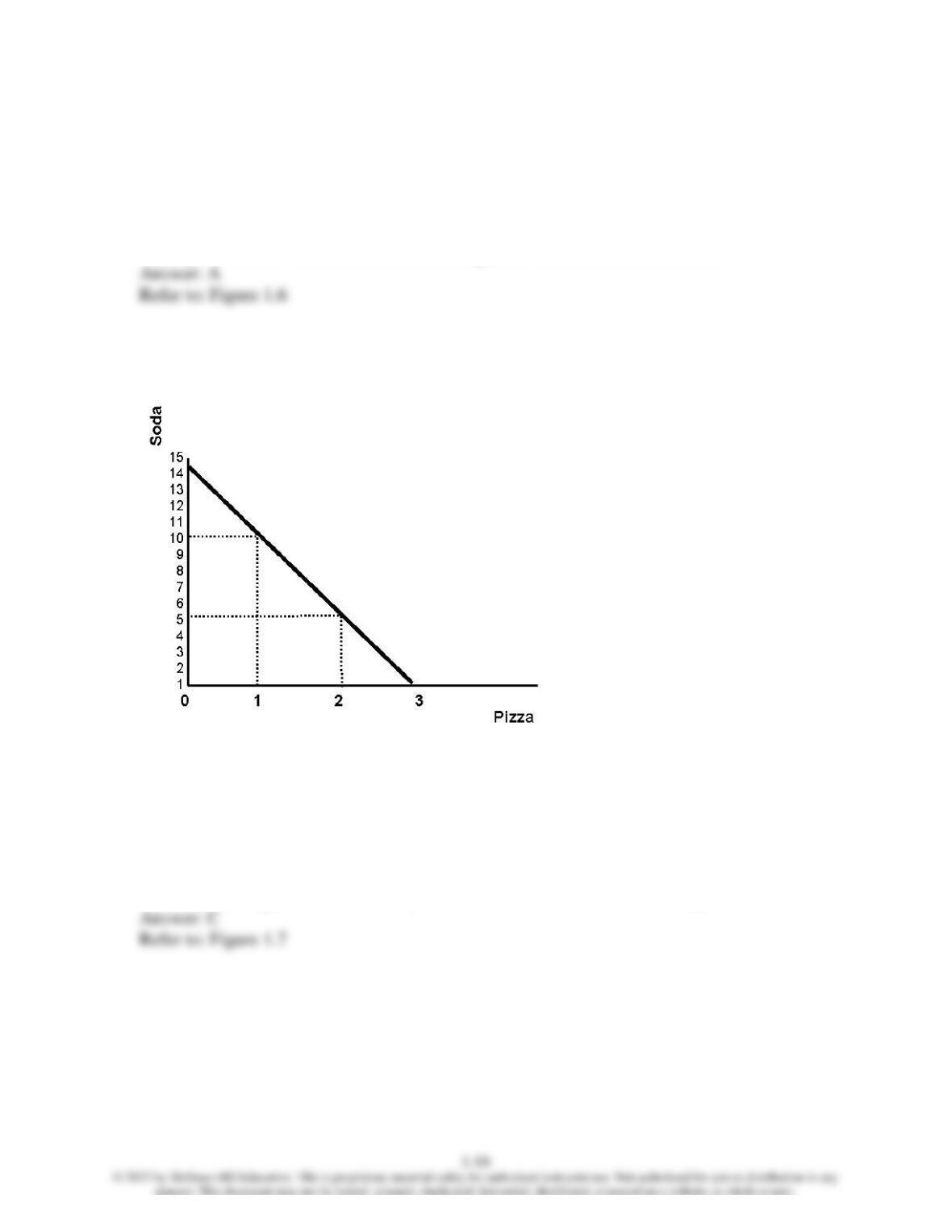
Figure 1.6
53) Using Figure 1.6 above you can tell that
A) there is increasing opportunity cost.
B) there is unemployment.
C) there is constant opportunity cost.
D) the technology does not exist to produce 90 units of soda and 2 units of pizza.
54) Using Figure 1.6 above you can tell that
A) the technology does not exist to produce 130 units of soda and 1 unit of pizza.
B) there is unemployment.
C) there is constant opportunity cost.
D) the technology does not exist to produce 90 units of soda and 3 units of pizza.
55) Using Figure 1.6 above we know the production of 90 units of soda and 2 units of pizza is
A) possible, but there would be unemployed resources.
B) possible, but only if all resources were fully employed.
C) impossible because we have the resources but do not have the technology.
D) impossible because we have the technology but do not have the resources.
56) Using Figure 1.6 above we know the production of 130 units of soda and 1 unit of pizza is
A) possible, but there would be unemployed resources.
B) possible, but only if all resources were fully employed.
C) impossible because we have the resources but do not have the technology.
D) impossible because we have the technology but do not have the resources.
57) Using Figure 1.6 above we know the production of 90 units of soda and 4 units of pizza is
A) possible, but there would be unemployed resources.
B) possible, but only if all resources were fully employed.
C) impossible because we either do not have the resources or the technology.
D) undesirable.
Chapter 01 – Economics: The Study of Opportunity Cost
58) Using Figure 1.6 above we know the production of 90 units of soda and 1 units of pizza is
A) possible, but there would be unemployed resources.
B) possible, but only if all resources were fully employed.
C) impossible because we have the resources but do not have the technology.
D) impossible because we have the technology but do not have the resources.
Use the following to answer questions 59-64:
Figure 1.7
59) Using Figure 1.7 above you can tell that
A) there is increasing opportunity cost.
B) there is unemployment.
C) there is constant opportunity cost.
D) the technology does not exist to produce 10 units of soda and 1 unit of pizza.
Chapter 01 – Economics: The Study of Opportunity Cost
60) Using Figure 1.7 above you can tell that
A) the technology does not exist to produce 5 units of soda and 3 units of pizza.
B) there is unemployment.
C) there is increasing opportunity cost.
D) the technology does not exist to produce 10 units of soda and 1 units of pizza.
61) Using Figure 1.7 above we know the production of 5 units of soda and 2 units of pizza is
A) possible, but there would be unemployed resources.
B) possible, but only if all resources were fully employed.
C) impossible because we have the resources but do not have the technology.
D) impossible because we have the technology but do not have the resources.
62) Using Figure 1.7 above we know the production of 10 units of soda and 1 unit of pizza is
A) possible, but there would be unemployed resources.
B) possible, but only if all resources were fully employed.
C) impossible because we have the resources but do not have the technology.
D) impossible because we have the technology but do not have the resources.
63) Using Figure 1.7 above we know the production of 10 units of soda and 2 units of pizza is
A) possible, but there would be unemployed resources.
B) possible, but only if all resources were fully employed.
C) impossible because we either do not have the resources or the technology.
D) undesirable.
64) Using Figure 1.7 above we know the production of 4 units of soda and 2 units of pizza is
A) possible, but there would be unemployed resources.
B) possible, but only if all resources were fully employed.
C) impossible because we have the resources but do not have the technology.
D) impossible because we have the technology but do not have the resources.
Chapter 01 – Economics: The Study of Opportunity Cost
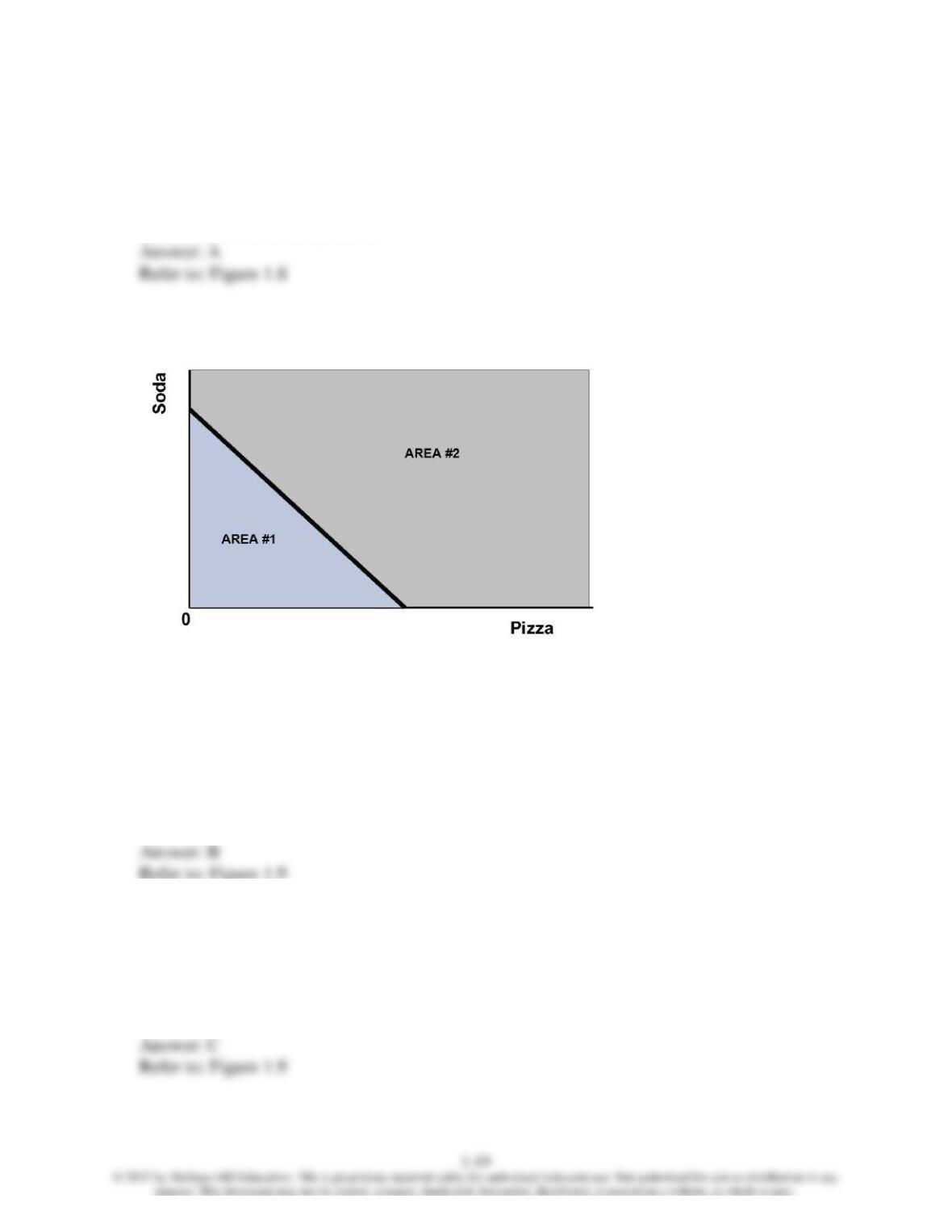
Use the following to answer questions 65-67
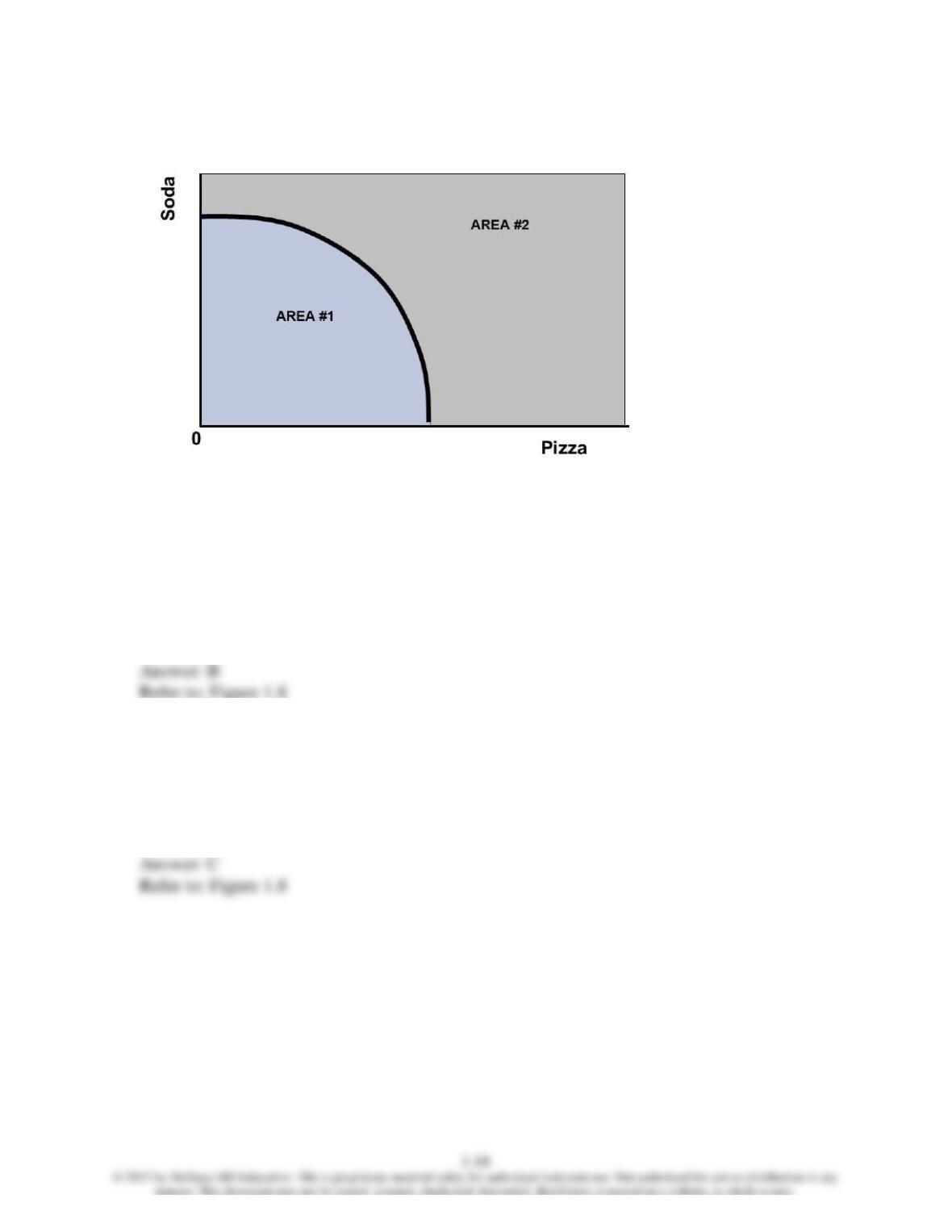
Figure 1.8
65) Referring to Figure 1.8, if a point is attainable it is in
A) AREA #1 but not on the curve.
B) AREA #1 or is on the curve.
C) AREA #2 but not on the curve.
D) AREA #2 or is on the curve.
66) Referring to Figure 1.8, if a point is unattainable it is in
A) AREA #1 but not on the curve.
B) AREA #1 or is on the curve.
C) AREA #2 but not on the curve.
D) AREA #2 or is on the curve.
Chapter 01 – Economics: The Study of Opportunity Cost
67) Referring to Figure 1.8, if a point represents unemployment it is in
A) AREA #1 but not on the curve.
B) AREA #1 or is on the curve.
C) AREA #2 but not on the curve.
D) AREA #2 or is on the curve.
Use the following to answer questions 68-70
Figure 1.9
68) Referring to Figure 1.9, if a point is attainable it is in
A) AREA #1 but not on the curve.
B) AREA #1 or is on the curve.
C) AREA #2 but not on the curve.
D) AREA #2 or is on the curve.
69) Referring to Figure 1.9, if a point is unattainable it is in
A) AREA #1 but not on the curve.
B) AREA #1 or is on the curve.
C) AREA #2 but not on the curve.
D) AREA #2 or is on the curve.
Chapter 01 – Economics: The Study of Opportunity Cost
70) Referring to Figure 1.9, if a point represents unemployment it is in
A) AREA #1 but not on the curve.
B) AREA #1 or is on the curve.
C) AREA #2 but not on the curve.
D) AREA #2 or is on the curve.
71) Chapter 1 entitled “Economics: The Study of Opportunity Cost” makes the point that we
A) can produce all we want of everything we want if we just work harder.
B) face tradeoffs because we have limited resources.
C) can avoid tradeoffs if we simply make the right decisions.
D) do not face tradeoffs because we have limited resources.
72) Imagine an economist ordering pizza by the slice. When deciding how many slices to order
she would pick that number where the enjoyment of the _____ equals the enjoyment she
could get from using the money on another good.
A) first slice
B) last slice
C) average slice
D) total number of slices
73) An economist, when analyzing a problem will compare the ___ and choose the outcome
where they are equal
A) average benefits to the average costs
B) marginal benefits to the marginal costs
C) total benefits to the total costs
D) fixed benefits to the fixed costs
74) An economist, when analyzing a problem will attempt to
A) maximize the net benefit of an action and this occurs where the marginal benefit equals
the marginal cost.
B) maximize the total benefit of an action.
C) minimize the total cost of an action.
D) maximize the net benefit of an action and this occurs where the average benefit equals the
average cost.

Chapter 01 – Economics: The Study of Opportunity Cost
75) Economic incentives can come from
A) markets.
B) government programs.
C) taxes.
D) all of the options are correct.
76) The statement that “since a farmer will make more money if he has a bumper crop means that
all farmers would make more money if they all had bumper crops” would be an example of
which of the following?
A) the fallacy that correlation is the same as causation
B) the fallacy of composition
C) truth in an obvious form
D) A) and B)
77) Logging companies are always more profitable if they are able to harvest more (rather than
less) lumber in a month. If you concluded from that fact that the logging industry is more
profitable if all of the firms in the industry harvest more, then you would be
A) right.
B) wrong because causation and correlation are not the same.
C) wrong and have fallen victim to the fallacy of composition.
D) wrong because firms operate on jealousy.
78) Every worker is better off making more money and having better benefits. If you concluded
from that fact that all workers would be better off if a law were passed requiring a 25%
increase in wages and benefits, then you would be
A) right.
B) wrong because causation and correlation are not the same.
C) wrong and have fallen victim to the fallacy of composition.
D) wrong because workers operate on jealousy.
79) Many forms of seafood (lobster, crab legs etc.) are consumed by dipping the meat in melted
garlic butter. If someone suggested that it would therefore be equally appealing to drink
melted butter after having eaten garlic and unseasoned seafood, you would know they had
fallen victim to which of the following?
A) the fallacy that correlation is the same as causation
B) the fallacy of composition
C) a logical tautology
D) none of the options are correct
Chapter 01 – Economics: The Study of Opportunity Cost
80) Of course, all individual students are better off if they get better grades. If you were to
conclude that all students would be better off if everyone received an “A” you would
A) have fallen victim to the fallacy of scarcity.
B) be right.
C) have fallen victim to the fallacy of composition.
D) be mistaking correlation with causation.
81) The fact that snow cones sales fall when snow accumulated from the sky suggests that snow
cones sales and snow on the ground are
A) directly correlated.
B) inversely correlated.
C) neither directly correlated nor inversely correlated.
D) both directly correlated and inversely correlated.
82) If you were to conclude, after carefully examining data and using proper evaluation
techniques, that a tax credit for attending college benefits the poor more than a tax deduction
(of equal total cost to the government) would, you would have engaged in _________
analysis to reach that conclusion.
A) contra-indicative
B) positive
C) normative
D) creative
83) When analyzing a problem, if an economist is attempting to understand why something
happened without considering whether or not the action was fair or just, the economist is
thinking
A) positively.
B) negatively.
C) normatively.
D) justifiably.
Chapter 01 – Economics: The Study of Opportunity Cost
84) When analyzing a problem, if an economist is attempting to understand what caused
something to happen without considering whether or not the action was fair or just, the
economist is thinking
A) positively.
B) negatively.
C) normatively.
D) justifiably.
85) When analyzing a problem, if an economist is attempting to understand whether or not an
action was fair or just, the economist is thinking
A) positively.
B) negatively.
C) normatively.
D) justifiably.
86) When analyzing a problem, if an economist is attempting to understand what the future
implications of an action are without considering whether or not the action was fair or just,
the economist is thinking
A) positively.
B) negatively.
C) normatively.
D) justifiably.
87) Some suggest that when economists claim to be thinking ________, they are _____.
A) normatively; deluding themselves
B) positively; deluding themselves
C) normatively; really thinking positively
D) negatively; deluding themselves
88) The fact that when the temperature rises snow shovel sales fall suggests the two are
A) directly correlated.
B) inversely correlated.
C) neither directly correlated nor inversely correlated.
D) both directly correlated and inversely correlated.
Chapter 01 – Economics: The Study of Opportunity Cost
89) The fact that when temperature rises snow cone sales rise suggests the two are
A) directly correlated.
B) inversely correlated.
C) neither directly correlated nor inversely correlated.
D) both directly correlated and inversely correlated.
90) The fact that as snow accumulates, snow shovel sales rise suggests the two are
A) directly correlated.
B) inversely correlated.
C) neither directly correlated nor inversely correlated.
D) both directly correlated and inversely correlated.
91) The statement that Congress passed a tax bill and two months later a recession began, so the
bill must have been poor policy is an example of
A) the fallacy that correlation is the same as causation.
B) the fallacy of composition.
C) truth in an obvious form.
D) both A) and B)
92) The statement that Congress passed a tax bill and two months later a recession ended, so the
bill must have been good policy is an example of
A) the fallacy that correlation is the same as causation.
B) the fallacy of composition.
C) truth in an obvious form.
D) both A) and B)
93) If you concluded from the fact that the last three recessions have occurred while Republicans
were President that their fiscal policies create recessions then you would be
A) right.
B) wrong because causation and correlation are not the same.
C) wrong and have fallen victim to the fallacy of composition.
D) wrong because Democrats are much worse.
Chapter 01 – Economics: The Study of Opportunity Cost
94) An example of an incentive designed to promote savings would be
A) a tax provision that reduces the effective interest rate garnered by savings.
B) an increase in the sales tax.
C) an increase in the capital gains tax rate.
D) a decrease in the exclusion from taxable income of the first $100 of dividends.
95) Each person is better off with a bigger tax return than with a small tax return. That means
that everyone would be better off if all taxes were zero. A person saying that is
A) right.
B) wrong because causation and correlation are not the same.
C) wrong and have fallen victim to the fallacy of composition.
D) wrong because firms operate on jealousy.
96) Suppose you heard a person speaking about two graphs. You couldn’t make out quite what
they were saying but you saw that since 1920, the variable on the left graph showed a
decreasing value and the variable on the right graph showed an increasing value. If they
asserted that the left graph variable’s decrease therefore caused the right variable’s increase
you would be
A) convinced of the soundness of their argument.
B) not yet convinced because you understand that causation and correlation are not the same.
C) not yet convinced because you understand the fallacy of composition.
D) correctly convinced that they were wrong.
97) Every worker is better off making more money and having better benefits. If you concluded
from that fact that all workers would be better off if a law were passed requiring a 25%
increase in wages and benefits then you would be
A) right.
B) wrong because causation and correlation are not the same.
C) wrong and have fallen victim to the fallacy of composition.
D) wrong because workers operate on jealousy.
98) Logging companies are always more profitable if they are able to harvest more (rather than
less) lumber in a month. If you concluded from that fact that the logging industry is more
profitable if all of the firms in the industry harvest more then you would be
A) right.
B) wrong because causation and correlation are not the same.
C) wrong and have fallen victim to the fallacy of composition.
D) wrong because firms operate on jealousy.
Chapter 01 – Economics: The Study of Opportunity Cost
99) If you concluded from the fact that the last three recessions have occurred while Republicans
were President that their fiscal policies create recessions then you would be
A) right.
B) wrong because causation and correlation are not the same.
C) wrong and have fallen victim to the fallacy of composition.
D) wrong because Democrats are much worse.
100) The statement that “since a farmer will make more money if he has a bumper crop means
that all farmers would make more money if they all had bumper crops” would be an
example of which of the following?
A) the fallacy that correlation is the same as causation
B) the fallacy of composition
C) truth in an obvious form
D) none of the options are correct
101) Any mechanism by which buyers and sellers negotiate an exchange is a
A) corporation.
B) market.
C) negotiable instrument.
D) brokerage.
102) A mechanism by which buyers and sellers of labor and financial capital negotiate an
exchange is a
A) stock market.
B) bond market.
C) factor market.
D) brokerage.
103) A mechanism by which buyers and sellers of goods and services negotiate an exchange is a
A) goods and services market.
B) goods and services convention.
C) goods and services union.
D) factor market.
Chapter 01 – Economics: The Study of Opportunity Cost
104) A mechanism by which buyers and sellers of the currencies of the various countries
negotiate an exchange is a
A) foreign bank.
B) foreign stock market.
C) foreign exchange market.
D) foreign currency reserve.
105) Buyers and sellers in the foreign exchange market negotiate an exchange of
A) foreign stocks.
B) foreign banks.
C) foreign government bonds.
D) currencies of various countries.
106) Buyers and sellers in a factor market might be negotiating an exchange of
A) labor or financial capital.
B) goods for use by final consumers.
C) services provided to final consumers.
D) either goods for use by final consumers or services provided to final consumers.
107) Buyers and sellers in the market for goods and services might be negotiating an exchange of
A) labor or financial capital.
B) goods for use by final consumers.
C) services provided to final consumers.
D) either goods for use by final consumers or services provided to final consumers.
108) If the (steadily decreasing) marginal benefit of another day spent in the hospital exceeds the
(steadily increasing) marginal cost of an additional day spent in the hospital, the rational
consumer of hospital services would be predicted to
A) check out of the hospital immediately.
B) stay in the hospital for at least that additional day.
C) demand a refund from the hospital for the previous day’s stay.
D) complain about the hospital food.
Chapter 01 – Economics: The Study of Opportunity Cost
109) If the (steadily increasing) marginal cost of another day spent in the hospital exceeds the
(steadily decreasing) marginal benefit of an additional day spent in the hospital, the rational
consumer of health care services would be predicted to
A) choose not to stay in the hospital for that additional day.
B) stay in the hospital for at least that additional day.
C) demand a private hospital room.
D) regret having ever entered that hospital.
110) If the (steadily decreasing) marginal benefit of another day spent in the hospital is larger
than the (steadily increasing) marginal cost of an additional day spent in the hospital, the
A) net benefit from the hospital stay must be positive.
B) net benefit from the hospital stay must be decreasing.
C) net benefit from the hospital stay must be increasing.
D) net benefit from the hospital stay is maximized.
111) If the (steadily decreasing) marginal benefit of another day spent in the hospital is smaller
than the (steadily increasing) marginal cost of an additional day spent in the hospital, the
A) net benefit from the hospital stay must be negative.
B) net benefit from the hospital stay must be decreasing.
C) net benefit from the hospital stay must be increasing.
D) net benefit from the hospital stay is maximized.
112) If the (steadily decreasing) marginal benefit of another day spent in the hospital is equal to
the (steadily increasing) marginal cost of an additional day spent in the hospital, the
A) net benefit from the hospital stay must be positive.
B) net benefit from the hospital stay must be negative.
C) net benefit from the hospital stay must be increasing.
D) net benefit from the hospital stay is maximized.