
Chapter 1: An Overview of Financial Management
58.
Which of the following statements is CORRECT?
a.
One disadvantage of organizing a business as a corporation rather than a partnership is that the equity
investors in a corporation are exposed to unlimited liability.
b.
Using restrictive covenants in debt agreements is an effective way to reduce conflicts between stockholders
and managers.
c.
Managers generally welcome hostile takeovers since the “raider” generally offers a price for the stock that is
higher than the price before the takeover action started.
d.
The managers of established, stable companies sometimes attempt to get their state legislatures to impose
rules that make it more difficult for raiders to succeed with hostile takeovers.
e.
Most business in the U.S. is conducted by corporations, and corporations’ popularity results primarily from
their favorable tax treatment.
59.
Which of the following statements is CORRECT?
a.
Well-designed bond covenants are useful for reducing potential conflicts between stockholders and
managers.
b.
The bid price in a hostile takeover is generally above the price before the takeover attempt is announced,
because otherwise there would be no incentive for the stockholders to sell to the hostile bidder and the
takeover attempt would probably fail.
c.
Stockholders in general would be better off if managers never disclosed favorable events and therefore
caused the price of the firm’s stock to sell at a price below its intrinsic value.
d.
Takeovers are most likely to be attempted if the target firm’s stock price is above its intrinsic value.
e.
The efficiency of the U.S. economy would probably be increased if hostile takeovers were absolutely
forbidden.
60.
Which of the following statements is CORRECT?
a.
Hostile takeovers are most likely to occur when a firm’s stock is selling below its intrinsic value as a result
of
poor management.
b.
The efficiency of the U.S. economy would probably be increased if hostile takeovers were absolutely
forbidden.
c.
The managers of established, stable companies sometimes attempt to get their state legislatures to remove
rules that make it more difficult for raiders to succeed with hostile takeovers.
d.
In general, it is more in bondholders’ interests than stockholders’ interests for a firm to shift its investment
focus away from safe, stable investments and into risky investments, especially those that primarily involve
research and development.
e.
Stockholders in general would be better off if managers never disclosed favorable events and therefore
caused the price of the firm’s stock to sell at a price below its intrinsic value.

61.
Which of the following statements is CORRECT?
a.
One disadvantage of operating as a corporation rather than as a partnership is that corporate shareholders are
exposed to more personal liability than are partners.
b.
Relative to proprietorships, corporations generally face fewer regulations, and they also find it easier to raise
capital.
c.
There is no good reason to expect a firm’s stockholders and bondholders to react differently to the types of
assets in which it invests.
d.
Stockholders should generally be happier than bondholders to have managers invest in risky projects with
high
potential returns as opposed to safe projects with lower expected returns.
e.
Stockholders in general would be better off if managers never disclosed favorable events and therefore
caused the price of the firm’s stock to sell at a price below its intrinsic value.
62.
Which of the following statements is CORRECT?
a.
Because bankruptcy requires that corporate bondholders be paid in full before stockholders receive anything,
bondholders generally prefer to see corporate managers invest in high risk/high return projects rather than
low
risk/low return projects.
b.
Since bondholders receive fixed payments, they do not share in the gains if risky projects turn out to be
highly
successful. However, they do share in the losses if risky projects fail and drive the firm into
bankruptcy.
Therefore, bondholders generally prefer to see corporate managers invest in low risk/low return
projects
rather than high risk/high return projects.
c.
One advantage of operating a business as a corporation is that stockholders can deduct their pro rata share of
the taxes the firm pays, thereby eliminating the double taxation investors would face in a partnership.
d.
One drawback of forming a corporation is that you lose the limited liability that you would otherwise receive
as a proprietor.
e.
Potential conflicts between stockholders and bondholders are increased if a firm’s bonds are convertible into
its common stock.
63.
Which of the following statements is CORRECT?
a.
Corporations face few regulations and more favorable tax treatment than do proprietorships and
partnerships.
b.
Managers who face the threat of hostile takeovers are less likely to pursue policies that maximize
shareholder
value compared to managers who do not face the threat of hostile takeovers.
c.
Bond covenants are an effective way to resolve conflicts between shareholders and managers.
d.
Because of their simplified organization, it is easier for proprietors and partnerships to raise large amounts of
outside capital than it is for corporations.
e.
One advantage to forming a corporation is that the owners of the firm have limited liability.
Chapter 1: An Overview of Financial Management
Multiple Choice: Problems
64.
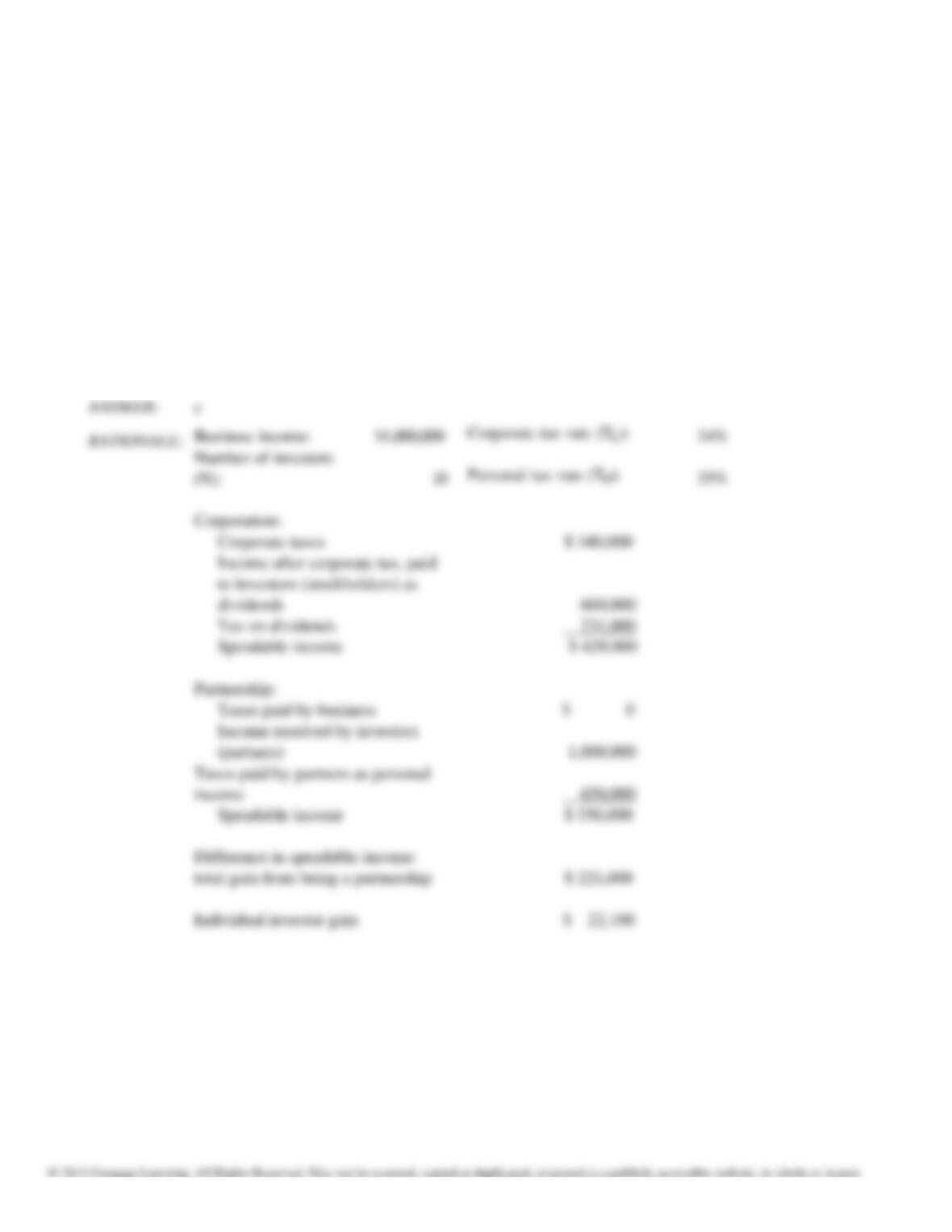
New Business is just being formed by 10 investors, each of whom will own 10% of the business. The firm is
expected to earn $1,000,000 before taxes each year. The corporate tax rate is 34% and the personal tax rate for
the
firm’s investors is 35%. The firm does not need to retain any earnings, so all of its after-tax income will be
paid out
as dividends to its investors. The investors will have to pay personal taxes on whatever they receive.
How much
additional spendable income will each investor have if the business is organized as a partnership
rather than as a
corporation?
a.
$20,384
b.
$20,800
c.
$21,225
d.
$21,658
e.
$22,100
65.
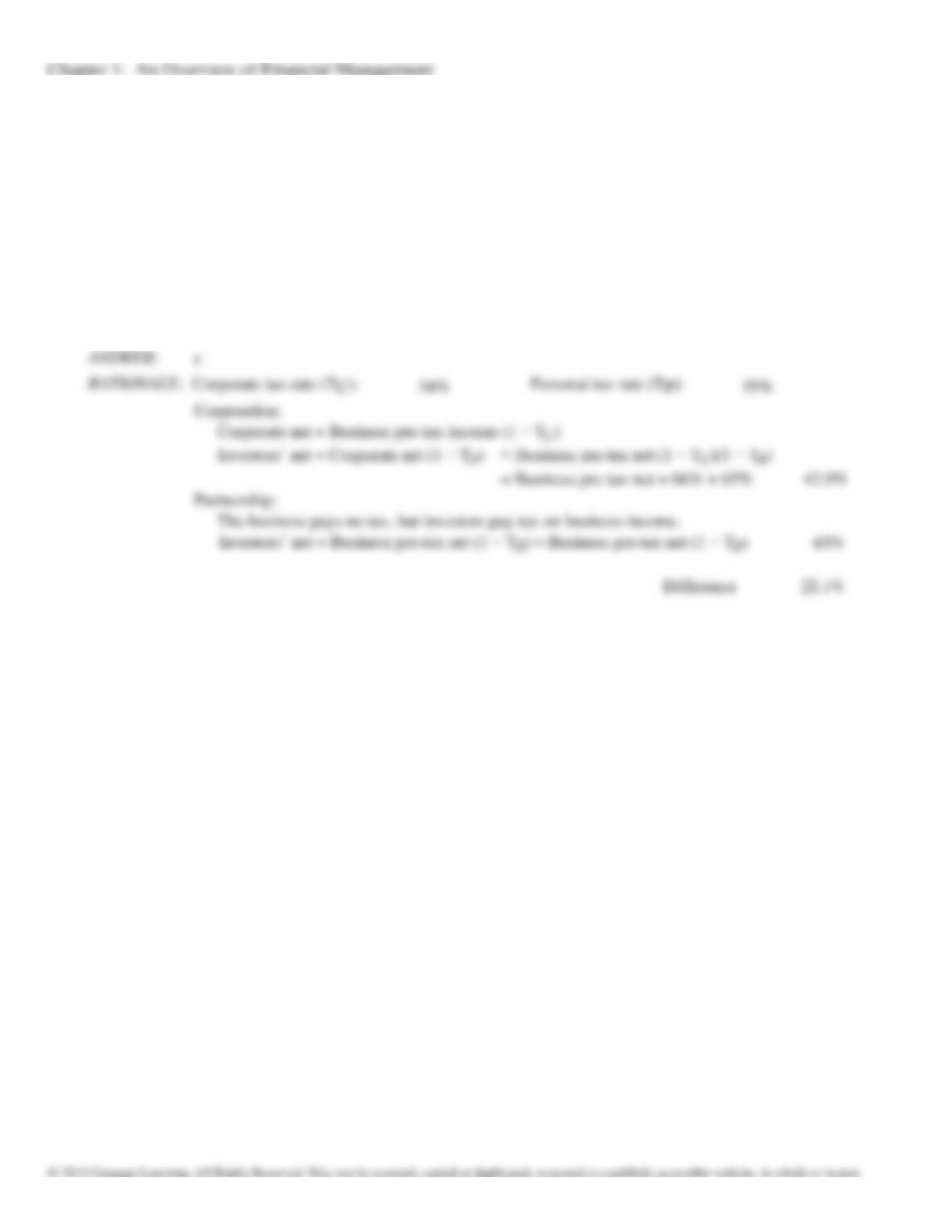
Assume that the corporate tax rate is 34% and the personal tax rate is 35%. The founders of a newly formed
business are debating between setting up the firm as a partnership versus a corporation. The firm will not need
to
retain any earnings, so all of its after-tax income will be paid out to its investors, who will have to pay
personal taxes
on whatever they receive. What is the difference in the percentage of the firm’s pre-tax income
that investors
actually receive and can spend under the corporate and partnership forms of organization?
a. 20.4%
b. 20.8%
c. 21.2%
d. 21.7%
e. 22.1%
66.
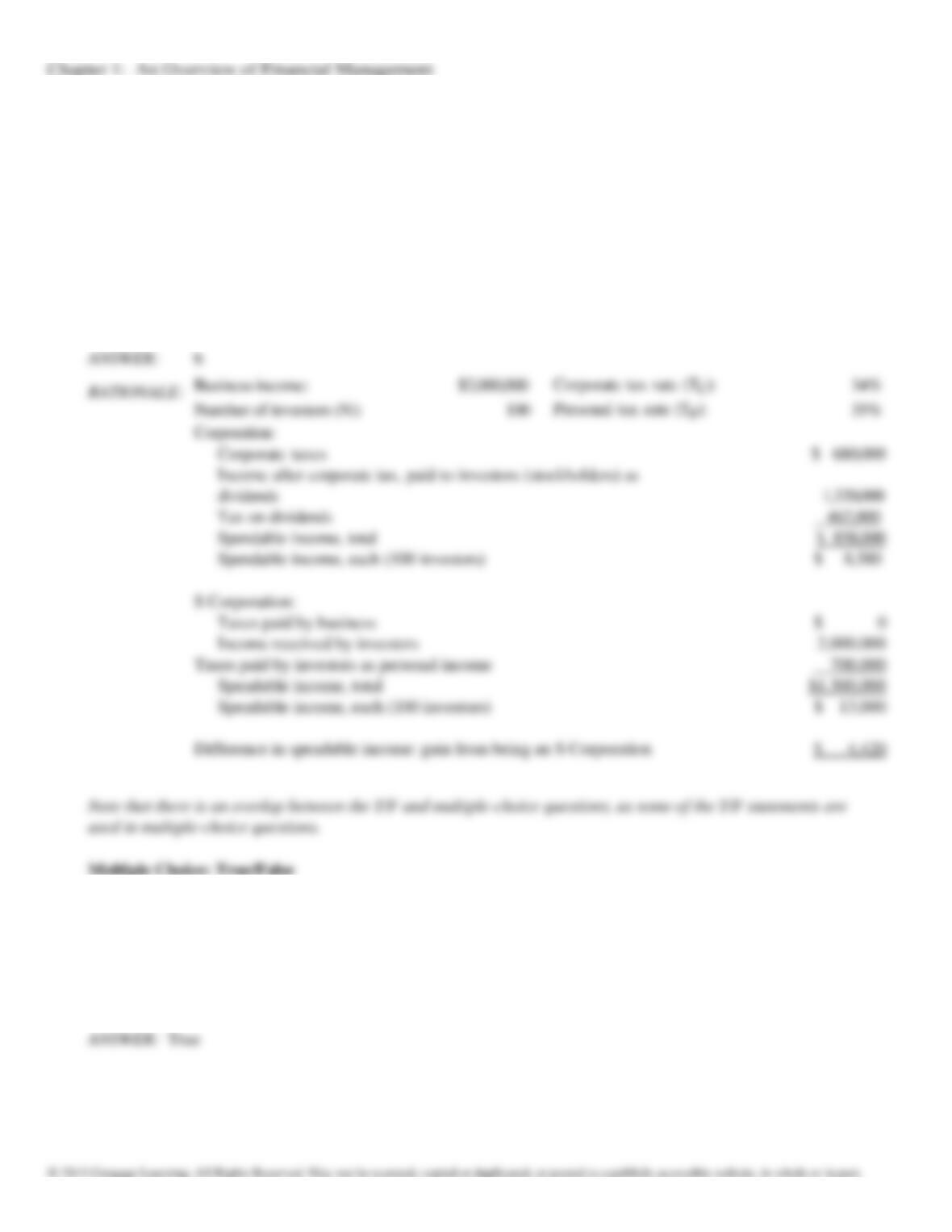
Charleston Corporation (CC) now operates as a “regular” corporation, but it is considering a switch to S
Corporation
status. CC is owned by 100 stockholders who each hold 1% of the stock, and each faces a personal
tax rate of 35%.
The firm earns $2,000,000 per year before taxes, and since it has no need for retained
earnings, it pays out all of its
earnings as dividends. Assume that the corporate tax rate is 34% and the personal
tax rate is 35%. How much more
(or less) spendable income would each stockholder have if the firm elected S
Corporation status?
a. $ 2,565
b. $ 4,420
c. $ 8,580
d. $11,150
e. $13,000
67.
A financial intermediary is a corporation that takes funds from investors and then provides those funds to those
who
need capital. A bank that takes in demand deposits and then uses that money to make long-term mortgage
loans is
one example of a financial intermediary.
a.
True
b.
False

68.
The NYSE is defined as a “spot” market purely and simply because it has a physical location. The NASDAQ,
on the
other hand, is not a spot market because it has no one central location.
a.
True
b.
False
69.
The NYSE is defined as a “primary” market because it is one of the largest and most important stock markets
in the
world.
a.
True
b.
False
70.
Primary markets are large and important, while secondary markets are smaller and less important.
a.
True
b.
False
71.
Private markets are those like the NYSE, where transactions are handled by members of the organization,
while
public markets are those like the NASDAQ, where anyone can make transactions.
a.
True
b.
False
72.
A share of common stock is not a derivative, but an option to buy the stock is a derivative because the value of
the
option is derived from the value of the stock.
a.
True
b.
False
73.
Financial institutions are more diversified today than they were in the past, when federal laws kept investment
banks,
commercial banks, insurance companies, and similar organizations quite separate. Today the larger
financial services
corporations offer a variety of services, ranging from checking accounts, to insurance, to
underwriting securities, to
stock brokerage.
a.
True
b.
False
74.
Hedge funds are somewhat similar to mutual funds. The primary differences are that hedge funds are less
highly
regulated, have more flexibility regarding what they can buy, and restrict their investors to wealthy,
sophisticated
individuals and institutions.
a.
True
b.
False

75.
Trades on the NYSE are generally completed by having a brokerage firm acting as a “dealer” buy securities
and
adding them to its inventory or selling from its inventory. The NASDAQ, on the other hand, operates as an
auction
market, where buyers offer to buy, and sellers to sell, and the price is negotiated on the floor of the
exchange.
a.
True
b.
False
76.
The “over-the-counter” market received its name years ago because brokerage firms would hold inventories of
stocks and then sell them by literally passing them over the counter to the buyer.
a.
True
b.
False
77.
If you decide to buy 100 shares of Google, you would probably do so by calling your broker and asking him or
her to
execute the trade for you. This would be defined as a secondary market transaction, not a primary market
transaction.
a.
True
b.
False
78.
The term IPO stands for “individual purchase order,” as when an individual (as opposed to an institution)
places an
order to buy a stock.
a.
True
b.
False
79.
In a “Dutch auction” for new stock, individual investors place bids for shares directly. Each potential bidder
indicates
the price he or she is willing to pay and how many shares he or she will purchase at that price. The
highest price that
permits the company to sell all the shares it wants to sell is determined, and this is the
“market clearing price.” All
bidders who specified this price or higher are allowed to purchase their shares at
the market clearing price.
a.
True
b.
False
80.
When a corporation’s shares are owned by a few individuals who are associated with the firm’s management,
we
say that the stock is closely held.
a.
True
b.
False

81.
A publicly owned corporation is a company whose shares are held by the investing public, which may include
other
corporations as well as institutional investors.
a.
True
b.
False
82.
If you wanted to know what rate of return stocks have provided in the past, you could examine data on the
Dow
Jones Industrial Index, the S&P 500 Index, or the NASDAQ Index.
a.
True
b.
False
83.
The annual rate of return on any given stock can be found as the stock’s dividend for the year plus the change
in the
stock’s price during the year, divided by its beginning–of-year price.
a.
True
b.
False
84.
The annual rate of return on any given stock can be found as the stock’s dividend for the year plus the change
in the
stock’s price during the year, divided by its beginning–of-year price. If you obtain such data on a large
portfolio of
stocks, like those in the S&P 500, find the rate of return on each stock, and then average those
returns, this would
give you an idea of stock market returns for the year in question.
a.
True
b.
False
85.
Each stock’s rate of return in a given year consists of a dividend yield (which might be zero) plus a capital
gains yield
(which could be positive, negative, or zero). Such returns are calculated for all the stocks in the
S&P 500. A
weighted average of those returns, using each stock’s total market value, is then calculated, and
that average return
is often used as an indicator of the “return on the market.”
a.
True
b.
False
86.
Each stock’s rate of return in a given year consists of a dividend yield (which might be zero) plus a capital
gains yield
(which could be positive, negative, or zero). Such returns are calculated for all the stocks in the
S&P 500. A simple
average of those returns (which gives equal weight to each company in the S&P 500) is
then calculated. That
average is called “the return on the S&P Index,” and it is often used as an indicator of the
“return on the market.”
a.
True
b.
False

87.
You recently sold 100 shares of Microsoft stock to your brother at a family reunion. At the reunion your
brother
gave you a check for the stock and you gave your brother the stock certificates. Which of the following
best
describes this transaction?
a.
This is an example of a direct transfer of capital.
b.
This is an example of a primary market transaction.
c.
This is an example of an exchange of physical assets.
d.
This is an example of a money market transaction.
e.
This is an example of a derivative market transaction.
88.
Which of the following statements is CORRECT?
a.
The NYSE does not exist as a physical location. Rather it represents a loose collection of dealers who trade
stock electronically.
b.
An example of a primary market transaction would be your uncle transferring 100 shares of Walmart stock
to
you as a birthday gift.
c.
Capital market instruments include both long-term debt and common stocks.
d.
If your uncle in New York sold 100 shares of Microsoft through his broker to an investor in Los Angeles,
this
would be a primary market transaction.
e.
While the two frequently perform similar functions, investment banks generally specialize in lending money,
whereas commercial banks generally help companies raise large blocks of capital from investors.
89.
Which of the following is a primary market transaction?
a.
You sell 200 shares of IBM stock on the NYSE through your broker.
b.
You buy 200 shares of IBM stock from your brother. The trade is not made through a broker; you just give
him cash and he gives you the stock.
c.
IBM issues 2,000,000 shares of new stock and sells them to the public through an investment banker.
d.
One financial institution buys 200,000 shares of IBM stock from another institution. An investment banker
arranges the transaction.
e.
IBM sells 2,000,000 shares of treasury stock to its employees when they exercise options that were granted
in
prior years.
90.
Which of the following is an example of a capital market instrument?
a.
Commercial paper.
b.
Preferred stock.
c.
U.S. Treasury bills.
d.
Banker’s acceptances.
e.
Money market mutual funds.

91.
Money markets are markets for
a.
Foreign currencies.
b.
Consumer automobile loans.
c.
Common stocks.
d.
Long-term bonds.
e.
Short-term debt securities such as Treasury bills and commercial paper.
92.
Which of the following statements is CORRECT?
a.
If you purchase 100 shares of Disney stock from your brother-in–law, this is an example of a primary market
transaction.
b.
If Disney issues additional shares of common stock through an investment banker, this would be a secondary
market transaction.
c.
The NYSE is an example of an over-the-counter market.
d.
Only institutions, and not individuals, can engage in derivative market transactions.
e.
As they are generally defined, money market transactions involve debt securities with maturities of less than
one year.
93.
You recently sold 200 shares of Disney stock, and the transfer was made through a broker. This is an example
of:
a.
A money market transaction.
b.
A primary market transaction.
c.
A secondary market transaction.
d.
A futures market transaction.
e.
An over-the-counter market transaction.
94.
Which of the following statements is CORRECT?
a.
Hedge funds are legal in Europe and Asia, but they are not permitted to operate in the United States.
b.
Hedge funds are legal in the United States, but they are not permitted to operate in Europe or Asia.
c.
Hedge funds have more in common with investment banks than with any other type of financial institution.
d.
Hedge funds have more in common with commercial banks than with any other type of financial institution.
e.
Hedge funds are not as highly regulated as most other types of financial institutions. The justification for this
light regulation is that only “sophisticated investors” (i.e., those with high net worths and high incomes) are
permitted to invest in these funds, and these investors supposedly can do any necessary “due diligence” on
their own rather than have it done by the SEC or some other regulator.

95.
Which of the following statements is CORRECT?
a.
While the distinctions are becoming blurred, investment banks generally specialize in lending money,
whereas
commercial banks generally help companies raise capital from other parties.
b.
The NYSE operates as an auction market, whereas NASDAQ is an example of a dealer market.
c.
Money market mutual funds usually invest their money in a well-diversified portfolio of liquid common
stocks.
d.
Money markets are markets for long-term debt and common stocks.
e.
A liquid security is a security whose value is derived from the price of some other “underlying” asset.
96.
Which of the following statements is CORRECT?
a.
The New York Stock Exchange is an auction market, and it has a physical location.
b.
Home mortgage loans are traded in the money market.
c.
If an investor sells shares of stock through a broker, then it would be a primary market transaction.
d.
Capital markets deal only with common stocks and other equity securities.
e.
While the distinctions are blurring, investment banks generally specialize in lending money, whereas
commercial banks generally help companies raise capital from other parties.
97.
Which of the following statements is CORRECT?
a.
The term “IPO” stands for Introductory Price Offered, and it is the price at which shares of a new company
are offered to the public.
b.
IPO prices are generally established by the market, and buyers of the new stock must pay the price that
prevails at the close of trading on the day the stock is offered to the public.
c.
In a “Dutch auction,” investors who want to buy shares in an IPO submit bids indicating how many shares
they want to buy and the price they are willing to pay. The company determines how many shares it wants to
sell. The highest price that enables the company to sell the desired number of shares is the price that all
buyers must pay.
d.
It is possible that the price set in an IPO is so high that investors will refuse to buy the number of shares that
the company wants to sell. In this situation, the IPO is said to be oversubscribed.
e.
It is possible that the price set in an IPO is so low that investors will want to buy more shares than the
company wants to sell. In that case, the company will have to issue more shares than it wants to sell.
98.
Which of the following statements is CORRECT?
a.
The most important difference between spot markets versus futures markets is the maturity of the
instruments
that are traded. Spot market transactions involve securities that have maturities of less than one
year whereas
futures markets transactions involve securities with maturities greater than one year.
b.
Capital market transactions involve only preferred stock or common stock.
c.
If General Electric were to issue new stock this year, this would be considered a secondary market
transaction since the company already has stock outstanding.
d.
Both NASDAQ dealers and “specialists” on the NYSE hold inventories of stocks.
e.
Money market transactions do not involve securities denominated in currencies other than the U.S. dollar.

99.
Which of the following statements is NOT CORRECT?
a.
When a corporation’s shares are owned by a few individuals, we say that the firm is “closely, or privately,
held.”
b.
“Going public” establishes a firm’s true intrinsic value and ensures that a liquid market will always exist for
the
firm’s shares.
c.
The stock of publicly owned companies must generally be registered with and reported to a regulatory
agency
such as the SEC.
d.
When stock in a closely held corporation is offered to the public for the first time, the transaction is called
“going public, or an IPO,” and the market for such stock is called the new issue or IPO market.
e.
It is possible for a firm to go public and yet not raise any additional new capital for the firm itself.