WEB APPENDIX 7A: ZERO COUPON BONDS
1.
Which of the following statements is CORRECT?
a.
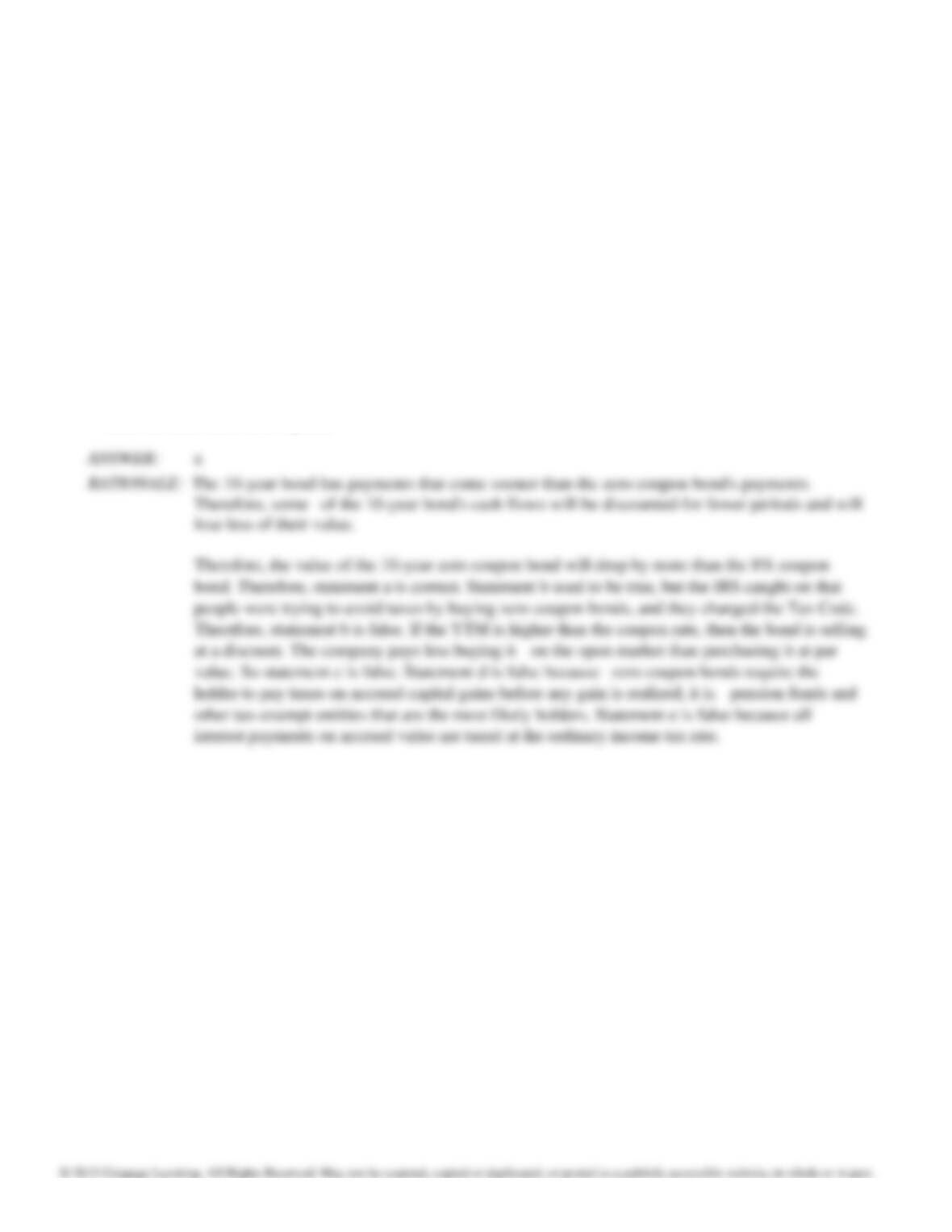
If interest rates increase, a 10-year zero coupon bond’s price will drop by a greater percentage than will a
10-year, 8% coupon bond.
b.
One nice thing about zero coupon bonds is that individual investors do not have to pay any taxes on a
zero
coupon bond until it matures, even if they are not holding the bonds as part of a tax-deferred
account.
c.
If a bond with a sinking fund provision has a yield to maturity greater than its coupon rate, the issuing
company would prefer to comply with the sinking fund by calling the bonds in at par rather than buying
the
bonds back in the open market.
d.
Because of the IRS’s tax treatment of zero coupon bonds, pension funds and other tax-exempt entities
rarely,
if ever, invest in zero coupon bonds.
e.
Interest must be paid on a zero coupon bond’s accrued value, but while the first year‘s interest is taxable at
the
ordinary income tax rate, subsequent years are taxed at the long-term capital gains rate (since they are
received after more than a year).
2.
Consider each of the following bonds:
Bond A: 8-year maturity with a 7% annual coupon.
Bond B: 10-year maturity with a 9% annual coupon.
Bond C: 12-year maturity with a zero coupon.
Each bond has a face value of $1,000 and a yield to maturity of 8%. Which of the following statements is NOT
correct?
a.
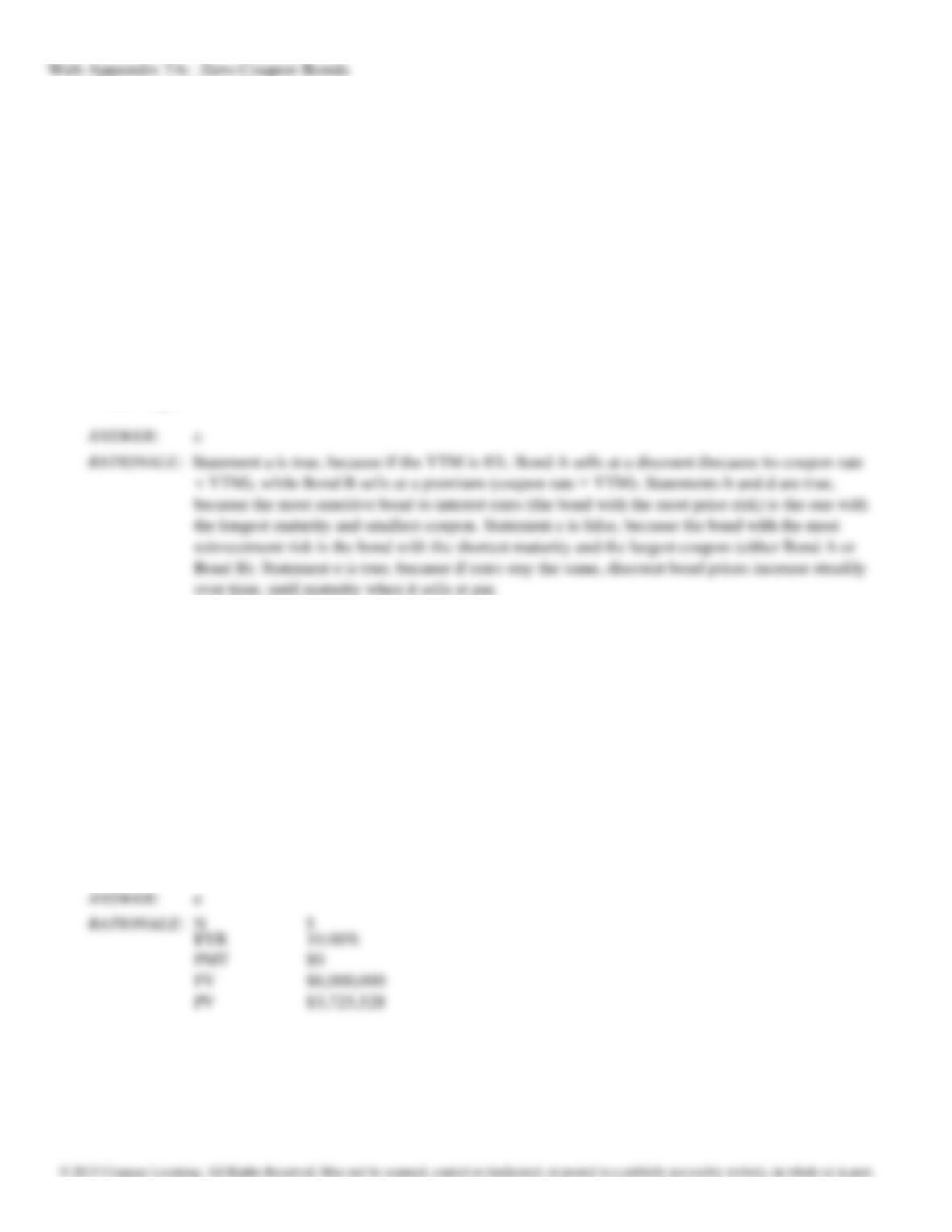
Bond A sells at a discount, while Bond B sells at a premium.
b.
If the yield to maturity on each bond falls to 7%, Bond C will have the largest percentage increase in its price.
c.
Bond C has the most reinvestment risk.
d.
Bond C has the most price risk.
e.
If the yield to maturity is constant, the price of Bond A will continue to increase over its life until it finally
sells
at par.
3.
McGwire Company’s pension fund projects that most of its employees will take advantage of an early retirement
program the company plans to offer in 5 years. Anticipating the need to fund these pensions, the firm bought zero
coupon U.S. Treasury Trust Certificates maturing in 5 years. When these instruments were originally issued, they
were 12% coupon, 30-year U.S. Treasury bonds. The stripped Treasuries are currently priced to yield 10%. Their
total maturity value is $6,000,000. What is their total cost (price) to McGwire today?
a. $3,366,714
b. $3,453,040
c. $3,541,580
d. $3,632,390
e. $3,725,528
4.
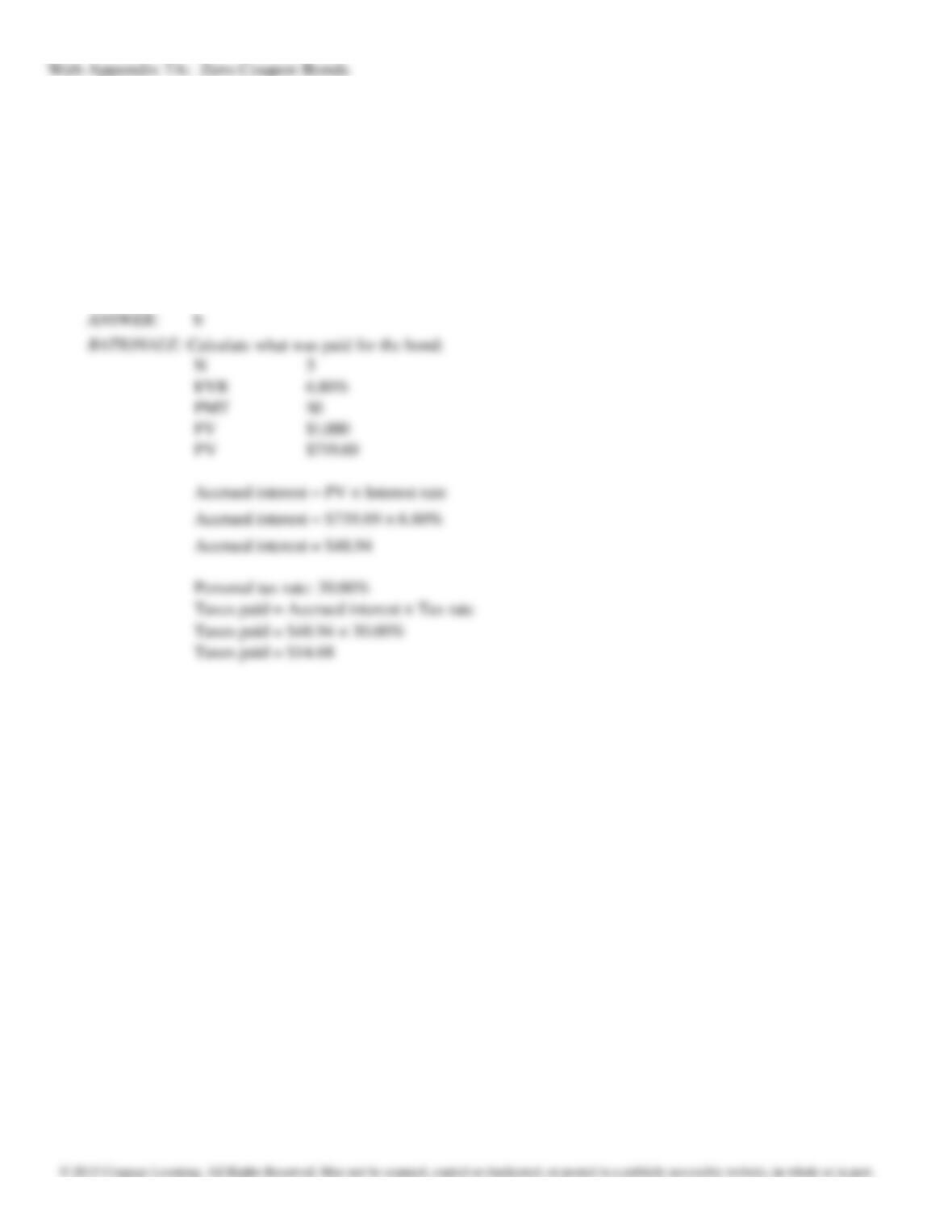
At the beginning of the year, you purchased a 5-year zero coupon bond with a yield to maturity of 6.8% and a face
value of $1,000. Your tax rate is 30%. What is the total tax that you will have to pay on the bond during the first
year?
a. $13.95
b. $14.68
c. $15.42
d. $16.19
e. $17.00
5.
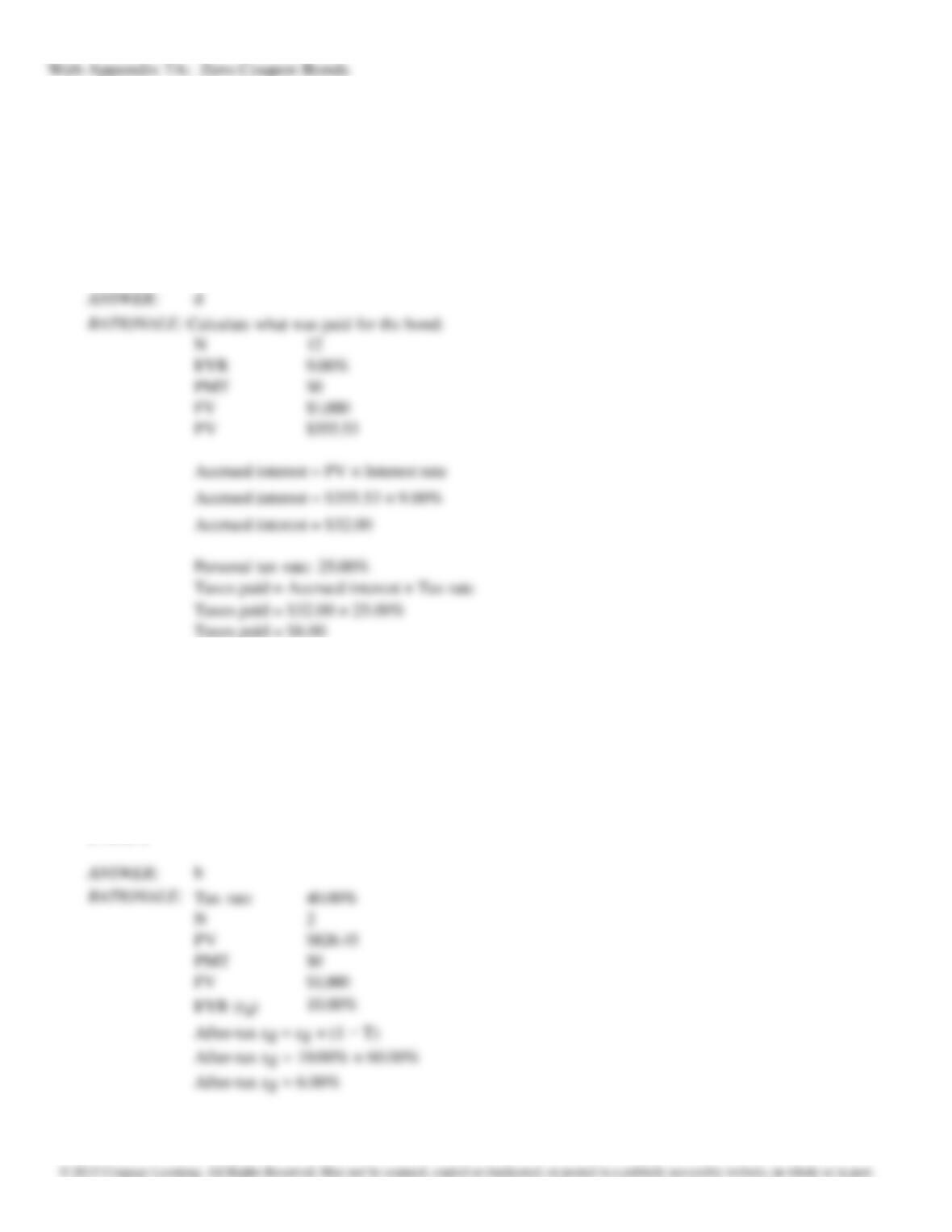
You just purchased a 12–year, $1,000 face value, zero coupon bond with a yield to maturity of 9%. If your tax rate
is
25%, how much in taxes will you have to pay at the end of the first year of holding the bond?
a. $6.86
b. $7.22
c. $7.60
d. $8.00
e. $8.40
6.
S. Claus & Co. is planning a zero coupon bond issue that has a par value of $1,000 and matures in 2 years. The
bonds will be sold today at a price of $826.45. If the firm‘s marginal tax rate is 40%, what is the annual after-tax cost
of debt to the company on this issue?
a. 5.70%
b. 6.00%
c. 6.30%
d. 6.61%
e. 6.95%
7.
A 15-year, $1,000 face value, zero coupon bond has a yield to maturity of 8%. What is the amount of tax an investor
in the 33% tax bracket will pay the first year of the bond?
a. $ 8.32
b. $ 8.74
c. $ 9.18
d. $ 9.63
e. $10.12
8.
On January 1st Julie bought a 7-year, zero coupon bond with a face value of $1,000 and a yield to maturity of 6%.
Assume that Julie’s tax rate is 25%. How much tax will Julie have to pay on the bond the first year she owns it?
a. $ 8.55
b. $ 9.00
c. $ 9.48
d. $ 9.98
e. $10.47
9.
U.S. Delay Corporation, a subsidiary of the Postal Service, must decide whether to issue zero coupon bonds or
quarterly payment bonds to fund construction of new facilities. The $1,000 par value quarterly payment bonds would
sell at $795.54, have a 10% coupon rate, and mature in 10 years. At what price would the zero coupon bonds with a
maturity of 10 years have to sell to earn the same effective annual rate as the quarterly payment bonds?
a. $220.77
b. $232.39
c. $244.62
d. $257.50
e. $270.37
10.
Recycler Battery Corporation (RBC) issued zero coupon bonds 5 years ago at a price of $214.50 per bond. RBC’s
zeros had a 20-year original maturity, with a $1,000 par value. The bonds were callable 10 years after the issue date
at a price 7% over their accrued value on the call date. If the bonds sell for $240 in the market today, what annual
rate of return should an investor who buys the bonds today expect to earn on them?
a. 9.01%
b. 9.48%
c. 9.98%
d. 10.48%
e. 11.00%
11.
Vogril Company issued 20-year, zero coupon bonds with an expected yield to maturity of 9%. The bonds have a par
value of $1,000 and were sold for $178.43 each. What is the expected interest expense on these bonds for Year 8?
a. $29.36
b. $30.82
c. $32.36
d. $33.98
e. $35.68
12.
A 2-year, zero coupon Treasury bond with a maturity value of $1,000 has a price of $873.4387. A 1-year, zero
coupon Treasury bond with a maturity value of $1,000 has a price of $938.9671. If the pure expectations theory is
correct, for what price should 1-year, zero coupon Treasury bonds sell one year from now?
a. $797.54
b. $839.52
c. $883.70
d. $930.21
e. $976.72
13.
A 4-year, zero coupon Treasury bond sells at a price of $762.8952. A 3-year, zero coupon Treasury bond sells at a
price of $827.8491. Assuming the expectations theory is correct, what does the market believe the price of 1-year,
zero coupon bonds will be in 3 years?
a. $921.54
b. $939.97
c. $958.77
d. $977.94
e. $997.50
14.
Assume that the State of Florida sold tax-exempt, zero coupon bonds with a $1,000 maturity value 5 years ago. The
bonds had a 25-year maturity when they were issued, and the interest rate built into the issue was a nominal 8%,
compounded semiannually. The bonds are now callable at a premium of 4% over the accrued value. What effective
annual rate of return would an investor who bought the bonds when they were issued and who still owns them earn
if they were called today?
a. 7.73%
b. 8.13%
c. 8.56%
d. 9.01%
e. 9.46%
15.
Assume that the City of Tampa sold an issue of $1,000 maturity value, tax-exempt (muni), zero coupon bonds 5
years ago. The bonds had a 25-year maturity when they were issued, and the interest rate built into the issue was a
nominal 10%, but with semiannual compounding. The bonds are now callable at a premium of 10% over the
accrued
value. What effective annual rate of return would an investor who bought the bonds when they were
issued and who
still owns them earn if they were called today?
a. 10.08%
b. 10.61%
c. 11.17%
d. 11.75%
e. 12.37%
ANSWER: e
16.
Schiffauer Electronics plans to issue 10-year, zero coupon bonds with a par value of $1,000 and a yield to maturity
of
9.5%. The company has a tax rate of 30%. How much extra in taxes would the company pay (or save) the
second
year (at t = 2) if it goes ahead and issues the bonds?
a. $12.59
b. $12.91
c. $13.23
d. $13.56
e. $13.90
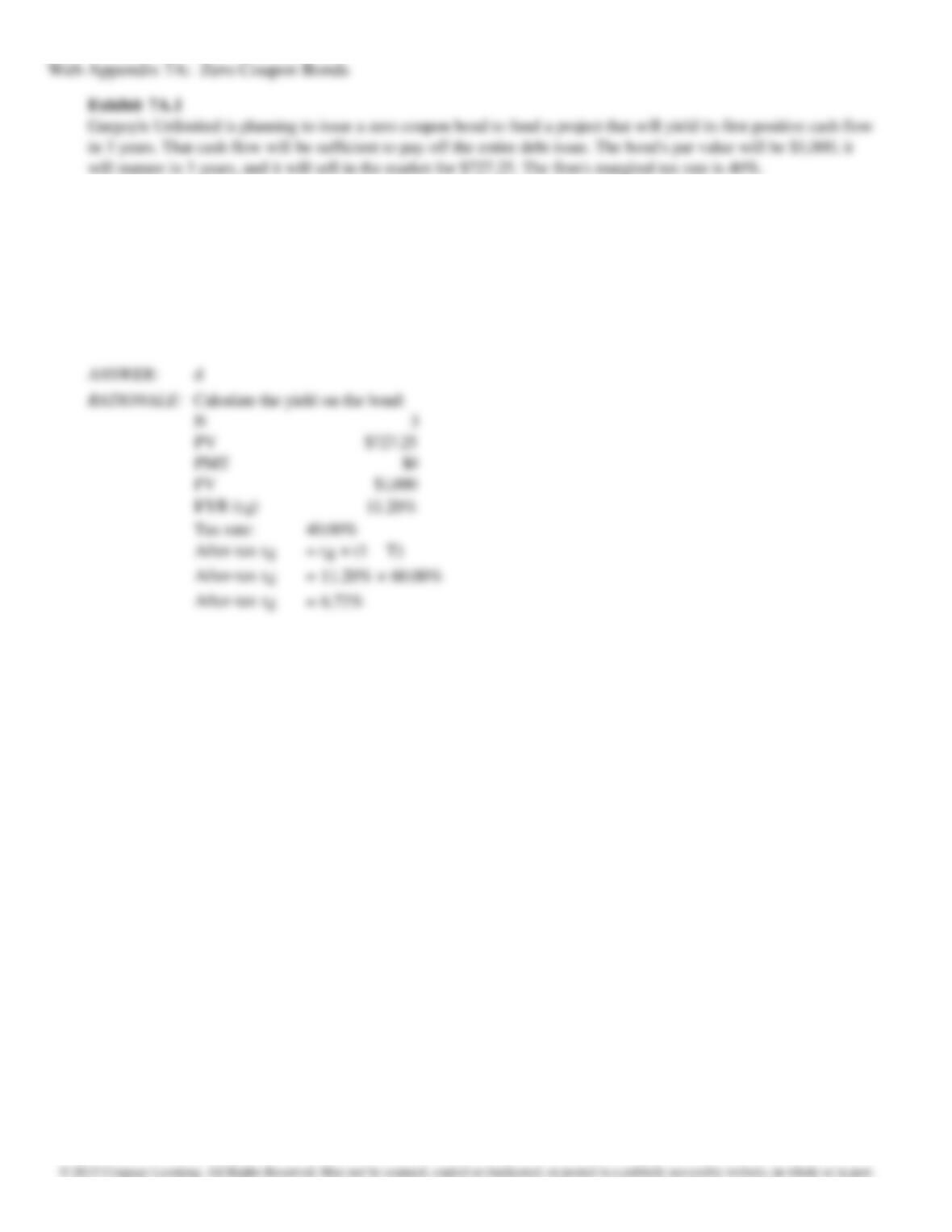
17.
Refer to Exhibit 7A.1. What is the expected after-tax cost of this debt issue?
a. 5.76%
b. 6.06%
c. 6.38%
d. 6.72%
e. 7.06%
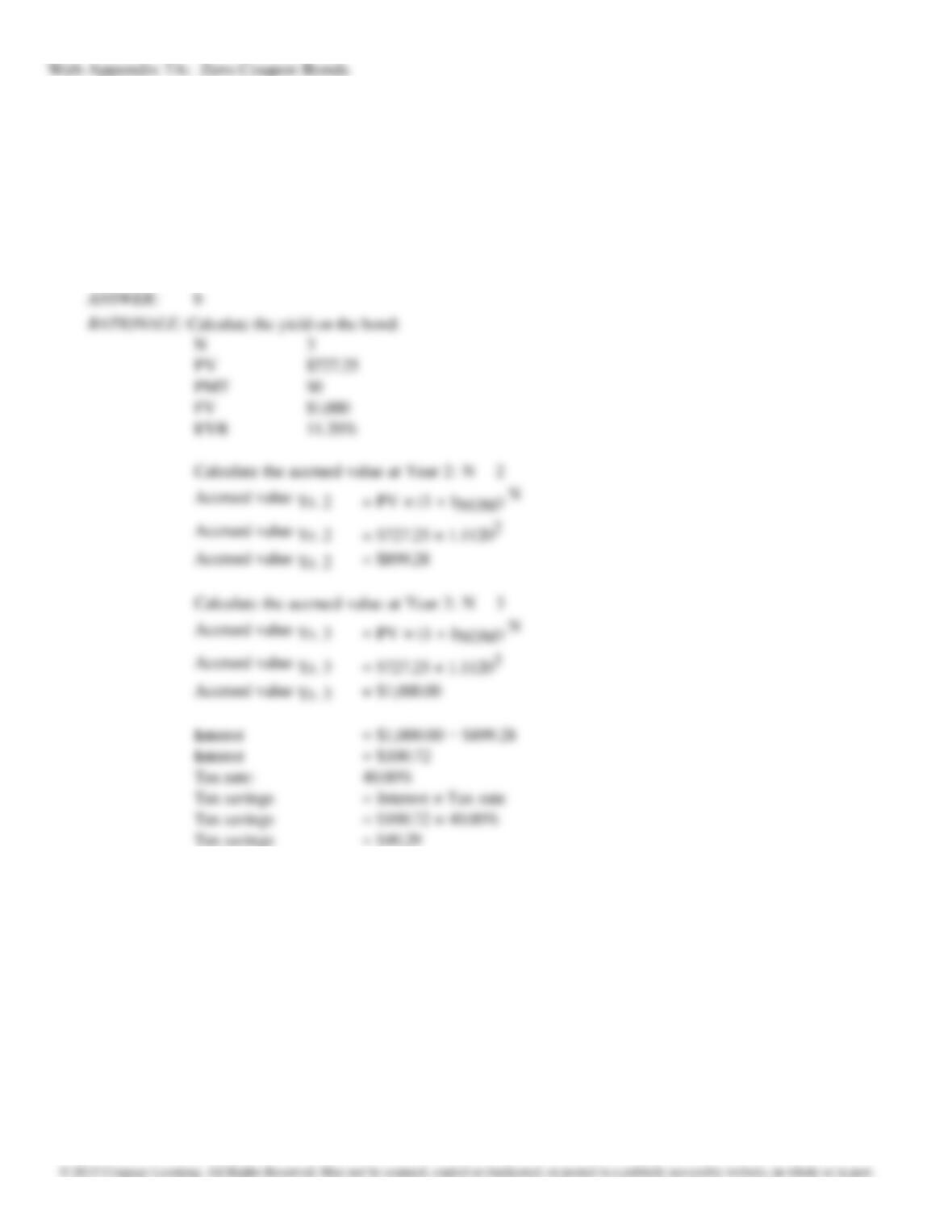
18.
Refer to Exhibit 7A.1. What is the nominal dollar value of the interest tax savings to the firm in the third year of the
issue?
a. $38.27
b. $40.29
c. $42.30
d. $44.42
e. $46.64