WEB APPENDIX 12C: USING THE CAPM TO ESTIMATE THE RISK
ADJUSTED COST OF CAPITAL
1.
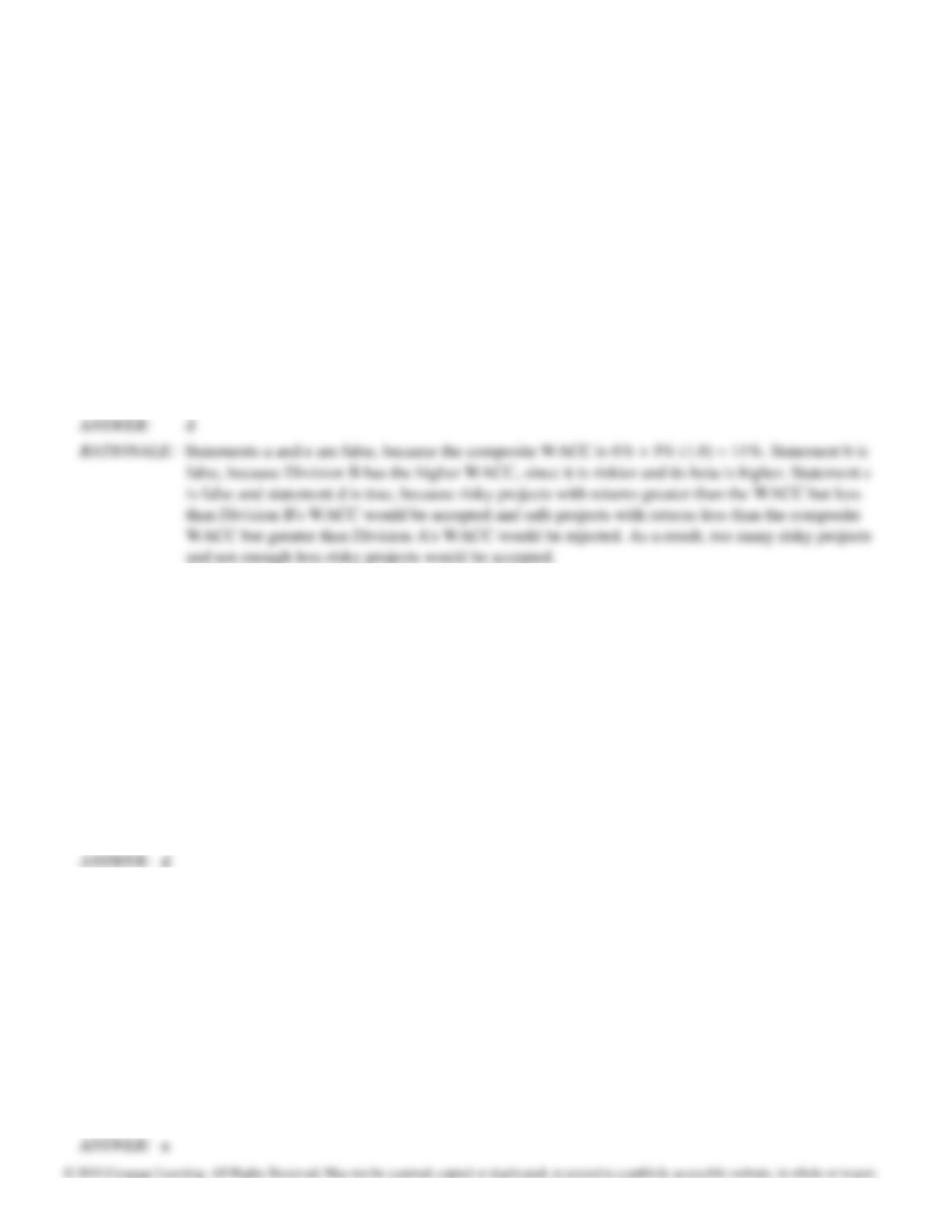
Sunshine Inc. has two equally-sized divisions. Division A has a beta of 0.8 and Division B has a beta of 1.2. The
company is 100% equity financed. The risk-free rate is 6% and the market risk premium is 5%. Sunshine assigns
different hurdle rates to each division based on each division’s market risk. Which of the following statements is
CORRECT?
a.
Sunshine‘s composite WACC is 10%.
b.
Division B has a lower WACC than Division A.
c.
If the same WACC is used for each division, the firm would select too many Division A projects and reject too
many Division B projects.
d.
If the same WACC is used for each division, the firm would select too many Division B projects and reject too
many Division A projects.
e.
Sunshine‘s composite WACC is 12%.
2.
If the firm is being operated so as to maximize shareholder wealth, and if our basic assumptions concerning the
relationship between risk and return are true, then which of the following should be true?
a.
If an asset’s beta is larger than the firm’s beta, then the required return on the asset is less than the required
return on the firm.
b.
If the beta of the asset is smaller than the firm’s beta, then the required return on the asset is greater than the
required return on the firm.
c.
If the beta of the asset is greater than the firm‘s beta prior to the addition of that asset, then the firm’s beta
after the purchase of the asset will be smaller than the original firm’s beta.
d.
If the beta of an asset is larger than the firm‘s beta prior to the addition of that asset, then the required return
on the firm will be greater after the purchase of that asset than prior to its purchase.
e.
None of the statements is true.
3.
Using the Security Market Line concept in capital budgeting, which of the following statements is CORRECT?
a.
If the expected rate of return on a given capital project lies above the SML, the project should be accepted
even if its beta is greater than the beta of the firm’s average project.
b.
If a project‘s return lies below the SML, it should be rejected if it has a beta greater than the firm’s existing
beta but accepted if its beta is below the firm’s beta.
c.
If two mutually exclusive projects’ expected returns are both above the SML, the project with the lower risk
should be accepted.
d.
If a project’s expected rate of return is greater than the expected rate of return on an average project, it should
be accepted.
e.
None of the statements is correct.
4.
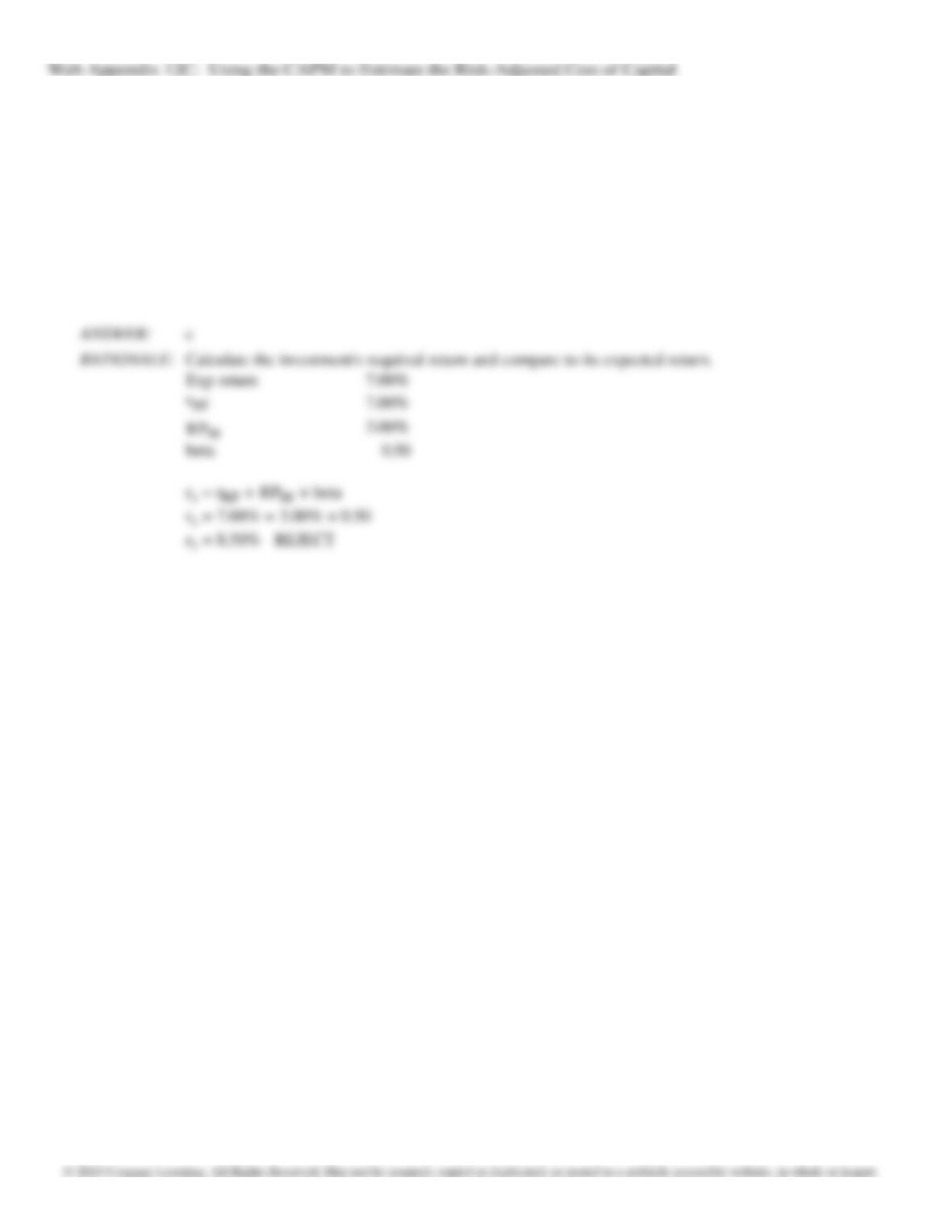
Louisiana Enterprises, an all–equity firm, is considering a new capital investment. Analysis has indicated that the
proposed investment has a beta of 0.5 and will generate an expected return of 7%. The firm currently has a required
return of 10.75% and a beta of 1.25. The investment, if undertaken, will double the firm‘s total assets. If rRF is 7%
and the market risk premium is 3%, should the firm undertake the investment?
a.
Yes; the expected return of the asset (7%) exceeds the required return (6.5%).
b.
Yes; the beta of the asset will reduce the risk of the firm.
c.
No; the expected return of the asset (7%) is less than the required return (8.5%).
d.
No; the risk of the asset (beta) will increase the firm’s beta.
e.
No; the expected return of the asset is less than the firm‘s required return, which is 10.75%.
5.
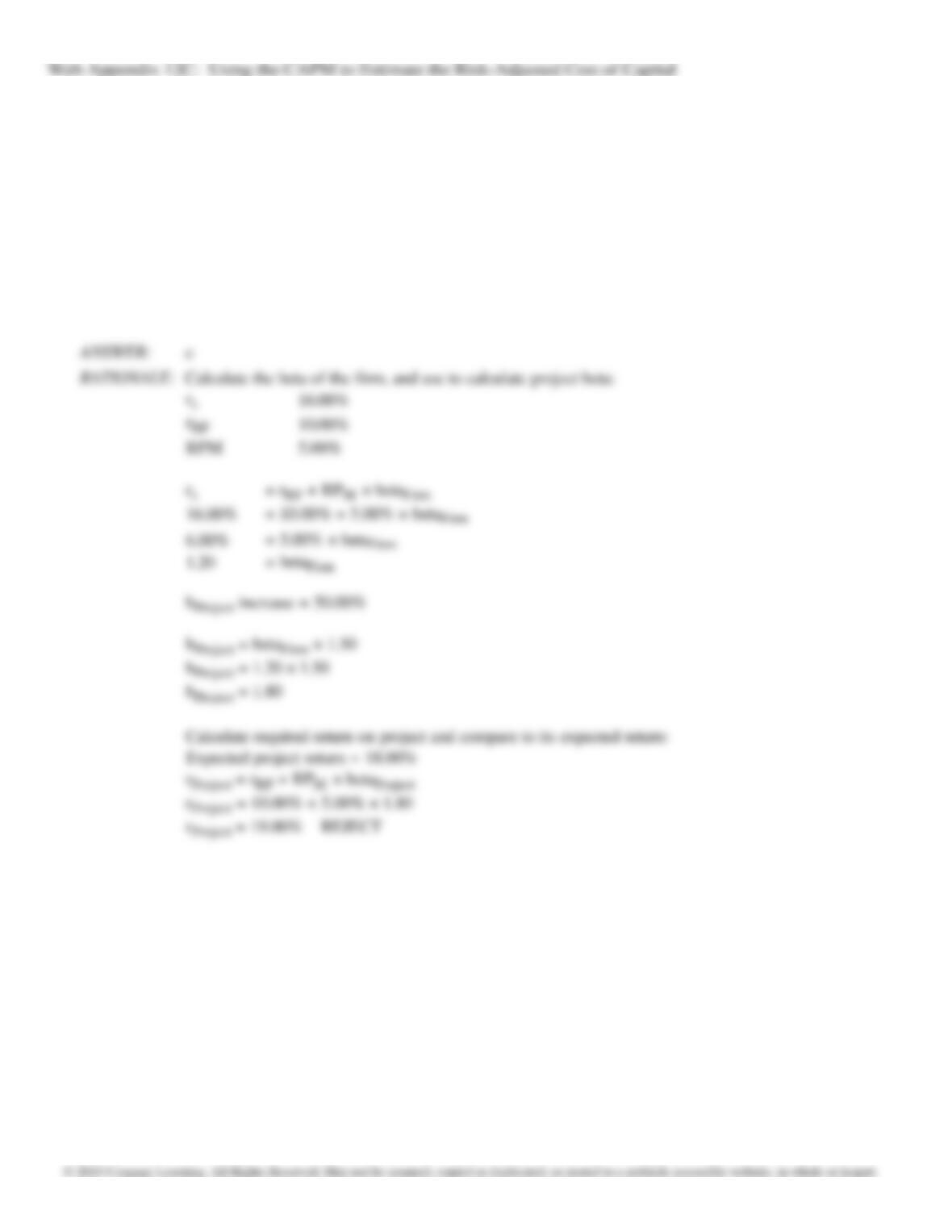
Assume you are the director of capital budgeting for an all-equity firm. The firm‘s current cost of equity is 16%; the
risk-free rate is 10%; and the market risk premium is 5%. You are considering a new project that has 50% more beta
risk than your firm‘s assets currently have, that is, its beta is 50% larger than the firm’s existing beta. The expected
return on the new project is 18%. Should the project be accepted if beta risk is the appropriate risk measure? Choose
the correct statement.
a.
Yes; its expected return is greater than the firm‘s WACC.
b.
Yes; the project’s risk-adjusted required return is less than its expected return.
c.
No; a 50% increase in beta risk gives a risk-adjusted required return of 24%.
d.
No; the project’s risk-adjusted required return is 2% above its expected return.
e.
No; the project’s risk-adjusted required return is 1% above its expected return.