1. By definition, imports are
a.
people who work in foreign countries.
b.
goods in which a country has an absolute advantage.
c.
limits placed on the quantity of goods leaving a country.
d.
goods produced abroad and sold domestically.
2. By definition, exports are
a.
limits placed on the quantity of goods brought into a country.
b.
goods in which a country has an absolute advantage.
c.
people who work in foreign countries.
d.
goods produced domestically and sold abroad.
3. Goods produced abroad and sold domestically are called
a.
exports.
b.
imports.
c.
exchange rates.
d.
opportunity costs.
4. Trade between countries
a.
allows each country to consume at a point outside its production possibilities frontier.
b.
limits a country’s ability to produce goods and services on its own.
c.
must benefit both countries equally; otherwise, trade is not mutually beneficial.
d.
can best be understood by examining the countries’ absolute advantages.
5. When a country has a comparative advantage in producing a certain good,
a.
the country should import that good.
b.
the country should produce just enough of that good for its own consumption.
c.
the country’s opportunity cost of that good is high relative to other countries’ opportunity costs of that same
good.
d.
None of the above is correct.
6. Which of the following would not result from all countries specializing according to the principle of comparative
advantage?
a.
The size of the economic pie would increase.
b.
Worldwide production of goods and services would increase.
c.
The well-being of citizens in each country would be enhanced.
d.
Each country’s production possibilities frontier would shift inward.
7. A country that currently does not trade with other countries could benefit by
a.
restricting imports and promoting exports.
b.
promoting imports and restricting exports.
c.
restricting both imports and exports.
d.
not restricting trade.
8. Suppose the United States has a comparative advantage over Mexico in producing pork. The principle of comparative
advantage asserts that
a.
the United States should produce more pork than what it requires and export some of it to Mexico.
b.
the United States should produce a moderate quantity of pork and import the remainder of what it requires
from Mexico.
c.
the United States should refrain altogether from producing pork and import all of what it requires from
Mexico.
d.
Mexico has nothing to gain from importing United States pork.
9. Belarus has a comparative advantage in the production of linen, but Russia has an absolute advantage in the production
of linen. If these two countries decide to trade,
a.
Belarus should export linen to Russia.
b.
Russia should export linen to Belarus.
c.
trading linen would provide no net advantage to either country.
d.
Without additional information about opportunity costs, this question cannot be answered.
10. Suppose that a worker in Boatland can produce either 5 units of wheat or 25 units of fish per year, and a worker in
Farmland can produce either 25 units of wheat or 5 units of fish per year. There are 10 workers in each country. Political
pressure from the fish lobby in Farmland and from the wheat lobby in Boatland has prevented trade between the two
countries on the grounds that cheap imports would kill the fish industry in Farmland and the wheat industry in Boatland.
As a result, Boatland produces and consumes 25 units of wheat and 125 units of fish per year while Farmland produces
and consumes 125 units of wheat and 25 units of fish per year. If the political pressure were overcome and trade were to
occur, each country would completely specialize in the product in which it has a comparative advantage. If trade were to
occur, the combined output of the two countries would increase by
a.
25 units of wheat and 25 units of fish.
b.
50 units of wheat and 50 units of fish.
c.
75 units of wheat and 75 units of fish.
d.
100 units of wheat and 100 units of fish.
11. Suppose that a worker in Boatland can produce either 5 units of wheat or 25 units of fish per year, and a worker in
Farmland can produce either 25 units of wheat or 5 units of fish per year. There are 30 workers in each country. No trade
occurs between the two countries. Boatland produces and consumes 75 units of wheat and 375 units of fish per year while
Farmland produces and consumes 375 units of wheat and 75 units of fish per year. If trade were to occur, Boatland would
trade 90 units of fish to Farmland in exchange for 80 units of wheat. If Boatland now completely specializes in fish
production, how many units of fish could it now consume along with the 80 units of imported wheat?
a.
490 units
b.
500 units
c.
610 units
d.
660 units
12. In which of the following cases should the United States produce more noodles than it wants for its own use and trade
some of those noodles to Italy in exchange for wine?
a.
Americans know less than Italians know about cooking noodles.
b.
The United States has an absolute advantage over Italy in producing noodles.
c.
Italy has a comparative advantage over the United States in producing wine.
d.
The opportunity cost of producing a gallon of wine is the same for Italy as it is for the United States.
13. Suppose the U.S. and Japan can both produce airplanes and televisions and the U.S. has a comparative advantage in
the production of airplanes while Japan has a comparative advantage in the production of televisions. Also suppose the
U.S. has an absolute advantage in the production of both airplanes and televisions. The U.S. should
a.
not trade airplanes or televisions with Japan.
b.
import airplanes from Japan and export televisions to Japan.
c.
export airplanes to Japan and import televisions from Japan.
d.
export both airplanes and televisions to Japan.
14. Suppose the U.S. and Japan both produce airplanes and televisions and the U.S. has a comparative advantage in the
production of airplanes while Japan has a comparative advantage in the production of televisions. If the U.S. exports
airplanes to Japan and imports televisions from Japan,
a.
both countries, as a whole, will be better off.
b.
all individuals in both countries will be better off.
c.
both countries, as a whole, will be worse off.
d.
all individuals in both countries will be worse off.
15. Serena Williams should pay someone else to mow her lawn instead of mowing it herself, unless
a.
Serena has an absolute advantage over everyone else in mowing her lawn.
b.
Serena has a comparative advantage over everyone else in mowing her lawn.
c.
Serena’s opportunity cost of mowing her lawn is higher than it is for everyone else.
d.
All of the above are correct.
16. Serena Williams should probably not mow her own lawn because
a.
her opportunity cost of mowing her lawn is higher than the cost of paying someone to mow it for her.
b.
she has a comparative advantage in mowing her lawn relative to a landscaping service.
c.
she has an absolute advantage in mowing her lawn relative to a landscaping service.
d.
she might sprain her ankle.
17. When two countries trade with one another, it is most likely because
a.
the wealthy people in each of the two countries are able to benefit, through trade, by taking advantage of other
people who are poor.
b.
some people involved in the trade do not understand that one of the two countries will become worse-off
because of the trade.
c.
the opportunity costs of producing various goods are identical for the two countries.
d.
the two countries wish to take advantage of the principle of comparative advantage.
Table 3-37
Assume that Aruba and Iceland can switch between producing coolers and producing radios at a constant rate.
Labor Hours
Needed to Make 1
Cooler
Radio
Aruba
2
5
Iceland
1
4
18. Refer to Table 3-37. Aruba should export
a.
coolers and import radios.
b.
radios and import coolers.
c.
both goods and import neither good.
d.
neither good and import both goods.
19. Refer to Table 3-37. Iceland should export
a.
coolers and import radios.
b.
radios and import coolers.
c.
both goods and import neither good.
d.
neither good and import both goods.
Table 3-38
Assume that England and Spain can switch between producing cheese and producing bread at a constant rate.
Labor Hours Needed to Make 1 Unit of
Number of Units Produced in 40 Hours
Cheese
Bread
Cheese
Bread
England
1
4
40
10
Spain
4
8
10
5
20. Refer to Table 3-38. England should export
a.
cheese and import bread.
b.
bread and import cheese.
c.
both goods and import neither good.
d.
neither good and import both goods.
21. Refer to Table 3-38. Spain should export
a.
cheese and import bread.
b.
bread and import cheese.
c.
both goods and import neither good.
d.
neither good and import both goods.
Table 3-39
Assume that Japan and Korea can switch between producing cars and producing airplanes at a constant rate.
Hours Needed to Make 1
Quantity Produced in 2400 Hours
Cars
Airplanes
Cars
Airplanes
Japan
30
150
80
16
Korea
50
150
48
16
22. Refer to Table 3-39. Japan should specialize in the production of
a.
cars and import airplanes.
b.
airplanes and import cars.
c.
both goods and import neither good.
d.
neither good and import both goods.
23. Refer to Table 3-39. Korea should specialize in the production of
a.
cars and import airplanes.
b.
airplanes and import cars.
c.
both goods and import neither good.
d.
neither good and import both goods.
Figure 3-25
Chile’s Production Possibilities Frontier
Colombia’s Production Possibilities Frontier
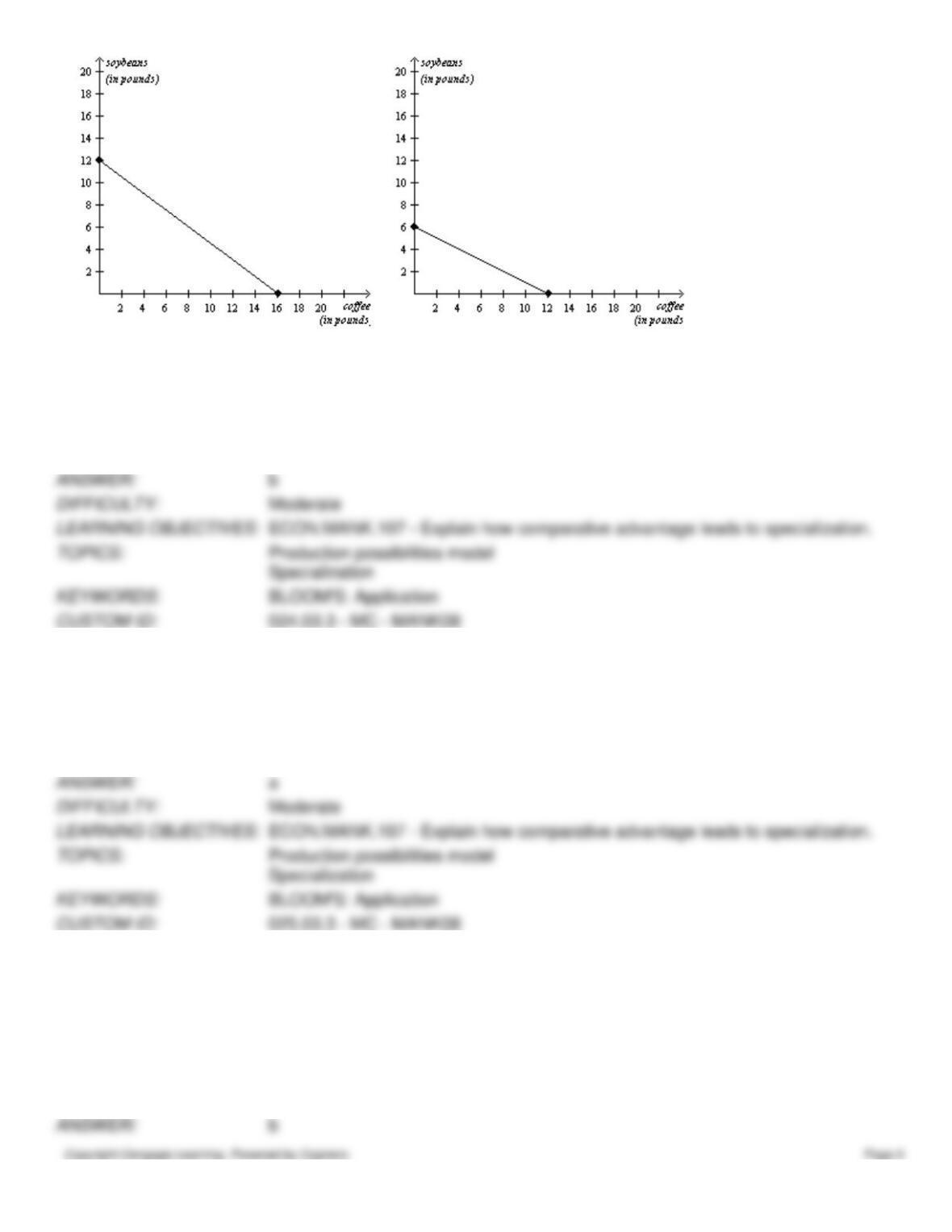
24. Refer to Figure 3-25. Chile should specialize in the production of
a.
coffee and import soybeans.
b.
soybeans and import coffee.
c.
both goods and import neither good.
d.
neither good and import both goods.
25. Refer to Figure 3-25. Colombia should specialize in the production of
a.
coffee and import soybeans.
b.
soybeans and import coffee.
c.
both goods and import neither good.
d.
neither good and import both goods.
26. Alexis is a lawyer. She bills her clients $100 an hour for her services. She can also mow her lawn in 30 minutes. She
can hire someone to mow her lawn who takes an hour. Of the following prices, which is the highest Alexis would pay
someone to mow her lawn?
a.
$99
b.
$49
c.
$29
d.
Alexis would always mow her own lawn because she can do it faster.
Table 3-40
Hours Needed to Make 1
Quantity Produced in 2400 Hours
Boat
Car
Boat
Car
Germany
40
30
60
80
Italy
40
50
60
48
27. Refer to Table 3-40. Germany should specialize in the production of
a.
boats and import cars.
b.
cars and import boats.
c.
both goods and import neither good.
d.
neither good and import both goods.
28. Refer to Table 3-40. Italy should specialize in the production of
a.
boats and import cars.
b.
cars and import boats.
c.
both goods and import neither good.
d.
neither good and import both goods.