Assume that two interior design companies, Alistair and Baine, are competing for
customers and if they both advertise, they would each earn $30 million in profits. If
neither advertises, they each earn $50 million in profits. If one advertises and the other
doesn’t, the firm that advertises earns $40 million in profit while the other earns $20
million in profit.
a. Present the information above in the form of a payoff matrix. Let Baine be the row
player and Alistair the column player.
b. Does each firm have a dominant strategy and if so what is it?
c. What is the Nash equilibrium?
Which of the following does not take place in the direct finance market?
A) Ownership in corporations is sold in the form of common stock.
B) Deposits from savers are accumulated and loans made to borrowers.

C) Ownership in corporations is sold in the form of preferred stock.
D) Corporate bonds are sold to savers.
If the cross-price elasticity of demand for computers and software is negative, this
means the two goods are
A) substitutes.
B) complements.
C) inferior.
D) normal.
Using cross-sectional data from the two Housing Assistance Supply Experiment
(HASE) sites–Brown County, Wisconsin, and St. Joseph County, Indiana, John
Mulford of Rand Research estimates that the long-run “permanent” income elasticity of
housing expenditures to be 0.45 for owners. Using this information, what is likely to
happen to housing expenditures if the government increases income transfers to
recipients in HASE sites?
A) Housing expenditures will increase significantly.
B) Housing expenditures in HASE sites significantly will fall as recipients moved out
of these areas to higher-income areas.

C) Housing expenditures will increase, but not significantly.
D) Housing expenditures will decrease by a small amount.
Indicate whether each of the following situations would shift the supply curve to the
left, to the right, or not at all.
a. An increase in the number of firms in the market
b. An increase in the current price of the product
c. A decrease in productivity
d. An increase in the expected future price of a product
e. A decrease in the price of an input

Article Summary
The article describes three key ways startup companies can get the most benefit from
celebrity endorsements. One way is choosing a celebrity that can bring credibility to the
company and then incorporating the celebrity into the company’s marketing strategy.
Second, get public relations value from the celebrity by offering exclusive interviews,
contests, and photos and videos of the celebrity with the product. Finally, make sure to
choose a celebrity who will represent the product at all times, giving the product
maximum exposure.
Source: Kevin Tighe II, “3 Ways Startups Can Turn Celebrity Endorsements Into Big
Gains,” Forbes, March 8, 2013.
Refer to the Article Summary. Economists refer to an increase in sales due to celebrity
endorsements as being the result of
A) network externalities.
B) the endowment effect.
C) social influence.
D) the ultimatum game.
Policymakers focus on marginal tax rate changes when making changes in the tax code
because the marginal tax rate
A) determines how tax revenue will change as national income increases.
B) affects people’s willingness to work, save, and invest.
C) always equals the average tax rate which is harder to measure.
D) determines how much revenue the government will have to spend.

Marginal utility is
A) the change in total utility divided by the price of the last unit of a good or service
consumed.
B) the change in total utility a person receives from consuming an additional unit of a
good or service.
C) the utility from consuming a given quantity of a good or service.
D) the decrease in total utility from consuming more and more units of a good or
service.
The payroll tax is a tax imposed on ________ that is used to fund Social Security and
Medicare.
A) employers only
B) workers only
C) employers and workers
D) the unemployed
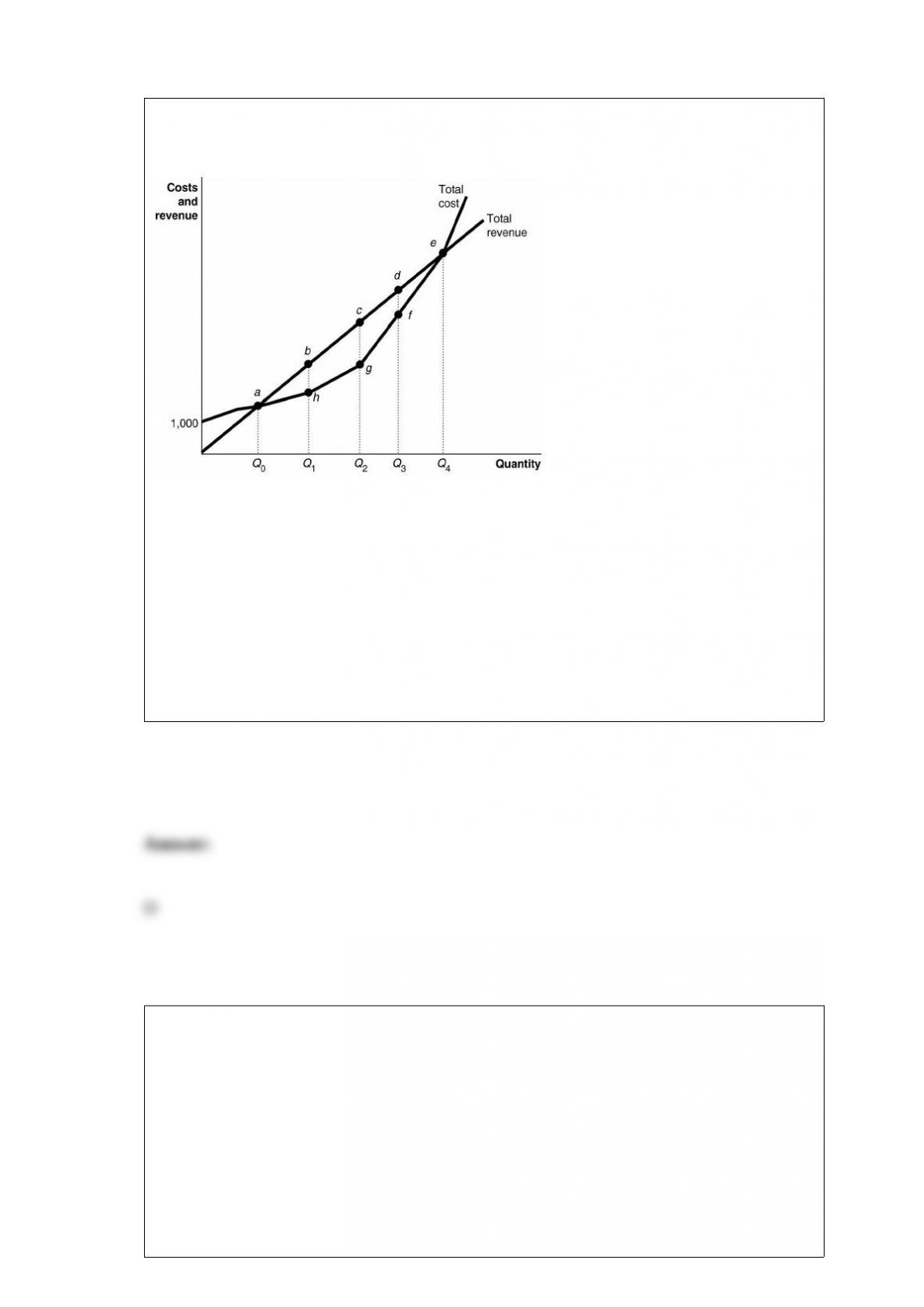
Figure 12-2
Refer to Figure 12-2. The firm breaks even at an output level of
A) Q1units.
B) Q2units.
C) Q3units.
D) Q4units.
Economists have estimated that the cross-price elasticity of demand between beer and
spirits is -0.50, the income elasticity for spirits is 1.21 and the income elasticity for
wine is 5.03. These elasticities mean that
A) beer and spirits are complements, spirits and wine are luxuries.
B) beer and spirits are normal goods, spirits and wine are luxuries.
C) beer and spirits are complements, spirits are substitutes.

D) beer and spirits are substitutes, spirits and wine are luxuries.
Assume that when the price of cantaloupes is $2.50 the demand for cantaloupes is
unit-elastic, and that the demand curve for cantaloupes is linear and downward sloping.
If firms lower the price of cantaloupes to $2.00 which of the following statements can
be made regarding the price elasticity of demand for cantaloupes?
A) The demand for cantaloupes at $2.00 must be inelastic.
B) We cannot determine whether the demand for cantaloupes is elastic or inelastic
without knowing what the quantity demanded is at each price.
C) The demand for cantaloupes at $2.00 must be elastic.
D) The demand for cantaloupes at $2.00 must be unit-elastic.
Figure 18-2
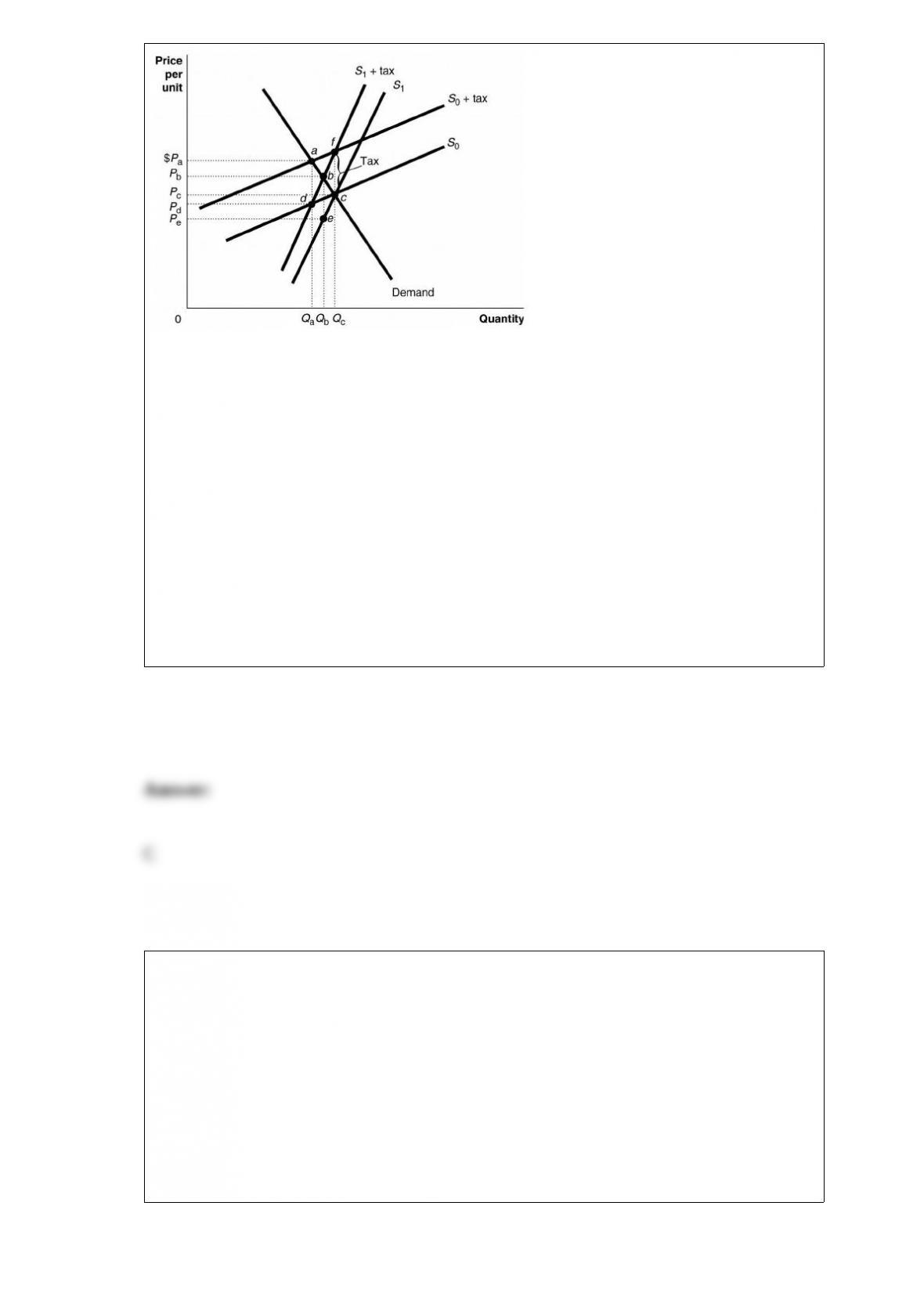
Figure 18-2 shows a demand curve and two sets of supply curves, one set more elastic
than the other.
Refer to Figure 18-2. If the government imposes an excise tax of $1.00 on every unit
sold, the consumer’s burden of the tax
A) is Pa– Pcunder either supply curve.
B) is Pb– Pcunder either supply curve.
C) is Pa– Pcif the supply curve is S0 and Pb– Pcif the supply curve is S1.
D) is Pa– Pdif the supply curve is S0 and Pb– Peif the supply curve is S1.
Suppose the supply of bicycles is price elastic. This means that
A) consumers will respond significantly to an increase in the quantity supplied of
bicycles.
B) suppliers will increase the quantity supplied of bicycles, but not immediately.
C) suppliers face many substitutes for bicycles.
D) suppliers will respond significantly to changes in the price of bicycles.

A demand curve which is ________ represents perfectly inelastic demand, and a
demand curve which is ________ represents inelastic demand.
A) downward sloping; vertical
B) horizontal; downward sloping
C) vertical; downward sloping
D) upward sloping; horizontal
Assume that price is greater than average variable cost. If a perfectly competitive seller
is producing at an output where price is $11 and the marginal cost is $14.54, then to
maximize profits the firm should
A) continue producing at the current output.
B) produce a larger level of output.
C) produce a smaller level of output.
D) There is not enough information given to answer the question.

The equilibrium wage and quantity of labor in the market for skilled workers is
determined by
A) the strength of labor unions.
B) the monopsony power of firms.
C) the demand and supply of labor.
D) the market value created by the output of these skilled workers.
The Aluminum Company of America (Alcoa) had a monopoly until the 1940s because
A) it was a public enterprise.
B) it had a patent on the manufacture of aluminum.
C) the company had a secret technique for making aluminum from bauxite.
D) it had control of almost all the available supply of bauxite.
Average fixed cost is equal to
A) the amount of total cost that does not change as output changes in the short run.

B) fixed cost divided by the quantity of output produced.
C) fixed cost multiplied by the quantity of output produced.
D) average total cost plus average variable cost.
Which of the following is an example of spending on goods and services in the circular
flow model?
A) Belinda purchases a new computer for her tax-preparation business.
B) Javier buys 800 square feet of wood flooring for his vacation home.
C) Celeste buys fresh herbs at the farmers’ market to use in her restaurant.
D) Timmy purchases a new examination table for use in his veterinary clinic.
Consider the following pairs of items:
a. shampoo and conditioner
b. iPhones and earbuds
c. a laptop computer and a desktop computer
d. beef and pork

e. air-travel and weed killer
Which of the pairs listed will have a negative cross-price elasticity?
A) a and b only
B) c and d only
C) e only
D) a, b, and c only
The basic activity of a firm is
A) to set the prices of its products as high as possible.
B) to compete with other firms that produce similar products.
C) to provide jobs for its employees.
D) to use inputs to produce outputs of goods and services.
Which of the following isnot a consequence of minimum wage laws?
A) Low skilled workers are hurt because minimum wage reduces the number of jobs
providing low skilled workers with training.

B) Employers will be reluctant to offer low-skill workers jobs with training.
C) Producers have an incentive to offer workers non-wage benefits such as health care
benefits and convenient working hours rather than a higher wage.
D) Some workers benefit when the minimum wage is increased.
Which of the following is an example of a common resource?
A) catfish in a private pond in Mississippi
B) impounded dogs in a dog pound
C) public health care services in the United States
D) sea otters in the coastal waters of the Pacific Ocean
If a typical firm in a perfectly competitive industry is incurring losses, then
A) all firms will continue to lose money.
B) some firms will exit in the long run, causing market supply to decrease and market
price to rise increasing profits for the remaining firms.
C) some firms will exit in the long run, causing market supply to decrease and market
price to fall increasing losses for the remaining firms.

D) some firms will enter in the long run, causing market supply to increase and market
price to rise increasing profit for all firms.
Average total cost is
A) total cost divided by the quantity of output produced.
B) total explicit costs divided by the quantity of output produced.
C) variable cost divided by the quantity of output produced.
D) the change in fixed plus variable cost divided by the quantity of output produced.
If a corporation retains all its profits and distributes none of the profit to owners, how
can owners benefit?
A) If the retained earnings are expected to create future profits, the market price of the
firm’s stock will increase and create a capital gain for stockholders if the stock is sold.
B) Shares of stock can be converted into bonds so stockholders will be able to earn
coupon payments.
C) Owners will only benefit if some profits are paid out in the form of dividends.
D) Owners will benefit by changing the board of directors.

In which of the following countries are substantial co-payments typically required as a
part of the health care system?
A) Canada and the United States
B) Japan and Canada.
C) the United States and Japan
D) the United States and the United Kingdom
A special region in which companies can engage in tariff-free importing and exporting
is called a(n) ________.
A) preferential trade area
B) export-processing zone
C) customs union
D) economic union
Jayanthi moves her yoga studio from her home to a space she rents in Oakland,
California. Holding everything else constant, as a result of this move
A) her explicit cost falls and her implicit cost rises.
B) her implicit cost falls and her explicit cost rises.
C) her economic cost rises.
D) her opportunity cost rises.
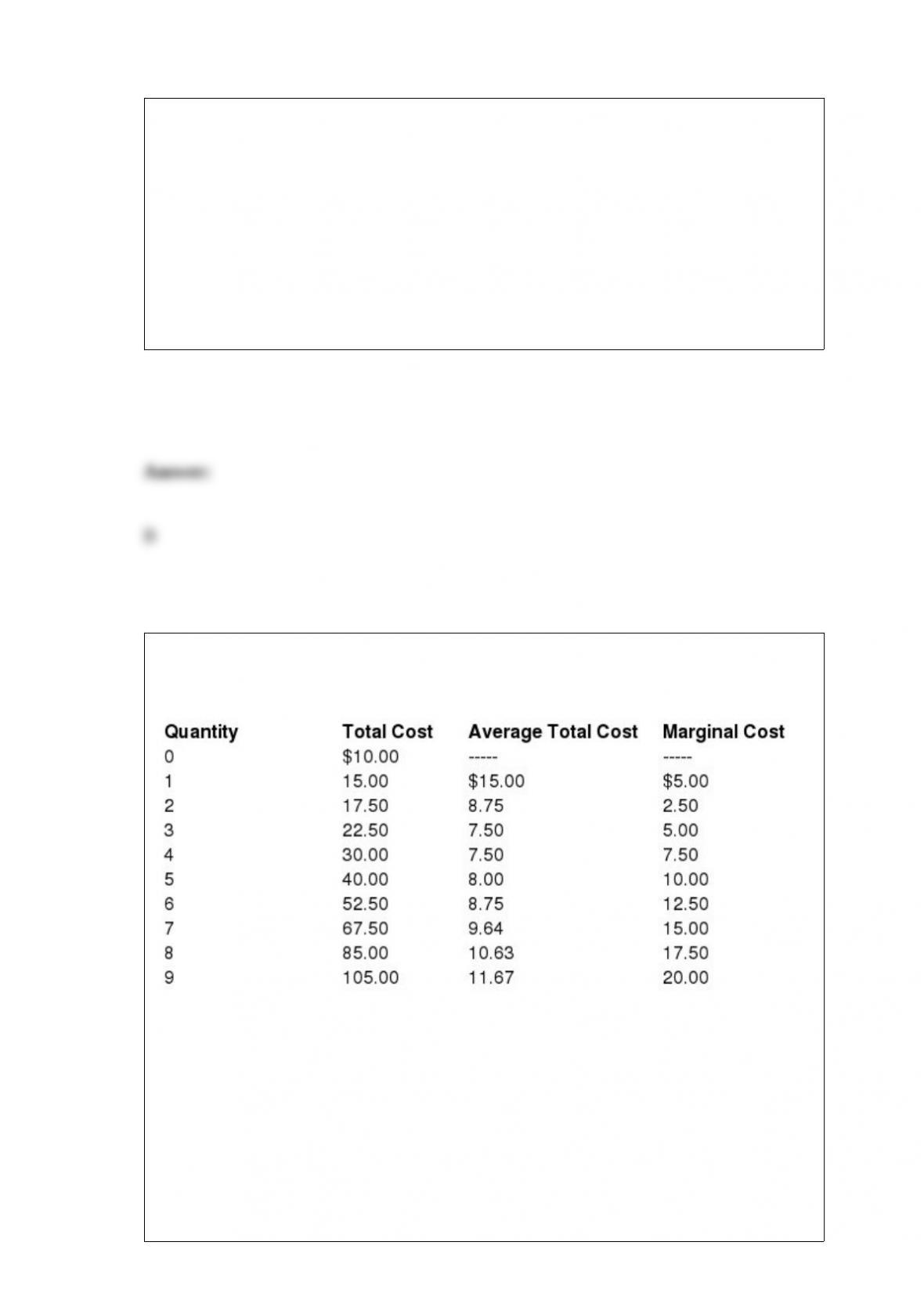
Table 12-3
Arnie sells basketballs in a perfectly competitive market. Table 12-3 summarizes
Arnie’s output per day (Q), total cost (TC), average total cost (ATC) and marginal cost
(MC).
Refer to Table 12-3. What price (P) will Arnie charge and how much profit will he earn
if the market price of basketballs is $12.50?
A) Price and profit cannot be determined from the information given.
B) P = $12.50; profit = $52.50

C) P = $12.50; profit = $22.50
D) P = $20; profit = $75.00.
Absolute poverty measures vary from country to country. For example, in 2013, the
poverty line in the United States for a family of four with two children was an annual
income of $23,550 but economists often use a much lower threshold income of $1 per
day when calculating the rate of poverty in poor countries. How is this absolute poverty
measured?
A) by comparing the percentage of households living below the poverty line to the total
population
B) by comparing a household’s income to the income required to maintain the average
standard of living in a society at a particular time
C) by comparing the amount of goods and services that a household’s income can
purchase to an objective measure of the amount of income needed to sustain a certain
predetermined standard of living
D) by comparing the amount of goods and services that a household’s income can
purchase in one country to the amount of goods and services that a household’s income
can purchase in another country of comparable living standard
Table 10-4
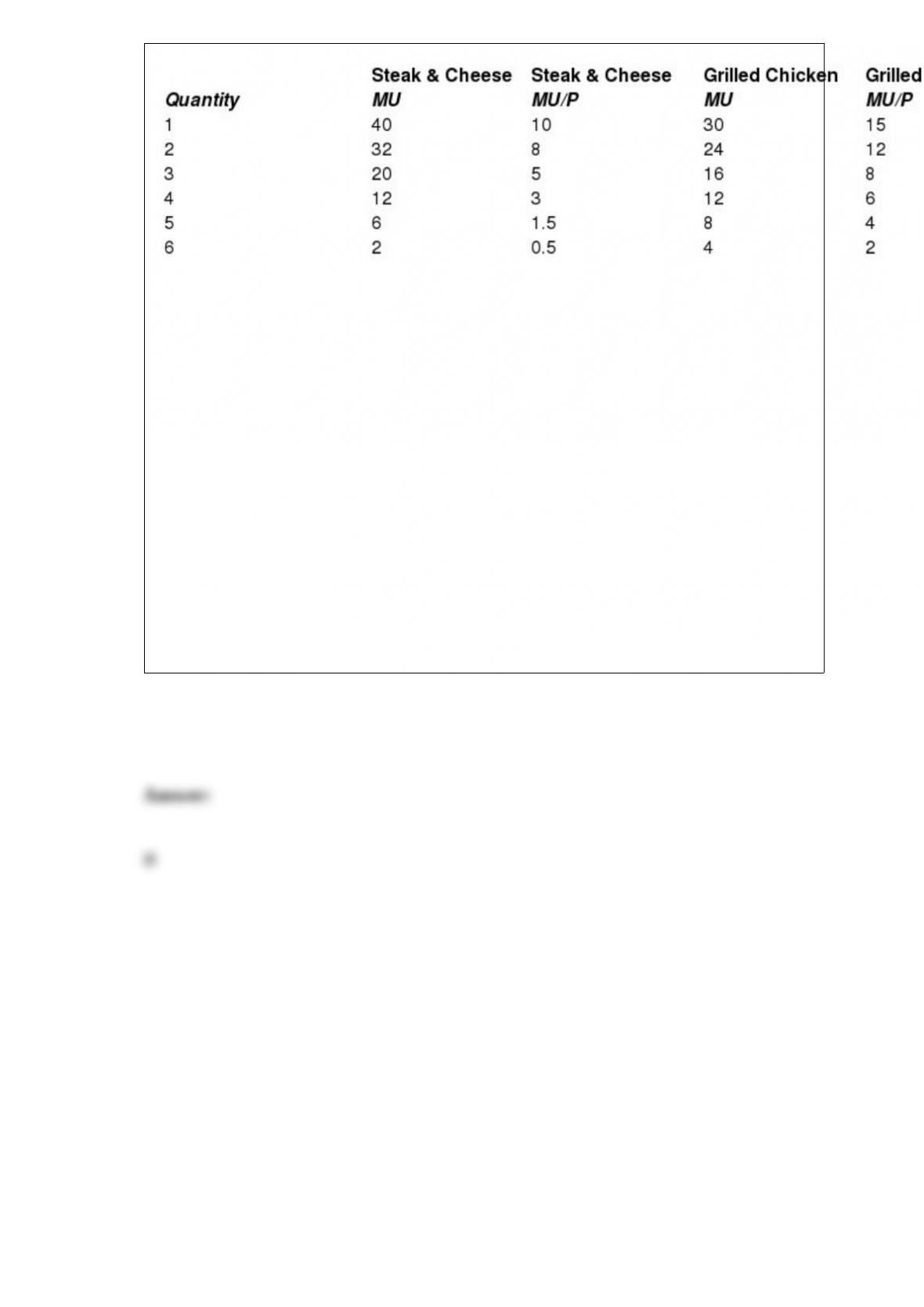
Refer to Table 10-4. For steak and cheese and grilled chicken sandwiches, the table
contains the values of the marginal utility (MU) and marginal utility per dollar (MU/P)
for Mabel Jarvis. Mabel has $14 to spend on steak and cheese and grilled chicken
sandwiches. Which of the following statements istrue?
A) If Mabel maximizes her utility she will buy three steak and cheese sandwiches and
two grilled chicken sandwiches.
B) If Mabel was maximizing her utility when spending $14 and then received an
additional $4, she would receive the most marginal utility per dollar if her next
purchase was another grilled chicken sandwich.
C) Mabel will first buy two steak and cheese sandwiches; then with her remaining $6
she will buy three grilled chicken sandwiches.
D) To maximize her utility, Mabel will need a total of $36, the income needed to buy 6
steak and cheese sandwiches and 6 grilled chicken sandwiches.