
An Internet company wants to increase the consumption of Internet packages by 15%.
The price elasticity of demand for Internet packages is 2. The telephone company
should:
A) lower the price of Internet packages by 30.0%.
B) lower the price of Internet packages by 7.5%.
C) lower the price of Internet packages by 3.0%.
D) raise the price of Internet packages by 0.1%.
When determining an appropriate congestion tax, economists would use which of the
following elements of the economic way of thinking?
A) thinking at the margin
B) isolating variables
C) making assumptions
D) all of the above
Which of the following is NOT an example of a question answered by positive
analysis?
A) How will an increase in the price of gasoline affect taxi drivers?

B) What fraction of an income-tax cut will be spent on consumer goods?
C) How will an increase in interest rates affect investment in factories?
D) Should the government increase the minimum wage?
In Figure 2.3, the move from production possibility curve YZ to production possibility
curve XV, could be caused by:
A) increased unemployment.
B) more land, labor or capital.
C) a decline in technology.
D) all of the above.
Which of the following is true about a perfectly competitive firm in the long run and in
the short run?
A) The supply curve in the short run is usually steeper than the supply curve in the long
run.
B) The supply curve in the short run is usually flatter than the supply curve in the long
run.

C) The demand curve in the short run is usually steeper than the marginal cost curve in
the long run.
D) The supply curve in the short run is usually steeper than the average total cost curve
in the long run.
Recall the application of the upward jump and downward slide of wine prices, what can
you determine from the price soared for the pinot noir wine grown in the Willamette
Valley in Oregon and for other brands the price tripled?
A) Wine consumers are not eager to pay high prices.
B) Producers were unable to increase production in the long run.
C) In the short run, the supply of wine is inflexible.
D) The demand is unit elastic.
If the substitution effect of a wage change outweighs the income effect of a wage
change, the labor-supply curve is:
A) upward sloping.
B) horizontal.
C) vertical.

D) backward bending.
An import ban results in:
A) a decrease in the supply of the product.
B) an increase in the product’s price.
C) a decrease in the quantity of the product bought and sold.
D) all of the above.
In Figure 5.3 the most inelastic supply curve:
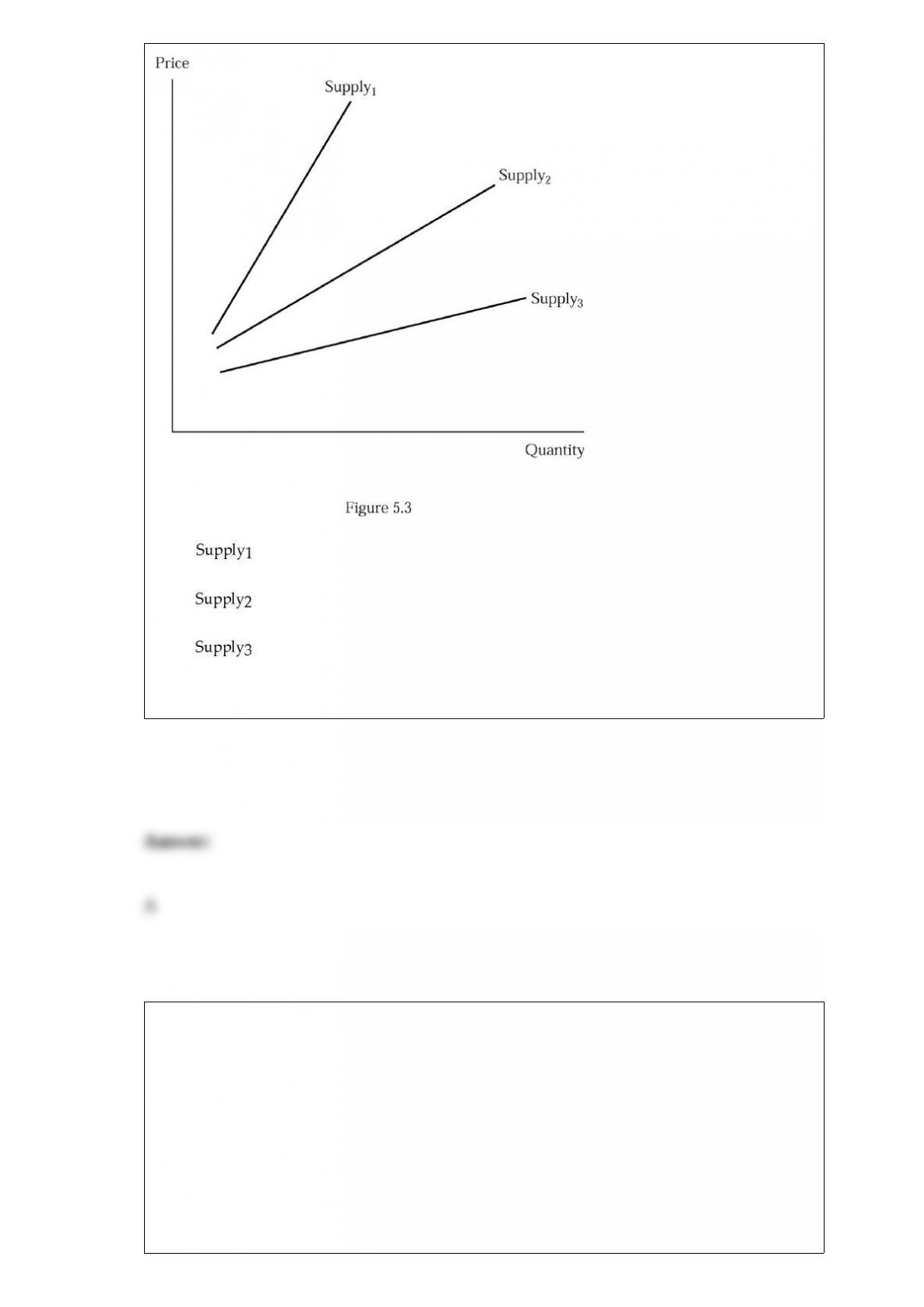
A) is .
B) is .
C) is .
D) Cannot be determined.
Suppose that in a month the price of a cup of coffee increases from $1 to $1.50. At the
same time, the quantity of cups of coffee demanded decreases from 200 to 190. The
price elasticity of demand for cups of coffee (calculated using the midpoint formula) is
approximately:
A) 0.13.
B) 0.5.
C) 7.8.

D) 20.
If the quantity demanded of soda increases by 4% when the price of coffee increases by
16%, the cross-price elasticity of demand between soda and coffee is:
A) -0.25.
B) 0.25.
C) -12.0.
D) 12.0.
Microsoft requires persons who purchase its operating system to also purchase its web
browser. This is an example of:
A) a tie-in sale.
B) competitive pricing.
C) price discrimination.
D) predatory pricing.

Recall the Application about the unisex pricing policy for automobile insurance in
the European Union to answer the following question(s).
According to the Application, the ban on gender discrimination in automobile insurance
pricing is expected to ________ insurance prices for women and ________ insurance
prices for men.
A) increase; increase
B) increase; decrease
C) decrease; increase
D) decrease; decrease
People make different choices because they differ in ways that are relevant to consumer
decision, which of the following are those ways?
A) strength of their gut feeling
B) weakness of the activity in the NAcc
C) cognitive weighting
D) A and C are correct.
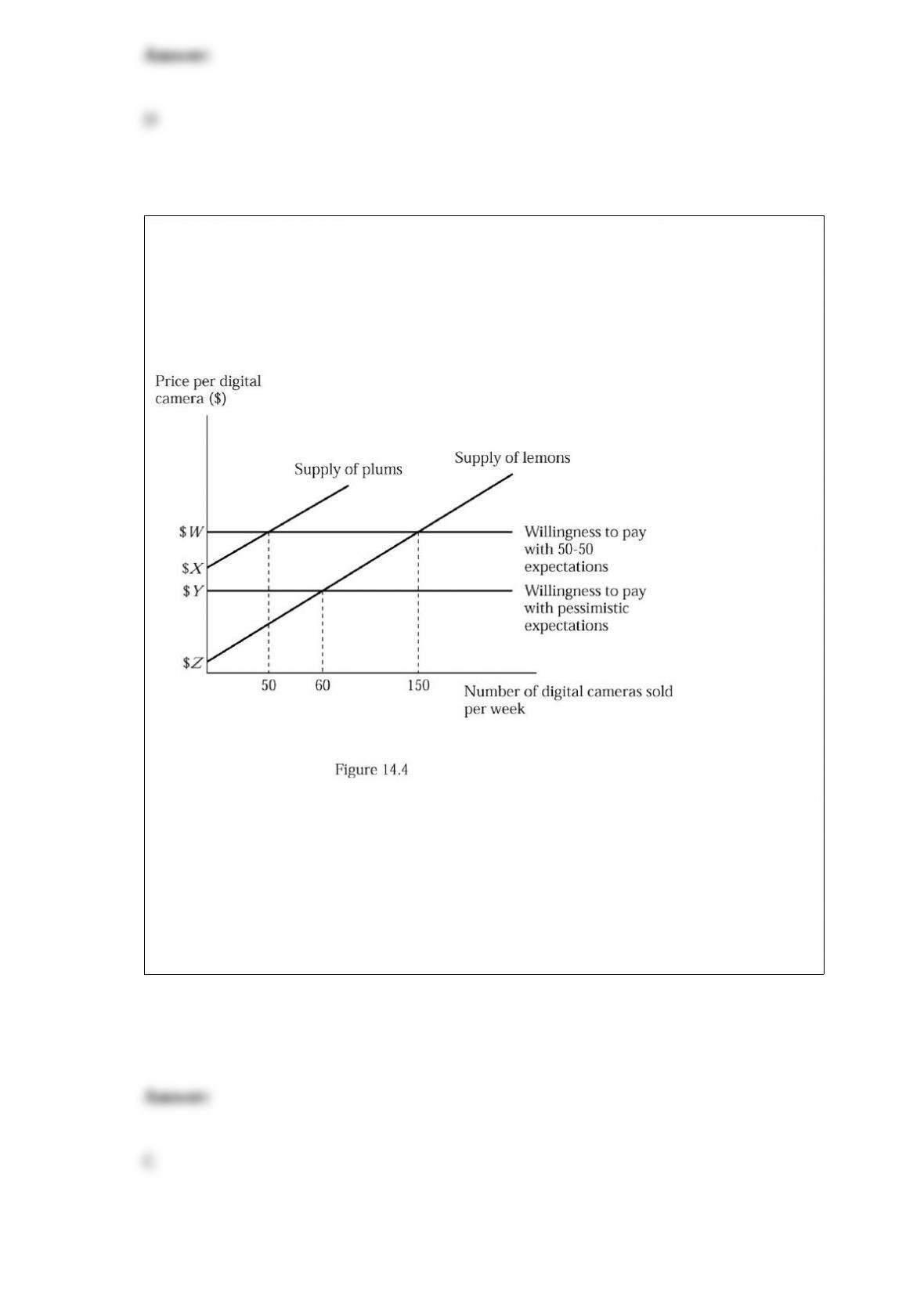
Figure 14.4 represents the market for used 12 megapixel digital cameras. Suppose
buyers are willing to pay $400 for a plum (high-quality) used digital camera and $200
for a lemon (low-quality) used digital camera. If buyers believe that 50% of used digital
cameras in the market are lemons (low quality), how many lemons will be supplied by
sellers?
A) 50
B) 60
C) 150
D) 200
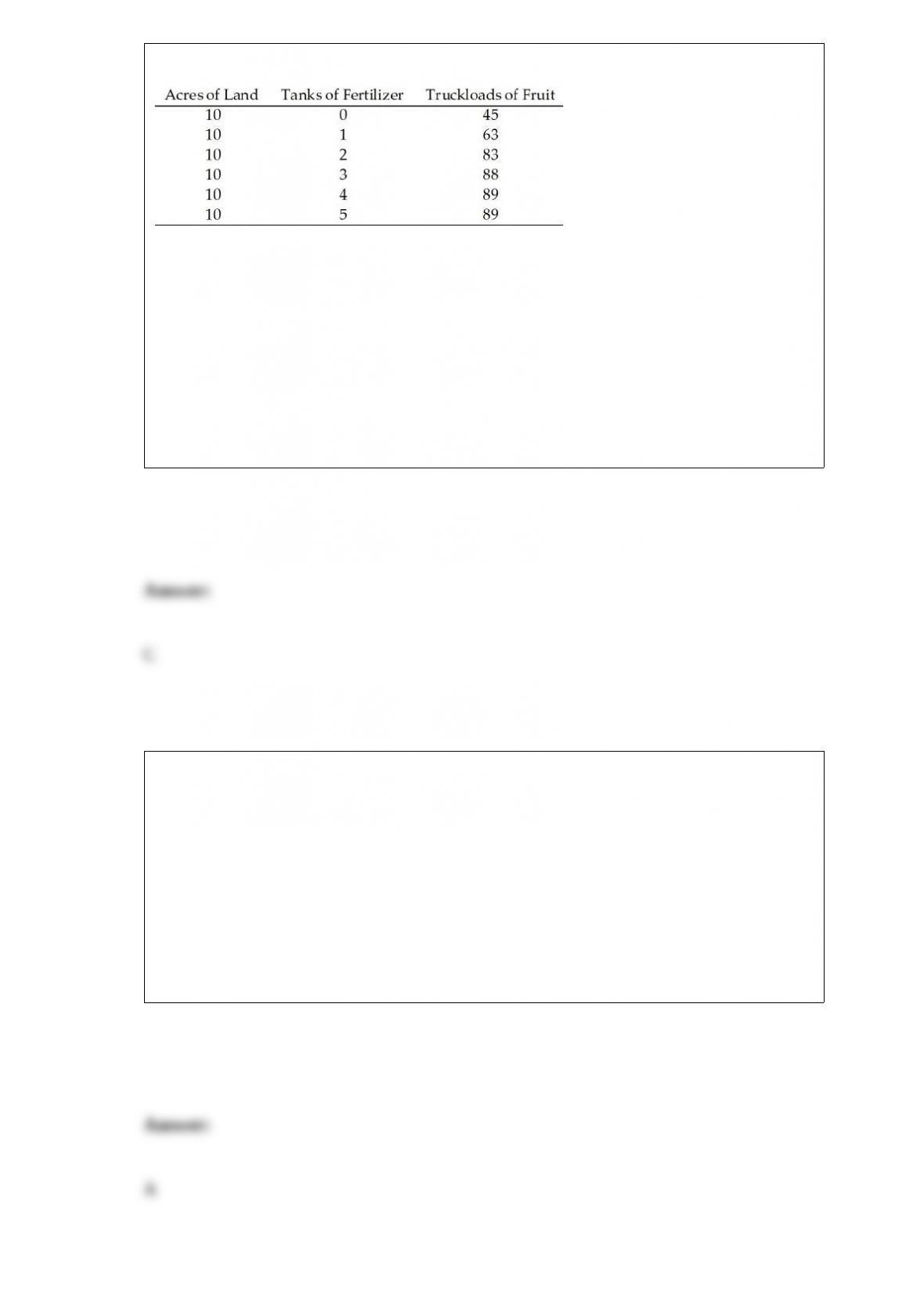
Refer to Table 2.4. The marginal product of the 2nd tank of fertilizer is:
Table 2.4
A) 41.5 truckloads of fruit.
B) 10 truckloads of fruit.
C) 20 truckloads of fruit.
D) 5 truckloads of fruit.
Suppose that in 2006, 12 million cars were purchased at $15,000 each, while in 2007,
10 million cars were purchased at $12,000 each. What might have caused this change?
A) The price of airplane tickets (a substitute for cars) fell.
B) The price of airplane tickets (a substitute for cars) rose.
C) Automobile manufacturing technology increased.
D) Automobile manufacturing technology decreased.
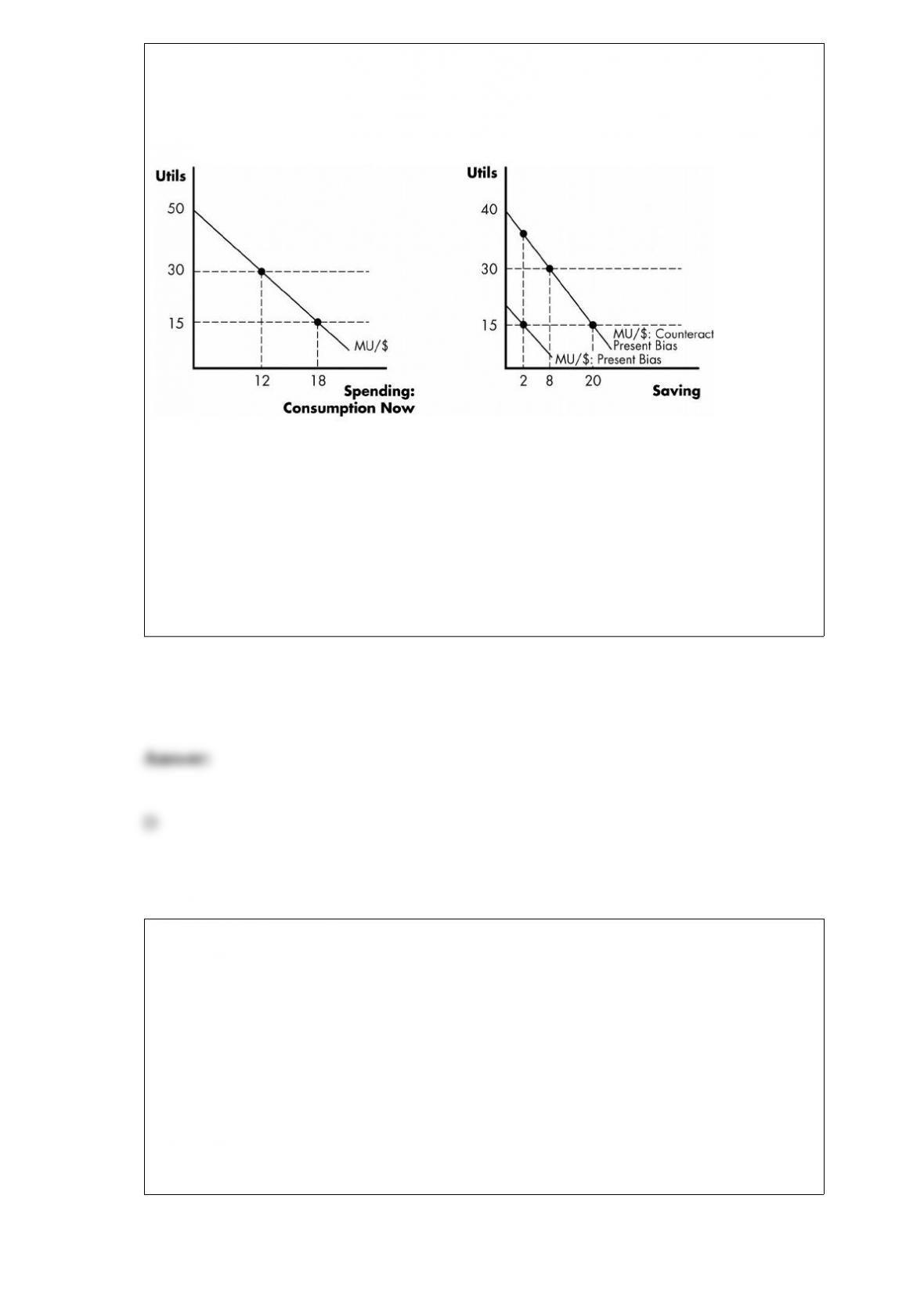
Refer to Figure 7.5. If the consumer uses cognition to offset present bias, he will
maximize utility at a marginal utility per dollar of ________ utils for consumption and
________ utils for saving.
Figure 7.5
The consumer must decide how to split $20 between spending and saving.
A) 15: 15
B) 15: 30
C) 30: 15
D) 30: 30
Suppose Johnson’s Rubber Factory belches black smoke into the air over the city of
Bellowsville. If the city of Bellowsville attempts to internalize the external costs
associated with the production of rubber with a pollution tax, then we expect:
A) a leftward shift of Johnson’s supply curve.
B) a rightward shift of Johnson’s supply curve.
C) no change in Johnson’s supply curve.
D) a leftward shift in the demand curve for Johnson’s rubber.
If insurance premiums are based on an experience rating:
A) every firm in a given area pays the same price for medical insurance.
B) insurance premiums are based on the past medical bills of a firm’s employees.
C) firms have no incentive to try to lower the health care costs of their employees.
D) firms will not be concerned with the health problems of job applicants.
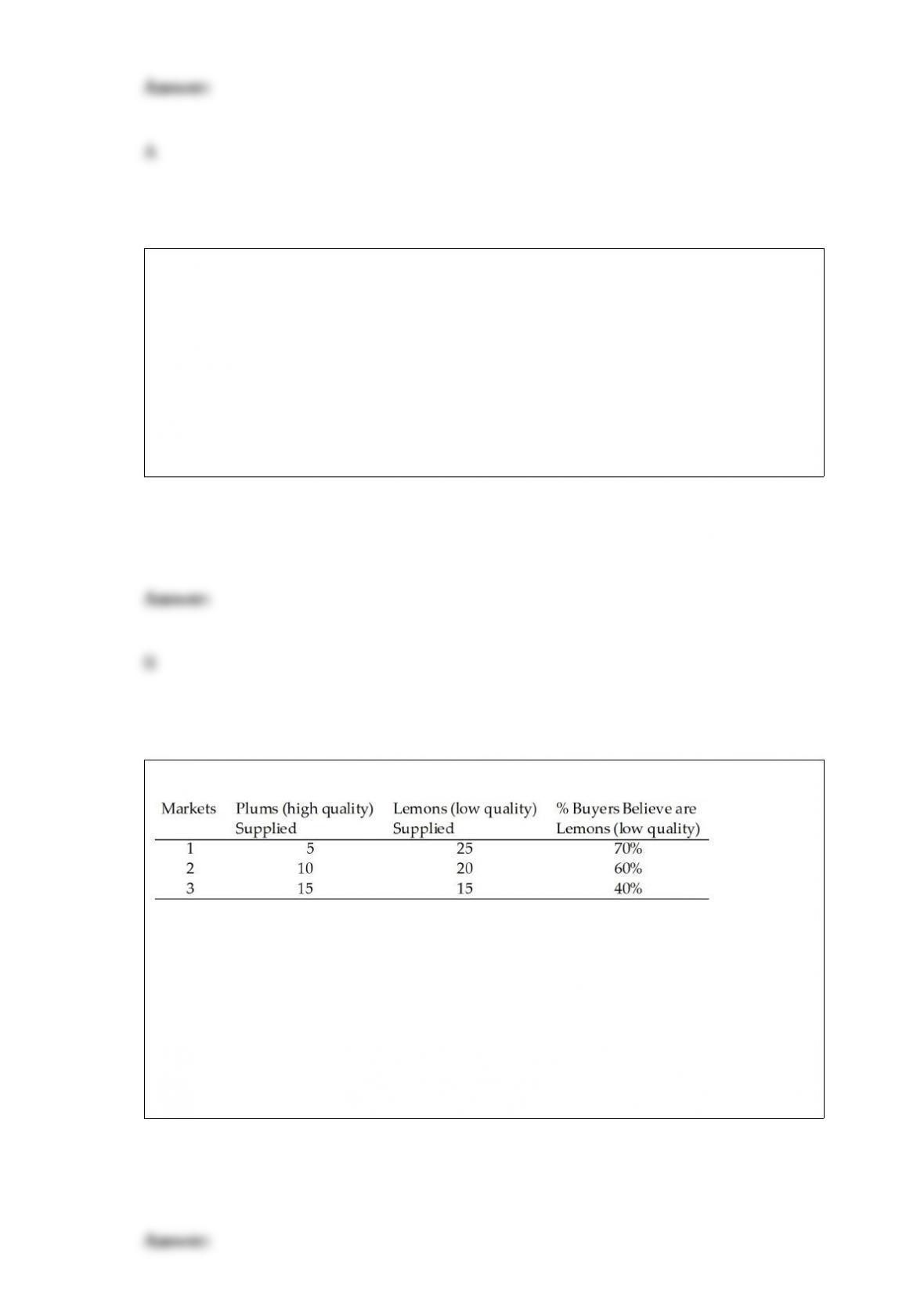
In Table 14.3, Market 3 would be in equilibrium if buyers believed lemons account for:
Table 14.3
A) 45% of the market.
B) 50% of the market.
C) 55% of the market.
D) 60% of the market.

Which of the following situations will arise in the domestic market following the
imposition of an import ban?
A) imports increase, domestic production increases, prices increase
B) imports increase, domestic production decreases, prices decrease
C) imports decrease, domestic production increases, prices increase
D) imports decrease, domestic production increases, prices decrease
According to the Application, if Latvia has no absolute advantage relative to its
neighboring European y countries, should it still trade with its neighbors?
A) Yes, it should specialize in timber because it has comparative advantage in it.
B) Yes, it should specialize in livestock because it has comparative advantage in it.
C) Yes, it should specialize in grain because it has comparative advantage in it.
D) No, it should not specialize in anything, and it should just trade with countries
outside its neighboring European countries.

The median-voter rule suggests that:
A) politicians try to fool all of the voters all of the time.
B) politicians decide how to vote on an issue by looking at how other politicians will
vote.
C) politicians often choose a position that reflects the preferences of the median voter.
D) politicians try to ensure that the services provided by the government are distributed
equally across voters.
Monopolistically competitive firms differentiate their products by:
A) selling products with slightly different physical characteristics.
B) selling products at different locations.
C) creating a special aura or image for the product with advertising.
D) all of the above
The “good news” for consumers from monopolistic competition is ________ but the
“bad news” for producers is that ________.
A) lower prices than monopoly; there are higher production costs

B) lower prices than monopoly; there are higher travel costs
C) lower prices than monopoly; there is less product variety
D) greater product variety; product prices are higher
A firm announces that it will refund the difference between its price and any price of a
competitor that is lower. This is an example of:
A) predatory pricing.
B) tying contracting.
C) marginal cost pricing.
D) guaranteed price matching.
Suppose that lenders believe that the government will provide assistance if too many of
the lenders’ borrowers do not pay back their loans. If lenders expect government
assistance they will:
A) make more loans to borrowers who are less likely to repay them.
B) make fewer loans to borrowers who are less likely to repay them.
C) increase the interest rates that they charge borrowers who are less likely to repay
loans.

D) not change their lending policies because this expectation is not reasonable.
The Robinson-Patman Act of 1936:
A) prohibited selling products at “unreasonably low prices” with the intent of reducing
competition.
B) made it illegal to monopolize a market.
C) repealed the Sherman Act.
D) outlawed price discrimination for the purpose of reducing competition.
As bags of nitrogen applied went from 0 to 1 to 2 to 3 to 4, crop yield went from 85 to
120 to 135 to 144 to 147 bushels per acre. The results show that as more bags of
nitrogen were added, holding all other inputs constant, output:
A) fell.
B) rose but at a declining rate.
C) rose but at an increasing rate.
D) stayed the same.

Suppose that you are willing to pay $25 for a new shirt and the market price is $35. In
this case:
A) you will not buy the good.
B) you will buy the good and receive a consumer surplus of $5.
C) you will buy the good and receive a consumer surplus of -$10.
D) you will buy the good and receive a consumer surplus of -$35.
When firms cooperate with each other rather than compete:
A) consumers will end up better off.
B) the firms will end up better off.
C) both consumers and firms end up better off.
D) they will agree to set low prices to help each other out.

The law of demand can be defined as:
A) a lot of people wanting the same thing.
B) the higher the price, the smaller the quantity demanded, ceteris paribus.
C) people are willing to make limited sacrifices to acquire products.
D) none of the above.
Why might a politician start a costly spending program if its costs exceed its social
benefits?
A) The politician is trying to find ways to raise more money for the next election.
B) The politician gains prestige and voters are not well informed of the benefits and
costs.
C) Voters do not care about the costs of programs, as long as their taxes do not go up.
D) The costs cannot be measured therefore the politicians focus on the benefits which
are explicit.