
Suppose the price of gasoline increases and that sport utility vehicles get poor gas
mileage compared to other available cars. One would expect:
A. the demand for gasoline to decrease.
B. the demand for sport utility vehicles to decrease.
C. the demand for sport utility vehicles to increase.
D. the quantity of sport utility vehicles demanded to decrease.
Expansionary policies are government stabilization policies intended to increase:
A. population.
B. unemployment.
C. average labor productivity.
D. planned spending.
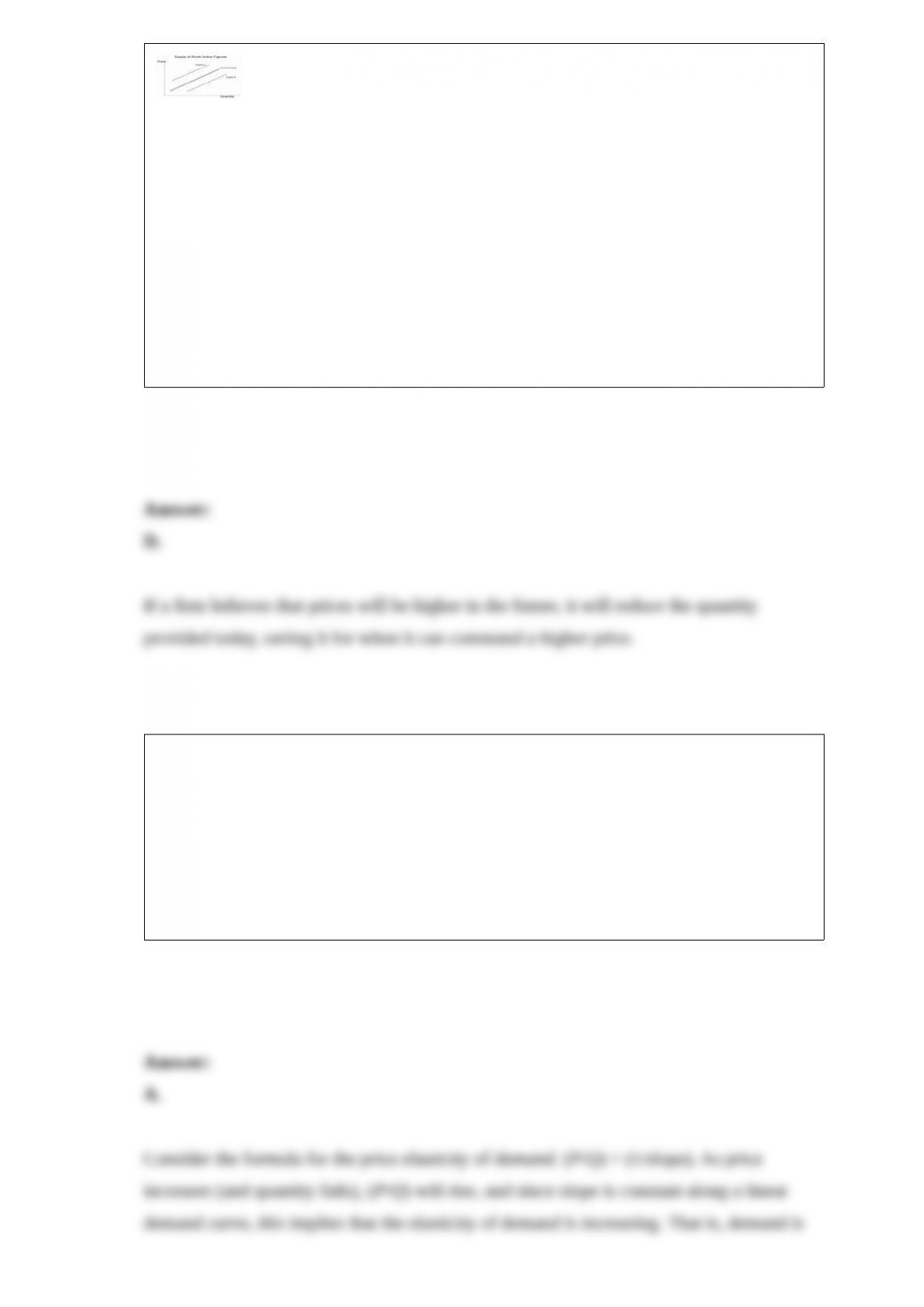
Refer to the figure above. Suppose that retailers learn that a new Shrek movie will be
released next month. That news is likely to cause:
A. no immediate change in supply, but a decrease in the quantity supplied.
B. no immediate change in supply, since the only effect will involve demand.
C. an immediate shift in the supply curve to Supply B in anticipation of increased future
prices.
D. an immediate shift in the supply curve to Supply A in anticipation of increased future
prices.
On a given linear demand curve, as price increases demand becomes ______
A. more elastic.
B. less elastic.
C. more negative.
D. more variable.

Refer to the table below. Julia’s opportunity cost of making a cake is:
A. 60 cakes
B. 6 cakes
C. 6/5 of a cake
D. 5/6 of a cake
If the Boskin Commission’s conclusion is correct, then the CPI ______ the “true”
inflation and improvements in living standards over time has been _____.
A. understates; overestimated
B. understates; underestimated
C. overstates; underestimated
D. measures; overestimated

Early settlers in the town of Dry Gulch drilled wells to pump as much water as they
wanted from the single aquifer beneath the town. (An aquifer is an underground body of
water.) As more people settled in Dry Gulch, the aquifer level fell and new wells had to
be drilled deeper at higher cost. The residents of Dry Gulch will overuse water relative
to the social optimum because ______.
A. each resident will fail to adequately consider the external cost of his or her own
water use
B. water is a scarce resource
C. each resident will fail to adequately consider the external benefit of his or her own
water use
D. the marginal cost of water is increasing
Refer to the figure below.
If this market is unregulated, the economic surplus received by consumers is:
A. $4.
B. $8.
C. $16.
D. $24.
Points that lie outside the production possibilities curve are ______, and points that lie
inside the production possibilities curve are ______.
A. efficient; inefficient
B. inefficient; efficient
C. unattainable; attainable
D. attainable; unattainable
Refer to the figure below. If the price of a latte increases from $2.00 to $2.50:
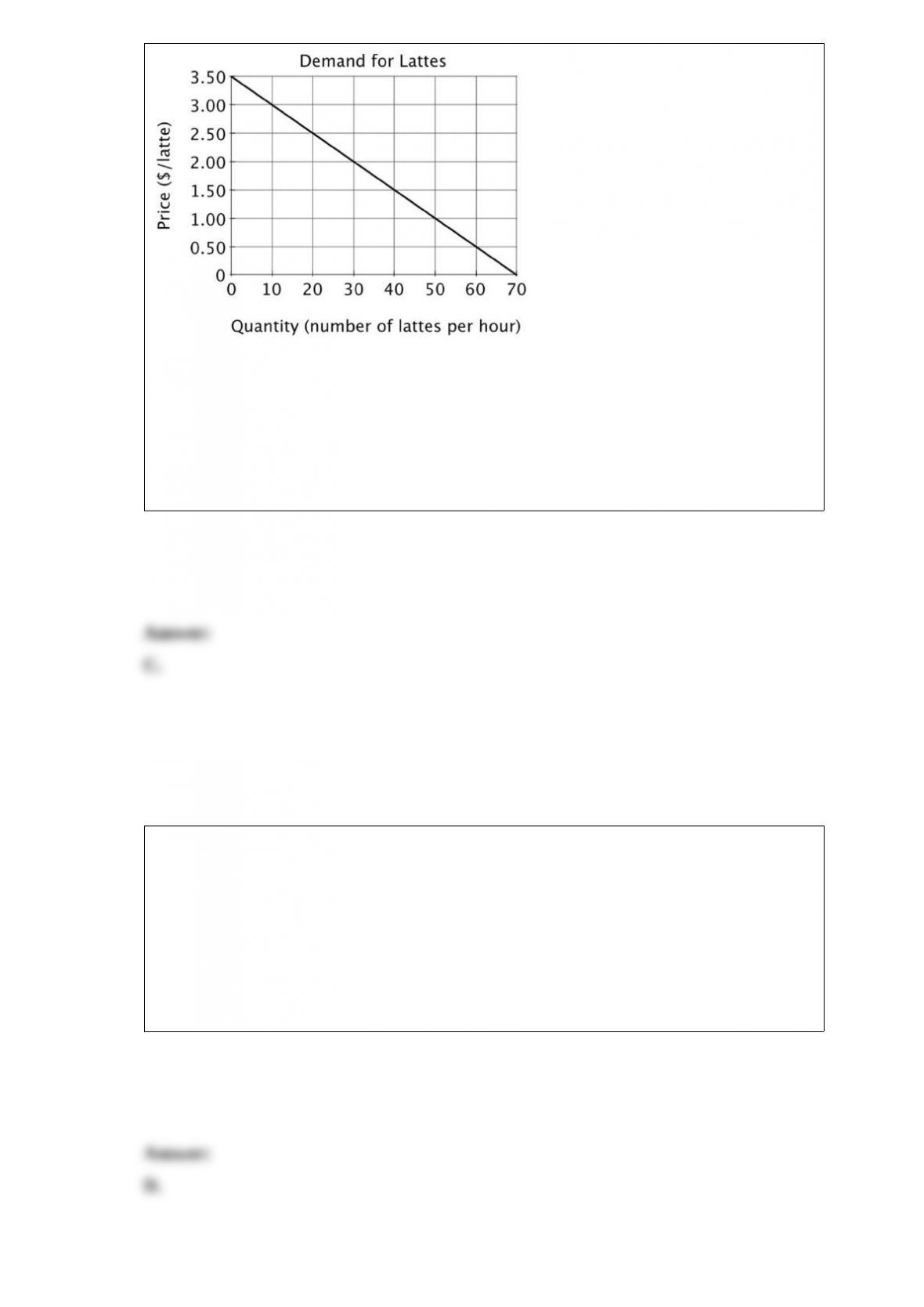
A. total expenditure would increase.
B. total expenditure would stay the same.
C. total expenditure would decrease.
D. the change in total expenditure, if any, would depend on the supply curve.
The key variable in determining changes in a country’s standard of living is the:
A. interest rate.
B. inflation rate.
C. unemployment rate.
D. long-run rate of economic growth.

When statisticians fail to take into account improvements in the quality of goods and
services, the CPI will tend to ______ the rate of inflation.
A. understate
B. precisely measure
C. be unrelated to
D. overstate
A purely self-interested diner is more likely to tip:
A. whenever he can afford to.
B. only when dining in a very up-scale restaurant.
C. only when dining in a restaurant at which he often eats.
D. always, to assure good service.

If the labor market for doctors is perfectly competitive, then an increase in the demand
for doctors is likely to cause:
A. doctors’ wages to increase.
B. the working conditions of doctors to deteriorate.
C. a persistent shortage of doctors.
D. the supply of doctors to fall.
Suppose Jordan and Lee are trying to decide what to do on a Friday. Jordan would
prefer to see a comedy while Lee would prefer to see a documentary. One documentary
and one comedy are showing at the local cinema. The payoffs they receive from seeing
the films either together or separately are shown in the payoff matrix below. Both
Jordan and Lee know the information contained in the payoff matrix. They purchase
their tickets simultaneously, ignorant of the other’s choice.
This game:
A. is a prisoner’s dilemma.
B. is not a prisoner’s dilemma.
C. is an ultimatum bargaining game.
D. has no Nash equilibrium.

A recession in the United States ______ the demand for exports from Canada resulting
in a reduction in Canadian autonomous expenditures and a(n) ______ output gap in
Canada.
A. reduces; expansionary
B. increases; expansionary
C. reduces; recessionary
D. increases; recessionary
A war destroys much of the capital stock in the country of Omega. As a result, holding
other factors constant, the real wage in Omega will ______ and employment in Omega
will ______.
A. increase; increase
B. increase; decrease
C. increase; not change
D. decrease; decrease

In general, the optimal amount of medical care is:
A. as much as one can afford.
B. enough to stay healthy.
C. the quantity at which the total cost of the care equals its total benefit.
D. the quantity at which the marginal cost of the care equals its marginal benefit.
Total economic surplus will be ______ in nations with well-defined property rights than
in nations with poorly-defined property rights.
A. less predictable
B. no different
C. higher
D. lower
Firms that extend credit to borrowers using funds from raised from savers are called:
A. bond dealers.
B. stock brokers.
C. central banks.
D. financial intermediaries.
Which of the following is NOT an example of the hurdle method of price
discrimination?
A. Offering a mail-in rebate.
B. Permanently reducing all prices by 10%.
C. Charging less for airline tickets if the trip includes a Saturday night stayover.
D. Giving a discount on movie tickets to people with a student ID.
The No Cash on the Table Principle asserts that:
A. in equilibrium, a few unexploited opportunities exist.
B. sometimes tips aren’t picked up.
C. in disequilibrium, no opportunities exist.

D. in equilibrium, all opportunities have been exploited.
Short-term economic fluctuations are ______ in length and severity and ______ to
predict.
A. regular; difficult
B. regular; easy
C. irregular; easy
D. irregular; difficult
Angela is currently playing five games of pool and bowling three games. At this level
of consumption, her marginal utility from a game of pool is 10 and her marginal utility
from bowling a game is 6. If both pool and bowling cost $1 a game, Angela should:
A. bowl more and play pool less.
B. just go home.

C. bowl only.
D. bowl less and play pool more.
Suppose two companies, Macrosoft and Apricot, are considering whether to develop a
new product, a touch-screen t-shirt. The payoffs to each of developing a touch-screen
t-shirt depend upon the actions of the other, as shown in the payoff matrix below (the
payoffs are given in millions of dollars).
If Macrosoft and Apricot make their decision at the same time, then which of the
following statements is correct?
A. The only Nash equilibrium is that both develop a touch-screen t-shirt.
B. The only Nash equilibrium is that neither develops a touch-screen t-shirt.
C. The game does not have a Nash equilibrium.
D. The game has more than one Nash equilibrium.

Hotelling’s model has been used to describe differentiation in the political “market.”
Suppose that 100 voters are evenly distributed between the extreme left and the extreme
right on the political spectrum, and that all voters vote, and they always vote for the
candidate closest to them on this spectrum. The numbers on this spectrum represent the
number of voters lying to the left of the number. So, at the midpoint, fifty voters lie to
the left and fifty to the right. At the extreme right end, all 100 voters lie to the left.
To an economic naturalist, this model helps explain why political candidates:
A. take more extreme positions than are held by the general population.
B. move toward more centrist positions during campaign season.
C. work to bring federally funded projects to their home districts.
D. are loyal to their political parties.
Refer to the figure below.
When Row Resorts and Column Cruises both play their dominant strategy:
A. both firms do better than if they had both played their dominated strategy.
B. Row Resorts earns a higher profit than does Column Cruises.
C. both firms do worse than if they had both played their dominated strategy.
D. Column Cruises earns a higher profit than does Row Resorts.
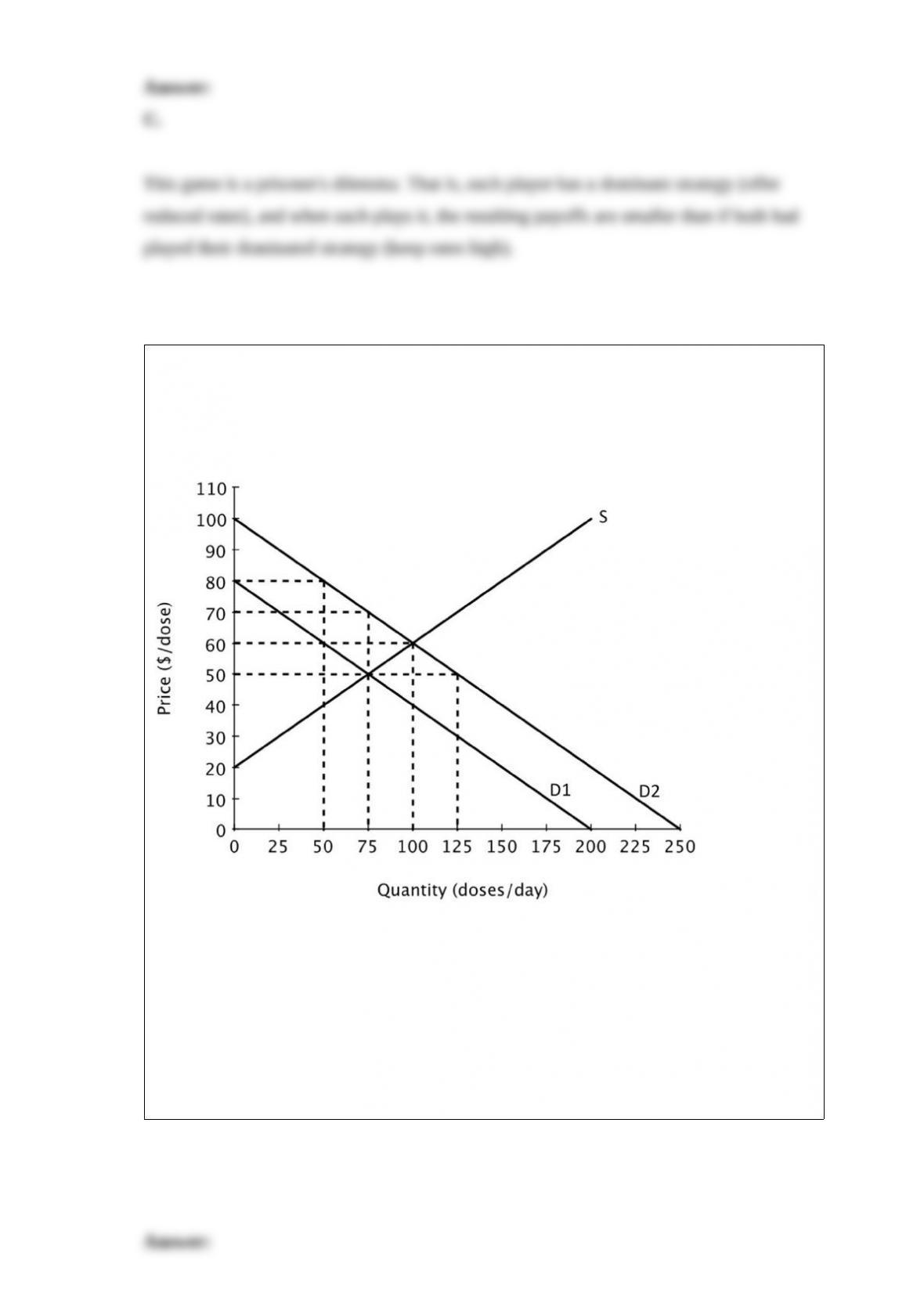
Suppose that a vaccine is developed for a highly contagious strain of flu. The likelihood
that anyone will get this flu decreases as more people receive the vaccine. One of the
demand curves below represents the private demand for the vaccine and the other
represents the social demand for the vaccine.
The government could increase total economic surplus by:
A. taxing production of the vaccine.
B. encouraging people to pay each other to get the vaccine.
C. subsidizing production of the vaccine.
D. providing 250 doses of the vaccine for free.
Suppose that the market price for hot dogs sold by street vendors has just risen from
$4.50 to $5, and that Curly has now begun operating a hot dog cart. We can assume
that:
A. Curly’s reservation price is $5.00 or more.
B. Curly’s reservation price is exactly $4.50.
C. Curly’s reservation price is greater than $4.50 but no more than $5.
D. Curly’s reservation price is exactly $5.
A winner-take-all labor market is one in which:
A. large differences in human capital translate into small differences in wages.
B. one worker receives all of the available compensation and the rest receive nothing.
C. small differences in human capital translate into small differences in wages.
D. small differences in human capital translate into large differences in wages.