
Which of the following will likely have the strongest demand for large expenditures on
environmental quality?
a. wealthy countries
b. poor countries
c. countries with air pollution problems
d. countries with water pollution problems
Which economist made the following statement: “Every major contraction in the U.S.
economy has either been created or greatly exacerbated by monetary instability. Every
major inflation has been caused by monetary expansion.”
a. Milton Friedman
b. John Maynard Keynes
c. Adam Smith
d. Paul Samuelson
An individual should continue to spend time searching for a job as long as
a. all salary offers are below what the person expected.
b. the marginal benefit expected from additional search exceeds the marginal cost.
c. job openings are available in the individual’s field.

d. information is available that the individual has not yet collected.
Aiden must decide whether or not to go to law school. He knows that he can earn
$50,000 per year with his bachelor’s degree, but he expects to earn a minimum of
$58,000 per year with the law degree. An economist would advise him to
a. take the job that just requires the bachelor’s degree.
b. go to law school, but only if he can finish within 3 years.
c. go to law school.
d. consider costs, revenues, and any nonmonetary job considerations he might have
also.
After a period of price stability in the 1990s, housing prices increased dramatically
during 2002-2005 because
a. regulations designed to make housing more affordable increased the demand for
housing and drove housing prices upward.
b. regulations designed to make housing more affordable decreased the number of
sub-prime loans and made home buying a safer investment.
c. mortgage lending standards tightened, and therefore mortgage loans for housing were
only available to buyers purchasing highly expensive homes.

d. home buyers were putting more money down and requiring more return on their
investment, driving housing prices up.
In 1980, the top 1 percent of earners paid 19.1 percent of the federal personal income
tax. By 2010, the share of this tax collected from the top 1 percent of earners
a. had declined to less than 15 percent.
b. was still slightly less than 20 percent.
c. had risen to approximately 25 percent.
d. had risen to over 35 percent.
An appreciation in the U.S. dollar benefits which of the following groups of people?
a. All people living in the United States.
b. U.S. producers who export farm equipment to other countries.
c. U.S. consumers who buy imported automobiles.
d. Foreigners who wish to travel to the United States.
e. U.S. consumers who buy only goods made entirely in the United States.

When expansionary monetary policy pushes interest rates downward to a low level,
a. the velocity of money will decline, which will weaken the expansionary impact on
demand and nominal GDP.
b. the velocity of money will increase, which will strengthen the expansionary impact
on demand and nominal GDP.
c. the prices of stocks and other real assets can be expected to fall, which will weaken
the impact of the expansionary policy on demand and nominal GDP.
d. the earnings derived from savings accounts will increase, which will stimulate
demand and nominal GDP.
In the main chorus of the Keynes-Hayek rap lyrics, Keynes states “I want to steer
markets” and Hayek replies, “I want them set free.” These statements are referring to
a. the tendency of Keynesians to favor government intervention and central planning
and the tendency of Hayekians to favor free markets.
b. the tendency of Keynesians to favor restrictive fiscal policy and the tendency of
Hayekians to favor expansionary fiscal policy.
c. the tendency of Keynesians to favor budget deficits and the tendency of Hayekians to
insist on budget surpluses.
d. the tendency of Keynesians to favor fiscal policy and of Heyekians to favor monetary
policy.
A firm that uses price discrimination to enhance its net revenues will
a. expand output as long as price exceeds average total costs.
b. expand output as long as average total costs are declining.
c. charge a higher price to consumers with a more elastic demand for the firm’s product.
d. charge a lower price to consumers with a more elastic demand for the firm’s product.
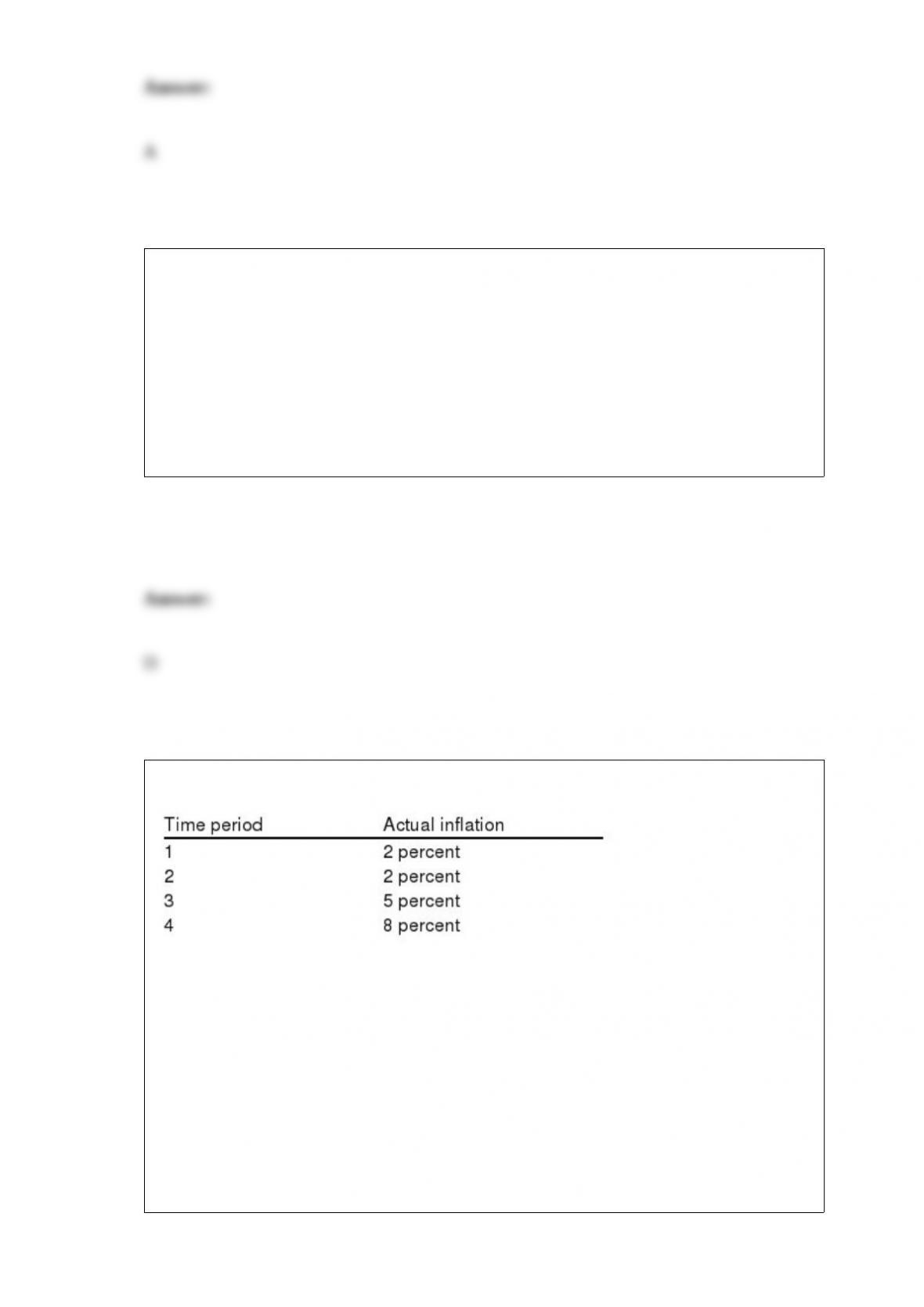
Use the table below to choose the correct answer.
According to the adaptive expectations hypothesis, at the beginning of period 3,
decision makers would expect inflation during period 3 to be
a. 2 percent.
b. 5 percent.
c. 7 percent.
d. 8 percent.

Sunk costs
a. are expenditures made in the past that cannot be regained no matter what is done now
or in the future.
b. are a component of variable costs, but not fixed costs.
c. represent foregone opportunities, and therefore the firm’s managers should consider
these costs when they are making current decisions.
d. can be avoided if the firm goes out of business.
Suppose the population (age 16 and over) of Cameroon is 250 million; 10 million are
unemployed, and 125 million hold jobs. The employment/population ratio in Cameroon
is
a. 8 percent.
b. 50 percent.
c. 54 percent.
d. 92 percent.

Economic analysis suggests that gains from specialization and exchange
a. will not be realized unless a central planning authority requires that all goods be
produced by the low opportunity cost supplier.
b. will be realized if individuals are allowed to pursue goals that are in their own
self-interest.
c. will not be realized unless business firms employ economists when making decisions
about the proper combination of resources to utilize in the production process.
d. will be realized if individuals place the public interest above the pursuit of their own
self-interest.
A local business sells its product for $40 each in a competitive price-taker market. At its
present rate of output, it’s marginal cost is $40, average variable cost is $45, and
average total cost is $60. The business should
a. increase output
b. reduce output but not to zero
c. maintain the present rate of output
d. shut down
e. raise the price
Activists believe that
a. discretionary changes in macroeconomic policy can help smooth the ups and downs

of the business cycle.
b. balancing the federal budget is of primary importance to economic stability.
c. the economy’s self-correcting mechanism, if not stifled by perverse policies, will
prevent prolonged periods of high unemployment.
d. the M1 money supply should be increased at a steady annual rate.
Suppose a certain firm is able to produce 165 units of output per day when 15 workers
are hired. The firm is able to produce 176 units of output per day when 16 workers are
hired (holding other inputs fixed). Then the marginal product of the 16th worker is
a. 10 units of output.
b. 11 units of output.
c. 16 units of output.
d. 176 units of output.

Fixed costs are best defined as
a. costs that do not vary with output.
b. costs that are at a minimum when output approaches the firm’s capacity.
c. the amount that one more unit of output adds to total costs.
d. costs that decline as output increases.
A price-taker firm will tend to expand its output so long as its
a. marginal revenue is positive.
b. marginal revenue is greater than the market price.
c. marginal revenue is less than the market price.
d. marginal cost is less than the market price.

Given the following figures, by approximately what percentage did Michael’s real
income increase between 2008 and 2009?
Michael’s 2008 money income = $60,000
Michael’s 2009 money income = $72,000
2008 CPI = 120.0
2009 CPI = 128.0
a. zero
b. 6.7 percent
c. 12.5 percent
d. 20 percent
Open market operations is the
a. tool most often used by the Fed to alter the money supply.
b. least effective tool the Fed has to alter the money supply.
c. tool used by the Treasury to raise tax revenues.
d. tool used by the Fed to regulate stock market activities.
Which of the following is true of deficit spending and government debt?
a. The opportunity costs of government spending must be incurred today and cannot be
passed on through deficit spending.
b. Because of the national debt, future generations will incur liabilities without any
corresponding benefits.
c. Financing government spending with debt allows the government to pass the
opportunity costs of government spending along to future generations.
d. All of the public debt is owed to foreigners because the people who pay taxes are
U.S. citizens.
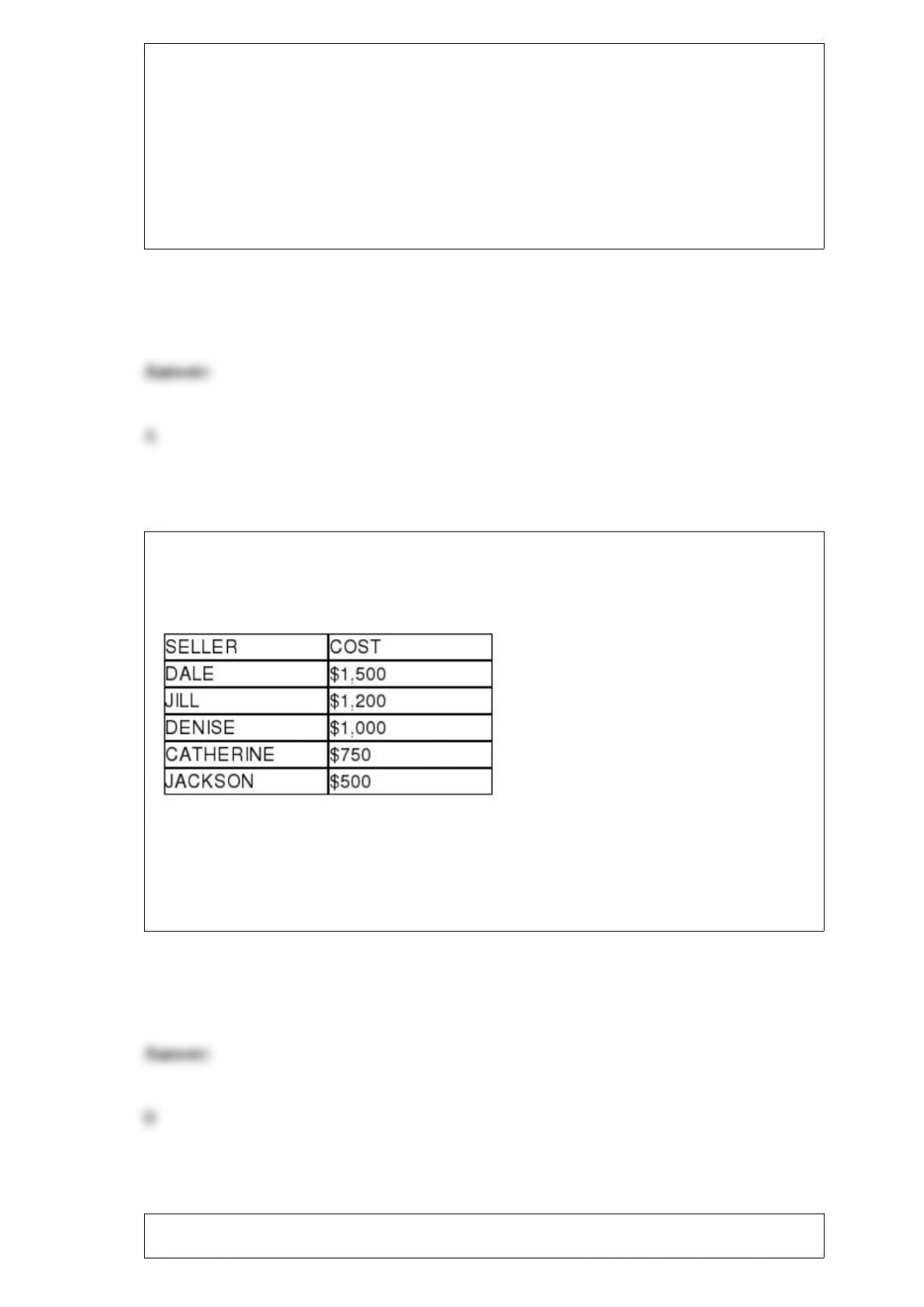
Table 3-2
Refer to Table 3-2. If the market price is $1,000, the producer surplus in the market is
a. $700.
b. $750.
c. $2,250.
d. $3,700.
There is substantial agreement among scholars that at least two functions of
government are legitimate. These two functions are the
a. protection of the rights of individuals to their person and property and the provision
of goods that cannot easily be provided through markets.
b. redistribution of income from some individuals to others and the waging of war to
expand the nation’s territory.
c. production of postal services and cable television.
d. taxation of goods that are generally considered immoral or bad and the regulation of
large corporations.
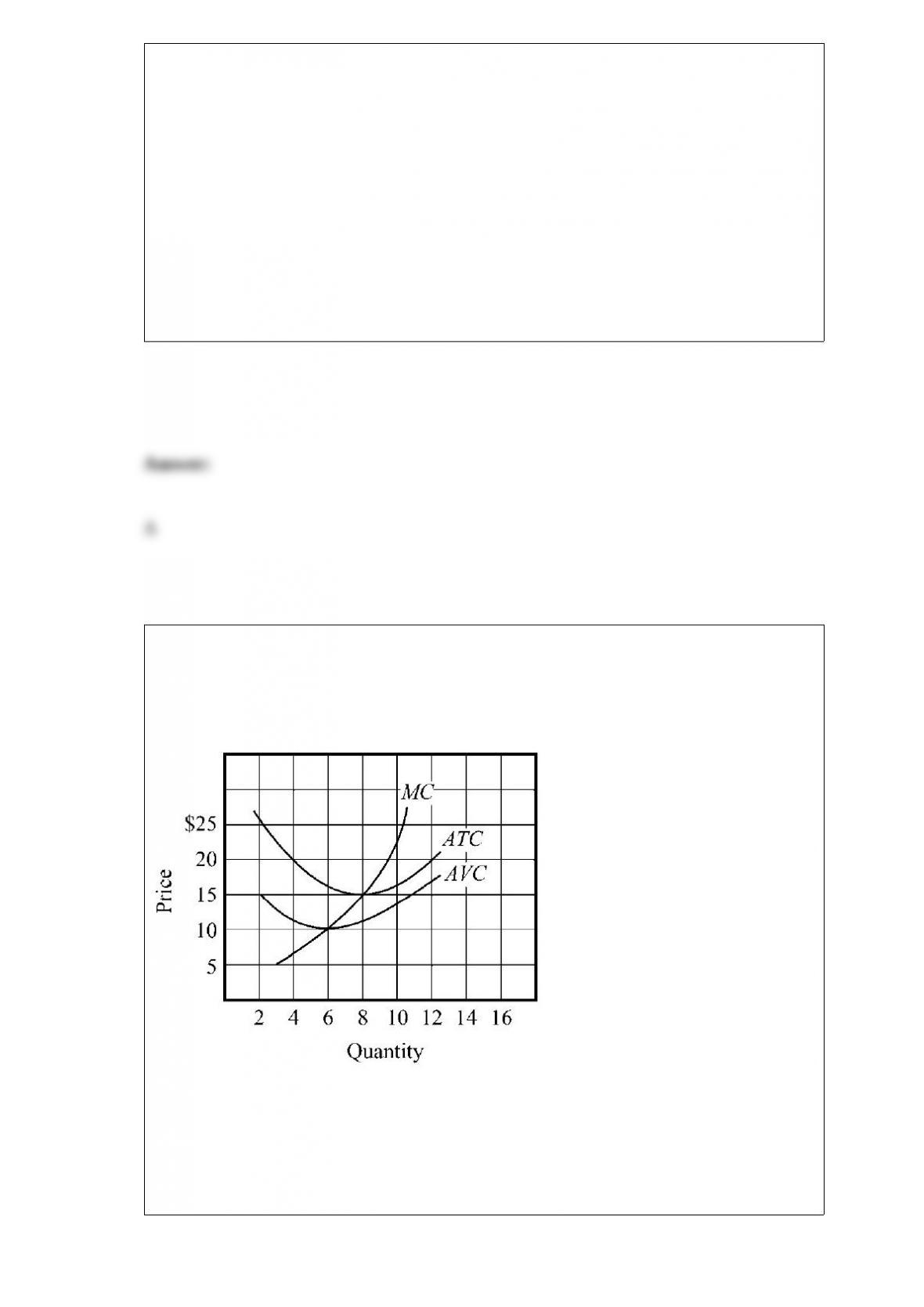
Use the figure to answer the following question(s).
Figure 8-10
In Figure 8-10, which output would minimize the firm’s average total cost of
production?
a. 4
b. 6
c. 8
d. 10
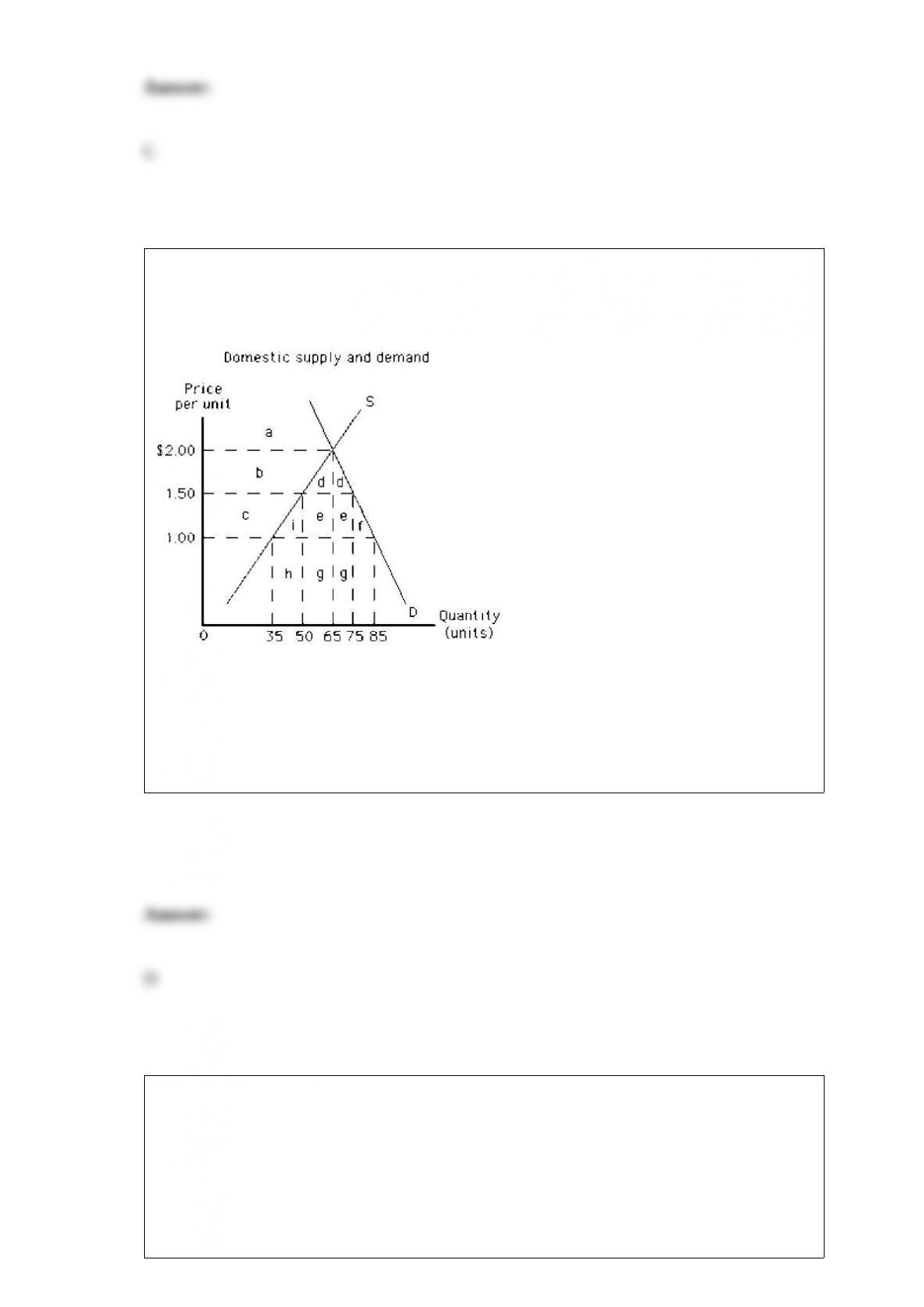
Figure 17-12
At a world price of $1.00 in Figure 17-12,
a. 20 units will be exported
b. 20 units will be imported
c. 50 units will be exported
d. 50 units will be imported
e. 10 units will be exported
The overall trend in resource prices has been
a. upward.
b. downward.
c. constant.

d. increasing exponentially.
Within the framework of the price-taker model, a price taker will always produce a
quantity of output that
a. minimizes the per-unit cost of production.
b. is expected to provide the largest possible total revenue.
c. maximizes total revenue minus total cost.
d. brings average total cost and price into equality.
An increase in the Consumer Price Index indicates that
a. the real income of households is increasing.
b. the purchasing power of the dollar is increasing.
c. the cost of buying the typical bundle of goods consumed by households is increasing.
d. the real net worth of consumers is increasing.

Economists define full employment as the level of employment that results when
a. the economy is in an economic boom.
b. the rate of unemployment is zero.
c. the rate of unemployment has fallen to its historical low of approximately two
percent.
d. the rate of unemployment is normal, considering both frictional and structural
factors.