
The price elasticity of demand for potatoes is estimated to be -1.3, and the quantity
demanded of potatoes is 3,000 bushels per week. In this situation, a 4% rise in the price
of potatoes would reduce the quantity demanded by
a. 92 bushels per week.
b. 120 bushels per week.
c. 156 bushels per week.
d. 975 bushels per week.
When deriving an Engel curve, if the optimum point for good X lies to the left as
income increases, good X is
a. a normal good.
b. an inferior good.
c. a Giffen good.
d. a substitute for good Y.
Suppose there are only two goods: food and clothing. What does it mean for the U.S. to
have a comparative advantage in food production?
a. The U.S. needs fewer resources to grow a given amount of food than do other

nations.
b. The U.S. sacrifices less clothing production to grow a given amount of food than do
other nations.
c. In the U.S., food production needs fewer resources than does a comparable amount of
clothing production.
d. In the U.S., food production costs less than does clothing production.
An indifference curve shows the baskets of goods which
a. have the same marginal values.
b. the consumer can purchase, given his income and the prices he faces.
c. are the most preferred of the baskets within his budget.
d. are all equally desirable, providing the consumer with some fixed level of
satisfaction.
Reducing Long-Run Labor Usage
The following questions refer to the accompanying diagram, which shows a firm
reducing its long-run labor usage from L0 to L1 in response to an increase in the wage
rate.
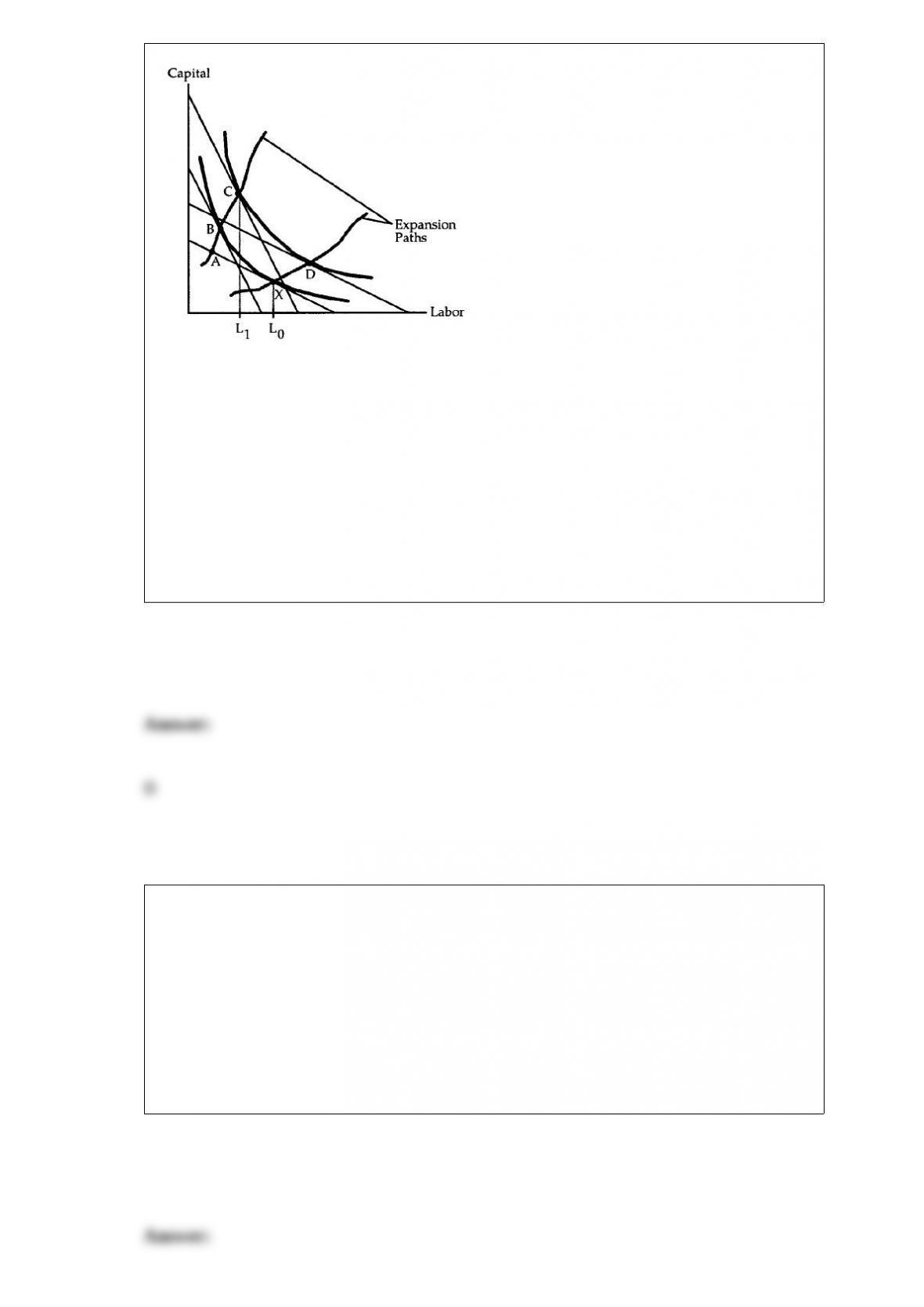
The substitution effect of the wage change is the movement from point X to
a. point A.
b. point B.
c. point C.
d. point D.
If the wages of loggers went up, the supply of logs would:
a. fall, thereby shifting to the right.
b. fall, thereby shifting to the left.
c. rise, thereby shifting to the right.
d. rise, thereby shifting to the left.

Only under which circumstances would it be possible for a tariff to increase the welfare
of residents of the importing country?
a. The supply curve is upward sloping.
b. The supply curve is upward sloping and the loss of consumer’s surplus is less than the
loss of producer’s surplus, which is borne by non-residents.
c. The supply curve is flat.
d. There are domestic producers competing with the importers.
In 1 hour, Robinson Crusoe can either shoot 4 birds or catch 4 fish. A typical native on a
nearby island can either shoot 5 birds or catch 10 fish in an hour’s time. Which of the
following is true according to the doctrine of comparative advantage?
a. Crusoe will be better off if he specializes in either activity and then trades with the
natives.
b. The natives have a comparative advantage in both shooting birds and catching fish,
so Crusoe cannot make himself better off by trading with the natives.
c. Crusoe should concentrate on shooting birds and then trade with the natives to obtain
fish.
d. Crusoe should spend his time catching fish, and he should trade with the natives to
obtain birds.
In an open economy in which only two goods are produced and possibly traded, we
would find that
a. production occurs where the production possibility curve is tangent to a line with the
slope equal to the ratio of the world relative prices.
b. production occurs where an indifference curve is tangent to the production
possibilities curve.
c. consumption occurs where an indifference curve is tangent to the production
possibilities curve.
d. consumption occurs where the production possibilities curve is tangent to a line with
a slope equal to the ratio of the world relative prices.
Marginal Cost of Production
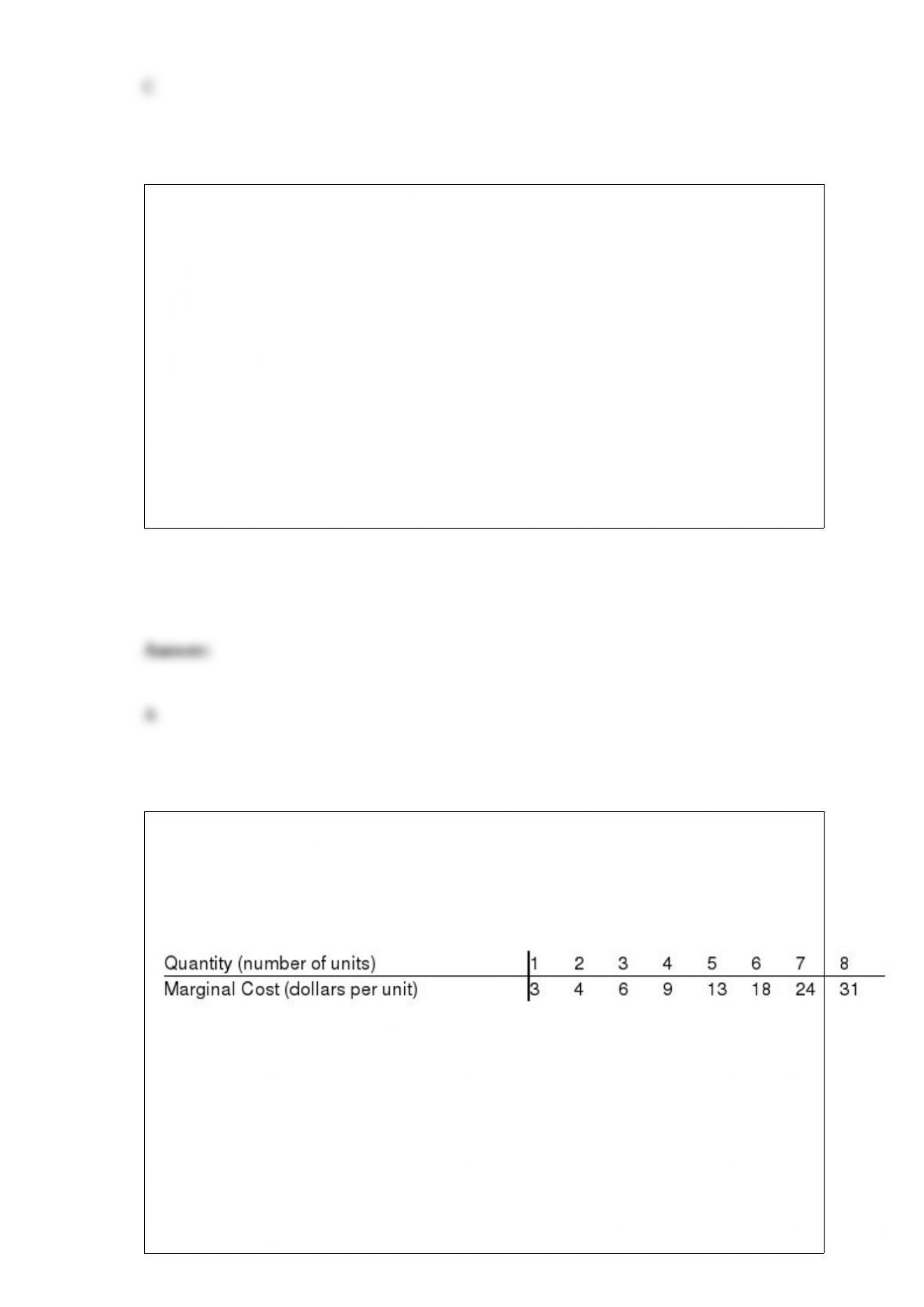
The following questions refer to the following table which shows a firm’s marginal cost
of production.
If the firm has $20 in fixed costs, producing 4 units generates variable costs of
a. $22.
b. $35.
c. $42.
d. $55.
Horizontal Merger
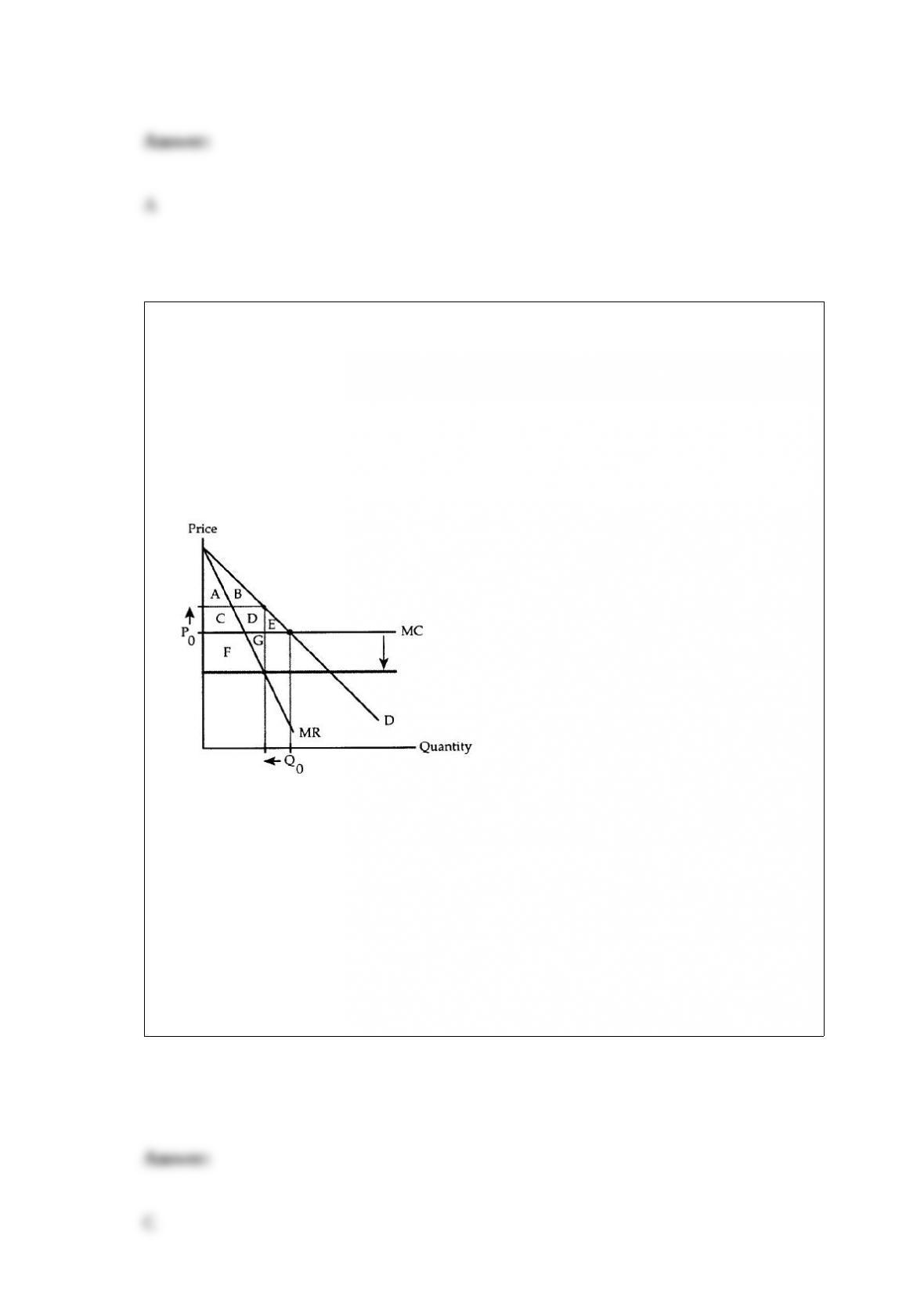
The following questions refer to the accompanying diagram, which shows the effects of
a horizontal merger. Before the merger, the firm behaves competitively producing Q0
and charging P0. The merger lowers the firm’s marginal cost and gives the firm enough
market power to switch to the monopoly equilibrium.
As a consequence of the merger, consumers lose surplus equal to
a. Area A + B.
b. Area C + D.
c. Area C + D + E.
d. Area G.
Cost of Production
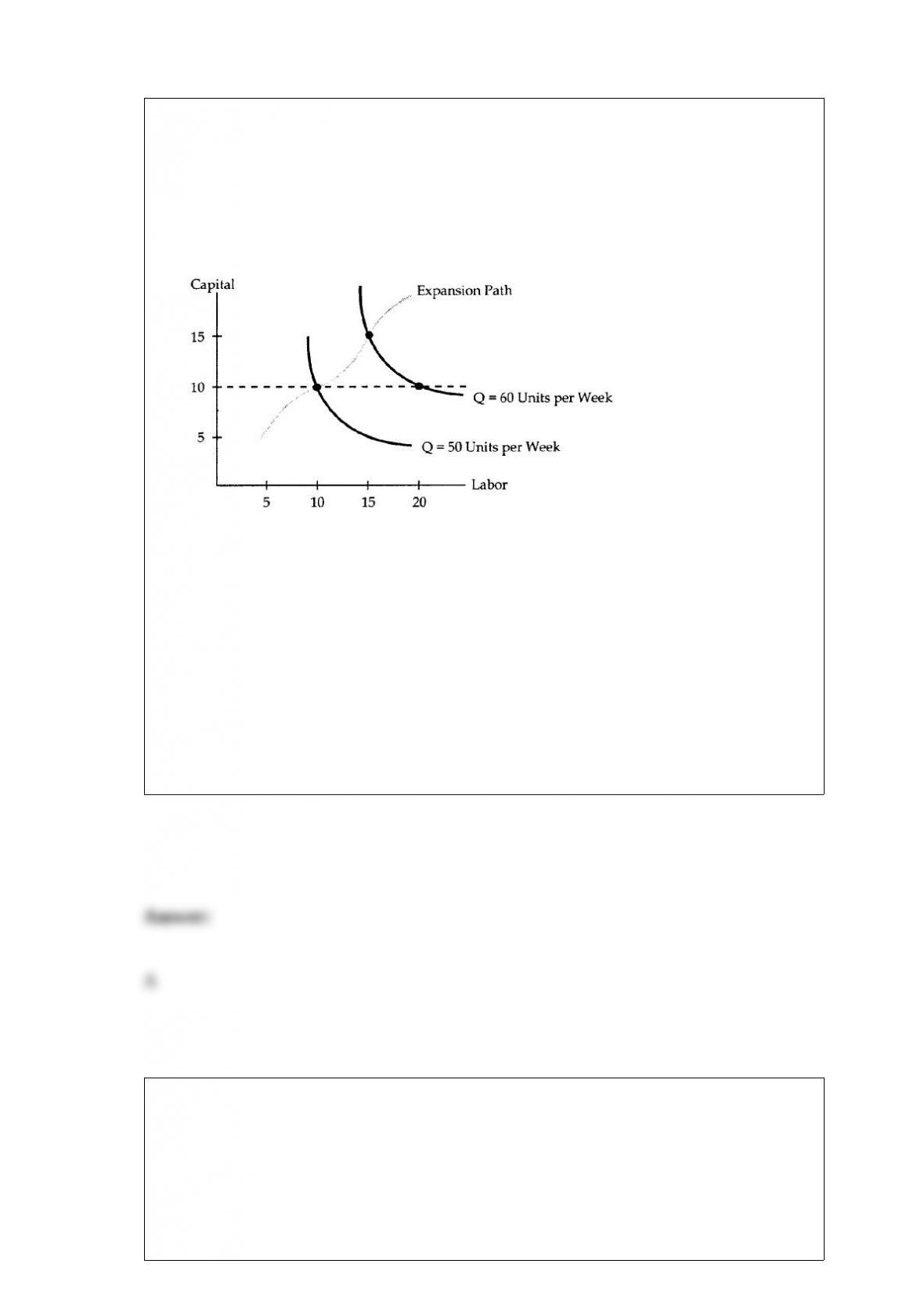
The following questions refer to the diagram below. The wage rate is assumed to be $12
per hour, the rental rate is assumed to be $6 per hour, and capital is assumed to be fixed
in the short run at 10 hours.
By comparing the two points on the expansion path, we can conclude that this
technology exhibits
a. decreasing returns to scale.
b. constant returns to scale.
c. increasing returns to scale.
d. zero returns to scale.
A country club charges a membership fee. Members pay competitive prices for the
club’s recreation and restaurant services. This situation is an example of
a. first-degree price discrimination.
b. second-degree price discrimination.

c. third-degree price discrimination.
d. a two-part tariff.
In the Cournot model of oligopoly, firms produce
a. the competitive quantity.
b. the monopoly quantity.
c. more than the monopoly quantity, but less than the competitive quantity.
d. less than the monopoly quantity.
What types of goods have downward-sloping Engel curves?
a. Normal goods only.
b. Inferior goods only.
c. Giffen goods only.
d. All types of goods.

If a rise in the price of good X causes the quantity demanded of good X to fall, then
a. the Engel curve for good X is downward sloping.
b. the (ordinary) demand curve for good X is downward sloping.
c. the demand for good X is elastic.
d. good X must be a Giffen good.
A game’s outcome is a Nash equilibrium when
a. any attempt to improve one player’s payoff will lower the other player’s payoff.
b. neither player wants to change his strategy, given the strategy chosen by the other
player.
c. the total payoff to the players is as large as possible.
d. the first player has selected his strategy taking the second player’s optimal response
into account.

If a firm is producing a quantity along the upward sloping portion of its marginal cost
curve at which marginal cost exceeds price and is earning positive economic profits, it
should
a. continue to produce this quantity.
b. decrease the quantity produced because doing so will increase profit.
c. increase the quantity produced because profits are still positive.
d. wait for the price to increase to its current marginal cost.
A profit maximizing price taker will produce at a level where
a. the wage equals the marginal product of labor.
b. the marginal revenue product of labor equals the price of their output.
c. the wage rate equals the price of their output.
d. the marginal revenue product of labor equals the wage rate.
Payments to a factor of production in excess of the minimum payments necessary to
call it into existence constitute
a. consumers’ surplus

b. rent
c. a golden parachute
d. an efficiency wage
Suppose Joe purchases 10 lottery tickets per month when his monthly income is $200.
Joe receives a raise at work, giving him an extra $40 per month in take-home pay, and
Joe now purchases 12 lottery tickets per month. What is Joe’s income elasticity of
demand for lottery tickets?
a. 2.
b. 1.
c. 0.3.
d. 0.05.
An equilibrium is an outcome in which
a. all individuals are simultaneously optimizing.
b. constraints are no longer binding.
c. social gain is as large as possible.

d. the wants of all agents are fully satisfied.
The decline in the average number of hours worked over the last century from 60 hours
to 40 hours can be explained as a consequence of
a. an increase in nonlabor income shifting labor supply to the left.
b. an increase in nonlabor income shifting labor supply to the right.
c. a decrease in the demand for labor.
d. an improved understanding of the importance of sleep to labor productivity.
Economists use the term variable costs to refer to
a. prices of inputs that are subject to sudden change, like fuel.
b. an increase in the price of any input.
c. costs that vary with the type of final product being produced.
d. costs that vary with the quantity of output produced.

In a Nash equilibrium, which of the following constrains an individual when he
optimizes?
a. The market prices.
b. His tastes.
c. The actions of other individuals.
d. Nothing-the individual has no constraints in a Nash equilibrium.
Goods X and Y
For the following questions, assume that good X is on the horizontal axis and good Y is
on the vertical axis in the consumer-choice diagram. PX denotes the price of good X, PY
is the price of good Y, and I is the consumer’s income. Unless otherwise stated, the
consumer’s preferences are assumed to satisfy the standard assumptions.
Which of the following would cause the vertical intercept to move upwards?
a. A decrease in the price of good Y.
b. An increase in the price of good X.
c. An increase in the price of good Y.
d. A decrease in the price of good Y.
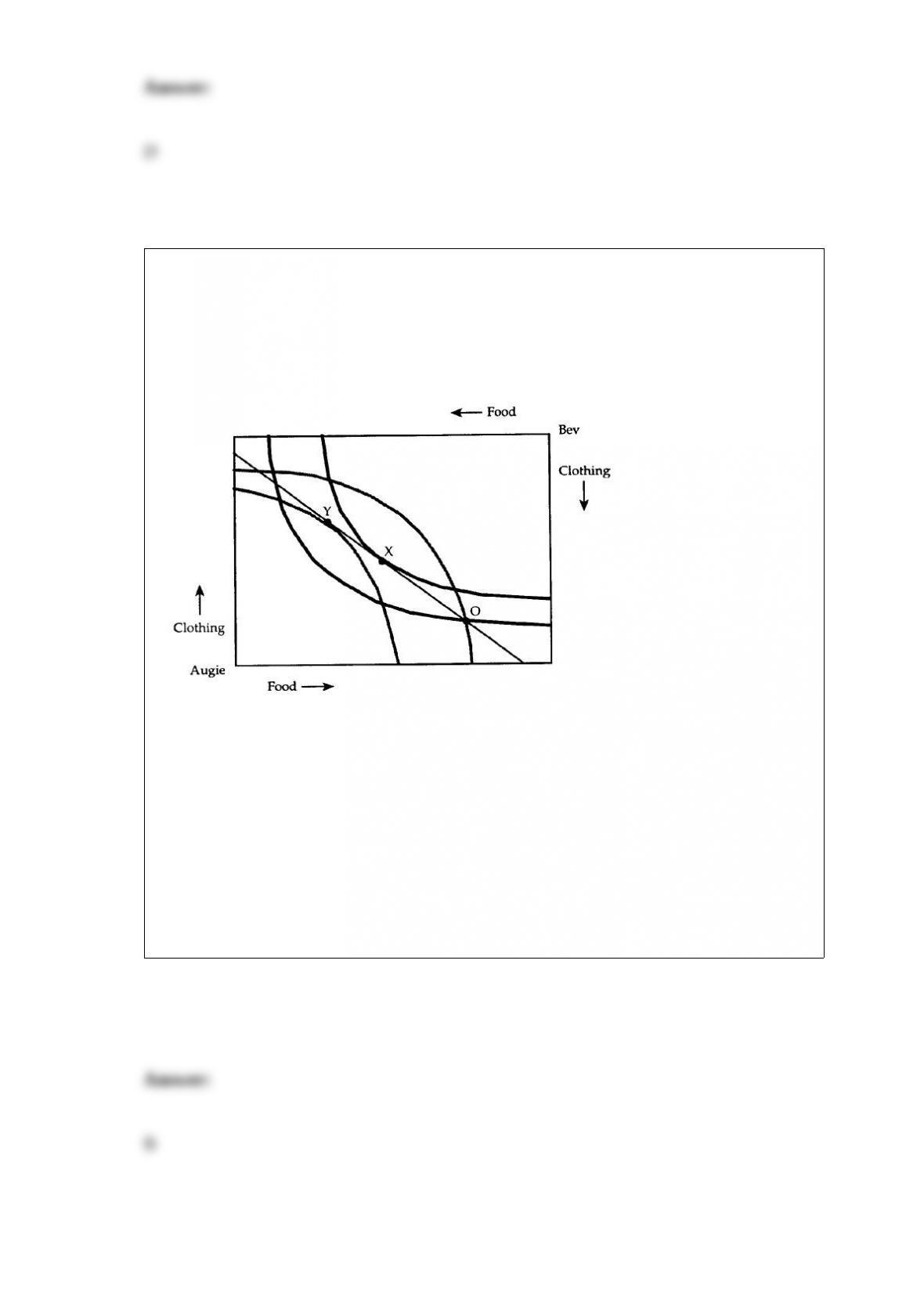
Edgeworth Box Economy
The accompanying diagram shows an Edgeworth box economy. The initial endowment
is point O. At current relative prices, Augie chooses point X and Bev chooses point Y.
The initial holdings of an individual in an Edgeworth box is referred to as
a. the contract point.
b. the endowment point.
c. the Pareto preferred point.
d. the competitive equilibrium point.
Suppose the supply of current consumption is perfectly inelastic and determined solely
by people’s endowments. What will be the effect of a temporary productivity increase
that raises people’s current endowments?
a. Current consumption will rise, but the effect on the interest rate is uncertain.
b. Both the demand and supply of current consumption will rise, with the net effect
being to lower the interest rate.
c. The demand for current consumption will rise, which will cause the interest rate to
rise.
d. The interest rate will fall, because the supply of current consumption rises and the
demand remains unchanged.
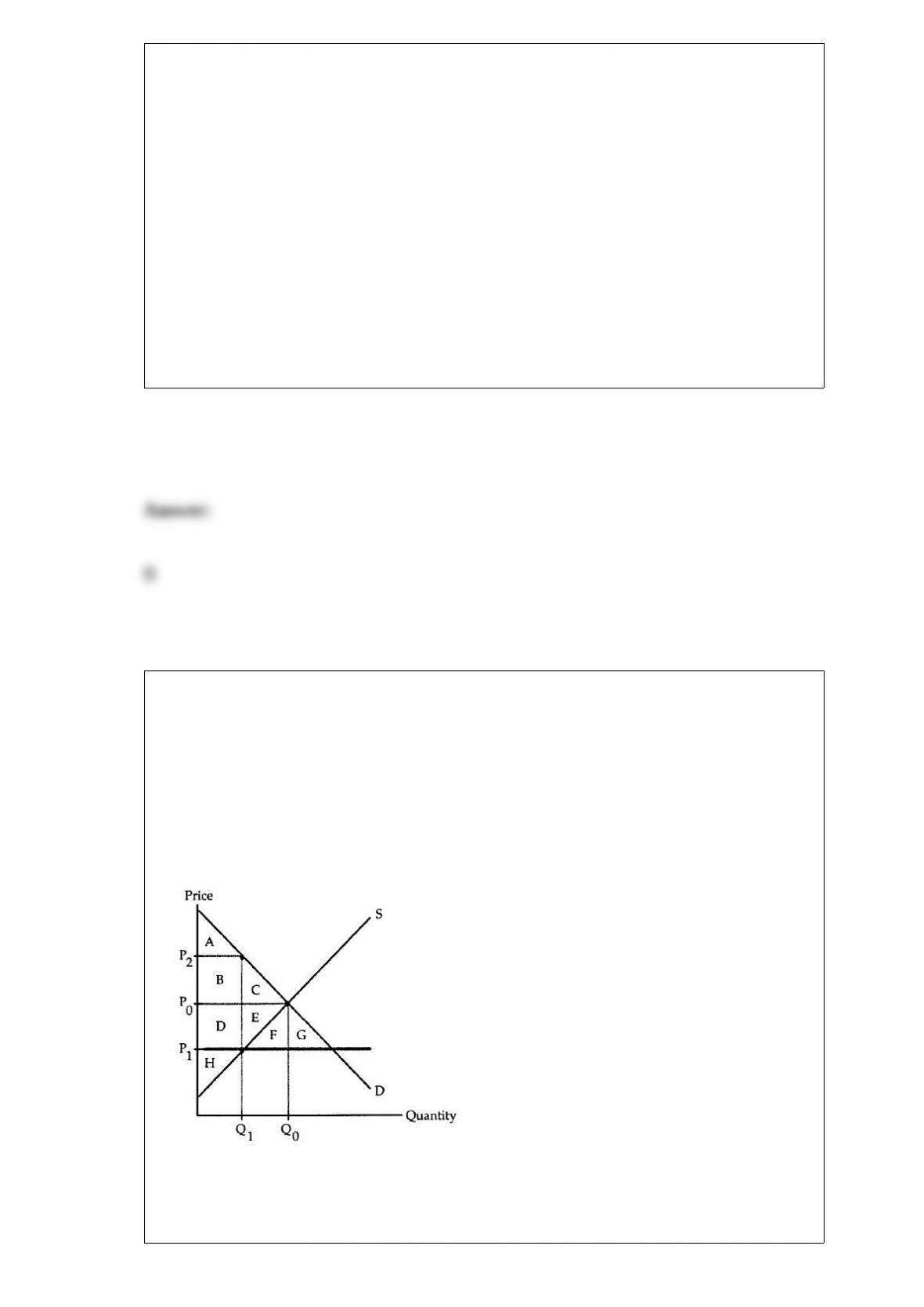
Price Ceiling
The following questions refer to the accompanying diagram which shows the effects of
a price ceiling. The initial price and quantity are P0 and Q0, respectively, and the price
ceiling is imposed at the price P1. Assume that none of the potential deadweight loss
can be avoided.
The price ceiling creates a deadweight loss equal to

a. area A + H.
b. area B + C + D + E.
c. area B + D.
d. area C + E.
How does a temporary technological improvement that raises labor’s marginal
productivity affect the supply of labor?
a. There is no change in labor supply-changes in marginal productivity affect only labor
demand.
b. The fall in labor supply is greater than if the improvement were permanent.
c. Labor supply will rise only if employers are willing to pay compensating
differentials.
d. Income effects lower labor supply, while intertemporal substitution raises labor
supply.
A bond with a $90,000 face value sells at a $10,000 discount one year prior to maturity.
What is the nominal interest rate paid by the bond?
a. 8.0%.

b. 8.9%.
c. 11.1%.
d. 12.5%.
Suppose transactions costs are created by a principal-agent problem. If the objective is
economic efficiency, who should be made liable for damages resulting from the
interaction of the principal and the agent?
a. The principal should be liable for all damages.
b. The agent should be liable for all damages.
c. Liability for damages should be equally split between the principal and the agent.
d. The assignment of liability is irrelevant according to the Coase Theorem.
Cost of Production
The following questions refer to the diagram below. The wage rate is assumed to be $12
per hour, the rental rate is assumed to be $6 per hour, and capital is assumed to be fixed
in the short run at 10 hours.
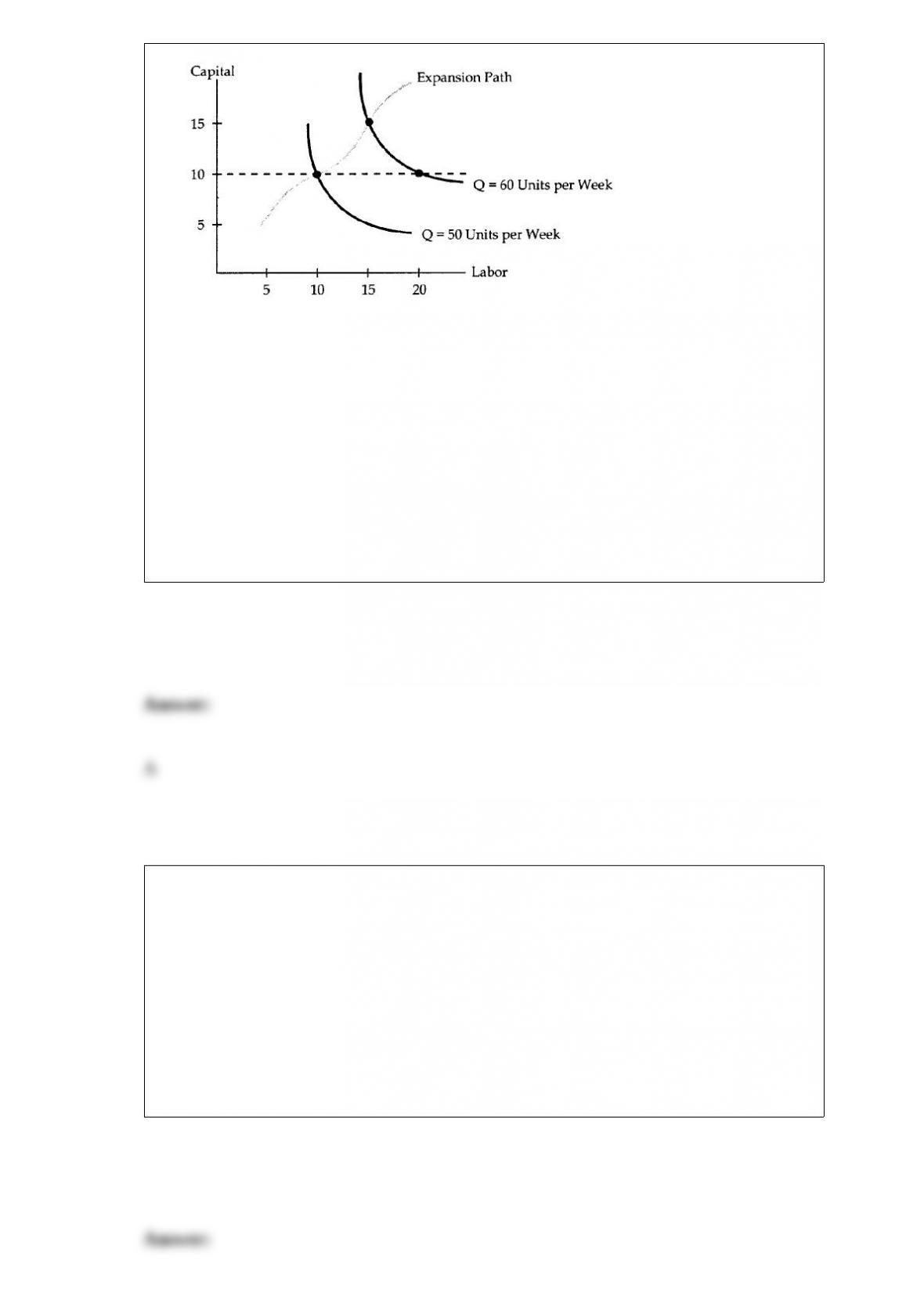
The short-run total cost of producing 50 units of output per week is $180, but the
long-run total cost is
a. $180.
b. $270.
c. $300.
d. $900.
When a player randomly chooses the strategy to play, with each strategy given a fixed
probability of being chosen, we say that the player is using
a. a mixed strategy.
b. a pure strategy.
c. a dominant strategy.
d. a Stackelberg strategy.

In a contestable market with room for many firms, industry output will be the same as
in a successful cartel.
Market demand always represents marginal value.
Producer’s surplus is equal to total revenue minus consumer’s surplus.
Will people, on average, tend to eat more grapefruit in Florida or in Illinois? In which
state will the people, on average, tend to eat better quality grapefruit? Explain, using the

concept of relative price.
A rise in supply is illustrated by an upward shift in the supply curve.
Consider a price ceiling imposed on a monopoly that is set below the competitive price.
Design a diagram showing the monopoly equilibrium in this case. Use your diagram to
show that a price ceiling set this low will create a shortage.
The factor-price effect makes an industry’s short-run supply response more elastic than
it otherwise would be.
Consider the following:
Cost minimization requires that the marginal product of labor equal the marginal
product of capital.
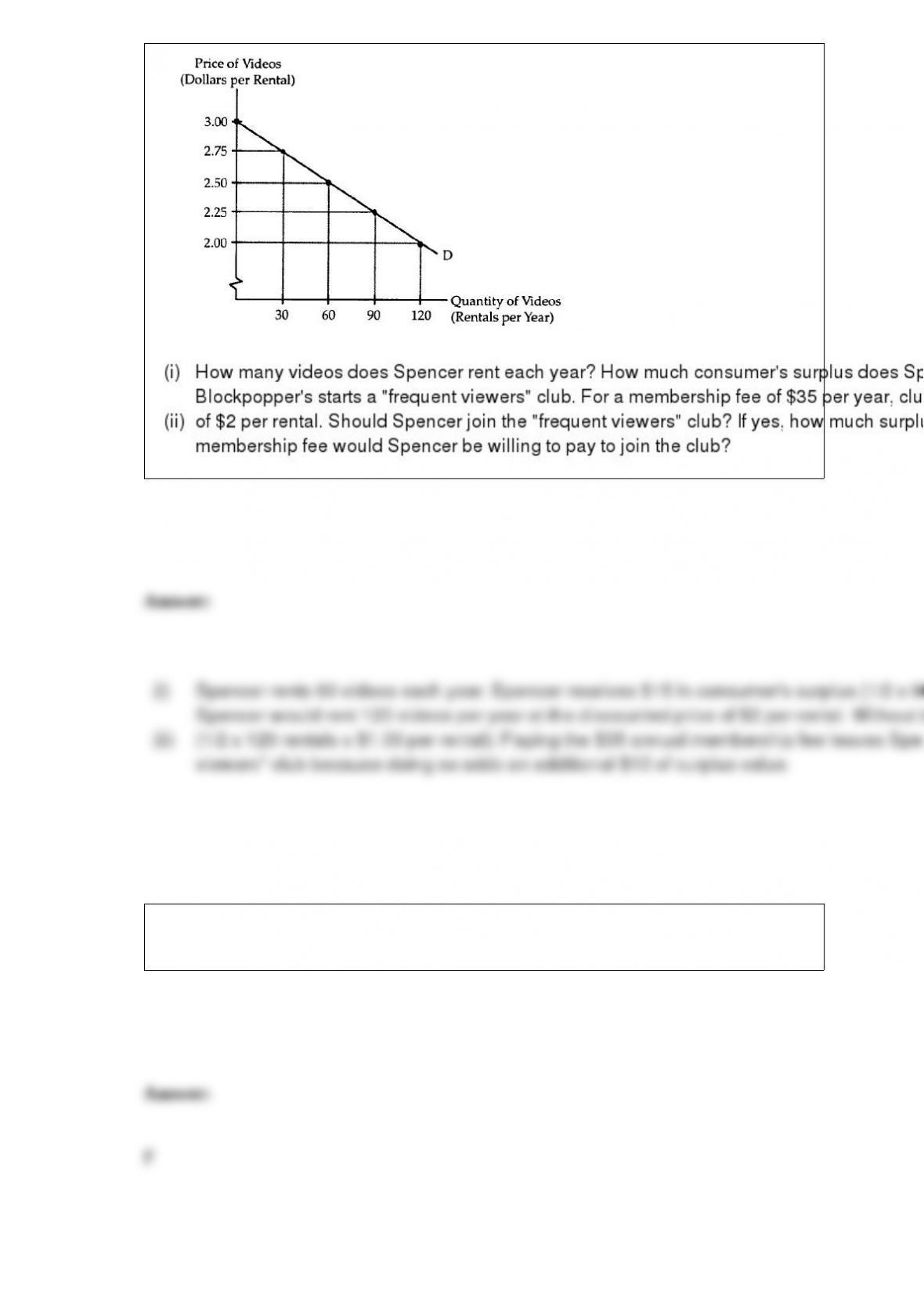
The diagram below shows Spencer’s annual demand for videos. Spencer currently rents
videos from Blockpopper’s, which charges $2.50 per rental.
One problem with a Clarke tax is that although it may not cover the complete cost of a
public good, it will never generate more than the cost of the good.

In the absence of transactions costs, changes in property rights have no effect on
economic efficiency.
When a two-part tariff is perfectly implemented, the monopoly charges a price that is
greater than its marginal cost.
An insurance company faces an adverse selection problem when people start taking
additional risks after they acquire insurance.
The large increase in the price of oil and in the total revenues and profits of the US oil
industry in the 1990’s are evidence that it was exercising monopoly power.