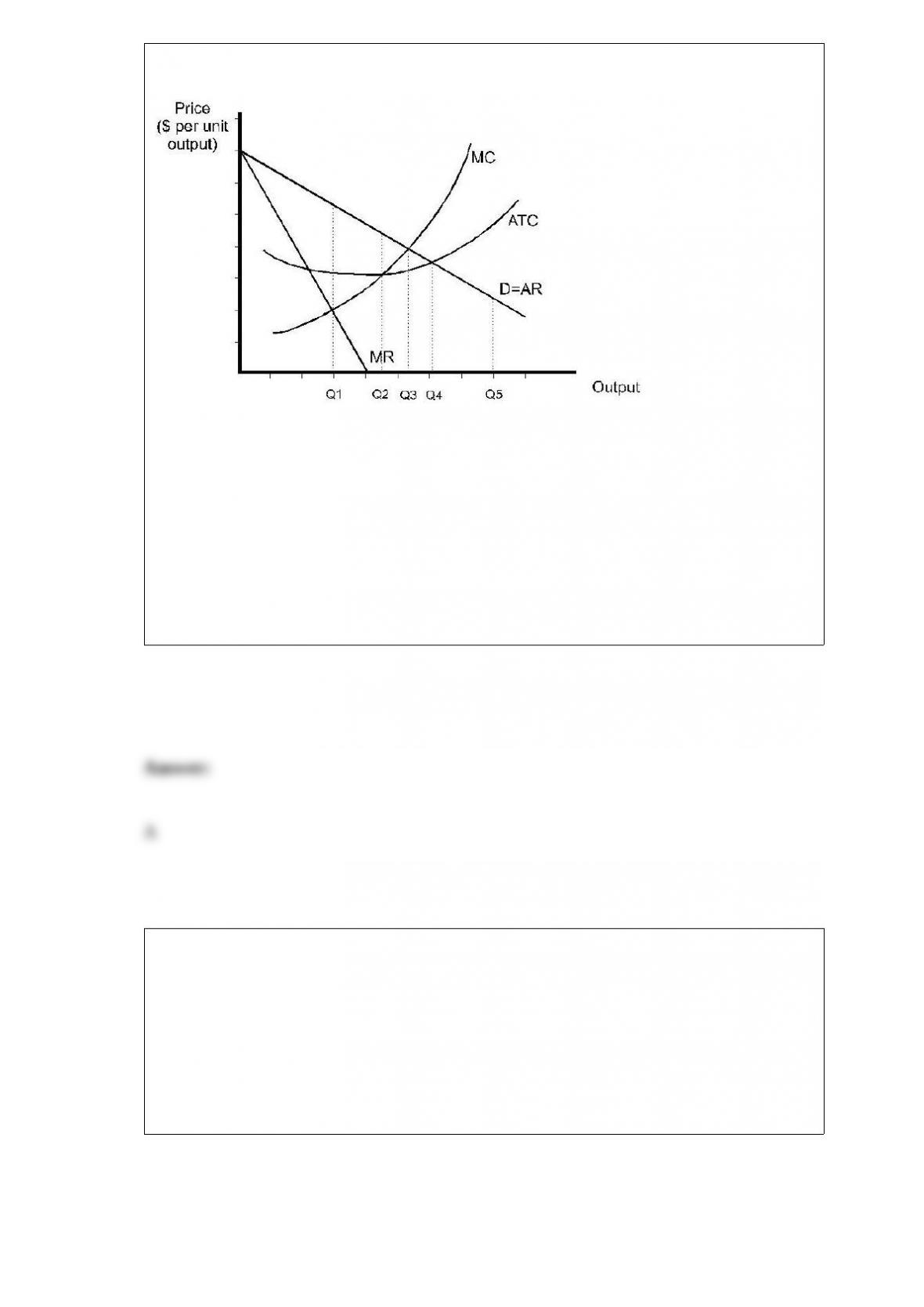
For the monopolist shown below, the profit maximizing level of output is:
A) Q1.
B) Q2.
C) Q3.
D) Q4.
E) Q5.
You have been hired by an attorney to perform an economic analysis of lost wages in a
wrongful death suit. The case involves an insurance agent, John Doe, who was killed in
an auto accident a few days after his 59th birthday. Mr. Doe could have expected to earn
$75,000 this year. Data suggest that the income of insurance agents has risen an average
of 6% over the past 20 years. Mr. Doe’s expected retirement age was 65, i.e., on his 65th
birthday. Available data provide the mortality rates given below for individuals of Mr.
Doe’s sex and occupation at various ages. Ten percent appears to be the appropriate
discount rate.
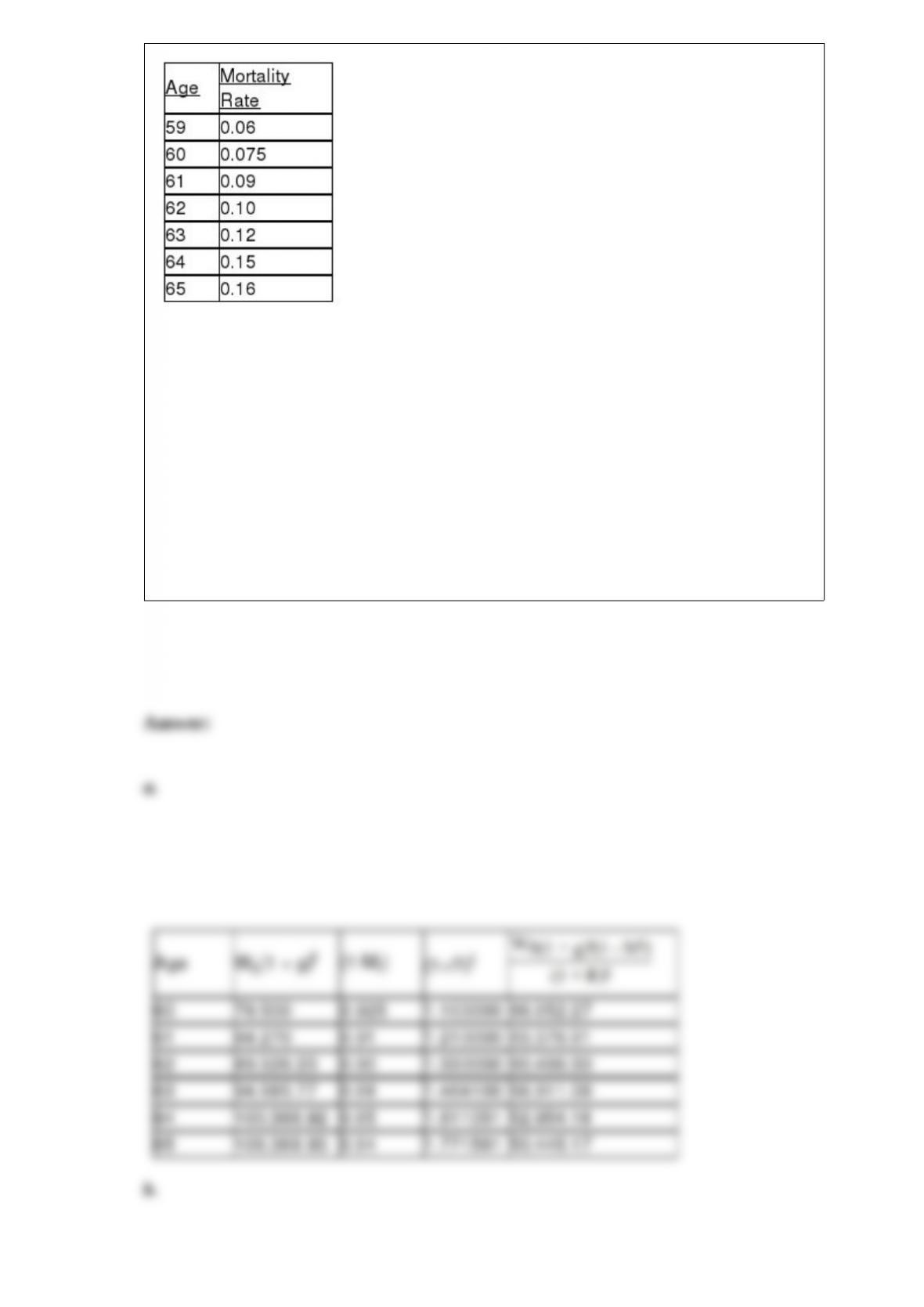
a. Calculate the present discounted value of Mr. Doe’s expected earnings stream. (For
simplicity, assume he receives all of his earnings for the preceding year on his birthday.)
b. The attorney has asked your advice regarding a minimum figure that should be
accepted as an out-of-court settlement. What guidance can you give the attorney?
Would additional information allow you to give the attorney a more precise estimate of
the figure that should be accepted? Give an example of how more information would
help.
c. You must be prepared for cross-examination by the defendant’s attorney. Where
would you expect the opposing attorney to attack your testimony?
An efficient allocation of goods in an exchange economy means that
A) goods were produced by the most efficient technology available.
B) no one can be made better off without making somebody else worse off.
C) those made worse off are not hurt as badly as the benefits resulting from those made
better off. That is, there is a net positive gain.
D) in a particular production process one gets the maximum output for a given input.
Under what circumstances are the marginal expenditure for an input and the average

expenditure always equal? Where there is a
A) competitive buyer.
B) competitive seller.
C) monopoly buyer.
D) monopoly seller.
In a recent article, two economists estimated that the 37.5% increase in price that would
result from a 75 cent tax increase on cigarettes would lead to a decrease in smoking
among college students of 30%. What can you conclude about the demand for cigarettes
among college students?
A) It is price elastic.
B) It is price inelastic.
C) It is unit elastic.
D) It is perfectly inelastic.
To enforce the optimum level of emissions, a government could set an emissions fee,
which would be
A) the dollar value indicated by the intersection of the MSB and MCA curves, and
would apply to every unit of pollutants the firm emitted.
B) the dollar value indicated by the intersection of the MSB and MCA curves, and
would apply to every unit of pollutants the firm emitted above the standard.
C) the vertical intercept of the MSB curve.
D) the vertical intercept of the MCA curve.
E) the vertical distance between the intercepts of the MSB curve and the MCA curve.
G.C. Donovan Company is a large pharmaceutical company located in the U.S., but
with worldwide sales. Donovan has recently developed two new medications that have
been licensed for sale in European Union countries. One medication is an
over-the-counter cold preparation that effectively eliminates all cold symptoms, while
the other is an antibiotic that is effective against drug resistant bacteria. A European
firm, Demtech Limited, has developed drugs that are similar to Donovan’s and will be
ready for the European market at approximately the same time. Liability concerns make
it unlikely that either firm will choose to market both new drugs at this time. Both firms
do plan to market one of the drugs this year.
Donovan’s managers consider their own lack of reputation among European physicians
to be an important obstacle in the antibiotic market. Consequently, Donovan feels more
comfortable marketing the cold preparation. Demtech, on the other hand, has an
excellent reputation among physicians but little experience in over-the-counter drugs so
that Demtech’s competitive advantage is with the antibiotic. Should Demtech choose to
market the cold remedy, it believes that its sales will increase if Donovan also enters the
cold remedy market and advertises heavily. Similarly, Donovan anticipates that its sales
in the antibiotic market would be enhanced if Demtech produces antibiotics, given
Demtech’s excellent reputation among physicians. In short, each firm believes that there
are circumstances under which participation by the other firm will complement rather
than compete with the firm’s own sales. Profits in millions of dollars are given in the
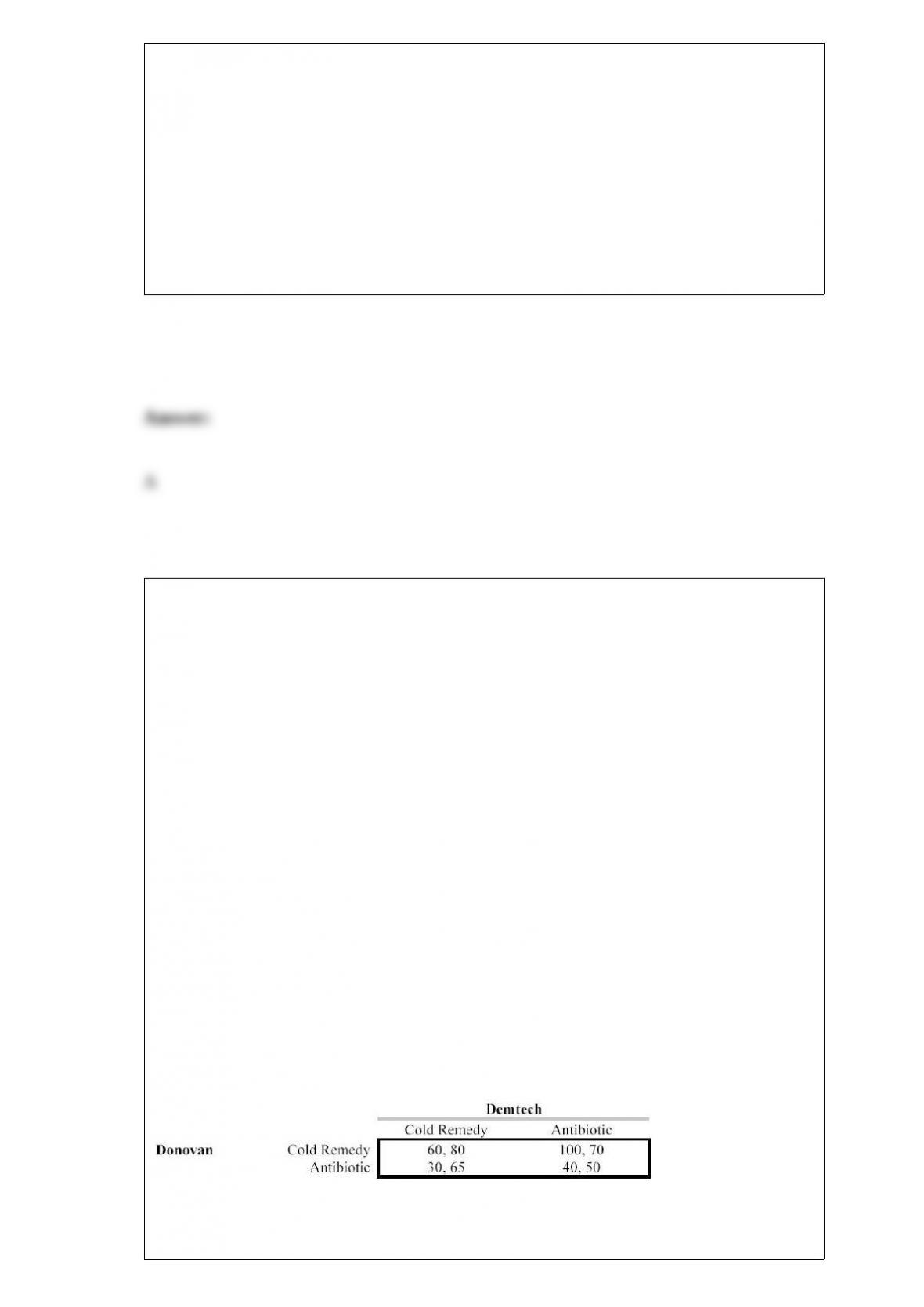
payoff matrix below.
a. Given the table above, does either firm have a dominant strategy? Is there a Nash
equilibrium? (Explain the difference between a Nash equilibrium and a dominant
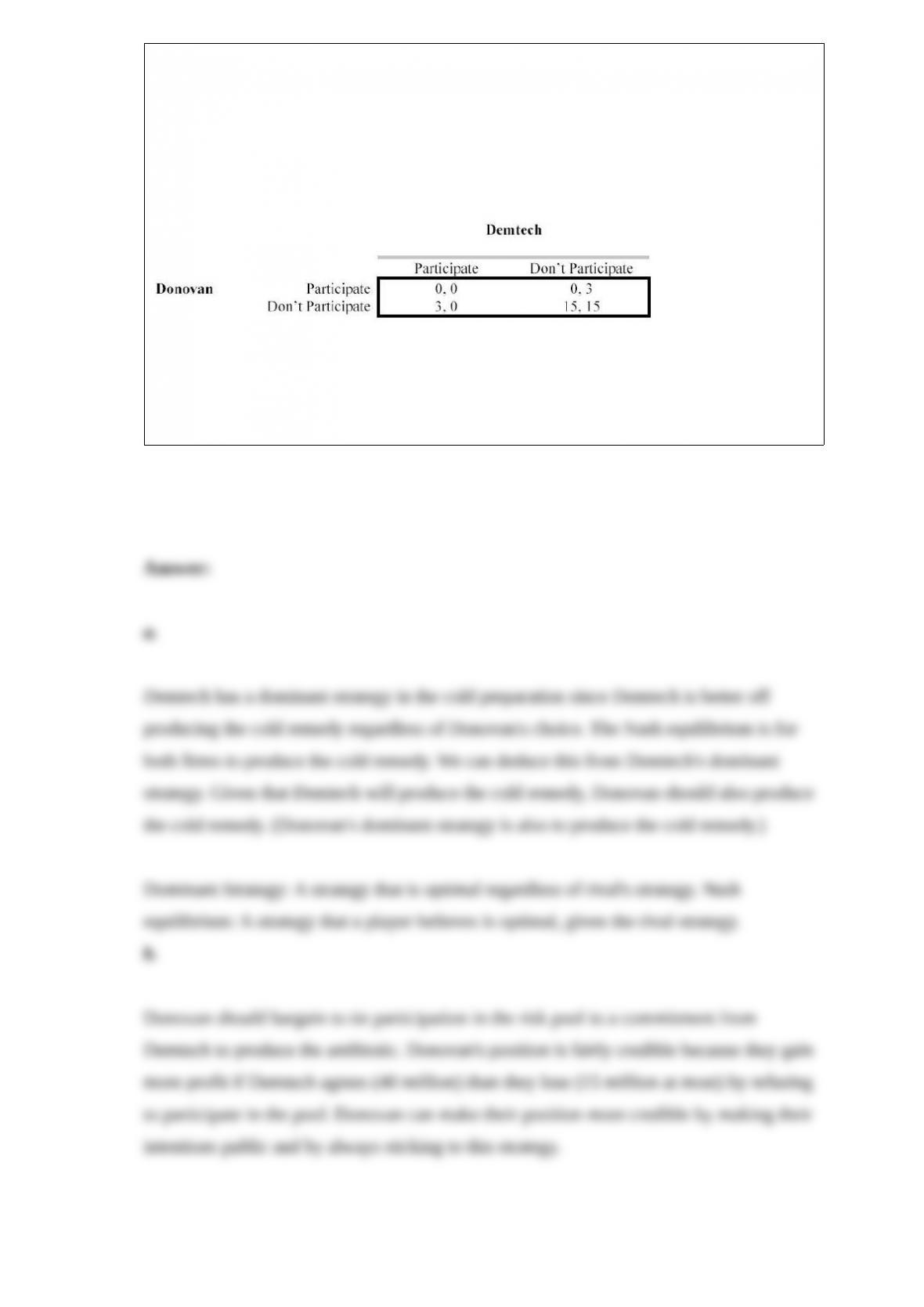
strategy.)
b. Pharmaceutical firms within the EU are attempting to organize a risk pool that would
share liability risks for new drugs. Since Donovan and Demtech are among the largest
pharmaceutical companies operating in Europe, the benefits of the risk pool depend
upon the participation of the other firm. Increased profits achieved through reduced risk
liability (measured in millions of dollars) are shown in the payoff matrix below.
Does either firm have an incentive to use participation in the risk pool as a bargaining
device in the drug-marketing decision? If so, what would be the nature of the bargain?
How credible is the firm’s bargaining position? What could be done to make the
bargaining position more credible?

Owners and managers
A) must be the same people.
B) may be different people with different goals, and in the long run firms that do best
are those in which the managers are allowed to pursue their own independent goals.
C) may be different people with different goals, but in the long run firms that do best
are those in which the managers pursue the goals of the owners.
D) may be different people with different but exactly complementary goals.
E) may be different people with the same goals.
The slope of the total product curve is the
A) average product.
B) slope of a line from the origin to the point.
C) marginal product.
D) marginal rate of technical substitution.
Scenario 12.2:

You are studying a market for which the kinked demand curve model applies. The
kinked demand curve is as follows:
Q = 1200 – 5P for 0 Q < 150
Q = 360 – P for 150 Q
The marginal cost is given as:
MC = Q
Refer to Scenario 12.2. Suppose that the marginal cost falls such that:
MC = Q – 10
What is the profit maximizing price?
A) 72
B) 240
C) 210
D) all of the above
E) none of the above
The city of Econoville has 100 residents who each have the identical demand function
for park area: P = 10 – Q. The marginal cost of providing parks is MC(Q) = 10 + 10Q.
Park area is a public good. That is, if the city of Econoville provides park area, all of the
residents can enjoy the area. If the city of Econoville does not offer public park area,
how much area of parks will each individual resident maintain on their own? What is
the optimal level of public parks in Econoville?

If a consumer must spend her entire income on some combination of two commodities
and chooses to spend it all on just one of the commodities then:
A) the other commodity is an economic bad.
B) the other commodity must have zero marginal utility.
C) the other commodity generates less utility per dollar spent on the good.
D) the two commodities must be perfect substitutes.
A bond has a current market value of $800. The holder of the bond will receive a single
payment of $1,000 one year from now. The interest rate is 10 percent. The effective
yield on the bond is:
A) $200.
B) 10 percent.
C) 25 percent.
D) negative.

E) The yield cannot be determined with the information provided.
How might department stores best protect themselves against the risk of recession?
A) Buy insurance policies that pay off when a recession occurs.
B) Stand ready to go out of business if a recession occurs.
C) Sell goods that are complements to one another.
D) Sell both substitute and complement goods.
E) Sell both normal and inferior goods.
In insurance markets, moral hazard creates economic inefficiency because:
A) insurance companies are price setters rather than price takers.
B) insurance products are not homogenous goods.
C) there are many buyers but only a few sellers.
D) insured individuals do not correctly perceive the costs or benefits of their actions.

Which price index tends to understate the impact of price changes on consumers?
A) Chain-weighted index
B) Laspeyres index
C) Paasche index
D) Ideal cost-of-living index
When the interest rate is R, the formula for finding the future value of $M two years
from now is
A) M (1 + R)2.
B) M (1 + R2).
C) M / (1 + R)2.
D) M / (1 + R2).

In general, the current stock of pollutants (St) may be modeled as St = Et + (1 – d)St-1
where d is the ________ and Et is the ________.
A) social discount rate, previous stock level
B) social discount rate, current emissions
C) stock dissipation rate, previous stock level
D) stock dissipation rate, current emissions
A consumer’s demand for CDs can be represented by a line with slope -b and intercept
a. If the current price of CDs is $P, then the ratio of consumer surplus to total
expenditures on CDs equals
A) (a – P)(a – bP).
B) 1/2(a – P)(a – bP).
C) D(a – bP).
D) (a – P)/P.
E) (a/b – P)/(2P).

For a perfect first-degree price discriminator, incremental revenue is
A) greater than price if the demand curve is downward sloping.
B) the same as the marginal revenue curve if the firm is a non-discriminating
monopolist.
C) equal to the price paid for each unit of output.
D) less than the marginal revenue for a non-discriminating monopolist.
A curve that represents all combinations of market baskets that provide the same level
of utility to a consumer is called:
A) a budget line.
B) an isoquant.
C) an indifference curve.
D) a demand curve.
E) none of the above
When 1983 is the CPI base year, the CPI value is 82.4 for 1980 and 2 for 2000.
Suppose we want to convert this CPI series to have a base year of 2000 (that is, CPI2000
= 100). What is the value of the revised CPI for 1980?

A) 2
B) 100
C) 9
D) 0
What is a good argument for using the model of the consumer despite the fact that it
requires making many simplifying assumptions?
A) It is complex to solve.
B) The assumptions are sometimes realistic.
C) It explains observed patterns of behavior.
D) It is used in many scholarly fields.
The United States and Brazil are competitors in the world soybean market. In the late
1960s and early 1970s, the Brazilian government developed regulations designed to
encourage Brazilian soybean production and exports. An unanticipated effect of the
Brazilian regulations was to stimulate U.S. soybean production and exports. The type of
economic analysis that would explain and predict these effects is called
A) closed economy macroeconomics.
B) international economics.
C) partial equilibrium analysis.
D) full market analysis.
E) general equilibrium analysis.
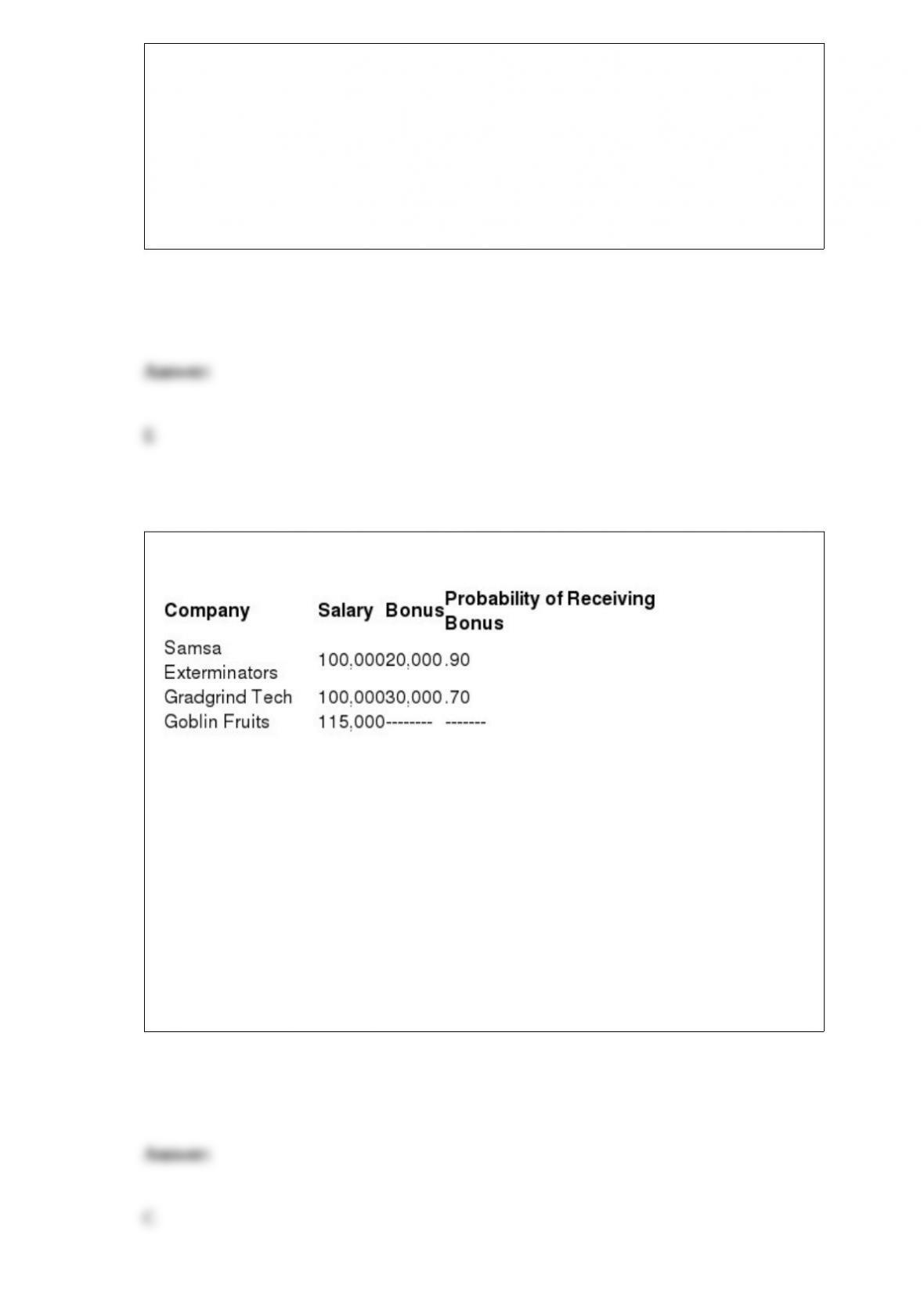
Upon graduation, you are offered three jobs.
Rank the three job offers in terms of expected income, from the highest to the lowest.
A) Samsa Exterminators, Gradgrind Tech, Goblin Fruits
B) Samsa Exterminators, Goblin Fruits, Gradgrind Tech
C) Gradgrind Tech, Samsa Exterminators, Goblin Fruits
D) Gradgrind Tech, Goblin Fruits, Samsa Exterminators
E) Goblin Fruits, Samsa Exterminators, Gradgrind Tech

Suppose your firm develops a new pharmaceutical product that may be used to reduce
blood cholesterol levels, so the firm is the monopoly seller of this drug. If the elasticity
of demand for this new product is -4, what markup should your firm use to set the
profit-maximizing price for the product?
A) The price-cost markup is 25% of the price
B) The price-cost markup is 25% of the marginal cost
C) The price-cost markup is 4% of the marginal cost
D) The price-cost markup is 4% of the price
The change in the quantity demanded of a good resulting from a change in relative price
with the level of satisfaction held constant is called the ________ effect.
A) Giffen
B) real price
C) income
D) substitution
Which of the following actions may be explained by the law of small numbers?

A) People buy lottery tickets.
B) People buy air travel insurance.
C) People purchase extended or long-term warranties or maintenance contracts for new
automobiles and appliances.
D) all of the above
Marginal utility measures:
A) the slope of the indifference curve.
B) the additional satisfaction from consuming one more unit of a good.
C) the slope of the budget line.
D) the marginal rate of substitution.
E) none of the above
An investor can acquire shares of stock in Acme Corporation either by purchasing
shares on the stock market or by purchasing a bond that is convertible into shares of
Acme stock. After careful study, the investor discovers that she can profit by purchasing
the bond, converting it to shares of stock, and selling the stock. This practice is called:

A) selling short.
B) arbitrage.
C) profiteering.
D) dumping.
E) none of the above
Which is NOT an advantage of emissions fees over standards?
A) Fees can give a firm the incentive to reduce emissions below the standard when new
technology allows.
B) Fees can reduce the cost of attaining some goal level of emissions when firms all
have the same abatement costs.
C) Fees can reduce the cost of attaining some goal level of emissions when firms have
different abatement costs and different standards can be assigned to different firms.
D) Fees can reduce the cost of attaining some goal level of emissions when firms have
different abatement costs and different standards cannot be assigned to different firms.
E) Fees may provide an incentive for a firm to investigate emissions-reduction
technology that will reduce emissions below existing standards.

Indifference curves are convex to the origin because of:
A) transitivity of consumer preferences.
B) the assumption of a diminishing marginal rate of substitution.
C) the assumption that more is preferred to less.
D) the assumption of completeness.
E) none of the above
When did housing prices start to fall during the most recent housing boom?
A) 2005
B) 2006
C) 2007
D) 2008

Figure 9.3
Refer to Figure 9.3. If the government establishes a price ceiling of $1.00, how many
pounds of berries will be sold?
A) 200
B) 300
C) 400
D) 600
E) 800