
The principle of “comparable worth” asserts that people with comparable, if not
identical, skills and responsibilities should receive the same pay. If this principle were
to become law, it would tend to
a. reduce the problem of the “cost disease of services.”
b. exacerbate the problem of the “cost disease” of the service sector.
c. be irrelevant to the “cost disease” problem.
d. eliminate the problem of externalities.
Which of the following has also been called the command and control approach?
a. Direct controls
b. Voluntary compliance
c. Tradable emissions permits
d. Taxes on pollution
A minimum wage law is predicted to produce
a. higher unemployment among young and inexperienced workers.
b. higher unemployment among all workers.
c. lower unemployment among young and inexperienced workers.
d. increased hiring of young and inexperienced workers.
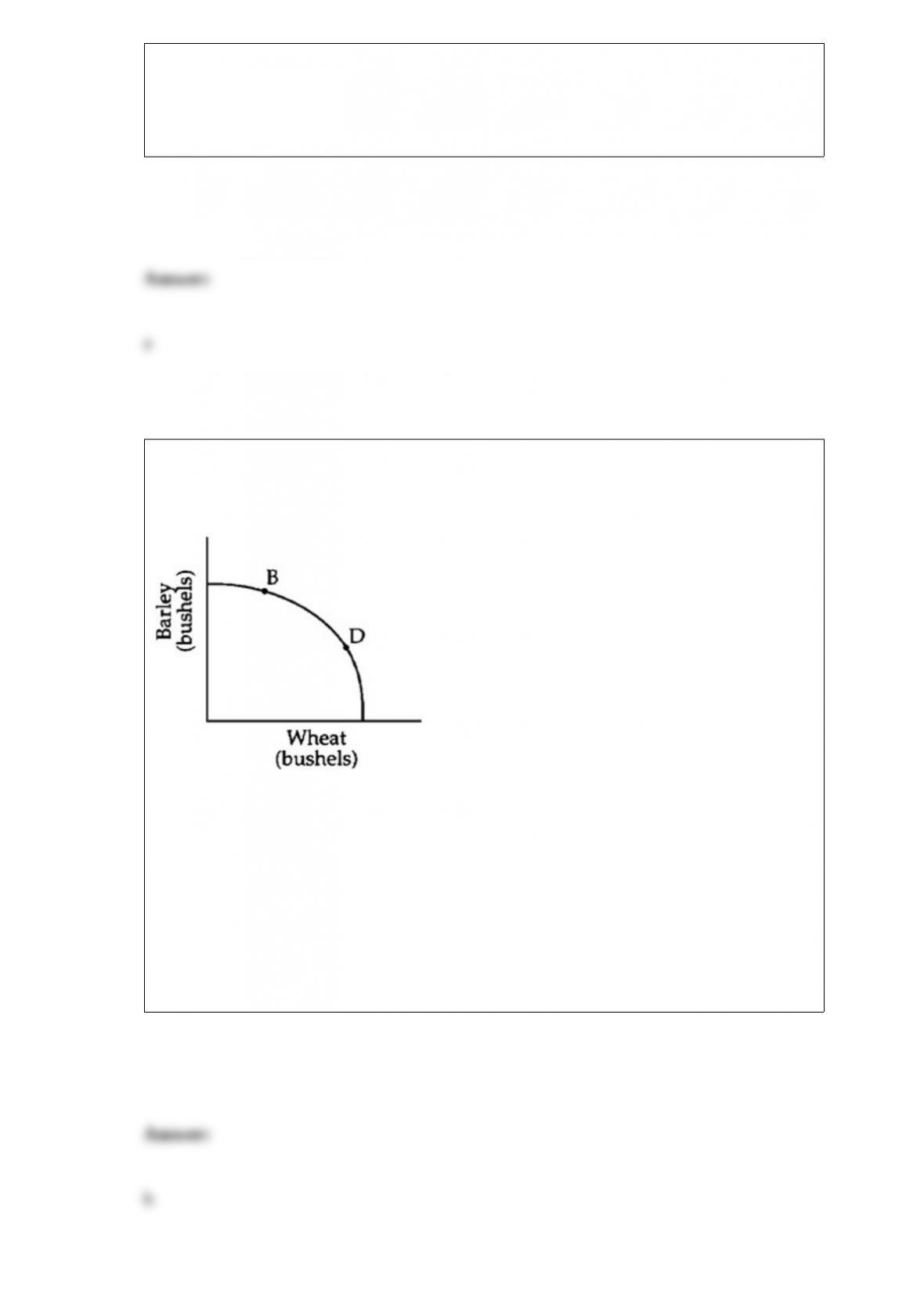
Figure 3-1
According to Figure 3-1, the opportunity cost of one more bushel of wheat is
a. higher at B than at D.
b. lower at B than at D.
c. equal at B and D.
d. impossible to determine from the information given.

Which of the following would cause an upward shift in the consumption function?
a. a stock market crash
b. an increase in the price level
c. a decrease in disposable income
d. a decrease in the price level
Lower real interest rates
a. tend to shift the consumption function upward.
b. have no significant effect on consumption.
c. tend to shift the consumption function downward.
d. tend to move the consumer upward along the consumption function.
When actual GDP does not rise as fast as potential GDP, the economy most likely will
experience
a. inflation.

b. recession.
c. economic growth.
d. falling unemployment.
The demand curve facing a firm is also the firm’s
a. total utility curve.
b. average revenue curve.
c. average utility curve.
d. total revenue curve.
Which of the following is not true with regard to the burden of the U.S. national debt?
a. The debt does burden future generations to the extent that it is sold to foreigners.
b. Budget deficits are not appropriate for stabilization purposes under any
circumstances.
c. The debt will reduce the nation’s capital stock if incurred during a fully employed
economy.
d. The large deficits of the 1980s and early 2000 were particularly worrisome because

they were not attributable to recessions.
One unpleasant cure for the U.S. trade deficit of the 1990s would be for foreigners who
hold U.S. financial assets to demand
a. lower interest rates to stimulate U.S. growth rates.
b. higher interest rates and generate a recession in the United States.
c. higher interest rates and generate an appreciation of the dollar.
d. lower interest rates and generate a depreciation of the dollar.
Opening trade between a nation that has “cheap labor” and one that has “expensive
labor” will
a. lower the standard of living in both countries.
b. raise the standard of living in both countries.
c. make some workers less efficient.
d. lead to an inappropriate allocation of resources.

If corporations have their choice, they will prefer to invest using
a. revenue from the sale of stocks.
b. revenue from the sale of bonds.
c. plowback.
d. money borrowed from the bank.
What does inflation do to the value of the oversimplified multiplier?
a. Inflation increases the value of the multiplier above the value of the oversimplified
formula.
b. Inflation does not change the value of the multiplier.
c. Inflation decreases the value of the multiplier below the value of the oversimplified
formula.
d. Inflation increases the value of the multiplier unless the level of unemployment also
rises.

The major difference between stocks and bonds is
a. a stock is ownership in the corporation and a bond is a debt instrument of the
corporation.
b. a stock is a debt instrument of the corporation and a bond is ownership in the
corporation.
c. a stock has value in the marketplace and a bond does not.
d. a bond has value in the marketplace and a stock does not.
One major tax loophole intended to help state & local governments raise funds is:
a. fiscal federalism
b. tax exempt municipal bond interest
c. tax deductible mortgage interest
d. tax credits for solar panels
When taxes alter individual behavior as people attempt to avoid the tax, efficiency
a. losses are probable.

b. gains are possible.
c. gains are impossible.
d. losses are impossible.
The tool most frequently relied on by the Fed is
a. interest rate changes.
b. changing the money multiplier.
c. changing the discount rate.
d. open market operations.
e. changing the reserve ratio.
In the case study discussed in the chapter, the electronics firm was losing money by
selling its calculators at a price that was below average cost.
a. True
b. False

If indifference curves and budget lines are used to analyze consumer choice, an inferior
good will
a. escape detection when income rises.
b. be easily identified because the quantity purchased will fall as income rises.
c. be easily identified because the quantity purchased will rise as income rises.
d. be easily identified because it will change the slope of the budget line.
e. escape detection because this model does not show that relationship.
Which of the following is a characteristic of a perfectly competitive market?
a. a few large firms
b. firms producing specialized products in order to attract consumers
c. each individual firm having some control over the market price
d. a large number of small firms

A public good is
a. any good provided by government.
b. a good that can be most cheaply provided by government, though it may in fact be
provided by private enterprise.
c. a good whose benefits cannot readily be restricted to a small group of people.
d. a good whose benefits cannot be enjoyed by an individual alone.
Sugar price supports primarily benefit consumers.
a. True
b. False
Compared to most other industrialized nations, the United States has greater income
inequality.
a. True
b. False

The price controls on consumer goods during World War II led to
a. permanent surpluses.
b. stable long-term prices.
c. a burst of inflation when they were ended.
d. increased production of consumer goods to satisfy demand.
In long-run equilibrium, a firm in perfect competition has no economic profit.
a. True
b. False
Firms have the option of maximizing sales revenue or maximizing profits. If a firm
chooses to maximize sales, then it will produce

a. more output and charge a lower price.
b. the same output and charge a lower price.
c. less output and charge a higher price.
d. less output and charge a lower price.
Opportunity cost can best be defined as the
a. money cost of a good or service.
b. money cost plus interest on money borrowed to buy a good or service.
c. cost of the resources used to produce a good or service.
d. value of the best alternative forgone when the alternative at hand is chosen.
Figure 6-7
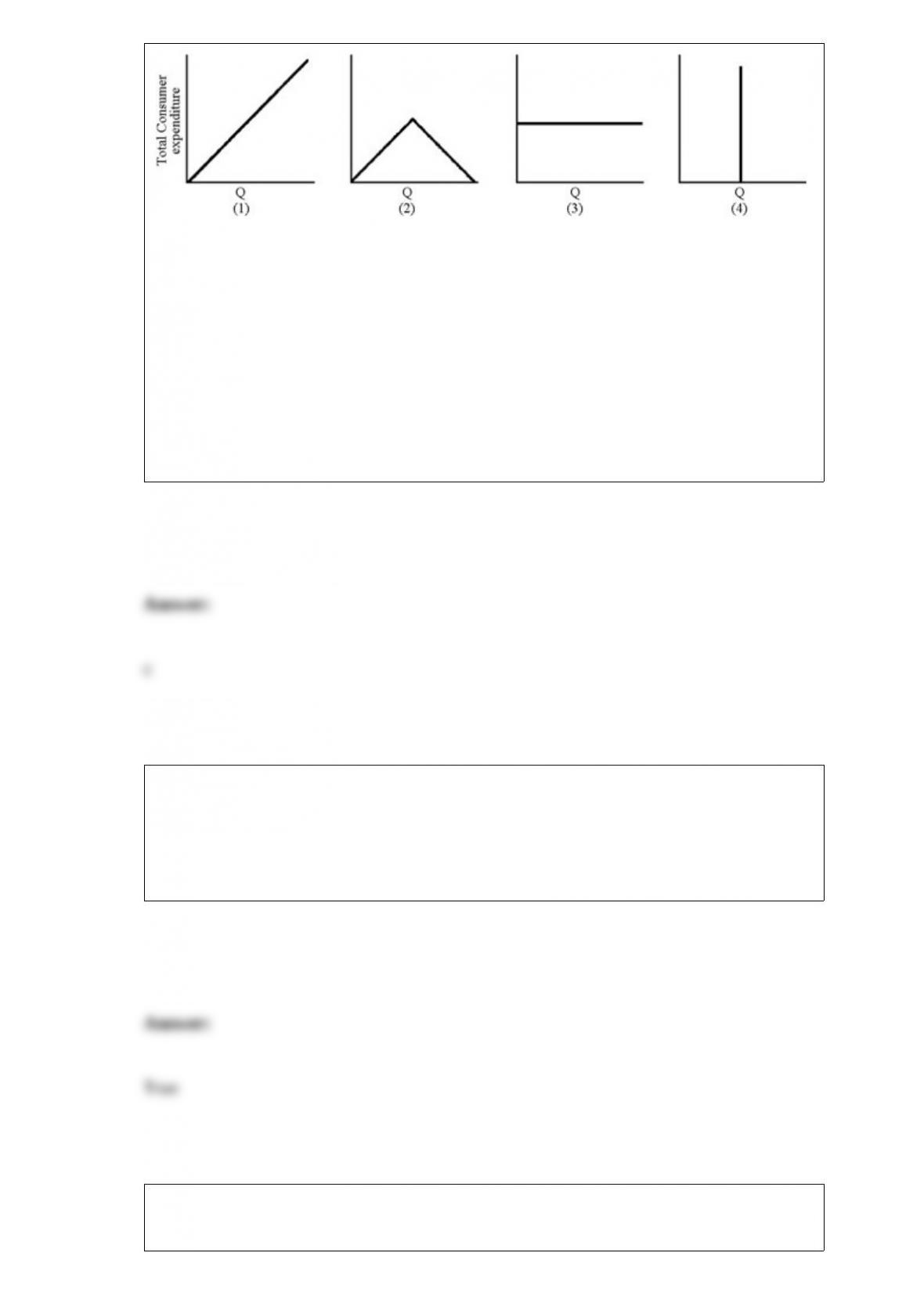
In Figure 6-7, which total expenditure curve belongs to a demand curve that is unit
elastic throughout?
a. 1
b. 2
c. 3
d. 4
Analogies between public and private debt are usually misleading.
a. True
b. False
Which of the following is a variable cost for an airline?
a. insurance
b. property taxes
c. jet fuel
d. rent of airport space
Harry Truman is credited with the statement, “Give me a one-armed economist,”
because economists are likely to say, “On the one hand, . . . on the other hand.” Why do
economists “waffle” more than physicists or chemists?
Differentiate between an open and a closed economy? Do you agree that US economy
is more open among the advanced industrial countries in the world?
Define the terms recessionary gap and inflationary gap. Why do they occur?
Explain some of the steps that a government would wish to adopt in an inflationary
environment.
Use consumer indifference curves and budget lines to illustrate the effects of an
increase in income for a normal good and an inferior good (use two graphs). Be sure
your diagrams are fully and correctly labeled.
Discuss the role of trust as a critical piece of any principal-agent situation. In particular,
what role did trust play in the recent stock market scandals?
Is an efficient market allocation fair? Explain.
Quebec is capable of producing 10 pallets of wood shingles or 8 barrels of maple syrup
with a unit of labor. Vermont is capable of producing 12 pallets of wood shingles or 12
barrels of maple syrup with a unit of labor. Assume that this is typical of the labor force
as a whole. Which location has the absolute advantage and which has the comparative
advantage, in the production of each good? Can these locations reap gains from trade?
Economists object to monopolies on the grounds of efficiency. Why is this? Explain.
Are returns to a single input and returns to scale one and the same? Explain.
Compare the effectiveness of fiscal policy in an open economy with mobile
international capital to fiscal policy in a closed economy. Why is it different? Use an
appropriate diagram to illustrate your answer.
Consumers expressed outrage at the high price of chainsaws after Hurricane Andrew hit
Florida and Louisiana, with newspaper editorials accusing suppliers of unconscionable
price gouging. Use a supply and demand graph to assist in explaining the increase in the
price of chain saws after Hurricane Andrew.
If there are no profits in competitive equilibrium, why do firms produce? How can they
stay in business?
Explain why bond prices and interest rates are inversely related.
Describe how a pollution-control authority might use an emissions permits system to
reduce pollution.
How do economists define efficiency? Elaborate.
What is the price of investment? How are they related? What has to be done to increase
investment?
The job market for which group always seems to have higher unemployment than the
labor force as a whole? Why?
Baumol and Blinder argue that oligopolies are interdependent firms. What do they mean
by this? Give three examples of the types of interdependence which might occur.