
When the price of good A is $50, the quantity demanded of good A is 500 units. When
the price of good A rises to $70, the quantity demanded of good A falls to 400 units.
Using the midpoint method, the price elasticity of demand for good A is
a. 1.50, and an increase in price will result in an increase in total revenue for good A.
b. 1.50, and an increase in price will result in a decrease in total revenue for good A.
c. 0.67, and an increase in price will result in an increase in total revenue for good A.
d. 0.67, and an increase in price will result in a decrease in total revenue for good A.
Assume Leo buys coffee beans in a competitive market. It follows that
a. Leo has a limited number of sellers from which to buy coffee beans.
b. Leo will negotiate with sellers whenever he buys coffee beans.
c. Leo cannot influence the price of coffee beans even if he buys a large quantity of
them.
d. None of the above is correct.
In economics, the cost of something is
a. the dollar amount of obtaining it.
b. always measured in units of time given up to get it.
c. what you give up to get it.
d. often impossible to quantify, even in principle.
Domestic producers of a good become worse off, and domestic consumers of a good
become better off, when a country begins allowing international trade in that good and
a. the country becomes an importer of the good as a result.
b. the world price exceeds the domestic price of the good that prevailed before
international trade was allowed.
c. the country in question has a comparative advantage, relative to other countries, in
producing the good.
d. total surplus does not change as a result.
The world price of a pound of almonds is $4.50. Before Uruguay allowed trade in
almonds, the price of a pound of almonds there was $3.00. Once Uruguay began
allowing trade in almonds with other countries, Uruguay began
a. exporting almonds and the price per pound in Uruguay remained at $3.00.
b. exporting almonds and the price per pound in Uruguay increased to $4.50.
c. importing almonds and the price per pound in Uruguay remained at $3.00.
d. importing almonds and the price per pound in Uruguay increased to $4.50.
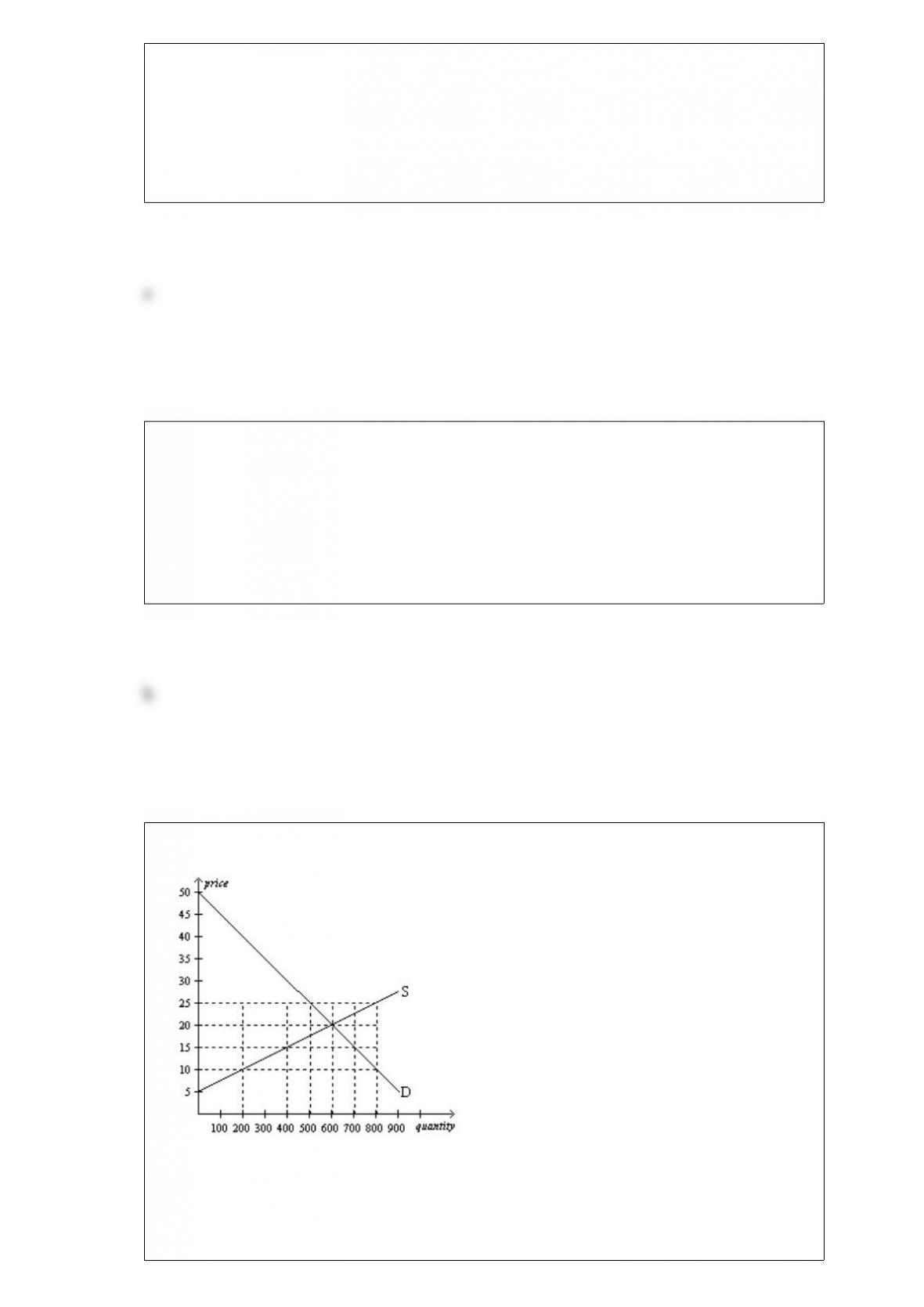
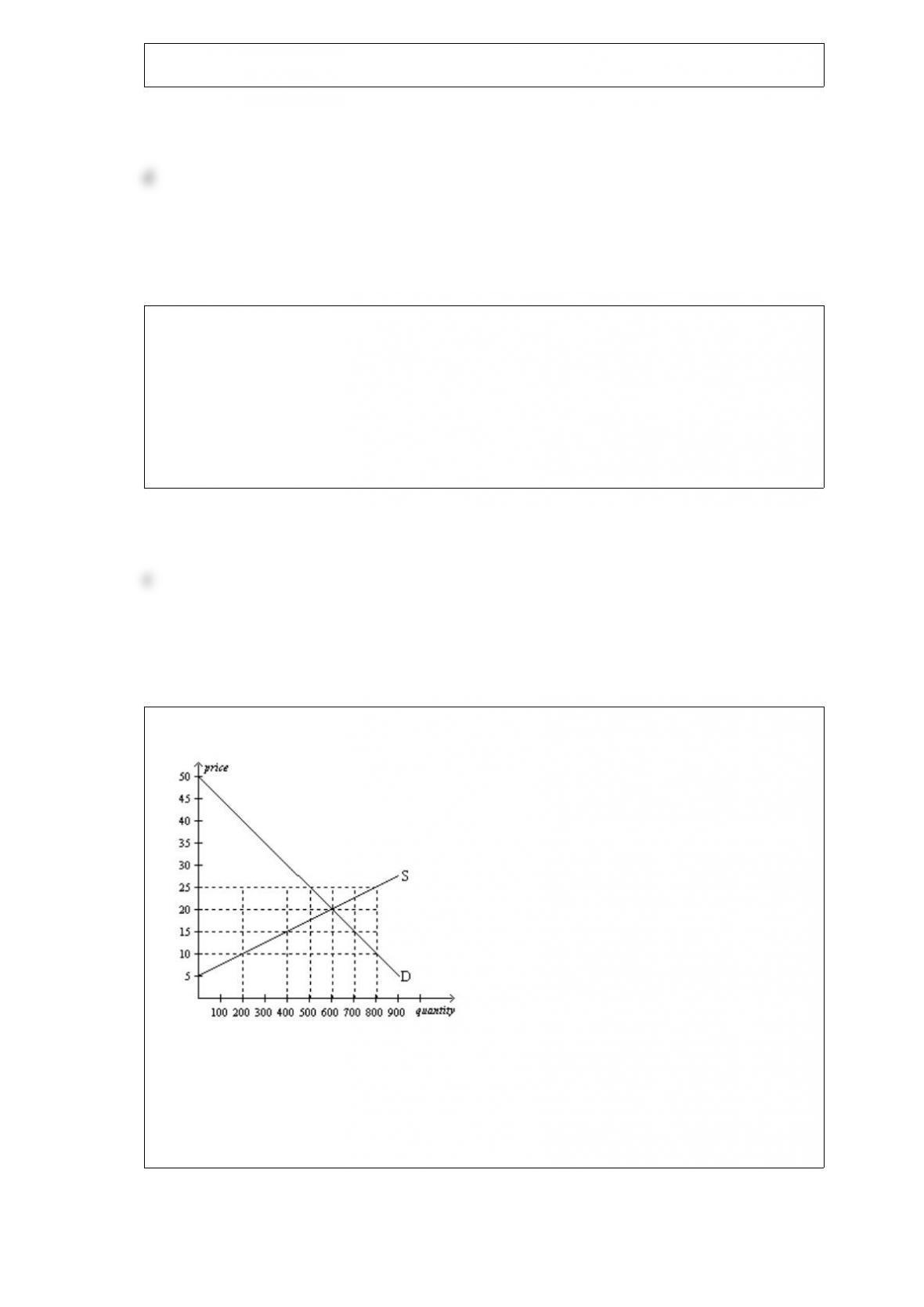
Figure 420
Refer to Figure 420. If price is $25, then quantity demanded and quantity supplied,
respectively, are
a. 500 units and 500 units.
b. 500 units and 800 units.

c. 600 units and 600 units.
d. 800 units and 500 units.
Table 712
The numbers reveal the opportunity costs of providing 10 piano lessons of equal
quality.
SellerCost
Marcia$200
Jan$250
Cindy$350
Greg$400
Peter$700
Bobby$800
Refer to Table 712. The equilibrium market price for 10 piano lessons is $300. What is
the total producer surplus in the market?
a. $50
b. $150
c. $1,050
d. $1,500
Economists view positive statements as
a. affirmative, justifying existing economic policy.
b. optimistic, putting the best possible interpretation on things.
c. descriptive, making a claim about how the world is.
d. prescriptive, making a claim about how the world ought to be.
Which of the following causes the price paid by buyers to be different than the price
received by sellers?
a. a binding price floor
b. a binding price ceiling
c. a tax on the good
d. All of the above are correct.
The slope of a line is equal to
a. the change in the value of x divided by the change in the value of y.
b. the change in the value of y divided by the change in the value of x.
c. the horizontal distance divided by the vertical distance.
d. the value of y divided by the value of x.
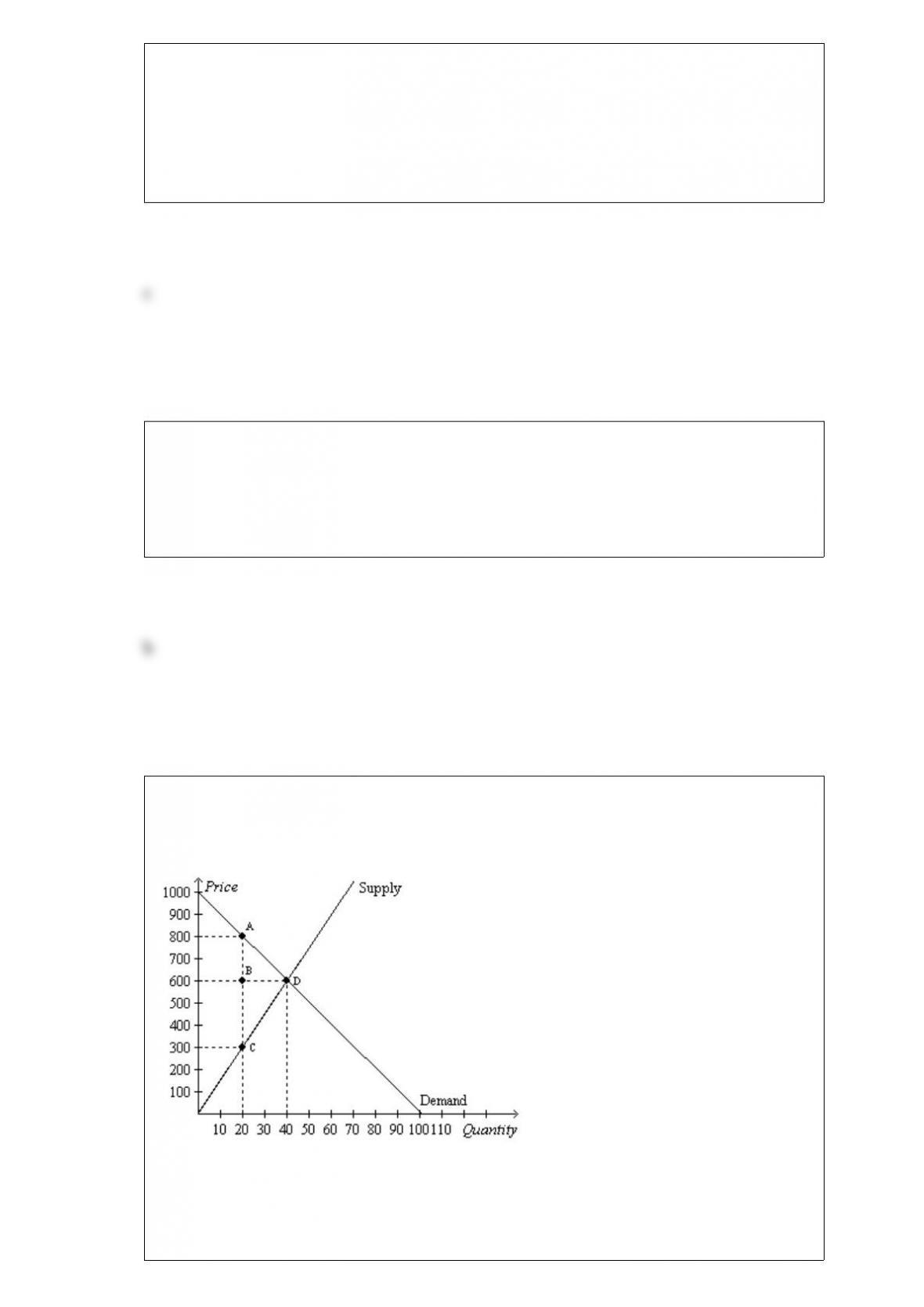
Figure 89
The vertical distance between points A and C represents a tax in the market.
Refer to Figure 89. The amount of the tax on each unit of the good is
a. $20.
b. $200.
c. $300.
d. $500.
Which of the following is a positive, as opposed to a normative, statement?
a. The US Department of Justice should allow a merger between AT&T and TMobile
because it would have little effect on consumers.
b. Antitrust laws should be used to prevent further concentration in the wireless
telephone service market.
c. The US Department of Justice sued AT&T to block its merger with TMobile.
d. The wireless telephone service market is too highly concentrated.
Figure 420
Refer to Figure 420. In this market, equilibrium price and quantity, respectively, are
a. $15 and 400 units.
b. $20 and 600 units.
c. $25 and 500 units.
d. $25 and 800 units.

Which of the following could be the crossprice elasticity of demand for two goods that
are complements?
a. 1.3
b. 0
c. 0.2
d. 1.4
Denise values a stainless steel dishwasher for her new house at $500. The actual price
of the dishwasher is $650. Denise
a. buys the dishwasher, and on her purchase she experiences a consumer surplus of
$150.
b. buys the dishwasher, and on her purchase she experiences a consumer surplus of
$150.
c. does not buy the dishwasher, and on her purchase she experiences a consumer surplus
of $150.
d. does not buy the dishwasher, and on her purchase she experiences a consumer
surplus of $0.
The willingness of citizens to pay for vaccinations does not include the benefit society
receives from having vaccinated citizens who cannot transmit an illness to others. This
extra benefit society gets from vaccinating its citizens is known as
a. productivity.
b. an externality.
c. market power.
d. property rights.
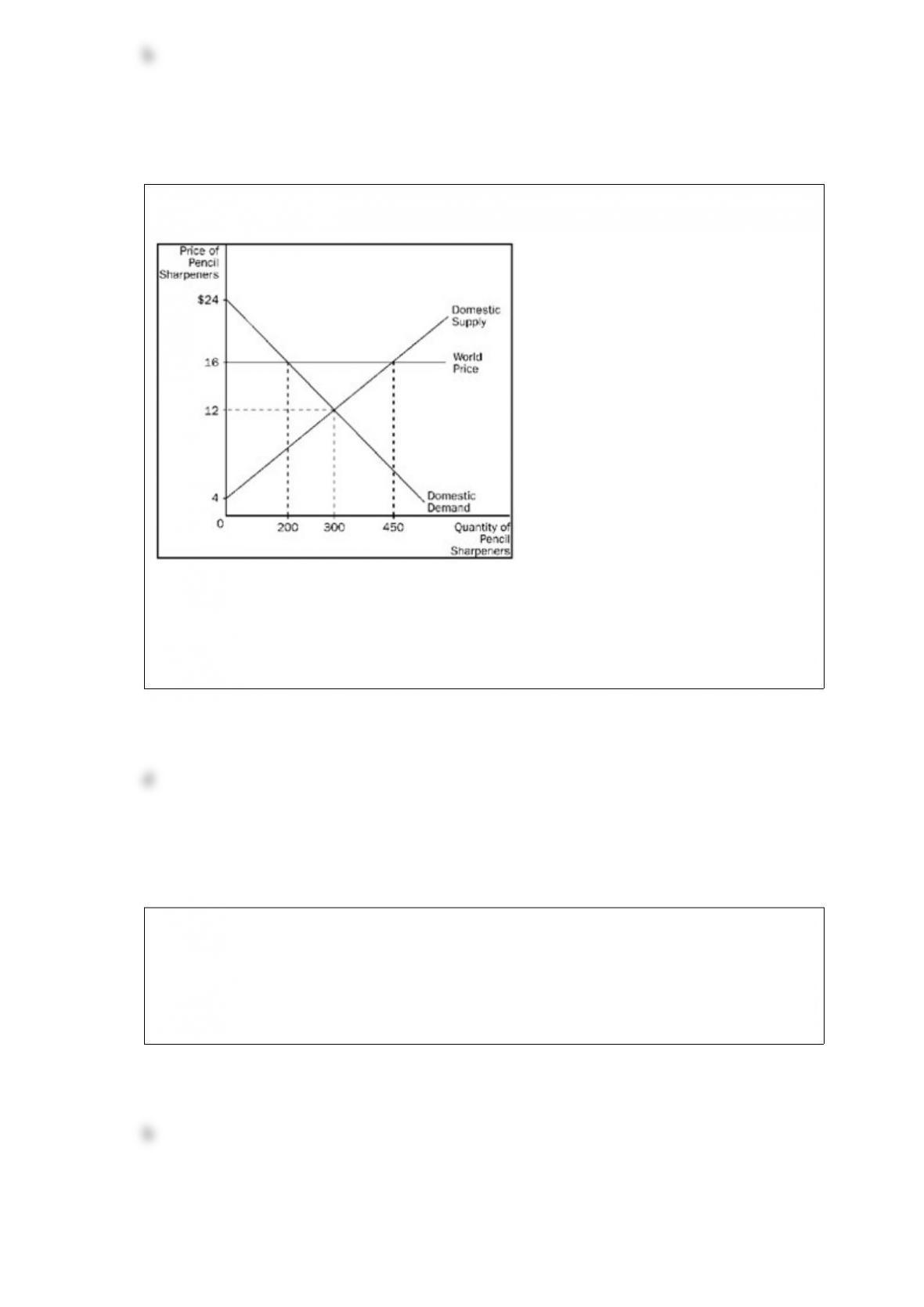
Figure 93. The domestic country is China.
Refer to Figure 93. With trade, China will
a. import 100 pencil sharpeners.
b. import 250 pencil sharpeners.
c. export 150 pencil sharpeners.
d. export 250 pencil sharpeners.
If the demand for bananas is elastic, then an increase in the price of bananas will
a. increase total revenue of banana sellers.
b. decrease total revenue of banana sellers.
c. not change total revenue of banana sellers.
d. There is not enough information to answer this question.

Table 327
Assume that Huang and Min can switch between producing parasols and producing
porcelain plates at a constant rate.
Labor Hours Needed to Make 1Quantity Produced in 36 Hours
ParasolPlateParasolPlate
Huang26186
Min24189
Refer to Table 327. The opportunity cost of 1 plate for Huang is
a. 1/3 parasol.
b. 1/2 parasol.
c. 3 parasols.
d. 4 parasols.
Table 316
The following table contains some production possibilities for an economy for a given
month.
BlanketsCoats
8600
12?
16200
Refer to Table 316. If the production possibilities frontier is bowed outward, then “?”
could be
a. 200.
b. 300.
c. 400.
d. 500.
Economists believe that production possibilities frontiers
a. never have a bowed shape.
b. rarely have a bowed shape.
c. often have a bowed shape.
d. always have a bowed shape.
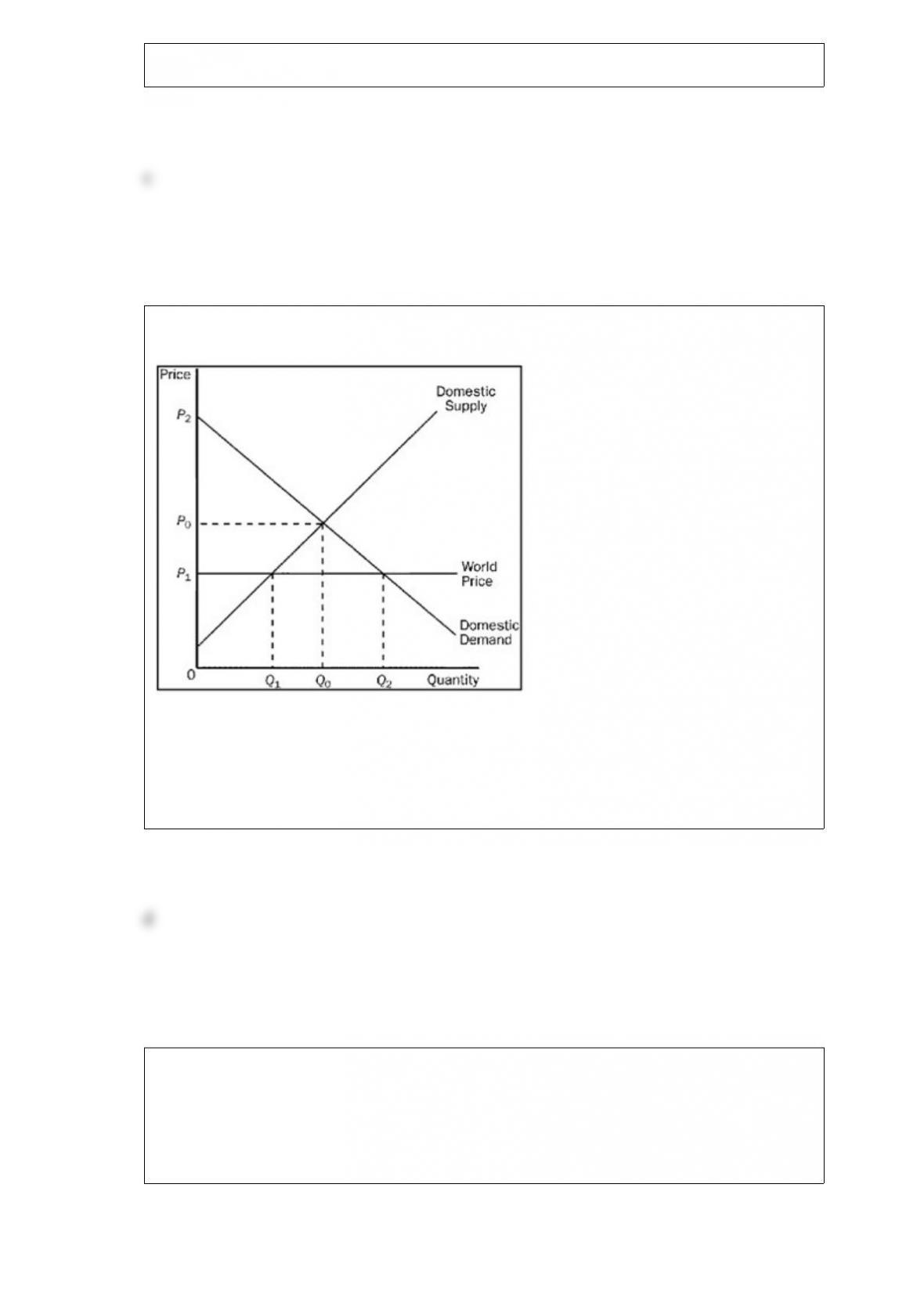
Figure 910. The figure applies to Mexico and the good is rifles.
Refer to Figure 910. When trade takes place, the quantity Q2Q1 is
a. the number of rifles bought and sold in Mexico.
b. the number of rifles produced in Mexico.
c. the number of rifles exported by Mexico.
d. the number of rifles imported by Mexico.
When a binding price floor is imposed on a market to benefit sellers,
a. no sellers actually benefit.
b. some sellers benefit, but no sellers are harmed.
c. some sellers benefit, and some sellers are harmed.
d. all sellers benefit.
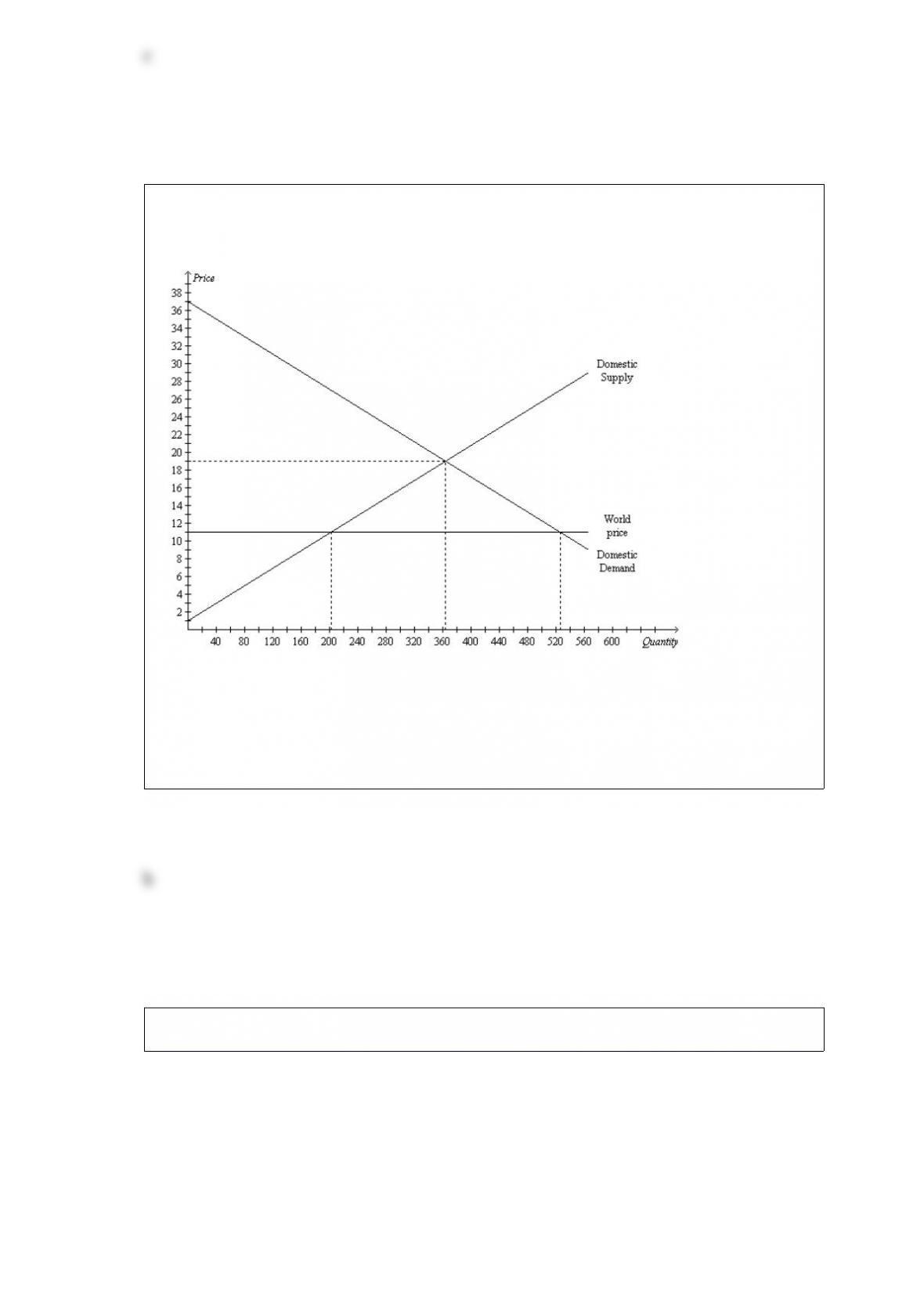
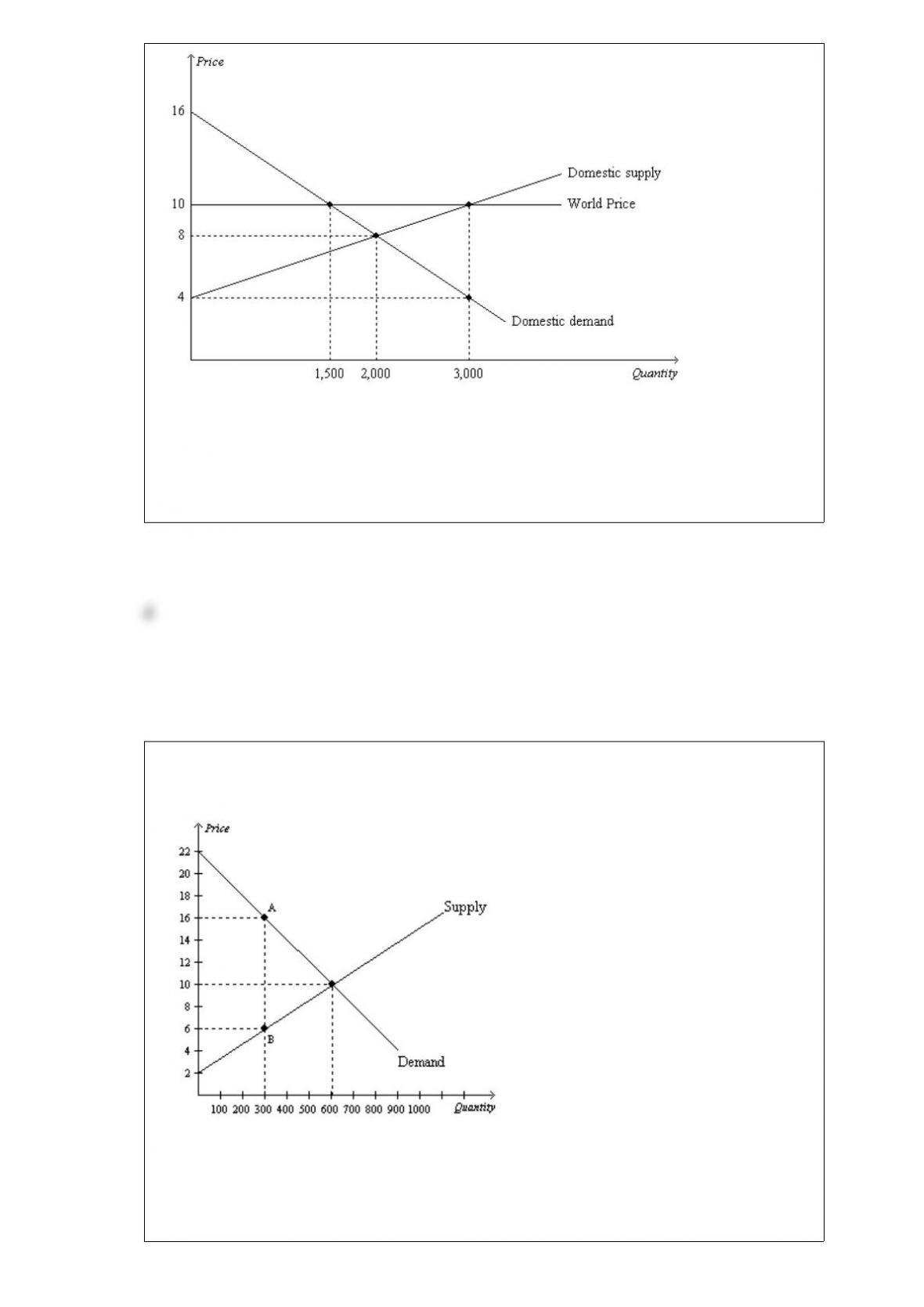
Figure 95
The figure illustrates the market for tricycles in a country.
Refer to Figure 95. With trade, producer surplus is
a. $500.
b. $1,000.
c. $1,500.
d. $2,000.
Figure 623
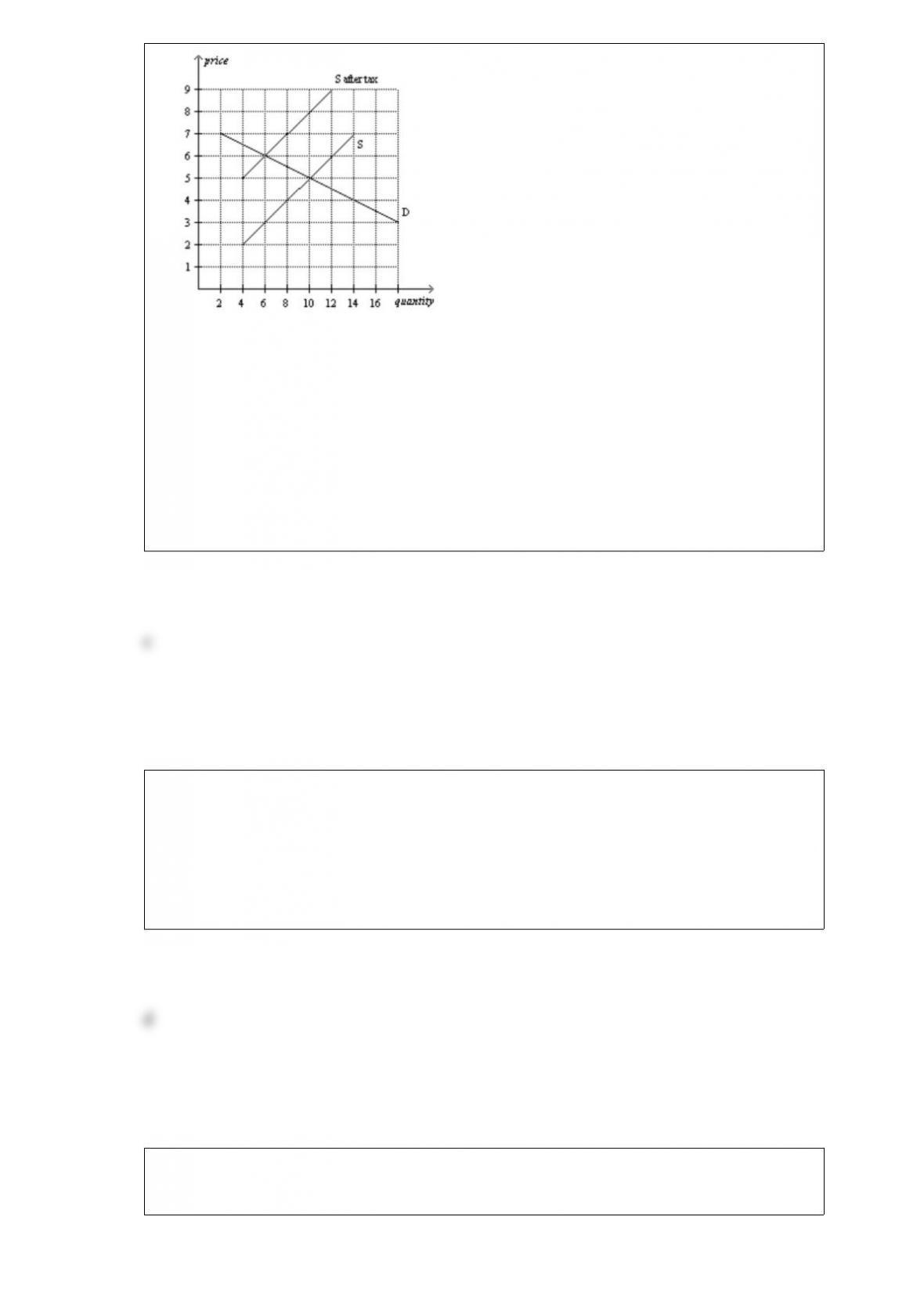
Refer to Figure 623. For every unit of the good that is sold, sellers are required to send
a. one dollar to the government, and buyers are required to send two dollars to the
government.
b. two dollars to the government, and buyers are required to send one dollar to the
government.
c. three dollars to the government, and buyers are required to send nothing to the
government.
d. nothing to the government, and buyers are required to send two dollars to the
government.
Which of the following would shift the supply of Green Bay Packers football jerseys to
the left?
a. The Green Bay Packers make it to the Super Bowl.
b. The price of the jerseys increases by $15.
c. The technology of sewing machines use to make the jerseys improves.
d. The cost of the fabric used to make the jerseys increases.
Figure 920
The figure illustrates the market for rice in Vietnam.
Refer to Figure 920. Vietnam’s gains from trade in rice amount to
a. 750.
b. 1,000.
c. 1,250.
d. 1,500.
Figure 86
The vertical distance between points A and B represents a tax in the market.
Refer to Figure 86. Without a tax, producer surplus in this market is
a. $1,500.
b. $2,400.
c. $3,000.

d. $3,600.
Assume the price of gasoline is $2.00 per gallon, and the equilibrium quantity of
gasoline is 10 million gallons per day with no tax on gasoline. Starting from this initial
situation, which of the following scenarios would result in the largest deadweight loss?
a. The price elasticity of demand for gasoline is 0.1; the price elasticity of supply for
gasoline is 0.6; and the gasoline tax amounts to $0.20 per gallon.
b. The price elasticity of demand for gasoline is 0.1; the price elasticity of supply for
gasoline is 0.4; and the gasoline tax amounts to $0.20 per gallon.
c. The price elasticity of demand for gasoline is 0.2; the price elasticity of supply for
gasoline is 0.6; and the gasoline tax amounts to $0.30 per gallon.
d. There is insufficient information to make this determination.
Table 45
The table below shows the quantities demanded of cases of Mt. Dew per month by four
families at various prices.
Price of Case of Mr. DewThe Adams FamilyThe Jones FamilyThe Smith
FamilyThe Williams Family
$79151214
$88121010
$97986
$106662
Refer to Table 45. Suppose the four families listed in the table are the only demanders
of Mt. Dew in the market. If the price of a case of Mt. Dew decreases by $1, the
a. market quantity demanded decreases by 10.
b. market quantity demanded increases by 10.
c. Adams family increases its quantity demanded by more than the Smith family.
d. Jones family increases its quantity demanded by more than the Williams family.

Table 336
Minutes Needed
to Make 1
TowelUmbrella
Antigua1220
Barbuda1510
Refer to Table 336. Antigua has a comparative advantage in the production of
a. towels and Barbuda has a comparative advantage in the production of umbrellas.
b. umbrellas and Barbuda has a comparative advantage in the production of towels.
c. both goods and Barbuda has a comparative advantage in the production of neither
good.
d. neither good and Barbuda has a comparative advantage in the production of both
goods.