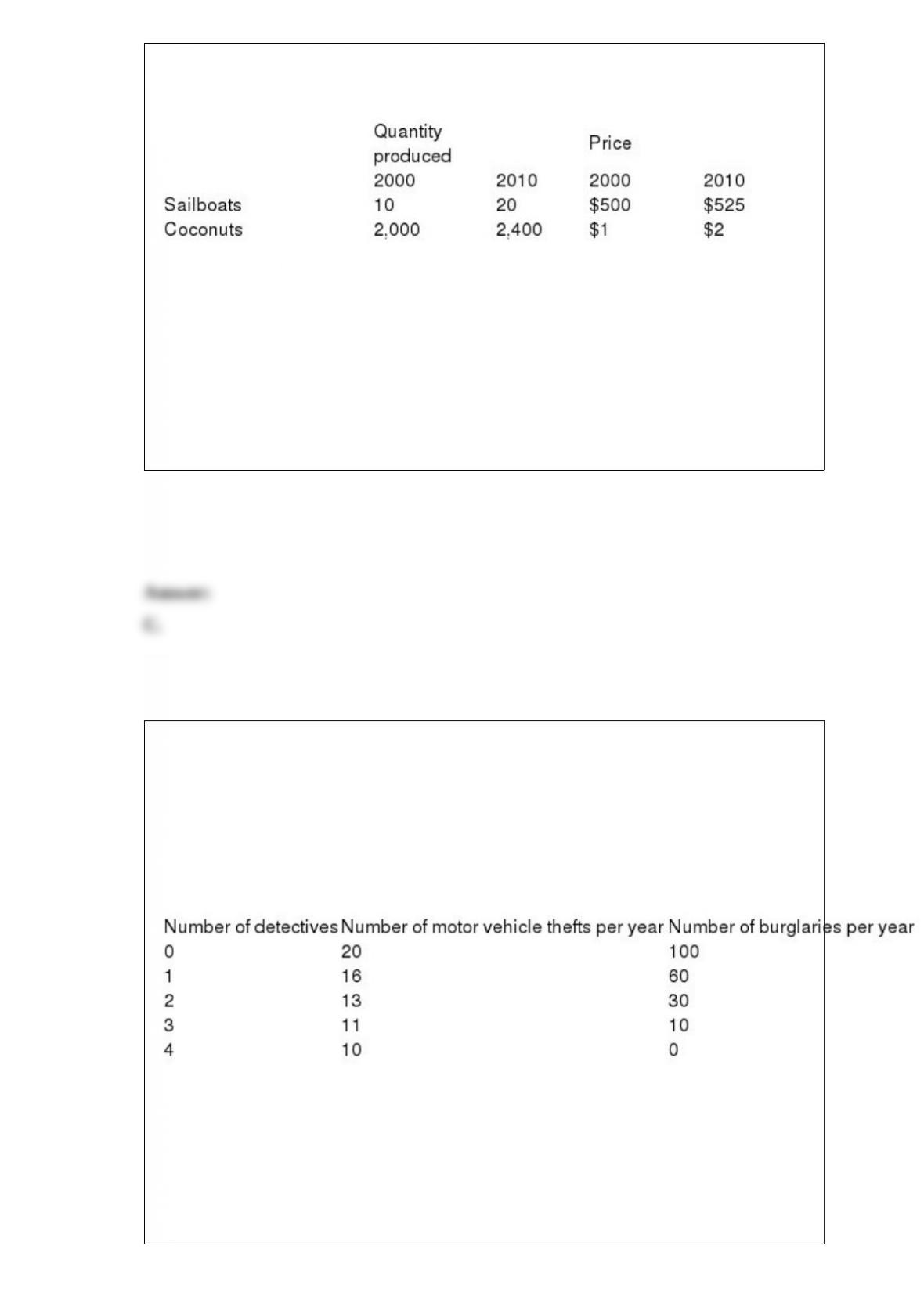
The table below gives the quantities and prices for 2000 and 2010 for an economy that
produces just two goods: sailboats and coconuts.
For this economy that produces just sailboats and coconuts, and with 2000 is the base
year, real GDP was approximately ______ times larger in 2010 than it was in 2000.
A. 1.34
B. 1.65
C. 1.77
D. 2.19
Consider a police department trying to decide how to allocate its crime prevention
resources between motor vehicle thefts and burglaries. The marginal benefit of one less
motor vehicle theft is $20,000, and the marginal benefit of one less burglary is $1,000.
Suppose the annual number of motor vehicle thefts and the annual number of burglaries
depends on the number of detectives assigned to each type of crime, as shown in the
table below. Each detective costs $35,000 each per year, regardless of whether the
detective is assigned to motor vehicle thefts or burglaries.
The marginal benefit of the second detective assigned to motor vehicle thefts is ______
per year.
A. $30,000
B. $3,000
C. $260,000

D. $60,000
Refer to the figure below. At the market equilibrium quantity, the social marginal cost
of the last ton of paper produced is ______ the marginal benefit of the last ton of paper
produced.
A. less than or equal to
B. equal to
C. less than
D. greater than
Suppose that Fiona spends all of her income on 10 units of good X and 14 units of good
Y. Fiona’s marginal utility from the 10th unit of good X is 24 utils, and her marginal
utility from the 14th unit of good Y is 20 utils. If the price of good X is $8 per unit and
the price of good Y is $5 per unit, then to comply with the rational spending rule, Fiona
should:
A. purchase more than 10 units of good X and less than 14 units of Y.
B. purchase less than 10 units of good X and more than 14 units of good Y.
C. purchase more than 10 units of good X and more than 14 units of good Y.
D. continue to purchase 10 units of good X and 14 units of good Y.

Alex, who is risk-neutral, is looking for an one-bedroom apartment to rent for the
month of August while he’s on vacation in Seattle. All of the one-bedroom apartments
in the neighborhood where he wants to stay are of equal quality, but 70 percent rent for
$700 per month, 20 percent rent for $600 per month, and 10 percent rent for $500 per
month. The first apartment Alex finds rents for $700 per month. If the cost to Alex of
searching for an apartment is $40, then searching for another apartment is a gamble
with an expected value of:
A. -$10.
B. $0.
C. $10.
D. $20.
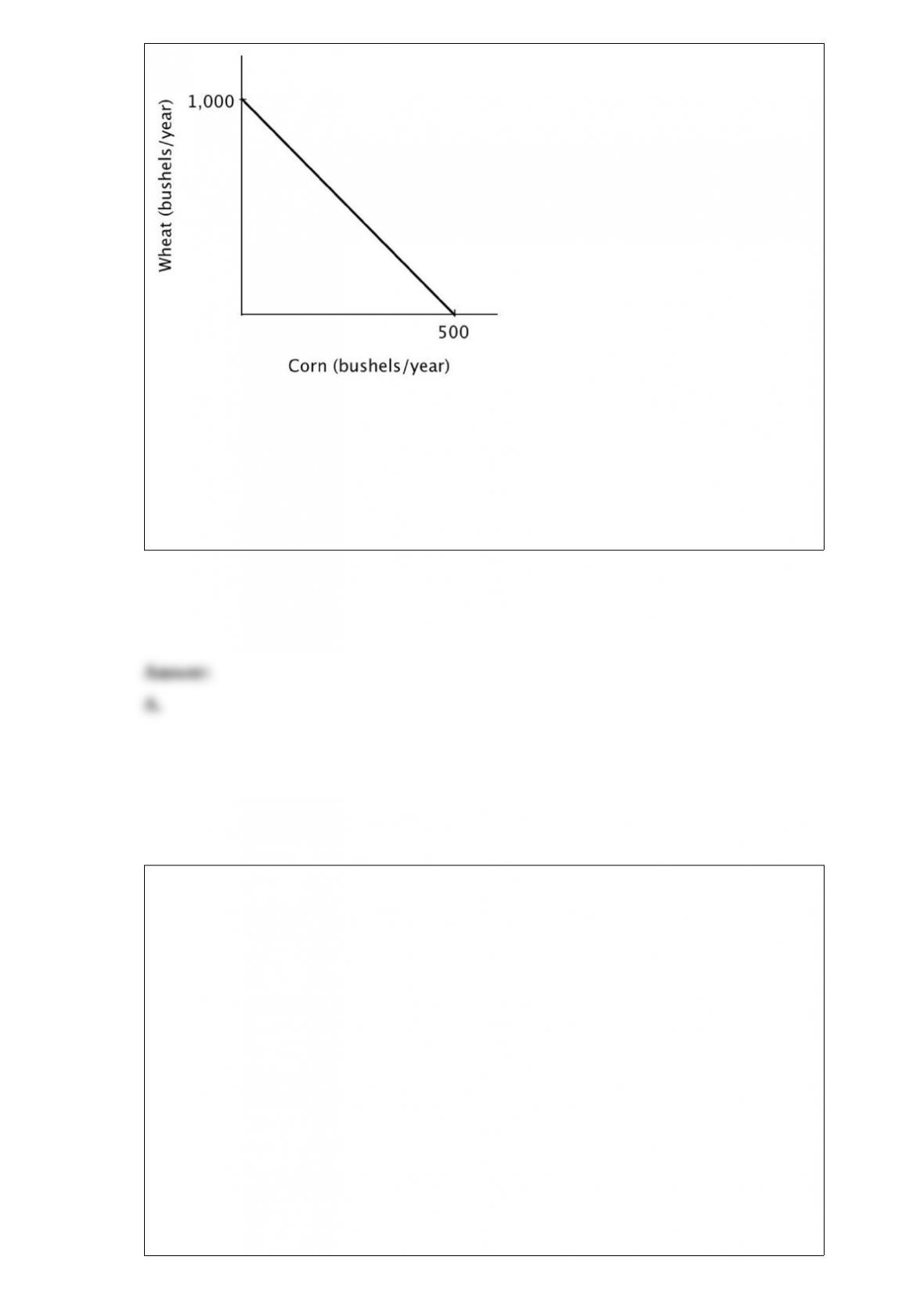
Refer to the figure below. The opportunity cost of producing one bushel of corn is:
A. 2 bushels of wheat.
B. ½ of a bushel of wheat.
C. 500 bushels of wheat.
D. 250 bushels of wheat.
Suppose Joe has a two-year old Honda Civic that’s in excellent condition and that he
would be willing to sell for $13,000. Lauren, who is risk-neutral, is considering whether
to buy Joe’s car. She’s willing to pay $14,000 for a two-year Honda Civic that’s in
excellent condition and only $10,000 for one that’s not in excellent condition. Lauren
cannot tell whether Joe’s car is in excellent condition. She believes that only 20 percent
of two-year old Hondas for sale in the market are in excellent condition and that the
other 80 percent are not in excellent condition. To Lauren, Joe’s car looks just like every
other two-year Honda that’s for sale. What’s the most Lauren is willing to pay for Joe’s
car?
A. $10,000
B. $10,800
C. $13,000
D. $14,000

The AS curve slopes upward because:
A. firms generally sell their products at preset prices.
B. relaxing the assumptions of the Keynesian model allows us to develop a more
realistic model where firms no longer care about prices.
C. many firms raise their prices when aggregate demand has increased.
D. inflation is higher in goods-producing industries than service-producing industries.
From an economic perspective, the best response to increased wage inequality is to:
A. block future technological change.
B. stop all international trade.
C. provide transition aid to disadvantaged workers.
D. make skill-biased technological change illegal.

If you post your car on eBay with a Buy-It-Now price of $1,800, you are using money
as:
A. bank reserves.
B. a medium of exchange.
C. a unit of account.
D. a store of value.
Suppose the value of the CPI is 1.100 in year one, 1.122 in year two, and 1.133 in year
three. Assume also that the price of computers increases by 3% between year one and
year two, and by another 3% between year two and year three. The price level is
increasing, the inflation rate is _______, and the relative price of computers is
_________.
A. decreasing; increasing
B. increasing; increasing
C. decreasing; decreasing
D. increasing; decreasing

The value of marginal product of labor equals the
A. marginal product of labor times the net price for which each unit of output sells.
B. total product of labor divided by the net price for which each unit of output sells.
C. marginal product of labor divided by the net price for which each unit of output sells.
D. average product of labor times the wage rate.
When a nation reduces the barriers to international trade:
A. each individual citizen becomes better off.
B. each individual citizen becomes worse off.
C. the total value of all goods and services produced by the nation falls.
D. the total value of all goods and serviced produced by the nation rises.
Profits, rents, interest, and royalties are examples of:
A. consumption.

B. labor income.
C. capital income.
D. investment.
An economy produces only 1,000,000 computers valued at $2,000 each. Of these,
200,000 are sold to consumers, 300,000 are sold to businesses, 300,000 are sold to the
government, and 100,000 are sold abroad. No computers are imported. At the end of the
year, the computer manufacturers hold the unsold computers in inventory. What is the
value of GDP?
A. $0.9 billion
B. $1.0 billion
C. $1.8 billion
D. $2.0 billion
Goods and services provided by state and local governments are:
A. included in GDP at market prices.
B. included in GDP at cost.

C. excluded from GDP because they are not sold in markets.
D. excluded from GDP because they are publicly provided.
Suppose the latest Hunger Games movie first played in theaters, where it sold out
during its opening week. Several months later it was available on pay-per-view TV.
Two years later it was shown on CBS, a broadcast television network. When the movie
was playing in theaters, it was a ______ good; when it was available on pay-per-view
TV, it was a ______ good; and when it was shown on CBS, it was a ______ good.
A. private; public; public
B. private; collective; public
C. collective; private; commons
D. collective; commons; public
The two main responsibilities of the Federal Reserve System are to ______ and to
______.
A. apprehend counterfeiters; regulate the stock market
B. enable banks to make affordable mortgages; control the exchange rate of the U.S.
dollar

C. insure bank deposits; print currency
D. conduct monetary policy; oversee financial markets
The economy of Alpha operates according to Okun’s law. In Alpha, potential GDP
equals $500 billion, actual GDP equals $480 billion, and the natural rate of
unemployment is 5 percent. What is the actual rate of unemployment in Alpha?
A. 1 percent
B. 3 percent
C. 4 percent
D. 7 percent
Suppose Colin brews beer and makes cheese. If Colin can increase his production of
beer without decreasing his production of cheese, then he is producing at an:
A. inefficient point.
B. efficient point.
C. unattainable point.
D. ideal point.
Refer to the figure below.
If a price ceiling were imposed at $4, producer surplus would be:
A. $24.
B. $16.
C. $8.
D. $4.
The degree of income inequality produced by competitive markets, in Professor Rawls’
view, is:

A. minor.
B. greater than the amount people would prefer.
C. consistent with the ideal amount.
D. acceptable.
A village has five residents, each of whom has an accumulated savings of $50. Each
villager can use the money to buy a government bond that pays 10% interest per year or
to buy a year-old goat, send it onto the commons to graze, and sell it after one year. The
price of the goat that the villager will get at the end of the year depends on the amount
of weight it gains while grazing on the commons, which in turn depends on the number
of goats sent onto the commons, as shown in table below. Assume that if a villager is
indifferent between buying a bond and buying a goat, the villager will buy a goat.
What will be the total village income if each villager decides how to invest based on his
or her individual self-interest?
A. $5
B. $125
C. $75
D. $25

If commercial banks are maintaining a 5 percent reserve/deposit ratio and the Fed
lowers the required reserve ratio to 3 percent, then banks may ______ their loans and
deposits, and the money supply may _____.
A. increase; increase
B. increase; decrease
C. decrease; increase
D. decrease; decrease
Suppose Sarah owns a small company that makes wedding cakes. The table below
shows how Sarah’s total cost varies depending on the number of wedding cakes she
makes each day.
If the market for wedding cakes is perfectly competitive, and wedding cakes sell for
$125 each, then Sarah should produce ______ cakes per day.
A. 0
B. 3
C. 5
D. 6
In Okunland, a country whose economy operates according to Okun’s law, real GDP

equals $7,520 billion, potential GDP equals $8,000 billion, and the actual
unemployment rate is 8 percent. What is the natural rate of unemployment in
Okunland?
A. 2 percent
B. 5 percent
C. 6 percent
D. 11 percent
The annual percentage rate of change in the price level is the:
A. relative price.
B. Fisher effect.
C. cost of living.
D. inflation rate.
A factory worker earned $10 an hour in 1980. The CPI was 0.82 in 1980. The same
factory worker was earning $15 an hour in 1990 when the CPI was 1.31. From 1980 to
1990, the factory worker’s hourly real wage:
A. increased from $7.63 to $18.29.

B. decreased from $12.20 to $11.45.
C. remained constant.
D. increased from $10 to $15
Suppose Sarah owns a small company that makes wedding cakes. The table below
shows how Sarah’s total cost varies depending on the number of wedding cakes she
makes each day.
Sarah’s fixed cost is ______ per day.
A. $10
B. $20
C. $100
D. $200
Jobs in which there is a higher risk of injury or death will:
A. hire risk-averse workers.
B. pay less than otherwise similar jobs.
C. pay the same as otherwise similar jobs.

D. pay more than otherwise similar jobs.
Pat goes to the local electronics store to learn about high-end audio equipment. The
salesperson spends an hour talking with Pat and demonstrating equipment. Pat then
leaves and orders an audio system on the Internet for $250 less than the price at the
store. Pat’s behavior:
A. is illegal.
B. is a form of statistical discrimination.
C. illustrates the free-rider problem.
D. illustrates the problem of adverse selection.