By drawing a demand curve with price on the vertical axis and quantity on the
horizontal axis, economists assume that the most important determinant of the demand
for a good is
A) consumer income.
B) consumer tastes and preferences.
C) the price of the good.
D) the quality of the good.
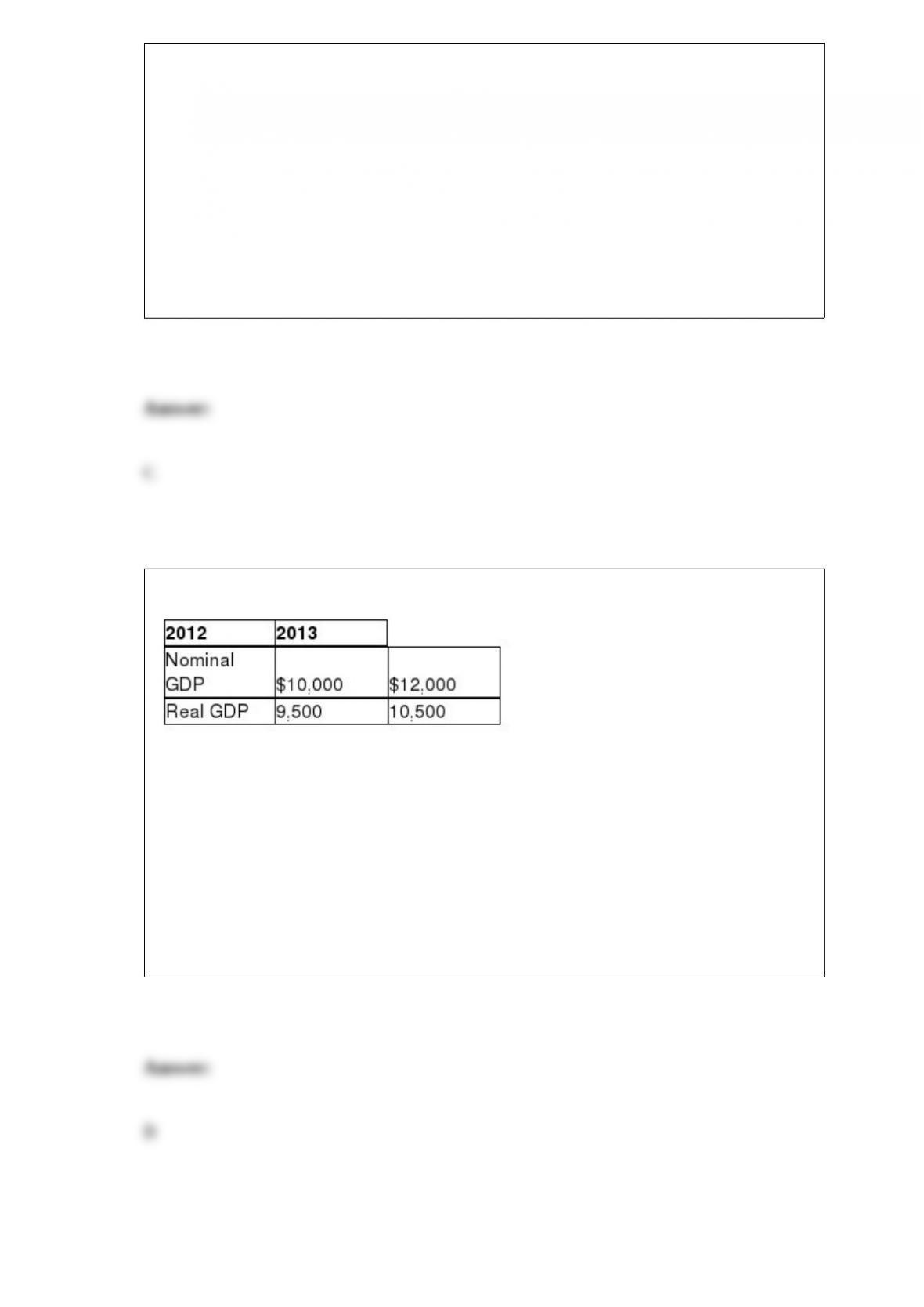
Table 8-16
Given the information above, what can we say has happened in the economy from 2012
to 2013?
A) The price level has fallen.
B) The price level has risen.
C) The price level has remained constant.
D) Not enough information is available to determine what has happened to prices.

How will contractionary monetary policy in Japan affect the demand and supply of the
yen in the foreign exchange market?
A) The demand for the yen will fall, and the supply of the yen will increase.
B) The demand for the yen will increase, and the supply of the yen will fall.
C) The demand for the yen will fall, and the supply of the yen will fall.
D) The demand for the yen will increase, and the supply of the yen will increase.
The primary purpose of labor unions is to
A) ensure that workers receive adequate safety training.
B) ensure that all members earn identical incomes.
C) negotiate with employers about wages and working conditions.
D) endorse candidates and donate money to them.
In economics, the term “free rider” refers to
A) a person who evades taxes.
B) a supervisor who delegates menial time-consuming activities to others.
C) one who volunteers her services.
D) one who waits for others to produce a good and then enjoys its benefits without

paying for it.
A narrow definition of monopoly is that a firm is a monopoly if it can ignore
A) government antitrust laws.
B) the pricing decisions of its suppliers.
C) the pricing decisions of firms that produce complementary products.
D) the actions of all other firms.
How will an interest rate decrease in the United States affect equilibrium in the foreign
exchange market?
A) The equilibrium exchange rate will increase, and the equilibrium quantity of dollars
traded cannot be determined.
B) The equilibrium exchange rate will decrease, and the equilibrium quantity of dollars
traded cannot be determined.
C) The equilibrium exchange rate cannot be determined, and the equilibrium quantity of
dollars traded will increase.
D) The equilibrium exchange rate will increase, and the equilibrium quantity of dollars
traded will increase.

The curve showing the short-run relationship between the unemployment rate and the
inflation rate is called
A) the monetary policy curve.
B) the Phillips curve.
C) the Sargent curve.
D) the unemployment curve.
When the price level in the United States falls relative to the price level of other
countries, ________ will fall, ________ will rise, and ________ will rise.
A) imports; exports; net exports
B) exports; imports; net exports
C) net exports; exports; imports
D) net exports; imports; exports
In the United States in 2012, the percentage of firms that employed more than 200
workers and offered health insurance as a fringe benefit to the workers was about

A) 29%.
B) 42%.
C) 61%.
D) 98%.
If you pay a constant percentage of your taxable income in taxes, the tax is
A) regressive.
B) proportional.
C) progressive.
D) random.
If households in the economy decide to take money out of checking account deposits
and put this money into savings accounts, this will initially
A) decrease M1 and increase M2.
B) decrease M1 and decrease M2.
C) decrease M1 and not change M2.
D) increase M1 and decrease M2.

The observation that people tend to value something more highly when they own it than
when they don’t is called the
A) wealth effect.
B) endowment effect.
C) path dependent effect.
D) endorsement effect.
John Maynard Keynes argued that if many households decide at the same time to
increase saving and reduce spending,
A) this will increase investment spending in the short run and expand the economy in
the long run.
B) the economy will benefit in the short run but the effect will not last into the long run.
C) this will have a major negative impact on the economy in both the short run and in
the long run.
D) they may make themselves worse off by causing aggregate expenditure to fall,
thereby pushing the economy into a recession.