
1) The labor supply curve for a particular occupation is upsloping because:
A.higher wages will be needed to attract workers from other occupations.
B.lower wages will be needed to increase employment.
C.higher wages will enable some workers to afford more leisure.
D.the labor demand curve is downsloping.
2) If the economy has a standardized budget surplus, this means that:
A.the public sector is exerting an expansionary impact on the economy.
B.tax revenues would exceed government expenditures if full employment were
achieved.
C.the actual budget is necessarily also in surplus.
D.the economy is actually operating at full employment.
3) mild demand-pull inflation:
a.raises the natural rate of unemployment.
b.usually leads to hyperinflation.
c.has an uncertain effect on real output.
d.decreases the natural rate of unemployment.
4) The U.S. recession of 2001 provides a good example of:
A.demand-pull inflation.
B.cost-push inflation.
C.a recessionary expenditure gap.
D.the repercussions of hyperinflation.
5) unemployment involving a mismatch of the skills of unemployed workers and the
skills required for available jobs is called:
a.frictional unemployment.
b.structural unemployment.
c.cyclical unemployment.
d.compositional unemployment.
6) the economic policies and programs of government affect all of the following except:
a.the distribution of income.
b.the allocation of resources.
c.the composition of output.
d.the underlying motives of consumers, workers, and firms.
7)
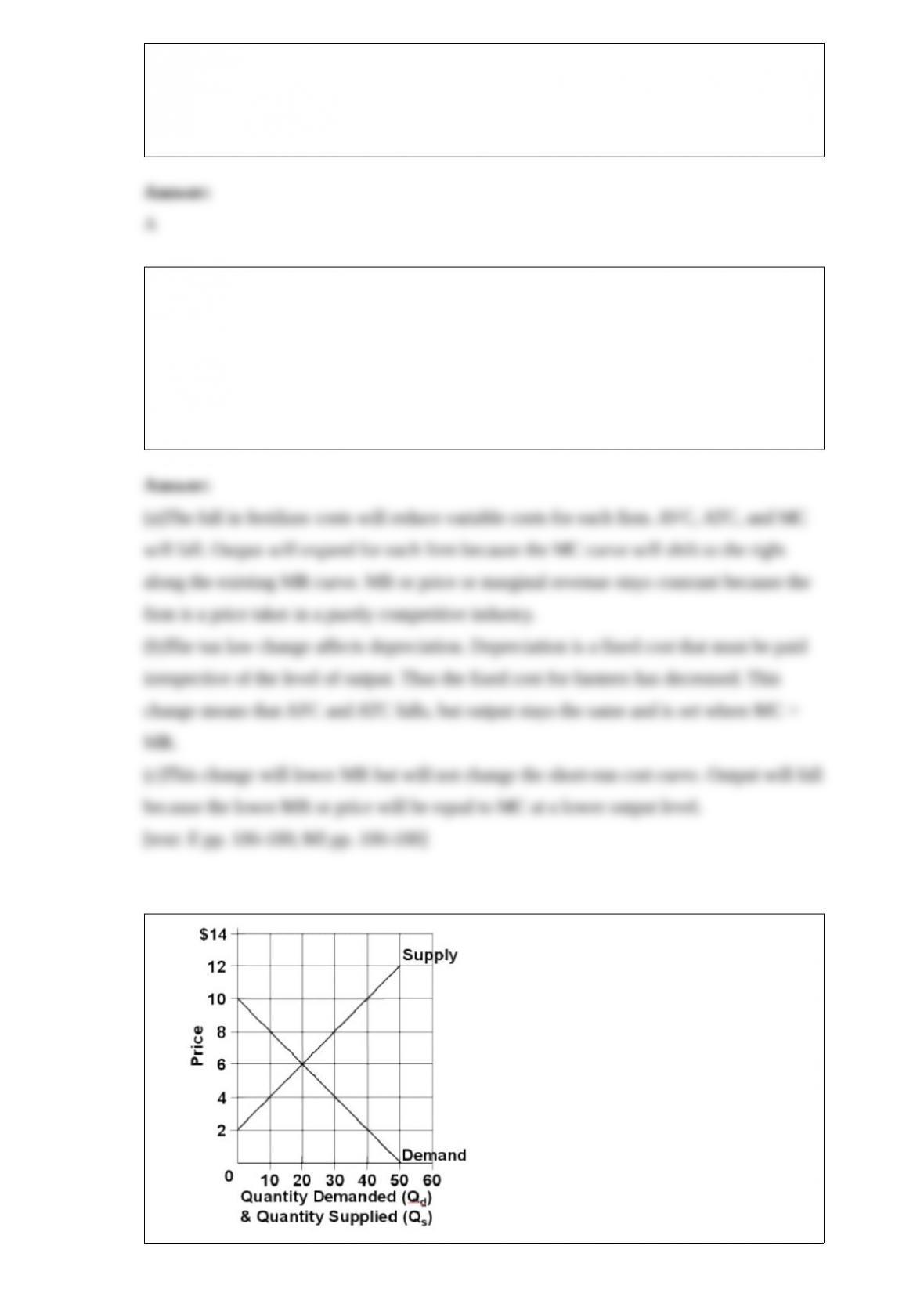
Refer to the above diagram. If equilibrium real output is Q2, then:
A.aggregate demand is AD1.
B.the equilibrium price level is P1.
C.producers will supply output level Q1.
D.the equilibrium price level is P2.
8) If excess reserves in the banking system are $4,000, checkable deposits are $40,000,
and the legal reserve ratio is 10 percent, then actual reserves are:
A.$4,000.
B.$6,000.
C.$8,000.
D.$5,000.
9) Assuming government wishes to either increase or decrease the level of aggregate
demand, which of the following pairs are not consistent policy measures?
A.a tax increase and an increase in the money supply
B.a tax reduction and an increase in the money supply
C.a reduction in government expenditures and a decline in the money supply
D.a tax increase and an increase in the interest rate
10) The agricultural market for corn can be characterized as a purely competitive
industry. How might the following events affect the short-run cost curves and output for
a firm in the industry?
(a)A reduction in the cost of fertilizer that is sold to corn farmers.
(b)The Internal Revenue Service (IRS) changes tax laws which increase the amount of
depreciation that farmers can deduct for equipment.
(c)The market price of corn falls.
11)
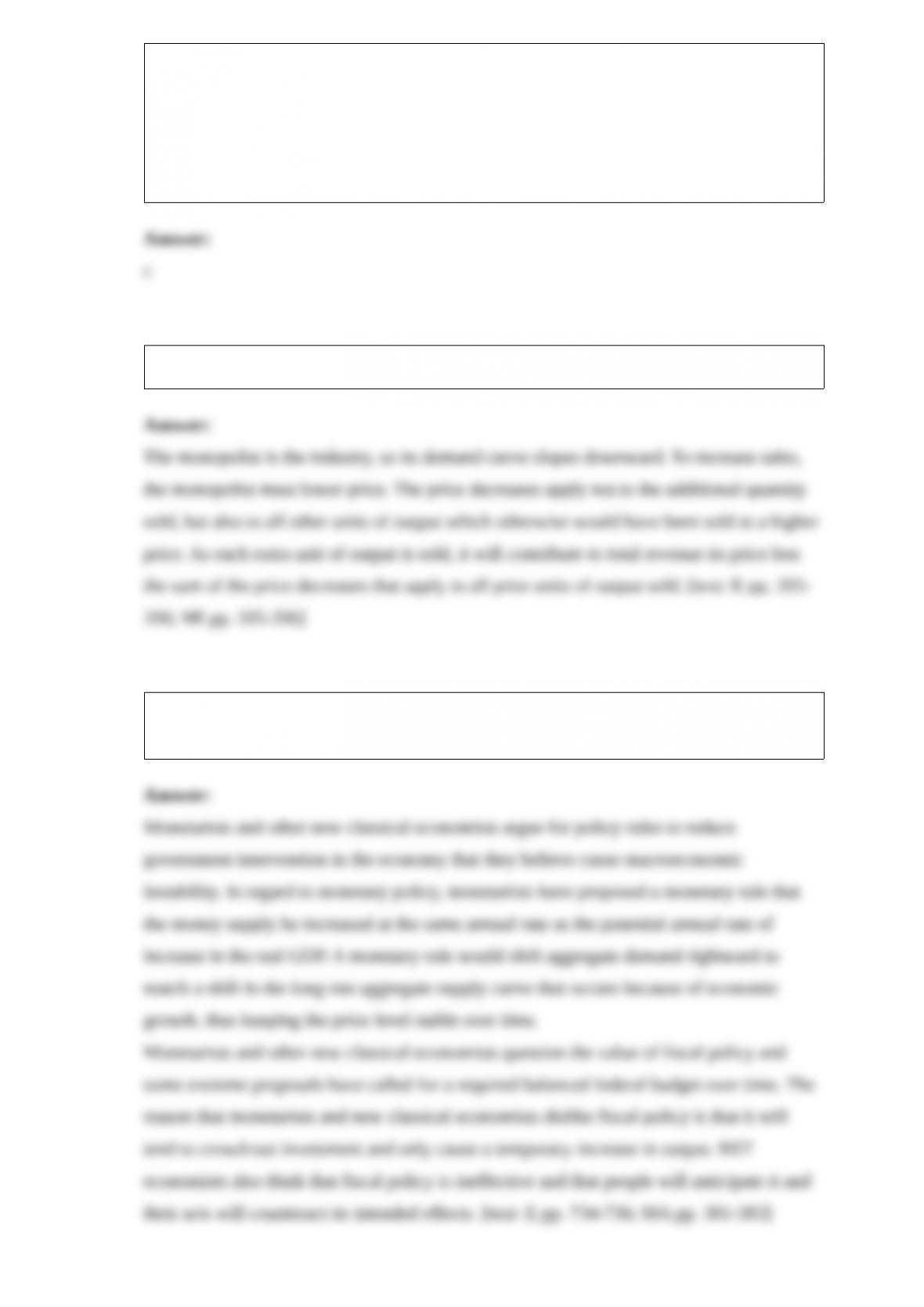
refer to the above graph. using qd for quantity demanded and p for price, which of the
following equations correctly states the demand for this product?
a.p = qd/10.
b.p = 50 – p/2.
c.p = 10 – .2qd.
d.p = 10 – 2qd.
12) Why is marginal revenue less than price for every level of output except the first?
13) How do new classical economists view the importance of policy rules and
discretion in macroeconomic policy?
14) What are the two conflicting goals of bankers? How do these conflicting goals get
resolved in the federal funds market?
15) What is the free rider problem and how does it cause the underproduction of a
public good in a competitive market?
16) What are the main characteristics of modern economic growth? What is the effect
of modern economic growth on the cultural, social and political arrangements of our
times?

17) (Consider This) Why is recent immigration a vital contributor to the American
economy?