
Which of the following is not a flow in the circular flow model?
A) the flow of goods and services and the flow of resources to produce goods and
services
B) the flow of profit and the flow of revenue
C) the flow of income earned by households and the flow of expenditures incurred by
households
D) the flow of revenue received by producers and the flow of payments to resource
owners
Eliza consumes 12 cappuccinos and 8 apple turnovers per week. The price of
cappuccino is $4 each and apple turnovers are $1 each.
a. What is the amount of income allocated to cappuccino and apple turnover
consumption?
b. What is the price ratio (the price of cappuccino relative to the price of apple
turnovers)?
c. Explain the meaning of the price ratio you computed.
d. If Eliza maximize utility, what is the ratio of the marginal utility of cappuccino to the
marginal utility of apple turnovers?
e. If the price of apple turnovers falls, will Eliza consume more apple turnovers, fewer
apple turnovers or the same amount of apple turnovers? Explain your answer using the
rule of equal marginal utility per dollar.

Which of the following individuals would be most negatively affected by anticipated
inflation?
A) a retired railroad engineer who receives a fixed income payment every month
B) a union contractor whose pay is adjusted based on changes in the CPI
C) a full-time employee at a pizza parlor who makes more than the minimum wage
D) a student who borrows $10,000 at a nominal interest rate of 5% to finance
educational expenses
Which of the following is an example of discretionary fiscal policy?
A) an increase in unemployment insurance payments during a recession
B) an increase in income tax receipts with rising income during an expansion
C) the tax cuts passed by Congress in 2001 to combat the recession
D) a decrease in food stamps issued during an expansion or boom

The corporate income tax is ultimately paid by all of the following except
A) owners of the corporation.
B) the corporation’s debtors in the form of lower rates of return on the corporation’s
bonds.
C) customers in the form of higher prices.
D) employees in the form of lower wages.
If the percentage increase in price is 15 percent and the value of the price elasticity of
demand is -3, then quantity demanded
A) will increase by 45 percent.
B) will increase by 5 percent.
C) will decrease by 45 percent.
D) will decrease by 5 percent.
How can the influence of a third variable be shown on a two-dimensional graph?

A) by allowing the relationship to be nonlinear
B) by allowing the position of the relationship line or curve to shift on the graph
C) by drawing a third axis coming out of the two axes
D) by super-imposing the third variable on the two-dimensional graph
Economic surplus is maximized in a competitive market when
A) demand is equal to supply.
B) the deadweight loss equals the sum of consumer surplus and producer surplus.
C) marginal benefit equals marginal cost.
D) producers sell the quantity that consumers are willing to buy.
Table 10-2

Using the table above, what is the approximate average annual growth rate from 2010
to 2013?
A) -1%
B) 1%
C) 2%
D) 4%
Consider a firm that uses two inputs, labor and capital, to produce its output. Assume
labor is measured on the horizontal axis and capital on the vertical axis. Which of the
following best explains why the marginal rate of technical substitution decreases in
absolute value as we move down an isoquant?
A) The law of diminishing returns: for a given decline in capital, decreasing amounts of
labor are required to produce the same level of output.
B) The law of increasing marginal opportunity cost: if a firm uses less and less capital it
must use more and more labor, which drives up the cost of labor.
C) The law of diminishing returns: for a given decline in capital, increasing amounts of
labor are required to produce the same level of output.
D) The law of imperfect substitutability: labor and capital are not perfect substitutes;
therefore, a firm must replace decreases in capital with increases in labor.
Marv Pilson has $50 worth of groceries in a shopping cart at his local Shop ‘n Save.

Assume that the marginal utility per dollar of the liter bottles of soft drink in Marv’s cart
equals 50. The marginal utility per dollar of the boxes of cereal in Marv’s cart equals 20.
Marv has only $50 to spend, but has not yet paid for his groceries. How can Marv
increase his total utility without spending more than $50?
A) Marv should substitute his favorite soft drink or the cereal in his cart for generic
brands that have lower prices.
B) Marv should buy more boxes of cereal and fewer bottles of soft drink.
C) Marv should buy fewer boxes of cereal and more bottles of soft drink.
D) Marv should buy fewer boxes of cereal and fewer bottles of soft drink. He can then
spend more on other items.
In 2012, Smileytown consumed 50,000 tubes of toothpaste. In 2013, toothpaste
consumption rose to 62,000 tubes. Calculate the percentage change in toothpaste
consumption.
A) 12%
B) 16.42%
C) 19.35%
D) 24%
The multiplier effect refers to the series of
A) autonomous increases in consumption spending that result from an initial increase in
induced expenditures.
B) induced increases in consumption spending that result from an initial increase in
autonomous expenditures.
C) autonomous increases in investment spending that result from an initial increase in
induced expenditures.
D) induced increases in investment spending that result from an initial increase in
autonomous expenditures.
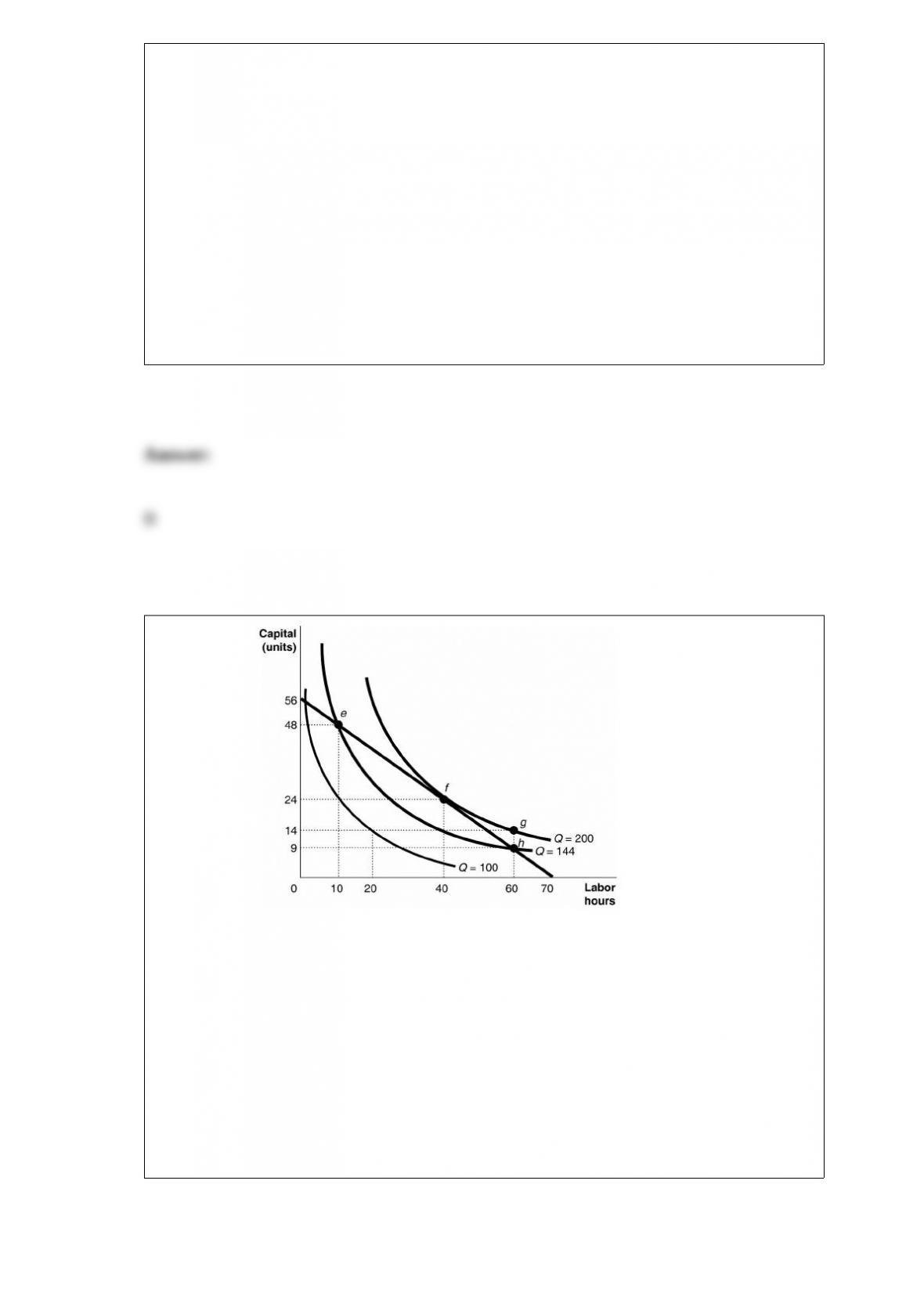
Figure 11-15
Suppose Hilda produces 100 gooseberry pies. What is the marginal rate of technical
substitution of labor for capital when labor is increased from 10 to 20 hours?
A) 1 unit of capital
B) 10 units of capital
C) 14 units of capital
D) 24 units of capital

Prior to 1970, mortgages were ________ resold in the secondary market.
A) never
B) rarely
C) often
D) always
You are planning to open a new Italian restaurant in your hometown where there are
three other Italian restaurants. You plan to distinguish your restaurant from your
competitors by offering northern Italian cuisine and using locally grown organic
produce. What is likely to happen in the restaurant market in your hometown after you
open?
A) Your competitors are likely to change their menus to make their products more
similar to yours.
B) The demand curve facing each restaurant owner shifts to the right.
C) The demand curve facing each restaurant owner becomes more elastic.
D) While the demand curves facing your competitors becomes more elastic, your
demand curve will be inelastic.

Mortgages issued to borrowers whose credit histories include failures to make payments
on bills are known as ________ mortgages.
A) catastrophic
B) variable rate
C) subprime
D) Alt-A
Figure 2-4
Figure 2-4 shows various points on three Different production possibilities frontiers for
a nation.
Consider the following events:
a. an increase in the patent protection period to 75 years
b. a hurricane that destroys a substantial portion of a nation’s capital stock
c. the implementation of a secure and enforceable property rights system Which of the
events listed above could cause a movement from W to Z?
A) a only

B) a and b only
C) a and c only
D) b and c only
E) a, b, and c
If, for the last bushel of apples produced and sold by an apple farm marginal revenue
exceeds marginal cost, then in producing that bushel the farm
A) added more to total cost than it added to total revenue.
B) added an equal amount to both total revenue and total cost.
C) added more to total revenue than it added to total cost.
D) maximized its profits or minimized its losses.
How will an increase in the government budget surplus as a result of lower government
spending (with no change in net taxes) affect private saving in the economy?
A) Private saving will increase by the amount of increase in the budget surplus.
B) Private saving will decrease by the amount of increase in the budget surplus.
C) Private saving will decrease by less than the amount of increase in the budget
surplus.

D) Private saving will be unaffected by the increase in the budget surplus.